

Global AI Content Generation Market Size and Forecast – 2026 To 2033
The global AI content generation market is expected to grow from USD 6 Bn in 2026 to USD 45 Bn by 2033, registering a compound annual growth rate (CAGR) of 35% from 2026 to 2033. The global AI content generation market is driven by the growing demand for personalized customer engagement content. On March 18, 2025, Adobe announced major updates across Adobe GenStudio, Adobe’s end-to-end content supply chain solution that optimizes the process of planning, creating, managing, activating and measuring content for marketing campaigns and personalized customer experiences. (Source: Adobe)
Key Takeaways of the Global AI Content Generation Market
- The text generation segment is expected to account for 33.0 % of the global AI content generation market share in 2026. Rising use of AI-generated content in e-commerce product descriptions is a major factor driving the growth of the segment. On May 21, 2025, Shopify announced the addition of an AI-powered store builder and enhanced AI assistant features that allow merchants to easily generate storefront content and improve product presentation with little manual input. (Source: Shopify)
- The large language models segment is estimated to capture 34.0 % of the market share in 2026. Rapid advancements in Large Language Models (LLM) is driving the growth of the segment. On March 26, 2025, Google significantly advanced its LLM portfolio through Gemini 2.5 Pro and Gemini 2.5 Flash, delivering improvements in reasoning, coding, multimodal understanding, and enterprise AI performance. (Source: Google)
- The marketing and advertising segment is estimated to capture 29.0 % of the market share in 2026. Increasing enterprise investment in AI productivity tools is a key factor driving the growth of the segment. On June 7, 2026, NHS England announced that it is significantly accelerating AI adoption across healthcare services by providing 505,000 clinicians and support staff with access to Microsoft 365 Copilot. (Source: Microsoft)
- North America is expected to dominate the AI content generation market in 2026 with a market share of 41.0 %. Growth of enterprise knowledge management and documentation automation in North America is driving the growth of the regional market. On July 1, 2025, M-Files and Microsoft announced a strategic expansion of their long-standing partnership. M-Files will now use Microsoft 365 and its API-only service, SharePoint Embedded1, to unlock native Microsoft 365 capabilities for M-Files AI-curated content, including agentic experiences delivered by Microsoft 365 Copilot and M-Files Aino. (Source: M-Files)
- Asia Pacific is expected to account for 29.0 % share in 2026 and is projected to record the fastest growth over the forecast period. Growing demand for personalized education and e-learning content creation in Asia Pacific is driving the growth of the regional market. On February 5, 2025, Indian edtech company, Great Learning, introduced AI Mentor and AI Teacher, designed to provide personalized guidance, adaptive explanations, coding assistance, and individualized learning support for students. (Source: Business Standard)
- Rapid Adoption of Multimodal AI Models: Organizations are quickly adopting multimodal artificial intelligence models that can create text, graphics, audio, video and code with one prompt. With these advanced models, businesses can seamlessly create content in several formats, allowing them to increase efficiency, maintain brand consistency, and support various digital communication strategies inside a single AI ecosystem.
- Growing Demand for AI-Generated Video Content: The need for AI-powered video creation solutions is quickly increasing as firms hunt for cost-effective ways to produce marketing videos, training videos, product demonstrations, and social media content. The rise of text-to-video, AI avatars, voice synthesis and automated editing tools is accelerating adoption across industries.
Segmental Insights
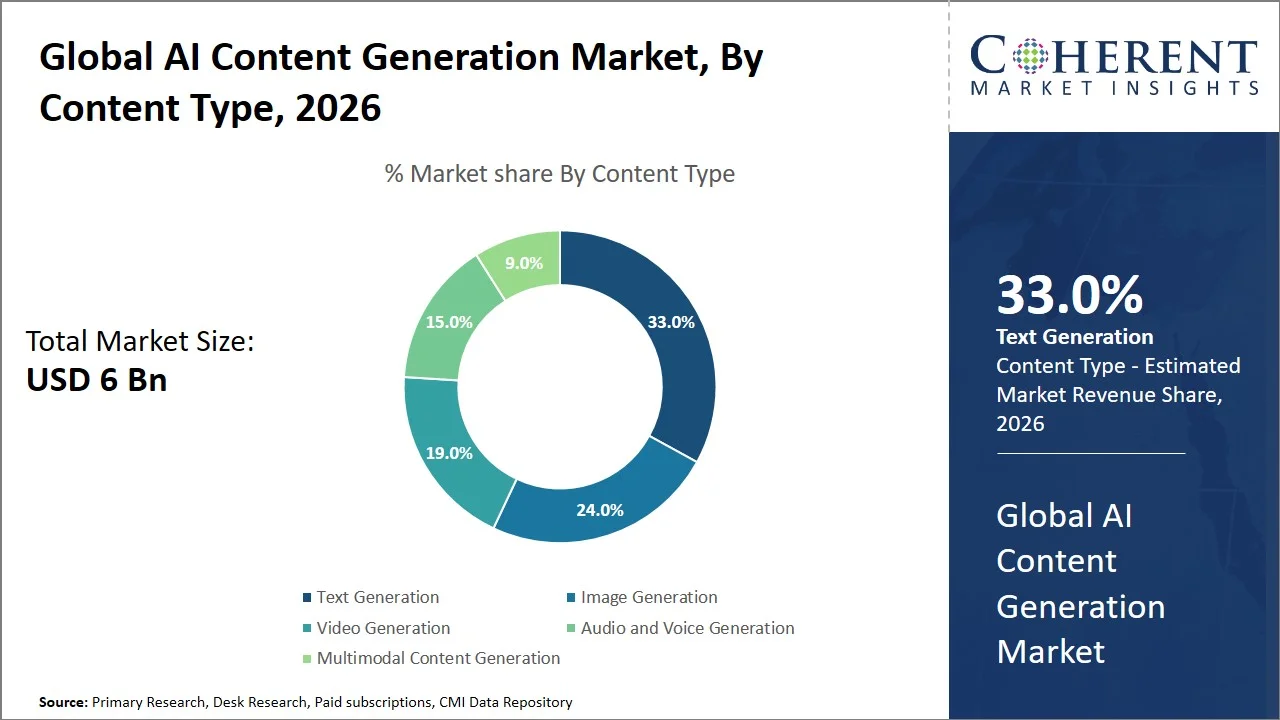
Why Does Text Generation Dominate the Global AI Content Generation Market?
The text generation segment is expected to account for 33.0% of the global AI content generation market share in 2026. Text generation is the leading segment in the global AI Content creation market. Written content is still the foundation of digital communication across sectors. AI-generated content is the backbone of marketing copy, social media postings, product descriptions, emails, blogs, customer service responses, reports, and documentation. Text production is the most adopted and economically scalable section of the AI content creation ecosystem, due to the massive volumes of text-based content needed by enterprises and the maturity and cost-effectiveness of big language models. On May 6, 2025, ServiceNow opened its annual customer and partner event, Knowledge 2025, by unveiling the new ServiceNow AI Platform to put any AI, any agent, any model to work across the enterprise. This next chapter introduces new innovations across the platform, along with deeper integrations with strategic partners like NVIDIA, Microsoft, Google, and Oracle to accelerate enterprise-wide orchestration. (Source: ServiceNow)
- Current Industry Events of 2026
- Market Size Estimation
- Regional Breakdown
- Competitive Landscape
- Customer Intelligence
- Segmental Analysis
- Pricing Analysis
- Key Market Drivers, Challenges & Future Trends
- Customized Insights Section
Why are Large Language Models the Most Preferred Technology?
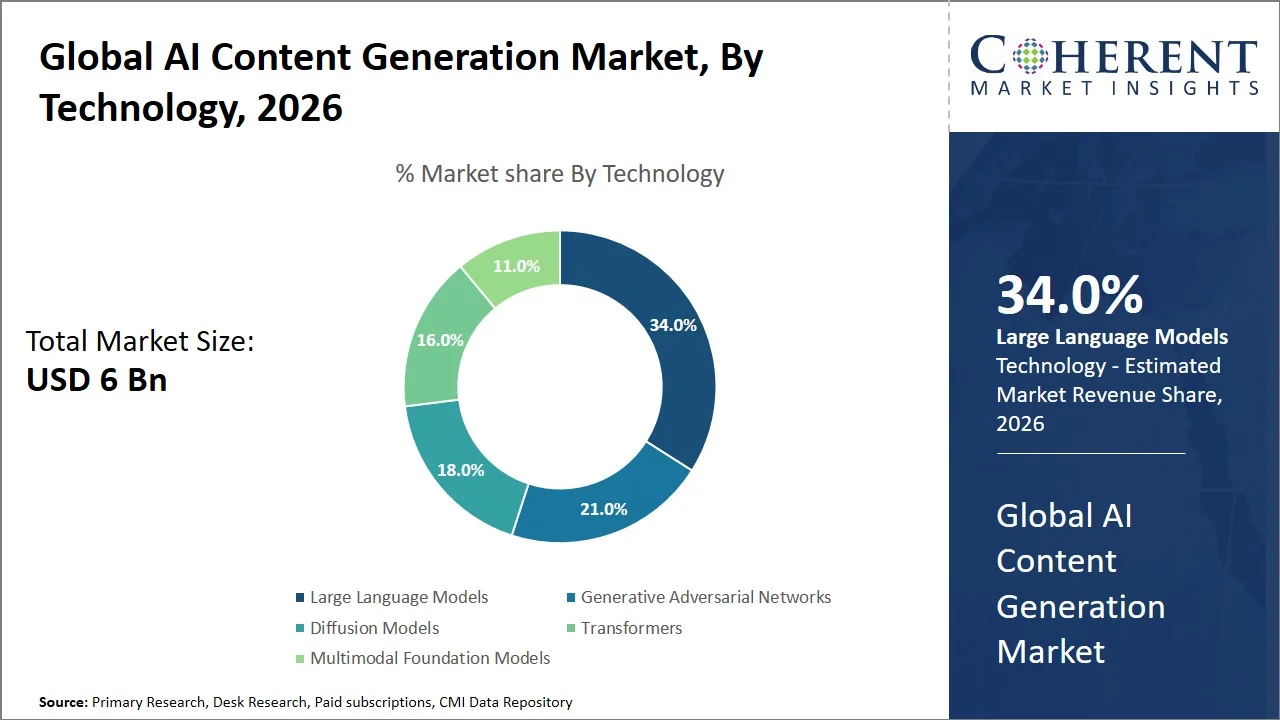
The large language models segment is expected to account for 34.0% of the global AI content generation market share in 2026. The most widely used technology is large language models as they can recognize context, generate human-like text and execute a wide range of language related activities from one model. They have a very high accuracy in generating cohesive articles, marketing content, product descriptions, emails, summaries, translations and conversational responses, making them quite adaptable for organizations. Also, LLMs are easy to fine-tune for individual industries and incorporate into business operations, allowing enterprises to scale content generation while preserving quality and uniqueness. On May 12, 2026, SAP SE introduced the Autonomous Enterprise to help enhance the world’s most critical business workflows, so that humans and AI work together to meet the accelerating demands of global business profitably, strategically and safely. (Source: SAP)
Marketing and Advertising Dominates the Global AI Content Generation Market
The marketing and advertising segment is expected to account for 29.0% of the global AI content generation market share in 2026. The AI content generation market is dominated by marketing and advertising segments as brands demand a huge amount of individualized content for digital campaigns, social media, email marketing, commercials, blogs, and product promotions. Using AI for content generation allows marketers to produce, optimize, and distribute content swiftly across many platforms, enhancing customer engagement and decreasing content production time and costs dramatically. The segment is the greatest adopter of AI content generating solutions due to the high demand for scalable and tailored marketing material. On October 13, 2025, Salesforce announced the general availability of Agentforce 360, the culmination of a year of transformation, redefining how work gets done in the age of AI. (Source: Salesforce)
Currents Events and their Impact
Current Events | Description and its Impact |
European Union AI Act |
|
China AI-Generated Content Labeling Measures |
|
(Source: EU AI Act , China Law Translate)
Global AI Content Generation Market - AI Governance Regulations Impacting Content Generation
AI governance rules are emerging as an important aspect in the AI content generation market as governments are implementing frameworks that address transparency, copyright, content authenticity, data protection and risk management. Regulations such as the EU AI Act, China’s generative AI policies and emerging AI governance frameworks in the U.S., the U.K., Japan, and Singapore are prompting suppliers to adopt content labeling, human oversight, audit trails and responsible AI practices. Although compliance regulations may increase operating expenses, they are also building more organizational confidence and promoting the use of trustworthy AI content generating systems.
- Countries With Formal AI Governance or AI Specific Regulatory Frameworks: 65+
- 78% of Global Enterprises Considering AI Compliance Requirements Pre-Deployment
- Organizations Adopting AI Content Review and Governance Policies: 61%
- AI Content Platforms with Watermarking or Content Provenance Features: 58%
- Organizations that need human review of high-risk AI-generated content: 72%
- 69% Large Enterprises Are Doing AI Risk Assessments Prior to Deployment
- Organizations with AI Usage Disclosure Policies in Place: 54%
- Percentage of Regulated Industries Requiring AI Audit Trails: 76%
- Enterprises Growing AI Governance Budgets Year over Year: 43%
- AI vendors investing on responsible AI and compliance features: 67%
- Copyright and Intellectual Property Risks Are a Concern for Organizations: 71%
- Companies Using AI Content Authenticity Verification Tools: 49%
- Average yearly growth in compliance spend for generative AI projects: 18-22%
- Europe: Region with the Most Extensive AI Regulatory Framework
- North America - Rapid Growth of AI Governance Solutions Market
- Key Regulatory Focus Areas: Transparency, Copyright Protection, Data Privacy, Content Labeling, Bias Mitigation and Accountability
Global AI Content Generation Market - AI Training and Inference Infrastructure Investments (2025)
Infrastructure Category | Training Infrastructure Investment (USD Billion) | Inference Infrastructure Investment (USD Billion) |
AI GPUs & Accelerators | 92.0 | 74.0 |
AI Data Centers & Power Infrastructure | 28.0 | 39.0 |
High-Speed Networking & Interconnects | 15.0 | 30.0 |
Storage & Data Management Systems | 12.0 | 18.0 |
Edge AI & Inference Platforms | 2.0 | 10.0 |
AI Content Generation Market Dynamics
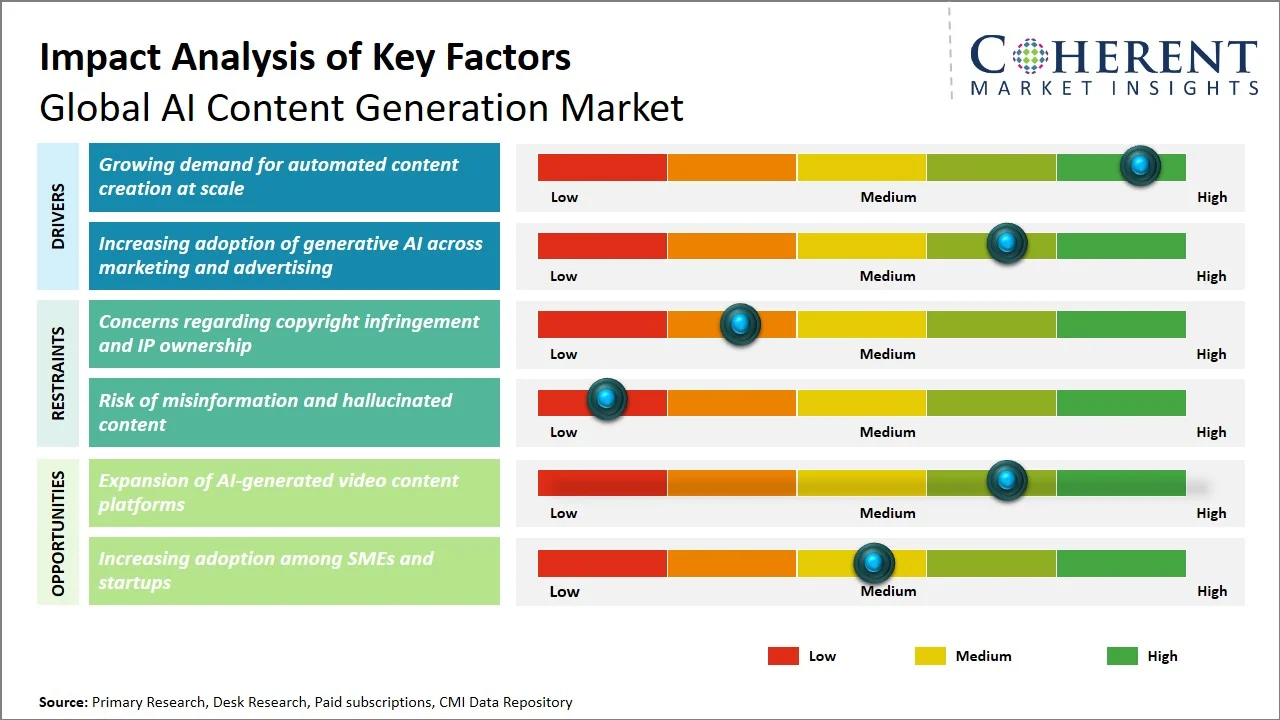
Market Drivers
Growing demand for automated content creation at scale
The increasing demand for automated content creation at scale is a key driver of the global AI content generation market, as organizations require ever-increasing volumes of content across websites, social media platforms, marketing campaigns, customer communications, and digital commerce channels. AI-powered content generation technologies help enterprises to quickly generate high-quality, tailored and consistent content while reducing dependency on manual procedures and reducing operational expenses and accelerating time-to-market. As content requirements across sectors continue to grow, firms are harnessing generative AI technologies to increase efficiency, improve audience engagement, and make it easier to scale content production.
On July 15, 2025, HubSpot introduced new Content Agent features to its Breeze AI platform to automatically generate blog posts, landing page content, marketing emails, SEO descriptions and social media content. The upgrade allows organizations to produce high volumes of marketing materials and reduce the burden of manual content generation. (Source: Hubspot)
Increasing adoption of generative AI across marketing and advertising
Companies are looking for more efficient ways to create customized and engaging content for different customer segments. Generative AI enables businesses to develop advertising, social media posts, email campaigns, product descriptions and promotional materials rapidly, and optimize content using audience preferences and behavioral data. Generative AI is becoming an integral part of modern marketing and advertising strategies, boosting the efficiency of campaigns, cutting the cost of content development and accelerating creative workflows.
On October 23, 2025, WPP launched WPP Open Pro, a groundbreaking new edition of its AI marketing platform, WPP Open, designed to empower brands of all sizes to plan, create and publish campaigns independently. WPP Open Pro will expand WPP’s reach across the global advertising market while also offering an efficient route for existing clients to leverage WPP’s platform and tools. (Source: WPP)
Emerging Trends in Countries with the Highest Concentration of AI Content Creators
- U.S.
- The U.S. has the world’s biggest concentration of AI content creators, supported by ecosystems surrounding companies like OpenAI, Google, Meta, Adobe, Anthropic, and Microsoft that service hundreds of millions of generative AI users.
- AI-driven marketing, media creation, influencer content and enterprise knowledge-management systems are booming in major creator cities such as San Francisco, New York, Los Angeles, Austin and Seattle.
- China
- China has built one of the largest AI creation communities through platforms such as Baidu ERNIE, Alibaba Qwen, Tencent Hunyuan, Kling AI, and Doubao, which have seen wide usage by digital marketers and e-commerce merchants.
- The country’s large-scale creator economy and social commerce ecosystem have sped up the adoption of AI-generated videos, livestream content, product descriptions and advertising creatives.
- India
- India is one of the fastest growing markets for AI content production driven by its vast digital workforce, burgeoning startup ecosystem and the extensive adoption of generative AI technologies across marketing and software sectors.
- AI-generated instructional content, multilingual content production and digital marketing assets are rapidly being created to cater to India’s broad language environment.
- U.K.
- The U.K. has a very mature AI ecosystem, including businesses like Synthesia, Stability AI and ElevenLabs, making it one of the most concentrated AI creation marketplaces internationally.
- London is emerging as a key location for AI-generated video, voice synthesis, digital media production, and enterprise content automation solutions.
- Japan
- Japan’s concentration of AI content creators is driven by significant adoption in gaming, animation, publishing and digital entertainment industries where AI-assisted creative workflows are quickly developing.
- Japanese companies are leveraging generative AI to aid in producing multilingual content, engaging with customers, and automating knowledge management.
- South Korea
- South Korea is emerging as a leader in the AI content generation business, driven by significant investments from tech companies and the extensive use of AI-generated media in the country's digital entertainment industry.
- Advanced broadband infrastructure and a creator economy in the country are accelerating uptake of AI-generated video, music, and influencer content.
- Germany
- Germany has one of the greatest concentrations of enterprise-focused AI content providers in Europe, especially in manufacturing, software, technical documentation, and industrial knowledge management.
- Generative AI has been widely used by enterprises, creating more need for AI-generated technical content, training materials, and business documentation.
- Canada
- Canada has world-class AI research hubs in Toronto, Montreal and Vancouver, and dense ecosystem of AI startups, content technology firms and digital producers.
- Robust growth in applications for AI-generated instructional content, enterprise communications and media production.
- Singapore
- Singapore has one of the greatest densities of AI creators globally per capita, driven by government-backed AI projects, robust cloud infrastructure and the presence of regional offices of key technology companies.
- The country is a regional hotspot for AI-powered marketing, multilingual content localization, consumer interaction, and enterprise content development in Southeast Asia.
- Australia
- Australia’s AI content producer ecosystem is quickly expanding with an emphasis on digital marketing, education technology, media production, and professional services automation.
- Finance, healthcare and higher education organizations are increasingly using generative AI to develop personalized content and automate knowledge-intensive operations.
- Expansion of Personalized and Hyper-Localized Content Creation: AI is being used by companies to develop highly personalized content to meet the specific demands and behaviors of individual customers. The AI-powered localization tools are enabling organizations to create multilingual content at scale, improving customer engagement and expansion into global and regional markets.
- Increasing Integration of Generative AI into Enterprise Workflows: Enterprises are embedding AI content generation capabilities into customer relationship management systems, marketing automation platforms, productivity tools, and knowledge management solutions. This makes content-related processes easier, increases staff efficiency and allows for the real-time generation of business documents, reports, customer communications and digital marketing materials.
Global AI Content Generation Market - Government AI Investments Supporting Generative AI
Governments are pouring money into artificial intelligence as governments seek to strengthen domestic AI capabilities, foster innovation in generative AI, deploy sovereign computing infrastructure and increase economic competitiveness. Funding programs are pouring into national AI research centers, high-performance computing facilities, sovereign big language models, AI startup ecosystems and public sector AI deployment efforts. These investments are accelerating the development and deployment of generative AI technologies, while decreasing reliance on foreign AI infrastructure and creating long-term innovation ecosystems.
- Global Government AI Spending (2025): USD 85 Billion
- Generative AI and Foundation Models Allocation: 32%
- North America Government AI Investment Share: 33%
- Asia Pacific Government AI Investment Share: 38%
- Share of Europe Government AI Investment: 22%
- % of Government AI Investment in Latin America: 3%
- Middle East & Africa Government AI Investment Share: 2%
- 250+ National AI Research Centers Funded by Governments
- AI Supercomputing Projects Funded by Governments Worldwide: 120+
- Countries with Dedicated Sovereign AI or National LLM Programs: 40+
- Public-Sector AI Pilot and Deployment Projects: 6,000+
- AI research & development government funding: 30%
- Government Funding for AI Startup Support Programs: 15%
- Government Funding on AI Skills and Workforce Development: 10%
- Annual Growth Rate of Government AI Investments (2026–2033): 24%
- Number of Countries having National Generative AI Strategies: 50+
- Percentage of Government AI Projects Using Generative AI Features: 41%
- Over 5,000 Government-Backed AI Startups and Innovation Programs
- Biggest Government AI Investor Region: Asia Pacific
- Middle East & Africa: Region with Fastest Growth
- Investment Areas of Focus: Sovereign LLMs, AI Data Centers, Supercomputing Infrastructure, Public Services Automation, Healthcare AI, Education AI, Defense AI and Digital Government Platforms
Global AI Content Generation Market - Hyper-Personalized Content Generation Adoption (2025)
Hyper-personalized content generation is one of the most powerful use cases of generative AI that is beginning to take shape where organizations can generate highly personalized text, images, videos, emails, product recommendations and customer communications based on individual preferences, behaviors, demographics and real-time interactions. Enterprises may leverage large language models, customer data platforms and predictive analytics to develop differentiated content experiences at scale for improved engagement rates, customer happiness, conversion performance and marketing efficiency. This is especially true in the applications for marketing, e-commerce, media, financial services and customer care.
- 64% of Global Enterprises Using AI for Hyper-Personalized Content
- Large Enterprises Implementing Personalized AI Content Solutions: 72%
- SMEs using AI-powered personalized content tools 51%
- Marketing Organizations That Leverage AI Personalization: 78%
- E-Commerce Companies Using AI-Generated Personalized Product Content: 69%
- Customer Engagement Platforms with Generative AI Personalization: 74%
- Percentage of Marketing Content Generated by Personalized AI: 61%
- Average lift in customer engagement rates: 28%
- Average Lift in Marketing Campaign Conversion Rates: 22%
- Average Content Production Time Reduction: 46%
- Organizations using real-time AI content personalization: 43%
- Companies Using Customer Data Platforms with Generative AI: 57%
- AI-Generated Personalized Email Campaign Accepted: 71%
- AI-Driven Personalized Recommendation Content Adoption is 67%
- Embracing Multilingual Personalized Content Generation: 49%
- CAGR of Hyper-Personalized Content Generation Adoption 2026 to 2033: 30%
- North America Adoption Share: 37%
- Asia Pacific Adoption Share: 31%
- Europe Adoption Share: 24%
- Asia-Pacific – Fastest Growing Regional Market
- Major End Use Industries: Marketing & Advertising, Retail & E-Commerce, Media & Entertainment, BFSI, Telecom and Healthcare
- Primary Content Types: Personalized Emails, Product Descriptions, Ad Copy, Social Media Content, Website Content, AI Chat Responses, Video Messages
Regional Insights
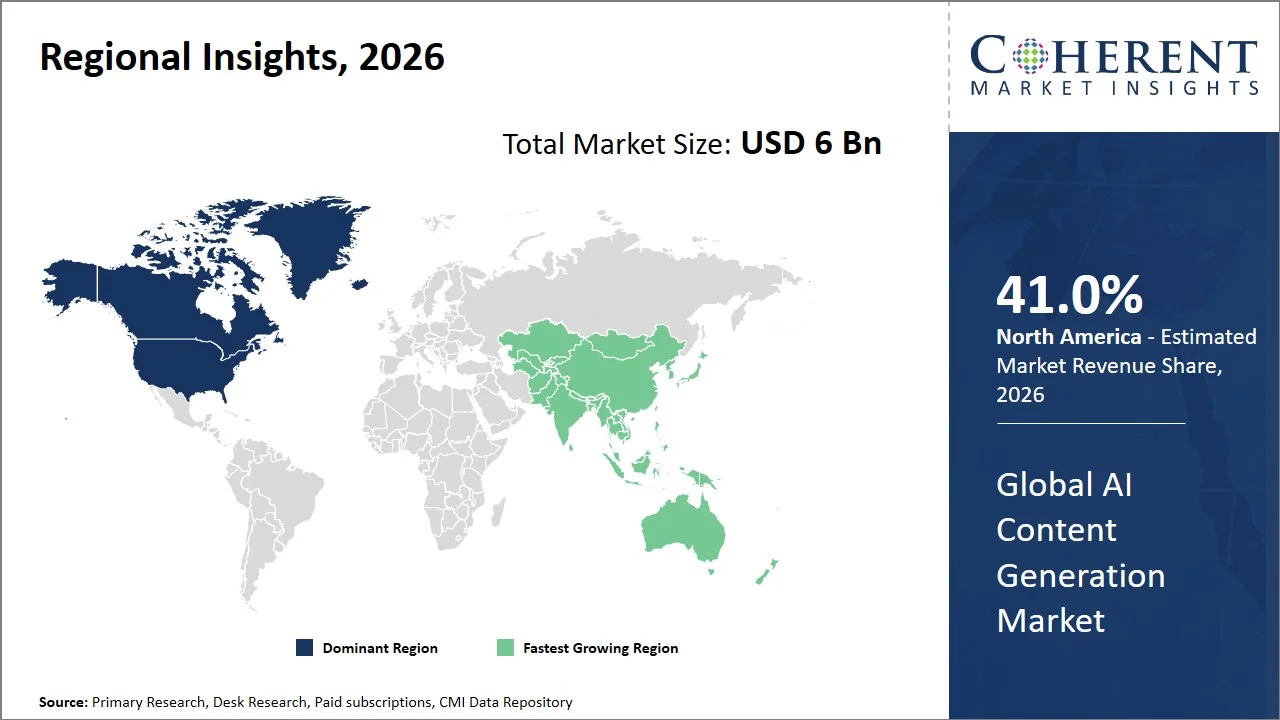
Why is North America a Strong Market for AI Content Generation?
North America is expected to account for a market share of 41.0% in 2026. North America continues to be the innovation hub of the AI content generation market with the presence of major generative AI developers and enterprise adopters. AI content technologies have been widely deployed in the region across advertising, media, software development, and consumer engagement. Significant advancements include OpenAI’s rapid deployment of GPT-based enterprise solutions through key integrations with Microsoft products like Copilot; and companies like Adobe adding Firefly generative AI features to Creative Cloud products aimed at content creators. Big media companies, e-commerce platforms and marketing agencies throughout the U.S. and Canada are increasingly turning to AI to automate authorship, content personalization and digital asset development. On February 17, 2026, EPAM Systems, Inc. announced the North American launch of Empathy Lab by EPAM, its AI-native agency designed to help brands build intelligent, human-centered growth systems in an era reshaped by AI. (Source: EPAM)
Why Does the Asia Pacific AI Content Generation Market Exhibit High Growth?
Asia Pacific is projected to account for 29.0% of the global AI content generation market and is expected to register the fastest growth. The Asia Pacific region is noted for its strong government-backed AI projects and an increasing need for local digital content in many languages. Enterprises in China, India, Japan, South Korea, and Southeast Asia are using AI produced content solutions for use in e-commerce, education, social media and customer support. Regional technology firms are developing home-grown large language models to reduce reliance on foreign AI systems, and the proliferation of short-video platforms, live commerce and digital-first consumer ecosystems has increased the demand for AI-generated text, image, and video content that is relevant to local markets and languages. On June 11, 2026, Tencent Cloud unveiled its portfolio of business-ready AI agents and applications at SuperAI 2026. Tencent WorkBuddy and Tencent Design Miora are two of the latest AI agents to transform assistive AI into execution-driven systems. (Source: Tencent)
Global AI Content Generation Market Outlook for Key Countries
Why is the U.S. Emerging as a Major Hub in the AI Content Generation Market?
The U.S. is the global center of innovation in AI content generation, with industry leaders like OpenAI, Anthropic, Google, and Meta located there. Enterprise use has extended beyond content marketing to software coding assistance, legal document drafting, customer support automation and media production. Salesforce is incorporating generative AI into CRM workflows with Einstein AI, while Hollywood studios, publishing houses and leading retailers are fast-tracking their experimentation with AI-generated content to increase efficiency and shorten production schedules.
Is China the Next Growth Engine for the AI Content Generation Market?
The China AI content generation market is dominated by local tech titans and is tightly controlled by the government. Baidu, Alibaba Cloud, and Tencent have also created their own huge language models and generative AI systems to help with content production, digital marketing, and office productivity. The country’s mandatory labeling of AI-generated content has triggered the creation of traceable and compliant generative AI systems, and sectors such as e-commerce, online education, and digital entertainment are quick to incorporate AI-generated text, images, and virtual avatars into their products.
U.K. AI Content Generation Market Analysis and Trends
The U.K. has become a key European hub for AI content generation, backed by a robust startup ecosystem and leading research institutions. London-based startups such as Synthesia have achieved global fame for their AI-generated video and avatar technology, used in corporate training, marketing and organizational communications. The UK’s publishing, financial services and marketing industries are increasingly taking up generative AI solutions for content creation and workflow automation, while ongoing government projects tackling AI copyright and intellectual property issues are guiding responsible commercialization of AI-generated content. On June 5, 2024, Stability AI announced the launch of Stable Audio Open, an open source model optimized for generating short audio samples, sound effects and production elements using text prompts. (Source: Stability AI)
India AI Content Generation Market Analysis and Trends
India has become one of the fastest growing consumers of AI content generating technology due to its vast digital user base and multilingual content needs. From e-commerce to edtech, finance to digital media, organizations are harnessing generative AI technologies to produce content in Hindi, Bengali, Tamil, Telugu, Marathi, and other regional languages. Companies such as Infosys, Wipro, and Tech Mahindra are growing their enterprise AI capabilities, while local entrepreneurs are building language-focused AI models for customer engagement, content localization and digital inclusion projects across the country.
Japan AI Content Generation Market Analysis and Trends
Demand for automation, digital transformation and multilingual communication is major driver for AI content generation industry in Japan. Tech giants including NTT DATA, Fujitsu and NEC Corporation are incorporating generative AI into enterprise apps, customer service platforms and business documentation systems. The country’s media, gaming and animation sectors are rapidly using AI-assisted content creation technologies in the creation of scripts, support for character design, localization and digital content creation to meet labor shortages and increase operational efficiency.
Global Content Generation Market - Human-to-AI Content Production Ratio (2025)
Region | Human-Created Content Share (%) | AI-Generated Content Share (%) | Human-to-AI Production Ratio |
North America | 66 | 34 | 1.9: 1 |
Asia Pacific | 70 | 30 | 2.3: 1 |
Europe | 74 | 26 | 2.8: 1 |
Latin America | 80 | 20 | 4.0: 1 |
Middle East & Africa | 83 | 17 | 4.9: 1 |
Global Content Generation Market - AI Content Accuracy Review Spending (2025)
Review Category | North America (USD Billion) | Europe (USD Billion) | Asia Pacific (USD Billion) | Latin America (USD Billion) | Middle East & Africa (USD Billion) |
Fact-Checking & Validation | 1.20 | 0.68 | 0.78 | 0.12 | 0.12 |
Compliance & Regulatory Review | 0.92 | 0.52 | 0.56 | 0.05 | 0.05 |
Brand Consistency Verification | 0.63 | 0.35 | 0.40 | 0.06 | 0.06 |
Content Moderation & Safety Screening | 0.54 | 0.31 | 0.36 | 0.05 | 0.04 |
Copyright & Intellectual Property Review | 0.42 | 0.24 | 0.25 | 0.05 | 0.04 |
Human Editorial Oversight | 0.39 | 0.20 | 0.25 | 0.07 | 0.09 |
Total Spending by Region | 4.10 | 2.30 | 2.60 | 0.40 | 0.40 |
How is the Expansion of AI-Generated Video Content Platforms Creating New Growth Opportunities in the AI Content Generation Market?
The emergence of AI-generated video content platforms is providing lucrative growth prospects in the AI content generation market by allowing organizations to make high-quality films in a quick, cost-effective manner and at scale without needing considerable production resources. Advanced AI technology can automatically compose scripts, build lifelike avatars, synthesis voices, translate content into numerous languages, and edit videos based on text prompts, thereby facilitating video creation for businesses of all sizes. The capability is fueling usage in marketing, advertising, corporate training, e-learning, social media and customer interaction applications as firms increasingly make video content a priority to enhance the reach, engagement and efficacy of their audience communications.
On May 5, 2026, Runway released Gen-4, bringing significant improvements to scene consistency, cinematic quality, character continuity, and timely adherence. The concept was created to serve filmmakers, advertisers, media firms and creative agencies looking for scalable AI-generated video production capabilities. (Source: Runway)
Global Content Generation Market - AI-Generated Content Volume by Modality
Modality | Annual AI-Generated Content Volume | Average Cost Reduction vs. Traditional Production (%) | Average Production Time Reduction (%) |
Text Content | 1.85 Trillion Pages | 72 | 83 |
Image Content | 620 Billion Images | 68 | 79 |
Video Content | 18.5 Billion Minutes | 61 | 74 |
Audio Content | 105 Billion Minutes | 65 | 77 |
Market Players, Key Development, and Competitive Intelligence
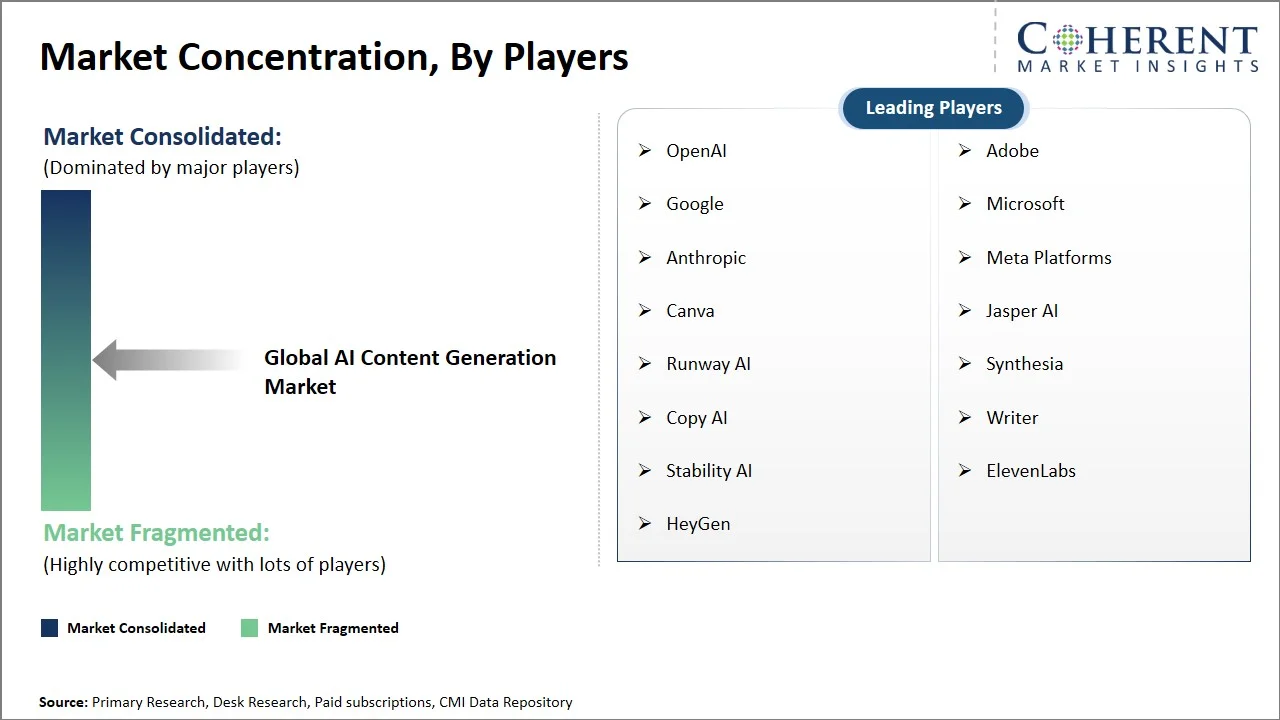
Key Developments
- On February 27, 2025, OpenAI introduced GPT-4.5, its largest generative AI model at the time, with enhanced writing quality, improved contextual understanding, reduced hallucinations, and stronger creative capabilities for content generation applications. The model was designed to support enterprise-scale content creation, marketing automation, and professional writing workflows.
- On October 14, 2024, Adobe announced the expansion of its Firefly family of creative generative AI models to video, in addition to new breakthroughs in its Image, Vector and Design models and significant momentum in Firefly’s adoption by leading brands and enterprises. The Firefly Video Model, now in limited public beta, is the first publicly available video model designed to be commercially safe.
Competitive Landscape
The global AI content generation market is highly competitive with the presence of major technology corporations, dedicated generative AI companies and innovative startups working on text, image, video and audio production. Market players are driving market leadership by enhancing foundation models, forging strategic collaborations, delivering AI from the cloud and integrating generative AI capabilities into corporate software platforms. To secure their competitive positioning and grow enterprise adoption, companies such as OpenAI, Adobe, Google, Microsoft, Anthropic, Meta, Synthesia, Runway, Jasper AI, and Canva are rapidly expanding their product portfolios with model improvements, multimodal AI capabilities, and industry-specific solutions.
Market Report Scope
AI Content Generation Market Report Coverage
| Report Coverage | Details | ||
|---|---|---|---|
| Base Year: | 2025 | Market Size in 2026: | USD 6 Bn |
| Historical Data for: | 2020 To 2024 | Forecast Period: | 2026 To 2033 |
| Forecast Period 2026 to 2033 CAGR: | 35% | 2033 Value Projection: | USD 45 Bn |
| Geographies covered: |
| ||
| Segments covered: |
| ||
| Companies covered: | OpenAI, Adobe, Google, Microsoft, Anthropic, Meta Platforms, Canva, Jasper AI, Runway AI, Synthesia, Copy AI, Writer, Stability A, ElevenLabs, and HeyGen | ||
| Growth Drivers: |
| ||
| Restraints & Challenges: |
| ||
Analyst Opinion (Expert Opinion)
- Enterprise demand for scalable and personalized content creation is driving significant growth and is positioning the market as one of the most disruptive categories in the broader artificial intelligence industry. Large language models, multimodal AI systems and content automation technologies are attracting big amounts of investment and legislative developments and copyright considerations are being keenly followed. Continuous technological innovation and more commercial uses are likely to sustain long-term industry expansion despite hurdles in content authenticity, intellectual property rights, and data governance.
- With generative AI technologies becoming more advanced, accessible and fully integrated into business workflows, the AI content generation market is expected to have significant growth possibilities. Growing adoption is anticipated across marketing, media, education, healthcare, customer service, software development, and enterprise knowledge management as organizations increasingly integrate AI-driven content solutions into core business operations. Furthermore, ongoing advancements in AI-generated video, speech, and multimodal content technologies are expected to create new monetization opportunities, expand commercial use cases, and drive additional revenue growth across the AI content generation ecosystem. Moreover, the increasing adoption of localized and sector-specific AI models, along with rising demand for automation and personalized digital experience, is expected to drive the market growth and generate significant opportunities for the existing players and new entrants in the coming years.
Speak to the analyst
Want personalized insights?
Take the findings above to one of our principal consultants, or have the report rebuilt around the segments, geographies and competitors you actually track.
Market Segmentation
- Content Type Insights (Revenue, USD Billion, 2021 - 2033)
- Text Generation
- Image Generation
- Video Generation
- Audio and Voice Generation
- Multimodal Content Generation
- Technology Insights (Revenue, USD Billion, 2021 - 2033)
- Large Language Models
- Generative Adversarial Networks
- Diffusion Models
- Transformers
- Multimodal Foundation Models
- Application Insights (Revenue, USD Billion, 2021 - 2033)
- Marketing and Advertising
- Social Media Content
- E-commerce Content
- Media and Entertainment
- Education and Training
- Customer Support
- Publishing
- End User Insights (Revenue, USD Billion, 2021 - 2033)
- Enterprises
- Media Companies
- E-Commerce Companies
- Educational Institutions
- Government Organizations
- Regional Insights (Revenue, USD Billion, 2021 - 2033)
- North America
- U.S.
- Canada
- Latin America
- Brazil
- Argentina
- Mexico
- Rest of Latin America
- Europe
- Germany
- U.K.
- Spain
- France
- Italy
- Russia
- Rest of Europe
- Asia Pacific
- China
- India
- Japan
- Australia
- South Korea
- ASEAN
- Rest of Asia Pacific
- Middle East
- GCC Countries
- Israel
- Rest of Middle East
- Africa
- South Africa
- North Africa
- Central Africa
- North America
- Key Players Insights
- OpenAI
- Adobe
- Microsoft
- Anthropic
- Meta Platforms
- Canva
- Jasper AI
- Runway AI
- Synthesia
- Copy AI
- Writer
- Stability AI
- ElevenLabs
- HeyGen
Sources
Primary Research Interviews
- Chief Executive Officers (CEOs) of Generative AI and AI Software Companies
- Chief Technology Officers (CTOs) and AI Product Heads
- Vice Presidents of Artificial Intelligence and Machine Learning
- Directors of Digital Transformation and Innovation
Magazines
- MIT Technology Review
- Harvard Business Review
- The Economist
- AI Magazine
Journals
- Journal of Artificial Intelligence Research
- Nature Machine Intelligence
- Artificial Intelligence Journal
- IEEE Transactions on Neural Networks and Learning Systems
Associations
- Association for the Advancement of Artificial Intelligence (AAAI)
- Association for Computing Machinery (ACM)
- Institute of Electrical and Electronics Engineers (IEEE)
Public Domain Sources
- Organisation for Economic Co-operation and Development (OECD)
- United Nations Conference on Trade and Development (UNCTAD)
- UK Department for Science, Innovation and Technology
- Government of Singapore Smart Nation Office
Proprietary Elements
- CMI Data Analytics Tool
- Proprietary CMI Existing Repository of information for last 10 years
Get access to 250+ pages report
Every segment, forecast, competitor profile and data table behind the analysis above — available for instant download.
- ESOMAR Member
- ISO 9001:2015 Certified
- D-U-N-S Registered
- GDPR & CCPA Compliant
Missing comfort of reading report in your local language? Find your preferred language:
Transform your Strategy with Exclusive Trending Reports
Frequently Asked Questions
The global AI content generation market is expected to stand at USD 6 Bn in 2026 and is expected to reach USD 45 Bn by 2033.
The CAGR of the global AI content generation market is projected to be 35% from 2026 to 2033.
Growing demand for automated content creation at scale and increasing adoption of generative AI across marketing and advertising are the major factors driving the growth of the global AI content generation market.
Concerns regarding copyright infringement and IP ownership and risk of misinformation and hallucinated content are the major factors hampering the growth of the global AI content generation market.
It helps automate product descriptions, customer communications, and marketing content while improving operational efficiency.
Regulations are increasing transparency, accountability, and compliance requirements for AI-generated content providers.
In terms of content type, the text generation segment is estimated to dominate the market revenue share in 2026.