

Global AI Laptop Market Size and Forecast: 2026-2033
The Global AI Laptop Market is estimated to be valued at USD 41.64 Bn in 2026 and is expected to reach USD 141.54 Bn by 2033, exhibiting a compound annual growth rate (CAGR) of 19.1% from 2026 to 2033.
Key Takeaways of the AI Laptop Market
- Ultrabooks leads the market holding an estimated share of 41.1% in 2026.
- North America is estimated to lead the market with a share of 32. 2% in 2026.
- Asia Pacific, holding a share of 20. 2% in 2026, is projected to be the fastest growing region.
Market Overview
Market trends indicate a strong shift towards the integration of AI-powered features such as intelligent voice assistants, adaptive battery management, enhanced security protocols, and real-time data analytics in laptops. Additionally, rising demand from enterprise users for AI-driven productivity tools and growing consumer preference for personalized computing experiences are fueling innovation. The trend towards hybrid work models further accelerates market growth, encouraging manufacturers to develop AI laptops that support seamless connectivity and advanced multitasking capabilities.
Current Events and their Impact
Current Events | Description and its impact |
Geopolitical and Trade Developments |
|
Economic and Infrastructure Trends |
|
Segmental Insights
- Current Industry Events of 2026
- Market Size Estimation
- Regional Breakdown
- Competitive Landscape
- Customer Intelligence
- Segmental Analysis
- Pricing Analysis
- Key Market Drivers, Challenges & Future Trends
- Customized Insights Section
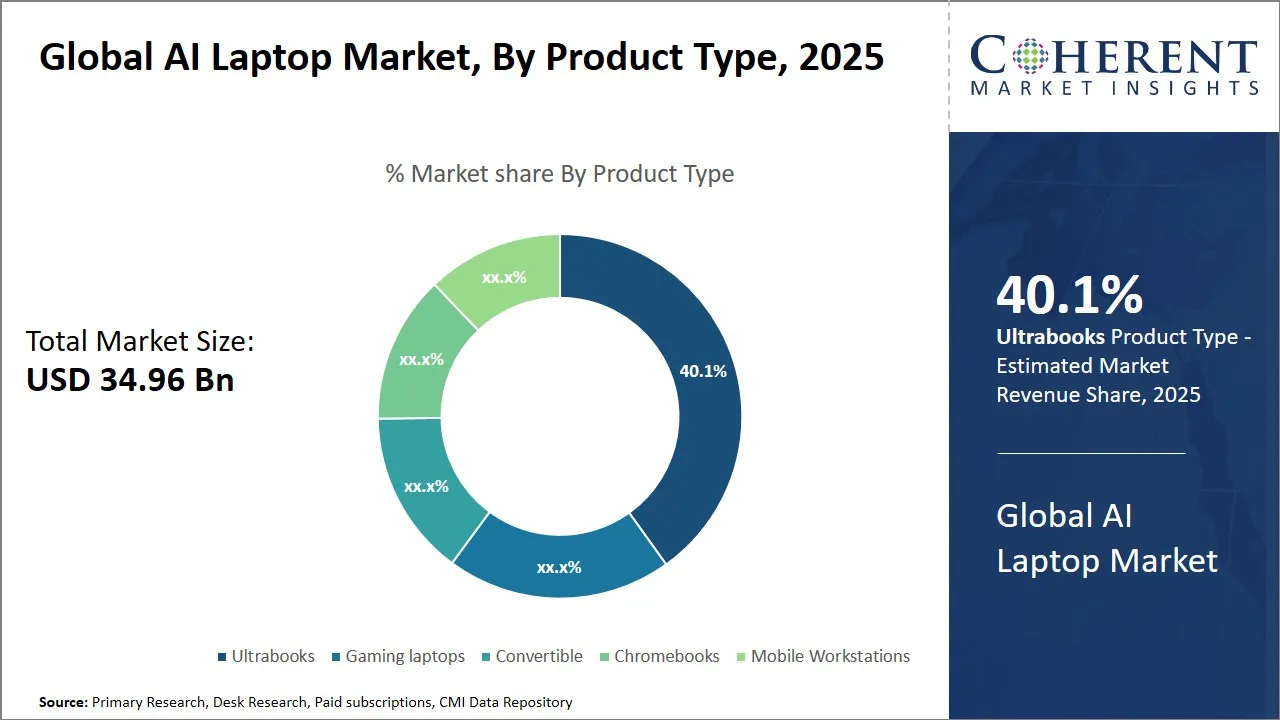
Global AI Laptop Market Insights, By Product Type – Ultrabooks Lead to their Unmatched Portability and Performance Synergy
Ultrabooks, holding a share of 41.1% in 2026, have emerged as the leading product type in the global AI laptop market, driven primarily by their unique combination of lightweight design and high computing power optimized for artificial intelligence applications. The growing demand for sleek, portable devices that do not compromise on processing capabilities has significantly fueled the adoption of AI-enabled ultrabooks among both professionals and consumers.
One of the key factors propelling the Ultrabooks segment is the increased integration of AI-focused hardware components such as advanced neural processing units (NPUs) and hybrid AI accelerators. These technologies enable Ultrabooks to execute complex machine learning tasks, natural language processing, and real-time data analysis efficiently, making them suitable for AI developers, data scientists, and tech-savvy professionals who require mobility without sacrificing performance.
Furthermore, the surge in remote work and flexible work environments underlines the growing need for lightweight devices that facilitate seamless multitasking and AI-powered productivity tools. Ultrabooks, known for their slim profiles and extended battery life, offer convenience and efficiency, thereby becoming the preferred choice for users who rely on AI-driven software for tasks like intelligent virtual assistance, predictive analytics, and adaptive user interfaces.
Another driving force behind ultrabooks’ dominance is their compatibility with the latest connectivity standards including Wi-Fi 6 and 5G, which are crucial for AI applications requiring real-time data exchange and cloud computing. This connectivity enhances the user experience by enabling smoother AI model updates and faster data synchronization, crucial for industries such as finance, healthcare, and creative design where AI laptop usage is gaining momentum.
Pricing Analysis of the AI Laptop Market
Model/Configuration | Price |
Lenovo ThinkBook Plus Gen 6 (Rollable OLED) | USD 3,299 starting price |
Apple MacBook Air 13-inch (M4 chip) | USD 999 starting |
Microsoft Surface Laptop (Copilot+ PC, 13.8-inch, Snapdragon X Plus) | USD 899.99 (retail) |
Regional Insights
North America AI Laptop Market Analysis and Trends
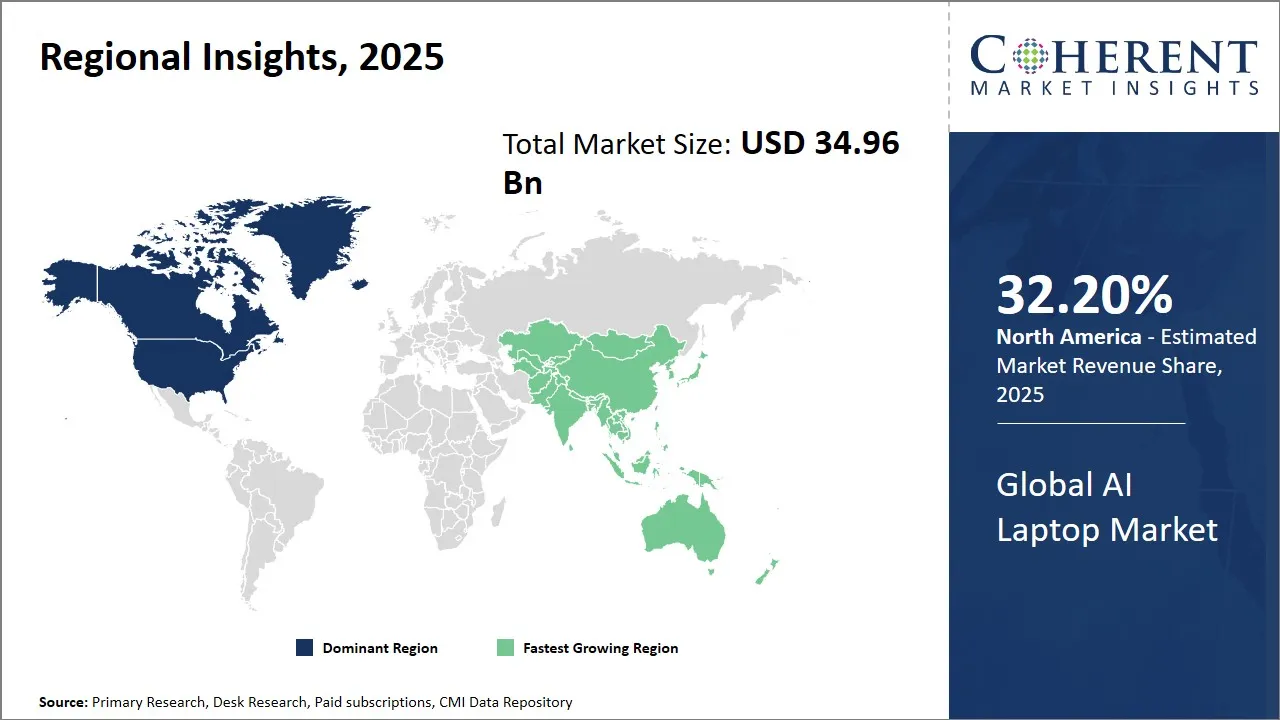
North America, holding a share of 32.20% in 2026, dominates the AI laptop market, driven by a robust technological ecosystem, strong presence of leading technology companies, and supportive government policies fostering innovation in artificial intelligence and computing hardware. The U.S., as the largest economy in the region, benefits from a concentration of major tech giants such as Apple, Dell, Microsoft, and NVIDIA, which continuously invest in AI-enabled laptop solutions incorporating advanced processors, GPUs, and AI inference engines.
The well-established research institutions and extensive venture capital funding contribute to rapid advancements in AI integration within laptops. Additionally, favorable trade dynamics and intellectual property protections support a competitive market environment, facilitating the introduction of cutting-edge AI laptops designed for consumer, commercial, and specialized industrial use cases.
Asia Pacific AI Laptop Market Analysis and Trends
Asia Pacific, holding a share of 20.2% in 2026, is expected to exhibit the fastest growth in the AI laptop market, fueled by accelerating digitization, rising middle-class demand, and government initiatives aimed at fostering AI technology adoption. Countries like China, Japan, South Korea, and India are at the forefront, supported by strong manufacturing ecosystems and expanding AI research infrastructures. China's commitment to becoming a global leader in AI innovation, coupled with substantial investments from both private and public sectors, accelerates the development of AI laptops that cater to diverse market needs.
Notable companies such as Lenovo, ASUS, and Xiaomi are leveraging advanced AI chips and software ecosystems to capture growing consumer interest. State-backed policies promoting smart manufacturing and AI R&D, combined with an increasing focus on exports and regional trade agreements, further propel the market’s rapid expansion across the region.
Global AI Laptop Market Outlook for Key Countries
U.S. AI Laptop Market Analysis and Trends
The U.S. remains a cornerstone of the AI laptop market with a concentration of innovators like Apple, Microsoft, and HP driving technological advances and product differentiation. The US benefits from Silicon Valley’s innovation ecosystem, where AI startups and established firms collaborate to integrate cutting-edge AI capabilities into laptops, such as voice recognition, personalized computing experiences, and advanced security features. Government support for AI research and development through agencies like DARPA enhances both hardware and software capabilities, solidifying the country’s leading role in the global AI laptop landscape.
China AI Laptop Market Analysis and Trends
China AI laptop market is rapidly expanding, supported by a vigorous manufacturing sector and extensive investments in AI technologies from companies such as Lenovo, Huawei, and Xiaomi. The Chinese government’s "New Generation Artificial Intelligence Development Plan" fuels growth by incentivizing innovation and encouraging the development of AI-enabled devices. An integrated supply chain ecosystem and burgeoning domestic demand encourage companies to develop laptops featuring AI-powered cameras, smart assistants, and performance optimization tools. China also benefits from preferential trade policies within the Asia Pacific region, helping local brands expand beyond national borders.
Japan AI Laptop Market Analysis and Trends
Japan continues to lead in precision hardware development within the AI laptop market, emphasizing reliability, quality, and smart functionality. Companies like Sony and Panasonic, along with tech startups, focus on incorporating AI to enhance user interfaces and power efficiency while maintaining high standards of craftsmanship. Government initiatives aligned with Society 5.0 and digital transformation accelerate AI adoption in computing devices. Japan’s market emphasizes innovation aimed at enterprise users and specialized applications, such as AI-supported design and research laptops.
India AI Laptop Market Analysis and Trends
India AI laptop market is growing rapidly, driven by increasing digital literacy, a young population, and growing IT industry demands. Domestic companies alongside global players like Dell and HP are introducing AI-enabled laptops tailored to education, remote work, and software development needs. The government’s Digital India and Make in India programs are pivotal in creating a favorable environment for manufacturing and innovation. Rising investments in AI startups and expanding internet penetration contribute significantly to the region’s expanding market footprint.
Germany AI Laptop Market Analysis and Trends
Germany AI laptop market is characterized by strong industrial integration and a focus on engineering excellence. Key players like Siemens collaborate with laptop manufacturers to embed AI functionalities that support automotive, manufacturing, and industrial design applications. The European Union’s stringent data privacy regulations and AI ethics initiatives shape market demands toward secure and transparent AI systems. Government and industry partnerships promote AI research hubs, further enhancing the country’s reputation as a center for smart computing innovation and AI integration in laptops tailored for professional and enterprise usage.
Market Players, Key Development, and Competitive Intelligence
Key Developments
- In July 2025, Lenovo officially launched the world’s first rollable laptop, the ThinkBook Plus Gen 6 rollable. It looks like a regular 14‑inch laptop, but it can extend vertically into a tall display, giving almost 50 per cent more screen space.
- In March 2025, Apple introduced the new MacBook Air with the M4 chip.
- In February 2025, Microsoft announced the latest additions to its Surface for Business Copilot+ PC family: Surface Pro and Surface Laptop, now available with the latest Intel Core Ultra processors (Series 2).
- In May 2024, Dell expanded its portfolio of AI PCs and workstations with the introduction of the five Copilot+ PCs powered by Snapdragon X Elite and Snapdragon X Plus processors. The launch included XPS 13, Inspiron 14 Plus, Inspiron 14, Latitude 7455 and Latitude 5455.
Top Strategies Followed by AI Laptop Market Players
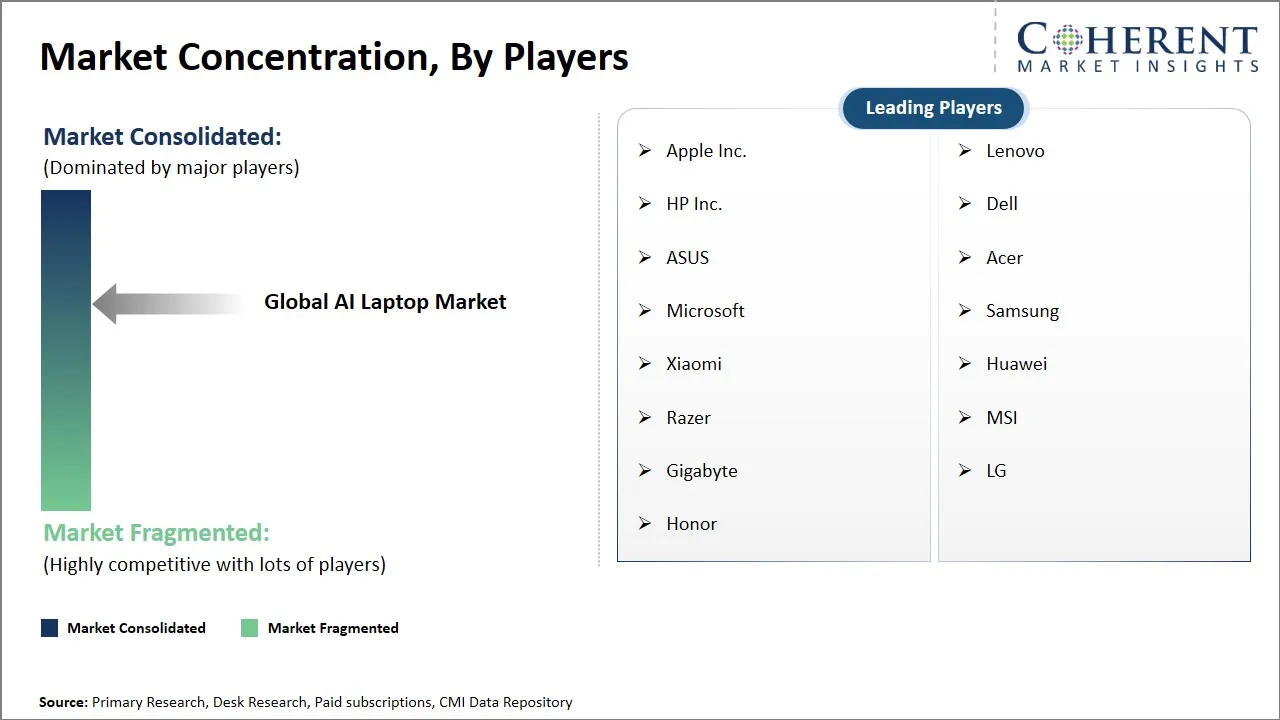
- Established players dominate the market through substantial investments in research and development (R&D), which enable them to continuously innovate and deliver high-performance AI-enabled laptops.
- Apple Inc. invested significantly in advancing its M4 chip with a next-gen Neural Engine capable of 38 trillion operations per second, enabling faster on-device AI tasks and power efficiency in MacBook Air and MacBook Pro models.
- Mid-level players, meanwhile, adopt a distinctly pragmatic approach focused on delivering cost-effective yet reliable AI laptops that appeal to price-sensitive consumers, including students, small businesses, and budget-conscious users.
- Acer’s Swift Go 14 AI laptop powered by Intel Core Ultra processors is positioned as a budget-friendly Copilot+ PC.
- Small-scale players in the AI laptop market face the challenge of competing against well-established and mid-tier companies, and thus, they adopt niche-focused strategies to maintain relevance and grow sustainably.
- Razer released the Blade 16 AI Edition, targeting gaming and creative professionals with NVIDIA RTX AI GPUs and AI-powered rendering tools.
Market Report Scope
AI Laptop Market Report Coverage
| Report Coverage | Details | ||
|---|---|---|---|
| Base Year: | 2025 | Market Size in 2026: | USD 41.64 Bn |
| Historical Data for: | 2020 To 2024 | Forecast Period: | 2026 To 2033 |
| Forecast Period 2026 to 2033 CAGR: | 19.1% | 2033 Value Projection: | USD 141.54 Bn |
| Geographies covered: |
| ||
| Segments covered: |
| ||
| Companies covered: | Apple Inc., Lenovo, HP Inc., Dell, ASUS, Acer, Microsoft, Samsung, Xiaomi, Huawei, Razer, MSI, Gigabyte, LG, and Honor | ||
| Growth Drivers: |
| ||
| Restraints & Challenges: |
| ||
Market Dynamics
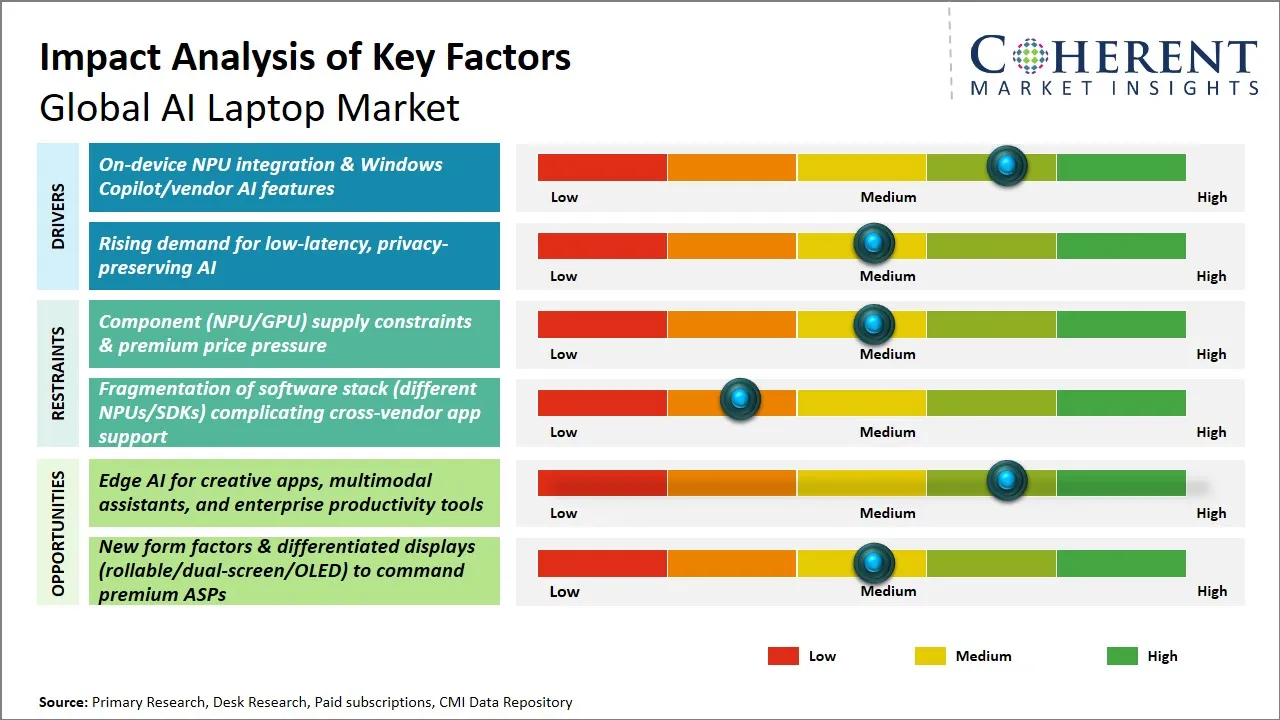
Global AI Laptop Market Driver – On-device NPU Integration & Windows Copilot/Vendor AI Features
The integration of on-device Neural Processing Units (NPUs) within AI laptops has significantly transformed user experiences by enabling faster, more efficient AI computation directly on the device, reducing reliance on cloud-based processing and enhancing data privacy. This hardware evolution allows laptops to perform complex tasks such as real-time image recognition, natural language processing, and predictive analytics with minimal latency, which is particularly beneficial for professionals requiring seamless multitasking and responsiveness.
Complementing this hardware shift, software innovations like Windows Copilot and proprietary AI features developed by leading vendors have further elevated the AI laptop ecosystem. These intelligent assistants and AI-powered tools provide contextual assistance, automate routine workflows, and enhance productivity by understanding user behavior and preferences. In 2024, Microsoft launched its Copilot+ PC initiative with devices like the Surface Laptop and Surface Pro powered by Qualcomm Snapdragon X Elite and Intel Core Ultra processors. These include NPUs capable of over 40 TOPS (trillion operations per second), enabling AI features such as “Recall” for contextual search and “Cocreator” for local image generation.
Global AI Laptop Market Opportunity – Edge AI for Creative Applications, Multimodal Assistants, and Enterprise Productivity Tools
The integration of Edge AI in the global AI laptop market presents a significant opportunity to revolutionize creative applications, multimodal assistants, and enterprise productivity tools. Edge AI, which processes data locally on devices rather than relying solely on cloud computing, enables real-time, low-latency AI functionalities essential for demanding creative workflows such as video editing, graphic design, and 3D rendering. This localized intelligence allows professionals to operate more efficiently without the constraints of constant internet connectivity or data privacy concerns. In February 2025, HP partnered with NVIDIA to integrate RTX AI GPUs into its ZBook Studio laptops, enabling edge-based AI for 3D modeling, video editing, and generative design directly on the device.
Additionally, multimodal assistants powered by Edge AI can interpret and respond to diverse input types including voice, gesture, and facial expressions, enhancing user interaction and accessibility across multiple environments. Such advanced assistants can streamline tasks like scheduling, data retrieval, and real-time collaboration, thereby increasing overall productivity. For enterprises, incorporating Edge AI in laptops facilitates more secure, efficient handling of sensitive business data and supports AI-driven applications tailored for project management, data analysis, and communication. This creates a robust ecosystem where productivity tools are smarter, faster, and more intuitive.
Analyst Opinion (Expert Opinion)
- Increasing enforcement of privacy regulations such as the EU’s GDPR and upcoming U.S. state-level AI transparency laws is accelerating OEM investment in on-device AI processing. By reducing reliance on cloud servers, vendors can ensure user data stays local, easing compliance and boosting customer trust.
- AI Transparency & Explainability Requirements – Regulators in the EU, Canada, and Australia are introducing rules mandating clear disclosure of AI-driven features and decision-making processes. This will push AI laptop makers to provide explainable AI interfaces, detailed user consent workflows, and opt-out options for automated functions.
- Energy Efficiency Standards for AI-Enabled Hardware – With AI workloads increasing device power demands, regions like the EU and Japan are strengthening energy efficiency and eco-design requirements for electronics. Manufacturers will need to balance NPU/GPU performance with optimized thermal and battery management to meet regulatory benchmarks.
Speak to the analyst
Want personalized insights?
Take the findings above to one of our principal consultants, or have the report rebuilt around the segments, geographies and competitors you actually track.
Market Segmentation
- Product Type Insights (Revenue, USD Bn, 2021 - 2033)
- Ultrabooks
- Gaming laptops
- Convertible
- Chromebooks
- Mobile Workstations
- Regional Insights (Revenue, USD Bn, 2021 - 2033)
- North America
- U.S.
- Canada
- Latin America
- Brazil
- Argentina
- Mexico
- Rest of Latin America
- Europe
- Germany
- U.K.
- Spain
- France
- Italy
- Russia
- Rest of Europe
- Asia Pacific
- China
- India
- Japan
- Australia
- South Korea
- ASEAN
- Rest of Asia Pacific
- Middle East
- GCC Countries
- Israel
- Rest of Middle East
- Africa
- South Africa
- North Africa
- Central Africa
- North America
- Key Players Insights
- Apple Inc.
- Lenovo
- HP Inc.
- Dell
- ASUS
- Acer
- Microsoft
- Samsung
- Xiaomi
- Huawei
- Razer
- MSI
- Gigabyte
- LG
- Honor
Sources
Primary Research Interviews
Stakeholders
- OEMs & Device Manufacturers
- Semiconductor & NPU designers
- ODMs and EMS providers
- Retailers & E-commerce platforms
- Enterprise IT buyers & procurement managers (large corporations, SMBs)
- Education procurement officers & campus IT administrators
- Creative professionals & content studios (video, 3D, design houses)
- Gaming publishers / eSports teams and pro gamers
- Component suppliers (displays — OLED/mini-LED, batteries, thermal subsystems)
- Mobile network operators / connectivity partners (for always-connected PCs)
- AI software vendors & SDK providers (Microsoft, NVIDIA, Hugging Face, Qualcomm SDK teams)
- Repair & after-sales service providers
- Sustainability & energy-efficiency consultants (eco-design specialists)
Databases
- IDC (International Data Corporation)
- Canalys
- Counterpoint Research
- UN Comtrade / ITC Trade Map
- Eurostat
- U.S. Census / U.S. International Trade Commission (trade data)
- World Bank Data (economic indicators)
Magazines
- Wired
- The Verge
- PCMag
- Laptop Mag
- AnandTech
- TechRadar
- Tom’s Hardware
- Edge AI / AI Trends (industry magazines)
Journals
- IEEE Transactions on Computers
- ACM Transactions on Computer Systems (TOCS)
- Journal of Parallel and Distributed Computing
- IEEE Transactions on Neural Networks and Learning Systems (for NPU/accelerator research)
- Journal of Systems Architecture
- International Journal of High Performance Computing Applications
Newspapers
- The Wall Street Journal (Tech section)
- Financial Times (Technology)
- The Economic Times (India)
- The Guardian (Technology)
- Nikkei Asia (electronics & semiconductor coverage)
Associations
- Consumer Technology Association (CTA)
- Semiconductor Industry Association (SIA)
- JEITA (Japan Electronics and Information Technology Industries Association)
- European Telecommunications Standards Institute (ETSI) — relevant for connectivity standards
- IEEE Consumer Electronics Society
- GNOME / Linux Foundation (relevant for open-source AI/OS work)
Public Domain Sources
- World Bank
- United Nations Conference on Trade and Development (UNCTAD)
- International Telecommunication Union (ITU)
- National statistics bureaus (e.g., U.S. Census Bureau, India’s MOSPI, China NBS)
- ResearchGate / arXiv (preprints on NPUs, on-device AI, edge computing)
Proprietary Elements
- CMI Data Analytics Tool, Proprietary CMI Existing Repository of information for last 8 years
Get access to 250+ pages report
Every segment, forecast, competitor profile and data table behind the analysis above — available for instant download.
- ESOMAR Member
- ISO 9001:2015 Certified
- D-U-N-S Registered
- GDPR & CCPA Compliant
Missing comfort of reading report in your local language? Find your preferred language:
Transform your Strategy with Exclusive Trending Reports
Frequently Asked Questions
The global laptop AI market is estimated to be valued at USD 41.64 Bn in 2026 and is expected to reach USD 141.54 Bn by 2033.
The CAGR of global laptop AI market is projected to be 19.1% from 2026 to 2033.
On-device NPU integration & Windows Copilot/vendor AI features and rising demand for low-latency, privacy-preserving AI are the major factors driving the growth of the global laptop AI market .
Component (NPU/GPU) supply constraints & premium price pressure and fragmentation of software stack (different NPUs/SDKs) complicating cross-vendor app support are the major factors hampering the growth of the global laptop AI market.
In terms of product type, Ultrabooks is estimated to dominate the market revenue share in 2026.
Apple Inc., Lenovo, HP Inc., Dell, ASUS, Acer, Microsoft, Samsung, Xiaomi, Huawei, Razer, MSI, Gigabyte, LG, and Honor are the major players.
North America is expected to lead the Global AI Laptop Market in 2026.