

Global Architectural Coatings Market Size and Share Analysis – 2026 to 2033
The architectural coatings market is estimated to be valued at USD 88.78 Bn in 2026 and is expected to reach USD 134.38 Bn by 2033, growing at a compound annual growth rate (CAGR) of 6.1% from 2026 to 2033.
Key Takeaways
- In terms of Resin Type, Acrylic Segment contributes 43.1% of the market due to its versatility and durable properties.
- In terms of Function, Ceramics Segment contributes the 43.6% share of the market. This is because ceramic coatings have seen increased demand from the construction industry in recent years.
- In terms of End-use Industry, Non-Residential segment contributes to 42.7% share in global market in 2026.
- North America has dominated the global architectural coatings market with 46.1% market share in 2026.
Market Overview
The demand for architectural coatings is expected to rise steadily over the next decade. The growth of the construction industry, along with increasing investments in infrastructure development projects across major countries worldwide, will drive the demand for architectural coatings. Rapid urbanization, rising disposable income, and changing architectural styles are also contributing to the increased consumption of architectural coatings.
Furthermore, advancements in coating technologies that allow for lower VOC emissions and self-cleaning properties are expected to boost the market growth during the forecast period. New product launches focusing on sustainability and performance improvement will further aid the architectural coatings industry in garnering greater revenue share.
Current Events and Its Impacts
Current Events | Description and its impact |
PPG Showcases High-Durability Architectural Coatings at AIA 2025 |
|
ECS 2025 Sustainable Resin Launches Fuel Green Coating Innovation |
|
Emergence of New Technologies
The coatings industry for architecture is experiencing a revolutionary transformation, spearheaded by the evolution of smart technologies and green materials. Smart coatings, such as thermochromic coatings and self-cleaning coatings, are on the rise. Thermochromic coatings shift color as a result of temperature changes, offering energy efficiency through reduced artificial heating and cooling consumption.
Self-cleaning coatings possess photocatalytic activity, degrading organic grime and pollutants, and sustaining the appearance of buildings and cutting maintenance costs. They are especially worth applying in urban environments, where there are heavy pollution and maintenance.
Moreover, thanks to the employment of nanotechnology, it is feasible to create ultra-thin, long-lasting coatings that can provide increased protection from the environment. Nanomaterials provide the coatings with the ability to be used in thinner gauge without compromising their function and render them best suited for applications where weight and space are a consideration.
Sustainability continues to be a concern, but now more with low-VOC and waterborne paints. Not only do these comply with strict environmental laws, but they also provide improved indoor air quality and smaller ecological footprint. Their adoption of digital technology, including Building Information Modeling (BIM), is even making design and installation of such sophisticated coatings feasible. With BIM, construction workers and designers can visualize the performance and visual outcome of each type of coating before they apply them, allowing better decision-making and more efficient project delivery.
The architectural coatings industry is embracing a smart, sustainable, and technologically sophisticated future that responds to the changing demands of contemporary building as much as it does to concern for the environment.
- Current Industry Events of 2026
- Market Size Estimation
- Regional Breakdown
- Competitive Landscape
- Customer Intelligence
- Segmental Analysis
- Pricing Analysis
- Key Market Drivers, Challenges & Future Trends
- Customized Insights Section
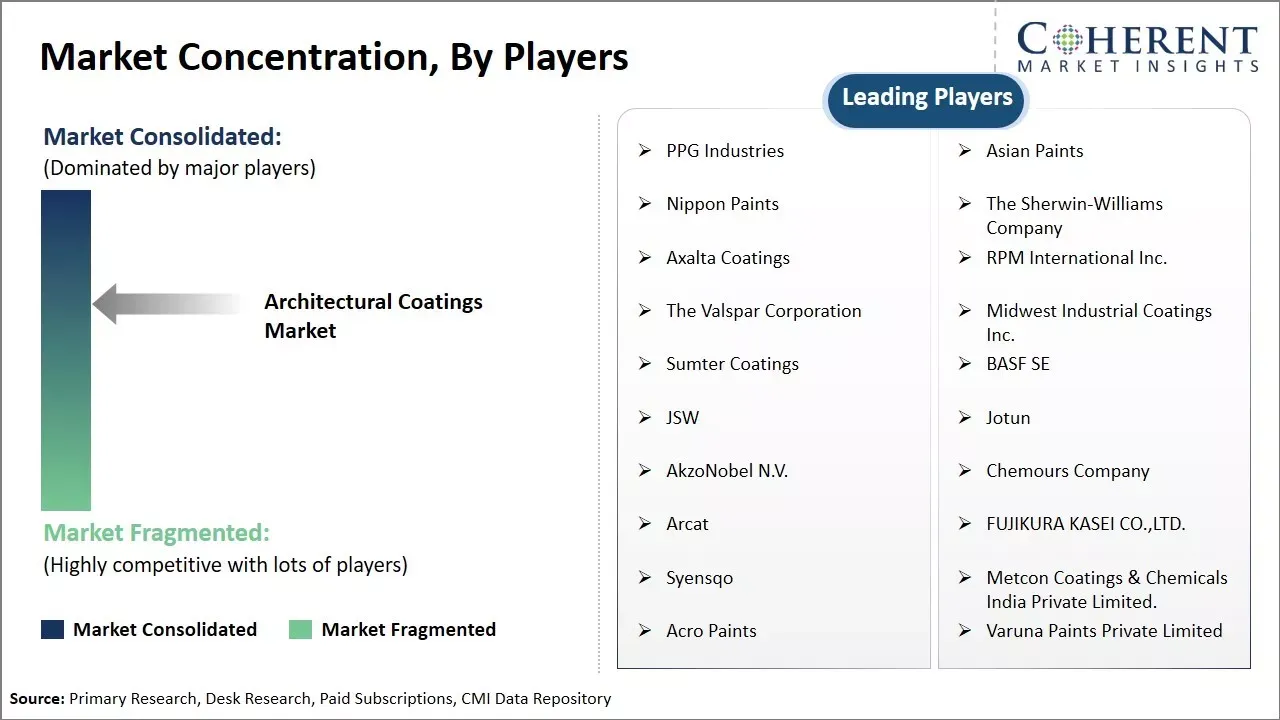
Concentration and Competitive Landscape
Market Driver
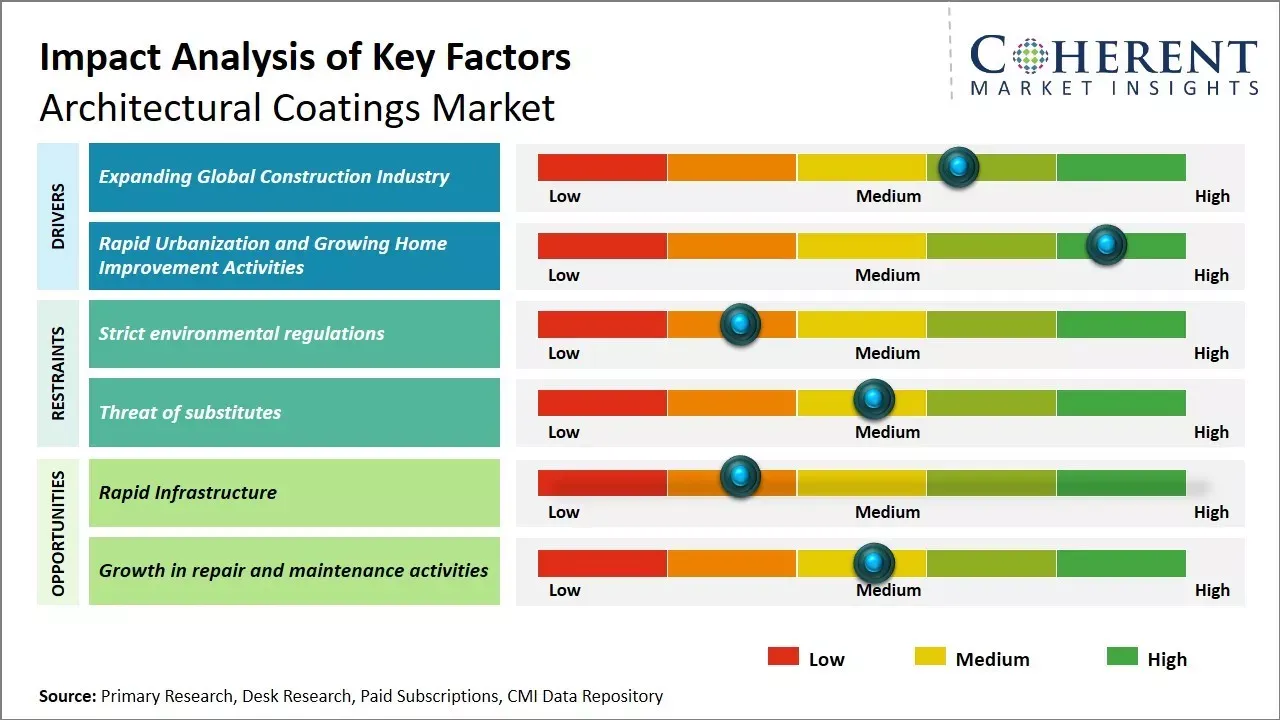
- Expanding Global Construction Industry
The global architectural coatings market is primarily driven by the rapid growth of the construction industry worldwide. For instance, according to data published by Invest India in 2023, the construction industry in India is expected to reach US$1.4 Tn by 2025. There has been a massive increase in the number of infrastructure projects, such as roads, bridges, airports, and commercial buildings being constructed globally, both in developed and developing regions.
This is propelling the demand for coating materials that are used to protect and beautify the surfaces of these structures from wear and tear. The residential construction sector is also thriving due to rising disposable incomes, growing urbanization, and increasing home ownership, especially in Asia Pacific and Middle Eastern countries. This has augmented the sales of paints, varnishes, and other coatings that are applied on interior and exterior surfaces of houses, apartments and other residential spaces.
- Rapid Urbanization and Growing Home Improvement Activities
Another key driver for the architectural coatings market growth worldwide has been the swift pace of urbanization. As more people migrate to cities in pursuit of education and employment opportunities, the demand for housing and commercial infrastructure grows exponentially. This phenomenon is very prominent in developing regions where over 50% of the population now resides in urban areas.
The aging building stocks in mature cities also require regular maintenance through painting, wallpapering, and other remodeling activities. On the residential front, home improvement has become a huge industry driven by changing aesthetics and rising disposable incomes. People are frequently upgrading and beautifying their homes through interior and exterior painting work.
The do-it-yourself culture is inspiring homeowners to handle minor painting jobs themselves, which is propelling the sales of architectural coatings through retail channels. Architects and builders also recognize that regular coats of top-quality paints, stains, and other facade products can protect the exteriors as well as enhance curb appeal of buildings significantly.
In its Q4 2024 earnings report, Sherwin-Williams highlighted strong growth in its Consumer Brands Group, fueled by DIY repainting activity and ongoing home improvement trends in North America. The company reported increased sales through major retail channels like Lowe’s and Home Depot, especially for interior and exterior architectural paints, stains, and sealants.
Market Opportunities: Rapid Infrastructure
The market sees several opportunities for growth. With rapid urbanization, infrastructure and building construction are booming globally. This drives the need for large volumes of coatings. Growing consumer preference for environmentally-friendly, low-VOC products.
Segmental Insights
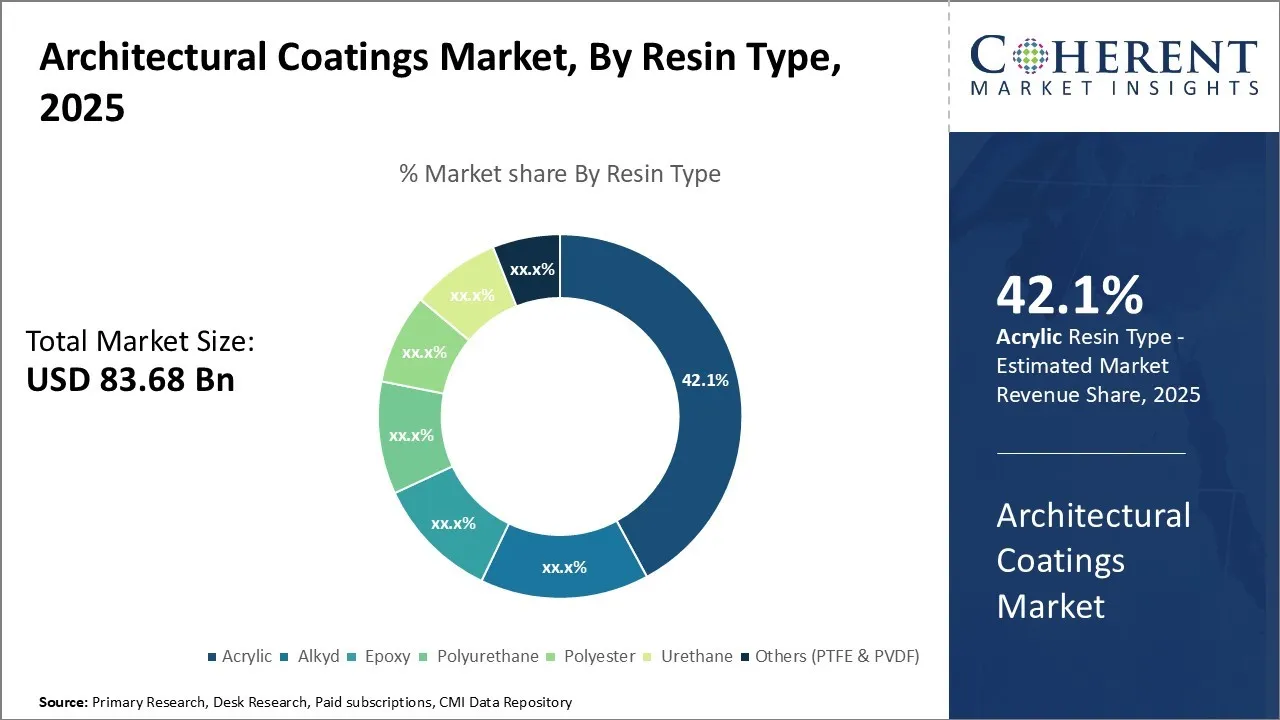
Architectural Coatings Market Insights, By Resin Type
In terms of resin type, acrylic contributes 43.1% of the market due to its versatility and durable properties. Acrylic resin provides UV protection and durability against weathering and fading. It forms a smooth and hard film on surfaces providing an aesthetic appeal. Acrylic paints are highly customizable with options for glossy, satin, or flat finishes. This allows builders and homeowners to match the exact design aesthetic and enhances facade beauty.
Additionally, the automotive industry also contributes to the demand for acrylic resins, as they are used in coatings and adhesives for vehicles. For instance, according to data published by Invest India in 2023, India is the world's third-largest automobile market.
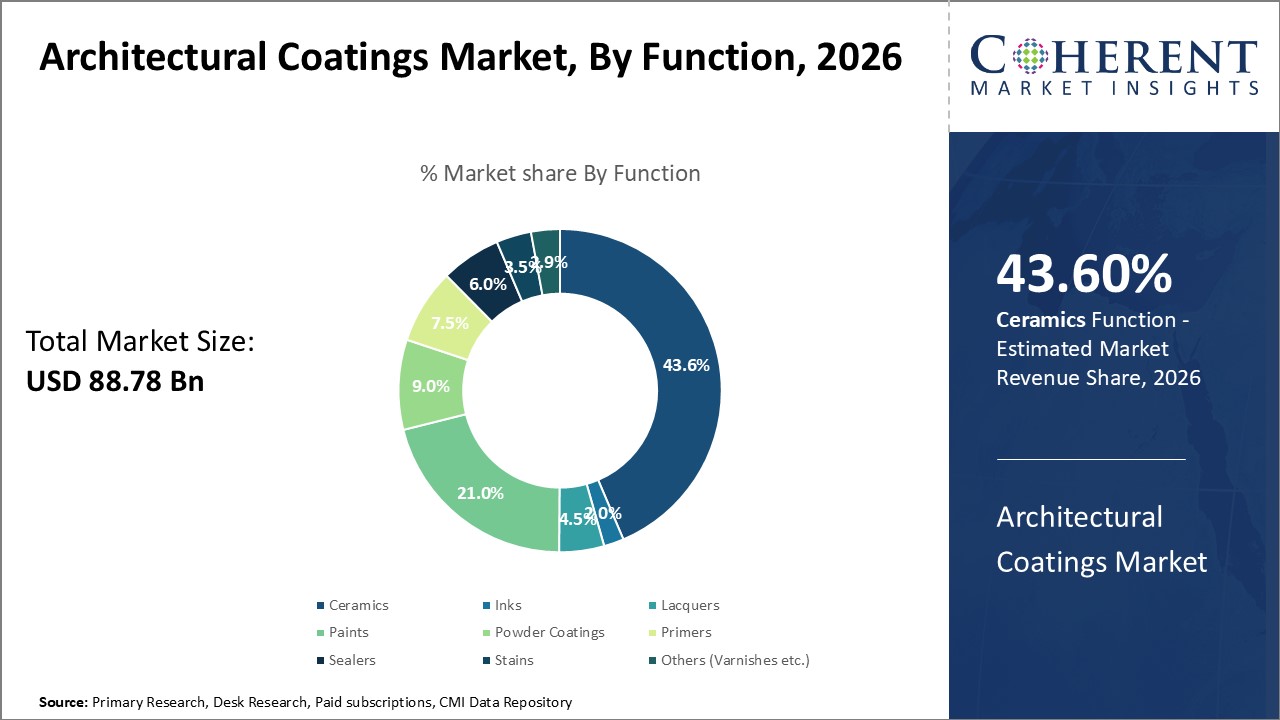
Architectural Coatings Market Insights, By Function
In terms of Function, Ceramics contributes the 43.6% share of the market. Ceramic coatings have seen increased demand from the construction industry in recent years. The smooth, non-porous and durable nature of ceramic coatings make them ideally suited for applications in both commercial and residential construction.
Ceramic coatings are widely used as tile adhesives and grouts for wall and floor coverings. They help create waterproof and stain-resistant surfaces that can withstand heavy foot traffic and harsh cleaning chemicals. Growing urbanization and rising incomes have fueled a boom in new construction across major markets. The commercial real estate sector in particular has experienced significant growth, with more office spaces, malls and other commercial buildings being erected each year.
This has created steady opportunities for ceramic coating producers to supply tile adhesives and grouts for bathroom fixtures, wall panels and flooring materials. Meanwhile, consumers are also spending more on home improvements and renovations, benefiting ceramic coating makers that offer do-it-yourself product lines.
In terms of technology, water borne contributes the 35.7% share of the market due to stringent regulations and sustainability benefits. Water borne coatings are solvent-free and utilize water as the primary carrier of binders and pigments. They contain less than 50 grams of VOC per liter and comply with the most stringent local air quality standards.
Many countries and districts have imposed restrictions on VOC content to under 250 or 100 grams per liter since 2001s. This fueled a transition from solvent borne to water borne technology. Water borne coatings meet such low VOC emission norms easily without expensive additions. Additionally, they avoid hazardous air pollutants from toxic solvents compared to traditional oil and alkyd-based paints.
Architectural Coatings Market Insights, By End-Use Industry
In terms of End-use Industry, Non-Residential contributes the 42.7% share. The non-residential segment in the architectural coatings market has been witnessing significant growth over the past few years owing to increasing construction activities across different sectors such as healthcare, education, retail and hospitality. Rapid urbanization along with growing population has boosted the demand for buildings and infrastructure in both developed and developing countries.
Moreover, rising consumer spending on leisure and entertainment has prompted renovation and expansion of existing malls, exhibition centers and multiplexes. Growing tourism worldwide has driven investment in building and refurbishing of hotels, resorts and convention centers. Various governments are also focusing on improving existing healthcare facilities as well as setting up new hospitals and clinics in order to provide better medical services to citizens. This has positively impacted the consumption of architectural coatings in the non-residential segment.
Regional Insights
North America Architectural Coatings Market Analysis and Trends
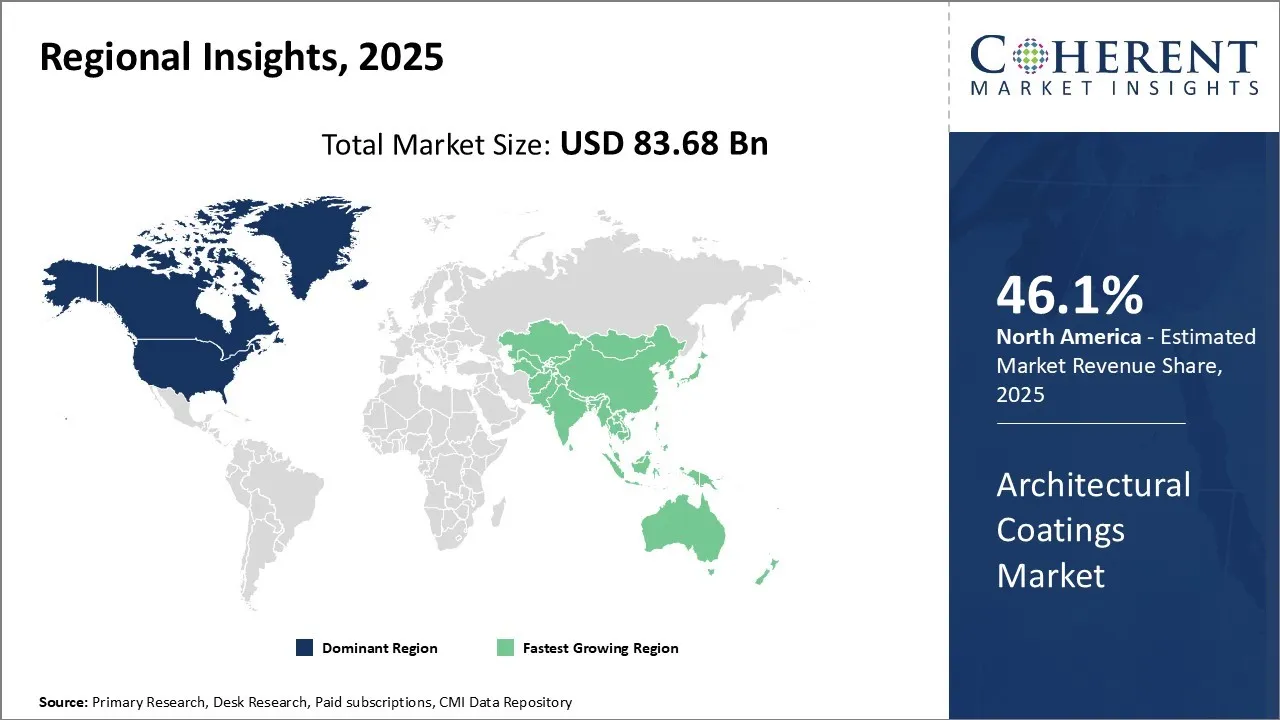
North America has dominated the global architectural coatings market with market share 46.1% for decades, owing to the strong presence of coating manufacturers as well as their wide scale adoption across various end-use industries in the construction and painting sectors.
The U.S. accounts for the largest share in the region due to the huge construction industry and increasing residential and commercial construction activities over the years. Moreover, major coating companies like PPG Industries, Sherwin-Williams, and Axalta Coating Systems are headquartered in the U.S., which gives it an edge over other countries.
Asia Pacific Architectural Coatings Market Analysis and Trends
Asia Pacific region has emerged as the fastest growing market for architectural coatings globally. China is the forerunner in the region owing to the rapid urbanization and industrialization, which have escalated numerous infrastructure projects and construction activities over the past few years. Also, low production costs and growing foreign investments in the real estate and infrastructure sectors have augmented the coatings demand.
Furthermore, other Asian countries like India, Indonesia, and Vietnam are anticipated to offer ample opportunities, as they are witnessing increased construction of commercial buildings, residential buildings, and civil construction works. This will propel the use of decorative and protective coatings in the coming years.
Architectural Coatings Market Dominating Countries
United States Architectural Coatings Market Analysis and Trend
The U.S. dominates the global architectural coatings industry due to its enormous construction industry, well-established infrastructure, and strict environmental regulations encouraging low-VOC and eco-friendly coatings usage. Giants like Sherwin-Williams and PPG Industries have headquarters in the U.S., giving the country a rich manufacturing and R&D foundation.
China Architectural Coatings Market Analysis and Trend
China dominates global architectural coatings production and consumption, driven by vast urbanization, state-led housing projects, and growing middle-class consumers. Decorative paint demand for new construction and refurbishment continues to be the driving force for market growth. However, the country is also increasingly under pressure to shift towards more environmentally friendly, low-emission coatings.
Germany Architectural Coatings Market Analysis and Trend
With its position as the industrial and construction hub of Europe, Germany has an impressive role to play in the architectural coatings sector. Waterborne and low-VOC coatings receive strong emphasis in the German market owing to stringent environmental laws. Local firms' innovation and precision along with environmentally friendly building trends render the market competitive and strictly regulated.
India Architectural Coatings Market Analysis and Trend
India is becoming an emerging growth hotbed due to increasing urban infrastructure growth, increasing disposable incomes, and growing residential and commercial property markets. Premium paint and coating trend, especially in urban areas, is propelling demand, although price continues to be a driving factor in consumption.
Market Report Scope
Architectural Coatings Market Report Coverage
| Report Coverage | Details | ||
|---|---|---|---|
| Base Year: | 2025 | Market Size in 2026: | USD 88.78 Bn |
| Historical Data for: | 2020 To 2024 | Forecast Period: | 2026 To 2033 |
| Forecast Period 2026 to 2033 CAGR: | 6.1% | 2033 Value Projection: | USD 134.38 Bn |
| Geographies covered: |
| ||
| Segments covered: |
| ||
| Companies covered: | PPG Industries, Asian Paints, Nippon Paints, The Sherwin-Williams Company, Axalta Coatings, RPM International Inc., The Valspar Corporation, Midwest Industrial Coatings Inc., Sumter Coatings, BASF SE, JSW, Jotun, AkzoNobel N.V., Chemours Company, Arcat, FUJIKURA KASEI CO., LTD., Syensqo, Metcon Coatings & Chemicals India Private Limited., Acro Paints, and Varuna Paints Private Limited. | ||
| Growth Drivers: |
| ||
| Restraints & Challenges: |
| ||
Architectural Coatings Industry News
- In October 2025, AkzoNobel launched the Interpon D Range and Specification Guide—a new tool aimed at supporting architects, designers, and coating applicators across North America in making well-informed choices when selecting powder coatings.
- In 2024, Arkema displayed a fresh series of environmentally-friendly coating technologies at Paint India. Some of these were Synaqua® resins with renewable content levels of up to 97% and Kynar Aquatec® for use in cool roof systems. Others were low-temperature powder coatings, UV/LED-curable systems, and recycled-content solutions. These developments complement global aspirations for low VOC emissions, energy efficiency, and circular economy in coatings.
Analyst View
- The architectural coatings market is experiencing transformation, driven by urbanization and construction growth, particularly in developing economies. Sustainability trends are accelerating demand for eco-friendly solutions, while technological innovations like water-borne coatings enhance performance and reduce environmental impact. However, raw material price volatility and stringent VOC regulations present significant challenges to profitability and compliance.
- Drivers include rising disposable incomes fueling home renovations and DIY projects, alongside infrastructure expansion in emerging markets. Advancements in coatings technology—such as durable, low-VOC formulations—cater to both aesthetic preferences and regulatory demands.
- Restraints involve economic sensitivities, where downturns directly impact construction activity and coating demand. Regulatory pressures also necessitate costly adaptations toward sustainable alternatives.
- Opportunities lie in developing AI-driven service solutions (e.g., process optimization tools) and sustainable product innovations like energy-efficient powder coatings. Expanding into high-growth regions, particularly Asia-Pacific, offers untapped potential due to rapid urbanization and infrastructure development.
- Regionally, Asia-Pacific dominates and is the fastest-growing market, supported by population growth and construction booms. Developed regions remain stable but are outpaced by emerging economies where infrastructure investments drive momentum.
Speak to the analyst
Want personalized insights?
Take the findings above to one of our principal consultants, or have the report rebuilt around the segments, geographies and competitors you actually track.
Market Segmentation
- By Resin Type (Revenue, USD Bn, 2021 - 2033)
- Acrylic
- Alkyd
- Epoxy
- Polyurethane
- Polyester
- Urethane
- Others (PTFE & PVDF)
- By Function (Revenue, USD Bn, 2021 - 2033)
- Ceramics
- Inks
- Lacquers
- Paints
- Powder Coatings
- Primers
- Sealers
- Stains
- Others (Varnishes, etc.)
- By Technology (Revenue, USD Bn, 2021 - 2033)
- Solvent Borne
- Water Borne
- By End-Use Industry (Revenue, USD Bn, 2021 - 2033)
- Residential
- Non-Residential
- By Regional (Revenue, USD Bn, 2021 - 2033)
- North America
- U.S.
- Canada
- Latin America
- Brazil
- Argentina
- Mexico
- Rest of Latin America
- Europe
- Germany
- U.K.
- Spain
- France
- Italy
- Russia
- Rest of Europe
- Asia Pacific
- China
- India
- Japan
- Australia
- South Korea
- ASEAN
- Rest of Asia Pacific
- Middle East
- GCC Countries
- Israel
- Rest of Middle East
- Africa
- South Africa
- North Africa
- Central Africa
- Company Profiles
- PPG Industries
- Asian Paints
- Nippon Paints
- The Sherwin-Williams Company
- Axalta Coatings
- RPM International Inc.
- The Valspar Corporation
- Midwest Industrial Coatings Inc.
- Sumter Coatings
- BASF SE
- JSW
- Jotun
- AkzoNobel N.V.
- Chemours Company
- Arcat
- FUJIKURA KASEI CO., LTD.
- Syensqo
- Metcon Coatings & Chemicals India Private Limited.
- Acro Paints
- Varuna Paints Private Limited
Sources
Primary Research interviews
- AkzoNobel N.V.
- PPG Industries, Inc.
- Sherwin-Williams Company
- BASF SE
- Others
Databases
- Factiva
- Hoovers
- Others
Magazines
- Paint & Coatings Industry Magazine (PCI)
- Coatings World Magazine
- Architectural Digest
- Others
Journals
- Journal of Coatings Technology and Research
- Progress in Organic Coatings
- Journal of Architectural Coatings
- Others
Newspapers
- The Wall Street Journal
- Financial Times
- The Economic Times
- Others
Associations
- American Coatings Association (ACA)
- British Coatings Federation (BCF)
- European Council of the Paint, Printing Ink and Artists' Colours Industry (CEPE)
- Indian Paint Association (IPA)
- Others
Public Domain sources
- U.S. Environmental Protection Agency (EPA)
- United States Census Bureau
- World Bank
- Others
Proprietary Elements
- CMI Data Analytics Tool
- Proprietary CMI Existing Repository of information for last 8 years
Get access to 250+ pages report
Every segment, forecast, competitor profile and data table behind the analysis above — available for instant download.
- ESOMAR Member
- ISO 9001:2015 Certified
- D-U-N-S Registered
- GDPR & CCPA Compliant
Missing comfort of reading report in your local language? Find your preferred language:
Transform your Strategy with Exclusive Trending Reports
Frequently Asked Questions
The Architectural Coatings Market size is estimated to be valued at USD 88.78 Bn in 2026, and is expected to reach USD 134.38 Bn by 2033.
The CAGR of the global Market is projected to be 6.1% from 2026 to 2033.
Expanding global construction industry and rapid urbanization are the major factor driving the growth of market.
Strict environmental regulations and growth of DIY culture are the major factor hampering the growth of market.
In terms of resin type, acrylic estimated to dominate the market revenue share 2026.
PPG Industries, Asian Paints, Nippon Paints, The Sherwin-Williams Company, Axalta Coatings, RPM International Inc., The Valspar Corporation, Midwest Industrial Coatings Inc., Sumter Coatings, BASF SE, JSW, Jotun, AkzoNobel N.V., Chemours Company, Arcat, FUJIKURA KASEI CO., LTD., Syensqo, Metcon Coatings & Chemicals India Private Limited., Acro Paints, and Varuna Paints Private Limited are the major players.
North America is expected to lead the global market.