

Global Artificial Grass Market Size and Forecast – 2026-2033
The Global Artificial Grass Market is estimated to be valued at USD 7,721.5 Mn in 2026 and is expected to reach USD 11,999.1 Mn by 2033, exhibiting a compound annual growth rate (CAGR) of 6.5% from 2026 to 2033.
Key Takeaways of the Artificial Grass Market
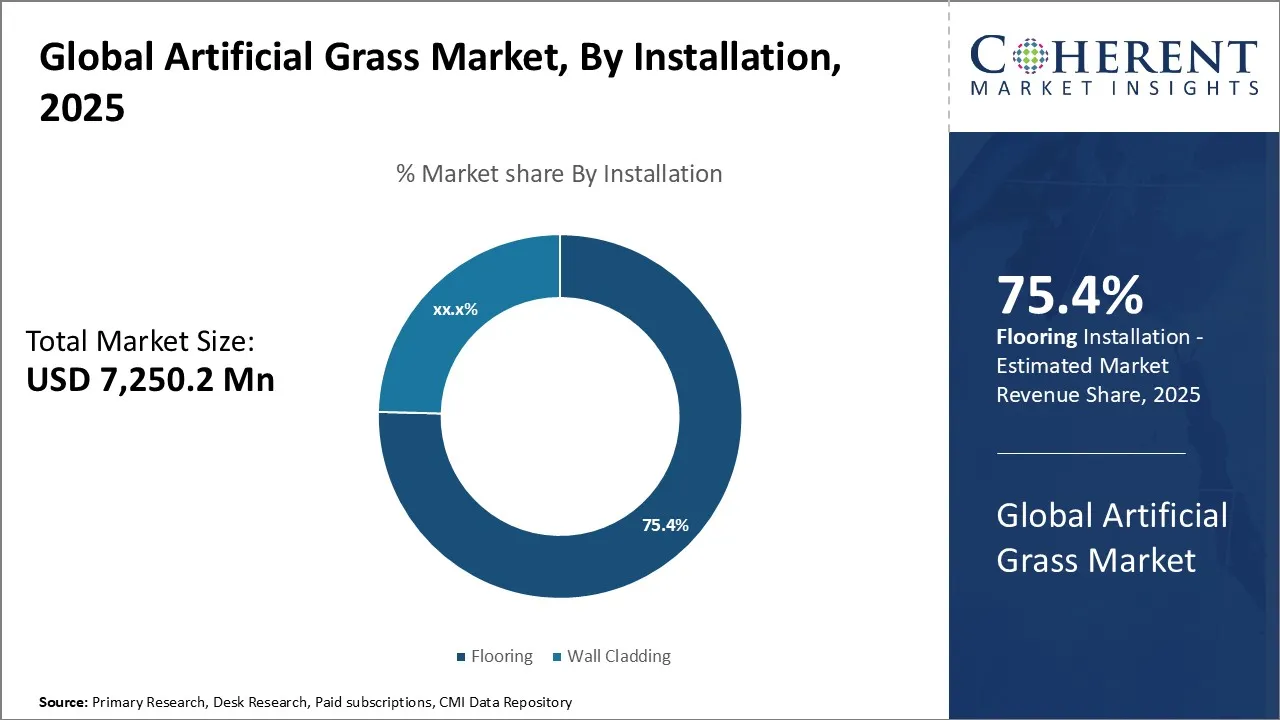
- The flooring segment is expected to account for a 76.4 % share of the market in 2026, driven by its wide range of applications and versatility in different settings.
- The polyethylene segment is expected to hold 62.8% share of the artificial grass market in 2026, due to its blend of performance, durability, and affordability.
- The petroleum-based infill segment is projected to account for a 70.4 % share of the market in 2026, driven mainly by its superior performance qualities and cost benefits.
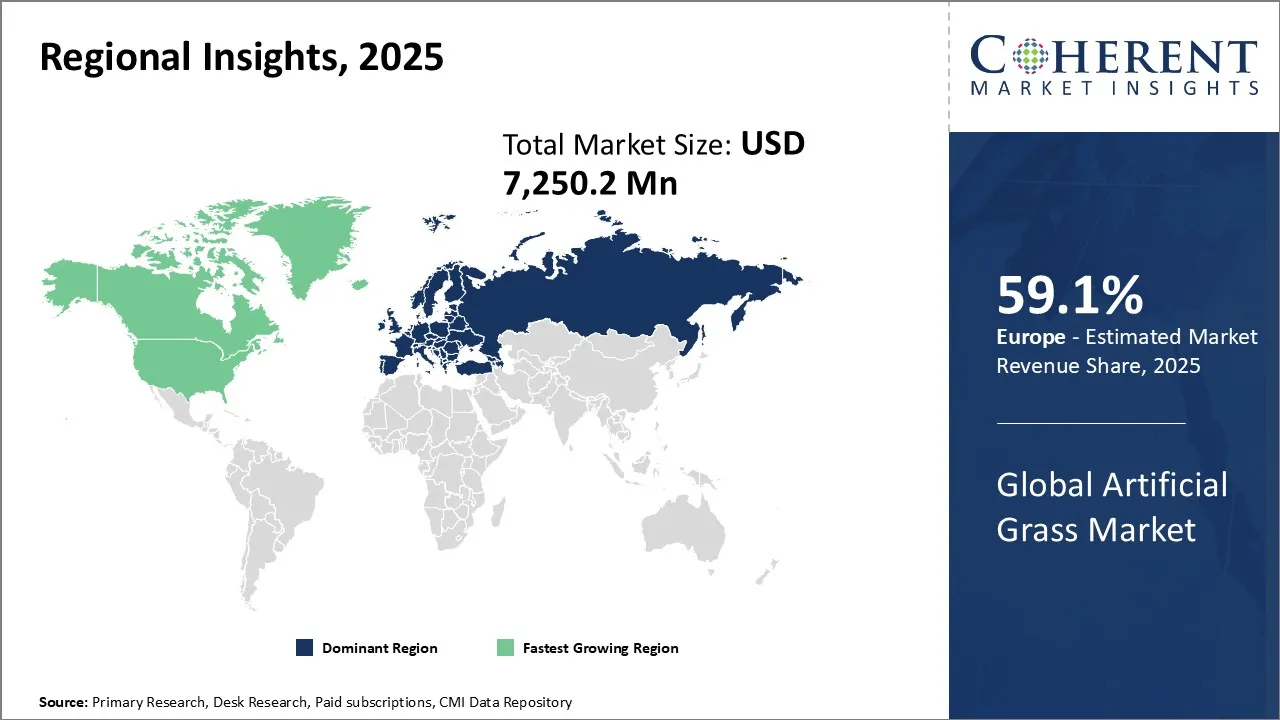
- Europe is set to lead the global artificial grass market in 2026 with a 59. 1% share, driven by strict environmental regulations and widespread use across residential, commercial, and public spaces. North America, holding 15.9%, is among the fastest-growing regions, fueled by urbanization, rising landscaping demand, and water-saving initiatives.
Market Overview
Current market trends highlight a growing preference for eco-friendly and low-maintenance landscaping solutions, propelling artificial grass demand. Innovations in material technology, such as enhanced durability and realistic aesthetics, are making artificial turf more appealing to end users. Additionally, urbanization and the expansion of sports facilities worldwide are further boosting market growth. The integration of smart landscaping technologies and rising government initiatives promoting water-saving alternatives continue to shape this dynamic market landscape.
Current Events and Its Impact
Current Events | Description and its impact |
Advancements in Turf Technology and Materials |
|
Policy and Environmental Considerations |
|
Segmental Insights
- Current Industry Events of 2026
- Market Size Estimation
- Regional Breakdown
- Competitive Landscape
- Customer Intelligence
- Segmental Analysis
- Pricing Analysis
- Key Market Drivers, Challenges & Future Trends
- Customized Insights Section
Artificial Grass Market Insights, By Installation – Flooring Segment Dominates due to Widespread Application and Versatility
The flooring segment is expected to contribute 76.4% share of the market in 2026, due to its diverse applications and adaptability across various environments. Flooring solutions using artificial grass are widely preferred in both residential and commercial spaces, which strongly fuels the demand for this segment. One of the primary growth drivers is the increasing urbanization and shrinking natural green spaces, leading this segment to expand at a CAGR of 6.2% during the forecast period. Homeowners, facility managers, and urban planners seek low-maintenance yet aesthetically pleasing alternatives to natural turf, and artificial grass flooring perfectly meets this need by providing lush greenery with minimal upkeep.

Artificial Grass Market Insights, By Material Type – The Polyethylene Segment Leads Because of its Blend of Performance, Durability, and Affordability
The polyethylene segment is expected to contribute 62.8% share of the artificial grass market in 2026, due to its combination of performance, durability, and cost-effectiveness. Expected to exhibit a CAGR of 6.3% during the forecast period, one of the critical reasons for polyethylene’s dominance is its ability to closely mimic the natural appearance and texture of real grass blades, offering enhanced visual appeal which is paramount for consumer acceptance. The material’s flexibility allows for the production of fibers with natural blade shapes and a softer feel, contributing to the overall user experience, especially in applications such as landscaping and sports surfaces.
Artificial Grass Market Insights, By Infill Materials - The Petroleum-based Infill Segment Dominates the Market, Supported by its Superior Performance and Cost Benefits
The petroleum-based infill segment is projected to contribute 70.4% share of the market in 2026 and record a CAGR of 7.0% during the forecast period, primarily due to its superior performance characteristics and cost advantages. This segment benefits from petroleum-based infill’s excellent shock absorption and resilience, which significantly enhance the playability and comfort of synthetic turf surfaces. These properties make it particularly suitable for high-impact applications such as sports fields, where player safety and surface consistency are paramount.
Regional Insights
Europe Artificial Grass Market Analysis and Trends
The Europe region is projected to lead the market with a 59.1% share in 2026 and record a 6.0% CAGR during 2026-2032, fueled by growing urbanization, increasing environmental awareness, and the expansion of sports infrastructure across various countries. The region benefits from a strong regulatory framework focused on sustainability, water conservation, and reducing chemical use in landscaping, which encourages the adoption of artificial grass as an eco-friendly alternative to natural lawns. Key players such as TenCate Grass, Tarkett, and Edel Grass have a significant presence, leveraging advanced manufacturing technologies and innovative product developments tailored to the Europe artificial grass market’s climate and aesthetic preferences.
North America Artificial Grass Market Analysis and Trends
The North America region is expected to exhibit the fastest growth in the market, contributing a 15.9% share in 2026, and exhibit a 6.4% CAGR during the forecast period supported by a robust ecosystem, high adoption of artificial turf in residential, commercial, and sports infrastructure sectors, and increasing environmental regulations. Countries such as the U.S. and Canada are leading the demand, with significant investments in upgrading sports facilities, public parks, and commercial landscapes fueling the adoption of artificial grass. The region benefits from advanced manufacturing capabilities and a strong presence of leading companies like Shaw Sports Turf, FieldTurf (a Tarkett company), and SYNLawn, which are continuously innovating in materials and installation technologies.
Global Artificial Grass Market Outlook for Key Countries
China Artificial Grass Market Trends
China's artificial grass market is rapidly evolving, with a projected CAGR of 7.4% during the forecast period, driven by aggressive urban development plans and increasing investments in sports infrastructure ahead of global sporting events and domestic leagues. Local manufacturers, supported by government subsidies for green infrastructure, have enhanced their production capacity and innovated products tailored to diverse climatic conditions. Companies like Namgrass and KingGrass are notable for expanding their presence both domestically and internationally. The government’s strong emphasis on water conservation and ecological landscaping is a key driver of the market.
Japan Artificial Grass Market Trends
Japan’s artificial grass market is well-developed, exhibiting a CAGR of 7.7%, and supported by major domestic and international players like Taisho Turf and SYNLawn Japan that drive innovation and quality standards. The market is propelled by stringent environmental policies promoting water conservation and sustainable landscaping, alongside limited green spaces in densely populated urban areas. Artificial grass is widely used in sports facilities, residential gardens, and commercial properties. Advancements in technology and product customization cater to Japan’s unique climate and aesthetic preferences.
India Artificial Grass Market Trends
India’s artificial grass market is expected to expand at a CAGR of 8.3% during the forecast period, driven by urban green initiatives and growing consumer preference for low-maintenance landscaping solutions amidst water scarcity issues. The country benefits from government campaigns promoting smart cities and sustainable urban spaces. Domestic companies, including Evergreen Synthetic Grass, are focusing on affordability and adaptation to local environments, fostering widespread adoption. Additionally, growth in sports infrastructure, including cricket grounds and football stadiums, further propels artificial grass demand.
South Korea Artificial Grass Market Trends
South Korea is emerging as a key player in Asia Pacific artificial grass market, exhibiting a CAGR of 7.8% during the forecast period, driven by increasing urbanization, limited green spaces, and growing environmental awareness. Government policies promoting water conservation and eco-friendly landscaping solutions support market growth. South Korea’s strong technology sector fosters innovation, with companies like Taeyoung E&T and Jeil Green advancing synthetic turf quality and durability to meet local demands. The market focuses on residential landscaping, sports facilities, and public parks, backed by efficient supply chains and growing consumer preference for sustainable outdoor solutions.
Australia Artificial Grass Market Trends
Australia’s artificial grass market is projected to record a CAGR of 8.4%, benefiting from an urgent need for water conservation amid frequent droughts, which makes synthetic turf a preferred alternative in residential and commercial landscaping. The country has seen notable contributions from companies like SYNLawn Australia and Everhard Industries, who provide tailored products suited for local climatic conditions. Government rebates and awareness programs promoting water-efficient landscaping further enhance market penetration. The sports sector, especially cricket and tennis, remains a significant consumer segment.
ASEAN Artificial Grass Market Trends
The ASEAN artificial grass market is projected to register a robust CAGR of 7.9%, driven by urbanization, water scarcity, and demand for low-maintenance landscaping. Seasonal droughts and variable rainfall make synthetic turf a water-efficient alternative to natural grass. Key players like SYNLawn and Everhard Industries offer products tailored for the region’s tropical climate. Government initiatives promoting sustainable landscaping further drive adoption. The sports sector—especially football, badminton, and tennis—remains a significant consumer, while investments in urban infrastructure and recreational facilities boost market growth across ASEAN.
Macro and Micro Economic Factors impacting on Artificial Grass Market
Micro- Economic Factors: Urbanization and construction booms in Asia-Pacific and emerging markets, fueling demand for landscaping and sports infrastructure.
- Water scarcity and climate change concerns, leading governments and businesses to invest in water-saving solutions like artificial grass.
- Technological advancements—improved durability, eco-friendly materials, and realistic aesthetics—boost adoption across regions.
- Economic growth and rising disposable incomes in regions such as Latin America and Asia-Pacific enable greater investment in residential and commercial landscaping.
- Regulatory support for sustainable urban development and water conservation, especially in North America and Europe, further accelerates market growth.
Micro- Economic Factors
- Installation and maintenance costs: While artificial grass reduces long-term maintenance, high upfront installation costs can deter some buyers.
- Raw material prices and supply chain dynamics, including currency fluctuations, directly impact profit margins and final product pricing.
- Competitive landscape: Major players invest in R&D, product innovation, and geographic expansion to capture market share.
- Consumer preferences for low-maintenance, visually appealing, and injury-reducing surfaces drive adoption in sports and residential sectors.
Market Players, Key Development, and Competitive Intelligence
Key Developments
- In April 2025, BASF and Hagihara Industries teamed up to develop highly durable polyolefin yarns for artificial sports turf. Their advanced Tinuvin formulation improves UV resistance, enhancing the grass’s durability and color retention in football, baseball, and tennis fields after three years of R&D.
- In June 2025, Synthetic Grass Warehouse (SGW) expanded its synthetic turf distribution operations to U.S. This strategic move enhances SGW’s presence in the southeastern market, providing top-quality, durable, and budget-friendly artificial grass solutions to both commercial and residential customers in the rapidly growing Atlanta area. This expansion supports the increasing demand for sustainable and low-maintenance outdoor landscaping alternatives.
Top Strategies Followed by Global Artificial Grass Market Players
- Established Players: Leading companies in the artificial grass market, such as Tarkett Sports, Shaw Sports Turf, and FieldTurf (a Tarkett company), invest heavily in R&D to create innovative, high-performance products. Their focus is on meeting evolving customer demands for enhanced durability, environmental sustainability, and realistic aesthetics.
- For instance, Shaw Sports Turf has made significant R&D investments to develop its "Natura" series—a sustainable turf product made using plant-based polymers. This innovation reflects the company’s commitment to advancing eco-friendly solutions through technological development and material science research.
- Mid-level players: These players in the artificial grass market focus primarily on offering cost-effective solutions that strike a balance between quality and affordability. These companies target price-sensitive consumers such as residential buyers, schools, and small commercial ventures who seek reliable products without premium pricing. To augment their competitiveness, many mid-level players leverage collaborations with suppliers and technology partners to enhance their manufacturing efficiency and product technology.
- For example, ACT Global produces the "Xtreme Turf" series, which delivers reliable quality at a competitive price point for budget-conscious buyers.
- Small-scale players: These players in the artificial grass market typically carve out niche positions by emphasizing specialized features or innovative products that cater to unique customer needs. These players often adopt cutting-edge technologies such as advanced polymer blends or eco-friendly materials that differentiate their offerings and appeal to environmentally conscious or design-focused buyers. To gain market entry and increase visibility, smaller firms build alliances with local startups, regional distributors, or manufacturing partners.
- For example, SYNLawn is a leading manufacturer and innovator in the artificial grass industry, known for its wide range of high-quality synthetic turf solutions that cater to diverse applications such as residential lawns, pet areas, playgrounds, golf, sports fields, rooftops, and commercial landscapes.
Market Report Scope
Artificial Grass Market Report Coverage
| Report Coverage | Details | ||
|---|---|---|---|
| Base Year: | 2025 | Market Size in 2026: | USD 7,721.5 Mn |
| Historical Data for: | 2020 To 2024 | Forecast Period: | 2026 To 2033 |
| Forecast Period 2026 to 2033 CAGR: | 6.5% | 2033 Value Projection: | USD 11,999.1 Mn |
| Geographies covered: |
| ||
| Segments covered: |
| ||
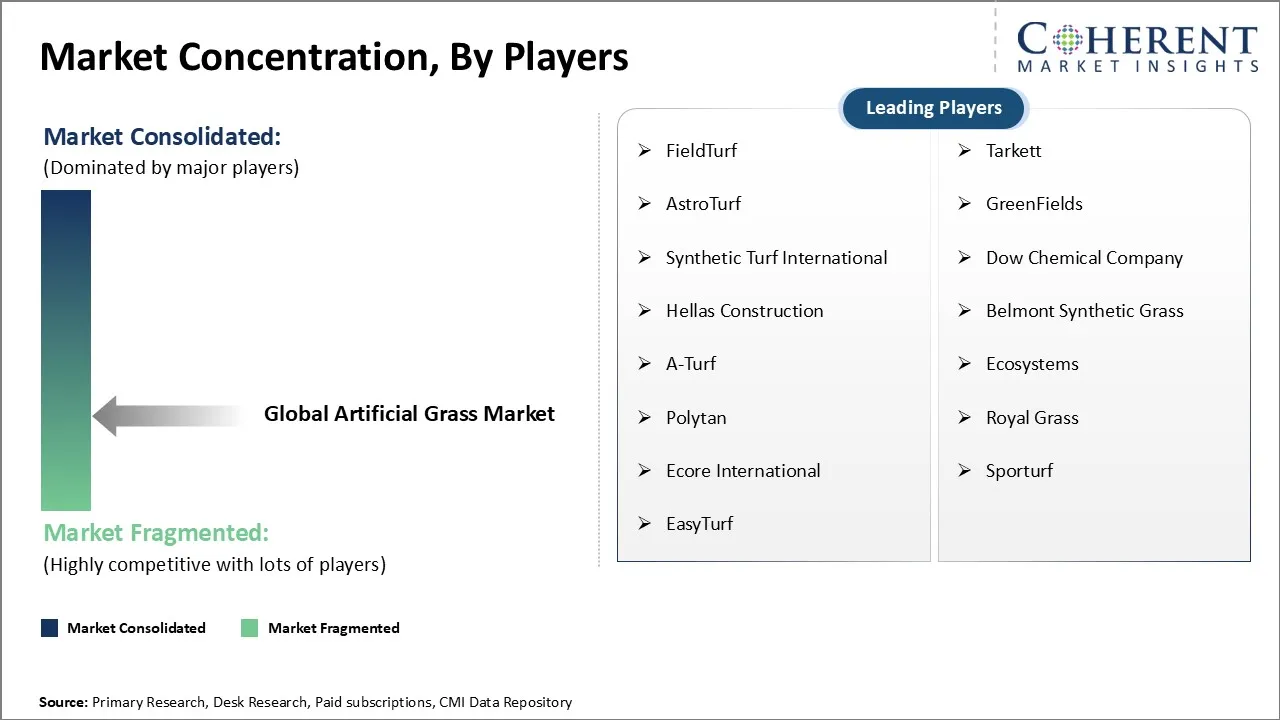
| Companies covered: | FieldTurf, Tarkett, AstroTurf, GreenFields, Synthetic Turf International, Dow Chemical Company, Hellas Construction, Belmont Synthetic Grass, A-Turf, Ecosystems, Polytan, Royal Grass, Ecore International, Sporturf, and EasyTurf | ||
| Growth Drivers: |
| ||
| Restraints & Challenges: |
| ||
Artificial Grass Market Dynamics
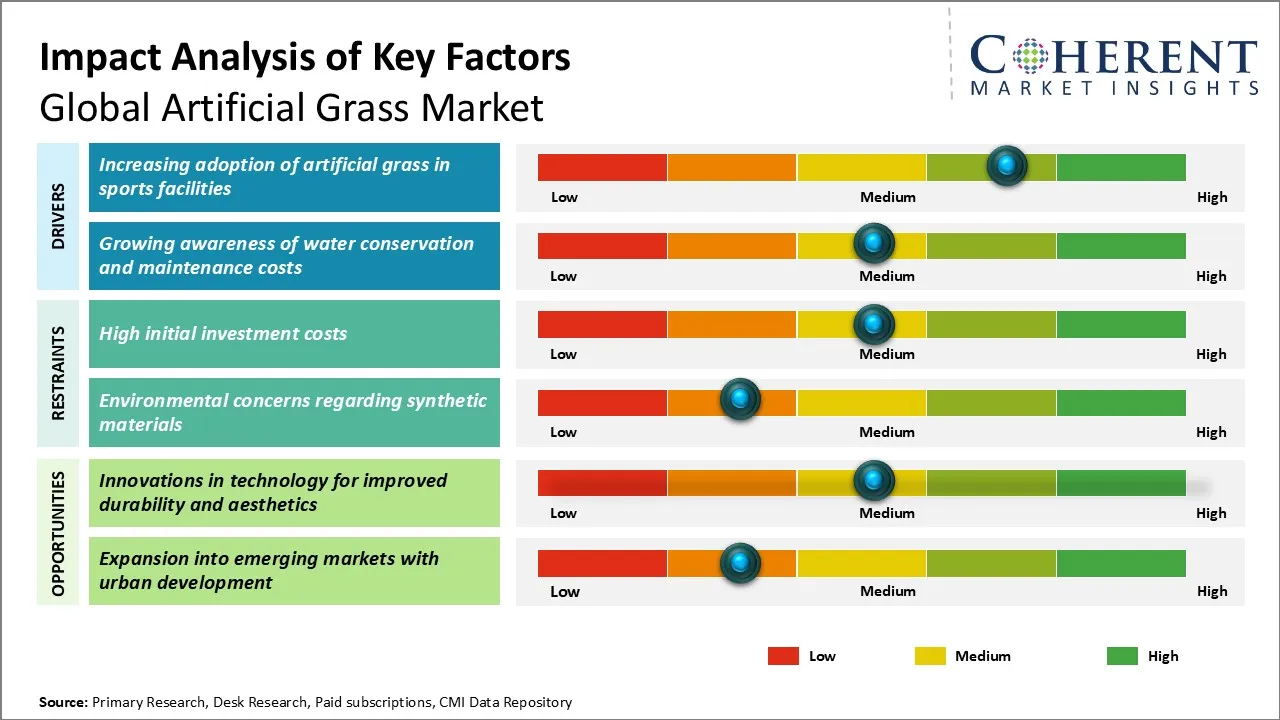
Artificial Grass Market Driver - Increasing Adoption of Artificial Grass in Sports Facilities
The rising adoption of artificial grass in sports facilities is a key driver of the global market, driven by its durability, low maintenance, and year-round usability. Professional sports organizations, sports hospitality, educational institutions, and municipal recreation departments are increasingly recognizing these advantages, leading to widespread adoption across various sporting disciplines including soccer, American football, rugby, and tennis. The FIFA World Cup Qatar 2022 showcased several training facilities equipped with advanced artificial turf systems, demonstrating the technology's acceptance at the highest levels of international sport. This trend is further accelerated by the growing emphasis on water conservation and sustainable practices, as artificial grass eliminates the need for irrigation systems that consume thousands of gallons of water annually per field.
Artificial Grass Market Opportunity - Innovations in Technology for Improved Durability and Aesthetics
The global artificial grass market is poised to benefit significantly from ongoing technological innovations aimed at enhancing both durability and aesthetic appeal. Advancements in polymer chemistry and fiber engineering have led to the development of next-generation artificial turf products that closely mimic the look and feel of natural grass while offering superior resilience against wear and environmental factors. Innovations such as UV-resistant coatings, anti-microbial treatments, and enhanced drainage systems are extending product lifespan and maintaining vibrant colors over time, even in extreme weather conditions.
The sports industry particularly benefits from these advancements, as evidenced by FIFA's ongoing research into synthetic turf systems that meet professional standards for player safety and performance. According to the European Environment Agency's 2022 report on sustainable sports infrastructure, synthetic turf installations in European sports facilities increased by 34% between 2020 and 2022, primarily driven by improved durability features that extend field lifespan to 15-20 years compared to previous generations lasting 8-10 years.
Analyst Opinion (Expert Opinion)
- The global artificial grass market is rapidly evolving, propelled by increasing demand for low-maintenance, eco-friendly landscaping solutions. Companies like FieldTurf and Turfscape are leading innovations, focusing on advanced technologies that replicate natural grass aesthetics while enhancing durability and drainage.
- Recent conferences, such as the World Soccer Convention (2023) and the Sports Facilities & Stadiums Conference (2022), showcased successful applications of artificial grass in various settings, from residential lawns to professional sports fields. Notably, case studies presented at these events highlighted how stadiums have upgraded to artificial turf, resulting in lower water usage and reduced maintenance costs, while still meeting rigorous performance standards.
- The growing trend of urbanization has driven municipalities to adopt artificial grass in public parks and recreational areas, further broadening the market's appeal.
Speak to the analyst
Want personalized insights?
Take the findings above to one of our principal consultants, or have the report rebuilt around the segments, geographies and competitors you actually track.
Market Segmentation
- Installation Insights (Revenue, USD Mn, 2021 - 2033)
- Flooring
- Wall Cladding
- Material Type Insights (Revenue, USD Mn, 2021 - 2033)
- Polyethylene
- Polypropylene
- Nylon
- Others (Polyamides, etc.)
- Infill Materials Insights (Revenue, USD Mn, 2021 - 2033)
- Petroleum-based infill
- Styrene-Butadiene Rubber
- Ethylene Propylene Diene Monomers
- Thermoplastic Elastomers
- Others (Acrylic Polymer Coated Sand, etc.)
- Sand Infill
- Plant-based Infill
- Application Insights (Revenue, USD Mn, 2021 - 2033)
- Commercial
- Sports
- Landscaping
- Others
- Residential
- Regional Insights (Revenue, USD Mn, 2021 - 2033)
- North America
- U.S.
- Canada
- Latin America
- Brazil
- Argentina
- Mexico
- Rest of Latin America
- Europe
- Germany
- U.K.
- Spain
- France
- Italy
- Russia
- Rest of Europe
- Asia Pacific
- China
- India
- Japan
- Australia
- South Korea
- ASEAN
- Rest of Asia Pacific
- Middle East
- GCC Countries
- Israel
- Rest of Middle East
- Africa
- South Africa
- North Africa
- Central Africa
- North America
- Key Players Insights
- FieldTurf
- Tarkett
- AstroTurf
- GreenFields
- Synthetic Turf International
- Dow Chemical Company
- Hellas Construction
- Belmont Synthetic Grass
- A-Turf
- Ecosystems
- Polytan
- Royal Grass
- Ecore International
- Sporturf
- EasyTurf
Sources
Primary Research Interviews
- CEO – Leading Synthetic Turf Manufacturer
- Procurement Manager – Global Landscaping Contractor
- Product Development Head – Major Turf Brand
- Sustainability Director – Artificial Grass Certification Body
Stakeholders
- Manufacturers
- End‑use Sectors:
- Sports Facilities (stadiums, football/soccer fields)
- Residential Landscaping (homeowners, DIY)
- Commercial & Urban Development (rooftop gardens, offices)
- Regulatory & Certification Bodies (FIFA Quality, EU Circular Economy)
- E‑commerce Platforms & Retailers (Amazon, Home Depot, Lowe’s)
- Technology Providers (smart‑drainage, IoT‑enabled turf)
Databases
- UN Comtrade Database
- India Import Export (EXIM) Database
Magazines
- Landscape & Design Weekly — Rising DIY installation trends
- Turf Today — Smart-turf and recycled backing launches
- Green Infrastructure Journal — Rooftop & commercial rooftop turf growth
Journals
- Journal of Sports Engineering & Technology — Usage of polyethylene fibers, infill safety
- Journal of Environmental Planning — Microplastic migration studies
- Sustainable Materials Journal — Modular, recyclable turf systems
Newspapers
- Financial Times — Water‑usage savings drive adoption; sports contracts
- The Guardian — EU bans on microplastic infill, consumer pressure
- European Nutrition News — Environmental regulation on turf disposal & recycling
- New York Times — Rise in residential turf installations amid drought
Associations
- European Chemicals Agency (EU Circular Economy mandates for recyclability)
- International Association of Landscape Professionals
- U.S. Green Building Council (LEED certification with smart‑turf systems)
Public Domain Sources
- U.S. EPA — microplastic runoff studies
- UN FAO — comparative water use: natural vs. synthetic turf
- California AB 1053 (disclosure requirements for turf material content)
Proprietary Elements
- CMI Data Analytics Tool, Proprietary CMI Existing Repository of information for last 8 years.
Get access to 250+ pages report
Every segment, forecast, competitor profile and data table behind the analysis above — available for instant download.
- ESOMAR Member
- ISO 9001:2015 Certified
- D-U-N-S Registered
- GDPR & CCPA Compliant
Missing comfort of reading report in your local language? Find your preferred language:
Transform your Strategy with Exclusive Trending Reports
Frequently Asked Questions
The global artificial grass market is estimated to be valued at USD 7,721.5 Mn in 2026 and is expected to reach USD 11,999.1 Mn by 2033.
The CAGR of the global artificial grass market is projected to be 6.5% from 2026 to 2033.
Increasing adoption of artificial grass in sports facilities and growing awareness of water conservation and maintenance costs are the major factors driving the growth of the global artificial grass market.
High initial investment costs and environmental concerns regarding synthetic materials are the major factors hampering the growth of the global artificial grass market.
In terms of installation, flooring is estimated to dominate the market revenue share in 2026.
FieldTurf, Tarkett, AstroTurf, GreenFields, Synthetic Turf International, Dow Chemical Company, Hellas Construction, Belmont Synthetic Grass, A-Turf, Ecosystems, Polytan, Royal Grass, Ecore International, Sporturf, and EasyTurf are the major players.
Europe is expected to lead the global artificial grass market in 2026.