

Global Automatic Content Recognition Market Size and Forecast – 2026-2033
The Global Automatic Content Recognition Market is estimated to be valued at USD 5.20 Bn in 2026 and is expected to reach USD 17.26 Bn by 2033, exhibiting a compound annual growth rate (CAGR) of 18.7% from 2026 to 2033.
Key Takeaways of the Automatic Content Recognition Market:
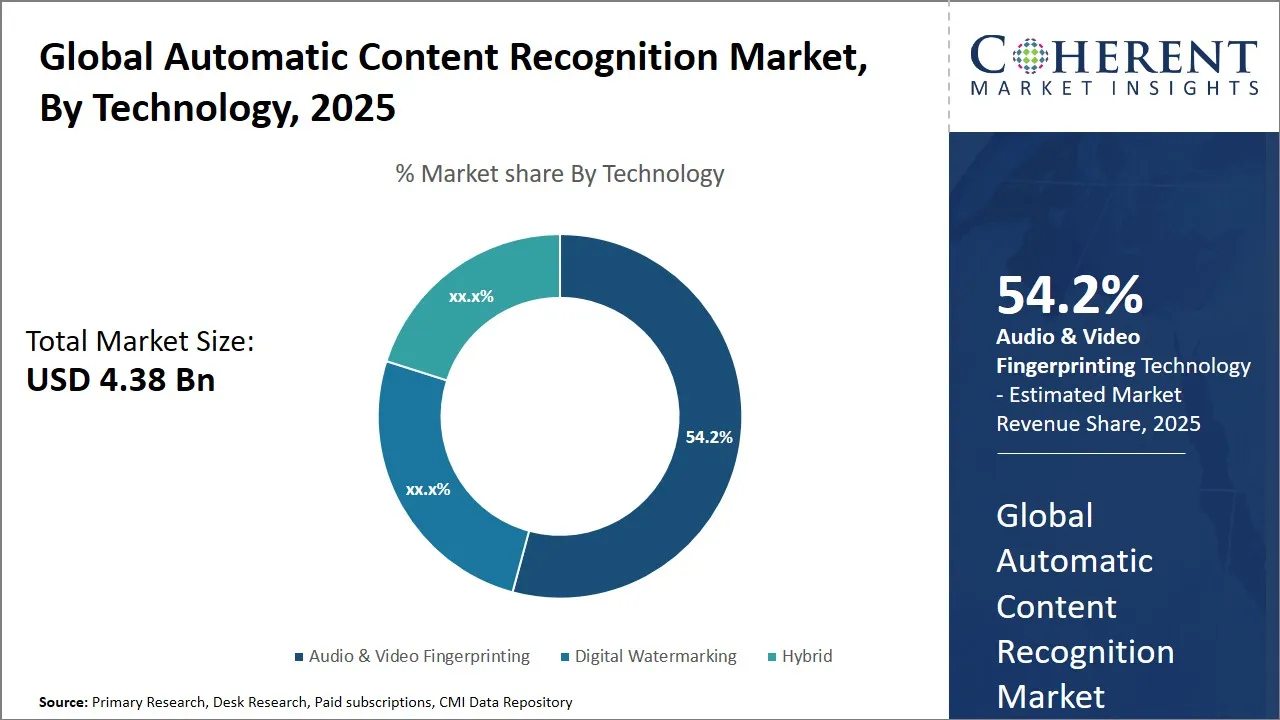
- The audio and video fingerprinting leads the market holding an estimated share of 55.2 % in 2026.
- The audience measurement & targeted advertising segment leads the market holding an estimated share of 42.5% in 2026.
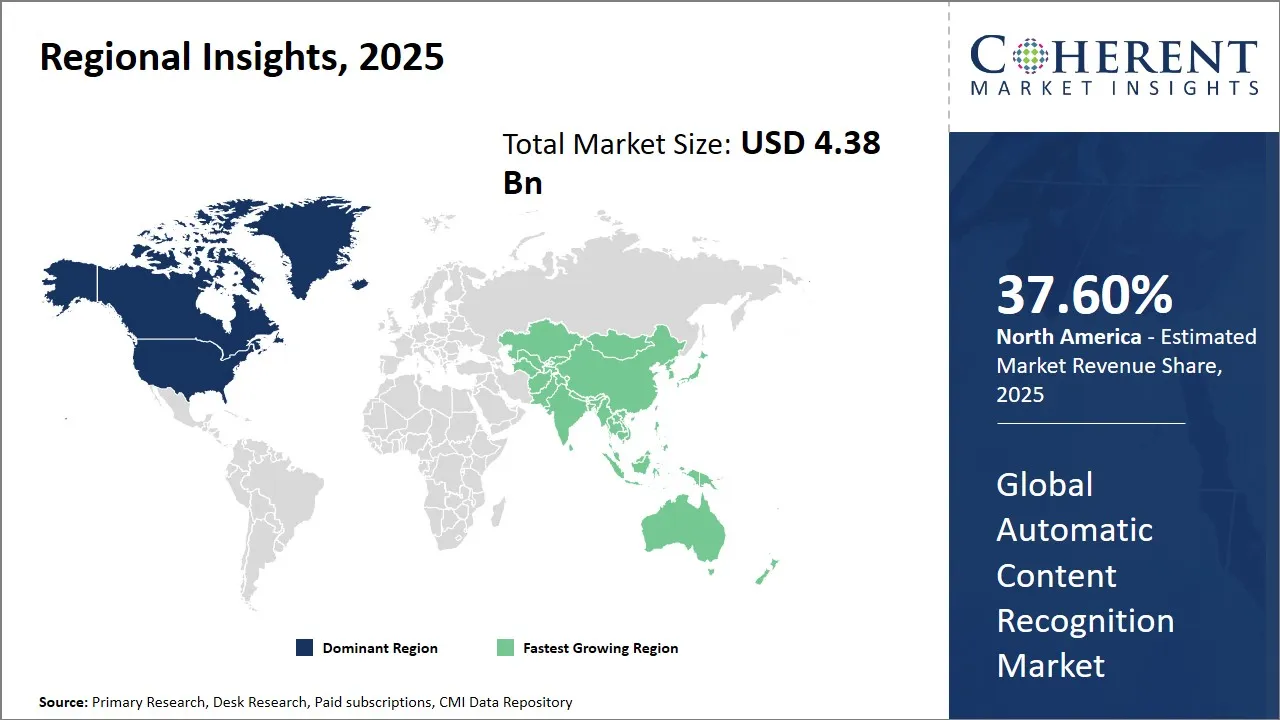
- North America is estimated to lead the market with a share of 37. 6% in 2026.
- Asia Pacific, holding a share of 30. 4% in 2026, is projected to be the fastest growing region.
Market Overview
The market is seeing a lot of growth because of the rising demand for personalized content delivery and improved viewer engagement. The use of automatic content recognition in smart TVs, connected devices, and digital advertising platforms is changing media consumption habits. Also, increasing investments in cloud-based ACR solutions and growing partnerships between content providers and technology vendors are adding to market growth, focusing on improved user experience and targeted advertising strategies.
Current Events and its Impact
Current Events | Description and its impact |
Market Expansions & Launches |
|
Advertising & Measurement Innovations |
|
Regional Growth Dynamics |
|
Segmental Insights
- Current Industry Events of 2026
- Market Size Estimation
- Regional Breakdown
- Competitive Landscape
- Customer Intelligence
- Segmental Analysis
- Pricing Analysis
- Key Market Drivers, Challenges & Future Trends
- Customized Insights Section
Global Automatic Content Recognition Market Insights, by Technology – Audio & Video Fingerprinting Leads Owing to its Unparalleled Accuracy and Versatility
Audio & video fingerprinting technology, holding a projected share of 55.2% in 2026, remains the dominant segment within the global automatic content recognition market. This technology extracts unique “fingerprints” from audio and video signals, which serve as compact digital summaries that can be quickly matched against extensive content databases.
As media viewing shifts from traditional TV screens to mobile devices, streaming services, and smart TVs, the need for seamless recognition of content across all these channels grows. Audio & Video Fingerprinting excels in cross-platform compatibility, allowing it to effectively track and analyze content irrespective of format or delivery mechanism.
To add, this technology is used for many applications such as content verification, copyright protection, and real-time audience measurement. In March 2025, Nielsen’s Gracenote improved its audio and video fingerprinting capabilities to power cross-platform content recognition for streaming services and smart TV platforms. Also, advertisers can use fingerprinting to deliver highly targeted and contextually relevant ads, improving viewer engagement and campaign effectiveness. Content creators and rights holders benefit from the ability to assert ownership, detect piracy, and enforce compliance, thereby protecting valuable intellectual property.
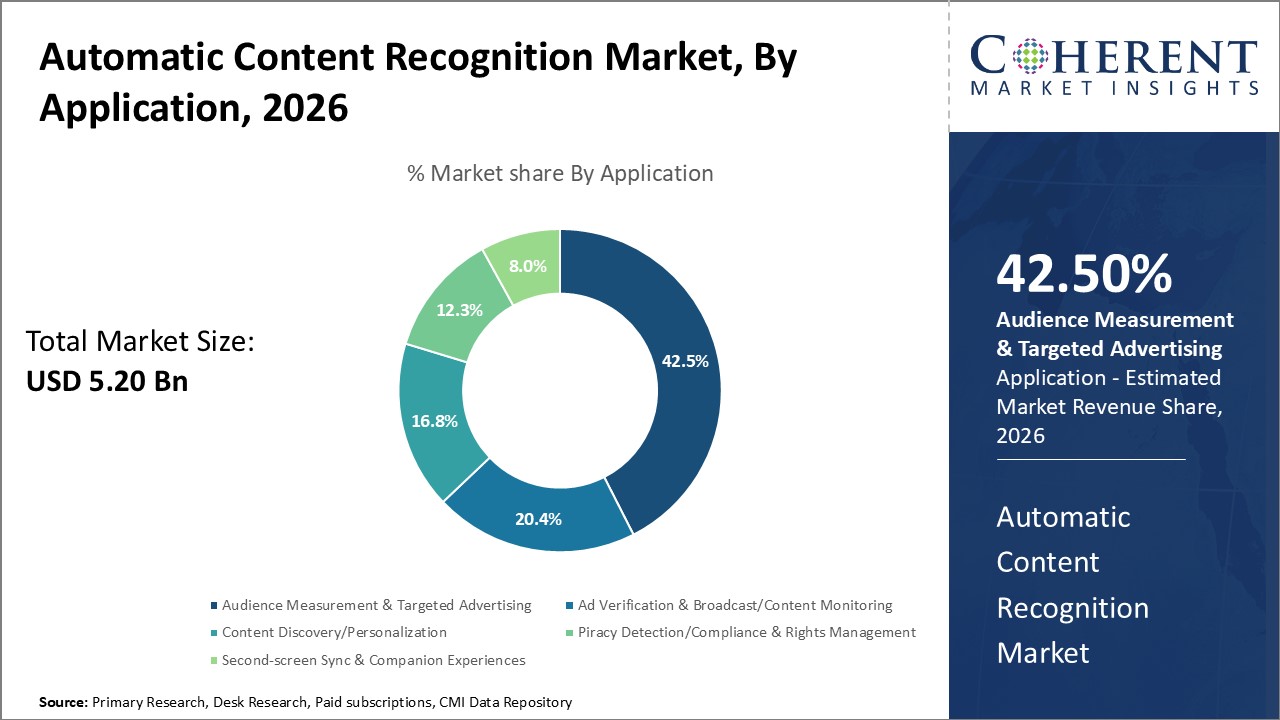
Global Automatic Content Recognition Market Insights, by Application – Audience Measurement & Targeted Advertising Leads Due to its Critical Role in Driving Advertising Efficiency and Personalized Content Delivery
Audience measurement & targeted advertising segment is expected to hold the largest share of 42.5% in 2026 within the global automatic content recognition market. As the media landscape becomes increasingly fragmented with a proliferation of channels and digital platforms, advertisers and broadcasters need tools to accurately measure audience behavior and tailor advertising content in real-time.
ACR technology can collect comprehensive viewing data that includes not only what is being watched, but also when, where, and how viewers interact with content. The rise in programmatic advertising adds to the importance of audience measurement & targeted advertising. ACR-driven insights allow ad platforms to dynamically adjust ad placements and creatives based on real-time viewer preferences and behaviors. Also, broadcasters use these insights to design and personalize content recommendations, creating companion experiences that deepen audience loyalty and extend viewer sessions.
To add, the use of ACR with second-screen experiences has redefined how advertisers engage with audiences. Synchronizing ad content between primary viewing devices and companion apps or smart devices adds to the ad impact and creates interactive marketing opportunities, driving higher engagement rates.
Impact of AI on the Automatic Content Recognition Market
Artificial Intelligence is transforming the automatic content recognition market by dramatically improving the speed, accuracy, and granularity of content identification. Traditional ACR relied primarily on pre-built fingerprint and watermark databases, which could be slow to update and limited in context awareness. With AI—particularly machine learning and deep learning models—ACR systems can now process vast amounts of audio-visual data in near real time, identify patterns that humans or static algorithms might miss, and even recognize derivative or altered content.
LG Ads Solutions’ partnership with Akkio in June 2025 integrated AI-powered analytics into LG’s ACR platform. By applying AI models to smart TV viewership data, the system could deliver near real-time audience intelligence and campaign performance feedback.
Regional Insights
North America Automatic Content Recognition Market Analysis and Trends
North America, holding an estimated share of 37.6% in 2026, dominates the global automatic content recognition market is driven by a well-established technological ecosystem, significant investments in media and entertainment, and advanced digital infrastructure. The presence of major industry players such as Gracenote (a subsidiary of Nielsen), Vobile Group, and Civolution reinforces the region’s leadership.
North America’s market benefits from the widespread adoption of smart TVs, OTT platforms, and integration of ACR in advertising and content monetization strategies. Government policies that encourage innovation and protect intellectual property further foster market stability and growth. Trade dynamics and collaborations between tech giants and media companies grant North America a competitive edge, allowing it to shape global standards for ACR technology.
Asia Pacific Automatic Content Recognition Market Analysis and Trends
Asia Pacific, holding a projected share of 30.4% in 2026, exhibits the fastest growth in the automatic content recognition market, fueled by rising smartphone penetration, expanding internet connectivity, and increasing demand for localized digital content across countries such as China, India, Japan, and South Korea. The rapid digitization of media consumption, coupled with government initiatives promoting smart technologies and digital economies, propels market expansion.
The emergence of regional players like Baidu (China), Tata Elxsi (India), and global multinationals establishing localized operations boosts innovation and adoption rates. Trade liberalization and strategic partnerships between technology providers and broadcasters amplify the region’s capacity to leverage ACR for advertising, content recognition, and user engagement.
Automatic Content Recognition (ACR) Market Outlook for Key Countries
U.S. Automatic Content Recognition Market Analysis and Trends
The U.S. is a cornerstone of innovation and early adoption in ACR technology, supported by a mature ecosystem of streaming services such as Netflix, Hulu, and Amazon Prime Video. Major companies, including Gracenote and Vobile Group, lead in developing sophisticated ACR solutions that power targeted advertising, content analytics, and enhanced viewer experiences. Robust intellectual property frameworks and heavy R&D investments contribute to sustained leadership. The U.S. also benefits from extensive collaboration between tech firms and media content providers, driving continuous advancements in ACR applications.
China Automatic Content Recognition Market Analysis and Trends
China automatic content recognition market is rapidly maturing, propelled by a massive digital native population and the dominance of local content platforms like iQIYI, Tencent Video, and Youku. The government’s strategic focus on digital infrastructure and smart city initiatives adds to the market adoption of ACR technologies. Domestic technology companies such as Baidu and Megvii are investing a lot in AI-driven content recognition, tailoring solutions to complex multilingual and multi-format content consumption patterns.
India Automatic Content Recognition Market Analysis and Trends
India automatic content recognition market is expanding swiftly due to the proliferation of affordable smartphones, increasing internet reach, and a vibrant OTT ecosystem led by platforms like Hotstar, ZEE5, and SonyLIV. Local IT and media companies, including Tata Elxsi and Affle, add to the development of context-aware ACR systems that address different language and regional content needs.
Germany Automatic Content Recognition Market Analysis and Trends
Germany remains a key player in Europe by virtue of its strong media production industry and stringent regulatory environment supporting data privacy and media transparency. Leading firms such as Fraunhofer IIS and Speechmatics innovate in audio and video content recognition, with a focus on compliance and quality assurance for broadcasters and advertisers. The country benefits from tight integration with European Union trade policies and standards, facilitating cross-border technology collaborations and market synergies that enhance the effectiveness of ACR deployments throughout the continent.
Market Players, Key Development, and Competitive Intelligence
Key Developments
- In July 2025, Samba TV, a leader in AI-driven media intelligence, announced a strategic partnership with Kochava, the leading omnichannel measurement and attribution company. This new collaboration aims to solve one of the industry's most persistent challenges: having always-on, consistently measured performance across both TV and digital platforms at scale.
- In June 2025, Nielsen and VIZIO’s Inscape are extending their strategic data relationship, building on their collaboration that began in 2022. This multi-year agreement reinforces their shared commitment to delivering comprehensive insights into what audiences are watching across broadcast, cable, and streaming.
- In June 2025, Samba TV announced its 40-market expansion with Acxiom, the connected data and technology foundation for the world’s leading brands and agencies. Building on years of collaboration, the companies will scale to over 40 markets to meet the growing need for data-led activation across international and emerging regions.
- In June 2025, LG Ad Solutions, a global leader in advanced advertising for Connected TV and cross-screen devices, announced a strategic partnership with Akkio, the AI-first platform built for media companies, to modernize how its customers interact with LG Ad Solutions industry-leading automatic content recognition (ACR) data—enabling faster, deeper insights into real consumer behavior at scale.
Top Strategies Followed by Automatic Content Recognition Market Players
- Established market leaders dominate the sector through substantial investments in research and development (R&D), driving innovation to create high-performance, robust ACR solutions that meet the increasing demands for accuracy, speed, and multi-platform compatibility.
- Nielsen has been channeling significant resources into enhancing its Gracenote ACR technology with AI-driven metadata enrichment, enabling faster and more precise content identification across multiple platforms.
- Mid-level players in the automatic content recognition market adopt a different but equally vital approach by focusing on cost-effective solutions that strike an optimal balance between quality and affordability.
- ACRCloud offers scalable, API-based ACR services that allow regional broadcasters and app developers—particularly in emerging markets—to integrate recognition capabilities without the high licensing costs of larger competitors.
- Small-scale players, on the other hand, carve out niche spaces within the highly competitive global automatic content recognition market by prioritizing specialized product features or innovation-driven offerings that address unique user needs.
- Intrasonics specializes in ultrasonic watermarking for second-screen interactivity, a niche segment that allows interactive content experiences without competing directly with large-scale measurement providers.
Market Report Scope
Automatic Content Recognition Market Report Coverage
| Report Coverage | Details | ||
|---|---|---|---|
| Base Year: | 2025 | Market Size in 2026: | USD 5.20 Bn |
| Historical Data for: | 2020 To 2024 | Forecast Period: | 2026 To 2033 |
| Forecast Period 2026 to 2033 CAGR: | 18.7% | 2033 Value Projection: | USD 17.26 Bn |
| Geographies covered: |
| ||
| Segments covered: |
| ||
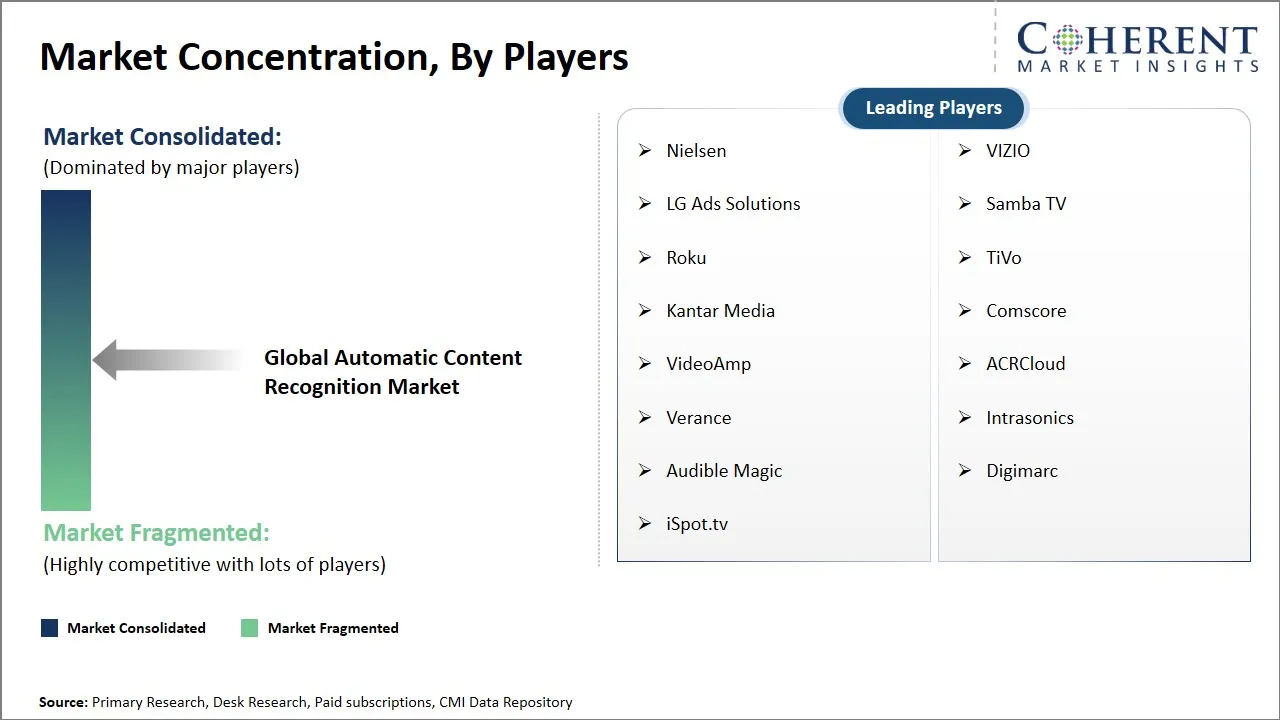
| Companies covered: | The Nielsen Company, VIZIO, Inc., LG Ads Solutions, Samba TV, Roku, TiVo, Kantar Media, Comscore, VideoAmp, ACRCloud, Verance, Intrasonics, Audible Magic, Digimarc, and iSpot.tv | ||
| Growth Drivers: |
| ||
| Restraints & Challenges: |
| ||
Market Dynamics
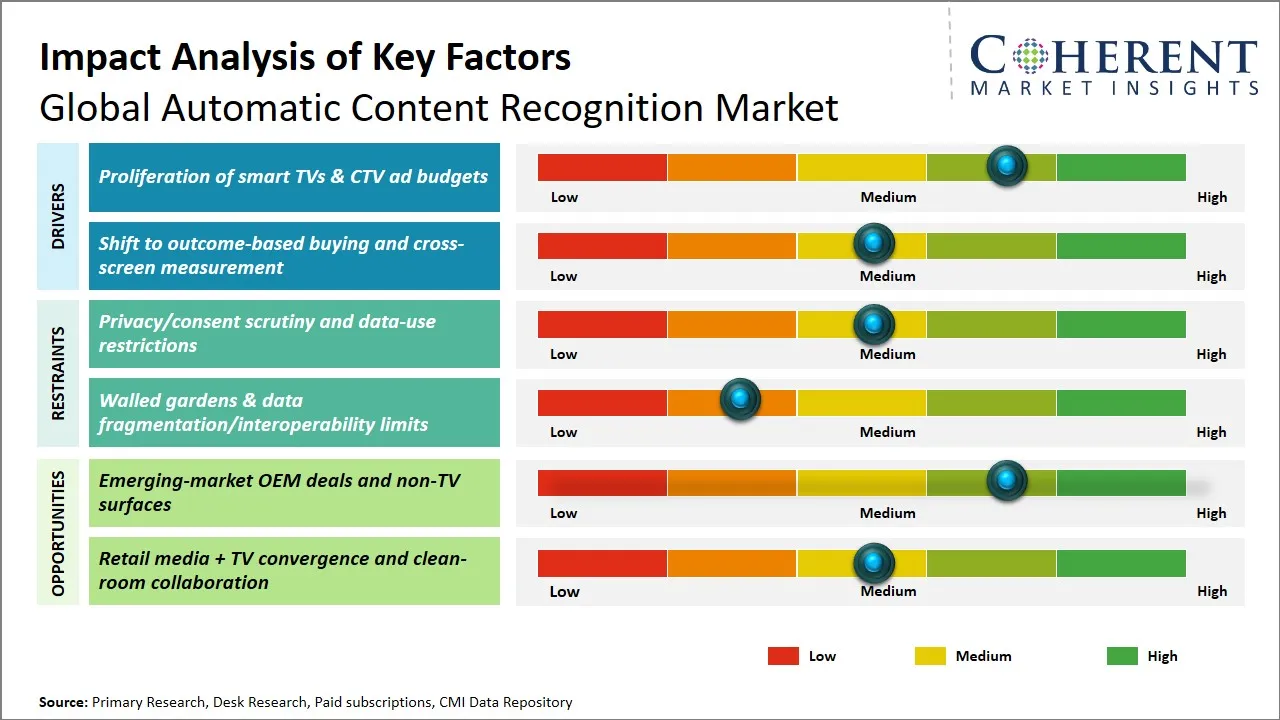
Global Automatic Content Recognition Market Driver – Proliferation of Smart TVs & CTV Ad Budgets
Smart TVs equipped with ACR can accurately detect the content being viewed, allowing advertisers to deliver highly targeted and interactive ads. This capability aligns with the rapid expansion of Connected TV (CTV) advertising budgets, as brands increasingly recognize the value of reaching audiences through digital streaming platforms rather than traditional linear TV. The shift toward CTV is driven by changing consumer behavior, with viewers preferring on-demand content and advertisers seeking to optimize ad spend through precise targeting and engagement metrics.
In March 2025, VIZIO reported record growth in its connected TV platform, driven by increased smart TV penetration in North America. The company’s ACR-powered ad platform, VIZIO Ads, expanded inventory and attracted more CTV ad spend from major brands, demonstrating how hardware proliferation directly fuels ACR data monetization.
Global Automatic Content Recognition Market Opportunity – Emerging-Market OEM Partnerships and Non-TV Device Integration
As emerging economies in regions such as Asia Pacific, Latin America, and Africa witness rapid digital adoption coupled with increasing consumer demand for smart devices, OEMs are actively seeking to integrate ACR capabilities to enhance user engagement and deliver personalized content experiences. Collaborations between ACR solution providers and local OEMs in these markets enable tailored offerings that address region-specific content preferences and device requirements, thereby accelerating market penetration.
Additionally, beyond traditional television screens, the integration of ACR technology into a diverse range of non-TV surfaces—including smartphones, tablets, in-car entertainment systems, smart speakers, and digital signage—presents a significant growth avenue. For instance, Samba TV has piloted ACR applications in in-car entertainment systems, opening non-TV avenues for data-driven personalization and ad targeting. The proliferation of connected devices in smart homes and public spaces provides ACR vendors with opportunities to harness contextual content recognition for targeted advertising, audience measurement, and interactive media applications.
Analyst Opinion (Expert Opinion)
- ACR integration with e-commerce platforms is enabling “click-to-buy” functionality during live and on-demand content, turning passive viewership into real-time retail engagement—particularly promising for fashion, sports, and home shopping segments.
- Extending ACR to connected car infotainment systems allows media companies to track content engagement on the move, opening up new ad inventory opportunities in mobility-based environments.
- Advances in AI-enhanced ACR now allow advertisers to target ads based on real-time scene or object recognition within content, making campaigns more contextually relevant and improving viewer receptivity.
Speak to the analyst
Want personalized insights?
Take the findings above to one of our principal consultants, or have the report rebuilt around the segments, geographies and competitors you actually track.
Market Segmentation
- Technology Insights (Revenue, USD Bn, 2021 - 2033)
- Audio & Video Fingerprinting
- Digital Watermarking
- Hybrid
- Application Insights (Revenue, USD Bn, 2021 - 2033)
- Audience Measurement & Targeted Advertising
- Ad Verification & Broadcast/Content Monitoring
- Content Discovery/Personalization
- Piracy Detection/Compliance & Rights Management
- Second-screen Sync & Companion Experiences
- Regional Insights (Revenue, USD Bn, 2021 - 2033)
- North America
- U.S.
- Canada
- Latin America
- Brazil
- Argentina
- Mexico
- Rest of Latin America
- Europe
- Germany
- U.K.
- Spain
- France
- Italy
- Russia
- Rest of Europe
- Asia Pacific
- China
- India
- Japan
- Australia
- South Korea
- ASEAN
- Rest of Asia Pacific
- Middle East
- GCC Countries
- Israel
- Rest of Middle East
- Africa
- South Africa
- North Africa
- Central Africa
- North America
- Key Players Insights
- The Nielsen Company
- VIZIO, Inc.
- LG Ads Solutions
- Samba TV
- Roku
- TiVo
- Kantar Media
- Comscore
- VideoAmp
- ACRCloud
- Verance
- Intrasonics
- Audible Magic
- Digimarc
- iSpot.tv
Sources
Primary Research Interviews
Stakeholders:
- Smart TV Manufacturers & OEMs
- Connected TV Platform Providers
- Advertising Technology & Measurement Firms
- OTT & Streaming Service Operators
- Second-Screen & Companion App Developers
- Data Privacy & Compliance Experts specializing in digital media analytics
Databases
- Global Digital Media Statistics Portal
- U.S. Federal Communications Commission (FCC) Data Hub
- Asia-Pacific Broadcasting Union (ABU) Database
- OECD Digital Economy Statistics
Magazines
- Streaming Media Magazine
- Broadcast & Cable
- Advanced Television (Advanced-Television.com)
- AdTech Innovators Digest
Journals
- Journal of Broadcasting & Electronic Media
- Digital Policy, Regulation and Governance Journal
- IEEE Transactions on Multimedia
- International Journal on Digital TV
Newspapers
- Variety
- The Hollywood Reporter
- The Economic Times (India) – Media & Entertainment Section
- The Guardian (UK) – Media Section
Associations
- Interactive Advertising Bureau (IAB)
- Digital Video Broadcasting (DVB) Project
- Advanced Television Systems Committee (ATSC)
- Asia-Pacific Broadcasting Union (ABU)
- Media Rating Council (MRC)
Public Domain Sources
- U.S. Census Bureau – Technology & Media Usage Data
- EUROSTAT – Digital Economy & Society Statistics
- United Nations Educational, Scientific and Cultural Organization (UNESCO) – Communication & Information Sector Data
- World Bank – ICT & Digital Infrastructure Indicators
- ResearchGate – Open Access Multimedia Research
Proprietary Elements
- CMI Data Analytics Tool, Proprietary CMI Existing Repository of information for last 8 years
Get access to 250+ pages report
Every segment, forecast, competitor profile and data table behind the analysis above — available for instant download.
- ESOMAR Member
- ISO 9001:2015 Certified
- D-U-N-S Registered
- GDPR & CCPA Compliant
Missing comfort of reading report in your local language? Find your preferred language:
Transform your Strategy with Exclusive Trending Reports
Frequently Asked Questions
The global automatic content recognition market is estimated to be valued at USD 4.38 billion in 2025 and is expected to reach USD 14.37 billion by 2032.
The CAGR of global automatic content recognition market is projected to be 18.5% from 2025 to 2032.
Proliferation of smart TVs & CTV ad budgets and Shift to outcome-based buying and cross-screen measurement are the major factors driving the growth of global automatic content recognition market.
Privacy/consent scrutiny and data-use restrictions and walled gardens & data fragmentation/interoperability limits are the major factors hampering the growth of global automatic content recognition market.
In terms of Technology, Audio & Video Fingerprinting segment is estimated to dominate the market revenue share in 2025.
Automatic Content Recognition (ACR) identifies audio or video content by comparing captured fingerprints or watermarks from a device (like a smart TV or app) against a reference database, enabling real-time content detection and data collection.
When a VIZIO smart TV uses Inscape ACR to detect what program a person is watching—whether live, recorded, or streamed—it can send anonymized viewing data to personalize recommendations or deliver targeted ads.