

Global Bags Market Size & Forecast – 2026 To 2033
The Global Bags Market is estimated to be valued at USD 174.82 Bn in 2026 and is expected to reach USD 275.26 Bn by 2033, exhibiting a compound annual growth rate (CAGR) of 6.70% from 2026 to 2033. Market growth is supported by frequent purchases of handbags, backpacks, travel bags, business bags, and sports bags across work, education, tourism, fitness, and everyday lifestyle applications. Higher disposable incomes are enabling consumers to move toward branded and premium products, while e-commerce platforms are improving product availability, price comparison, and access to international labels.
Manufacturers are also differentiating portfolios through lightweight construction, modular storage, recycled materials, tracking compatibility, and replaceable components. In May 2025, Bellroy introduced its Transit Carry-On, incorporating an airline-compatible design, recycled polycarbonate shell, removable packing cells, an AirTag pocket, and replaceable wheels, handles, and locks, reflecting the growing demand for durable and feature-rich travel bags.
Key Takeaways of the Global Bags Market
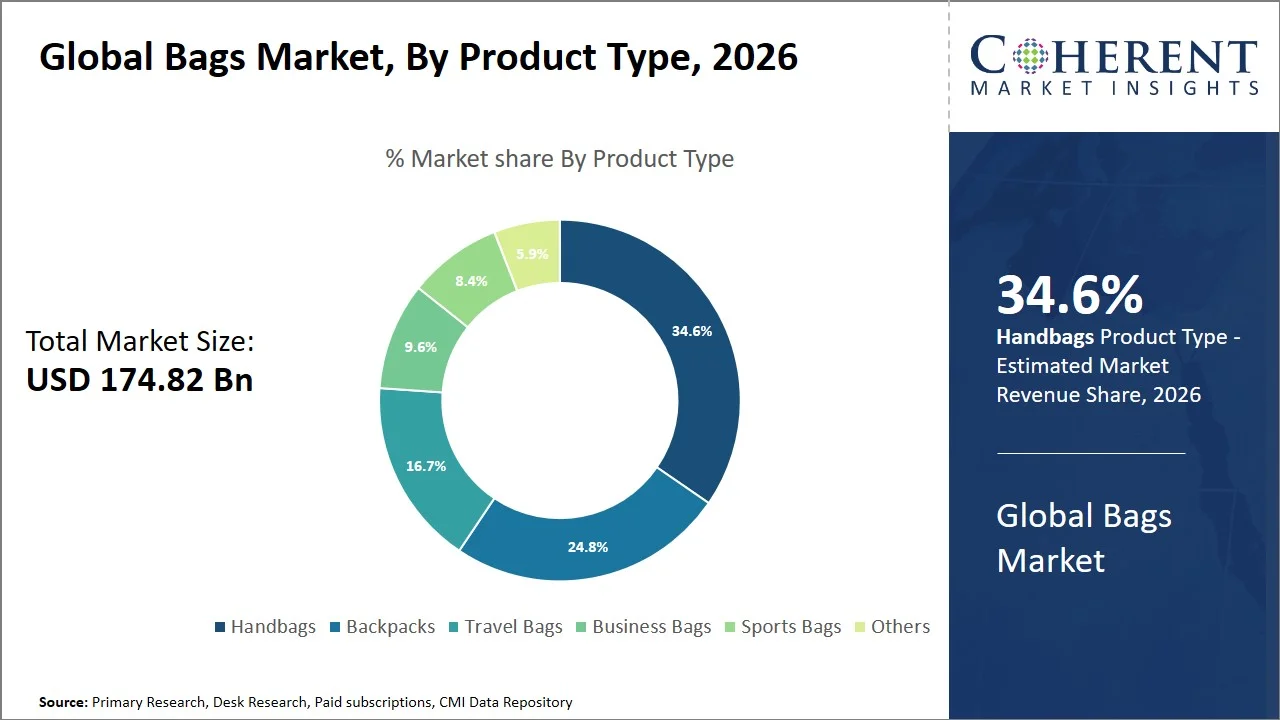
- Handbags are expected to hold 34.6 % of the global bags market in 2026 because they combine daily utility with fashion-led replacement purchases, support frequent seasonal refreshes, and allow brands to span accessible, premium, and luxury price points. In June 2025, Tapestry highlighted strong consumer traction for Coach’s Brooklyn, Tabby, and Rogue handbag families, reinforced by customization through bag charms.
- Leather is expected to account for 31.8 % of the global bags market in 2026, supported by durability, premium tactile appeal, repair potential, and suitability across handbags, business bags, and travel accessories. In September 2024, Mulberry disclosed its partnership with British Pasture Leather to develop relationships with regenerative farmers and establish an end-to-end U.K. leather supply chain.
- The mass segment are expected to represent 47.8 % of the global bags market in 2026 because broad affordability converts school, work, commuting, and leisure needs into high-volume purchases across stores and e-commerce. In April 2024, Fast Retailing reported that UNIQLO’s Round Mini Shoulder Bag became a major European hit, attracting younger and female shoppers who subsequently became repeat customers.
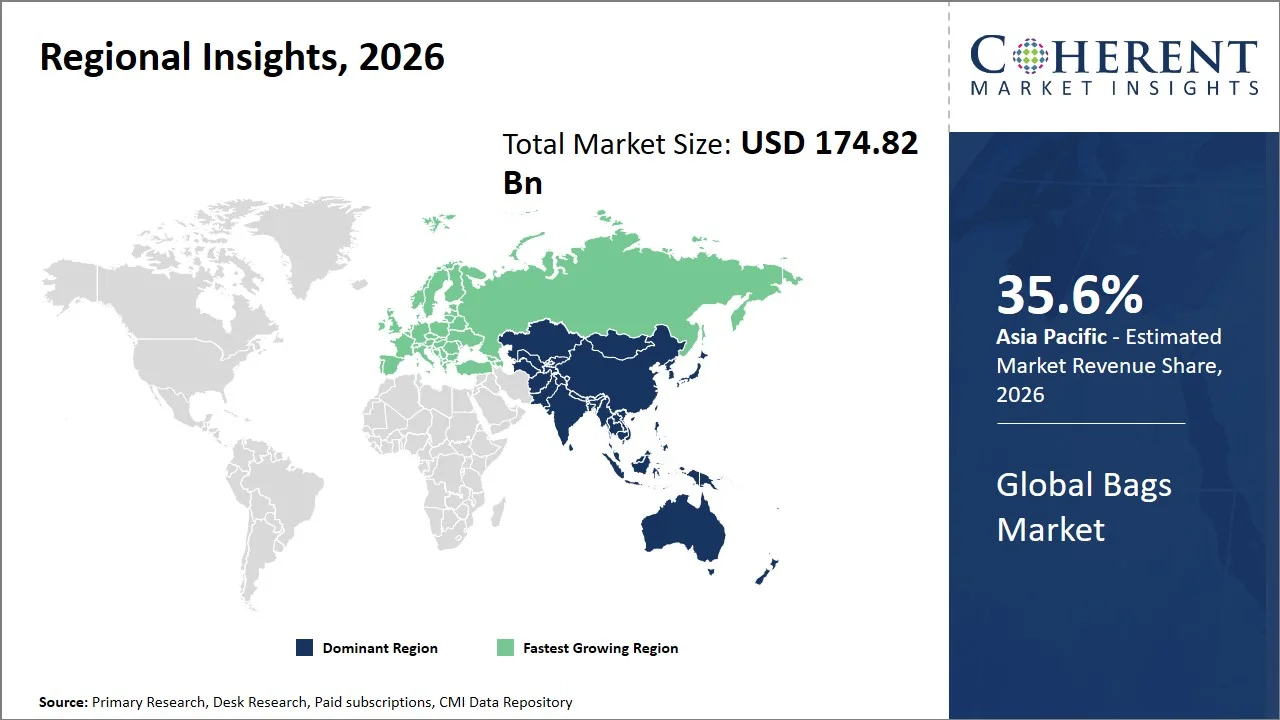
- Asia Pacific is expected to account for 35.6 % of the global bags market in 2026, reflecting dense urban consumer bases, established manufacturing clusters, broad price-point coverage, and extensive marketplace-led retail. In May 2025, Safari Industries reported FY2024–25 revenue from operations of USD 18.39 Bn, up from USD 16.09 Bn, alongside manufacturing locations in Gujarat and Rajasthan in India.
- Europe is expected to hold 27.4 % of the global bags market in 2026, with expansion supported by premium brand density, travel activity, omnichannel investment, and stronger emphasis on durable, design-led products. In November 2025, Samsonite reported European net sales growth of 0.9% in the third quarter, led by gains in France, the U.K., and Germany.
- Circularity Becomes Product Architecture: Bag manufacturers are moving sustainability from marketing claims into design decisions through replaceable components, repair services, recycled inputs, traceable sourcing, and resale-ready construction. This changes material selection, supplier qualification, warranty economics, and after-sales capabilities. Brands that engineer longer product lifecycles can defend pricing and customer loyalty, while competitors relying on disposable designs may face weaker retailer acceptance and higher compliance exposure.
- Utility-Led Personalization Reshapes Portfolios: Buyers increasingly expect bags to adapt across commuting, hybrid work, fitness, short travel, and social use rather than serve one occasion. Modular compartments, device protection, adjustable carrying formats, lightweight construction, and personalization therefore become portfolio priorities. This favors brands using rapid consumer feedback and flexible sourcing, while retailers can improve conversion through use-case merchandising instead of organizing assortments solely by traditional product categories.
Segmental Insights
Why Do Handbags Dominate the Global Bags Market?
Handbags are expected to account for 34.6% of the global bags market in 2026 because they serve both functional and fashion-led purchasing occasions. Buyers use structured totes, shoulder bags, crossbody formats, clutches, and compact carryalls for work, commuting, social events, and gifting, which supports frequent style and color refreshes. Manufacturers can reuse core hardware, closures, handles, and pattern blocks across multiple collections, improving development speed while preserving visible brand codes. Department stores, specialty boutiques, and online channels also merchandise handbags as high-rotation accessories, enabling cross-selling with wallets, charms, and small leather goods. This leadership gives suppliers scope to balance permanent icons with limited seasonal editions and protect margins through design differentiation. In July 2025, Kering reported that Gucci’s Giglio bag had already become one of the house’s most successful launches after its Cruise 2026 unveiling.
- Current Industry Events of 2026
- Market Size Estimation
- Regional Breakdown
- Competitive Landscape
- Customer Intelligence
- Segmental Analysis
- Pricing Analysis
- Key Market Drivers, Challenges & Future Trends
- Customized Insights Section
Why Does Leather Represent the Largest Material Segment in the Global Bags Market?
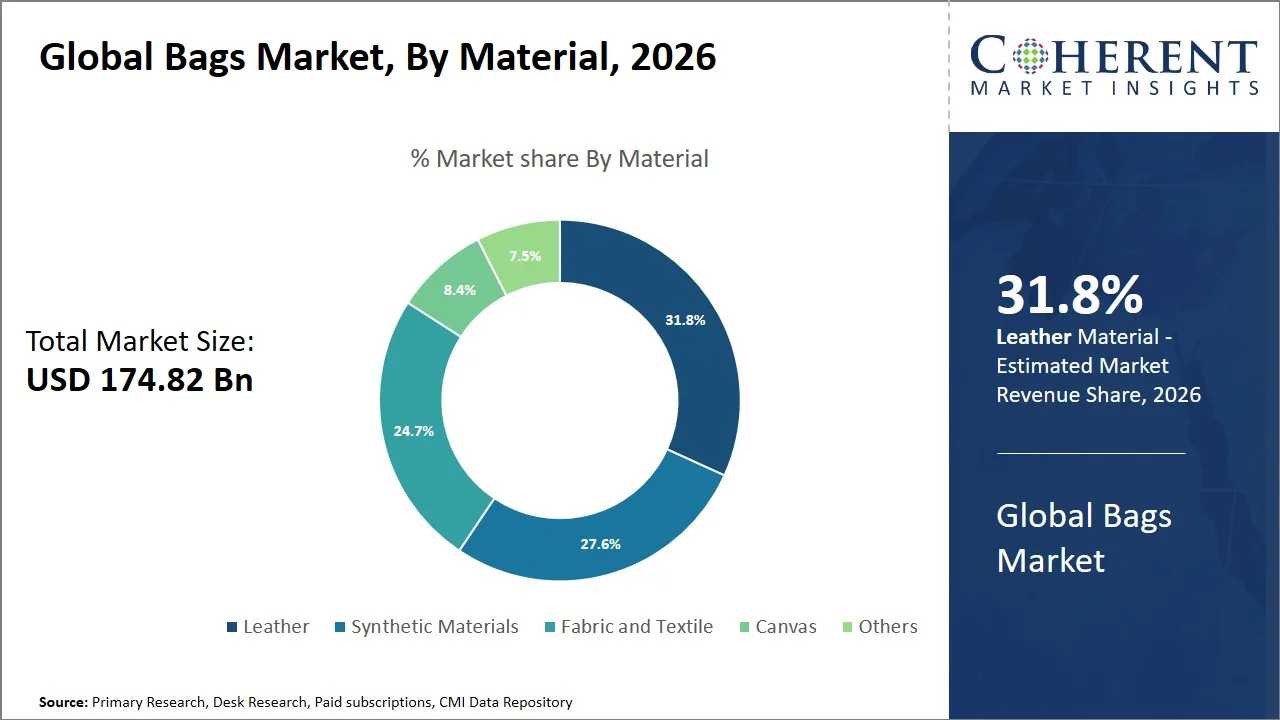
Leather is expected to represent 31.8% of the global bags market in 2026 because it provides structure, abrasion resistance, repairability, and a distinctive ageing profile that synthetic substitutes do not fully replicate. These attributes are especially relevant for premium handbags, executive briefcases, business bags, and travel pieces expected to retain shape under repeated use. On the supply side, hide grading, tanning, precision cutting, edge finishing, stitching, and hardware assembly create technical barriers that support specialist manufacturers and trained artisan networks. Leather also enables brands to offer refurbishment, component replacement, and long-term after-sales services, strengthening lifecycle value and customer retention. For investors and suppliers, the segment supports higher unit realization but requires disciplined sourcing, quality control, and traceability. In April 2026, Hermès inaugurated its twenty-fifth French leather-goods workshop in Loupes, planned for 260 artisan saddler-leatherworker positions and production of established bag lines.
Why Does the Mass Segment Dominate the Global Bags Market?
The mass segment is expected to hold 47.8% of the global bags market in 2026 because bags are recurring household purchases rather than uniformly discretionary luxury items. Students, commuters, families, and recreational users prioritize usable capacity, acceptable durability, and accessible replacement cost when buying backpacks, totes, gym bags, lunch bags, and basic travel products. Suppliers serve this demand through standardized fabrics, synthetic materials, simplified construction, large production runs, and private-label programs that lower unit costs. Supermarkets, value retailers, department stores, and online marketplaces extend reach into price-sensitive and underpenetrated locations, while promotions accelerate inventory turnover. Commercial success therefore depends on procurement scale, replenishment accuracy, and disciplined opening-price architecture rather than exclusivity. In June 2025, Target Brands, Inc. maintained the previous year’s price on its top-selling USD 5 backpack as part of its back-to-school value program.
Global Bags Market Dynamics
Key Market Drivers
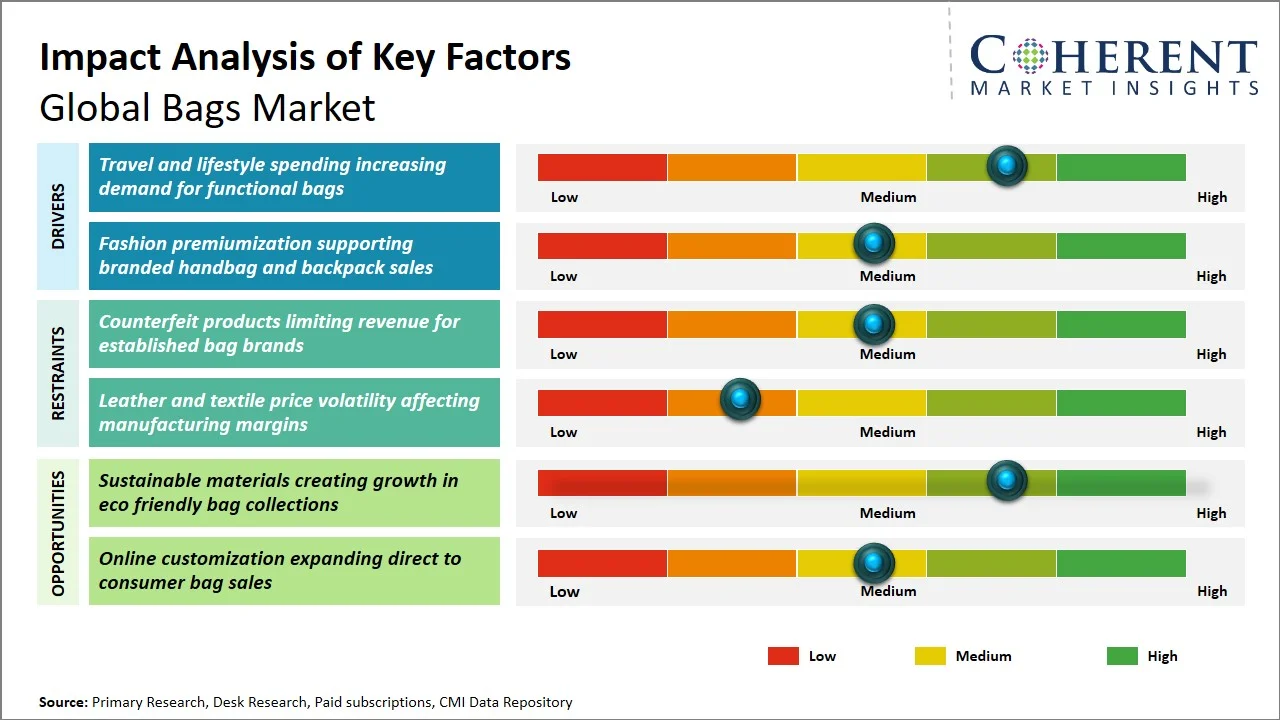
- Travel and Lifestyle Spending Expands Functional Carrying Needs: Travel and lifestyle spending is increasing the demand for luggage, weekender bags, duffels, cabin backpacks, and compact crossbody formats because each additional trip creates a packing, mobility, and organization requirement. Frequent leisure breaks and blended business-leisure travel also encourage consumers to maintain separate bags for short-haul, checked, and personal-item use rather than relying on one universal product. Manufacturers of travel bags, wheel systems, technical fabrics, locks, and packing accessories benefit, while airport retailers, specialty stores, and online travel platforms gain cross-selling opportunities. Commercially, the driver rewards lightweight construction, airline-compatible dimensions, expandable interiors, and coordinated bag families that raise basket value. In January 2026, the International Air Transport Association reported that global passenger demand increased during 2025, with international traffic expanding faster than domestic travel, reinforcing addressable use occasions for travel-oriented bags.
- Fashion Premiumization Strengthens Branded Bag Economics: Fashion premiumization supports branded handbag and backpack sales by shifting buyer evaluation from basic carrying capacity toward design authorship, recognizable silhouettes, material finish, scarcity, and cultural relevance. Premium brands can therefore generate value through signature hardware, seasonal color updates, controlled distribution, and communication that links a bag to a broader lifestyle identity. Leather suppliers, specialist component makers, craftspeople, department stores, and luxury e-commerce operators benefit from higher specifications and stronger merchandising investment. The commercial significance extends beyond unit pricing: successful hero products can support small leather goods, charms, straps, and repeat purchases without requiring an entirely new customer-acquisition model. In March 2025, Prada Group stated that its leather-goods offer had been enriched and that new products received a strong response alongside continued emphasis on established icons, illustrating how product renewal and brand heritage reinforce premium accessory demand.
Emerging Market Trends
- Assortment Compression and Icon-Led Merchandising: Assortment compression is emerging as a disciplined alternative to broad seasonal proliferation in the global bags market. Brands are concentrating design, marketing, and inventory behind fewer recognizable shapes, then refreshing those platforms through color, size, trim, and accessory variations. This approach improves demand forecasting, reduces markdown exposure, simplifies component procurement, and gives retailers clearer stories to present across physical and digital shelves. It also increases the importance of selecting the right core silhouette because an underperforming platform can affect several planned drops. Large brands with consumer data, repeatable design codes, and controlled distribution are positioned to benefit, while suppliers that depend on frequent low-volume style changes may face order volatility. Over the forecast period, portfolio productivity is likely to matter more than raw SKU count, encouraging manufacturers to build modular product systems and faster replenishment around proven forms.
- Material Claims Shift Toward Verifiable Performance: Material claims are moving from broad sustainability language toward verifiable performance and composition evidence. Buyers, retailers, and sourcing teams increasingly expect suppliers to demonstrate abrasion resistance, colorfastness, coating chemistry, recycled content, repair compatibility, and end-of-life limitations rather than relying on an unqualified material label. This changes product development because alternative fabrics and finishes must meet functional expectations for travel, sports, business, and fashion use without creating premature failure or warranty costs. Testing laboratories, traceability providers, certified material suppliers, and vertically integrated manufacturers are likely to gain influence, while brands with fragmented documentation may face slower onboarding and higher compliance risk. During the forecast period, substantiated material performance should become a stronger basis for premium pricing, retailer acceptance, and institutional procurement, narrowing the advantage of competitors that compete mainly through visual imitation or unsupported environmental positioning.
Current Events and their Impact
Current Events | Description and its Impact |
EU General Product Safety Regulation Becomes Applicable – December 2024 |
|
California PFAS Restrictions for Handbags and Backpacks – January 2025 |
|
Regional Insights
Why Does Asia Pacific Dominate the Global Bags Market?
Asia Pacific is expected to account for 35.6% of the global bags market in 2026 because the region combines high-volume consumption with a deep manufacturing and sourcing ecosystem. China and India anchor demand across handbags, backpacks, travel bags, business bags, and sports bags, while regional textile, synthetic-material, and leather supply chains enable rapid product refreshes at multiple price points. Mobile-first retail and marketplace distribution also improve access beyond major urban centers, allowing domestic and international brands to scale assortments efficiently. Premium labels increasingly localize launches and cultural storytelling for Asian consumers. In April 2024, Louis Vuitton (LVMH) presented its Women’s Prefall collection in Shanghai, China, featuring established bags such as the Capucine and Dauphine alongside the debut of the Slim Trunk, demonstrating the region’s importance for luxury bag merchandising and brand engagement.
Why is Europe Emerging as the Fastest-Growing Region in the Global Bags Market?
Europe is expected to hold 27.4% of the global bags market in 2026 and emerge as the fastest-growing region as premium craftsmanship, tourism-linked purchasing, outdoor lifestyles, and circular product expectations reshape category demand. European buyers increasingly evaluate durability, repairability, material origin, and resale potential alongside design, encouraging manufacturers to invest in traceable leather, recycled textiles, replaceable components, and stronger after-sales service. The region’s dense network of fashion houses, specialist retailers, department stores, and cross-border e-commerce platforms supports both established and emerging brands. Regulation is also changing product-development priorities. In July 2024, the European Commission confirmed that the Ecodesign for Sustainable Products Regulation had entered into force, establishing a framework for durability, repairability, recycled content, and environmental information across almost all physical goods placed on the European Union.
Global Bags Market Outlook for Key Countries
Why is the U.S. a Key Market for Bags?
The U.S. is a key country in the global bags market because it supports substantial demand across fashion handbags, school backpacks, business bags, sports bags, and travel luggage. Consumers purchase through brand stores, department stores, specialty retailers, marketplaces, and direct-to-consumer websites, giving suppliers multiple routes to test products and manage inventory. The market also rewards collaborations, limited editions, personalization, and recognizable brand heritage, particularly when these strategies connect with younger buyers without losing established customers. Strong domestic travel, campus consumption, gifting, and hybrid-work use cases sustain broad category participation. In August 2024, Vera Bradley and Urban Outfitters launched a vintage-inspired capsule comprising totes, shoulder bags, duffels, a card pouch, and a bag charm, showing how U.S. brands are using nostalgia and retailer partnerships to attract Generation Z shoppers.
Why is India Important in the Global Bags Market?
India is important in the global bags market because urbanization, expanding digital commerce, rising travel activity, and a large student and working population create demand across backpacks, handbags, laptop bags, duffels, and trolley luggage. The country also offers a competitive manufacturing base for textiles, synthetic materials, vegan alternatives, and handcrafted designs, enabling domestic brands to combine accessible pricing with differentiated Indian aesthetics. Online-first companies are increasingly adding exclusive stores to improve product trial, strengthen brand visibility, and reduce dependence on marketplaces. This creates investment opportunities in supply-chain control, design capability, and regional retail expansion. In October 2024, Stellaris Venture Partners recorded that Indian lifestyle brand Zouk raised USD 10 million to expand its offline presence, highlighting investor confidence in locally designed bags, wallets, and luggage sold through an omnichannel model.
Why Does China Support Growth in the Global Bags Market?
China supports growth in the global bags market through its integrated manufacturing base, large domestic consumer market, advanced e-commerce infrastructure, and strong capabilities in textiles, synthetic materials, hardware, molding, and finished-product assembly. These advantages allow brands to manage high-volume production while shortening development cycles for fashion bags, backpacks, sports bags, and travel products. Domestic companies are also moving beyond contract manufacturing by building brand portfolios, acquiring international labels, and investing in technical outdoor products. This strengthens competition in both mass and premium segments. In August 2025, ANTA Sports reported completing the acquisition of Jack Wolfskin and establishing a joint management team for a multi-year brand revitalization; Jack Wolfskin’s official portfolio includes hiking packs, daypacks, laptop backpacks, duffels, travel bags, and shoulder bags.
Why is Germany a Strategic Country in the Global Bags Market?
Germany is a strategic country in the global bags market because its reputation for engineering, functional design, material performance, and product longevity supports premium luggage, business bags, backpacks, and outdoor carrying systems. German consumers provide a receptive market for durable products backed by warranties, repair networks, and transparent specifications, while the country’s central European location supports cross-border retail and distribution. Domestic expertise in industrial design and technical textiles also helps brands differentiate through lightweight construction, ergonomic carrying systems, security features, and long-life components rather than fashion alone. From March 2025, RIMOWA made eligible suitcases purchased through its official German stores or German online shop subject to a free replacement service if lost or stolen within two years, reinforcing service-led premium positioning and lifecycle value.
Why is Brazil an Important Growth Market for the Global Bags Market?
Brazil is an important growth market for the global bags market because its large urban population, established fashion culture, domestic leather and footwear capabilities, and extensive franchise networks support demand for handbags, backpacks, casual bags, and travel products. Consumers are served through shopping malls, brand stores, multi-brand retailers, digital channels, and regional franchise partners, allowing suppliers to build nationwide reach and support frequent collection turnover. Seasonal fashion, workplace use, social occasions, and domestic tourism create varied purchasing needs across mass and premium price bands. In December 2024, Azzas 2154 reported that Arezzo operated 24 company-owned stores and 421 franchises, while its Schutz brand-maintained points of sale across every Brazilian state, illustrating the distribution depth available to national bags and accessories brands.
Technology Adoption Landscape in the Global Bags Market
Technology | Adoption Level | Key Application Area | Business Impact |
Three-Dimensional CAD and Virtual Sampling | High | Handbag, backpack, luggage, and component design | Reduces physical sampling rounds, improves proportion visualization, and accelerates buyer approval before tooling or material cutting. |
Automated Pattern Nesting and Laser Cutting | High | Leather, canvas, fabric, foam, and synthetic-panel cutting | Improves material yield, cutting consistency, production speed, and repeatability across high-volume styles. |
Programmable Sewing and Reinforcement Systems | Medium | Straps, handles, seams, zipper zones, and load-bearing panels | Standardizes critical stitches, reduces operator variation, and improves durability in backpacks, sports bags, and travel products. |
Direct-to-Material Digital Printing | Medium | Printed fabric bags, personalized totes, linings, and limited collections | Supports short production runs, rapid design changes, localized graphics, and reduced dependence on large printed-material inventories. |
Machine-Vision Defect Inspection | Medium | Stitch alignment, surface marks, color consistency, hardware placement, and logo verification | Detects repeatable defects earlier, reduces rework, and improves quality consistency across contract-manufacturing locations. |
RFID, NFC, and QR-Based Product Identification | Medium | Inventory control, authenticity, care information, ownership registration, and after-sales support | Improves stock visibility, product verification, customer engagement, and traceability across retail and service networks. |
How are Accessible and Adaptive Carrying Designs Creating New Growth Opportunities in the Global Bags Market?
Accessible and adaptive carrying solutions represent an underdeveloped growth opportunity in the global bags market. Many mainstream handbags, backpacks, and travel bags still assume two-handed opening, strong grip, unrestricted shoulder movement, and conventional standing mobility. Products designed for wheelchair users, older consumers, people with limited dexterity, caregivers, and sensory-sensitive customers could incorporate magnetic or low-force closures, high-contrast interiors, one-handed access, secure chair attachments, balanced weight distribution, quiet hardware, and clearly organized compartments. Companies can capture this opportunity by involving users during design validation, developing attachment and closure testing protocols, and partnering with rehabilitation, travel-accessibility, healthcare, and specialist retail channels. Modular components would allow adaptive features to extend across work, school, personal-care, and travel categories without creating isolated niche products. Participation requires ergonomic expertise, inclusive research, small-batch manufacturing flexibility, and careful safety communication. Specialists may lead early innovation, but established bag companies with scalable sourcing and broad distribution could normalize accessible design and build defensible customer loyalty.
Market Players, Key Development, and Competitive Landscape
Key Developments
- In April 2026, H-E-B announced the distribution of 276,000 reusable bags across its Texas retail network, with additional bags made primarily from ocean-bound plastic available for purchase. This is important for the global bags market because retailer-led programs can normalize repeat use, create large-volume demand for recycled-material totes, and link bag design with store loyalty, environmental communication, and community-based waste-reduction initiatives.
- In December 2025, BÉIS and Chipotle announced an eleven-piece travel capsule, including wheeled luggage, totes, slings, a duffel, luggage covers, and accessory pouches with application-specific insulated features. This is important for the global bags market because it shows how cross-industry collaborations can combine functional product design with entertainment-led merchandising, attract new customer communities, and create limited collections without relying solely on conventional seasonal fashion campaigns.
- In March 2024, Thule launched the Subterra 2 luggage collection, expanding the range with totes, sling bags, and crossbody formats alongside adaptable luggage products featuring removable compression panels and convertible carrying configurations. This is important for the global bags market because it demonstrates how manufacturers can extend a successful travel platform into coordinated everyday-carry categories while improving packing flexibility and cross-category sales.
Competitive Landscape
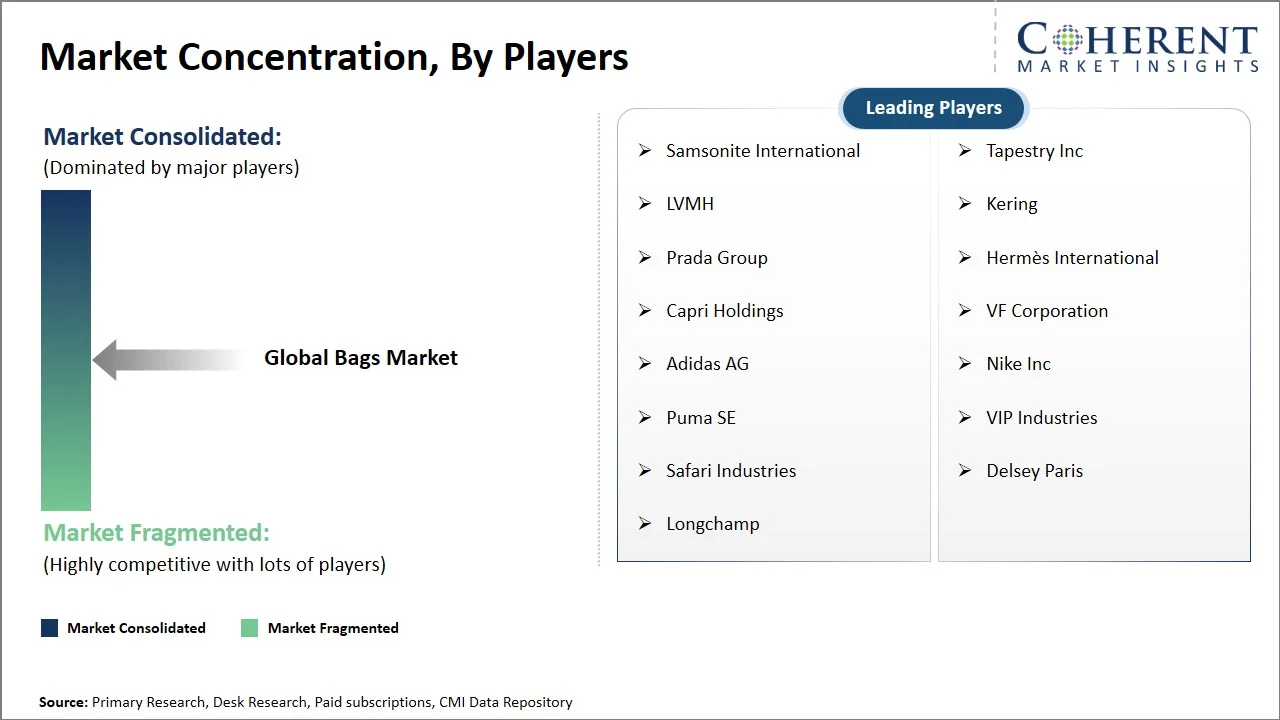
The global bags market is fragmented, with luxury fashion houses, luggage specialists, outdoor and sports brands, mass retailers, digital-native labels, regional leather-goods manufacturers, and private-label producers operating across distinct price and application tiers. Scale improves sourcing leverage and distribution reach, but leadership remains category-specific because design identity, technical performance, price positioning, and regional retail access vary considerably. Competition is shaped by product distinction, quality consistency, responsive supply, compliance documentation, inventory discipline, and the ability to maintain customer relevance across online and offline channels.
Key focus areas include
- Design identity and recognizable product architecture help brands reduce direct price comparison and retain customer attention.
- Durability and component performance are critical for zippers, handles, wheels, straps, seams, and load-bearing panels.
- Price architecture must balance entry-level accessibility, promotional flexibility, material costs, and acceptable gross margins.
- Supply reliability depends on diversified material sources, hardware availability, flexible minimum order quantities, and lead-time control.
- Regulatory and chemical compliance increasingly influence retailer onboarding, international market access, and supplier qualification.
- Distribution reach across specialty retail, department stores, marketplaces, direct-to-consumer platforms, and franchise networks determines scalability.
- Private-label and contract-manufacturing capabilities allow producers to serve retailers that require exclusive specifications, rapid replenishment, and controlled pricing.
- Regional localization remains important for dimensions, colors, climate performance, school calendars, travel patterns, and culturally relevant styling.
Market Report Scope
Bags Market Report Coverage
| Report Coverage | Details | ||
|---|---|---|---|
| Base Year: | 2025 | Market Size in 2026: | USD 174.82 Bn |
| Historical Data for: | 2020 To 2024 | Forecast Period: | 2026 To 2033 |
| Forecast Period 2026 to 2033 CAGR: | 6.70% | 2033 Value Projection: | USD 275.26 Bn |
| Geographies covered: |
| ||
| Segments covered: |
| ||
| Companies covered: | Samsonite International, Tapestry Inc, LVMH, Kering, Prada Group, Hermès International, Capri Holdings, VF Corporation, Adidas AG, Nike Inc, Puma SE, VIP Industries, Safari Industries, Delsey Paris, and Longchamp | ||
| Growth Drivers: |
| ||
| Restraints & Challenges: |
| ||
Analyst Expert (Analyst Opinion)
- Global bags market leadership is likely to shift from selling isolated bag styles toward managing compatible carrying ecosystems. Brands that coordinate luggage, work bags, organizers, straps, protective inserts, and small accessories through common dimensions and attachment interfaces can increase repeat purchasing while simplifying customer choice. This model may make product compatibility, service continuity, and portfolio planning more important than launching unrelated seasonal designs.
- Data-triggered, localized micro-batch manufacturing could materially weaken the traditional calendar-led wholesale model. Pre-orders, digital demand testing, automated pattern preparation, and flexible regional production may allow companies to commit inventory only after detecting genuine consumer interest. Businesses dependent on long forecasting cycles and large speculative orders could face pressure, while digitally integrated brands and responsive contract manufacturers would gain negotiating power.
- Global bags market participants should prioritize dual-region sourcing, component standardization, chemical-compliance databases, performance testing, and channel-specific price architecture. Hardware, coatings, specialist fabrics, and freight remain potential margin vulnerabilities, making supplier transparency and substitute-material qualification essential. Companies should avoid excessive investment in novelty electronics or overly complex features that create warranty exposure without solving a clear carrying problem. Local fulfilment and selective manufacturing partnerships deserve greater attention where import rules are tightening.
Speak to the analyst
Want personalized insights?
Take the findings above to one of our principal consultants, or have the report rebuilt around the segments, geographies and competitors you actually track.
Market Segmentation
- Product Type Insights (Revenue, USD Bn, 2021 - 2033)
- Handbags
- Backpacks
- Travel Bags
- Business Bags
- Sports Bags
- Others
- Material Insights (Revenue, USD Bn, 2021 - 2033)
- Leather
- Synthetic Materials
- Fabric and Textile
- Canvas
- Others
- Price Range Insights (Revenue, USD Bn, 2021 - 2033)
- Mass
- Premium
- Luxury
- Distribution Channel Insights (Revenue, USD Bn, 2021 - 2033)
- Online Retail
- Specialty Stores
- Department Stores
- Supermarkets and Hypermarkets
- Others
- Regional Insights (Revenue, USD Bn, 2021 - 2033)
- North America
- U.S.
- Canada
- Latin America
- Brazil
- Argentina
- Mexico
- Rest of Latin America
- Europe
- Germany
- U.K.
- Spain
- France
- Italy
- Russia
- Rest of Europe
- Asia Pacific
- China
- India
- Japan
- Australia
- South Korea
- ASEAN
- Rest of Asia Pacific
- Middle East
- GCC Countries
- Israel
- Rest of Middle East
- Africa
- South Africa
- North Africa
- Central Africa
- North America
- Key Players Insights
- Samsonite International
- Tapestry Inc
- LVMH
- Kering
- Prada Group
- Hermès International
- Capri Holdings
- VF Corporation
- Adidas AG
- Nike Inc
- Puma SE
- VIP Industries
- Safari Industries
- Delsey Paris
- Longchamp
Source
Primary Research Interviews
- Bag and luggage manufacturers
- Leather, textile, synthetic-material, hardware, zipper, wheel, and strap suppliers
- Product development, sourcing, manufacturing, quality, procurement, sales, and merchandising executives
- OEMs, ODMs, private-label manufacturers, distributors, retailers, e-commerce platforms, and institutional buyers
- Designers, material specialists, testing laboratories, and compliance professionals
Stakeholders
- Handbag, backpack, travel bag, business bag, and sports bag brands
- Material and component suppliers
- Contract manufacturers and private-label producers
- Department stores, specialty retailers, wholesalers, marketplaces, and franchisees
- Consumers, travelers, students, professionals, athletes, and corporate buyers
End-use Sectors
- Personal and commuting use
- Business and travel
- Education
- Sports and outdoor activities
- Fashion, luxury, gifting, and promotional applications
- Delivery, occupational, healthcare, and specialty carrying applications
Regulatory & Government Bodies
- U.S. Consumer Product Safety Commission
- U.S. Federal Trade Commission and Customs and Border Protection
- European Commission and European Chemicals Agency
- Bureau of Indian Standards
- China market-regulation and customs authorities
- Japan, UAE, Brazil, and national consumer-safety, customs, and textile-labeling authorities
Databases
- UN Comtrade
- ITC Trade Map
- WTO Statistics
- USITC DataWeb
- Eurostat and EU PRODCOM
- World Bank and OECD databases
- National trade, manufacturing, retail, tourism, and expenditure databases
- SEC EDGAR and company filings
Magazines and Journals
- Women’s Wear Daily
- Vogue Business
- The Business of Fashion
- Sourcing Journal
- Leather International
- Fashion and Textiles
- Textile Research Journal
- Journal of Retailing and Consumer Services
- Journal of Cleaner Production
Newspapers
- Financial Times
- The Wall Street Journal
- The Economic Times
- Business Standard
- The Hindu BusinessLine
Associations
- Travel Goods Association
- American Apparel & Footwear Association
- International Council of Tanners
- Leather Working Group
- Council for Leather Exports
- China Leather Industry Association
- Textile Exchange
- National and regional luggage, leather, textile, retail, and e-commerce associations
- Public Domain Sources:
- WTO, UN, ITC, World Bank, and European Commission
- National customs, product-safety, textile, leather, tourism, and consumer-protection agencies
- Company annual reports, investor presentations, product catalogues, sustainability reports, and press releases
Key Standards
- ISO 9001 and ISO 14001
- Textile and leather testing standards for strength, abrasion, colorfastness, and chemical content
- EU REACH and General Product Safety Regulation
- U.S. consumer-product, textile-labeling, Proposition 65, and PFAS requirements
- Country-specific labeling, certification, packaging, customs, and import rules
Proprietary Elements
- CMI Data Analytics Tool, Proprietary CMI Existing Repository of information for last 10 years.
Get access to 250+ pages report
Every segment, forecast, competitor profile and data table behind the analysis above — available for instant download.
- ESOMAR Member
- ISO 9001:2015 Certified
- D-U-N-S Registered
- GDPR & CCPA Compliant
Missing comfort of reading report in your local language? Find your preferred language:
Transform your Strategy with Exclusive Trending Reports
Frequently Asked Questions
The CAGR of the global bags market is projected to be 6.70% from 2026 to 2033.
The global bags market is estimated to be valued at USD 174.82 billion in 2026 and is expected to reach USD 275.26 billion by 2033.
Leather is the leading material due to its durability, premium appearance, repairability, and extensive use in handbags, business bags, and travel accessories.
Online retail is gaining importance as consumers increasingly compare products, access international brands, and purchase bags through marketplaces and direct-to-consumer websites.
Sustainable materials, modular designs, personalization, lightweight construction, repair services, and digitally enabled product discovery are shaping product development and competitive strategies.
Travel and lifestyle spending increasing demand for functional bags and fashion premiumization supporting branded handbag and backpack sales are the major factors driving the growth of the global bags market.
Counterfeit products limiting revenue for established bag brands and leather and textile price volatility affecting manufacturing margins are the major factor hampering the growth of global bags market.