

Global Bioink Market Size and Forecast – 2026 To 2033
The global bioink market is expected to grow from USD 218.6 Mn in 2026 to USD 751.9 Mn by 2033, registering a compound annual growth rate (CAGR) of 19.3% from 2026 to 2033. The market for global bioink is poised for significant expansion, fueled by the increasing government-backed research in three-dimensional bioprinting and tissue engineering.
The U.S. National Institute of Biomedical Imaging and Bioengineering funds Worcester Polytechnic Institute’s “3D Bioprinting of Strong Living Scaffolds” project, which is developing cyto compatible emulsion bioinks for mechanically strong, cell-laden tissue scaffolds.
Key Takeaways of the Global Bioink Market
- Natural polymer-based bioinks are projected to hold 54.9 % of the global bioink market share in 2026, making it dominant material type segment, across Europe, supported by the region’s established collagen and gelatin biomaterial ecosystem. For instance, the European Medicines Agency discussed engineered living materials involving bio-ink and stem cells in its 2025 innovation activities, reflecting regulatory interest in advanced biomaterial-based tissue engineering.
- Tissue engineering is projected to hold 42.3 % of the global bioink market share in 2026, making it dominant application segment, across North America benefiting from an increasingly defined regulatory pathway for bioprinted tissue-engineered products. For instance, in December 2025, the U.S. Food and Drug Administration fully recognized ASTM F3659, “Standard Guide for Bioinks Used in Bioprinting,” covering bioink characterization, printability, sterility, cytocompatibility, and post-printing cell viability for tissue-engineered medical products.
- Pharmaceutical and biotechnology companies are projected to hold 48.6 % of the global bioink market share in 2026, making it dominant end user segment, across North America, where regulatory agencies are actively supporting human-relevant models for pharmaceutical research. For instance, in April 2025, the U.S. Food and Drug Administration announced plans to promote organoids and other human-based laboratory models for drug safety testing, strengthening the potential use of three-dimensional bioprinted tissue models and associated bioinks in pharmaceutical research.
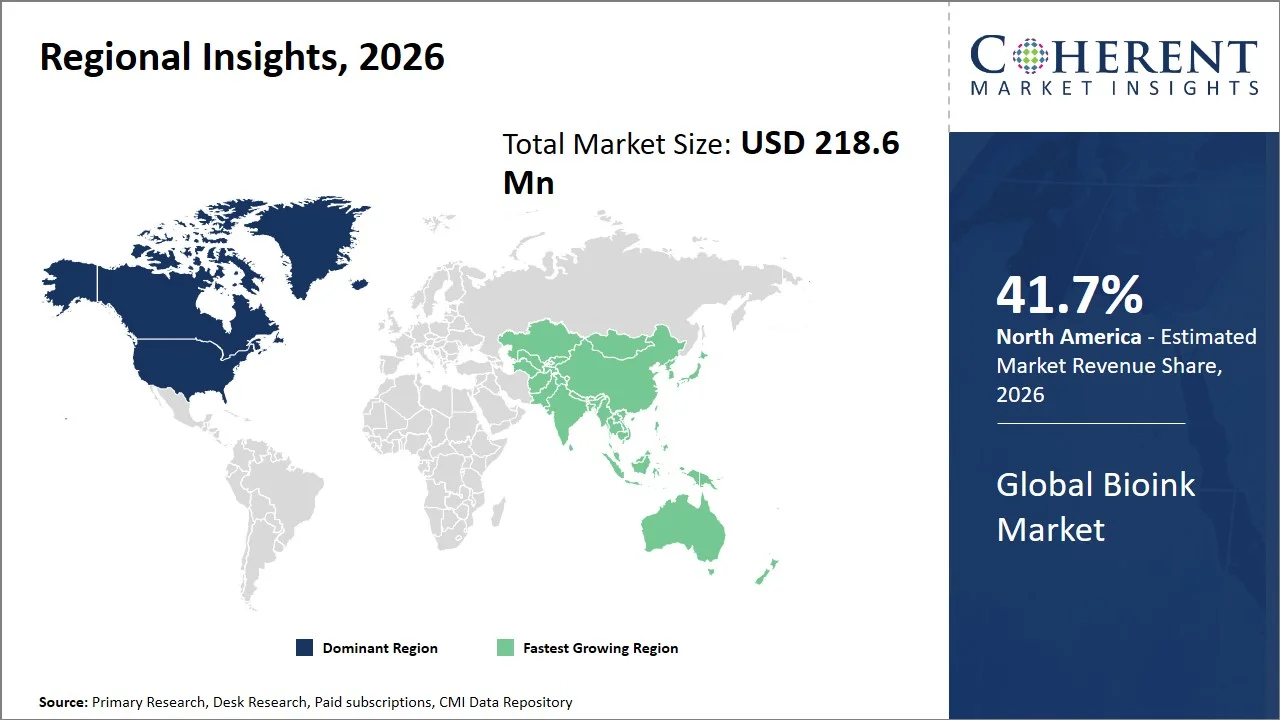
- North America market maintains dominance with an expected share of 41.7 % in 2026, bolstered by its established research and commercialization ecosystem for advanced biomaterials and three-dimensional bioprinting. For instance, Canada’s Natural Sciences and Engineering Research Council funded research at the University of British Columbia to develop a bioink containing nanocellulose crystals for tissue-engineering applications, reinforcing the region’s active bioink-development pipeline.
- Asia Pacific is expected to exhibit the fastest growth in the global bioink market, registering an estimated CAGR of 21.4 % during 2026–2033, propelled by expanding biomaterial and bioprinting research across the region. For instance, Japan’s JETRO has identified three-dimensional bioprinting and bioink technology as an area of biotechnology and life-science activity, including the establishment of a dedicated bioprinting company subsidiary in Kyoto.
Segmental Insights
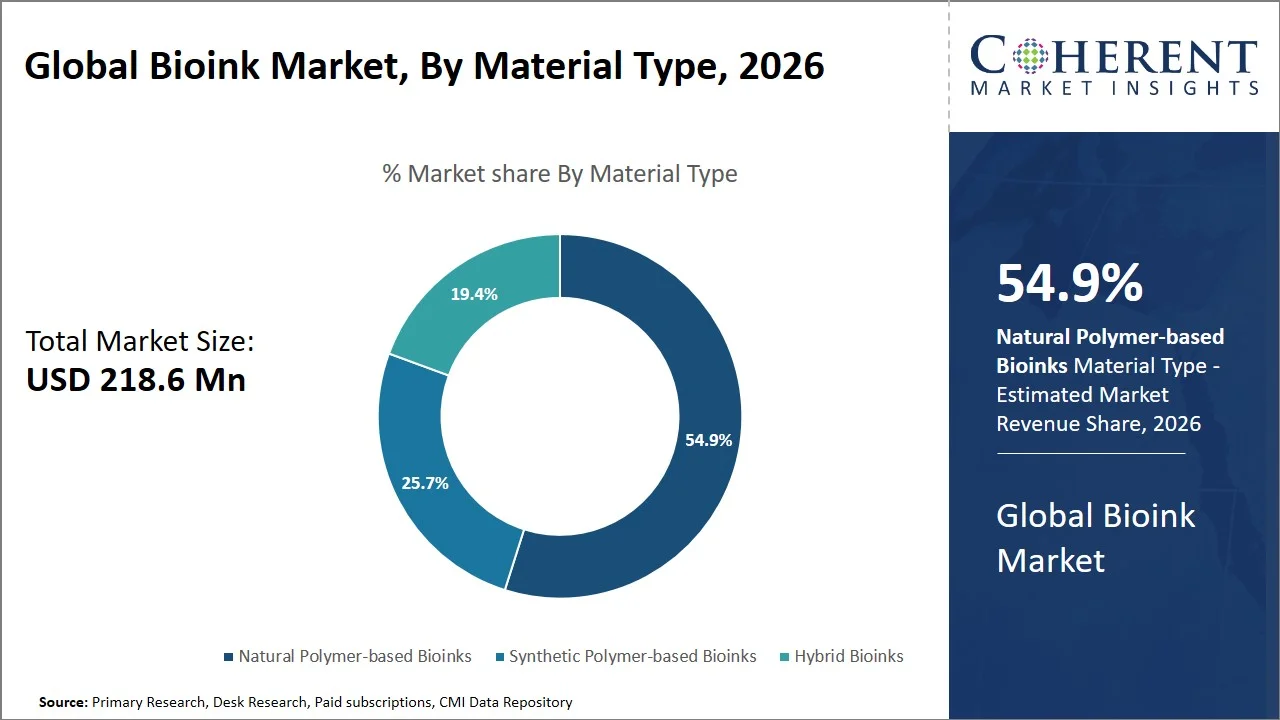
Why Do Natural Polymer-based Bioinks Dominate the Global Bioink Market?
Natural polymer-based bioinks are projected to hold the market share of 54.9% in 2026, owing to their high biocompatibility, extracellular matrix-mimicking, cell adhesion, proliferation, and differentiation properties. Also, the materials like collagen, gelatin, alginate, and hyaluronic acid could be further crosslinked, conjugated with functional molecules, blended to obtain tissue-specific mechanical and biochemical properties. Good cellular compatibility properties make them an ideal material for tissue engineering and regenerative medicine. For instance, in July 2026, the researchers from the University of Hong Kong proposed natural polymer-based bioinks composed of hyaluronic acid, GelMA and gelatin for 3D liver tissue fabrication. The compositions were tailored for the properties necessary in print-ability, structural integrity, degradability and cell viability to enhance development of a target-specific bioink. (Source: MDPI)
- Current Industry Events of 2026
- Market Size Estimation
- Regional Breakdown
- Competitive Landscape
- Customer Intelligence
- Segmental Analysis
- Pricing Analysis
- Key Market Drivers, Challenges & Future Trends
- Customized Insights Section
Why Does Tissue Engineering Represent the Largest Application Segment in the Bioink Market?
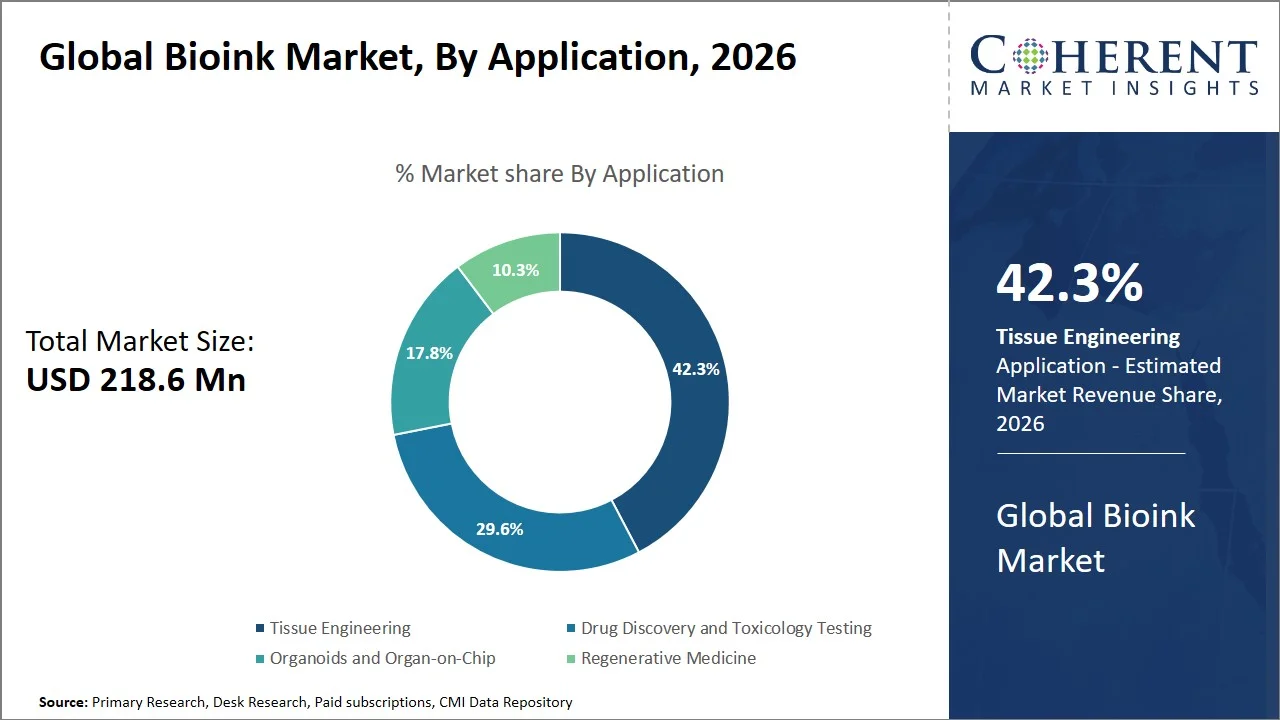
Tissue engineering is projected to hold a market share of 42.3% in 2026, owing to increasing use of bioprinted constructions for tissue regeneration, implantable grafts and development of personalized tissues. Bioinks help to deliver cells and biomaterials into desired positions in a controlled manner and provide structural and biological milieu for the development and maturation of tissues. Application is continuously increasing as vascularized and patient specific constructions of tissues are being developed. For instance, in February 2026, Rice University joined an ARPA-H-funded, up to USD 24.8 million project over five years in support of developing patient specific bioprinted kidney tissue through bioinks capable of supporting viability and vascularization, aiming to address the organ-donor shortage.
Pharmaceutical and Biotechnology Companies Segment Dominates the Global Bioink Market
The pharmaceutical and biotechnology companies segment is projected to hold a market share of 48.6% in 2026, owing to the rising adoption of bioinks across industry players for bioprinting tissue models. Three-dimensional tissue models have high efficacy in drug testing, assessment of toxic effects, building disease models, and developing therapies based on regenerative medicine. Enhanced physiologically-relevant testing compared to 2D cell culture models have uplifted the growth of the pharmaceutical and biotechnology segment, with an increased R&D funding for development of human alternatives. For instance, the U.S. National Center for Advancing Translational Sciences (NCATS) employs 3-D printing to develop normal and disease tissue models as microplate-format tools for drug discovery and development. NCATS is currently soliciting opportunities with pharmaceutical and biotech organizations to incorporate these models into drug discovery processes and to support the demand for bioink-enabled pharmaceutical research.
Currents Events and their Impact
Current Events | Description and its Impact |
Seoul National University of Science and Technology Develops Kombucha-Derived Bioink for Personalized Tissue Repair (February 2025) |
|
Pohang University of Science and Technology (POSTECH) Researchers Develop Light-Activated Decellularized Extracellular-Matrix Bioinks (May 2025) |
|
Bioink Market Dynamics
Market Drivers
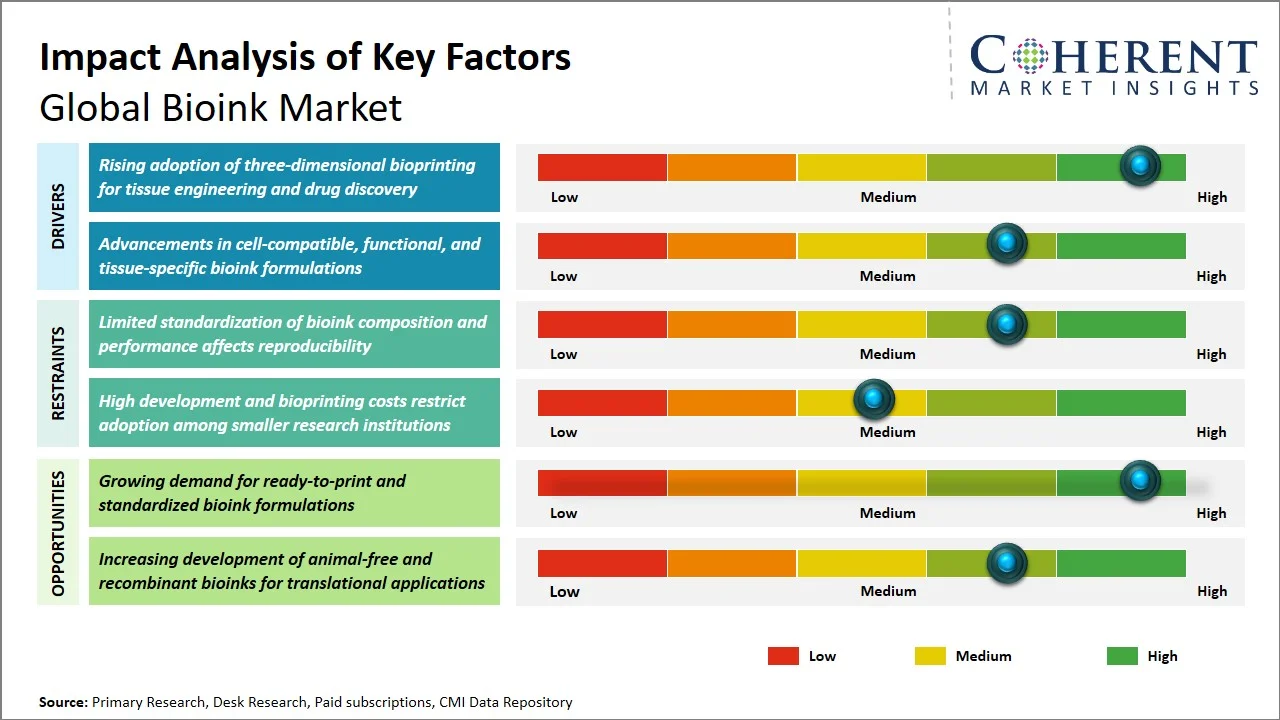
- Rising adoption of three-dimensional bioprinting for tissue engineering and drug discovery: The global bioink market is being propelled by the expanding use of three-dimensional bioprinting for tissue engineering, drug discovery, and physiologically relevant tissue models. Advances in bioprinting are increasing demand for bioinks that support precise cell placement while maintaining viability and structural integrity. For instance, in January 2025, the U.S. National Science Foundation highlighted research developing advanced three-dimensional bioprinted tissue structures, including complex blood-vessel networks, demonstrating the expanding application base for bioink-enabled tissue fabrication.
- Advancements in cell-compatible, functional, and tissue-specific bioink formulations: Advances in cell-compatible and tissue-specific bioinks are strengthening the bioink market by enabling formulations to better replicate the biochemical, mechanical, and cellular characteristics of targeted tissues. Development is moving beyond generic hydrogels toward high-cell-density and organ-specific formulations that support controlled cell organization, differentiation, and tissue maturation. This is expanding bioink applications across complex tissue engineering and regenerative-medicine models. For instance, in July 2025, researchers from the University of Illinois Chicago and collaborating institutions reported tissue-specific high-cell-density bioinks incorporating stem cells and growth-factor-loaded gelatin microparticles, enabling fabrication of multi-phase tissues such as osteochondral tissue with controlled cellular organization
- Growing demand for bioinks in drug discovery and toxicology testing: The expanding use of three-dimensional bioprinted tissue models for drug screening and disease modeling is creating a significant demand for bioinks capable of reproducing human tissue microenvironments. Bioinks that support consistent cell distribution and tissue-specific architecture are increasingly important for developing more physiologically relevant models, particularly in pharmaceutical research. For instance, In July 2025, researchers developed a three-dimensional bioprinted breast cancer model using decellularized breast-tissue bioinks to study cancer stemness, tumor invasion, and drug efficacy, demonstrating the growing use of tissue-specific bioinks in pharmaceutical research.
Emerging Trends
- Increasing Adoption of Multi-Material Bioinks: Bioink development is shifting toward multi-material formulations that combine different mechanical, biological, and structural properties within a single tissue construct. This trend is particularly relevant for reproducing the complexity of native tissues rather than relying on single-material formulations.
- Growing Focus on Vascularized Tissue Bioprinting: Bioink innovation is increasingly targeting the fabrication of vascularized tissue structures, with rapidly cross linkable formulations and embedded bioprinting being explored to overcome limitations in nutrient diffusion and construct size.
- Integration of Artificial Intelligence in Bioink Development: Artificial intelligence is emerging as a tool for predicting bioink behavior and optimizing formulation and printing parameters, helping reduce trial-and-error during development and improve consistency of bioprinted constructs.
Regional Insights
Why is North America a Strong Market for Bioink?
North America leads the global bioink market, accounting for an estimated 41.7% share in 2026, owing to well-established academic institutes, robust healthcare facilities, and high investment in the biotech sector, and regenerative medicines. North America exhibits strong presence of researcher base on biomaterials & 3D bioprinting technologies along with considerable commercialization. In terms of governmental support, the policies implemented by respective government are providing fund for R & D of complex medical disorders also the favorable regulation from the U.S. FDA support bioink product development and potential clinical applications. For instance, in December 2025, the ASTM F3659 "Standard Guide for Bioinks Used in Bioprinting" was approved by U.S. Food and Drug Administration (FDA). The guideline describes important bioink properties like printability, sterility, cytocompatibility and viability of cells after printing.
Why Does Asia Pacific Bioink Market Exhibit High Growth?
Asia-Pacific is expected to exhibit the fastest growth in the global bioink market, registering an estimated CAGR of 21.4% during 2026–2033. The region is projected to account for approximately 24.8% of the global market in 2026, because of rapidly growing healthcare infrastructure, increasing investment in biotechnologies and growing bioprinting capabilities. Many nations including China, Japan, South Korea and India are rising their investment on bio-material, tissue engineering and 3D bioprinting research and studies. Governments in various countries are focusing on development of biotechnology innovation hubs.
For instance, in January 2026, the City of Kobe established innovation initiatives within the Kobe biomedical innovation cluster to expand its biomedical ecosystem and further promote medical device research, development and the bio/life science industrial sector. Moreover, rising awareness and uptake of regenerative medicine-related treatments are boosting the use of bioinks in both research and new clinical applications.
Global Bioink Market Outlook for Key Countries
Why is the U.S. Leading Innovation and Adoption in the Bioink Market?
The U.S. dominates the bioink market owing to its robust integration offering with drug development, tissue engineering, and translational research. Established ecosystems incorporating biotechnology firms, drug developer organizations, R&D centers, and bioink producers enable prompt market entry of new technologies. Furthermore, bolstering their dominance are human cell-relevant 3-D tissue models and regeneration technologies in process which continue to expand the market requirements of sophisticated bioprinting compositions.
Is Japan a Favorable Market for Bioink Market?
Japan is one of the most promising markets for the bioink market, due to the well-developed regenerative-medicine sector, established iPSC research community and a well-founded drive to transfer cell-technologies to clinical treatments. Japan government is very supportive on regenerative and cellular medicine (R&CM) and covers every range from basic research to commercialization thus it is a prospective market for bioink in tissue engineering, drug discovery and customized treatments.
Is China Emerging as a Key Growth Hub for the Bioink Market?
China is positioned as a key growth hub in the global bioink market driven by an exponential increase in the number of bioprinting researchers, biomaterial developments, and tissue engineering techniques employed by many of the large universities. China is also advancing into organ sized bioprinting and tissue specific bioinks, while government funded research, technological advancement and regenerative medicine is developing swiftly.
Why Does Germany Top the European Bioink Market?
Germany leads the European bioink market owing to its high potential in biomaterials engineering, tissue engineering, and sophisticated bioprinting technology. Germany excels in the formulation of specific application bioinks and biomaterials for regeneration of tissue structure, 3D tissue model for tissue engineering and regenerative medicine. Furthermore, its sophisticated manufacturing technology supports high potential bioink solutions to reach the market.
Is Bioink Market Developing in India?
India is a high-potential market for bioink primarily driven by development in three-dimensional bioprinting research, biomaterial development, and tissue engineering capabilities. There are major educational institutions (such as IIT Hyderabad, IIT Kanpur, and IIT Madras) which are pushing the tissue specific bioink research boundaries for cartilage, regenerative medicine and disease models, while domestic bioprinting capabilities are expanding.
Global Bioink Research & Development Landscape by Application
Application Area | Primary Bioink Use | Market Relevance |
Tissue Engineering | Fabrication of structured tissues and scaffolds | Highest |
Drug Discovery and Toxicology Testing | Three-dimensional human-relevant testing models | High |
Organoids and Organ-on-Chip | Reproduction of tissue microenvironments | High |
Regenerative Medicine | Development of implantable or therapeutic tissue constructs | Emerging |
How are the growing demand for ready-to-print and standardized bioink formulations creating new growth opportunities in the bioink market?
Ready-to-use and standard bioinks that simplify formulation and increase workflow reproducibility offer significant opportunities in the global bioink market. Standardized ready-to-use formulations offer consistency in printability, cell viability and batch-to-batch reproducibility to aid adoption by research as well as the pharmaceutical industry. Tissue-specific ready-to-use bioinks that are transferable across multiple platforms are a compelling opportunity. For instance, in June 2025, Tessella Biosciences in collaboration with McMaster University designed a printable bioink capable of developing, a stable and viable lung tissue model at body temperature. This bioink is capable of producing a tissue more suited for drug development and disease modeling, demonstrating potential for other tissue specific and physiologically suitable bioinks.
Market Players, Key Development, and Competitive Intelligence
Key Developments
- In March 2026, GELITA and Black Drop entered into a research and development agreement to develop high-performance bioinks based on novel methacrylated gelatin formulations for three-dimensional tissue models and implants. The collaboration combines GELITA’s hydrogel material expertise with Black Drop’s bioprinting capabilities, supporting the development of more application-specific and clinically relevant bioink formulations.
- In February 2026, CollPlant launched BioFlex, a ready-to-print recombinant human collagen-based bioink kit designed for Digital Light Processing three-dimensional bioprinting. The product is intended for advanced tissue models, tissue engineering, regenerative medicine, and development of transplantable organs, highlighting the market’s shift toward standardized, ready-to-use, and reproducible bioink formulations.
- In June 2024, BIO INX launched DEGRES INX, a biodegradable and biocompatible shape-memory resin developed for light-based bioprinting. The material can recover its original printed shape at body temperature, enabling four-dimensional bioprinting and potential minimally invasive biomedical applications, including tissue regeneration.
Competitive Landscape
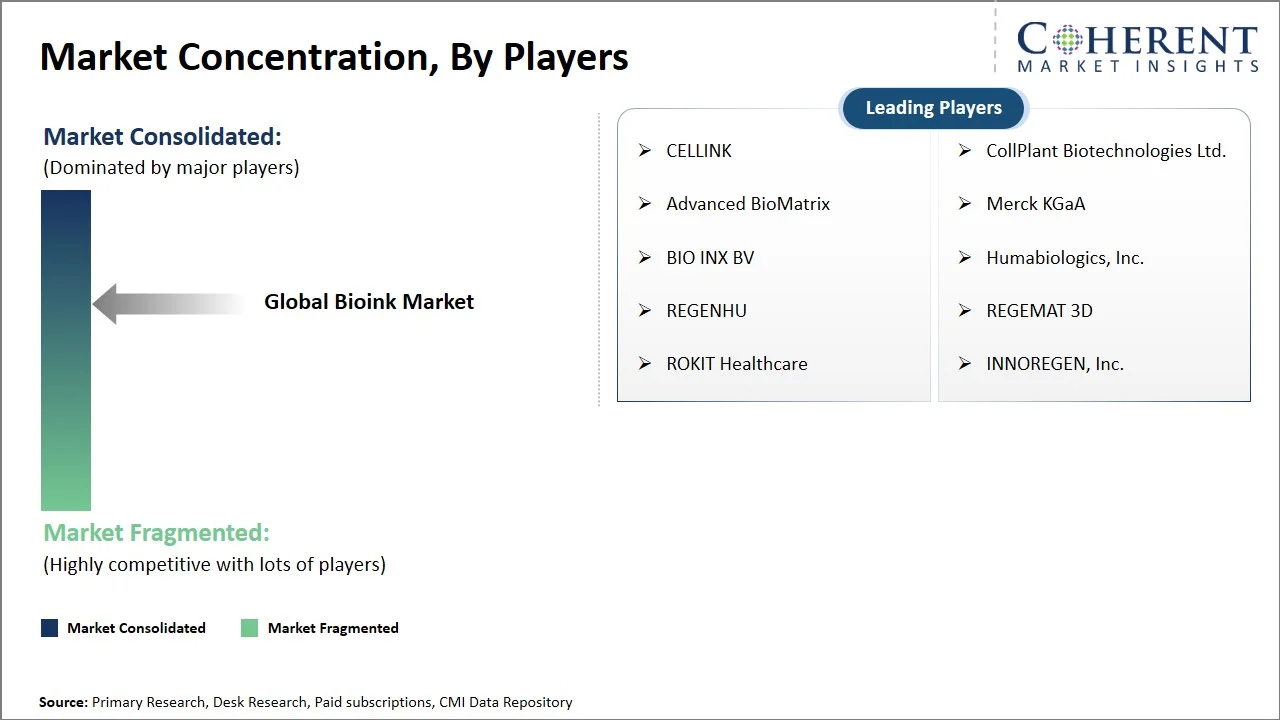
The global bioink market is moderately competitive, with competition centered on bioink formulation performance, printability, biocompatibility, reproducibility, and compatibility with different bioprinting platforms. Players are increasingly differentiating through ready-to-print formulations, tissue-specific bioinks, recombinant and animal-free materials, and application-focused solutions for tissue engineering, drug discovery, and organoid models. Key focus areas include:
- Development of ready-to-print and application-specific bioink formulations
- Improvement of printability, cell viability, mechanical strength, and reproducibility
- Development of recombinant, animal-free, and chemically defined bioinks
- Optimization of bioinks for high-resolution and multi-material bioprinting
- Expansion into drug discovery, organ-on-chip, tissue engineering, and regenerative medicine applications
Market Report Scope
Bioink Market Report Coverage
| Report Coverage | Details | ||
|---|---|---|---|
| Base Year: | 2025 | Market Size in 2026: | USD 218.6 Mn |
| Historical Data for: | 2020 To 2024 | Forecast Period: | 2026 To 2033 |
| Forecast Period 2026 to 2033 CAGR: | 19.3% | 2033 Value Projection: | USD 751.9 Mn |
| Geographies covered: |
| ||
| Segments covered: |
| ||
| Companies covered: | CELLINK, CollPlant Biotechnologies Ltd., Advanced BioMatrix, Merck KGaA, BIO INX BV, Humabiologics, Inc., REGENHU, REGEMAT 3D, ROKIT Healthcare, INNOREGEN, Inc. | ||
| Growth Drivers: |
| ||
| Restraints & Challenges: |
| ||
Analyst Opinion (Expert Opinion)
- The global bioink market is expected to move from general-purpose research formulations toward standardized, tissue-specific, ready-to-print bioinks designed for reproducible bioprinting workflows. In our view, the strongest long-term shift will be toward formulations that combine biological functionality with consistent printability and scalable manufacturing.
- The maximum opportunities will probably exist within natural polymer-based bioinks for tissue engineering applications in China where demand can expand alongside the development of advanced biomaterials, bioprinting capabilities, and regenerative-medicine research. The opportunity is particularly attractive for collagen-, gelatin-, and extracellular-matrix-based formulations tailored to specific tissue applications.
- In order to obtain a competitive advantage, market participants should prioritize ready-to-print, application-specific bioinks rather than competing solely on material composition. Developing reproducible formulations with defined mechanical and biological properties, compatibility across multiple printing platforms, and scalable manufacturing capabilities can provide a stronger competitive edge.
Speak to the analyst
Want personalized insights?
Take the findings above to one of our principal consultants, or have the report rebuilt around the segments, geographies and competitors you actually track.
Market Segmentation
- Material Type Insights (Revenue, USD Mn, 2021 - 2033)
- Natural Polymer-based Bioinks
- Synthetic Polymer-based Bioinks
- Hybrid Bioinks
- Application Insights (Revenue, USD Mn, 2021 - 2033)
- Tissue Engineering
- Drug Discovery and Toxicology Testing
- Organoids and Organ-on-Chip
- Regenerative Medicine
- End User Insights (Revenue, USD Mn, 2021 - 2033)
- Academic and Research Institutions
- Pharmaceutical and Biotechnology Companies
- Hospitals and Medical Centers
- Contract Research Organizations
- Others
- Regional Insights (Revenue, USD Mn, 2021 - 2033)
- North America
- U.S.
- Canada
- Latin America
- Brazil
- Argentina
- Mexico
- Rest of Latin America
- Europe
- Germany
- U.K.
- Spain
- France
- Italy
- Russia
- Rest of Europe
- Asia Pacific
- China
- India
- Japan
- Australia
- South Korea
- ASEAN
- Rest of Asia Pacific
- Middle East
- GCC Countries
- Israel
- Rest of Middle East
- Africa
- South Africa
- North Africa
- Central Africa
- North America
- Key Players Insights
- CELLINK
- CollPlant Biotechnologies Ltd.
- Advanced BioMatrix
- Merck KGaA
- BIO INX BV
- Humabiologics, Inc.
- REGENHU
- REGEMAT 3D
- ROKIT Healthcare
- INNOREGEN, Inc.
Sources
Primary Research Interviews
- Bioink formulation scientists
- Three-dimensional bioprinting researchers
- Tissue-engineering researchers
- Regenerative-medicine specialists
- Pharmaceutical research scientists using three-dimensional tissue models
- Executives from bioink and biomaterial companies
Stakeholders
- Bioink manufacturers
- Three-dimensional bioprinter manufacturers
- Pharmaceutical and biotechnology companies
- Tissue-engineering companies
- Academic bioprinting laboratories
- Contract research organizations
- End-use Sectors
- Tissue-engineering laboratories
- Pharmaceutical and biotechnology research
- Regenerative-medicine research centers
- Academic and medical research institutions
- Regulatory & Health Bodies
- U.S. Food and Drug Administration (FDA)
- European Medicines Agency
- European Commission
- Medicines and Healthcare products Regulatory Agency
- National Medical Products Administration, China
- Pharmaceuticals and Medical Devices Agency, Japan
- National Institute of Food and Drug Safety Evaluation, South Korea
Databases
- ClinicalTrials.gov
- National Center for Biotechnology Information
- U.S. Food and Drug Administration databases
- European Medicines Agency databases
- National Institutes of Health databases
Journals
- Advanced Healthcare Materials
- Tissue Engineering
- Trends in Biotechnology
Associations
- International Society for Biofabrication
- Tissue Engineering and Regenerative Medicine International Society
- Regenerative Medicine Coalition
- ASTM International
- International Organization for Standardization
Public Domain Sources
- U.S. Food and Drug Administration
- National Institutes of Health
- National Institute of Standards and Technology
- European Commission
- World Health Organization
- U.S. Department of Health and Human Services
Proprietary Elements
- CMI Data Analytics Tool, Proprietary CMI Existing Repository of information for last 10 years.
Get access to 250+ pages report
Every segment, forecast, competitor profile and data table behind the analysis above — available for instant download.
- ESOMAR Member
- ISO 9001:2015 Certified
- D-U-N-S Registered
- GDPR & CCPA Compliant
Missing comfort of reading report in your local language? Find your preferred language:
Transform your Strategy with Exclusive Trending Reports
Frequently Asked Questions
The global bioink market is estimated to be valued at USD 218.6 Mn in 2026 and is expected to reach USD 751.9 Mn by 2033.
Natural polymer-based bioinks dominate due to their high biocompatibility, extracellular matrix-like properties, and suitability for supporting cell growth and tissue formation.
Bioink is a cell-compatible biomaterial formulation used in three-dimensional bioprinting to fabricate living tissue constructs and biological models.
The CAGR of global bioink market is projected to be 19.3% from 2026 to 2033.
Common bioink materials include collagen, gelatin, alginate, hyaluronic acid, fibrin, synthetic polymers, and extracellular-matrix-derived materials.
Bioinks enable the creation of three-dimensional human-relevant tissue models that can be used for drug screening, disease modeling, and toxicity assessment.
A hybrid bioink combines natural and synthetic materials to balance biological functionality with mechanical strength and printability.