

Global Biscuits Market Size and Forecast – 2026 To 2033
The Global Biscuits Market is estimated to be valued at USD 150.39 Bn in 2026 and is expected to reach USD 227.63 Bn by 2033, exhibiting a compound annual growth rate (CAGR) of 6.1% from 2026 to 2033. Market growth is projected to be supported by frequent snacking habits, product diversification, wider modern-retail and e-commerce access, and increasing expenditure on convenient packaged foods. Manufacturers are introducing premium biscuit flavors, portion-controlled snack packs, reduced-sugar and high-fiber formulations, and channel-specific packaging formats. These packaging formats include resealable family packs for supermarkets, single-serve packs for convenience stores and vending machines, travel-friendly multipacks, e-commerce bundles, and decorative tins or premium gift boxes for festive and gifting occasions. In July 2024, Loacker introduced its Chocolaterie wafer line in dark, milk, and white chocolate variants across family packs, snack formats, multipacks, and stand-up bags, demonstrating how flavor innovation and diversified packaging can expand consumption occasions and retail-channel coverage.
Key Takeaways of the Global Biscuits Market
- Sweet biscuits are expected to hold 46.8 % of the global biscuits market in 2026 because they span mass-market glucose and butter products, premium cookies, indulgent formats, gifting, and family consumption. Their broad price ladder and frequent flavor renewal support high retail turnover. In May 2025, Britannia launched Good Day Chunkies in Divine Chocochip and Tropical Coconut variants, extending its sweet-cookie portfolio.
- Chocolate is expected to account for 28.6 % of the global biscuits market in 2026 because it supports coatings, chips, creams, fillings, and layered formats across mainstream and premium price points. The flavor also enables strong brand extensions and gifting propositions. In April 2026, ITC launched Sunfeast Farmlite Sugar Free Cookies in Choco Nut and Hazelnut & Oats variants through leading quick-commerce platforms.
- Flexible pouches and wrappers are expected to capture 38.4 % of the global biscuits market in 2026 because they combine low material use, high-speed line compatibility, portion flexibility, printable branding, and effective moisture protection. These benefits support both affordable packs and multipack formats. In June 2024, Saica and Mondelēz introduced a recyclable, heat-sealable paper-based packaging solution for biscuit and confectionery multipacks.
- Asia Pacific is expected to command 39.6 % of the global biscuits market in 2026, supported by high household penetration, affordable single-serve packs, expanding modern retail, localized flavors, and large manufacturing ecosystems in India, China, and Southeast Asia. In August 2024, Bühler India launched locally designed SmartLine ovens and rotary molders for biscuits and crackers, improving access to efficient regional production technology.
- Europe is expected to hold 25.4 % of the global biscuits market in 2026 and remain the fastest-growing region as premiumization, flavor experimentation, sustainable packaging, and private-label development reshape mature consumption. Manufacturers are also investing in automation and flexible capacity. In July 2025, pladis announced a USD 77.59 million investment across its U.K. operations to modernize biscuit facilities, increase capacity, and improve productivity.
- Better-for-You Indulgence: Biscuit manufacturers are combining indulgent textures with reduced sugar, whole grains, plant proteins, fiber, and recognizable ingredients. The business opportunity lies in maintaining taste while supporting wellness-oriented purchasing. Companies with strong formulation capabilities can command premium positioning, enter new consumption occasions, and protect brand relevance, while traditional high-sugar portfolios may face increased reformulation pressure and weaker retailer support.
- Channel-Specific Pack Design: Product strategy is shifting toward formats created for supermarkets, convenience stores, quick commerce, gifting, and on-the-go consumption rather than one universal pack. This requires flexible production planning, differentiated pack sizes, stronger shelf visibility, and channel-based pricing. Suppliers that coordinate packaging, assortment, and replenishment by retail format can improve conversion, reduce inventory mismatch, and strengthen bargaining power with distributors.
Segmental Insights
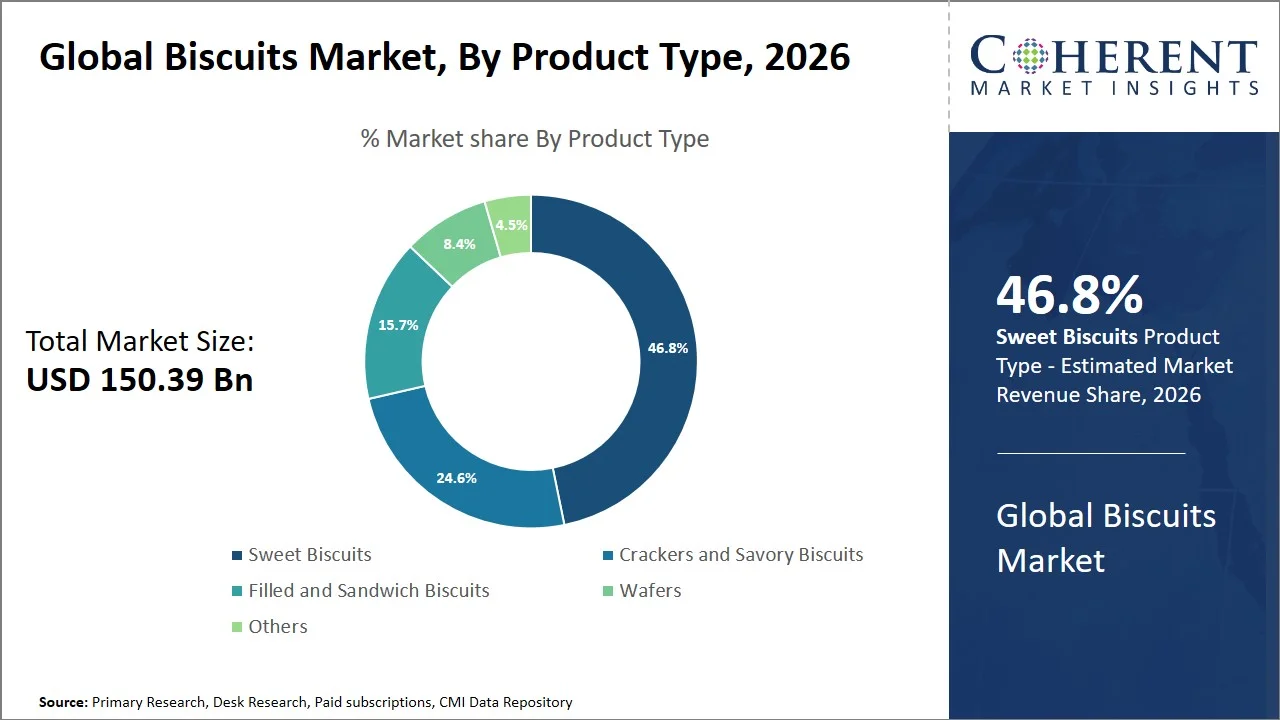
Why Do Sweet Biscuits Dominate the Global Biscuits Market?
Sweet biscuits are expected to account for 46.8% of the global biscuits market in 2026 because the category covers glucose biscuits, butter cookies, shortbread, cream biscuits, and premium indulgent formats across mass and specialty price tiers. Their familiar taste, long shelf life, tea-time suitability, and compatibility with school, workplace, gifting, and household-sharing occasions generate repeat purchases. Manufacturers benefit from standardized dough systems, scalable rotary molding, and broad ingredient availability, while retailers can merchandise the category through value packs, multipacks, and premium assortments. The segment also accommodates reformulation for gluten-free, reduced-sugar, and portion-controlled positioning without abandoning established product identities. In April 2025, Arnott’s documented a nine-product gluten-free biscuit portfolio that included sweet formats such as Tim Tam, Shortbread Cream, Tiny Teddy, Scotch Finger, and Mint Slice, showing how established sweet-biscuit platforms can be adapted for dietary requirements.
- Current Industry Events of 2026
- Market Size Estimation
- Regional Breakdown
- Competitive Landscape
- Customer Intelligence
- Segmental Analysis
- Pricing Analysis
- Key Market Drivers, Challenges & Future Trends
- Customized Insights Section
Why Does Chocolate Represent the Largest Flavor Segment in the Global Biscuits Market?
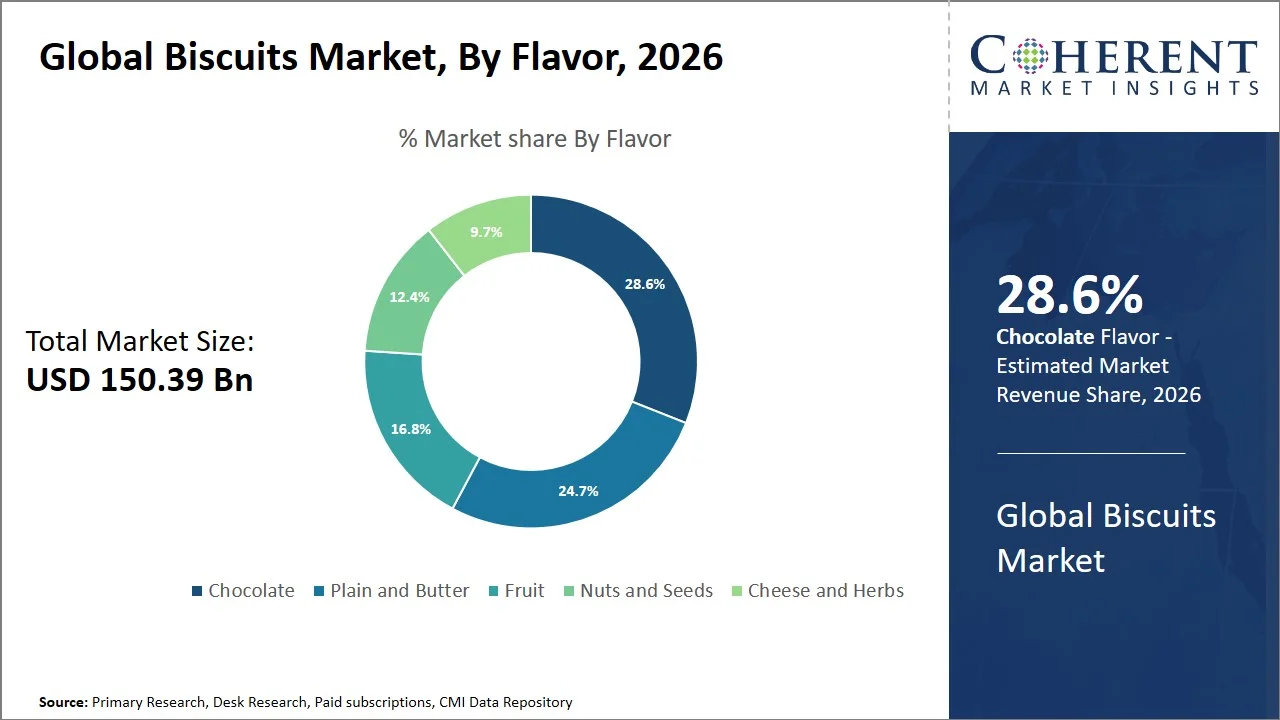
Chocolate is expected to represent 28.6% of the global biscuits market in 2026 because it can be incorporated as cocoa dough, chips, cream fillings, enrobing, drizzle, or coatings, allowing brands to create multiple sensory and price propositions from one flavor platform. Its compatibility with cookies, wafers, sandwich biscuits, and premium gift products supports broad application across children, families, and adult indulgence buyers. From a manufacturing perspective, bake-stable chips, heat-resistant coatings, and standardized cocoa powders improve consistency and facilitate regional flavor customization. Chocolate also supports premium pricing and frequent limited-edition launches, strengthening shelf visibility for manufacturers and retailers. In March 2024, Cargill introduced NatureFresh Professional block chocolates, chocolate chips, and cocoa powder for bakery customers at AAHAR, alongside cookie and other baked-product applications developed through its Indian innovation capabilities.
Why Do Flexible Pouches and Wrappers Dominate the Packaging Segment of the Global Biscuits Market?
Flexible pouches and wrappers are expected to hold 38.4% of the global biscuits market in 2026 because they provide moisture and aroma protection while using less material than rigid packs. Horizontal flow wrapping supports high-speed packing of single biscuits, on-edge slugs, sandwich products, cookies, and crackers, while printed films offer strong shelf branding across value and premium ranges. Manufacturers can change pack lengths, portion counts, and promotional graphics without redesigning the underlying product, improving channel responsiveness. Lightweight packs also reduce freight space and enable affordable single-serve distribution through convenience stores and traditional retail. Equipment suppliers benefit as producers invest in automation, gentle product handling, and material flexibility. In July 2024, Syntegon presented its Pack 301 LS system for flow wrapping biscuits and crackers and a retrofit enabling the same equipment to process film and paper-based packaging.
Current Events and their Impact
Current Event | Description and Its Impact |
January 2025 – U.S. FDA proposes front-of-package nutrition labeling |
|
February 2025 – EU Packaging and Packaging Waste Regulation enters into force |
|
January 2026 – U.K. restrictions on advertising less healthy foods take effect |
|
Global Biscuits Market Dynamics
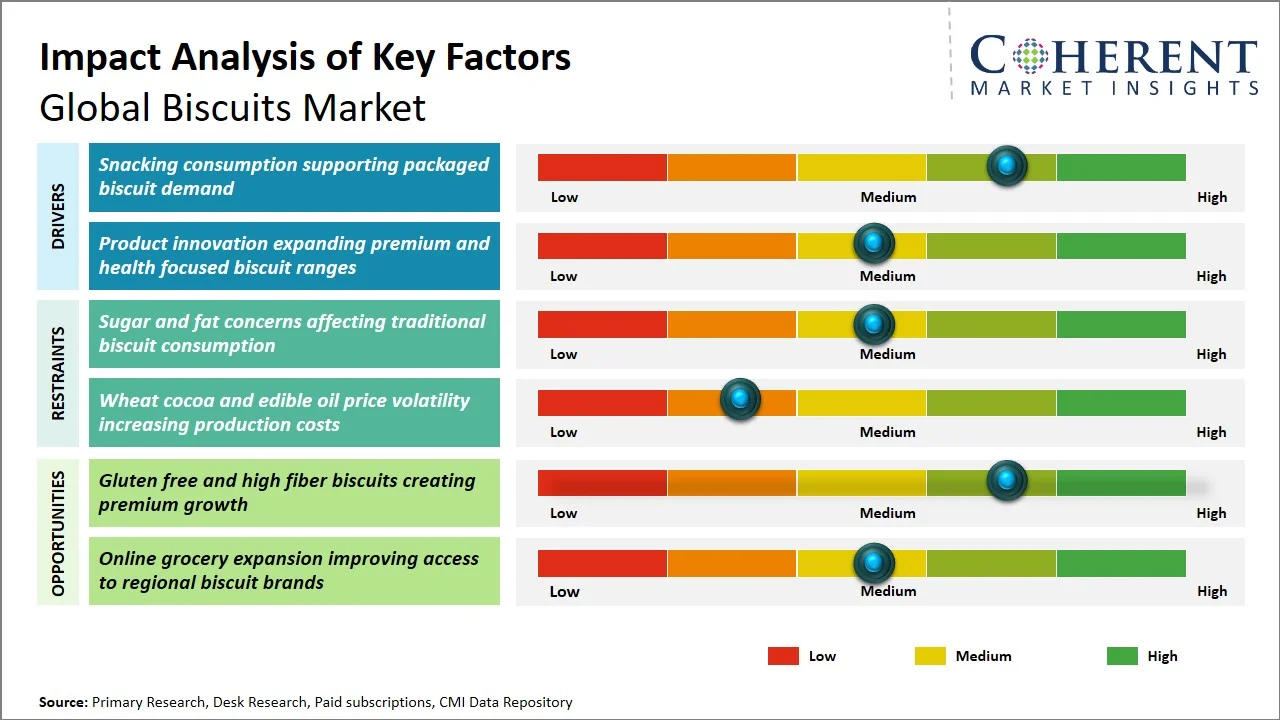
Key Market Drivers
- Multi-Occasion Snacking Expands Packaged Biscuit Consumption: Packaged biscuits benefit from their ability to serve several eating occasions without preparation, refrigeration, or utensils. Single-serve crackers, portioned cookies, and resealable packs fit commuting, school, workplace, vending, and foodservice environments, turning distribution availability into a direct demand lever. Manufacturers producing durable formats with controlled breakage and long ambient shelf life gain access to more outlets, while distributors and convenience operators benefit from rapid rotation and predictable handling. Occasion-specific formats also support differentiated pricing and increase category visibility outside traditional grocery aisles. In January 2025, Kellanova Away From Home introduced a broad U.S. snack lineup for convenience, foodservice, micro-market, and vending channels, including several Cheez-It cracker formats and portable baked products. The rollout illustrates how channel-ready innovation is widening the commercial role of packaged biscuits and crackers.
- Premium and Health-Focused Innovation Strengthens Category Value: Product innovation is expanding the biscuit category from conventional indulgence toward premium, reduced-sugar, fiber-rich, protein-oriented, and specialty-diet propositions. Reformulated biscuits attract health-conscious consumers while supporting premium pricing and retailer differentiation. Success depends on maintaining familiar taste, snap, aroma, and mouthfeel despite changes to sweeteners, fats, flours, or inclusions. Ingredient suppliers, application laboratories, premium brands, and manufacturers with flexible lines are positioned to benefit, whereas undifferentiated portfolios may face price pressure. In October 2025, KCG Corporation launched Imperial Danish Style Butter Cookies Less Sugar, formulated with reduced sugar while retaining the established butter-cookie positioning. The introduction demonstrates how manufacturers are using nutritional reformulation to protect indulgent brand equity and open additional purchasing occasions among health-conscious consumers.
Emerging Market Trends
- Premiumization of Private-Label Biscuits: Retailers are repositioning private-label biscuits from low-cost alternatives into premium cookies, dietary variants, seasonal assortments, and exclusive flavors. Access to shopper data and direct control over shelf space allows retailers to identify category gaps quickly and launch targeted products. This strengthens the demand for contract manufacturers with flexible production, strong certification, rapid product development, and confidential formulation capabilities, while mid-tier brands face greater pressure on pricing, differentiation, and retailer access.
- Ingredient-Risk Management in Biscuit Formulation: Volatility in cocoa, butter, sugar, wheat, and edible-oil prices is pushing manufacturers to redesign recipes around cost stability. Producers are adopting partial coatings, optimized fillings, alternative fat systems, and modular dough platforms to protect taste while reducing exposure to expensive inputs. This shifts investment toward dual sourcing, rapid sensory validation, and flexible formulation. Suppliers offering reliable substitutes and technical support will gain relevance, while rigid product portfolios may experience sustained margin pressure.
Regional Insights
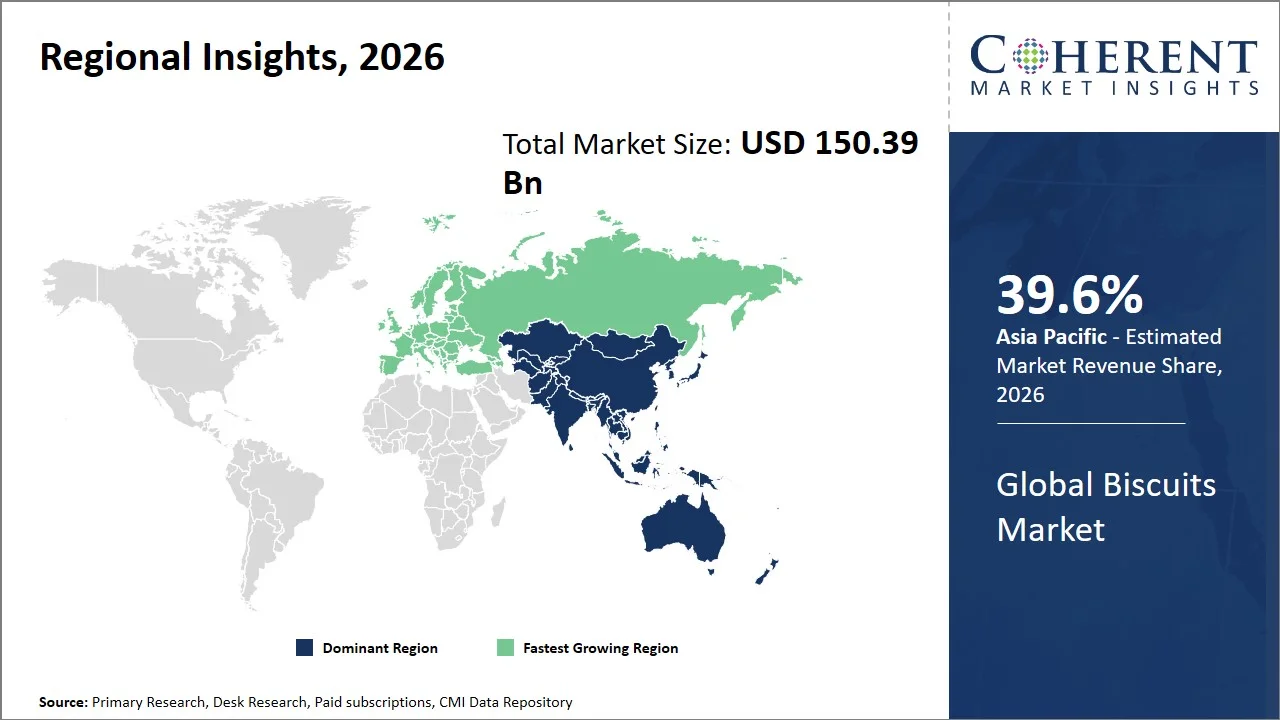
Why Does Asia Pacific Dominate the Global Biscuits Market?
Asia Pacific is expected to dominate the global biscuits market with a 39.6% share in 2026. The region combines large consumer populations, frequent tea-time and on-the-go snacking, wide acceptance of affordable single-serve packs, and strong demand for locally adapted sweet, savory, filled, and wafer products. Dense traditional retail networks coexist with supermarkets, convenience chains, and quick-commerce platforms, allowing manufacturers to serve multiple price tiers. Local wheat processing, contract manufacturing, and expanding automated baking capacity also support high-volume production close to consumption centers. Suppliers that balance affordability with flavor localization and portion flexibility are positioned to gain distribution. In August 2025, Lotus Bakeries reported that its greenfield Biscoff plant in Chonburi, Thailand, was advancing ahead of schedule and would gradually begin production during the second half of 2025, strengthening regional supply across Asia Pacific.
Why is Europe Emerging as the Fastest-Growing Region in the Global Biscuits Market?
Europe is expected to be the fastest-growing region in the global biscuits market and account for 25.4% of the market share in 2026. Growth is increasingly value-led, supported by premium cookies, chocolate-coated formats, specialty flavors, gifting assortments, and reformulated products with clearer ingredient and sustainability positioning. The region’s concentrated supermarket and private-label channels encourage rapid assortment renewal, while established biscuit clusters provide skilled labor, packaging expertise, and export connectivity. Producers are also modernizing plants to handle shorter runs and more varied product formats without sacrificing cost control. In June 2026, Ferrero announced a USD 68.53 million investment in France, including USD 34.27 million to support Nutella Cookies at the Biscuits Delacre plant in Nieppe. The investment illustrates how European manufacturers are adding capacity around differentiated branded biscuits rather than relying only on volume expansion in established categories.
Global Biscuits Market Outlook for Key Countries
Why is the U.S. a Key Market for the Global Biscuits Market?
The U.S. is a key market for biscuits because cookies and crackers serve several consumption occasions, including lunchboxes, workplace breaks, household desserts, travel, entertaining, and foodservice. National grocery chains, mass merchants, club stores, convenience outlets, and e-commerce platforms give brands broad routes to market but also intensify competition for shelf space and promotional visibility. Consumers respond strongly to indulgent flavors, larger bakery-style formats, seasonal editions, portion-controlled packs, and products that combine convenience with freshness. The country’s mature refrigerated dough, packaged cookie, and premium cracker segments also support innovation beyond conventional shelf-stable biscuits. In May 2025, General Mills launched Pillsbury BIG COOKIES refrigerated dough in three bakery-style flavors through Walmart, followed by a nationwide retail rollout. The introduction demonstrates how U.S. suppliers are translating bakery-shop attributes into convenient at-home formats and using major retail partnerships to scale new biscuit-related consumption occasions.
Why is India Important in the Global Biscuits Market?
India is important in the global biscuits market because biscuits function as an affordable, widely distributed packaged food across urban and rural households. Tea-time consumption, low-unit-price packs, school and workplace snacking, and gifting support demand across glucose, cream-filled, savory, digestive, and premium cookie categories. The country also offers a broad manufacturing base, domestic wheat and sugar supply, extensive kirana distribution, and growing supermarket, online, and quick-commerce channels. Regional taste preferences create room for both national portfolios and localized products, while improved processing and packaging capabilities strengthen export potential. In June 2026, the Agricultural and Processed Food Products Export Development Authority facilitated the first 40-metric-tonne biscuit shipment from Varanasi to Oman following the India–Oman Comprehensive Economic Partnership Agreement. The shipment demonstrates how trade facilitation and regional manufacturing can connect Indian biscuit producers with new international markets.
Why Does China Support Growth in the Global Biscuits Market?
China supports growth in the global biscuits market through its large packaged-food manufacturing base, sophisticated e-commerce ecosystem, and diverse consumption of cookies, wafers, sandwich biscuits, rice crackers, and gift packs. Urban consumers increasingly purchase snacks through content-commerce platforms, warehouse clubs, convenience stores, and rapid-delivery channels, encouraging manufacturers to tailor pack sizes and launch cycles by channel. Domestic producers also benefit from industrial clusters, scalable packaging capacity, and strong capabilities in flavor localization and seasonal merchandising. Premium products can coexist with family-value formats because purchasing behavior varies considerably by city tier and occasion. In November 2025, China Want reported that revenue from its rice-cracker segment increased by 3.5% during the first half of its financial year, with new products contributing a double-digit share of segment revenue. The result highlights the importance of continual product renewal and channel diversification in China.
Why is the U.K. a Strategic Country in the Global Biscuits Market?
The U.K. is a strategically important biscuits market because biscuits are closely integrated with tea breaks, household treats, workplace sharing, lunchboxes, and seasonal gifting. Large supermarket groups and discounters provide national scale, while convenience stores and online grocery support smaller packs and immediate-consumption formats. Competition is shaped by private labels, established heritage brands, chocolate biscuit bars, premium cookies, and frequent limited-edition flavors. Retailers increasingly expect recyclable packaging, clear value positioning, and reliable promotional supply, requiring manufacturers to coordinate product design with channel economics. In September 2024, Nestlé UK & Ireland relaunched the KitKat Two Finger Cookies and Cream biscuit bar in multipacks through Tesco and Asda, using packaging made with 75% recycled plastic. The launch illustrates how U.K. suppliers combine familiar brands, flavor renewal, major-retailer distribution, and packaging improvement to maintain consumer interest in a mature category.
Why is Brazil an Important Growth Market for the Global Biscuits Market?
Brazil is an important growth market for biscuits because the category reaches consumers through supermarkets, cash-and-carry stores, neighborhood retailers, wholesalers, and increasingly digital channels. Biscuits fit breakfast, coffee-break, school, travel, and household-sharing occasions, supporting the demand for plain, filled, wafer, savory, and chocolate-based formats. A large domestic food-processing base and strong regional brands enable manufacturers to serve different income groups with pack-size and price differentiation. Premiumization is developing alongside continued demand for affordable family products, making portfolio balance commercially important. In March 2026, ABIMAPI reported that biscuits generated US$ 6.70 billion in Brazilian industry revenue during 2025 and remained the largest category within the association’s biscuits, pasta, bread, and cake portfolio. The result shows that even when volume conditions are challenging, brand mix, pricing, product differentiation, and broad household relevance can sustain category value.
Technology Adoption Landscape in the Global Biscuits Market
Technology | Adoption Level | Key Application Area | Business Impact |
Automated ingredient micro-dosing and continuous mixing | High | Flour, sugar, fats, leavening agents, flavors, and minor ingredients | Improves recipe accuracy, reduces manual handling, and supports consistent dough properties across large production batches. |
Rotary molding, wire cutting, and precision depositing | High | Sweet biscuits, cookies, crackers, filled products, and shaped formats | Enables high throughput, product uniformity, shape differentiation, and efficient production of multiple biscuit formats. |
Zoned tunnel ovens with airflow and humidity control | High | Baking, moisture reduction, color formation, and texture development | Improves bake consistency, energy utilization, product structure, and control over crispness and residual moisture. |
Inline moisture, color, and machine-vision inspection | Medium | Post-bake quality control and defect rejection | Detects underbaking, overbaking, breakage, dimensional variation, and surface defects before products reach packaging. |
Robotic handling and high-speed flow wrapping | High | Product transfer, stacking, slug loading, portion packs, and multipacks | Reduces product damage and labor dependence while increasing packaging speed, hygiene, and format flexibility. |
Digital oven simulation and line-performance analytics | Medium | Recipe scale-up, heat-profile optimization, downtime analysis, and yield control | Shortens production trials, supports preventive adjustment, and improves line economics across frequently changing product portfolios. |
How are Flexible Co-Manufacturing Platforms Creating New Growth Opportunities in the Global Biscuits Market?
Flexible co-manufacturing platforms enable retailers, digital-native brands, foodservice operators, and regional biscuit companies to access industrial production capacity without investing in their own manufacturing facilities. The opportunity remains underdeveloped because many traditional factories are optimized for long runs and limited recipe changeovers, making small launches, allergen-controlled products, and channel-exclusive packs expensive. Companies can capture this gap by offering modular dough preparation, multiple forming technologies, segregated ingredient handling, rapid packaging changes, and regulatory support across export markets. Priority applications include premium cookies, specialty-diet biscuits, seasonal assortments, travel packs, and retailer-owned products requiring lower minimum order quantities. Commercial participation demands strong confidentiality systems, food-safety certification, flexible procurement, pilot-scale development, and transparent costing. Specialist contract manufacturers are likely to benefit the most, although vertically integrated ingredient or packaging suppliers may enter through partnerships. Established branded companies can also use these platforms to test concepts before committing internal capacity, reducing launch risk while accelerating access to new channels and geographies.
Market Players, Key Development, and Competitive Landscape
Key Developments
- In April 2026, Orion launched Choco Songyi Matcha as a permanent product after its earlier limited-edition release generated strong consumer interest. The product combines a matcha-flavored chocolate top with a cocoa biscuit base. This is important for the global biscuits market because it demonstrates how manufacturers can convert short-term flavor testing into permanent portfolio expansion and use consumer feedback to reduce commercialization risk.
- In December 2024, Biscuit International announced its planned acquisition of Patisserie Casteleijn, a Netherlands-based producer specializing in stroopwafels and syrup-filled biscuits. This is important for the global biscuits market because the transaction strengthens private-label manufacturing capacity in a specialized sweet-biscuit category and illustrates continued consolidation among European contract producers seeking broader product capabilities and retailer access.
- In December 2024, The J.M. Smucker Co. completed the divestiture of the Voortman cookie business to Second Nature Brands. The transaction transferred the brand, its Canadian manufacturing facility, and associated employees to the new owner. This is important for the global biscuits market because it concentrates Voortman within a snack-focused portfolio and demonstrates how companies are reallocating capital around brands with clearer strategic ownership and investment priorities.
Competitive Landscape
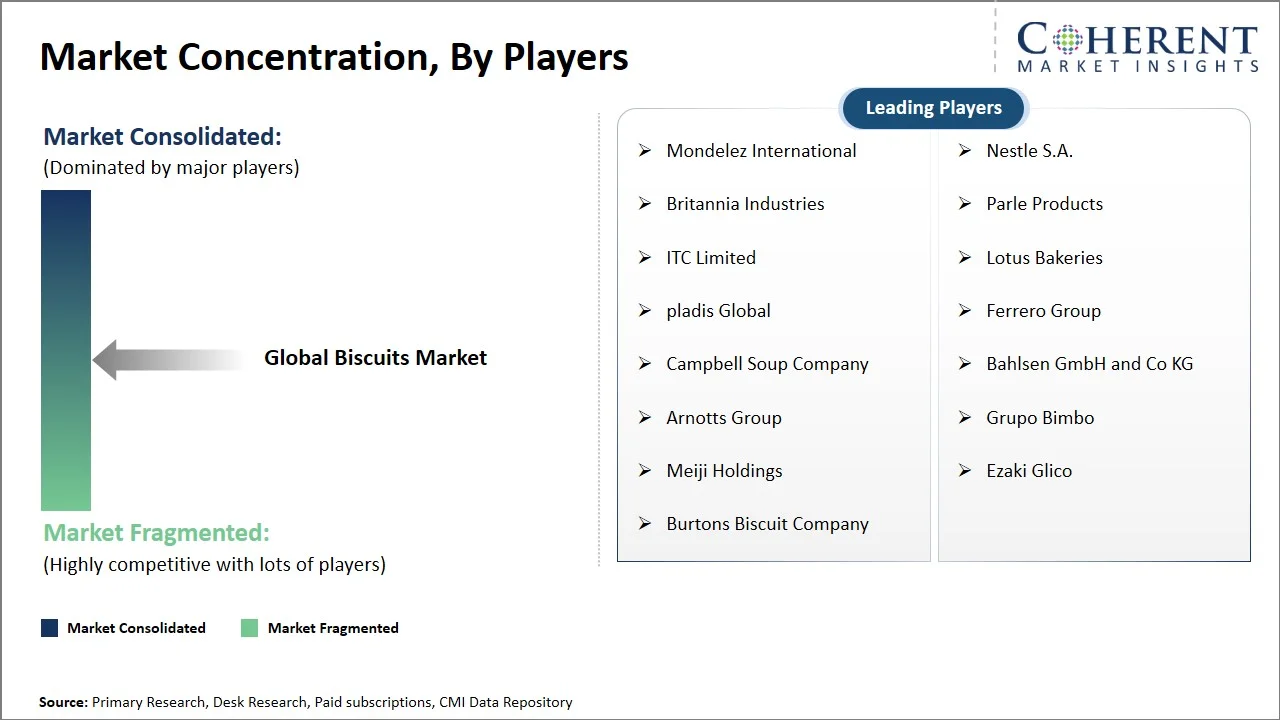
The global biscuits market is fragmented at the worldwide level, with moderate consolidation within individual branded and private-label markets. Multinational snack companies compete alongside national biscuit leaders, retailer-focused manufacturers, contract producers, premium specialists, and regional family-owned businesses. Competitive position depends on brand recognition, price-pack architecture, sensory quality, manufacturing scale, retail access, packaging compliance, and supply reliability. Regional companies remain influential where local flavors, traditional retail relationships, rapid replenishment, and affordable pack sizes determine purchasing behavior.
Key focus areas include
- Product differentiation: Texture, fillings, coatings, inclusions, flavors, and freshness determine shelf visibility and repeat purchasing.
- Price-pack architecture: Manufacturers must balance affordable entry packs, family formats, multipacks, and premium products.
- Manufacturing flexibility: Rapid changeovers and multi-format lines help suppliers serve seasonal, private-label, and limited-run requirements.
- Retail execution: Shelf placement, promotional support, category management, and replenishment performance influence commercial success.
- Food safety and compliance: Allergen controls, traceability, labeling accuracy, and export certifications determine customer qualification.
- Supply-chain reliability: Access to wheat, sugar, cocoa, fats, films, cartons, and transport capacity protects production continuity.
- Brand and customer relationships: Established consumer trust and long-term retailer agreements create barriers to new market entry.
- Local production strategies: Regional manufacturing can reduce freight costs, shorten lead times, and support market-specific formulations.
Market Report Scope
Biscuits Market Report Coverage
| Report Coverage | Details | ||
|---|---|---|---|
| Base Year: | 2025 | Market Size in 2026: | USD 150.39 Bn |
| Historical Data for: | 2020 To 2024 | Forecast Period: | 2026 To 2033 |
| Forecast Period 2026 to 2033 CAGR: | 6.1% | 2033 Value Projection: | USD 227.63 Bn |
| Geographies covered: |
| ||
| Segments covered: |
| ||
| Companies covered: | Mondelez International, Nestle S.A., Britannia Industries, Parle Products, ITC Limited, Lotus Bakeries, pladis Global, Ferrero Group, Campbell Soup Company, Bahlsen GmbH and Co KG, Arnotts Group, Grupo Bimbo, Meiji Holdings, Ezaki Glico, and Burtons Biscuit Company | ||
| Growth Drivers: |
| ||
| Restraints & Challenges: |
| ||
Analyst Opinion (Expert Opinion)
- Global biscuits market leadership will increasingly depend on regional product platforms rather than identical global assortments. Successful manufacturers are likely to standardize core dough, processing, and quality systems while adapting flavors, sweetness, portion sizes, claims, and packaging to local purchasing behavior. This model can preserve scale economies without forcing unsuitable products into every market.
- Retail-media networks, quick-commerce data, and digital purchasing signals could materially shorten biscuit-development cycles. Product decisions that previously relied on annual research may shift toward continuous testing of flavors, packs, and prices. Companies able to connect commercial data directly with formulation and production planning will scale successful concepts faster, placing slower annual innovation models under pressure.
- Manufacturers should strengthen sensory science, flexible manufacturing, commodity-risk management, and market-specific regulatory capabilities. Investment should prioritize products with clear repeat-purchase potential rather than excessive limited-edition activity that creates complexity without durable sales. Companies should secure alternative suppliers for critical ingredients, develop disciplined margin thresholds, and use partnerships where local distribution knowledge is more valuable than wholly owned expansion.
Speak to the analyst
Want personalized insights?
Take the findings above to one of our principal consultants, or have the report rebuilt around the segments, geographies and competitors you actually track.
Market Segmentation
- Product Type Insights (Revenue, USD Bn, 2021 - 2033)
- Sweet Biscuits
- Crackers and Savory Biscuits
- Filled and Sandwich Biscuits
- Wafers
- Others
- Flavor Insights (Revenue, USD Bn, 2021 - 2033)
- Chocolate
- Plain and Butter
- Fruit
- Nuts and Seeds
- Cheese and Herbs
- Others
- Packaging Type Insights (Revenue, USD Bn, 2021 - 2033)
- Flexible Pouches and Wrappers
- Boxes and Cartons
- Trays
- Tins and Containers
- Others
- Distribution Channel Insights (Revenue, USD Bn, 2021 - 2033)
- Supermarkets and Hypermarkets
- Convenience Stores
- Online Retail
- Specialty and Bakery Stores
- Others
- Regional Insights (Revenue, USD Bn, 2021 - 2033)
- North America
- U.S.
- Canada
- Latin America
- Brazil
- Argentina
- Mexico
- Rest of Latin America
- Europe
- Germany
- U.K.
- Spain
- France
- Italy
- Russia
- Rest of Europe
- Asia Pacific
- China
- India
- Japan
- Australia
- South Korea
- ASEAN
- Rest of Asia Pacific
- Middle East
- GCC Countries
- Israel
- Rest of Middle East
- Africa
- South Africa
- North Africa
- Central Africa
- North America
- Key Players Insights
- Mondelez International
- Nestle S.A.
- Britannia Industries
- Parle Products
- ITC Limited
- Lotus Bakeries
- pladis Global
- Ferrero Group
- Campbell Soup Company
- Bahlsen GmbH and Co KG
- Arnotts Group
- Grupo Bimbo
- Meiji Holdings
- Ezaki Glico
- Burtons Biscuit Company
Sources
Primary Research Interviews
- Biscuit manufacturers, ingredient suppliers, packaging companies, distributors, retailers, and contract producers
- R&D, procurement, production, quality, regulatory, marketing, and sales executives
Stakeholders
- Sweet biscuit, cracker, wafer, sandwich biscuit, and cookie manufacturers
- Flour, sugar, cocoa, dairy, fat, flavor, filling, packaging, and equipment suppliers
- Importers, exporters, private-label producers, retailers, distributors, and e-commerce platforms
End-use Sectors
- Household snacking, tea-time consumption, gifting, travel, and lunchbox products
- Foodservice, cafés, schools, offices, vending, supermarkets, convenience stores, and online retail
Regulatory & Government Bodies
- U.S. FDA, European Commission, EFSA, and UK FSA
- Health Canada, FSSAI, China SAMR and NHC
- Japan MHLW, Brazil ANVISA, FSANZ, and customs authorities
Databases
- UN Comtrade, ITC Trade Map, WTO Statistics, Eurostat, and USITC DataWeb
- FAOSTAT, World Bank, OECD, China Customs, India DGCI&S, and Brazil Comex Stat
- Company filings, retail listings, pricing, trade, and consumer-review databases
Magazines and Journals
- Baking & Snack, Baking Business, and World Bakers
- Journal of Cereal Science, Cereal Chemistry, Food Chemistry, and LWT
Associations
- American Bakers Association
- International Association of Plant Bakers
- Cereals & Grains Association
- Institute of Food Technologists
- All India Biscuit Manufacturers’ Association and ABIMAPI
Public Domain Sources
- Food-safety, nutrition, trade, and regulatory authorities
- Customs databases, industry associations, company reports, product catalogues, packaging specifications, and press releases
- Retailer, supermarket, convenience-store, and online marketplace listings
Key Standards and Regulations
- U.S. FD&C Act, FSMA, and FDA food-labeling requirements
- EU General Food Law and Food Information to Consumers Regulation
- Codex food hygiene, additives, contaminants, and nutrition-labeling standards
- India FSSAI regulations, China GB 2760 and GB 7718
- Canada, FSANZ, Brazil ANVISA, allergen, packaging, shelf-life, and nutrition-claim requirements
Proprietary Elements
- CMI Data Analytics Tool, Proprietary CMI Existing Repository of information for last 10 years.
Get access to 250+ pages report
Every segment, forecast, competitor profile and data table behind the analysis above — available for instant download.
- ESOMAR Member
- ISO 9001:2015 Certified
- D-U-N-S Registered
- GDPR & CCPA Compliant
Missing comfort of reading report in your local language? Find your preferred language:
Transform your Strategy with Exclusive Trending Reports
Frequently Asked Questions
The CAGR of the global biscuits market is projected to be 6.1% from 2026 to 2033.
The global biscuits market is estimated to be valued at USD 150.39 billion in 2026 and is expected to reach USD 227.63 billion by 2033.
Biscuits are mainly sold through supermarkets, hypermarkets, convenience stores, specialty stores, bakery outlets, and online retail platforms.
Sweet biscuits offer familiar flavors, convenient snacking, broad affordability, long shelf life, and suitability for tea-time, gifting, travel, and household consumption.
Key trends include premium flavors, reduced-sugar formulations, whole-grain products, sustainable packaging, portion-controlled packs, and channel-specific product formats.
Snacking consumption supporting packaged biscuit demand and product innovation expanding premium and health focused biscuit ranges are the major factors driving the growth of the global biscuits market.
Sugar and fat concerns affecting traditional biscuit consumption and wheat cocoa and edible oil price volatility increasing production costs are the major factors hampering the growth of the global biscuits market.