

Global Board Game Market Size and Forecast – 2026 to 2033
According to Coherent Market Insights, the global board game market is estimated to be valued at USD 14.32 Bn in 2026 and is expected to reach USD 20.97 Bn by 2033, exhibiting a compound annual growth rate (CAGR) of 5.6% from 2026 to 2033.
Key Takeaways of the Board Game Market
- Monopoly segment is expected to capture 36.1% of the board game market share in 2026.
- The 2-5 years segment is estimated to account for 39.6% of the market share in 2026.
- Specialty stores segment is projected to hold 43.9% of the global board game market share in 2026.
- The Europe region is expected to dominate the market with a 34.3% share in 2026.
- The Asia Pacific region will hold 21.3% share in 2026 and record the fastest growth.
Market Overview
- A significant trend shaping the board game market is the rising popularity of hybrid board games that combine traditional gameplay instant game with digital elements, appealing to both classic enthusiasts and tech-savvy millennials.
- Additionally, there is a growing focus on niche and thematic games targeting specific communities, such as strategy and cooperative games.
- Moreover, the surge in social gaming and the use of online platforms to facilitate multiplayer experiences are driving broader adoption, fostering a revitalized interest in board games as a social and recreational activity.
Currents Events and Its Impacts
Current Events | Description and its Impact |
Trump‑Era Tariffs on Chinese Imports |
|
Hybrid/Digital Integration Trends |
|
Segmental Insights
- Current Industry Events of 2026
- Market Size Estimation
- Regional Breakdown
- Competitive Landscape
- Customer Intelligence
- Segmental Analysis
- Pricing Analysis
- Key Market Drivers, Challenges & Future Trends
- Customized Insights Section
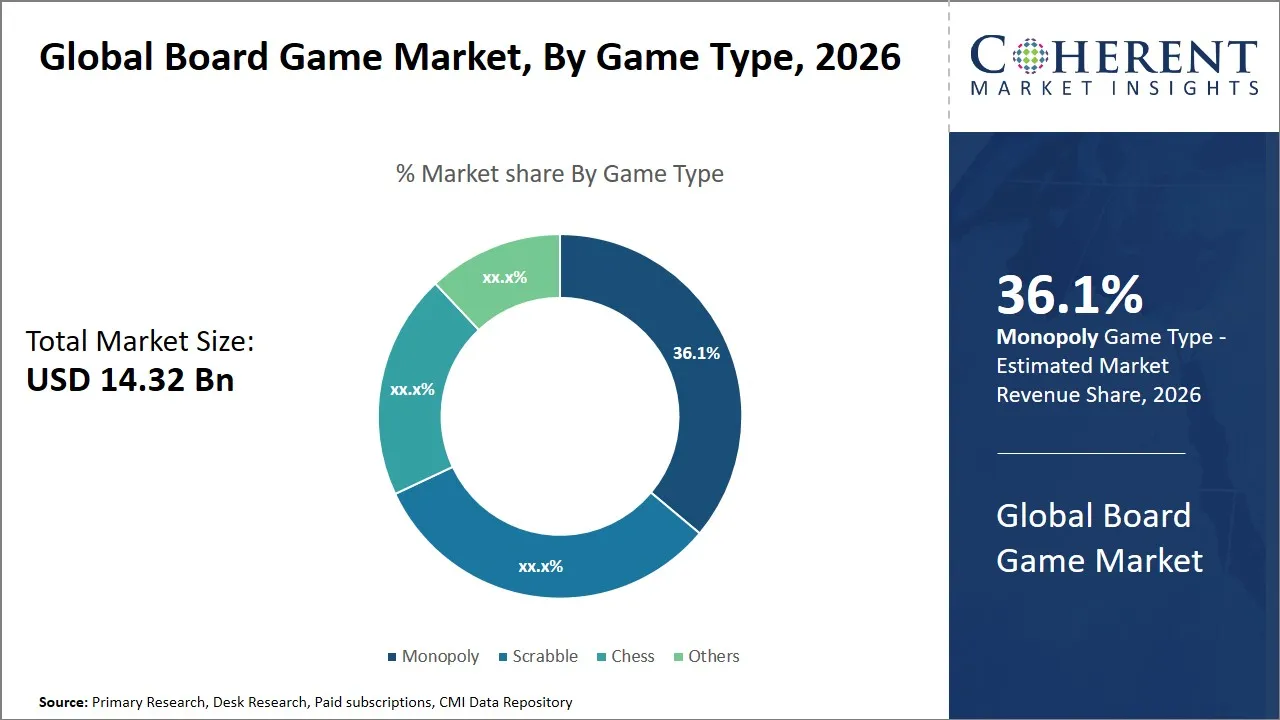
Why Does Monopoly Dominate the Global Board Game Market in 2026?
Monopoly segment is projected to hold 36.1% of the board game market share in 2026. The iconic brand recognition, classic appeal, and the versatility of the gameplay that appeals to a wide range of people are the leading drivers of this position. Themes of monopolies in property acquisition and financial strategy do not discriminate based on any age or cultural background and therefore it is a common household staple. The game has managed to maintain a long-term demand since it is widely-known on many generations, parents tend to transfer the game to their children, which makes the cycle of familiarity and the desire to continue the interest.
In addition, the fact that Monopoly has constantly reinvented itself with themed versions such as pop culture, regional, and limited-edition helps it dominate the market greatly. These differences are a draw to collectors and fans and enhance replay value of the games and keep the brand in the minds of consumers. Also, Monopoly simple, but tactical gameplay will most readily suit both amateurs and those who want more interaction in their games without losing complexity.
2-5 Years Dominates Owing to Growing Focus on Developmental Learning Through Play
The 2-5 years segment is set to hold 39.6% in the global board game market share in 2026. It is a very crucial stage in life as cognitive, motor, and social skills are developed and thus, parents and people who take care of children desire to find some games which could not only amuse but also educate. Special board games that encourage basic learning through colors, shapes, numbers, and easy rules are often tailored to the preschoolers.
This segment is very appealing because the influx of enlightenment regarding the advantages of play-based learning has prompted manufacturers to create games that can be used to facilitate early childhood learning. Also, early childhood board games can sometimes be used as both a recreational and developmental activity that attracts demand among educational institutions and traditional consumers. This complex use is what makes these types of games a part and parcel of lots of families and kindergartens.
Specialty Stores Capture the Largest Share Due to Curated Selection and Consumer Experience
Specialty stores segment is projected to hold 43.9% of the market share in 2026. This trend is informed by the uniqueness in value propositions offered to consumers by these stores. These shops have a status quo of board games, including the exclusive, luxury, and niche games that are not always found in the mass retailers or online shops. The specialty stores serve common customers and serious gamers who also want expert recommendations, community interaction, and shopping experiences by offering on-board games and related products only.
Face-to-face communication that specialty stores provide is significant in fueling their supremacy. The customers who visit these stores enjoy the benefit of having highly educated staff who will guide them on the type of games to buy depending on their age, passions, or level of skill thereby improving the customer satisfaction level and boosting their chances of making a purchase. This customized service will make consumers trust and become loyal, which will lead to visiting the location repeatedly and providing referrals.
Regional Insights
Europe Board Game Market Analysis and Trends
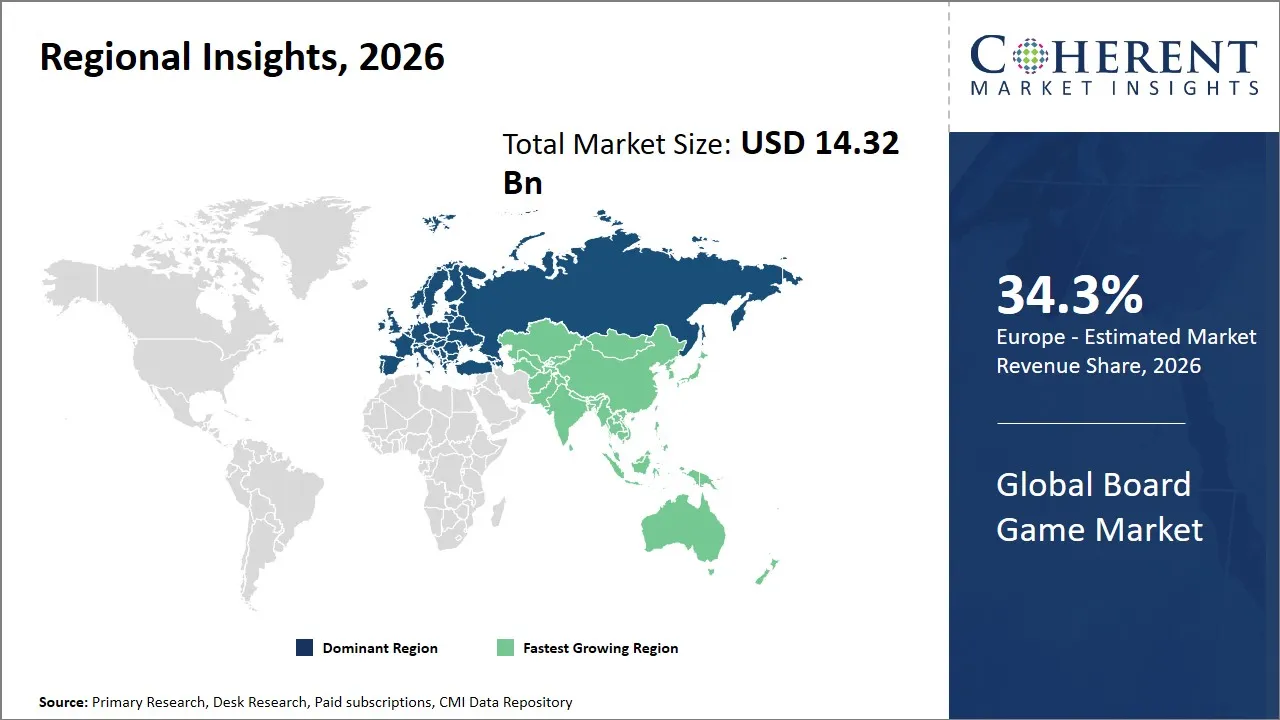
The Europe region is projected to lead the market with a 34.3% share in 2026, driven by a well-established ecosystem characterized by a rich cultural appreciation for tabletop gaming, deep-rooted traditions, and a strong presence of both historic and modern game publishers. Countries like Germany, France, and the U.K. have established successful communities of board game players that are backed by large retail chains, hobby shops and special conventions like Spiel in Essen, which serves as an international center of new releases and networking. The government policies of most European states favor the creative industries and they make grants and subsidies that favor both the game designers and manufacturers.
In 2025, German board game publisher Ravensburger announced a partnership with Asmodee, one of the largest board game distributors in Europe, to expand their international reach.
Asia Pacific Board Game Market Analysis and Trends
The Asia Pacific region is expected to exhibit the fastest growth in the market contributing 21.3% share in 2026, driven by growing urbanization, rising middle-income and an expanding youth population with social and leisure related inclinations. The market growth is also backed by the growing digital market and adoption of digital marketing strategies, which are oriented toward the local preferences. The presence of the industry in the countries like China, Japan and South Korea is dynamically changing fast with more and more local studios producing culturally contextualized games that are blending traditional story-telling with contemporary gamification.
Global Board Game Market Outlook for Key Countries
Germany Board Game Market Trends
The board game market in Germany continues to be a stronghold of the entire world board game industry due to the fact that it is credited with the birthplace of the modern Euro-style board games. Thousands of fans and industry experts gather annually because of such events as the Spiel fair and the country has a well-developed supply chain infrastructure. Firms like Ravensburger and Hans Gluck are of critical importance to the market and are stimulating innovation besides adhering to old German design traditions of games. The market dominance of Germany has been established through the support of the German government on creative businesses and education regarding the board games as a cultural artifact.
U.S. Board Game Market Trends
The U.S. has been at the head of the North American market in terms of board game with a wide product portfolio in family, party and hobbyist categories. Its market leadership is guaranteed by the presence of large players like Hasbro and Wizards of the Coast with their respective titles which are Monopoly and Magic the Gathering respectively. The U.S. has the advantage of an increasing population of independent designers and a culture of strong crowdfunding, most evident on Kickstarter, which fosters innovation. The policy frameworks are conducive to entrepreneurship and the presence of a robust retail and e-commerce ecosystem means that the accessibility is large.
China Board Game Market Trends
The market in China board game is one of the most dynamic in the Asia Pacific area. The large consumer base coupled with growing acceptance of the board games as a mainstream recreational activity drives the intense demand. The success of companies such as CMON Limited to exploit the domestic and the westwards market is indicative of the increasing influence of China. The attitude of the government regarding safeguarding IP rights has increased the business climate of the developers. Increasing numbers of people are playing in social gaming cafes and there is the ubiquitous integration of mobile app tie-ins, which lead to the liveliness of the marketplace.
France Board Game Market Trends
The France market for board game enjoys the advantage of strong culture of social playing and game design innovation. The presence of Asmodees in France headquarters is a major contributor to the market positioning of the country because the firm uses its international network to distribute and acquire creative talent. The availability of many local publishers makes it possible to have differentiated game products to satisfy both families and hobbyists. The French laws are very much supportive to the creative sector that helps to attract an investment and develop a new business. The visibility and interactivity of the market and the community is also encouraged by the annual Festival des Jeux at Cannes.
South Korea Board Game Market Trends
The South Korea market development for board games is reflective of the broader trends in Asia Pacific. The physical facilities are enhanced by an effective digital infrastructure, and the inclusion of the offline board game cafes in the mix as a consumer interest, social interaction incubator. Cultural exportation and creative industries by government policies foster local production of titles, which are attractive to local and regional players. Such companies as The Brain and Huch and Friends are popular in the country and in other countries. The advanced logistics and trading systems in South Korea help to respond swiftly to the market and cooperate with other countries.
Price Elasticity by Game Complexity
Game Complexity | Price (USD) | Demand Change (%) |
Beginner | 20 | -5% |
Intermediate | 30 | -10% |
Advanced | 50 | -12% |
Market Players, Key Development, and Competitive Intelligence
Key Developments
- In July 2025, Victor Wembanyama, a France-based basketball player, organized a chess tournament in the country. The tournament was introduced in collaboration with the brand Nike and a local chess club. Approximately 150 individuals participated in the tournament.
- In June 2025, Panda, a Canada based board game manufacturer expanded its manufacturing facility outside China to Brazil. The company collaborated with Kawagraf, a Brazil based print and manufacturing company to expand its production in the country. The company has manufactured over 70 Mn board game products from its factory in China and now the expansion to Brazil will assist it in increasing production volume.
- In February 2025, Pe Metawe Games, a board games store in Edmonton, Canada, announced plans to create an inclusive board gaming community.
- In January 2025, Board Game Business Expo Japan 2025 (BGBE 2025), a board game event, was organized in Osaka, Japan. The event explored the business potential of the product and assisted industry participants in networking.
Top Strategies Followed by Global Board Game Market Players
Player Type | Strategic Focus | Example |
Established Market Leaders | Heavy investment in R&D and innovation | For example, Monopoly created by Hasbro has had themed versions, mobile application integrations, and new twists to the gameplay to remain relevant to modern consumers. With these R&D investments they can be ahead of the consumer trends, either by improving the user experience with the new technology or a new, immersive form of game. |
Mid-Level Players | Cost-effective solutions with balanced quality | Ravensburger, like other companies working with Disney, is able to market high-quality games at moderate prices, including its Disney Villainous game that offers a good gameplay experience at a relatively low price that is accessible to a wide audience. These organizations tend to focus on price aware buyers by reducing the costs of production and acquiring materials at a better rate. |
Small-Scale Players | Niche specialization & innovative variants | For example, Exploding Kittens have been found to be highly successful by coming up with a fun and unique card game variant, which had a strong following. |
Market Report Scope
Board Game Market Report Coverage
| Report Coverage | Details | ||
|---|---|---|---|
| Base Year: | 2025 | Market Size in 2026: | USD 14.32 Bn |
| Historical Data for: | 2020 To 2024 | Forecast Period: | 2026 To 2033 |
| Forecast Period 2026 to 2033 CAGR: | 5.6% | 2033Value Projection: | USD 20.97 Bn |
| Geographies covered: |
| ||
| Segments covered: |
| ||
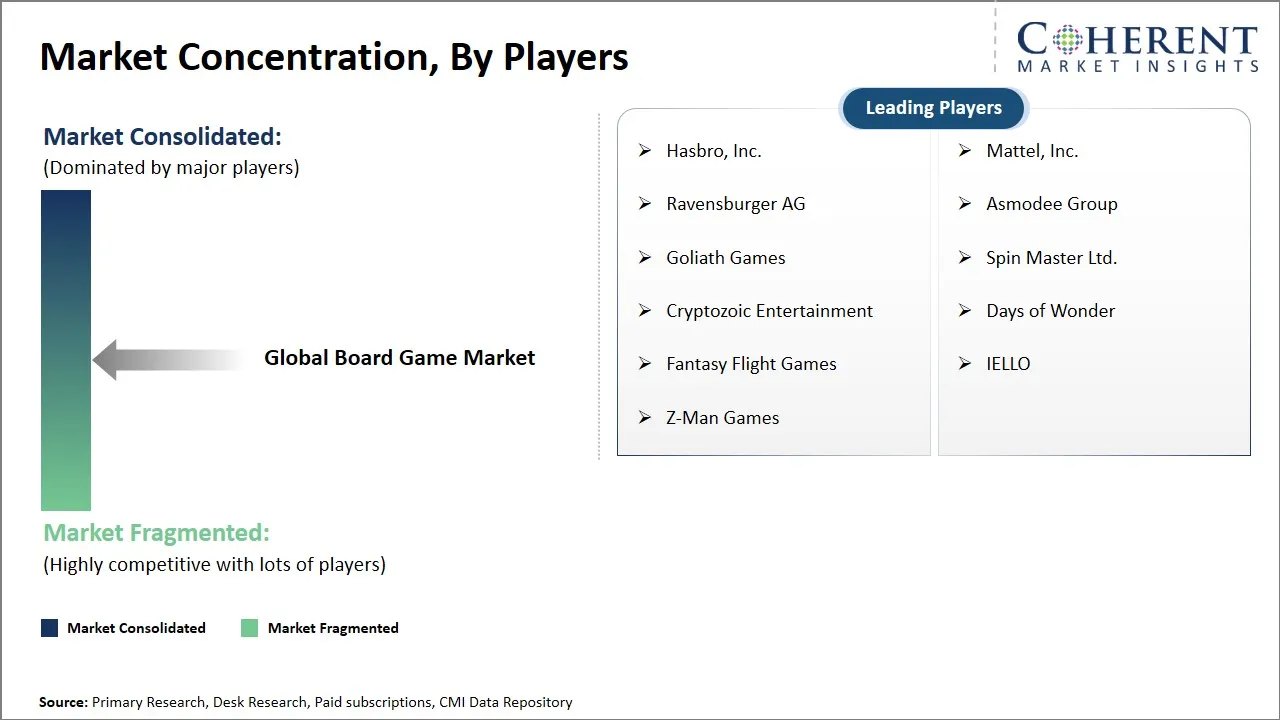
| Companies covered: | Hasbro, Inc., Mattel, Inc., Ravensburger AG, Asmodee Group, Goliath Games, Spin Master Ltd., Cryptozoic Entertainment, Days of Wonder, Fantasy Flight Games, IELLO, and Z-Man Games | ||
| Growth Drivers: |
| ||
| Restraints & Challenges: |
| ||
Board Game Market Dynamics
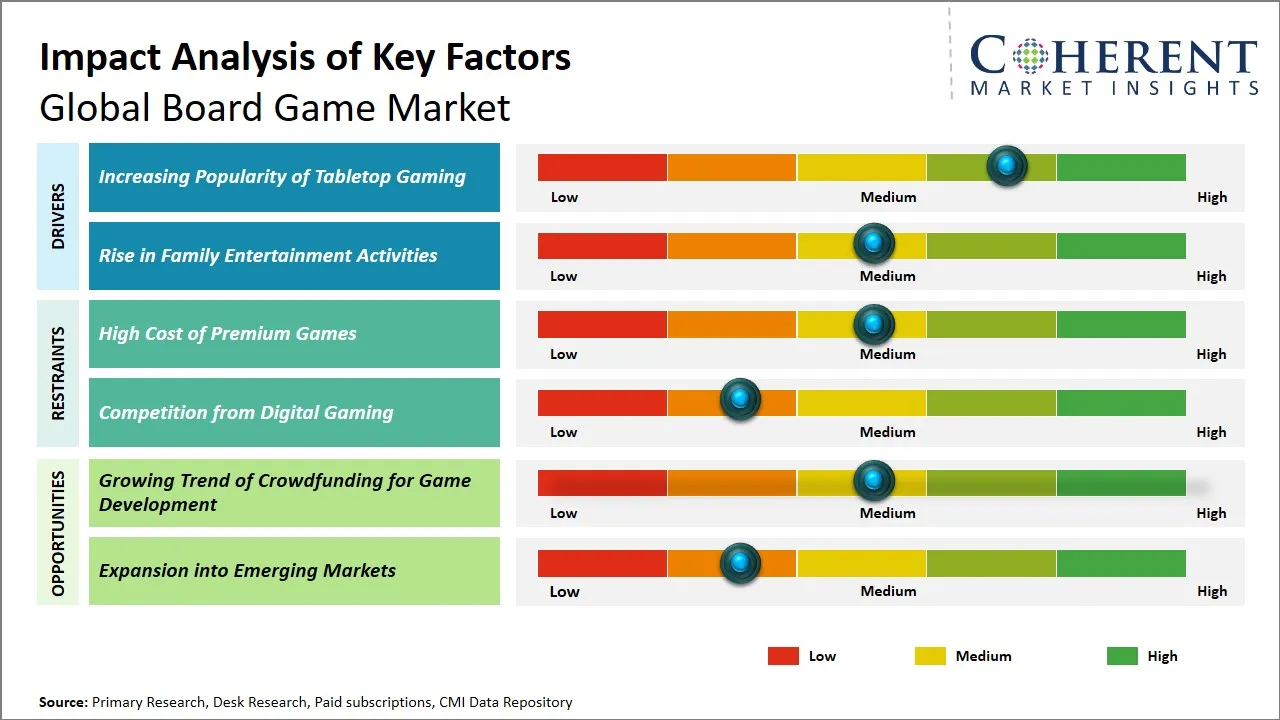
Board Game Market Driver - Increasing Popularity of Tabletop Gaming
The revival of tabletop gaming has become an important trend to stimulate the board game market in the world due to a rapid increase in the demand to socialize and experience entertainment in the form of tabletop games, murder mystery. With the growing popularity of digital fatigue due to the inability to avoid screens, board games are gaining more and more popularity among consumers seeking a chance to interact with friends and family in the real world, in-person. The new cultural trend is also enhanced by how hobbyist groups and influencers are encouraging tabletop games as a leisure activity and a creative one.
As an example, the Gloomhaven tactic role-playing board game, which was one of the most successful tabletop games in a few years. Its popularity shows the increasing trend of sophisticated, immersive experiences in the tabletop game industry, attractive to the players looking at deeper engagement and gameplay storytelling.
Board Game Market Opportunity - Growing Trend of Crowdfunding for Game Development
The increasing popularity of crowdfunding game development presents an excellent opportunity to the global board game market as a company focusing on this area can easily access a vast customer base, a previously unexplored niche, to fund its innovative technologies and projects. Social platforms like Kickstarter, Indiegogo and Game found have democratized access to capital and allowed independent designers and small studios to bypass traditional publishing barriers and reach enthusiastic backers globally directly. This reorientation does not only boost the process of development and introduction of niche, thematic and novel board games but also creates a more diverse and innovative product pipeline, catering to the different tastes of consumers.
As an example, Frosthaven, the sequel to the successful game Gloomhaven which is one of the biggest crowdfunding campaigns in the board game industry. This example highlights the growing popularity of niche games attracting content and funding directly through the gaming community without using the traditional publishing avenue and fulfilling demand.
Analyst Opinion (Expert Opinion)
- The boom of the board game market is remarkable, based on the changing consumer interests toward social and offline entertainment in the post-pandemic world. The Tabletop Game Manufacturers Conference (2023) and the International Toy Fair (2022) provided insights into the main trends in the industry, with companies such as Hasbro or Ravensburger playing with new unique game mechanisms and thematic elements to attract new gaming audiences.
- The recent release of a gamified storytelling series by Hasbros is an indication of the ways in which traditional board games are being adapted to integrate some digital component and be attractive to younger consumers who are tech-savvy. Conversations at these meetings highlighted the growing popularity of cooperative games and the emergence of strategy and thematic depth niche markets.
- The testable issues like growing competition by the digital gaming platforms and the necessity of employing efficient distribution strategies were often mentioned as obstacles. When the companies focus on the consumer engagement via social media, crowdfunding, and community-building projects, they are likely to flourish. The board game market will eventually grow as it is able to constantly innovate and modify according to shifting consumer needs and create a feeling of community amongst players.
Speak to the analyst
Want personalized insights?
Take the findings above to one of our principal consultants, or have the report rebuilt around the segments, geographies and competitors you actually track.
Market Segmentation
- Game Type Insights (Revenue, USD Bn, 2021 - 2033)
- Monopoly
- Scrabble
- Chess
- Others
- Age Group Insights (Revenue, USD Bn, 2021 - 2033)
- 2-5 Years
- Between 5 and 12 Years
- Between 12 and 25 Years
- Above 25 Years
- Sales Channel Insights (Revenue, USD Bn, 2021 - 2033)
- Specialty Stores
- Online E-Commerce
- Hypermarkets and Supermarkets
- Others
- Regional Insights (Revenue, USD Bn, 2021 - 2033)
- North America
- U.S.
- Canada
- Latin America
- Brazil
- Argentina
- Mexico
- Rest of Latin America
- Europe
- Germany
- U.K.
- Spain
- France
- Italy
- Russia
- Rest of Europe
- Asia Pacific
- China
- India
- Japan
- Australia
- South Korea
- ASEAN
- Rest of Asia Pacific
- Middle East
- GCC Countries
- Israel
- Rest of Middle East
- Africa
- South Africa
- North Africa
- Central Africa
- North America
- Key Players Insights
- Hasbro, Inc.
- Mattel, Inc.
- Ravensburger AG
- Asmodee Group
- Goliath Games
- Spin Master Ltd.
- Cryptozoic Entertainment
- Days of Wonder
- Fantasy Flight Games
- IELLO
- Z-Man Games
Sources
Primary Research Interviews
- CEO – Leading Board Game Publisher (e.g., Hasbro or Asmodee equivalent)
- Supply Chain Director – Major Board Game Distributor (e.g., Alliance Game Distributors)
- Production Lead – Board Game Manufacturer (e.g., Panda Game Manufacturing)
- Sustainability Officer – Tabletop Game Industry Certification Authority
Stakeholders
- Manufacturers
- End-use Sectors
- Board Game Publishers and Designers
- Retailers and Board Game Cafes
- Family Entertainment Centers and Event Organizers
- Regulatory & Certification Bodies (e.g., USPTO for IP, EUIPO for designs)
- E-commerce Platforms and Retailers (Amazon, BoardGameGeek Store, Kickstarter)
- Technology Integration Players: Hybrid board-digital game developers
Databases
- UN Comtrade Database (HS Code 9504 for games)
- India Import Export (EXIM) Database
- Statista Toys & Games Market Data (Board Games segment)
- Euromonitor International Consumer Toys Reports
- Grand View Research Playing Cards & Board Games
Magazines
- Tabletop Gaming Magazine – Trends in board game releases
- Senet Magazine – Board gaming craft and community
- Spielbox – Reviews and expansions for hobby games
- Game Trade Magazine – Industry news and distribution
Journals
- Board Game Studies – Academic analysis of tabletop games
- International Journal of Toy Research – Consumer behavior in games
- Games and Culture – Social impact of board gaming
- Journal of Play – Educational aspects of board games
Newspapers
- The Wall Street Journal – Mergers in gaming industry (e.g., Hasbro)
- Reuters – Market growth and crowdfunding trends
- Business Standard (India) – Rising demand in Asia-Pacific
- Variety – Entertainment shifts to analog gaming
Associations
- Game Manufacturers Association (GAMA)
- Tabletop Game Designers Association (TGDA)
- International Games & Puzzles Association
- Board Game Geek Community Forums
- Crowdfunding Association for Tabletop Games
Public Domain Sources
- USPTO – Trademarks and patents for board games
- European Commission – Design rights for game components
- World Intellectual Property Organization (WIPO) – IP guidelines for games
- OECD – Consumer goods trade reports for toys and games
- Public Domain Review – Classic board games (e.g., expired copyrights)
Proprietary Elements
- CMI Data Analytics Tool
- Proprietary CMI Existing Repository of information for last 8 years.
Get access to 250+ pages report
Every segment, forecast, competitor profile and data table behind the analysis above — available for instant download.
- ESOMAR Member
- ISO 9001:2015 Certified
- D-U-N-S Registered
- GDPR & CCPA Compliant
Missing comfort of reading report in your local language? Find your preferred language:
Transform your Strategy with Exclusive Trending Reports
Frequently Asked Questions
The global board game market is estimated to be valued at USD 14.32 Bn in 2026 and is expected to reach USD 20.97 Bn by 2033.
The CAGR of global board game market is projected to be 5.6% from 2026 to 2033.
Increasing popularity of tabletop gaming and rise in family entertainment activities are the major factors driving the growth of the global board game market.
High cost of premium games and competition from digital gaming are the major factors hampering the growth of the global board game market.
In terms of game type, monopoly is estimated to dominate the market revenue share in 2026.
Popular subcategories include cooperative games, party games, and legacy games, which offer evolving experiences.
Europe is expected to lead the global board game market in 2026.