

Global Boron Market Size and Forecast – 2026-2033
The global boron market is estimated to be valued at USD 3.38 Bn in 2026 and is expected to reach USD 4.89 Bn by 2033, exhibiting a compound annual growth rate (CAGR) of 5.4% from 2026 to 2033.
Key Takeaways of the Boron Market
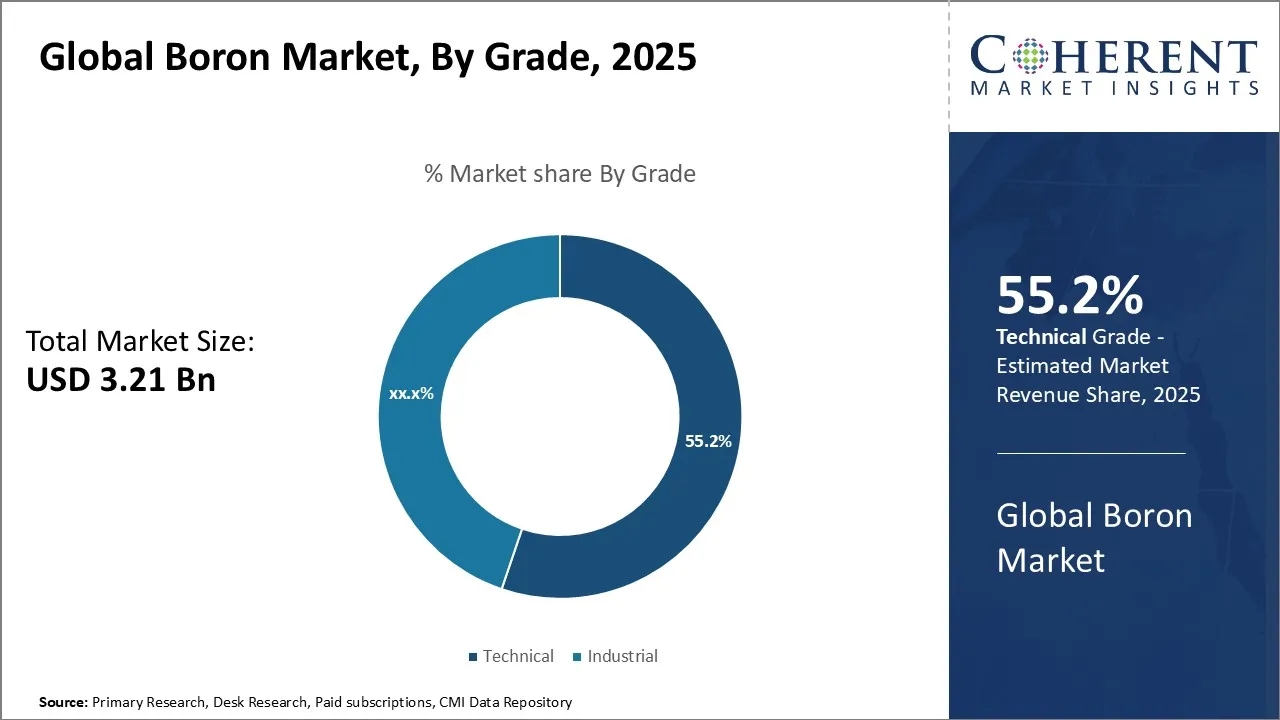
- The technical segment is expected to account for 56.2% of the global boron market share in 2026.
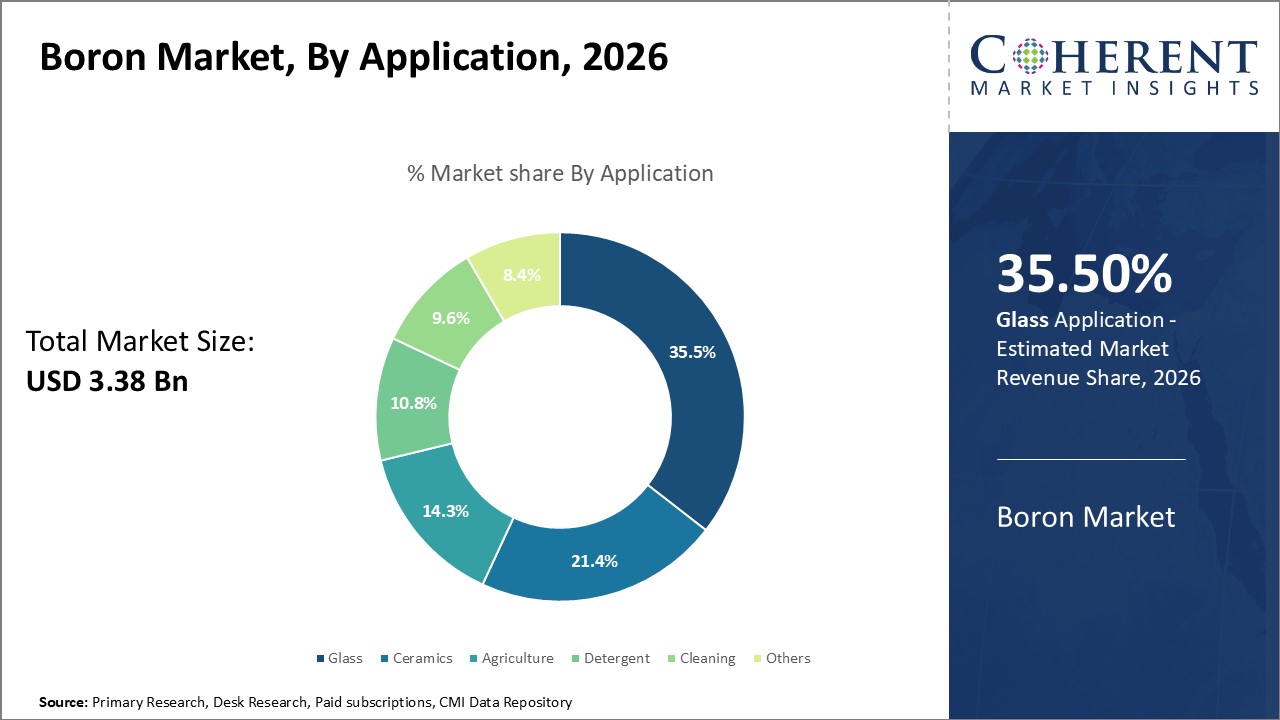
- The glass segment is projected to capture 35.5% of the global boron market share in 2026.
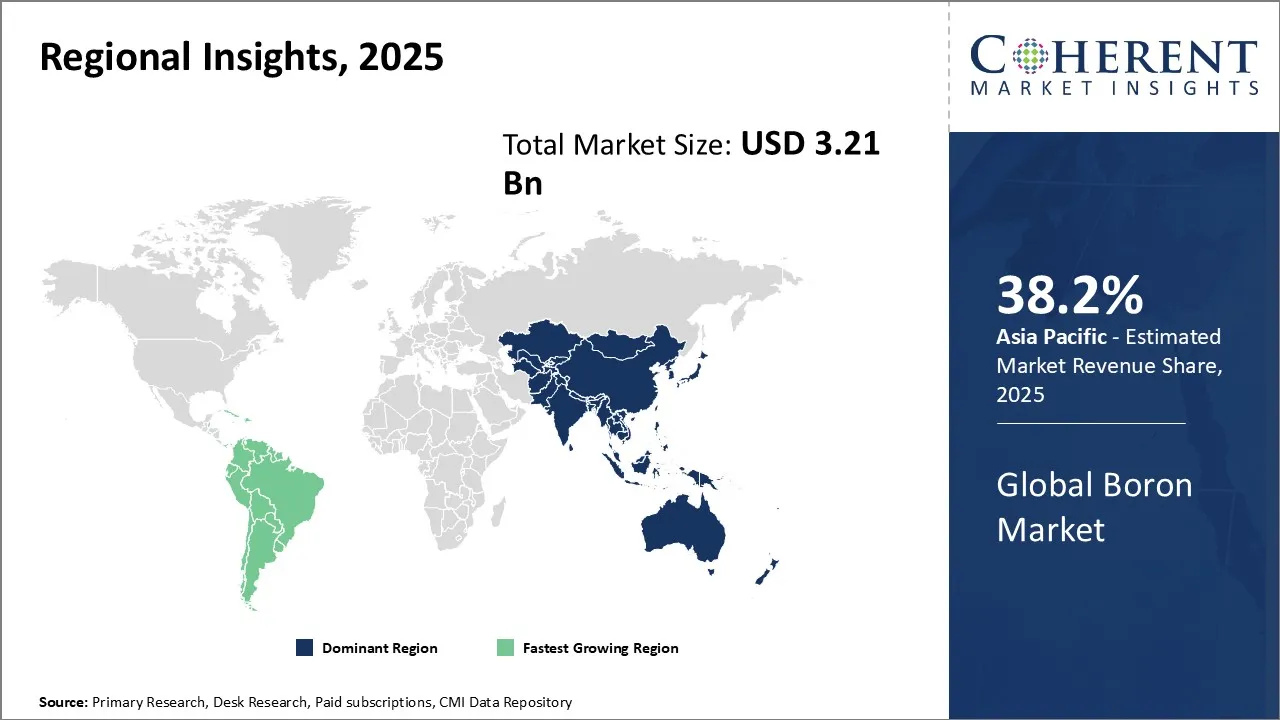
- Asia Pacific is projected to dominate the global boron market in 2026 with a 38.2% share. Latin America, capturing 22.5%, will be the fastest-growing region.
Market Overview
A market trends indicate a growing emphasis on sustainable and eco-friendly boron-based products, as industries seek to reduce environmental impact. There is a notable shift towards the utilization of boron in fire retardants and energy storage solutions, reflecting its versatility. Additionally, stringent regulations on raw material sourcing and processing are prompting manufacturers to innovate in extraction and purification methods. The integration of boron in advanced materials for automotive and construction sectors further propels the market growth in the coming years.
Currents Events and their Impact
Current Events | Description and its Impact |
EU Critical Raw Materials Act (CRMA) formalized, boron/borates on EU critical list |
|
5E Advanced Materials (Fort Cady, U.S.) transitions from pilot to first commercial boric acid delivery milestones |
|
Segmental Insights
- Current Industry Events of 2026
- Market Size Estimation
- Regional Breakdown
- Competitive Landscape
- Customer Intelligence
- Segmental Analysis
- Pricing Analysis
- Key Market Drivers, Challenges & Future Trends
- Customized Insights Section
Boron Market Insights, by Grade – Technical Segment Dominates the Market Owing to its Critical Role in High-Performance Applications
The technical segment is projected to account for 56.2% of the global boron market share in 2026, due to its superior purity and specialized properties required for advanced industrial processes. Boron is highly used in technical grade and is widely used in industries that require accuracy in chemical composition and uniformity, which is a major motivation in the demand of the material. The growing use of technical boron in the production of high strength and lightweight materials is one of the primary drivers of the development of this segment.
Also, the technical grade boron is in demand due to the growing electronics and semiconductor industries. As electronic equipment becomes more sophisticated there is an increasing demand of almost pure boron compounds in the manufacture of semiconductors, optical fibers, and other forms of communication. The importance of technical grade borons in improving the electrical conductivity and its thermal resistance properties is imperative in addressing the high demands of these industries.
Boron Market Insights, by Application - Glass Contributes the Highest Share Driven by Expanding Industrial and Architectural Needs
The glass segment is expected to capture 35.5% of the global boron market share in 2026, due to boron’s essential contribution to improving glass properties. Borosilicate and borate are some of the commonly used boron compounds, which are essential in the production of the many varieties of glass that are prized by their thermal resistance, durability and chemical stability. Boron-enhanced glass has high demand as a product due to its high-performance glass products that are used in the construction and automotive industries.
Regional Insights
Asia Pacific Boron Market Analysis and Trends
The Asia Pacific region is projected to lead the market with a 38.2% share in 2026, driven by the region's vast natural reserves, particularly in countries like Turkey and China, which serve as major boron producers and exporters. The mining ecosystem which has been well established and good industrial demand enhances the leading position of Asia Pacific. The policies of these countries are usually focused on the development of resources and incentives to exports, building strong production capabilities in the country.
Regional demand is also supported by the availability of good industries like agriculture (fertilizers), glass manufacturing, and ceramics. Such firms as Eti Maden (Turkey) and China Yunnan Boron Co. play a central role, taking advantage of modern technologies in extraction and world distribution channels to absorb the leadership of the market in Asia Pacific. The trade processes support Asia Pacific as a net exporter with the strategic exports being to Europe, North America and emerging markets maintaining the momentum.
Latin America Boron Market Analysis and Trends
The Latin America region is expected to exhibit the fastest growth in the market contributing 22.5% share in 2026, propelled by increasing exploration activities and investments in mining infrastructure in countries such as Argentina and Chile. The increasing industrialization foundation in the agricultural sector and the manufacture of glass are contributing to a high level of demand of products that contain boron.
The government policies that support promotion of foreign direct investment in mining sectors and trade agreement that help to provide opportunities of export increase their potential to grow. Rio Tinto and other local mining companies are also significant corporations that are busy developing activities in the area. Moreover, it is also positioned near the emerging markets in North and South America which is a strategic advantage in trade and the reason behind the rapid growth of the boron market in Latin America.
Global Boron Market Outlook for Key Countries
Turkey Boron Market Analysis and Trends
Turkey’s market is the mainstay of the boron industry in the world, due to its abundance and large deposits of boron especially in the western Anatolia region. The main entity of Turkeys power is the state-owned mining company eti Maden, which is supported by the strong governmental effort aimed at maximizing the production of resources and the export volumes. Its strategic position that lies between Europe and Asia helps it to reach into different markets.
The supply chain of turkeys is highly integrated covering its mining, processing, and distribution, which makes it one of the leading suppliers of boron in the world. The incessant technological development and investment in sustainability contribute to the competitiveness of Turkeys in the global market as well.
China Boron Market Analysis and Trends
China boron market is focused around mining and downstream application market segments owing to high domestic demand in the electronics sector, agriculture sector and glass sector. The focus on self-sufficiency in critical minerals by the Chinese governments favors growth in the boron mining and processing capacities. Firms such as the Yunnan Boron Co. have come up with vertically integrated companies making China an important importer and processor of boron ores.
Also, the enormous manufacturing sector of China consumes boron in various industrial processes and products like glass fiber and detergents, which also promotes consumption internally. Increased infrastructure and environmental policies also open the opportunities of innovations in the products of boron that are more efficient.
U.S. Boron Market Analysis and Trends
The U.S. boron market is characterized by both domestic production and steady import reliance to meet industrial demand. Key players such as Rio Tinto Borates operate major mining facilities in California, supplying borates to the national market for uses in agriculture, chemicals, and glass manufacturing. Government environmental policies influence production methods and encourage sustainable mining practices. The robust industrial ecosystem, coupled with advances in high-tech applications like aerospace and electronics, supports consistent boron demand. Trade relationships with exporting countries further complement supply chains, ensuring availability of high-purity boron compounds.
Argentina Boron Market Analysis and Trends
Argentina boron market is emerging rapidly, buoyed by newly discovered boron reserves and increased exploration efforts. Mining companies, both domestic and international, are investing in infrastructure to develop these reserves, supported by government initiatives to boost mining exports and regional economic growth. Argentina’s agricultural sector’s rising need for boron-containing fertilizers drives local demand, as does growth in glass and ceramic industries. The country’s integration into South American trade networks and proximity to larger markets like Brazil provide logistical advantages. Growing mining expertise and strategic partnerships foster Argentina’s burgeoning position in the global boron landscape.
Macro and Micro Economic Factors Impacting Boron Market Growth
Macroeconomic drivers
- Industrial production cycles in glass, ceramics, detergents, electronics, and construction raise boron demand, with growth tied to revitalization in consumer goods, infrastructure, and semiconductor/electronics output.
- Agricultural expansion and productivity targets support sustained uptake of boron micronutrients in fertilizers, linking demand to food security policy and farming modernization.
- Trade policy and tariffs affect boron flows and downstream sectors like solar glass and specialty glass, where tariff frictions can dampen project economics and imports, moderating growth.
Macro constraints and risks
- Geopolitical disruptions and supply chain bottlenecks can tighten availability for glass/ceramics and electronics, raising costs and delaying consumption recovery in key regions.
- Environmental regulations on extraction and processing can extend timelines and increase compliance costs, potentially constraining new supply additions.
- Substitutes and material thrifting in construction and chemicals can temper boron intensity in certain applications during downturns or high-price periods.
Microeconomic demand factors
- End-use innovation: growth in boron applications for high-performance glass/ceramics, flame retardants, aerospace materials, and semiconductor processes underpins premium-grade demand.
- Agriculture use-cases: agronomy practices targeting yield/quality gains sustain recurring demand for boron-containing fertilizers, supported by awareness and adoption rates in developing markets.
Microeconomic supply factors
- Limited domestic production in many demand centers creates import dependence, exposing buyers to freight, FX, and trade-policy volatility in landed costs.
- Raw material and processing cost swings (energy, reagents, labor) drive producer margins and influence offer prices and contract structures across cycles.
- Sustainable mining practices and permitting: operators investing in environmental stewardship can gain social license and secure long-term output, but with higher upfront costs and longer lead times.
Market Players, Key Development, and Competitive Intelligence
Company Insights
- Joylong Chemicals Co., Ltd., headquartered in Changsha, Hunan Province, China, is a comprehensive manufacturing and trading enterprise specializing in the production and export of inorganic and specialty chemicals. The company has established a strong presence in both domestic and international markets, serving industries such as glass and ceramics, metallurgy, enamel coating, pharmaceuticals, and agriculture.
Top Strategies Followed by Global Boron Market Players
- Established Players: The industry is dominated by established players who heavily invest in research and development (R&D) to develop high-performance and value-added products made of boron. Developing superior formulations and better applications to suit the changing requirements of industries, particularly in agriculture, automotive and electronics, are some of the priorities of these companies. These established firms are very active in expanding their presence over the world by increasing distribution networks and establishing regional offices and manufacturing facilities to capture growth opportunities in emerging markets.
- For example, Rio Tinto needs to develop safe and high-purity borates to use in semiconductors and electric vehicles; as an example, the Rio Tinto Company runs the Boron mine in California.
- Boron middle-range players are usually concerned about providing affordable solutions balancing between the quality and cost in favor of price-sensitive customers in the developing markets. Their objective is to cut a sizeable market share by providing credible products at low prices, which attracts businesses that have high budget limitations but demand a steady performance. These middle range companies usually get involved in joint ventures and collaboration in order to increase their production capacity and technological knowhow.
- An example of this is Quiborax in Chile who is cooperating with distributors in Asia to be stronger in its export status and Searles Valley Minerals that gives more attention to the energy efficiency in the borax mining to continue in the price competition.
- Small-scale players, though limited in resources, adopt highly focused strategies to sustain and grow within niche segments of the global boron market. They distinguish themselves by concentrating on specialized or innovative product features tailored to specific end-use applications, such as customized boron compounds for particular agricultural needs or unique formulations for niche chemical processes. To remain competitive, these smaller firms adopt cutting-edge technologies and agile manufacturing techniques that allow for faster innovation cycles and lower overhead costs
Market Report Scope
Boron Market Report Coverage
| Report Coverage | Details | ||
|---|---|---|---|
| Base Year: | 2025 | Market Size in 2026: | USD 3.38 Bn |
| Historical Data for: | 2020 To 2024 | Forecast Period: | 2026 To 2033 |
| Forecast Period 2026 to 2033 CAGR: | 5.4% | 2033 Value Projection: | USD 4.89 Bn |
| Geographies covered: |
| ||
| Segments covered: |
| ||
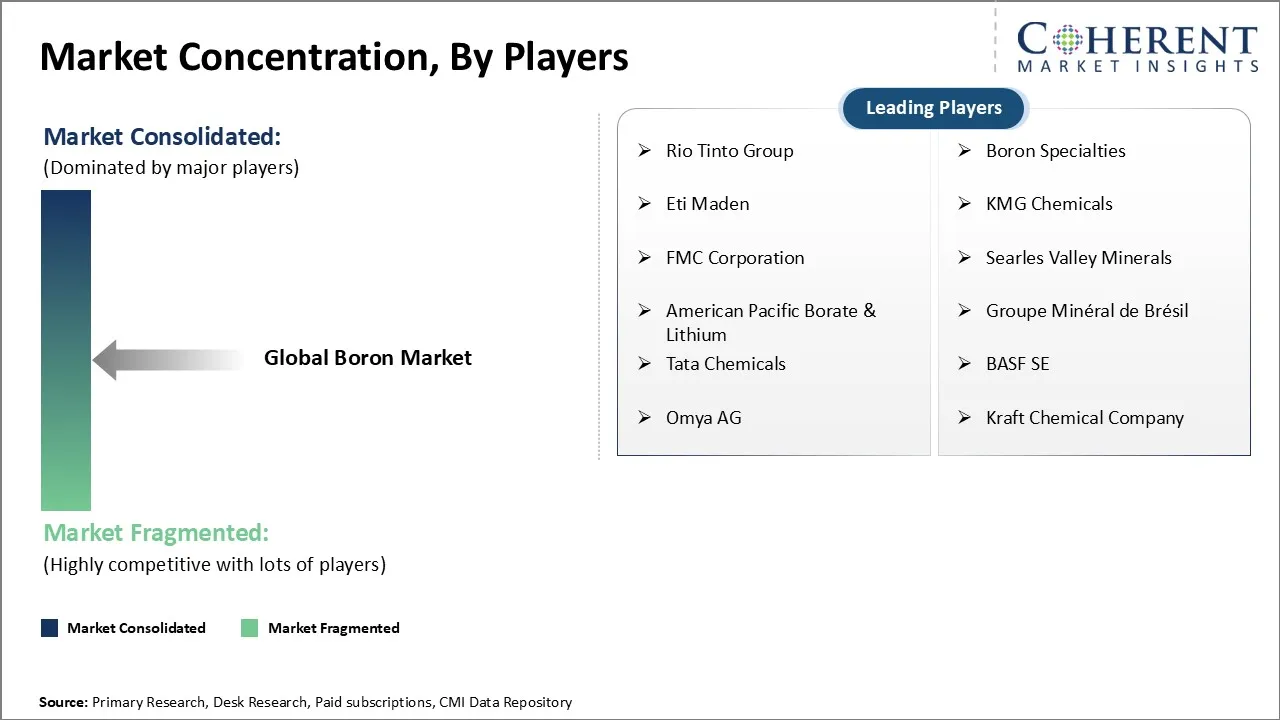
| Companies covered: | Rio Tinto Group, Boron Specialties, Eti Maden, KMG Chemicals, FMC Corporation, Searles Valley Minerals, American Pacific Borate & Lithium, Groupe Minéral de Brésil, Tata Chemicals, BASF SE, Omya AG, and Kraft Chemical Company | ||
| Growth Drivers: |
| ||
| Restraints & Challenges: |
| ||
Market Dynamics
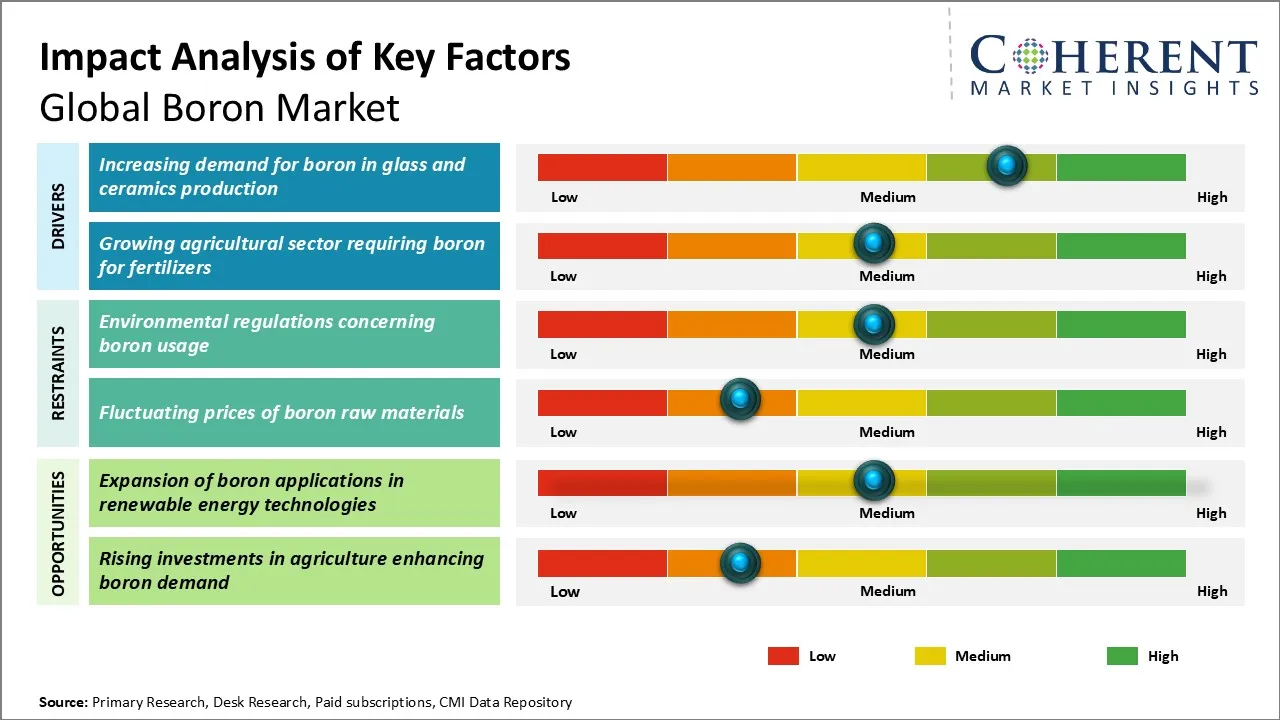
Boron Market Driver - Increasing Demand for Boron in Glass and Ceramics Production
Increased demand of boron in glass and advanced ceramics production is also a major impetus of the world boron market. Boron compounds are very important in the improvement of the durability, thermal resistance and chemical stability of glass and ceramic products. Most notably, borosilicate glass, containing boron oxide, is commonly used in laboratory glassware and cookware, and pharmaceutical containers, because of its thermal resistance and thermal shock resistance. Similarly, boron is used as a fluxing material in ceramics which reduces the melting points and increases the strength and gloss of the products.
A good example is borosilicate glass which contains 12-13% boron oxide. It finds application in Pyrex cookware, laboratory beakers and pharmaceutical vials. As an example, Schott AG and Corning Inc. employ formulations of boron to manufacture high-performance laboratory ware and display glass that is much more resistant to thermal shock.
Boron Market Opportunity - Expansion of Boron Applications in Renewable Energy Technologies
Global focus on the use of renewable energy technologies is another major growth potential in the global boron market. The chemical and physical unparallel allow boron’s to be an indispensable part of various clean energy applications, especially the fabrication of lightweight and high-strength products in wind turbines, solar panels and energy storage units. As an example, boron fibers are currently being used to improve the ratio of strength to weight of wind turbine blades and therefore, efficiency and durability and also lowering manufacturing and operation costs. There are also boron-based compounds that are essential in manufacturing advanced batteries such as lithium-ion batteries that form the core of electric vehicles (EVs) and grid storage solutions.
Analyst Opinion (Expert Opinion)
- The market for boron will be experiencing massive growth due to the rising demand in the different industries like agriculture, glasses, and ceramics. The presentations at the International Boron Symposium (2023) and the Global Minerals Conference (2022) revealed the new ways of using boron, with companies such as Rio Tinto and Borax at the forefront of improvements in environmentally friendly extraction practices.
- The recent advancement by Rio Tintos into the new technology of eco processing highlights a strategic change towards environmental minimization in response to the consumers desire of sustainable processing. Debates in these conferences have signified the setbacks of the supply chain disruption and geopolitical influence on sourcing of boron, and this has cast doubts on the price volatility.
- The firms that will achieve competitive advantages will be those oriented to the development of alternative sources of boron and improvement of recycling techniques. In addition, the increased usage of boron in renewable energy sources, including solar panels and batteries, has new growth prospects. Entering into collaborations with research institutions to learn new applications will also increase market positioning. Finally, the growth of the boron markets will rely on its capacity to overcome the challenges in the supply chain and the innovations in sustainability and the increased use in new technologies.
Speak to the analyst
Want personalized insights?
Take the findings above to one of our principal consultants, or have the report rebuilt around the segments, geographies and competitors you actually track.
Market Segmentation
- Grade Insights (Revenue, USD Bn, 2021 - 2033)
- Technical
- Industrial
- Application Insights (Revenue, USD Bn, 2021 - 2033)
- Glass
- Ceramics
- Agriculture
- Detergent
- Cleaning
- Others
- Regional Insights (Revenue, USD Bn, 2021 - 2033)
- North America
- U.S.
- Canada
- Latin America
- Brazil
- Argentina
- Mexico
- Rest of Latin America
- Europe
- Germany
- U.K.
- Spain
- France
- Italy
- Russia
- Rest of Europe
- Asia Pacific
- China
- India
- Japan
- Australia
- South Korea
- ASEAN
- Rest of Asia Pacific
- Middle East
- GCC Countries
- Israel
- Rest of Middle East
- Africa
- South Africa
- North Africa
- Central Africa
- North America
- Key Players Insights
- Rio Tinto Group
- Boron Specialties
- Eti Maden
- KMG Chemicals
- FMC Corporation
- Searles Valley Minerals
- American Pacific Borate & Lithium
- Groupe Minéral de Brésil
- Tata Chemicals
- BASF SE
- Omya AG
- Kraft Chemical Company
Sources
Primary Research Interviews
- Technical Director – Leading Boron Chemical Manufacturer
- Global Sourcing Manager – Major Industrial Minerals Distributor
- Innovation Lead – Boron-Based Advanced Materials Firm
- Regulatory Affairs Executive – Specialty Chemicals Association
Stakeholders
- Boron Compound Manufacturers
- End-use Sectors:
- Glass & Ceramics (Borosilicate glass, fiberglass, enamel, insulation)
- Agriculture (Micronutrient fertilizers, specialty agrochemicals)
- Detergents & Cleaners (borates for detergents, soaps)
- Industrial & Metallurgy (alloys, fluxes, flame retardants, electromagnets)
- Pharmaceuticals & Healthcare (antiseptics, supplements)
- Electronics & Energy Storage (neodymium magnets, lithium–boron batteries)
- Distributors & Logistics Providers
- Regulatory & Certification Bodies
- E-commerce Platforms and Specialized Chemical Marketplaces
- Technology Integration Players: Process Automation, Traceability, and Green Chemistry Consultants
Databases
- UN Comtrade Database (borates, boron oxides, boric acid trade)
- India Import Export (EXIM) Database (boron products, HS codes)
- USGS Mineral Commodity Summaries – Boron statistics and reserves
Magazines
- Industrial Minerals Magazine – Borates pricing, supply, and demand
- Chemical Week – Boron market M&A and technology updates
- Glass International – Boron’s role in advanced glass and insulation
- Fertilizer International – Trends in micronutrient (boron) fertilizers
- Specialty Chemicals Magazine – Innovations in boron applications
Journals
- Journal of Cleaner Production – Sustainability in boron extraction/processing
- Mineral Processing & Extractive Metallurgy Review – Boron resource refinement and applications
- Journal of Agricultural and Food Chemistry – Boron in micronutrient fertilizers and plants
- Journal of Non-Crystalline Solids – Boron in glass manufacturing
- Energy Storage Materials – Boron in batteries and energy tech
Newspapers
- The Wall Street Journal – Boron industry trends, new discoveries
- Bloomberg – M&A and investment into critical minerals including boron
- Asia Miner – Boron mining and project updates in Asia-Pacific
- Chemical & Engineering News – Advanced boron applications
Associations
- Industrial Minerals Association – Europe (IMA-Europe)
- Borax (Rio Tinto Borates) Industry Reports
- Fertilizer Association of India (FAI)
- American Chemistry Council (ACC) – Boron product regulatory dossiers
- International Fertilizer Association (IFA)
Public Domain Sources
- European Chemicals Agency (ECHA) – Boron classification, REACH guidelines
- USGS – Annual boron minerals and materials reports
- Bureau of Indian Standards (ISI) – Boron standards for fertilizers/industrial use
- Food and Agriculture Organization (FAO) – Boron in crop micronutrients
- World Bank – Critical minerals outlook
Proprietary Elements
- CMI Data Analytics Tool, Proprietary CMI Existing Repository of information for last 8 years.
Get access to 250+ pages report
Every segment, forecast, competitor profile and data table behind the analysis above — available for instant download.
- ESOMAR Member
- ISO 9001:2015 Certified
- D-U-N-S Registered
- GDPR & CCPA Compliant
Missing comfort of reading report in your local language? Find your preferred language:
Transform your Strategy with Exclusive Trending Reports
Frequently Asked Questions
The global boron market is estimated to be valued at USD 3.38 Bn in 2026 and is expected to reach USD 4.89 Bn by 2033.
The CAGR of the global boron market is projected to be 5.4% from 2026 to 2033.
Increasing demand for boron in glass and ceramics production and growing agricultural sector requiring boron for fertilizers are the major factors driving the growth of the global boron market.
Environmental regulations concerning boron usage and fluctuating prices of boron raw materials are the major factors hampering the growth of the global boron market.
In terms of grade, the technical segment is estimated to dominate the market revenue share in 2026.
Rio Tinto Group, Boron Specialties, Eti Maden, KMG Chemicals, FMC Corporation, Searles Valley Minerals, American Pacific Borate & Lithium, Groupe Minéral de Brésil, Tata Chemicals, BASF SE, Omya AG, and Kraft Chemical Company are the major players.
Asia Pacific is expected to lead the global boron market in 2026.