

Global Bus Validator Market Size and Forecast – 2026 To 2033
The global bus validator market is expected to grow from USD 3.75 Bn in 2026 to USD 8.20 Bn by 2033, registering a compound annual growth rate (CAGR) of 9% from 2026 to 2033. The global bus validator market is driven by the increasing integration of mobile ticketing and QR-code validation technologies. On May 14, 2026, BMTC introduced the latest generation electronic ticketing devices with dynamic QR-code generation and validation. The new platform will provide mobile tickets, QR-based fare payments, digital passes and smart cards via a centralized software system, augmenting QR-based mobile ticketing in the Bengaluru bus network in India.
Key Takeaways of the Global Bus Validator Market
- The hardware segment is expected to account for 62.0 % of the global bus validator market share in 2026. Growing expansion of Bus Rapid Transit (BRT) networks in emerging economies is driving the growth of the segment. On May 13, 2025, Volvo Buses started the production of its first electric bi-articulated bus chassis. With zero CO2 emissions and very low noise levels, the Volvo BZRT model, in articulated and bi-articulated versions, is manufactured at Volvo’s Brazilian plant in Curitiba, which is now capable of exporting the chassis to BRT systems worldwide. (Source: Volvo)
- The one-station validator segment is estimated to capture 54.0 % of the market share in 2026. Growing deployment of Automated Fare Collection (AFC) systems in urban transit is a major factor driving the growth of the segment. On January 12, 2026, Aurionpro Solutions announced it has won a significant order from Delhi Metro Rail Corporation (DMRC) for the implementation of Automated Fare Collection (AFC) systems for the Bhopal and Indore Metro Rail projects.
- The contactless smart card validators segment is estimated to capture 36.0 % of the market share in 2026. Increasing demand for real-time passenger and ridership analytics is driving the growth of the segment. On January 29, 2026, the Helsinki Regional Transport Authority (HSL) commissioned INIT to deliver a state-of-the-art on-board system for its entire vehicle fleet. The project includes container-based software, vehicle hardware, and services and will be rolled out across approximately 1,700 buses, trams, metro cars, trains, and ferries.
- Asia Pacific is expected to dominate the bus validator market in 2026 with a market share of 38.0 %. Growing public transport investments across Asia Pacific is a prime driver for the regional market. On June 19, 2026, JBM Ecolife Mobility secured an investment of approximately USD 80 million from Motilal Oswal Alternates to support the deployment of around 2,000 electric buses across India.
- North America is expected to account for 27.0 % share in 2026 and is projected to record the fastest growth over the forecast period. Growing expansion of Mobility-as-a-Service (MaaS) platforms in North America is driving the growth of the regional market. On September 14, 2025, Cubic Transportation Systems announced the launch of Open Payments on the Umo Mobility platform, a next-generation capability that simplifies fare payments and delivers a faster, more seamless rider experience. (Source: Cubic)
- Rapid Shift Toward Open-Loop and Contactless Payments: Transit agencies are moving fast to install validators accepting EMV bank cards, mobile wallets, digital payments, wearables and NFC-enabled smartphones at the moment of boarding. It minimizes dependency on proprietary transit cards, increases convenience to passengers and allows seamless fare payments across different modes of transportation.
- Integration of Account-Based Ticketing (ABT) Platforms: Modern bus validators are being connected into cloud-based, account-centric fee collection systems, where ticket calculation, capping, concessions and transaction management are processed centrally rather than stored on physical cards. This enables changeable tariff rules, remote updates and a more personalized customer experience.
Segmental Insights
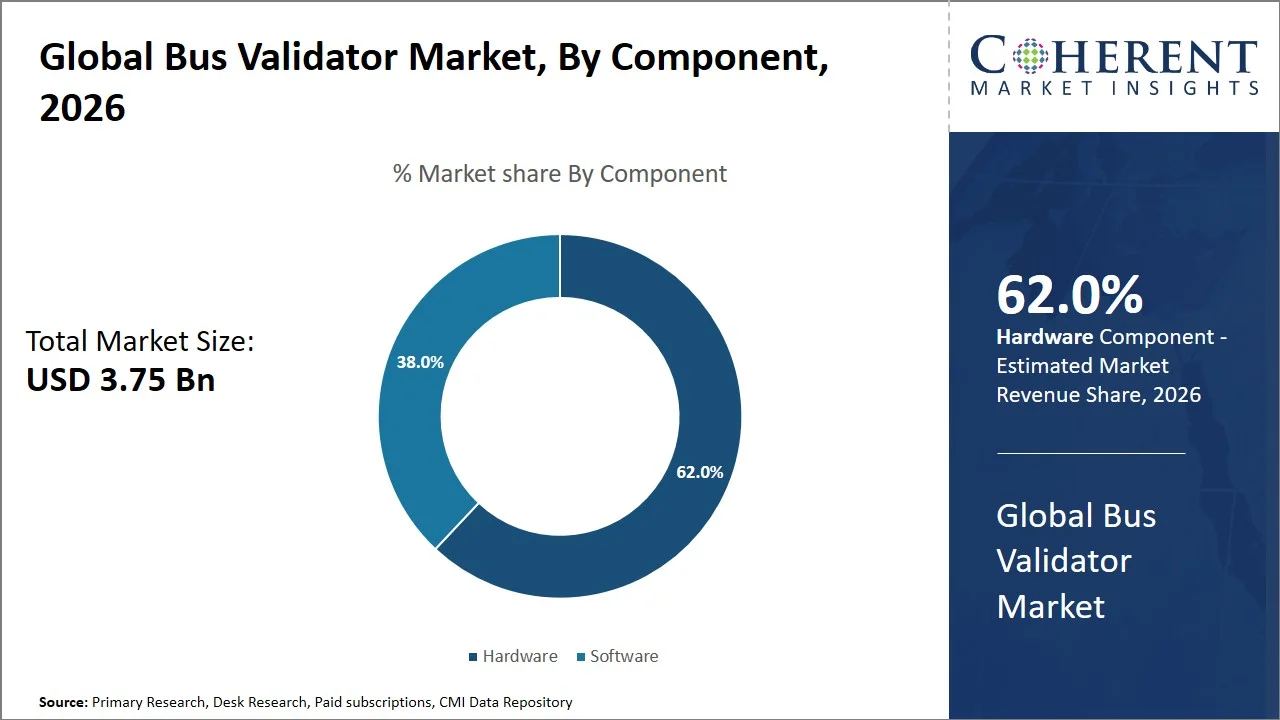
Why Does Hardware Dominate the Global Bus Validator Market?
The hardware segment is expected to account for 62.0% of the global bus validator market share in 2026. With the increasing deployment of contactless fare collecting systems throughout public transport networks, there is increased need for large investments in physical validation infrastructure. Buses need reliable hardware components from transit operators such as NFC readers, smart card readers, QR code scanners, touch displays, communication modules and secure processing units. Hardware costs are the most in bus validator projects, because each bus must have its own validation equipment and periodic hardware upgrades to keep up with evolving payment methods.
On December 8, 2025, Edmonton Transit Services (ETS), Canada, in partnership with Vix Technology, announced the full launch of the Arc next-generation fare payment system across the region’s bus and light-rail networks. This milestone completes a transformative, multi-phase project culminating with the introduction of open payments using credit/debit cards and mobile devices across thousands of validators spanning six municipalities and all major transit modes. (Source: Vix)
- Current Industry Events of 2026
- Market Size Estimation
- Regional Breakdown
- Competitive Landscape
- Customer Intelligence
- Segmental Analysis
- Pricing Analysis
- Key Market Drivers, Challenges & Future Trends
- Customized Insights Section
Why is One-Station Validator the Most Preferred Type?
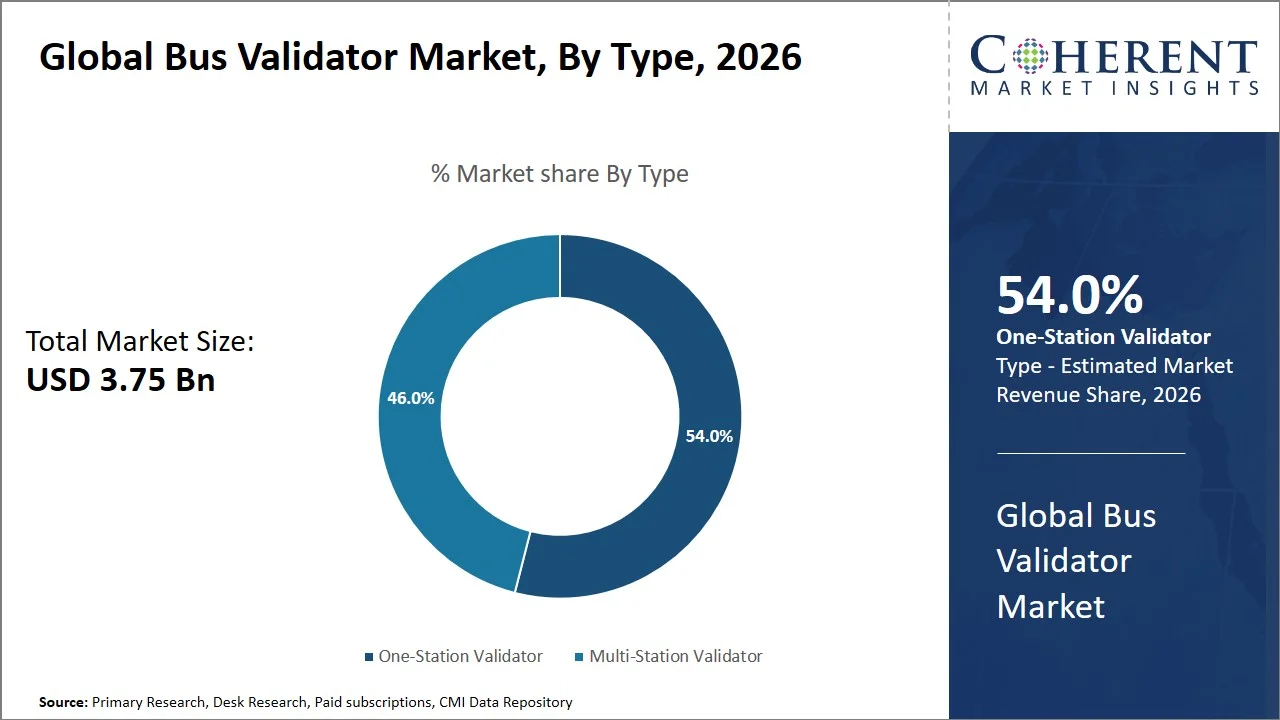
The one-station validator segment is expected to account for 54.0% of the global bus validator market share in 2026. The prevalence of typical city buses with a single passenger entry point has made the one-station validator the ideal solution for a lot of transport operators. These systems only require a single validation unit per vehicle, resulting in lower installation, maintenance and operational expenses than multi-station designs. The simpler deployment strategy allows for speedier fleet-wide implementation, while offering effective fare validation and passenger processing for the majority of urban and regional bus services.
Contactless Smart Card Validators Dominates the Global Bus Validator Market
The contactless smart card validators segment is expected to account for 36.0% of the global bus validator market share in 2026. The increasing emphasis on speedier and more convenient fare collection in public transportation systems has hastened the deployment of contactless smart card validators. With these validators, passengers may complete transactions in seconds via a simple tap-and-go method, shortening boarding times and enhancing operational efficiency. They have been chosen over other transit payment technologies like NFC validators, by transit agencies updating their payment infrastructure because they offer stability, robust security features, and compatibility with large-scale automated fare collecting networks.
Currents Events and their Impact
Current Events | Description and its Impact |
European Union - Single Digital Booking and Ticketing Initiative (2026) |
|
European Union - Rail Telematics Interoperability Regulation (2026) |
|
(Source: European Commission, European Union)
Bus Validator Market Dynamics
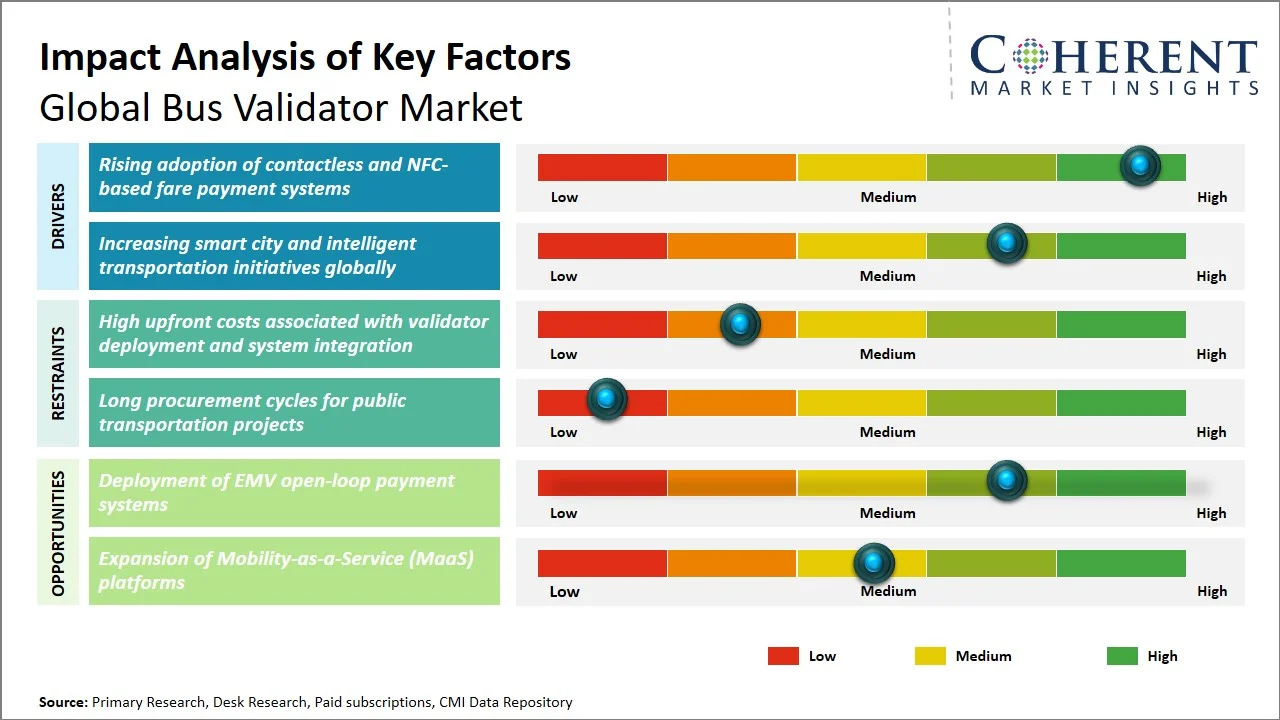
Market Drivers
Rising adoption of contactless and NFC-based fare payment systems
The rising implementation of contactless and NFC-based fare payment systems is transforming public transportation networks by enabling faster, more convenient and cashless passenger transactions. More and more transit agencies are resorting to validators that accept tap-and-go payments with smart cards, mobile wallets and NFC-enabled smartphones. These solutions help reduce boarding times, streamline operational efficiency, and improve the entire client experience. The use of contactless fare collection technology in the world’s bus fleets is driven by a growing focus on digital mobility solutions and government measures to boost smart transportation infrastructure. On October 7, 2025, Tompkins Consolidated Area Transit modernized their fare collection system with Genfare on enabling contactless bank cards, NFC-enabled mobile wallets, smart cards and mobile ticketing. The project also incorporated automated fare capping, further boosting the convenience of contactless transit for passengers.
Increasing smart city and intelligent transportation initiatives globally
Increasing smart city and intelligent transportation initiatives worldwide are driving significant investment in digitally connected public transit infrastructure Governments and city authorities are using smart fare collection systems, real-time passenger information and integrated mobility networks to enhance the efficiency and sustainability of urban transportation. Hence, the need for modern bus validators is expanding due to their importance in supporting seamless ticketing, data collecting, passenger analytics and interoperability in smart transportation ecosystems.
On February 24, 2026, Iteris, Inc announced a collaboration with JMDiaz, Inc. and LYT to support the Los Angeles County Metropolitan Transportation Authority (LA Metro) in deploying a countywide cloud-based Transit Signal Priority (TSP) system across 13 major corridors in Los Angeles County, U.S. (Source: Iteris)
Emerging Trends
- Adoption of AI and Real-Time Passenger Analytics: Next-generation validators are increasingly integrated with intelligent transportation management systems that track real-time data on passengers, boarding and route use. Transit operators use this knowledge to optimize routing, improve fleet allocation, eliminate congestion, and better manage revenue.
- Convergence with Smart City and Mobility-as-a-Service (MaaS) Ecosystems: Bus validators become multimodal access points for integrated ticketing of buses, metros, railroads, bike-sharing and other mobility services. This trend fuels the demand for interoperable validation technology to provide a common travel planning, fare payments and mobility management throughout smart city transportation networks.
Regional Insights

Why is Asia Pacific a Strong Market for Bus Validators?
Asia Pacific is expected to account for a market share of 38.0% in 2026. The Asia Pacific region is the most active region for bus validator deployments due to the large-scale transit digitization schemes underway in China, India, Japan, Singapore, and South Korea. Cities like Singapore have rolled out account-based ticketing through the Land Transport Authority, while large Chinese municipalities like Shanghai and Shenzhen have rolled out QR code, NFC and mobile wallet validation across bus networks. India is fast deploying validators through the National Common Mobility Card, which is generating a strong need for interoperable fare validation infrastructure across numerous transport modes. On April 15, 2026, Datamatics announced that it is associated with Phase 1 of Mumbai Metro line 2B and 9 as implementing partner of Automatic Fare Collection (AFC) and mobile ticketing systems. The AFC system has provided for faster entry-exit and auto fare deduction.
Why Does the North America Bus Validator Market Exhibit High Growth?
North America is projected to account for 27.0% of the global bus validator market and is expected to register the fastest growth. In North America, legacy fare collection systems are being replaced by open-loop payment systems where bank cards and mobile wallets are accepted directly at bus validators. Transit organizations including New York’s Metropolitan Transportation Authority, the Chicago Transit Authority and the Los Angeles County Metropolitan Transportation Authority have launched contactless payments on their whole fleets of buses. The region is also seeing an increase in the implementation of account-based ticketing systems, which centralize fare processing and allow for seamless interaction between buses, rail services and regional transit networks. On December 2, 2025, LECIP INC. announced that it has been awarded contracts for the supply of fare collection systems from Orange County Transportation Authority (OCTA) and Collier County, U.S. (Source: Lecip Inc)
Global Bus Validator Market Outlook for Key Countries
Why is China Emerging as a Major Hub in the Bus Validator Market?
China is a key market with high investments in smart public transportation and a high penetration of digital payment ecosystems. Bus operators in cities including Beijing, Shanghai, Guangzhou and Shenzhen support fare validation through platforms including Alipay and WeChat Pay as well as transit smart cards. Thanks to the country’s focus on smart city development and intelligent transportation systems, advanced validators capable of processing QR-code, NFC and multimodal transactions in real time have been deployed.
Is the U.S. the Next Growth Engine for the Bus Validator Market?
The U.S. is undertaking large transportation modernization projects to improve customer convenience and reduce cash processing. Agencies like New York City’s MTA have developed their OMNY contactless payment infrastructure to allow riders to tap their bank cards and mobile devices directly on buses and transit services. Similar efforts in Chicago, Miami and Los Angeles are resulting in modifications to validator hardware to accommodate open-loop payments, fare capping and account-based ticketing features.
U.K. Bus Validator Market Analysis and Trends
The U.K. has developed one of the most advanced contactless fare payment platforms for bus travel. London’s bus network (run by Transport for London) has become a global model for tap-and-go fare collecting with contactless bank cards and mobile wallets, with more regional operators following suit. Government-driven efforts to enhance multimodal transport integration are further incentivizing the deployment of validators that allow for smooth travel between buses, railroads and urban mobility services.
India Bus Validator Market Analysis and Trends
With the widespread rollout of National Common Mobility Card-enabled ticketing systems and digitization plans for public transport, India is emerging as one of the fastest changing marketplaces. Cities including as Delhi, Mumbai, Bengaluru and Ahmedabad are rolling out validators for NCMC-based payments, QR code ticketing and smartphone fare collection on municipal bus services. Government initiatives such as smart city and urban mobility programs are speeding the shift away from cash-based ticketing toward interoperable digital validation systems capable of supporting multimodal transportation networks.
Japan Bus Validator Market Analysis and Trends
Japan’s bus validator market benefits from the country’s highly modern public transportation system and the widespread adoption of contactless transit cards. Widely employed on urban and regional bus networks, validators compatible with IC card platforms such as Suica and PASMO facilitate fast passenger boarding and fare collection. Transit operators are also modernizing validator systems to accommodate smartphone-based payments and more interaction with digital mobility services as part of ongoing efforts to modernize transportation.
Global Bus Validator Market - Active Bus Validators Installed Base by Country (2026)
Country | Estimated Active Bus Validators Installed Base (Units) |
China | 1,180,000 |
India | 620,000 |
Japan | 310,000 |
U.S. | 285,000 |
Brazil | 225,000 |
U.K. | 185,000 |
South Korea | 170,000 |
Germany | 155,000 |
France | 145,000 |
Russia | 135,000 |
How is the Deployment of EMV Open-Loop Payment Systems Creating New Growth Opportunities in the Bus Validator Market?
EMV open-loop payment solutions are emerging as major growth potential for the bus validator industry, offering passengers the convenience of paying fare directly using contactless bank cards, credit cards, debit cards and mobile wallets instead of dedicated transit cards. This trend is prompting transit agencies to replace their existing validator infrastructure with EMV compatible hardware and software capable of processing real-time financial transactions in a safe manner. Open-loop also helps operators cut card issuing and management costs and improves customer convenience, with seamless travel across numerous transport modes, which will drive demand for next-generation bus validators with more advanced payment acceptance capabilities. On February 12, 2026, Denver’s Regional Transportation District proceeded to expand its Tap-N-Ride platform to include EMV contactless credit cards, debit cards, smartphones and smartwatches for fare payments.
Market Players, Key Development, and Competitive Intelligence

Key Developments
- On August 1, 2025, WeGo Public Transit, in partnership with INIT Innovations in Transportation Inc., a leader in fare payment technologies, launched a new contactless fare payment system across Nashville’s fixed-route buses, including express routes, and the WeGo Star commuter train.
- On May 15, 2025, Scheidt & Bachmann announced a major achievement with the full deployment of FareGo FB|30 fareboxes across the Chicago Transit Authority (CTA) bus fleet. With over 2,000 CTA buses now equipped with Scheidt & Bachmann’s modern fare collection solution, this project marks a significant step forward in CTA’s system modernization.
Competitive Landscape
The global bus validator market is driven by competition between established fare collecting and intelligent transportation technology companies, who are competing through product innovation, payment compatibility and long-term transit authority contracts. Cubic Corporation, INIT, Scheidt & Bachmann, Genfare, Vix Technology and LECIP Holdings are developing validators that handle contactless payments, EMV open-loop transactions, QR code ticketing and account based ticketing platforms. Across the market, strategic collaborations with transit agencies, software integration skills and the capacity to support multimodal transportation ecosystems are increasingly being leveraged as significant competitive differentiators.
Market Report Scope
Bus Validator Market Report Coverage
| Report Coverage | Details | ||
|---|---|---|---|
| Base Year: | 2025 | Market Size in 2026: | USD 3.75 Bn |
| Historical Data for: | 2020 To 2024 | Forecast Period: | 2026 To 2033 |
| Forecast Period 2026 to 2033 CAGR: | 9% | 2033 Value Projection: | USD 8.20 Bn |
| Geographies covered: |
| ||
| Segments covered: |
| ||
| Companies covered: | Cubic Corporation, INIT, Scheidt Bachmann, Genfare, LECIP Holdings, Vix Technology, AEP Ticketing Solutions, IVU Traffic Technologies, LG CNS, GMV, Access IS, Newcapec Electronics, Cardlan, GOLONG Technology, and Busmatick | ||
| Growth Drivers: |
| ||
| Restraints & Challenges: |
| ||
Analyst Opinion (Expert Opinion)
- Growing inclination towards cashless mode of fare collection and continuous digital transformation of public transportation systems are likely to have a beneficial impact on the industry. There is an increased focus on interoperable payment infrastructure, real-time passenger data management and seamless mobility experiences that is expected to speed up the replacement of legacy validation systems. Sustained expenditures in smart transportation projects and transit modernization schemes are anticipated to underpin long-term adoption of advanced bus validator technologies.
- EMV open-loop payment systems, account-based ticketing platforms and integrated mobility networks are expected to have great development potential. The rising trend of smart city projects and multimodal transportation ecosystems is expected to raise demand for validators capable of supporting different payment options and centralized fare management. Next-generation bus validator systems are likely to grow in functionality and value proposition in the future years with the adoption of cloud-based fare collecting platforms, AI-powered passenger analytics and mobile-first ticketing solutions.
Speak to the analyst
Want personalized insights?
Take the findings above to one of our principal consultants, or have the report rebuilt around the segments, geographies and competitors you actually track.
Market Segmentation
- Component Insights (Revenue, USD Billion, 2021 - 2033)
- Hardware
- Software
- Type Insights (Revenue, USD Billion, 2021 - 2033)
- One-Station Validator
- Multi-Station Validator
- Technology Insights (Revenue, USD Billion, 2021 - 2033)
- Contactless Smart Card Validators
- NFC Validators
- QR Code Validators
- Chip and PIN Validators
- Magnetic Stripe Validators
- End User Insights (Revenue, USD Billion, 2021 - 2033)
- Transit Authorities
- Fleet Operators
- Smart City Projects
- Regional Insights (Revenue, USD Billion, 2021 - 2033)
- North America
- U.S.
- Canada
- Latin America
- Brazil
- Argentina
- Mexico
- Rest of Latin America
- Europe
- Germany
- U.K.
- Spain
- France
- Italy
- Russia
- Rest of Europe
- Asia Pacific
- China
- India
- Japan
- Australia
- South Korea
- ASEAN
- Rest of Asia Pacific
- Middle East
- GCC Countries
- Israel
- Rest of Middle East
- Africa
- South Africa
- North Africa
- Central Africa
- North America
- Key Players Insights
- Cubic Corporation
- INIT
- Scheidt Bachmann
- Genfare
- LECIP Holdings
- Vix Technology
- AEP Ticketing Solutions
- IVU Traffic Technologies
- LG CNS
- GMV
- Access IS
- Newcapec Electronics
- Cardlan
- GOLONG Technology
- Busmatick
Sources
Primary Research Interviews
- Bus Operators & Public Transit Authorities
- Bus Validator Hardware Manufacturers
- Transit Technology Solution Providers
- Ticketing & Payment System Integrators
Magazines
- Passenger Transport Magazine
- Mass Transit Magazine
- Intelligent Transport Magazine
- Bus & Coach Buyer Magazine
Journals
- Journal of Public Transportation
- IEEE Transactions on Intelligent Transportation Systems
- Transportation Research Part C: Emerging Technologies
Associations
- International Association of Public Transport (UITP)
- American Public Transportation Association (APTA)
- Confederation of Passenger Transport (CPT)
- Smart Card Alliance (now Secure Technology Alliance)
Public Domain Sources
- European Commission – Transport & Mobility Publications
- U.S. Department of Transportation (DOT) Reports
- World Bank – Urban Transport Data & Reports
- International Energy Agency (IEA) – Transport Sector Reports
Proprietary Elements
- CMI Data Analytics Tool
- Proprietary CMI Existing Repository of Information for the Last 10 Years
Get access to 250+ pages report
Every segment, forecast, competitor profile and data table behind the analysis above — available for instant download.
- ESOMAR Member
- ISO 9001:2015 Certified
- D-U-N-S Registered
- GDPR & CCPA Compliant
Missing comfort of reading report in your local language? Find your preferred language:
Transform your Strategy with Exclusive Trending Reports
Frequently Asked Questions
The global bus validator market is expected to stand at USD 3.75 Bn in 2026 and is expected to reach USD 8.20 Bn by 2033.
The CAGR of the global bus validator market is projected to be 9% from 2026 to 2033.
Rising adoption of contactless and NFC-based fare payment systems and increasing smart city and intelligent transportation initiatives globally are the major factors driving the growth of the global bus validator market.
High upfront costs associated with validator deployment and system integration and long procurement cycles for public transportation projects are the major factors hampering the growth of the global bus validator market.
In terms of component, the hardware segment is estimated to dominate the market revenue share in 2026.
Bus validators support digital mobility infrastructure by enabling integrated and data-driven public transportation services.
They enable quick digital ticket verification while reducing dependence on paper tickets.