

Middle East Conveyor Belts Market Size and Share Analysis - Growth Trends and Forecast (2026 - 2033)
The Middle East conveyor belts market size is estimated to reach USD 244 Mn in 2026 and is projected to grow at a compound annual growth rate (CAGR) of 4.3% during the forecast period (2026-2033), surpassing USD 327 Mn by 2033. This is due to rising demand for efficient material handling systems across key end-use industries such as mining, oil & gas, construction, and manufacturing.
Key Takeaways from the Middle East Conveyor Belts Market Report
- Based on product type, fabric-reinforced rubber belts are expected to lead the market with a share of 55% in 2026 as a result of their versatility, cost-effectiveness, and widespread adoption across construction, mining, and general material handling applications.
- By cover type, abrasion-resistant conveyor belts segment is slated to hold a market share of 40% in 2026 due to heavy mining, cement, and construction activity in GCC countries.
- In terms of application, mining segment is forecast to account for 23% of the Middle East conveyor belts market share in 2026, driven by increasing mineral exploration activities and rising demand for efficient bulk material handling systems in harsh operating environments.
- Turkey is expected to lead the Middle East conveyor belts industry with a share of 35% in 2026 on account of its strong industrial base, rapid growth in construction and infrastructure development projects, and expanding mining and cement production activities.
- Saudi Arabia, with a share of 25% in 2026, is anticipated to offer lucrative growth opportunities to conveyor belt manufacturers during the forecast period, owing to rapid infrastructure growth and increasing investments in logistics, ports, and mega development projects across the country.
Segmental Insights
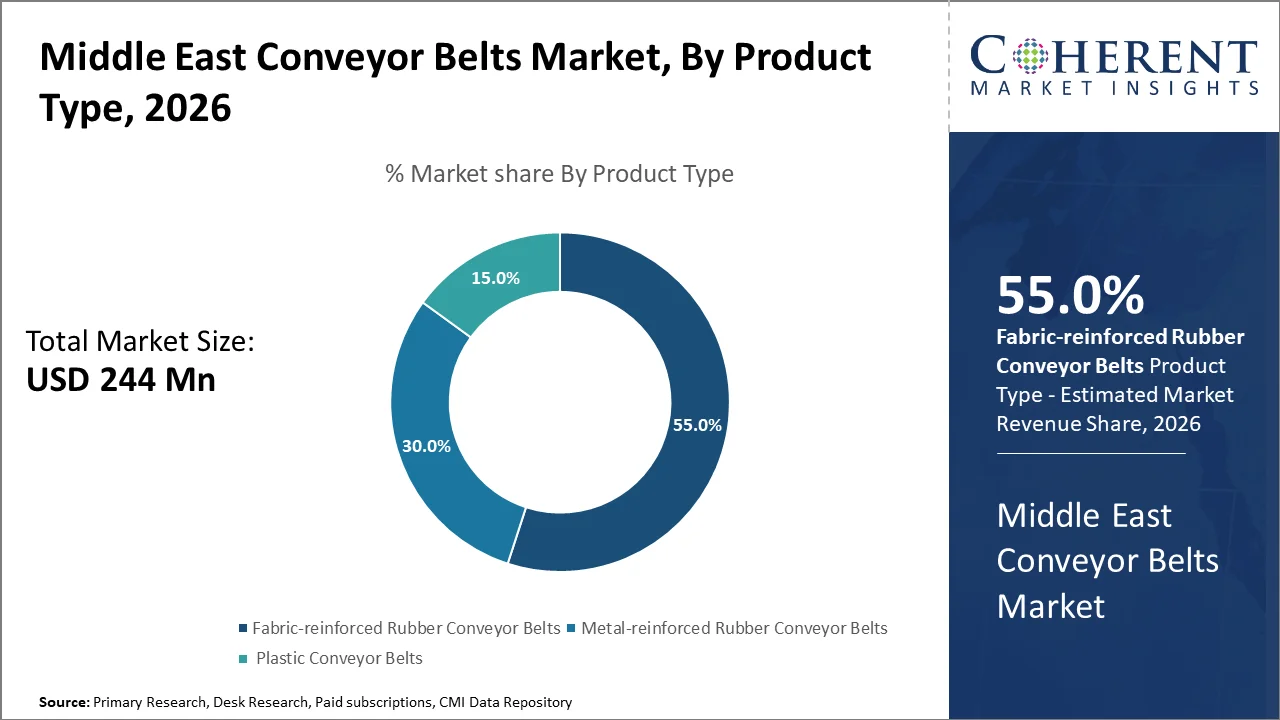
Which Product Type Is in High Demand in the Middle East Conveyor Belts Market?
Fabric-Reinforced Rubber Belts Remain the Top-Selling Product Type in the Middle East
Demand is expected to remain high for fabric-reinforced rubber belts in the Middle East, with this segment accounting for a revenue share of 55% in 2026. This dominance can be attributed to the versatility, cost-effectiveness, and rising adoption of fabric-reinforced rubber belts in construction, mining, and general material handling applications.
Fabric-reinforced rubber belts are preferred because they offer high tensile strength, flexibility, and durability under harsh operating conditions such as extreme temperatures and abrasive environments commonly found in Middle Eastern industries. In addition, their low maintenance requirements and long operational lifespan make them a cost-efficient solution for end users.
- Current Industry Events of 2026
- Market Size Estimation
- Regional Breakdown
- Competitive Landscape
- Customer Intelligence
- Segmental Analysis
- Pricing Analysis
- Key Market Drivers, Challenges & Future Trends
- Customized Insights Section
Which Conveyor Belt Cover Type Dominates the Middle East Market?
Abrasion-Resistant Conveyor Belts Lead the Target Industry
As per Coherent Market Insights’ latest Middle East conveyor belt market analysis, abrasion-resistant conveyor belts segment is set to account for a market share of 40% in 2026. This is mostly due to the region’s harsh operating environments, particularly in mining, cement, steel, and construction sectors, where belts are exposed to heavy loads, sharp materials, and high levels of surface wear. Abrasion-resistant belts offer longer service life, reduced downtime, and lower maintenance costs, making them the preferred choice for high-intensity industrial applications across the Middle East.
Market Dynamics
Middle East Conveyor Belts Market Growth Drivers
Increasing Infrastructure and Mega-Project Investments
The rising number of large-scale infrastructure and mega-project developments is providing a strong impetus for the growth of conveyor belts market in the Middle East. Countries such as Saudi Arabia, United Arab Emirates, and Qatar are heavily investing in smart cities, industrial zones, ports, and airport expansions. These projects require efficient bulk material handling systems, thereby increasing the demand for conveyor belts across construction and industrial applications.
According to a 2025 survey by PwC, 75% of capital project and infrastructure professionals in the Middle East expect an increase in capital spending over the next two years. This is expected to create a conducive environment for the growth of conveyor belts market during the forthcoming period. In addition, major national programs like Saudi Vision 2030 are leading to huge investments in transport, logistics, and industries, which is increasing the demand for conveyor belt systems.
Adoption of Industrial Automation
Industries across countries such as Saudi Arabia, United Arab Emirates, and Turkey are increasingly adopting automation technologies to enhance operational efficiency and reduce dependency on manual labor. Conveyor belt systems play a crucial role in automated material handling across key sectors, including manufacturing, mining, logistics, and airport operations.
According to industry studies, nearly 98% of manufacturers in the Middle East are already using or planning to implement AI and automation technologies. This shift towards automated conveyor belt systems is expected to foster market growth during the assessment period. Rapid expansion of e-commerce and warehousing activities in the region is also encouraging adoption of automated conveyor systems for sorting, packaging, and distribution processes.
Middle East Conveyor Belts Market Trends
Rising Adoption of Lightweight Conveyor Belts
Demand for lightweight and low-noise conveyor systems is steadily increasing across the Middle East nations. This is because industries in the region are shifting toward energy-efficient and low-maintenance material handling solutions. Lightweight conveyor belts are more reliable, use less energy, and are easier to maintain than traditional heavy-duty belts. These systems are widely used across packaging, food processing, textiles, pharmaceuticals, and logistics sectors.
Middle East Conveyor Belts Market Opportunities
Rapid Industrial Growth Across Middle East
Expansion of oil & gas, mining, petrochemicals, and construction industries across the Middle East is expected to create lucrative growth opportunities for conveyor belts market during the forecast period. This is because these industries heavily rely on conveyor belt systems for efficient bulk material handling and transportation.
Middle East Conveyor Belts Market Innovations
Rise of Smart and Sustainable Conveyor Belt Technologies
Innovations in conveyor belt systems are rapidly transforming industrial operations across the Middle East with digital and sustainable designs. Manufacturers are introducing IoT-enabled smart conveyor belts with sensors that monitor temperature, wear, and alignment in real time, enabling predictive maintenance and reducing downtime in mining, logistics, and oil & gas sectors.
There is also a shift toward energy-efficient and eco-friendly belt materials, including lightweight composites and recyclable polymers. This is helping companies reduce operational costs and carbon footprints. Advanced flame-resistant and heat-resistant belts are also gaining traction in harsh environments, particularly in desert and petrochemical applications.
For example, in June 2025, Fenner Dunlop introduced advanced high-strength fabric technologies like Ultra X and Nova X belts. These innovations improve durability, reduce maintenance, and increase efficiency in mining and bulk material handling. They will help the company woo more and more customers as well as meet rising demand for reliable and sustainable conveyor solutions in the Middle East.
Emergence of Halal-Compliant Conveyor Systems
Rising consumption of halal-certified food products across the Middle East is creating significant opportunities for conveyor belt manufacturers. While conveyor belts themselves are not classified as halal products, their materials, coatings, and lubricants must comply with halal standards to prevent contamination during food processing. As a result, food manufacturers are increasingly seeking conveyor systems that meet stringent hygiene and halal-compliance requirements.
Several global players, including Cambridge Engineered Solutions, have obtained halal-compliant certifications for their products from organizations such as Islamic Services of America, indicating a growing, though still specialized, focus on compliant processing equipment. This trend is expected to support innovation and drive demand for halal-compatible conveyor solutions in the region during the forthcoming period.
Current Events and Their Impact
Current Event | Description and its Impact |
GCC mega infrastructure projects (Saudi Vision 2030, NEOM, UAE ports expansion) |
|
Mining and industrial expansion in Saudi Arabia & Oman |
|
Middle East Conveyor Belts Market Outlook – Country-wise
Turkey Remains at the Epicenter of Conveyor Belts Market Growth in the Middle East
Turkey conveyor belts market is poised to register steady growth during the forecast period, capturing a share of 35% in the Middle East market in 2026. This can be attributed to its strong industrial manufacturing base, expanding export-oriented production, and rising mining and quarrying activities.
The country’s well-developed automotive, cement, and machinery industries are increasingly adopting automated conveyor systems to improve production efficiency and reduce labor dependency. In addition, Turkey’s growing integration of Industry 4.0 technologies is accelerating the deployment of smart conveyor solutions in manufacturing facilities.
The country’s mining and natural stone sector is also a major demand driver, particularly for abrasion-resistant conveyor belts used in marble, coal, and aggregate handling. Turkey is one of the world’s leading exporters of marble and natural stone, with total exports of natural stone products valued at approximately $1.9 billion in 2023. This supports conveyor usage in quarrying and processing operations.
Saudi Arabia Becoming a major industry for Conveyor Belt Manufacturers
Saudi Arabia, with a share of 25% in 2026, is poised to create lucrative growth opportunities for manufacturers of conveyor belts during the forecast period. Growth in the Saudi Arabia conveyor belts market is driven by Vision 2030-led industrial diversification, large-scale mining expansion, and mega infrastructure projects.
The country is tapping into an estimated $2.5 trillion in untapped mineral resource potential, including phosphate, gold, copper, and bauxite. This, in turn, is significantly boosting demand for heavy-duty conveyor systems in mining and ore transportation. Conveyor belts are becoming essential for long-distance, high-capacity material movement in remote mining operations under harsh desert conditions.
In addition, giga-projects such as NEOM, The Red Sea Project, and Qiddiya are driving massive requirements for construction material handling, cement logistics, and earthmoving operations, where conveyor systems play a critical role. Saudi Arabia is also strengthening its position as a regional logistics hub through expanding ports and automated warehousing systems, increasing adoption of conveyor-based cargo handling. The rise of e-commerce fulfillment centers and industrial automation in logistics is also fueling demand for high-performance, heat- and abrasion-resistant conveyor belts across the country.
Who are the Major Companies in the Middle East Conveyor Belts Market?
Some of the major players in Middle East Conveyor Belts Market are Al Kuwaiti Industrial Solutions, Ziligen A.S., Arabian Universal, Semperit AG Holding, Bridgestone Corporation, Schieffer Magam Industries Ltd., ContiTech AG (Continental AG), Phoenix Conveyor Belt Systems Gmbh, Derby Conveyor Belt Industry and Trade Inc., Kale Conveyor, FaBa Commercial Services, and Fenner Dunlop Conveyor Belting.
Key Strategies Adopted by Industry Players
Leading manufacturers of conveyor belts across the Middle East are adopting various organic and inorganic strategies to boost their sales as well as stay ahead of the competition. They are focusing on supplying customized and heavy-duty conveyor belts designed for industries like mining, cement, and logistics, where durability and heat resistance are critical. Some companies are also investing in local manufacturing and service centers to reduce delivery time and provide faster maintenance support. For example,
- In March 2026, Fenner Conveyors launched the INFINITY SERIES of recycled-content conveyor belts. These new material handling solutions are designed to deliver reliable performance as well as reduce environmental impact.
- In February 2025, Multi-Conveyor developed a mild steel, bolted construction Z-shaped incline belt conveyor. The system was designed to safely and efficiently transport snack crackers during processing.
- In May 2024, Chiorino Group acquired Ziligen, a Turkey-based company specializing in the production of conveyor belts and flat transmission belts. The acquisition helped Chiorino expand its manufacturing presence and strengthen its position in the market.
Market Report Scope
Middle East Conveyor Belts Market Report Coverage
| Report Coverage | Details | ||
|---|---|---|---|
| Base Year: | 2025 | Market Size in 2026: | USD 244 Mn |
| Historical Data for: | 2020 To 2024 | Forecast Period: | 2026 To 2033 |
| Forecast Period 2026 to 2033 CAGR: | 4.3% | 2033 Value Projection: | USD 327 Mn |
| Geographies covered: |
| ||
| Segments covered: |
| ||
| Companies covered: | Al Kuwaiti Industrial Solutions, Ziligen A.S., Arabian Universal, Semperit AG Holding, Bridgestone Corporation, Schieffer Magam Industries Ltd., ContiTech AG (Continental AG), Phoenix Conveyor Belt Systems Gmbh, Derby Conveyor Belt Industry and Trade Inc., Kale Conveyor, FaBa Commercial Services, and Fenner Dunlop Conveyor Belting. | ||
| Growth Drivers: |
| ||
| Restraints & Challenges: |
| ||
Analyst Opinion (Expert Opinion)
- Mining and industrial expansion is driving steady demand. The Middle East mining sector is expanding due to mineral diversification efforts, especially in countries like Saudi Arabia. Industry estimates suggest mining output targets are rising significantly under national strategies such as Vision 2030. This is increasing demand for heavy-duty conveyor belts used in ore and mineral transport, supporting steady mid-single-digit market growth.
- Oil & gas sector remains a stable end-user. The oil and gas industry continues to use conveyor systems in refineries, ports, and material handling operations. With the Middle East producing over 30% of global crude oil, ongoing maintenance and expansion of downstream facilities ensure consistent demand for heat-resistant and heavy-duty conveyor belts.
- Ports, logistics, and trade growth are accelerating adoption. Major logistics hubs like Jebel Ali (UAE) and King Abdullah Port (Saudi Arabia) are expanding capacity. Regional cargo handling volumes are rising with trade diversification, and port throughput is estimated to grow steadily with container traffic increasing in the mid-single-digit range annually. This is boosting demand for high-speed and durable conveyor systems in material handling operations.
Speak to the analyst
Want personalized insights?
Take the findings above to one of our principal consultants, or have the report rebuilt around the segments, geographies and competitors you actually track.
Market Segmentation
- By Product Type Insights ( Revenue, USD Mn, 2021 - 2033)
- Metal-reinforced Rubber Conveyor Belts
- Fabric-reinforced Rubber Conveyor Belts
- Plastic Conveyor Belts
- By Cover Type Insights ( Revenue, USD Mn, 2021 - 2033)
- Conductive Conveyor Belt
- Abrasion-resistant Conveyor
- Heat- & Flame- resistant Conveyor
- Oil-resistant Conveyor Belt
- By Weight Insights ( Revenue, USD Mn, 2021 - 2033)
- Lightweight
- Medium-weight
- Heavy weight
- By Application Insights ( Revenue, USD Mn, 2021 - 2033)
- Mining
- Food Production Industry
- Commercial
- Construction Industry
- Electricity Generating Stations
- Automotive Industry
- Chemical & Fertilizers
- Packaging Industry
- By Country Insights ( Revenue, USD Mn, 2021 - 2033)
- Middle East
- KSA
- Oman
- Qatar
- UAE
- Kuwait
- Bahrain
- Israel
- Turkey
- Middle East
- Key Players in the Middle East Conveyor Belts Market
- Al Kuwaiti Industrial Solutions
- Ziligen A.S.
- Arabian Universal
- Semperit AG Holding
- Bridgestone Corporation
- Schieffer Magam Industries Ltd.
- ContiTech AG (Continental AG)
- Phoenix Conveyor Belt Systems Gmbh
- Derby Conveyor Belt Industry and Trade Inc.
- Kale Conveyor
- FaBa Commercial Services
- Fenner Dunlop Conveyor Belting
Sources
Primary Research interviews
- Industry experts
- Conveyor belt manufacturers
- Procurement managers from mining, cement, steel, and logistics sectors in the Middle East
- Equipment distributors
- Plant operations personnel
Databases
- National statistical databases
- Customs and trade databases
- Import-export shipment databases
- Industry production databases
- Government open data portals of GCC countries
Magazines
- Industrial equipment magazines
- Mining and construction trade magazines
- Manufacturing and supply chain publications
- Engineering-focused trade periodicals
Journals
- Mechanical engineering journals
- Materials science journals
- Industrial automation journals
- Logistics and supply chain engineering journals
Newspapers
- Leading regional and international business newspapers covering infrastructure, mining, and industrial development news in the Middle East.
Associations
- Mining associations
- Construction industry associations
- Manufacturing and engineering associations
- Logistics and supply chain associations
- Chambers of commerce in GCC countries.
Public Domain sources
- Government ministry publications (industry, mining, energy, and transport)
- World Bank and IMF public datasets
- United Nations trade data
- National infrastructure development reports
- Publicly available regulatory filings
Proprietary Elements
- CMI Data Analytics Tool
- Proprietary CMI Existing Repository of information for last 8 years
Get access to 250+ pages report
Every segment, forecast, competitor profile and data table behind the analysis above — available for instant download.
- ESOMAR Member
- ISO 9001:2015 Certified
- D-U-N-S Registered
- GDPR & CCPA Compliant
Missing comfort of reading report in your local language? Find your preferred language:
Transform your Strategy with Exclusive Trending Reports
Frequently Asked Questions
The conveyor belts market in the Middle East is estimated to be valued at US$ 244 Mn in 2026
The Middle East Conveyor Belts Market value is expected to reach US$ 327 Mn by 2033.
The target market is poised to exhibit a CAGR of 4.3% from 2026 to 2033.
Major growth factors include rapid urbanization, industrial boom, increasing infrastructural projects, and rising demand for energy-efficient conveyor belt systems.
Fabric-reinforced rubber belts, holding 55% share in 2026, is set to dominate the market.
Some major companies in the Middle East Conveyor Belts Market include Al Kuwaiti Industrial Solutions, Ziligen A.S., Arabian Universal, Semperit AG Holding, Bridgestone Corporation, Schieffer Magam Industries Ltd., ContiTech AG (Continental AG), Phoenix Conveyor Belt Systems Gmbh, Derby Conveyor Belt Industry and Trade Inc., Kale Conveyor, FaBa Commercial Services, and Fenner Dunlop Conveyor Belting.
Turkey, with 35% share in 2026, is set to lead the market during the forecast period.