

Global Cashmere Clothing Market Size and Forecast – 2026 To 2033
The Global Cashmere Clothing Market size is anticipated to achieve the value of USD 4.08 Bn in 2026 and is projected to achieve the market valuation of USD 6.63 Bn by 2033, exhibiting a CAGR of 7.2% between 2026 and 2033. The rising consumption of premium apparel and expanding presence of digital retail channels are expected to drive the market growth. In addition, higher apparel spending intensity supports demand for premium clothing, as U.S. BLS data published in 2025 showed that average spending on women’s apparel was USD 655 in 2023, around 61% higher than men’s apparel spending of USD 406. (Source: U.S. Bureau of Labor Statistics)
Key Takeaways of the Global Cashmere Clothing Market
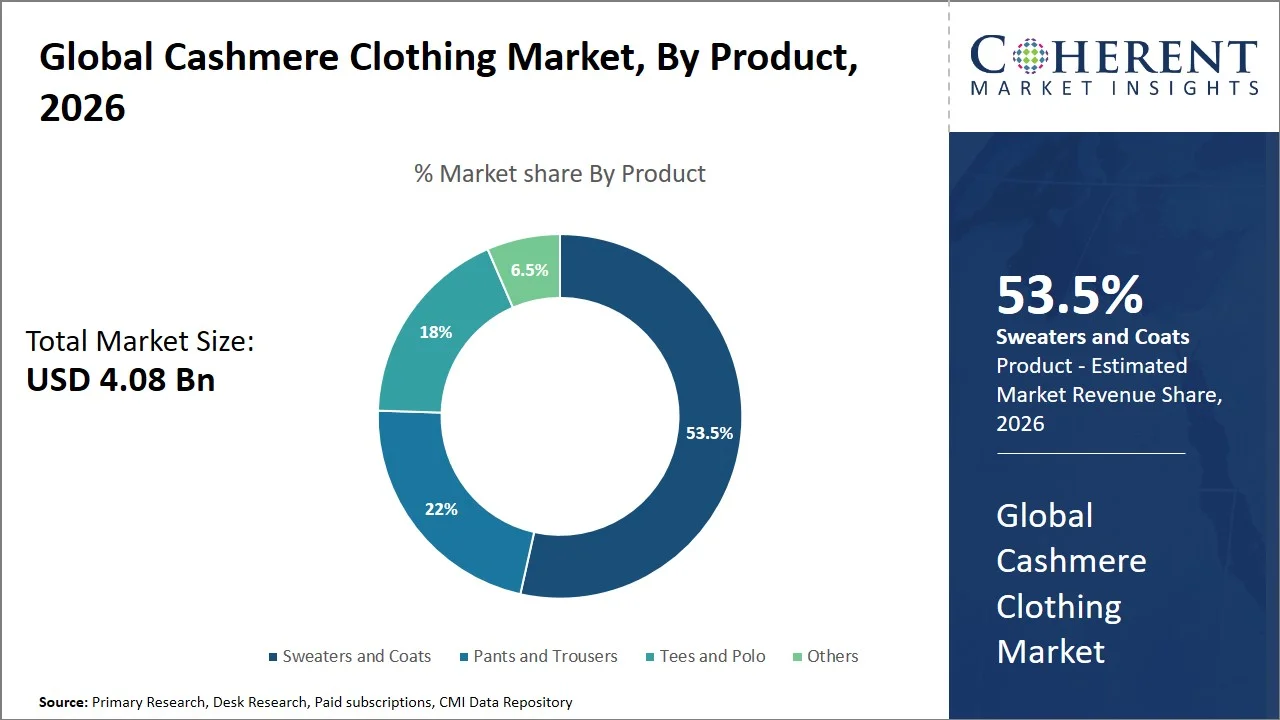
- The sweaters and coats segment is expected to hold 53.5 % share of the cashmere clothing market in 2026, making it the dominant product segment. Sweaters and coats remain the preferred cashmere apparel categories as consumers associate cashmere mainly with winterwear, warmth, softness, and premium layering. Luxury brands such as Loro Piana, Brunello Cucinelli, Naadam, and N.Peal continue to position cashmere sweaters, cardigans, coats, and outerwear as core seasonal collections, supporting segment dominance.
- The women segment is expected to hold 56.9 % share of the cashmere clothing market in 2026, owing to higher product variety, stronger fashion-led purchasing, and wider availability of women’s premium knitwear. Women’s cashmere apparel includes sweaters, wraps, scarves, cardigans, dresses, coats, and loungewear, creating broader purchase occasions. The global personal luxury goods market reached around USD 423.75 Bn in 2024, supporting demand for premium apparel categories such as cashmere clothing.
- The offline segment is projected to hold 68.5 % share of the cashmere clothing market in 2026, as consumers prefer physical stores for premium cashmere products due to the need to assess softness, fabric weight, fit, finishing, and authenticity before purchase. Department stores, luxury boutiques, brand-owned stores, and multi-brand premium fashion outlets remain important sales channels, especially for high-value cashmere sweaters, coats, and scarves.
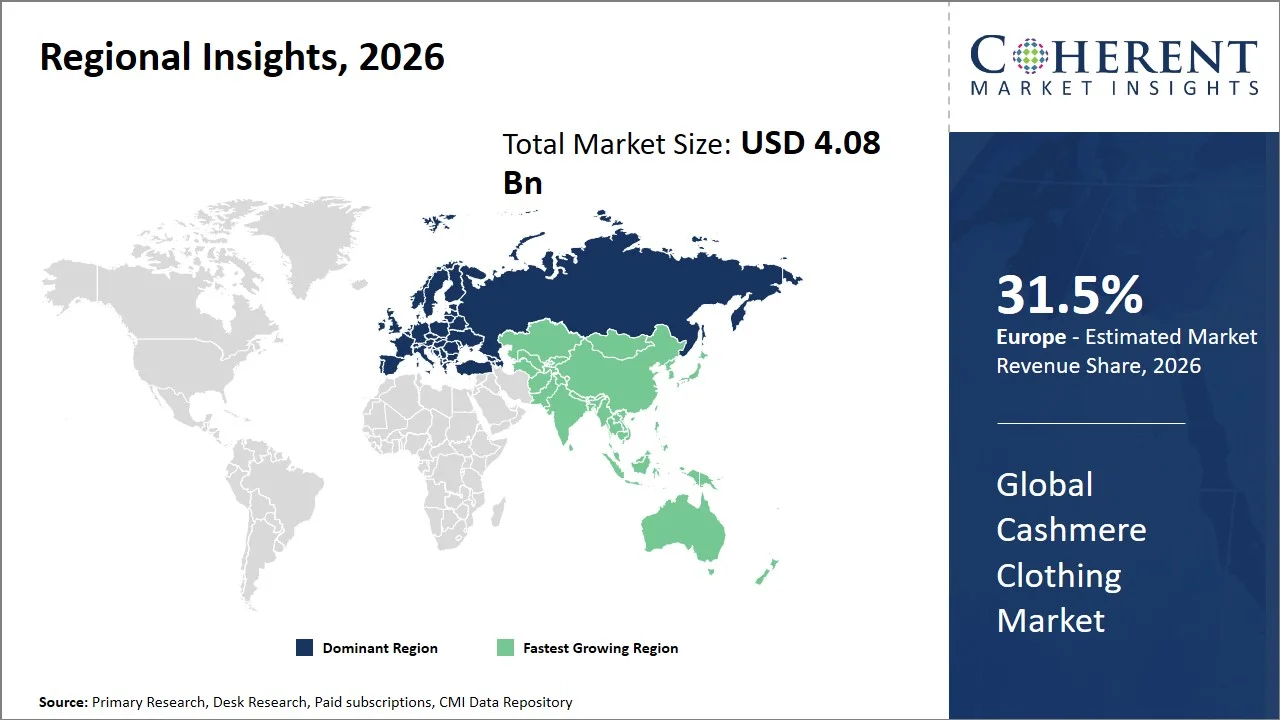
- Europe leads the global cashmere clothing market, accounting for an estimated 31.5 % share in 2026. The region benefits from a strong luxury fashion ecosystem, established premium apparel brands, and high consumer preference for natural fibers and craftsmanship-led clothing. Europe’s personal luxury goods market reached around USD 128.06 Bn in 2024, supported by tourist spending and premium retail strength, which directly supports cashmere apparel demand.
- The Asia Pacific cashmere clothing market is likely to grow at the highest rate, accounting for an estimated 22.7 % market share in 2026, driven by rising disposable incomes, expanding luxury retail, and growing online fashion consumption in China, Japan, South Korea, and India. In China, online retail sales of physical goods reached USD 1.82 trillion in 2024, accounting for 26.8% of total retail sales, improving access to premium apparel categories including cashmere clothing.
- Quiet Luxury Alignment: Premium cashmere feather clothing is increasingly benefiting from the demand for understated luxury, where consumers prefer soft, durable, logo-free, and high-quality wardrobe essentials.
- Market Expansion Catalysts: Growth in premium knitwear, winter layering, gifting demand, and sustainable, eco fiber sourcing is supporting the wider adoption of cashmere sweaters, cardigans, scarves, coats, and wraps.
Segmental Insights
Why Does the Sweaters and Coats Segment Dominate the Cashmere Clothing Market?
The sweaters and coats segment is expected to hold 53.5% share of the cashmere clothing market in 2026, largely because they epitomize the perfect blend of luxury, functionality, and timeless style that consumers seek. Cashmere's softness, warmth, and lightweight insulation are the natural properties that make sweaters and coats popular, especially in cooler weather and winter times. These clothes are considered an essential item in the wardrobe as they bring comfort and beauty. Sweaters and coats are the predominant choice since cashmere is ideal for winter wear and layering outfits.
According to the Food and Agriculture Organization (FAO), cashmere is a light, soft and durable fiber, which is a utilized luxury fashion material worldwide. This is also quite suitable for sweaters, cardigans, coats and outerwear where warmth, softness and low weight are essential. Luxury brands, for instance, have built their official boutique, with Brunello Cucinelli, cashmere sweaters and outerwear being a major part of the collections for both men and women. (Source: FAO)
- Current Industry Events of 2026
- Market Size Estimation
- Regional Breakdown
- Competitive Landscape
- Customer Intelligence
- Segmental Analysis
- Pricing Analysis
- Key Market Drivers, Challenges & Future Trends
- Customized Insights Section
Why do Women Mostly Used Cashmere Clothing?
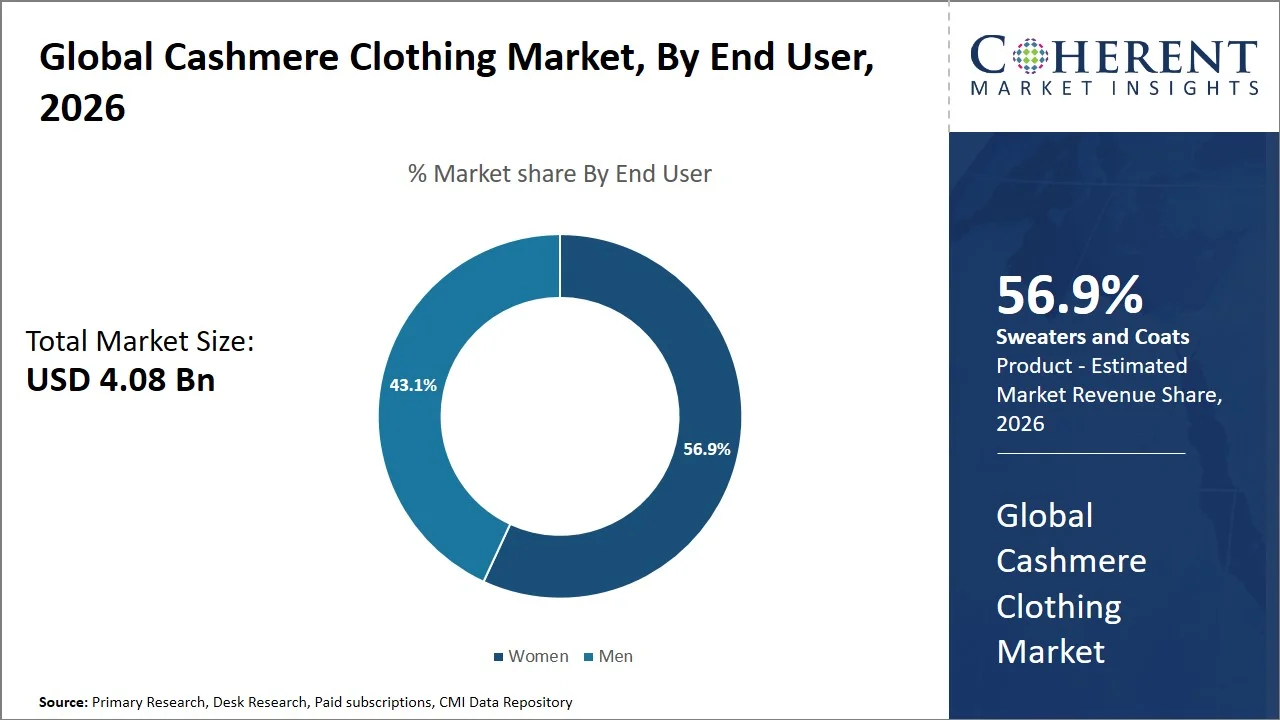
The women segment is expected to hold 56.9% share of the market in 2026, because women’s apparel has wider product variety, including sweaters, coats, cardigans, dresses, scarves, shawls, polos, and tops. Higher spending on women’s apparel is reflected in U.S. BLS consumer expenditure data, which shows average annual spending of USD 655 per person on women’s apparel in 2023, compared to USD 406 per person on men’s apparel. Luxury brands like Brunello Cucinelli also offer ample women cashmere lines to add to their design depth and luxury positioning in the women's category. (Source: U.S. Bureau of Labor Statistics)
Offline Segment Dominates the Cashmere Clothing Market
The offline segment is projected to hold 68.5% share of the cashmere clothing market in 2026, because cashmere is a premium product which consumers prefer to touch and feel before buying. This is particularly important in the case of high dollar sweaters and coats. For instance, the U.S. Census Bureau statistics showed that e-commerce retail sales grew from 16.9% of the total U.S. retail sales in Q1 2026, but still made up a small share of overall sales. It reinforces the reasoning that physical outlets will continue to play a key role for high-end apparel categories, while internet outlets will continue to grow as a secondary outlet. (Source: United Nations Census Bureau)
Currents Events and their Impact
Current Events | Description and its Impact |
EU Circular Textile Rules and Digital Product Passport Push |
|
Climate & Supply Shock: Mongolia Dzud Impact on Cashmere Goat Herds |
|
(Source: Sustainable Fibre Alliance)
Market Dynamics
Market Driver
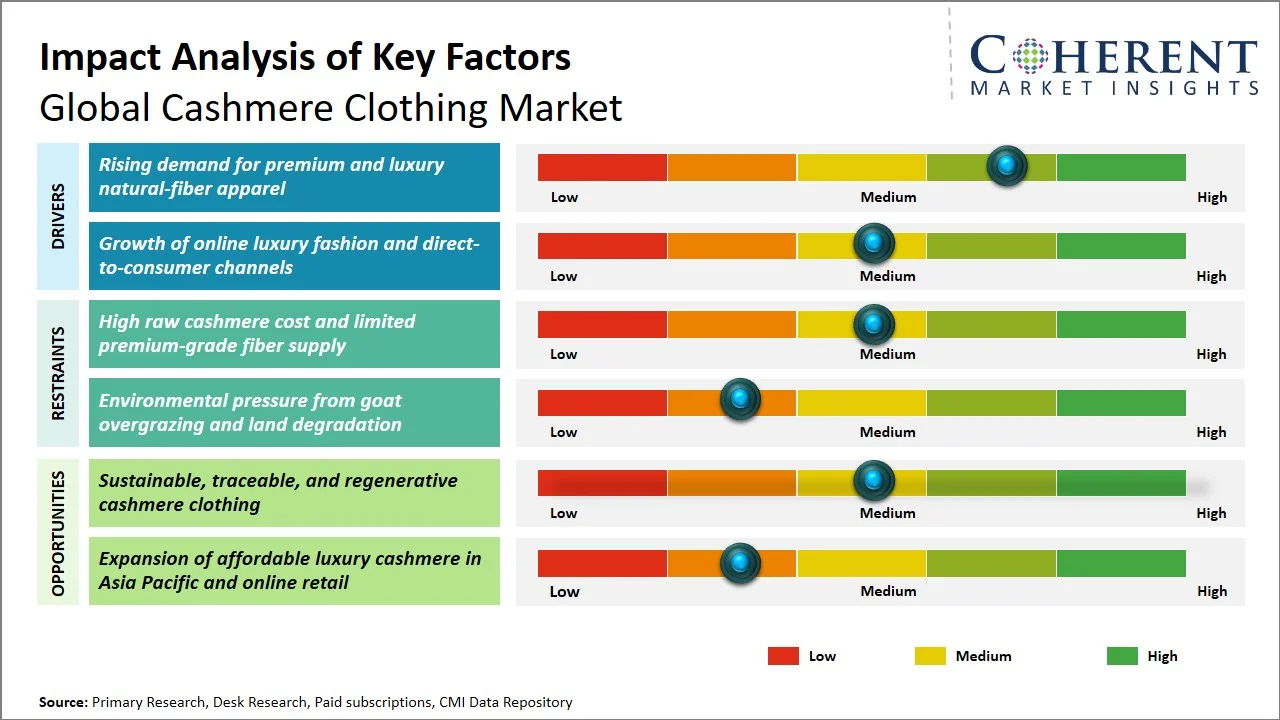
- Rising Demand for Premium and Luxury Natural-Fiber Apparel: The increasing demand for premium and luxury natural-fiber apparel benefits from the general rise of premium apparel, as softness, warmth, durability, and “quiet luxury” styling all appeal to the end user. Even in less buoyant macroeconomic times, luxury is still a substantial consumption category, as Bain predicted that PLS sales would total USD 423.75 Bn in 2024 and is expected to reach USD 416.36 Bn in 2025. Brands that incorporate cashmere as one of their primary luxury fabrics include Brunello Cucinelli, Loro Piana, Zegna and Johnstons of Elgin.
- Online luxury and D2C expansion: With the digital format, brands can sell luxury cashmere online worldwide through their website, luxury marketplaces, online boutiques, etc. According to the U.S. International Trade Administration, worldwide B2C e-commerce is projected to total US$ 5.5 trillion by 2027 and fashion will be one of the biggest categories. It enables cashmere brands to sell directly to consumers through product categories such as sweaters, scarves, cardigans, and accessories. (Source: International Trade Association)
Emerging Trends
- Premiumization and Quiet Luxury Positioning: Cashmere clothing is increasingly positioned as a premium lifestyle product, driven by demand for soft, lightweight, durable, and timeless apparel. Luxury brands are focusing on classic sweaters, coats, scarves, cardigans, and capsule collections to attract consumers looking for high-quality investment pieces rather than fast-fashion products.
- Sustainable and Traceable Cashmere Sourcing: Brands are increasingly emphasizing ethical sourcing, animal welfare, certified supply chains, and fiber traceability to address concerns around overgrazing, quality authenticity, and environmental impact. This trend is helping premium brands build consumer trust and justify higher pricing in the global cashmere clothing market.
Regional Insights
Why is Europe a Strong Market for Cashmere Clothing?
Europe leads the global cashmere clothing market, accounting for an estimated 31.5% share in 2026. The region has a well-established luxury fashion ecosystem, strong distribution network, and high disposable income consumers. Italy, France, and the U.K. are home to a few esteemed luxury apparel companies that have made cashmere a sign of high-end and sustainable fashion The supportive government policies for sustainable textile production and innovation (such as the EU Strategy for Sustainable and Circular Textiles, EU textile extended producer responsibility rules under the revised Waste Framework Directive, France’s AGEC Law for anti-waste and circular economy, and the U.K. Sustainable Clothing Action Plan) are well aligned with eco-conscious consumer trends driving cashmere demand. (Source: European Commission)
The modern logistics infrastructure and the favorable location to raw materials sources in Europe (Mongolia, China) makes it possible to operate efficient supply chains. Innovation in cashmere quality, blending and sustainability of sourcing is key, and notable companies like Loro Piana (Italy), Brunello Cucinelli (Italy) and Burberry (U.K.) are continuously working for new solutions.
Why Does the Asia Pacific Cashmere Clothing Market Exhibit High Growth?
The Asia Pacific cashmere clothing market is likely to grow at the highest rate, accounting for an estimated 22.7% market share in 2026, mainly driven by growing awareness of high-quality natural fibers such as cashmere, developing luxury retail infrastructure, and the growing number of aspirational consumers. Rising urbanization and the growth of the middle and upper middle class creates demand for premium cashmere products, especially in China, Japan, South Korea and India.
The government’s efforts toward developing the competitiveness and capability of local players and making trade easier have made it easier for local players to compete with international brands in the textile industry (for instance, India’s PM Mega Integrated Textile Region and Apparel (PM MITRA) Parks Scheme, which approved seven integrated textile parks with world-class infrastructure, plug-and-play facilities, and an outlay of ₹4,445 crore up to 2027–28). (Source: Press Information Bureau Government of India Ministry of Textiles)
Global Cashmere Clothing Market Outlook for Key Countries
Why is Italy Leading Innovation and Adoption in the Cashmere Clothing Market ?
Italy has a robust “Made in Italy” luxury manufacturing ecosystem, supported by some of the world’s most renowned luxury brands, including Loro Piana and Brunello Cucinelli. This has helped Italy emerge as one of the leading global destinations for luxury cashmere apparel. Ultimately, Brunello Cucinelli's official company archives reveal its roots in “coloured cashmere knitwear for women”, demonstrating the Italian players' transformation of cashmere as a fashion-driven luxury to a string of cashmere.
In 2025, Brunello Cucinelli generated USD 1.64 Bn of revenue (+11.5% YoY), with robust sales in the U.S. and Asia, as the demand for Italian luxury products continues to grow worldwide, particularly for cashmere. In addition, Italy is strengthening its efforts on traceability and compliance on product from high quality cashmere, due to the concerns over labor practices in the supply chain.
Is China Emerging as a Key Growth Hub for the Cashmere Clothing Market ?
China is a key cashmere clothing market because it combines raw material access, processing scale, and finished garment manufacturing. Inner Mongolia is one of the world's biggest producers and exporters of good quality cashmere, and Erdos City is one of the most important cashmere production bases in the world. Erdos Group is combating unsustainable cashmere by introducing sustainable cashmere development in source pastures and goat breeding, cashmere collection and collaboration with industry. The Ellen MacArthur Foundation also mentions Erdos' “Sweater Reborn” service, which is based on the principles of extending the life of the product and circular consumption. This means that China is crucial to quality, sustainability and branded mass-produced cashmere apparel.
Why Does the U.S. Top Cashmere Clothing Market ?
The U.S. is a mature premium cashmere clothing market, supported by high consumer spending on luxury apparel, strong department store networks, and fast-growing online fashion sales. This trend is supporting brands such as Naadam and J. Crew, which sell luxury cashmere products such as sweaters, scarves, cardigans, and coats through both online platforms and physical retail stores. Sourcing transparency, tariffs, and sourcing diversification are important for cashmere brands as textile and apparel imports continue to be a critical supply chain.
Is the Cashmere Clothing Market Developing in Japan?
Japan’s cashmere clothing market is supported by the demand for durable, timeless, and high-quality knitwear, along with advanced textile machinery capabilities. SHIMA SEIKI, headquartered in Wakayama, Japan, provides top-notch knitting machines along with WHOLEGARMENT technology capable of knitting seamless knitwear and minimizing material waste. The company's consolidated sales for the fiscal year that ended last March were USD 204.4 Mn, continuing its involvement in knitwear technology. This helps maintain Japan's competitiveness in premium knitwear production, product accuracy and cashmere finishing of quality garments. (Source: SHIMA SEIKI MFG., LTD.)
How is the Rising Demand for Sustainable, Traceable, and Regenerative Cashmere Clothing Creating New Growth Opportunities in the Cashmere Clothing Market?
Sustainable clothes present great opportunities in the global market of cashmere clothing, as the demand for such garments is increasingly seen in consumers' preferences. It is expected that brands will manage to become sustainable because of their approach to cashmere supply chains, while the need for sustainability and responsibility is becoming more and more relevant amongst consumers. The change in luxury brands is being directed toward responsible sourcing and traceability. collections.
Dependence on Asian Textile Manufacturing
Factor | Explanation | Impact on Cashmere Clothing Market |
Raw cashmere concentration | China and Mongolia are the key sources of raw and semi-processed cashmere. Mongolia’s raw cashmere export chain still sends a large share of output to China for processing. | The global cashmere clothing market remains highly dependent on Asian supply availability, especially for yarn, fabric, and finished knitwear. |
Cost advantage | Asian textile hubs offer lower production costs, skilled labor, and established supplier networks | Helps brands maintain margins, especially in mid-premium and accessible luxury cashmere categories. |
Market Players, Key Development, and Competitive Intelligence
Key Developments
- In January 2026, White + Warren launched its Clubhouse Collection, introducing sporty cashmere styles such as hoodies, cardigans, and shorts, reflecting the shift toward casual, athleisure-inspired cashmere designed for everyday wear beyond traditional luxury knitwear.
- In November 2025, Sainsbury’s Tu Clothing launched a 100% cashmere collection featuring jumpers and cardigans at accessible price points, marking a strategic move to democratize premium fabrics and expand cashmere adoption among mass-market consumers.
- In October 2025, New Zealand-based cashmere brand Elle & Riley expanded into the U.S. with its first store in Beverly Hills, reflecting the growing trend of emerging premium brands entering key luxury markets to build global presence and direct consumer engagement.
- In August 2025, French cashmere brand Kujten announced the opening of its first U.S. flagship on Madison Avenue, marking a strategic expansion into the American luxury market with a focus on enhancing brand visibility and offering a full range of cashmere collections in a premium retail setting.
Competitive Landscape
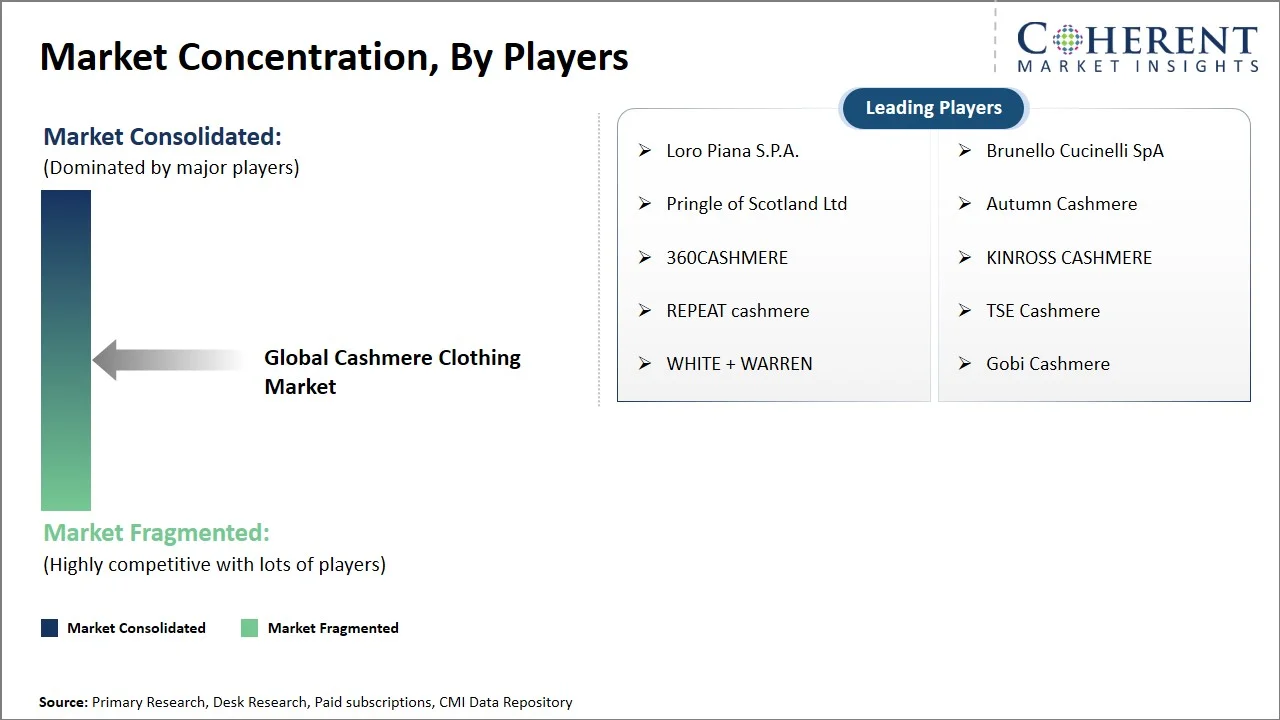
The cashmere clothing industry is moderately competitive with the rise of demand for high quality, lightweight, warm and luxury cashmere natural fiber clothing. Luxury and premium fashion brands prevail by leveraging brand equity, supply chain and retail outlets, and niche brands prevail by building their brand through craftsmanship, sustainability and direct to consumer pricing. Focus areas are:
- High-quality, soft, durable and traceable cashmere garments
- Focusing on diversification of products through sweaters, scarves, coats, shawls and blended products.
- Sustainable sourcing, ethical animal welfare practices and the premium retail/e-commerce expansion.
Market Report Scope
Cashmere Clothing Market Report Coverage
| Report Coverage | Details | ||
|---|---|---|---|
| Base Year: | 2025 | Market Size in 2026: | USD 4.08 Bn |
| Historical Data for: | 2020 To 2024 | Forecast Period: | 2026 To 2033 |
| Forecast Period 2026 to 2033 CAGR: | 7.2% | 2033 Value Projection: | USD 6.63 Bn |
| Geographies covered: |
| ||
| Segments covered: |
| ||
| Companies covered: | Loro Piana S.P.A., Brunello Cucinelli SpA, Pringle of Scotland Ltd, Autumn Cashmere, 360CASHMERE, KINROSS CASHMERE, REPEAT cashmere, TSE Cashmere, WHITE + WARREN, and Gobi Cashmere | ||
| Growth Drivers: |
| ||
| Restraints & Challenges: |
| ||
Analyst Opinion (Expert Opinion)
- The cashmere clothing market is projected to change from being a seasonal luxury apparel to a year a round premium wardrobe category. The future will see lightweight knitwear, simple layering options and those subtle luxury designs that seamlessly marry comfort, longevity and subtle branding. When fewer and better quality clothes are preferred, cashmere products, which are long-lasting, soft and add versatility to a wardrobe, are likely to be in higher demand from consumers.
- Sweaters, cardigans, pullovers, scarves and wraps are likely to be the highest value product categories since they enable repeat purchases, gifting, and wardrobe changes throughout the seasons. China is the source of scale and depth of luxury consumption, and the U.S. and Europe are the source of strong premium apparel demand. Japan is appealing for minimalist, fine gauge, high quality cashmere products.
- Players should create a competitive advantage through traceability, product quality assurance, and easy luxury positioning. The market is growing more competitive, and softness is not the only differentiator or a premium claim. Fiber purity, cashmere grade, sourcing origin, anti-pilling performance, and the durability of the garment should be clearly communicated by brands.
Speak to the analyst
Want personalized insights?
Take the findings above to one of our principal consultants, or have the report rebuilt around the segments, geographies and competitors you actually track.
Market Segmentation
- Product Insights (Revenue, USD Bn, 2021 - 2033)
- Sweaters and Coats
- Pants and Trousers
- Tees and Polo
- Others
- End User Insights (Revenue, USD Bn, 2021 - 2033)
- Women
- Men
- Distribution Channel Insights (Revenue, USD Bn, 2021 - 2033)
- Offline
- Online
- Regional Insights (Revenue, USD Bn, 2021 - 2033)
- North America
- U.S.
- Canada
- Latin America
- Brazil
- Argentina
- Mexico
- Rest of Latin America
- Europe
- Germany
- U.K.
- Spain
- France
- Italy
- Russia
- Rest of Europe
- Asia Pacific
- China
- India
- Japan
- Australia
- South Korea
- ASEAN
- Rest of Asia Pacific
- Middle East
- GCC Countries
- Israel
- Rest of Middle East
- Africa
- South Africa
- North Africa
- Central Africa
- North America
- Key Players Insights
- Loro Piana S.P.A.
- Brunello Cucinelli SpA
- Pringle of Scotland Ltd
- Autumn Cashmere
- 360CASHMERE
- KINROSS CASHMERE
- REPEAT cashmere
- TSE Cashmere
- WHITE + WARREN
- Gobi Cashmere
Sources
Primary Research Interviews
- Cashmere apparel manufacturer
- Supply chain director of a premium knitwear or luxury apparel producer
- Brand sourcing manager for cashmere garments
- Sustainability officer of a textile certification or traceability body
Stakeholders
- Manufacturers of house wraps and weather-resistive barriers (e.g., DuPont, CertainTeed, Benjamin Manufacturers and brand owners of cashmere clothing, including luxury and premium knitwear players
- Wool and fiber processors, yarn spinners, and garment converters
- Retailers and e-commerce brands selling cashmere apparel
- End-use sectors: premium fashion, luxury apparel, winterwear, and gifting
- Logistics and trading firms handling raw cashmere fiber and finished garments
Databases
- India Import Export (EXIM) Database for cashmere garment imports and exports
- Eurostat Trade Statistics for apparel, knitwear, and luxury textile imports
- USITC DataWeb for apparel trade and country-level import trends
- OECD trade and textile value-chain datasets for premium fiber and apparel flows
Magazines
- Vogue Business for luxury and premium fashion demand trends
- Women’s Wear Daily for brand, retail, and sourcing developments
- The Business of Fashion for cashmere consumer and sustainability trends
- Fashion Network for market shifts in premium knitwear
- Textile Outlook International for fiber and apparel industry updates
Journals
- Textile Research Journal for fiber performance and apparel development
- Journal of Fashion Marketing and Management for luxury and consumer demand analysis
- Sustainability for ethical sourcing and traceability in cashmere supply chains
- Fashion and Textiles for material innovation and garment performance
Newspapers
- The Wall Street Journal for luxury spending and apparel demand
- Financial Times for premium fashion and global sourcing trend
- Business Standard for India-linked textile trade and premium apparel demand
- The Economic Times for retail and import/export coverage
Associations
- Textile Exchange, which provides supply chain standards and sustainability frameworks relevant to fibers and apparel
- International Wool Textile Organisation (IWTO) for fiber and wool-market context
- The Cashmere and Camel Hair Manufacturers Institute (CCHMI) for fiber and label standards
- Sustainable Fibre Alliance for cashmere sustainability and traceability
Public Domain Sources
- Textile Exchange standards and material guidance for sustainability verification
- UNEP resources on sustainable fashion and raw-material impacts
- FAO materials on livestock, rangelands, and fiber-producing ecosystems where relevant
Proprietary Elements
- CMI Data Analytics Tool, Proprietary CMI Existing Repository of information for last 10 years.
Get access to 250+ pages report
Every segment, forecast, competitor profile and data table behind the analysis above — available for instant download.
- ESOMAR Member
- ISO 9001:2015 Certified
- D-U-N-S Registered
- GDPR & CCPA Compliant
Missing comfort of reading report in your local language? Find your preferred language:
Transform your Strategy with Exclusive Trending Reports
Frequently Asked Questions
The global cashmere clothing market is estimated to be valued at USD 4.08 Bn in 2026 and is expected to reach USD 6.63 Bn by 2033.
The CAGR of global cashmere clothing market is projected to be 7.2% from 2026 to 2033.
The global cashmere clothing market includes apparel made from cashmere fiber, such as sweaters, cardigans, coats, scarves, shawls, dresses, and other premium winterwear and luxury fashion products.
Rising demand for premium and luxury natural-fiber apparel and growth of online luxury fashion and direct-to-consumer channels are the major factors driving the growth of the global cashmere clothing market.
Sustainable cashmere is gaining importance because consumers and brands are increasingly focusing on ethical sourcing, animal welfare, pasture management, traceability, and reduced environmental impact.
High raw cashmere cost and limited premium-grade fiber supply and environmental pressure from goat overgrazing and land degradation are the major factors hampering the growth of the global cashmere clothing market.
In terms of product, the sweaters and coats segment is estimated to dominate the market revenue share in 2026.