

Global Central Solar Inverter Market Size and Forecast – 2026-2033
The Global Central Solar Inverter Market is estimated to be valued at USD 11,356.2 Mn in 2026 and is expected to reach USD 18,963.5 Mn by 2033, exhibiting a compound annual growth rate (CAGR) of 7.6% from 2026 to 2033.
Key Takeaways of the Central Solar Inverter Market
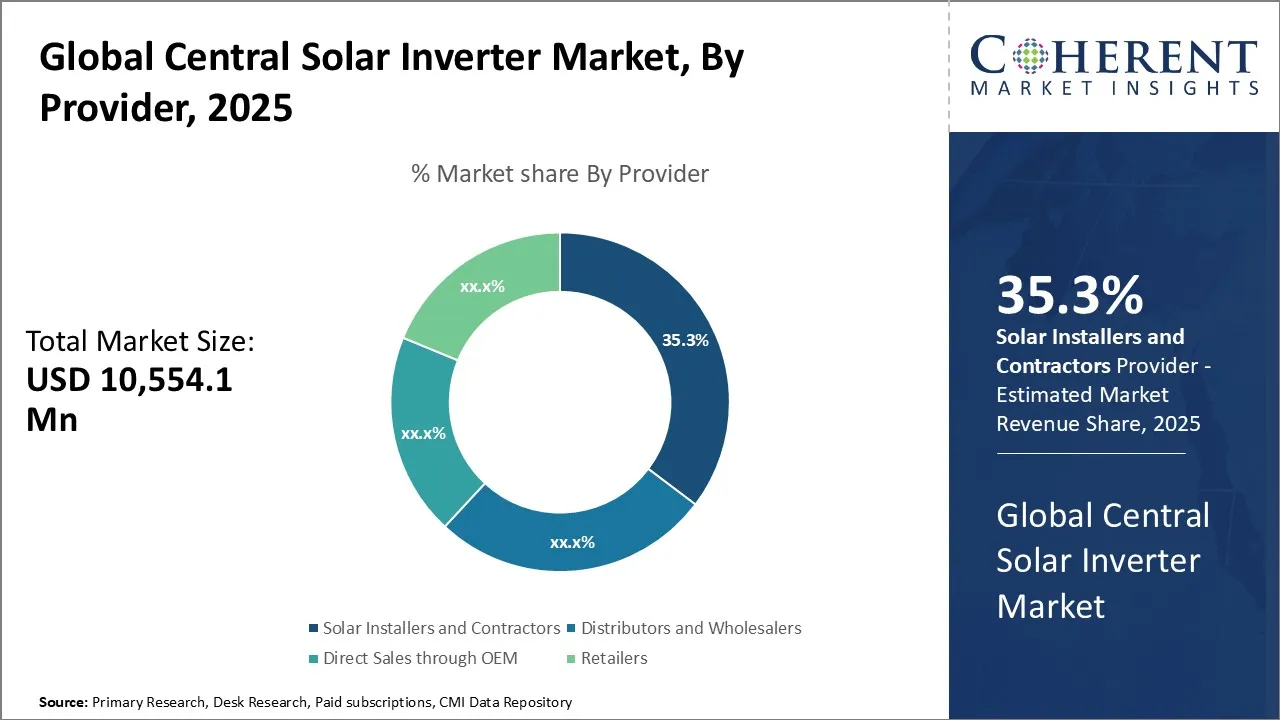
- The Solar Installers and Contractors segment is anticipated to account for 36.3% of the global central solar inverter market share by 2026.
- The Utility-scale segment is projected to represent 66.5 % of the global central solar inverter market share by 2026.
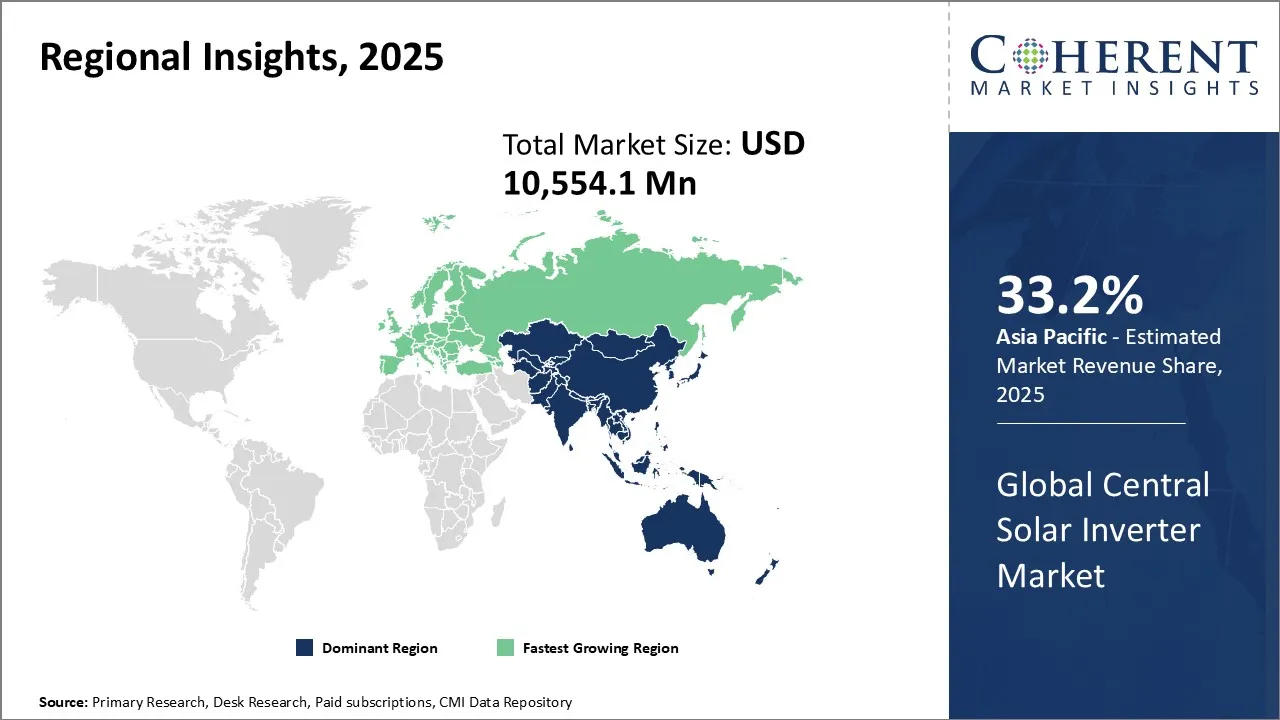
- Asia Pacific is set to lead the global central solar inverter market in 2026, with a 33.2 % share. Europe, with a 31.3% share, will be the fastest-growing region.
Market Overview
A notable market trend is the rising integration of smart inverters equipped with advanced grid management features, enabling better energy conversion and enhanced grid stability. Additionally, the shift towards renewable energy technologies and stringent environmental regulations are pushing investments in large-scale solar projects which demand high-capacity central solar inverters. The growing emphasis on reducing carbon footprints and increasing solar power generation, particularly through the adoption of solar PV panels, in emerging economies is also accelerating product development and market penetration globally.
Current Events and Its Impact
Current Events | Description and its impact |
Global Expansion of Utility-Scale Projects |
|
Government Policy Shifts and Incentives |
|
Segmental Insights
- Current Industry Events of 2026
- Market Size Estimation
- Regional Breakdown
- Competitive Landscape
- Customer Intelligence
- Segmental Analysis
- Pricing Analysis
- Key Market Drivers, Challenges & Future Trends
- Customized Insights Section
Central Solar Inverter Market Insights, By Provider - Solar Installers and Contractors Segment Dominates due to Increasing Demand for Renewable Energy
The Solar Installers and Contractors segment is expected to contribute 36.3% of the global central solar inverter market share in 2026, owing to their direct engagement with end users and expertise in system customization. The dominance of solar installers and contractors in the global central solar inverter market can primarily be attributed to their critical role as the key intermediaries between manufacturers and end users. Additionally, this segment is expected to grow at a CAGR of 8.4%.
These providers possess the technical proficiency and on-site capabilities required to assess, design, and install solar inverter systems tailored to specific project requirements. Their direct involvement throughout the installation lifecycle, including consultation, customization, and after-sales service, enhances customer confidence and satisfaction, which significantly drives their market share.
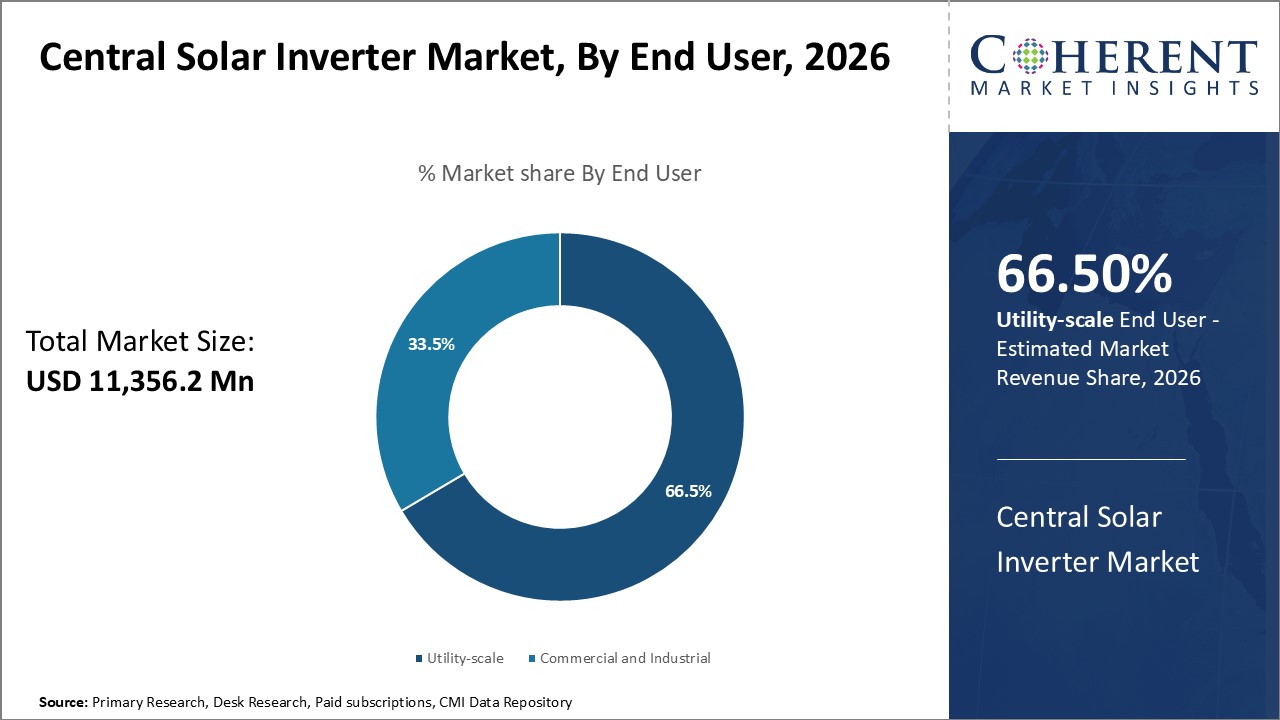
Central Solar Inverter Market Insights, By End User - The Utility-scale Segment Leads Due to Growing Demand for Large-Scale Renewable Energy Projects and the Rising Need for Enhanced Grid Integration
The Utility-scale segment is expected to contribute 66.5% of the global central solar inverter market share in 2026, driven by large-scale renewable energy projects and increasing grid integration needs. Utility-scale solar power projects constitute the largest segment by end use in the global central solar inverter market, largely propelled by the global imperative to transition towards clean energy at a massive scale. This segment is anticipated to grow at a CAGR of 8.0%.
Central solar inverters play a vital role in these projects by converting the direct current generated by vast solar arrays into alternating current suitable for grid transmission, thus serving as a pivotal interface between the generation assets and the power grid.
Regional Insights
Asia Pacific Central Solar Inverter Market Analysis and Trends
The Asia Pacific region is projected to hold the largest market share, accounting for 33.2% in 2026. This dominance is driven by rapid solar energy adoption, strong manufacturing capabilities, and extensive government support. Countries like China and India have introduced favorable policies, including subsidies, tax incentives, and ambitious renewable energy targets, which are expected to fuel substantial market growth. The region is set to experience an 8.1% CAGR.
The region’s well-established manufacturing ecosystem supports cost-effective production of central solar inverters, facilitating widespread deployment both domestically and for export. Key industry players such as Huawei Technologies, Sungrow Power Supply Co., and Delta Electronics have anchored the market by leveraging their technological innovation and large-scale production in the region. Furthermore, increasing investments from international players and collaborations with local manufacturers amplify Asia Pacific's commanding presence in the global solar inverter landscape.
Europe Central Solar Inverter Market Analysis and Trends
The Europe region is expected to exhibit the fastest growth in the market, contributing a 31.3% share in 2026, driven by increasing energy demands, a strong commitment to renewable energy, and a transition towards cleaner energy sources. European countries such as Germany, Spain, and France have implemented ambitious renewable energy targets and supportive policies, including subsidies, tax incentives, and feed-in tariffs, which are boosting solar energy adoption. The region is projected to experience a 7.7% CAGR.
The region benefits from a robust pipeline of solar projects, including both residential and utility-scale installations. Market players like SMA Solar Technology, ABB, and Siemens are actively expanding their presence in Europe, adapting products to meet stringent environmental and regulatory standards. Moreover, the region's focus on energy security and sustainability is further driving demand for high-performance central inverter solutions. The favorable regulatory framework and strategic investments in solar energy infrastructure make Europe an attractive market for both local and international manufacturers.
Central Solar Inverter Market Outlook for Key Countries
China Central Solar Inverter Market Trends
China continues to lead the global central solar inverter market, backed by its status as the world’s largest solar power generator and manufacturer. The country’s vast solar farms necessitate reliable, high-capacity central solar inverters, driving demand. The region is expected to exhibit a 8.9% CAGR. Major domestic companies such as Huawei and Sungrow are pivotal players, innovating with digitalized, efficient inverter solutions tailored for large utility-scale projects. Government policies like the 14th Five-Year Plan emphasize renewable energy expansion, reinforcing China’s market leadership.
India Central Solar Inverter Market Trends
India’s central solar inverter market is rapidly expanding due to aggressive renewable energy targets and a growing focus on solar energy to meet rising electricity demands. The region is expected to experience a 7.6% CAGR. Central solar inverters are preferred for large solar parks supported by government auctions and incentives under schemes like the National Solar Mission. Companies including TMEIC and ABB have increased their presence by offering robust, grid-compliant inverters suited for India’s variable grid conditions and diverse climatic zones, which boosts system reliability and adoption.
U.S. Central Solar Inverter Market Trends
The U.S. central solar inverter market is characterized by strong project development activity and technological sophistication. The region is expected to exhibit a 7.3% CAGR. Federal incentives, state-level renewable portfolio standards, and carbon reduction goals drive demand for central solar inverters in large-scale solar installations. Leading players such as SMA Solar Technology, Power Electronics, and SolarEdge provide advanced inverter technologies aimed at maximizing efficiency and grid integration. The evolving regulatory environment fosters innovation and adoption of smart inverters designed for resilient and flexible grid operations.
Germany Central Solar Inverter Market Trends
Germany plays a critical role in Europe’s central solar inverter market owing to its pioneering renewable energy policies and high penetration of solar PV systems. The region is expected to display an 8.5% CAGR. Though central inverters are more common in utility installations than residential applications, Germany’s emphasis on energy transition and grid stability catalyzes demand for smart and reliable inverter solutions. Companies like SMA Solar Technology and KACO new energy dominate the market, offering inverters integrated with grid management and monitoring features aimed at supporting Europe’s clean energy goals.
U.K. Central Solar Inverter Market Trends
The U.K.’s central solar inverter market reflects the country’s commitment to renewable energy and its transition to a low-carbon economy. With a projected 8.2% compound annual growth rate (CAGR), the U.K. government’s initiatives, such as the Clean Growth Strategy and ambitious carbon reduction goals, require scalable and efficient solar technologies. Large solar installations supported by incentives like the Contracts for Difference (CfD) scheme are driving the demand for high-capacity inverters.
Leading international firms, including SMA Solar Technology and ABB, are actively engaged in the U.K. market, providing advanced inverter technologies designed for optimal performance and integration with the grid. The U.K.’s push for energy security, combined with continued infrastructure investment, ensures strong growth prospects for the central solar inverter market.
End User Feedback and Unmet Needs in the Central Solar Inverter Market
High Reliability and Efficiency in Utility-scale Applications:
One of the most frequently cited positives by end-users, particularly utilities, is the reliability and efficiency of modern central solar inverters. A utility company operating a large photovoltaic (PV) farm reported satisfaction with the inverter's ability to handle fluctuations in power generation and ensure stable grid integration. The inverter's performance during both peak and off-peak conditions was consistently high, enabling the utility to meet grid requirements effectively. The key feature that stood out was the inverter's ability to operate efficiently under variable environmental conditions—such as fluctuating sunlight levels—while maintaining high conversion efficiency.
Limited Customization and Compatibility Issues in Industrial Use
An integration and customization are frequently voiced by industrial users. Many manufacturers and industrial players face challenges in integrating solar inverters with their existing energy management systems (EMS). A notable issue reported by a food processing company in Germany was the lack of flexibility in the inverter's configuration options. While the inverter performed well in isolated conditions, it struggled with adapting to specific load profiles in an industrial setting. This was particularly problematic when trying to link the inverter with the facility’s existing grid-tied systems and energy storage solutions.
Market Players, Key Development, and Competitive Intelligence
Key Developments
- In November 2024, SMA Solar Technology AG announced that its Sunny Central UP inverter successfully completed an independent Life Cycle Assessment (LCA), underscoring the product's sustainability credentials and contribution to CO₂ reduction. Conducted by the Fraunhofer Institute for Building Physics and certified by DEKRA Assurance Services GmbH, the LCA evaluates the inverter’s environmental impact across its entire life cycle—from raw material extraction to end-of-life. This achievement highlights SMA’s commitment to environmentally responsible product design and lifecycle optimization.
- In August 2024, TMEIC Corporation Americas, a subsidiary of TMEIC Corporation (Japan), announced its plans to relocate its headquarters to Houston, Texas. The strategic move aims to enhance customer proximity, strengthen regional operations, and support the company’s long-term growth initiatives across the Americas.
Top Strategies Followed by Global Central Solar Inverter Market Players
- Established companies dominate the market by investing heavily in research and development (R&D) to continuously innovate and enhance product performance. These industry leaders focus on designing high-efficiency, reliable, and technologically advanced solar inverters that cater to large-scale solar power projects, thereby setting benchmarks for quality and performance.
- For instance, SMA Solar Technology (Germany), a leader in the global solar inverter market, has set benchmarks for quality with its innovative product lines. SMA’s central inverters are widely recognized for their high energy conversion efficiency and ability to scale up for large utility-scale solar projects.
- Mid-level market participants adopt strategies that help them position themselves as providers of cost-effective yet reliable solutions. These players prioritize balancing quality with affordability to appeal specifically to price-sensitive consumers, including small and medium-sized solar project developers who seek dependable technology within constrained budgets. Recognizing the importance of scaling up efficiently, mid-level companies often pursue collaborations and joint ventures to enhance their manufacturing capabilities and accelerate technology adoption.
- For example, Fronius International, which provides a range of central solar inverters that are both efficient and affordable for smaller utility-scale and commercial applications. Fronius has targeted developing regions like Southeast Asia and Eastern Europe, where solar adoption is gaining momentum, by offering flexible and economical pricing models while still delivering high-quality products.
- Small-scale players carve out niches by concentrating on specialized solar inverter features or pioneering innovative product designs that address unique market needs. To remain competitive in a market dominated by larger firms, these smaller entities often adopt cutting-edge technologies, such as advanced power electronics, integrated energy management solutions, or digital monitoring systems, to differentiate their offerings.
- For example, GreenBrilliance, which specializes in providing solar inverters with integrated energy management solutions that cater to the residential and small commercial sectors. By focusing on energy efficiency and integrating digital monitoring systems, GreenBrilliance offers products that appeal to customers seeking personalized, cutting-edge technology.
Market Report Scope
Central Solar Inverter Market Report Coverage
| Report Coverage | Details | ||
|---|---|---|---|
| Base Year: | 2025 | Market Size in 2026: | USD 11,356.2 Mn |
| Historical Data for: | 2020 To 2024 | Forecast Period: | 2026 To 2033 |
| Forecast Period 2026 to 2033 CAGR: | 7.6% | 2033 Value Projection: | USD 18,963.5 Mn |
| Geographies covered: |
| ||
| Segments covered: |
| ||
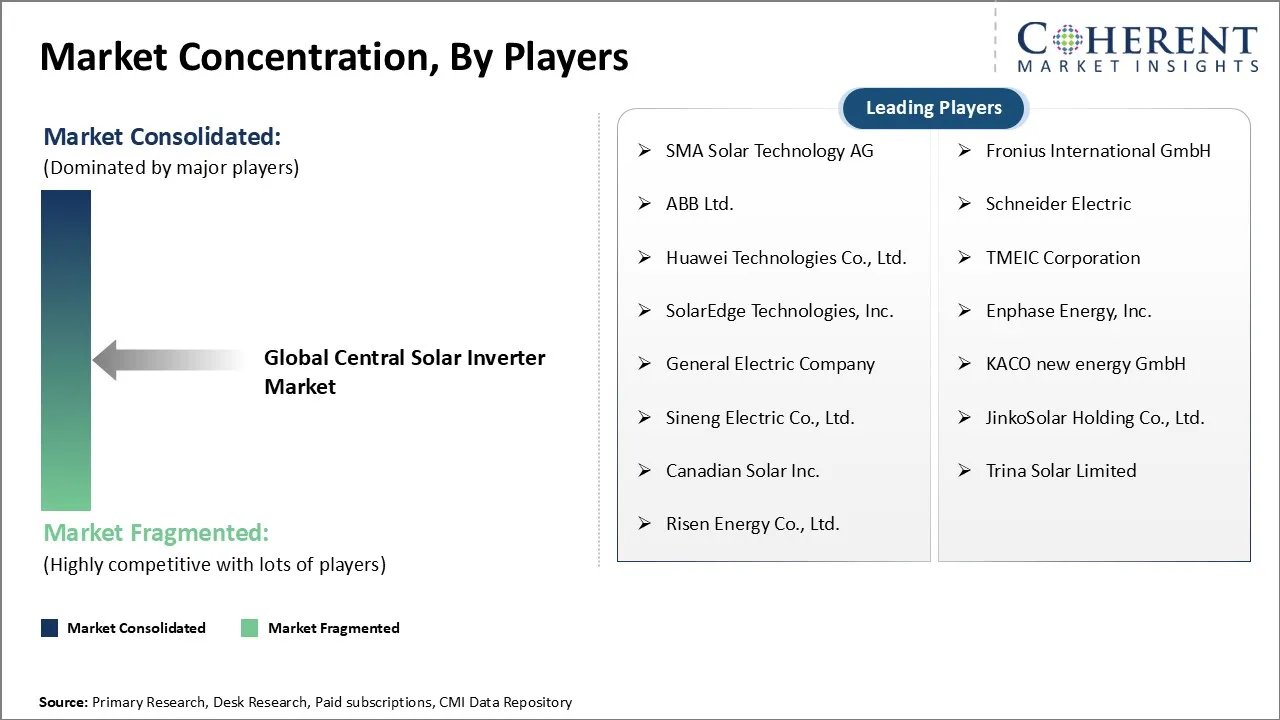
| Companies covered: | SMA Solar Technology AG, Fronius International GmbH, ABB Ltd., Schneider Electric, Huawei Technologies Co., Ltd., TMEIC Corporation, SolarEdge Technologies, Inc., Enphase Energy, Inc., General Electric Company, KACO new energy GmbH, Sineng Electric Co., Ltd., JinkoSolar Holding Co., Ltd., Canadian Solar Inc., Trina Solar Limited, and Risen Energy Co., Ltd. | ||
| Growth Drivers: |
| ||
| Restraints & Challenges: |
| ||
Central Solar Inverter Market Dynamics
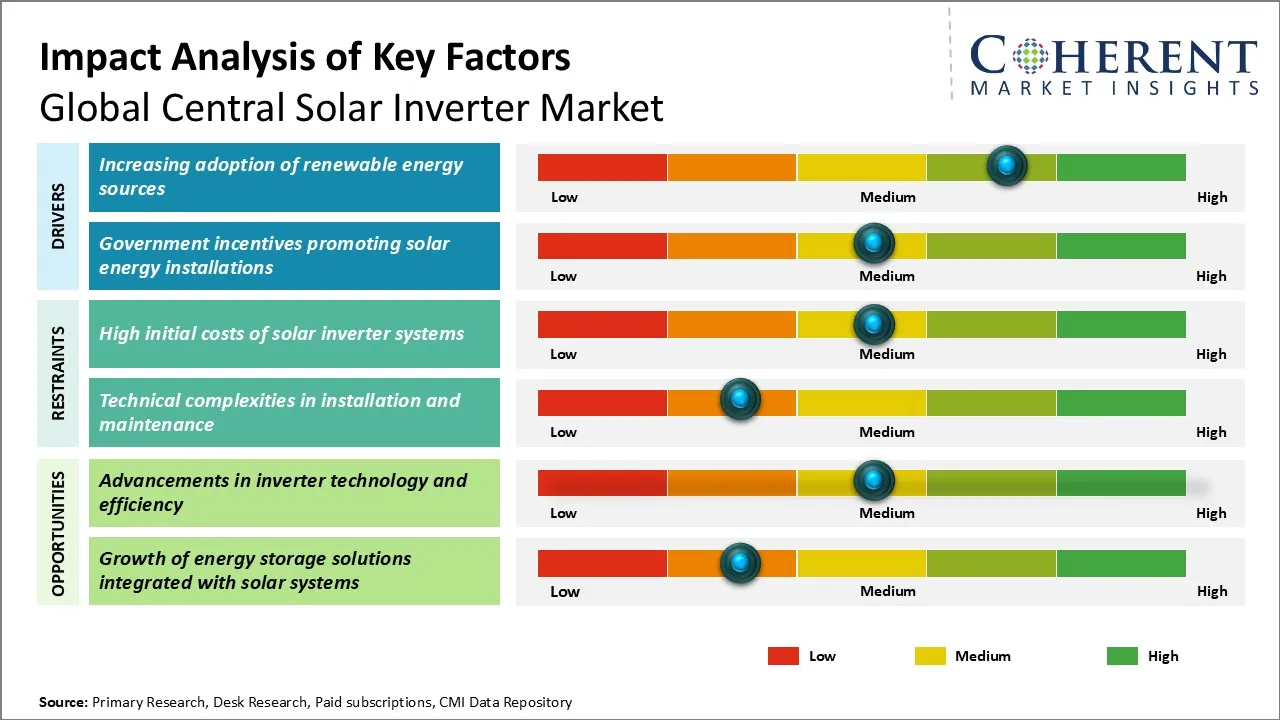
Central Solar Inverter Market Driver - Increasing Adoption of Renewable Energy Sources
The global shift towards cleaner and sustainable energy solutions is significantly driving the adoption of renewable energy sources, particularly solar power, which in turn is propelling the demand for central solar inverters. As governments and private sectors worldwide commit to reducing carbon footprints and meeting stringent environmental regulations, large-scale solar power installations are becoming increasingly prevalent. Central solar inverters play a critical role in these installations by efficiently converting the direct current (DC) generated by solar panels into alternating current (AC) suitable for grid integration and end-use applications. The growing emphasis on scaling up solar farms to meet energy demands has necessitated reliable and high-capacity inverter solutions, making central solar inverters indispensable.
For example, in countries like Germany, India, and the U.S., aggressive renewable energy targets and government incentives have spurred the development of large-scale solar projects. For instance, India has set an ambitious target of 500 GW of non-fossil fuel-based energy capacity by 2030, which includes a significant push for solar energy. The implementation of feed-in tariffs, tax credits, and subsidies for solar installations has boosted solar power generation capacity, driving demand for central inverters capable of handling large-scale solar farms.
Central Solar Inverter Market Opportunity - Advancements in Inverter Technology and Efficiency
The global central solar inverter market is poised to benefit significantly from ongoing advancements in inverter technology and efficiency, presenting a substantial growth opportunity. As solar energy adoption accelerates worldwide, the demand for more reliable, efficient, and cost-effective inverters has become critical. Technological innovations such as enhanced silicon carbide (SiC) semiconductors, advanced power electronics, and digitalization through smart inverters are enabling higher energy conversion efficiencies, reduced thermal losses, and improved reliability. These advancements not only boost overall system performance but also lower operational and maintenance costs, making solar power projects more economically viable.
For example, Companies like SMA Solar Technology and Fronius are increasingly adopting SiC-based power semiconductors in their central inverters. SiC technology enables higher efficiency by reducing power losses and improving heat dissipation, thus enhancing the overall performance of solar power systems. These semiconductors also allow inverters to operate at higher voltages and power capacities, which is crucial for large-scale solar projects.
Analyst Opinion (Expert Opinion)
- The global central solar inverter market is poised for robust growth, driven by the accelerating shift towards renewable energy and the increasing scale of solar installations. Companies like SMA Solar Technology and Fronius are leading the charge with advanced inverter technologies that enhance efficiency and reliability in large-scale solar projects.
- Recent conferences, such as the Solar Power International (SPI) (2023) and the Intersolar Europe (2022), have highlighted pivotal innovations in inverter design and digital integration, showcasing how these advancements optimize energy management. Presentations at these events emphasized the crucial role of central inverters in maximizing output and minimizing downtime, particularly in utility-scale solar farms.
- Additionally, the growing emphasis on smart grid technologies and energy storage solutions is driving demand for more sophisticated inverter systems capable of seamless integration. As global commitments to reduce carbon emissions intensify, the central solar inverter market is well-positioned for substantial expansion. The convergence of technological innovation, regulatory support, and increasing investments in solar infrastructure will be key factors shaping the future landscape of this vital sector in the renewable energy ecosystem.
Speak to the analyst
Want personalized insights?
Take the findings above to one of our principal consultants, or have the report rebuilt around the segments, geographies and competitors you actually track.
Market Segmentation
- Provider Insights (Revenue, USD Mn, 2021 - 2033)
- Solar Installers and Contractors
- Distributors and Wholesalers
- Direct Sales through OEM
- Retailers
- End User Insights (Revenue, USD Mn, 2021 - 2033)
- Utility-scale
- Commercial and Industrial
- Regional Insights (Revenue, USD Mn, 2021 - 2033)
- North America
- U.S.
- Canada
- Latin America
- Brazil
- Argentina
- Mexico
- Rest of Latin America
- Europe
- Germany
- U.K.
- Spain
- France
- Italy
- Russia
- Rest of Europe
- Asia Pacific
- China
- India
- Japan
- Australia
- South Korea
- ASEAN
- Rest of Asia Pacific
- Middle East
- GCC Countries
- Israel
- Rest of Middle East
- Africa
- South Africa
- North Africa
- Central Africa
- North America
- Key Players Insights
- SMA Solar Technology AG
- Fronius International GmbH
- ABB Ltd.
- Schneider Electric
- Huawei Technologies Co., Ltd.
- TMEIC Corporation
- SolarEdge Technologies, Inc.
- Enphase Energy, Inc.
- General Electric Company
- KACO new energy GmbH
- Sineng Electric Co., Ltd.
- JinkoSolar Holding Co., Ltd.
- Canadian Solar Inc.
- Trina Solar Limited
- Risen Energy Co., Ltd.
Sources
Primary Research Interviews
- R&D Director – Leading Central Inverter Manufacturer
- Procurement Manager – Major Solar EPC Contractor
- Product Development Head – Global PV Inverter Brand
- Sustainability Manager – Renewable Energy Certification Body
Stakeholders
- Manufacturers
- End-use Sectors:
- Utility-Scale Solar Farms
- Industrial and Commercial Buildings
- Large-Scale Renewable Projects
- Grid-level Solar Installations
- Regulatory & Certification Bodies
- Ministry of New and Renewable Energy (MNRE)
- Bureau of Indian Standards (BIS)
- International Electrotechnical Commission (IEC)
- E-commerce Platforms and Retailers
- Technology Integration Players:
- Grid management and monitoring solution providers
- Smart inverter and IoT manufacturers
Databases
- UN Comtrade Database
- India Import Export (EXIM) Database
Magazines
- Renewable Energy World – Inverter and grid-integration innovations
- PV Magazine – Market trends, technology, regional insights
- SolarQuarter – Indian and Asia-Pacific market updates on central inverter deployments
- Power Today – Project reports, demand analysis, interviews
Journals
- IEEE Transactions on Power Electronics – Central inverter design and reliability
- Solar Energy Journal – Grid integration, energy yield studies
- Journal of Renewable and Sustainable Energy – Case studies on central inverter deployment
Newspapers
- The Economic Times – Solar policy and project updates
- Financial Times – Global growth in large-scale inverters
- The Guardian – Sustainability trends in solar energy
Associations
- Solar Energy Industries Association (SEIA)
- Indian Solar Manufacturers Association (ISMA)
- International Solar Alliance (ISA)
- International Electrotechnical Commission (IEC)
- Clean Energy Council
Public Domain Sources
- MNRE, Government of India – Solar Energy Policy, Inverter Quality Norms
- BIS – Solar inverter product standards and certification guidelines
- OECD/IEA – International market and safety trends
Proprietary Elements
- CMI Data Analytics Tool, Proprietary CMI Existing Repository of information for the last 8 years.
Get access to 250+ pages report
Every segment, forecast, competitor profile and data table behind the analysis above — available for instant download.
- ESOMAR Member
- ISO 9001:2015 Certified
- D-U-N-S Registered
- GDPR & CCPA Compliant
Missing comfort of reading report in your local language? Find your preferred language:
Transform your Strategy with Exclusive Trending Reports
Frequently Asked Questions
The CAGR of global central solar inverter market is projected to be 7.6% from 2026 to 2033.
Increasing adoption of renewable energy sources and government incentives promoting solar energy installations are the major factors driving the growth of the global central solar inverter market.
High initial costs of solar inverter systems and technical complexities in installation and maintenance are the major factors hampering the growth of the global central solar inverter market.
In terms of Provider, Solar Installers and Contractors are estimated to dominate the market revenue share in 2026.
SMA Solar Technology AG, Fronius International GmbH, ABB Ltd., Schneider Electric, Huawei Technologies Co., Ltd., TMEIC Corporation, SolarEdge Technologies, Inc., Enphase Energy, Inc., General Electric Company, KACO new energy GmbH, Sineng Electric Co., Ltd., JinkoSolar Holding Co., Ltd., Canadian Solar Inc., Trina Solar Limited, and Risen Energy Co., Ltd. are the major players in the global central solar inverter market.
Asia Pacific is expected to lead the global central solar inverter market in 2026.