

Global Coal to Liquid Market Size and Forecast – 2026 to 2033
According to Coherent Market Insights, the global coal to liquid market is estimated to be valued at USD 4.67 Bn in 2026 and is expected to reach USD 8.11 Bn by 2033, exhibiting a compound annual growth rate (CAGR) of 8.2% from 2026 to 2033.
Key Takeaways of the Coal to Liquid Market
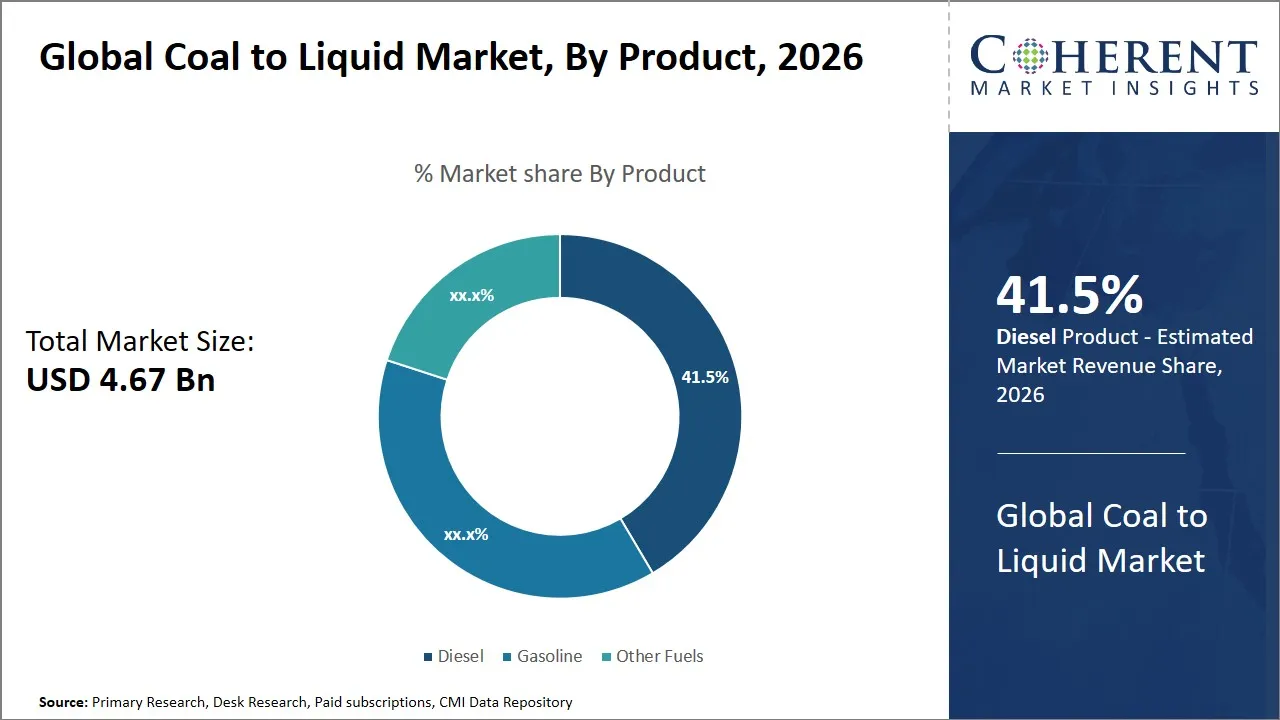
- The diesel segment is expected to account for 41.5% of the global coal to liquid market share in 2026.
- The direct liquefaction segment is projected to capture 57.8% of the coal to liquid market share in 2026.
- The transportation fuel segment is expected to hold a 45.8% of the market share in 2026.
- The Asia Pacific region is expected to dominate the market with a 43.3% share in 2026.
- The Europe region is projected to experience the fastest market growth, contributing a 19.3% share in 2026.
Market Overview
- A significant market trend in the coal to liquid sector is the rising focus on integrating eco-friendly and cost-effective technologies to minimize carbon footprints.
- Governments and industries are increasingly prioritizing cleaner coal conversion processes, spurring innovations in catalysts and process optimization.
- Additionally, the utilization of coal to liquid fuels in transportation and power generation remains strong, supported by fluctuating crude tall oil prices and geopolitical uncertainties.
- This trend highlights a balance between leveraging coal resources and meeting sustainability goals, driving continuous development within the market.
Currents Events and Its Impacts
Current Events | Description and its impact |
India Coal Gasification & CTL Push |
|
Energy Transition & Climate Policy Pressure |
|
Segmental Insights
- Current Industry Events of 2026
- Market Size Estimation
- Regional Breakdown
- Competitive Landscape
- Customer Intelligence
- Segmental Analysis
- Pricing Analysis
- Key Market Drivers, Challenges & Future Trends
- Customized Insights Section
Why Does Diesel Dominate the Global Coal to Liquid Market?
Diesel segment is expected to hold 41.5% of the global coal to liquid market share in 2026, owing to its critical role as a versatile and efficient fuel across multiple industries. The dominating status of the diesel can be attributed to its high energy density and performance efficiency relative to other forms of fuel like the gasoline and other forms of fuel. This property renders diesel an essential ingredient in heavy transport, industrial machines and power production industries. The increasing reliance of economic activities in the world, especially in the developing world, makes the demand of reliable and cost-effective transportation fuels to the forefront, as more transportation fuels become more and more dependent on diesel.
For example, in the mining sector, diesel is heavily used to fuel large trucks and machinery required for extracting and transporting raw materials. Diesel’s efficiency allows these machines to operate over long periods without refueling, making it indispensable for industries where operational uptime and cost-effectiveness are crucial.
Direct Liquefaction Leads in Technology Segment Fueled by Process Efficiency and Product Quality
Direct liquefaction segment is projected to hold 57.8% of the market share in 2026, due to its technological advantages in converting coal directly into liquid hydrocarbons with higher yield and flexibility. It is done by hydrogenating and extracting coal on a molecule level and producing liquid fuels very similar in quality and performance to conventional petroleum products.
The main reason that has led to the preference of direct liquefaction is the high-quality fuel that it generates and specifically in the case of diesel and gasoline substitutes, which are of the highest industry standards. The direct liquefaction process allows having more control over the final product, which allows the generation of cleaner and more stable fuels. This translates to better efficiency of combustion in addition to lower emission when it is applied in transportation and other uses which would fit the tightening environmental laws internationally.
Transportation Fuel Dominates the Global Coal to Liquid Market
Transportation fuel segment is expected to capture 45.8% of the coal to liquid market share in 2026, propelled by increasing global mobility demands and the imperative to diversify fuel sources for transport sectors. The transport sector continues to be the largest consumer of liquid fuels in the world and the availability of high energy content fuels such as coal to liquid processes which are produced forms the basis of this segments supremacy.
The high pace of urbanization, population rising, and the development of logistics systems create unceasing demand on the efficient and low-cost transportation fuels. Liquid fuels which are based on coal are critical in the supplementation of traditional fuels which are based on petroleum particularly in geopolitically sensitive areas where the crude oil supply is limited. This diversification guarantees uninterrupted supply of fuel to commercial and transportation vehicles as well as freights that are vital to economic operations in the different continents.
Regional Insights
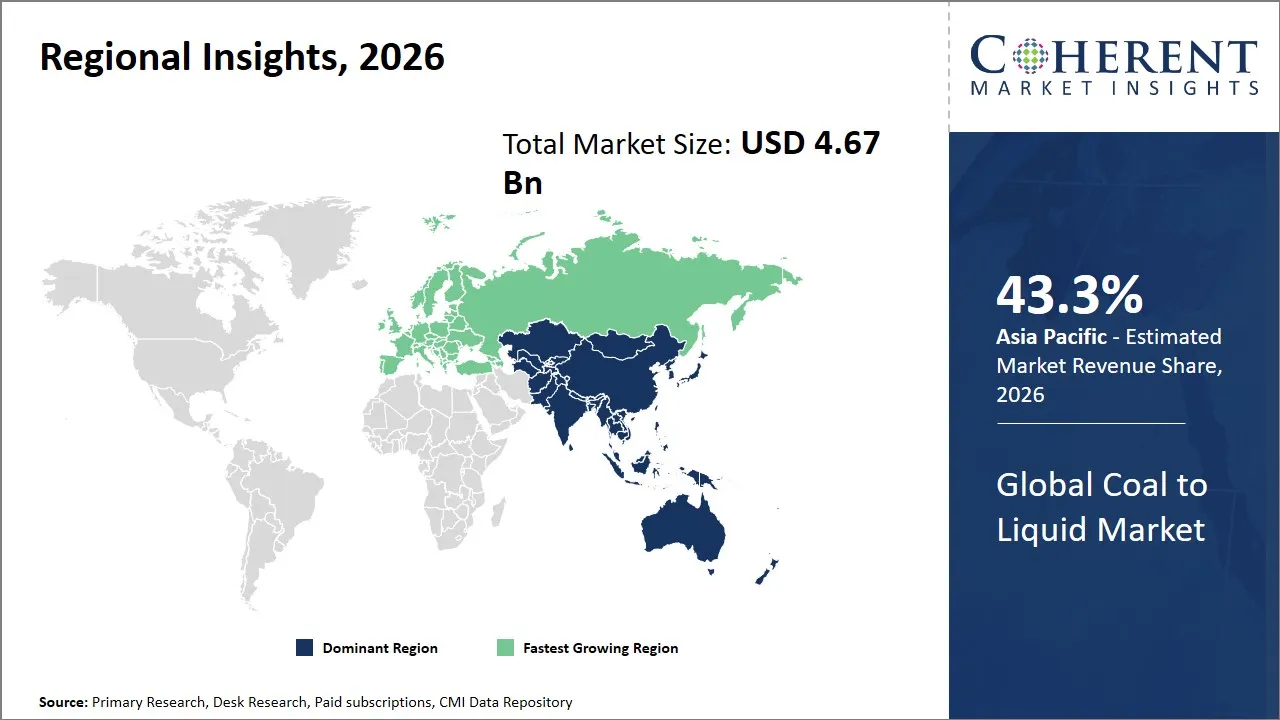
Asia Pacific Coal to Liquid Market Analysis and Trends
The Asia Pacific region is projected to lead the market with a 43.3% share in 2026, because of the rich coal deposits and the robust industrial base in the region as well as the heavy government funding on alternative fuel technology. The market is driven by countries such as China and India who are using their domestic coal reserves to drive down reliance on the importation of crude oil. Policies in favor of energy security and environmental sustainability, like the plans of China in its Five-Year Plans and the focus of coal gasification in India supports the CTL development.
China National Coal Group, China Coal Technology and Engineering Group, and Indian Oil Corporation are major companies that have played a central role and promoted the production capacity, and commercialization of CTL technologies. Well-developed coal mining industries, combined chemical manufacturing industries and massive infrastructure also support the ecosystem facilitating smooth coal-to-liquid conversions. The emphasis on cutting emissions has promoted investments to cleaner CTL processes, which has made Asia Pacific leadership even stronger.
Europe Coal to Liquid Market Analysis and Trends
The Europe region is expected to exhibit the fastest growth in the market contributing 19.3% share in 2026. The exploration of cleaner and more sustainable energy options in accordance with the European Green Deal and the overall EU energy policies is the key contributor to the development of CTL production in the area. As Europe lacks the rich coal reserves that other continents possess, the other nations like Germany and Poland are looking to CTL technology as an energy diversification strategy with the aim of cleaner coal technologies and carbon capture and storage (CCS) as a mitigating factor to environmental impact.
The European market is highly predisposed by its firm belief in minimizing greenhouse gas emissions and this has made it invest heavily on research and development of a CTL technology that is environmentally friendly. The European players are moving towards efficient production and environmental performances of CTL production with a concentration on incorporation of CCS technologies to reduce carbon footprints and improve the long-term feasibility of synthetic fuels.
Global Coal to Liquid Market Outlook for Key Countries
China Coal to Liquid Market Trends
The coal to liquid market in China is the foremost in the world because of coal reserves and its strategic motivation to use it in the realization of energy self-sufficiency. State-owned companies are the biggest producers of CTL such as China National Coal Group and Shenhua Group, which invest in fine coal liquefaction plants.
The government policies are based on the reduction of crude oil dependence and the reduction of carbon emissions, and the research in the direction of cleaner CTL processes including carbon capture and use is provided with financial support. The coal mining, transportation, and refining infrastructure of China is well developed and makes the CTL operations possible. Also, the vast domestic market of fuels offers a profitable foundation of CTL products, including synthetic fuels and chemical feedstocks, thus guaranteeing the market dynamics.
South Africa Coal to Liquid Market Trends
The coal to liquid market in South Africa is defined by the existence of one of the global coal-to-liquid technological leaders Sasol. The operations involving the transformation of coal into liquid fuels and chemicals are what Sasols have incorporated, reiterating the superior skill and dedication of the country towards CTL. Energy security programs by the government have continued to help CTL in the face of the volatile oil prices in the world.
The geographical strength of South Africa coal reserves and the ability of Sasol are synergistic, and the ongoing projects are aimed at optimizing the processes and improving the environmental activity. Collaborative ventures with international technology providers foster innovation, positioning South Africa as a key hub in the global CTL landscape.
India Coal to Liquid Market Trends
The coal to liquid market in India is continuously changing at an impressive pace due to the presence of vast reservoirs of coal and the interest by the government in alternative sources of fuel to counter the importation of the crude oil. Indian oil corporation and Coal India limited are the key players in the pilot and commercial CTL project.
The policies in the country favoring coal gasification and liquefaction seek to tap into the clean energy technologies and the investment efforts are directed towards incorporating the CTL in the larger energy and chemical industry. Indias diversification of energy is in line with the desire to have improved rural energy and spending less on importation. Indias CTL is developed with infrastructure development and technology transfer contracts with foreign firms that contribute to the dynamic growth in the market.
U.S. Coal to Liquid Market Trends
The coal to liquid market in the U.S. has been known to be innovative in synthetic fuels and environmental sustainability. Despite the fact that coal resources of the country are substantial, the development of CTL exists in the market that is strongly affected by the production of shale oil and the use of renewable energy. The firms like Sasol (where it has subsidiary presence in the U.S. in the form of Sasol North America) and ExxonMobil are doing research and pilot projects in an attempt to streamline CTL technology to produce cleaner fuels.
The regulatory frameworks promote reduced emissions and carbon management, which define the commercial viability. The intermittent desire to use CTL as an additional source of fuel is motivated by energy security issues and strategic reserve. The trade policies are in support of local production but the rival fuels have put the trade policies to competition.
Germany Coal to Liquid Market Trends
The Germany market for coal to liquid is successful in the wider framework of developed chemical industry and energy change in project. Germany does not have coal deposits in the country as other countries do, but it pays special attention to research-based CTL innovations that are more oriented on sustainability and carbon emission reduction. Such renowned companies as BASF and Linde also incorporate CTL technologies into the synthetic fuel and chemical manufacturing environment.
The policies of the government give priority to clean energy technologies that meet the Energiewende targets, which affects the viability of the CTL project. The reliance on imports causes one to consider production of synthetic fuels to sustain industrial energy demands. Germanys good regulatory and technology background make it a significant center of innovation to develop next-generation CTL solutions.
Country-wise Energy Security Dependency Index (Import Dependence vs CTL Potential)
Country | Energy Import Dependence (%) | CTL Production Potential (Million Barrels per Day) | Energy Security Dependency Index |
U.S. | 20 | 0.5 | 0.70 |
China | 50 | 1.2 | 0.40 |
India | 60 | 0.8 | 0.30 |
Market Players, Key Development, and Competitive Intelligence
Key Developments
- In 2024, China Shenhua Energy Co. Ltd expanded its Coal-to-Liquid (CTL) operations, emphasizing the production of cleaner liquid fuels to address rising energy demands.
- In 2024, Linc Energy Systems announced advancements in Coal-to-Liquid (CTL) technology, aiming to enhance efficiency and minimize environmental impact. The company is focused on utilizing coal reserves to develop more sustainable energy solutions.
Top Strategies Followed by Global Coal to Liquid Market Players
Player Type | Strategic Focus | Example |
Established Market Leaders | Heavy investment in R&D and innovation | For example, Sasol has heavily invested in its own proprietary Slurry Phase Distillate (SPD) technology, which has made the CTL processes used in its operations much more efficient in form of energy consumption and cost-effectiveness, making it a more sustainable and profitable operation. |
Mid-Level Players | Cost-effective solutions with balanced quality | Topsoe (a mid-sized player) has come up with a cheaper and scaled-up version of H-Coal process in CTL production that provides a competitive alternative to conventional CTL technologies. |
Small-Scale Players | Niche specialization & innovative variants | For instance, Clean Coal Technologies (a small player in the CTL market), which has invented a modular CTL plant that can be quickly shipped to the remote areas. The innovation enables small players to serve areas that are poorly equipped and the costs are kept low. |
Market Report Scope
Coal to Liquid Market Report Coverage
| Report Coverage | Details | ||
|---|---|---|---|
| Base Year: | 2025 | Market Size in 2026: | USD 4.67 Bn |
| Historical Data for: | 2020 To 2024 | Forecast Period: | 2026 To 2033 |
| Forecast Period 2026 to 2033 CAGR: | 8.2% | 2033 Value Projection: | USD 8.11 Bn |
| Geographies covered: |
| ||
| Segments covered: |
| ||
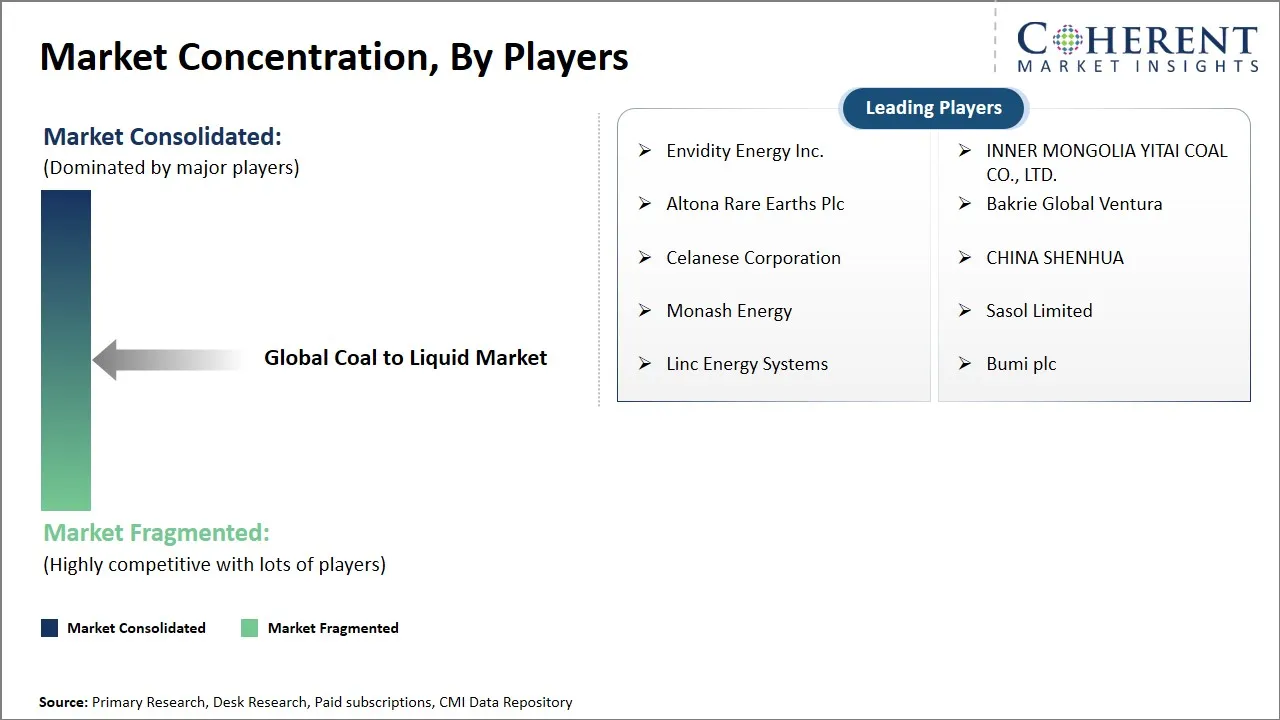
| Companies covered: | Envidity Energy Inc., INNER MONGOLIA YITAI COAL CO., LTD., Altona Rare Earths Plc, Bakrie Global Ventura, Celanese Corporation, CHINA SHENHUA, Monash Energy, Sasol Limited, Linc Energy Systems, and Bumi plc | ||
| Growth Drivers: |
| ||
| Restraints & Challenges: |
| ||
Coal to Liquid Market Dynamics
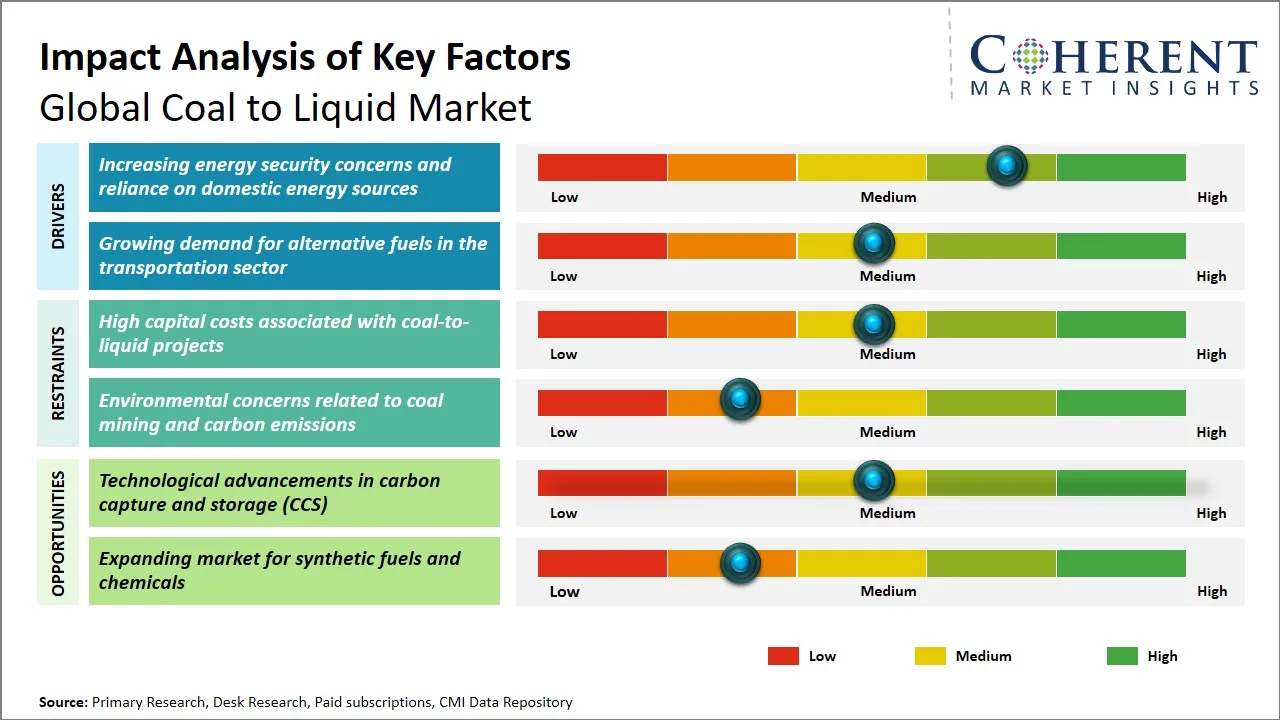
Coal to Liquid Market Driver - Increasing Energy Security Concerns and Reliance on Domestic Energy Sources
The increasing energy security issues at the global level have greatly heightened the attention of decreasing reliance on imported fossil fuels, hence steering the need to either use coal-to-liquid (CTL) technologies. A lot of nations are working towards increasing their energy self-sufficiency by exploiting the rich local coal deposits to create liquid biofuels to alleviate the exposure to vulnerability that is associated with geopolitical frictions, inversing prices of oil and supply interruption. This not only gives a strategic cushion in response to the volatile nature of the international energy market, but also helps the national economy to be secure by supporting local industries and jobs.
For example, China, which is the largest coal producer on earth, has been one of the major implementers of the CTL technologies to improve its energy security. Amid the fear of unstable oil prices and dependence on imports, China was pouring a lot of money in CTL projects to enable it use its rich coal resources in the production of liquid fuel.
Coal to Liquid Market Opportunity - Technological Advancements in Carbon Capture and Storage (CCS)
The global coal to liquid market stands to benefit significantly from ongoing technological advancements in Carbon Capture and Storage (CCS), presenting a substantial growth opportunity amid increasing environmental regulations and climate change concerns. CCS technology, which entails the capturing of emission of carbon dioxide in the course of coal-to-liquid processes and proper storage of the same in underground sites or other usages can seriously lower carbon footprint of CTL operations. New technologies have improved the scale, efficiency, and cost-effectiveness of CCS systems, which has made them easier to integrate with CTL systems.
For example, the invention of CCS technology is already taking steps in the CTL industry. One of the best examples is the Quest Carbon Capture and Storage project in Canada initiated by Shell. This CCS plant utilizes the best bet of capturing and storing up to 1 Mn tons of CO2 per year that will greatly offset the carbon emissions of producing oil sands.
Analyst Opinion (Expert Opinion)
- The coal to liquid market is experiencing renewed interest, driven by the global push for energy diversification and the search for alternative fuels in response to energy security concerns. The International Conference on Coal Utilization (2023) and the Global Energy Summit (2022) shed some light on the essential progress, and such companies as Sasol and China National Chemical Corporation (ChemChina) are the first to present innovations in CTL technology to make them more efficient and less harmful to the environment.
- The recent strategic move by Sasols to expand its CTL plants in order to generate cleaner liquid fuels is a good example of a strategic effort to strike a balance towards economic feasibility and sustainability. These conferences talked of the importance of CTL in offering a reliable source of energy during the volatile oil markets yet there were prevailing challenges such as the emission of carbon and threat of inexpensive renewable energy sources which were often cited as hindrances.
- Those businesses investing in carbon capture and storage (CCS) technologies and working with governments to create favorable regulatory frameworks will probably perform well. The coal to liquid market will eventually expand based on how it is able to be innovative and continually tackle issues of environmental concerns and respond to the changing dynamics of the world energy sphere.
Speak to the analyst
Want personalized insights?
Take the findings above to one of our principal consultants, or have the report rebuilt around the segments, geographies and competitors you actually track.
Market Segmentation
- Product Insights (Revenue, USD Bn, 2021 - 2033)
- Diesel
- Gasoline
- Other Fuels
- Technology Insights (Revenue, USD Bn, 2021 - 2033)
- Direct Liquefaction
- Indirect Liquefaction
- Application Insights (Revenue, USD Bn, 2021 - 2033)
- Transportation Fuel
- Cooking Fuel
- Others
- Regional Insights (Revenue, USD Bn, 2021 - 2033)
- North America
- U.S.
- Canada
- Latin America
- Brazil
- Argentina
- Mexico
- Rest of Latin America
- Europe
- Germany
- U.K.
- Spain
- France
- Italy
- Russia
- Rest of Europe
- Asia Pacific
- China
- India
- Japan
- Australia
- South Korea
- ASEAN
- Rest of Asia Pacific
- Middle East
- GCC Countries
- Israel
- Rest of Middle East
- Africa
- South Africa
- North Africa
- Central Africa
- North America
- Key Players Insights
- Envidity Energy Inc.
- INNER MONGOLIA YITAI COAL CO., LTD.
- Altona Rare Earths Plc
- Bakrie Global Ventura
- Celanese Corporation
- CHINA SHENHUA
- Monash Energy
- Sasol Limited
- Linc Energy Systems
- Bumi plc
Sources
Primary Research Interviews
- CEO – Leading Coal-to-Liquids Producer (e.g., Sasol or Shell equivalent)
- Supply Chain Director – Major Synthetic Fuels Distributor
- Production Lead – Gas-to-Liquids (GTL) Technology Provider
- Sustainability Officer – CTL Project Certification Authority
Stakeholders
- Manufacturers
- End-use Sectors
- Fuels Industry (Diesel, Gasoline, Jet Fuel)
- Chemicals Sector (Methanol, Olefins, Dimethyl Ether)
- Power Generation (Synthetic Fuels for Utilities)
- Regulatory & Certification Bodies (e.g., IEA for clean coal technologies, EU ETS compliance for emissions)
- E-commerce Platforms and Retailers (Alibaba Industrial Fuels, Energy Suppliers, Sigma-Aldrich for chemicals)
- Technology Integration Players: GTL/CTL plant developers using Fischer-Tropsch synthesis
Databases
- UN Comtrade Database
- India Import Export (EXIM) Database (Synthetic Fuels)
- IEA Coal-to-Liquids Reports
- Eurostat Energy Trade Statistics
- BP Statistical Review of World Energy (CTL sections)
Magazines
- Hydrocarbon Processing – Trends in coal-to-liquids technology
- Oil & Gas Journal – GTL and CTL production innovations
- Power Engineering International – Synthetic fuels for power generation
- Chemical Engineering – Fischer-Tropsch synthesis advancements
- Energy Tech Review – CTL market dynamics and commercialization
Journals
- Fuel Journal – Coal-to-liquids conversion efficiency
- Energy & Fuels – Gasification and syngas processing for CTL
- Applied Energy – Techno-economic analysis of coal-to-liquids plants
- International Journal of Hydrogen Energy – Hydrogen production in CTL processes
- Journal of Cleaner Production – Environmental impact of coal-to-liquids
Newspapers
- The Wall Street Journal – Global synthetic fuels demand
- Financial Times – CTL projects in China and South Africa
- Business Standard (India) – Coal gasification and CTL initiatives
- Reuters – CTL technology investments and price volatility
- South China Morning Post – China's coal-to-chemicals expansion
Associations
- Gasification Technologies Council
- Synthetic Fuels Association
- International Energy Agency (IEA) Clean Coal Centre
- World Coal Association
- Fischer-Tropsch Synthesis Forum
- Global CCS Institute
Public Domain Sources
- IEA – Coal-to-liquids technology roadmaps
- European Commission – Carbon capture guidelines for CTL plants
- World Bank – Financing frameworks for synthetic fuel projects
- US DOE – NETL reports on coal gasification and CTL
- IPCC – Carbon footprint assessments for coal conversion technologies
Proprietary Elements
- CMI Data Analytics Tool
- Proprietary CMI Existing Repository of information for last 8 years.
Get access to 250+ pages report
Every segment, forecast, competitor profile and data table behind the analysis above — available for instant download.
- ESOMAR Member
- ISO 9001:2015 Certified
- D-U-N-S Registered
- GDPR & CCPA Compliant
Missing comfort of reading report in your local language? Find your preferred language:
Transform your Strategy with Exclusive Trending Reports
Frequently Asked Questions
The global coal to liquid market is estimated to be valued at USD 4.67 Bn in 2026 and is expected to reach USD 8.11 Bn by 2033.
The CAGR of global coal to liquid market is projected to be 8.2% from 2026 to 2033.
Increasing energy security concerns and reliance on domestic energy sources and growing demand for alternative fuels in the transportation sector are the major factors driving the growth of the global coal to liquid market.
CTL faces competition from biofuels and hydrogen but remains viable due to coal availability.
High capital costs associated with coal-to-liquid projects and environmental concerns related to coal mining and carbon emissions are the major factors hampering the growth of the global coal to liquid market.
The future depends on technological advancements and the competitiveness of renewable energy alternatives.
In terms of product, diesel is estimated to dominate the market revenue share in 2026.