

Global Cognitive Services Market Size and Forecast – 2026 To 2033
The global cognitive services market is expected to grow from USD 77 Bn in 2026 to USD 310 Bn by 2033, registering a compound annual growth rate (CAGR) of 27% from 2026 to 2033. The global cognitive services market is driven by the growing adoption of computer vision and speech analytics solutions. On May 31, 2026, NVIDIA launched NVIDIA Cosmos 3, an open world foundation model for physical AI built on a breakthrough mixture-of-transformers architecture that combines vision reasoning, world generation and action prediction in a single system. (Source: NVIDIA)
Key Takeaways of the Global Cognitive Services Market
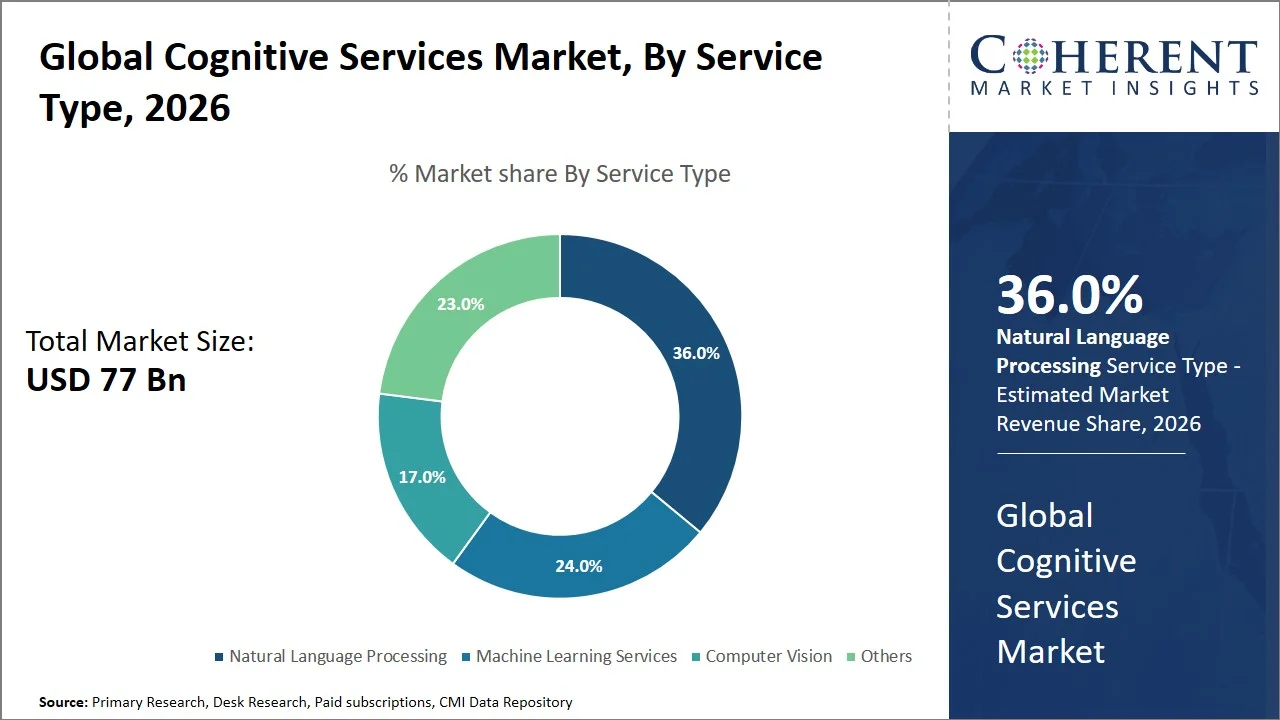
- The natural language processing segment is expected to account for 36.0 % of the global cognitive services market share in 2026. Increasing demand for personalized customer experiences is driving the growth of the segment. On June 9, 2025, Salesforce launched agentic self-service with Agentforce to increase customer resolutions and cut costs. (Source: Salesforce)
- The cloud segment is estimated to capture 44.0 % of the market share in 2026. Expansion of cloud-based AI and cognitive platforms is a major factor driving the growth of the segment. On May 20, 2026, Alibaba announced a comprehensive upgrade to its full-stack AI capabilities, covering cloud infrastructure, model services, AI chips, and basic models, to help customers build, deploy, and scale AI agents more efficiently, reliably, and effectively. (Source: Alibaba)
- The customer experience management segment is estimated to capture 26.0 % of the market share in 2026. Rising investments in generative AI and large language models is driving the growth of the customer experience management segment. On February 27, 2026, OpenAI announced a USD 110 billion round of funding, backed by major investments from Amazon, NVIDIA and SoftBank, to expedite the creation of next-generation large language models and expand AI infrastructure internationally. (Source: Open AI)
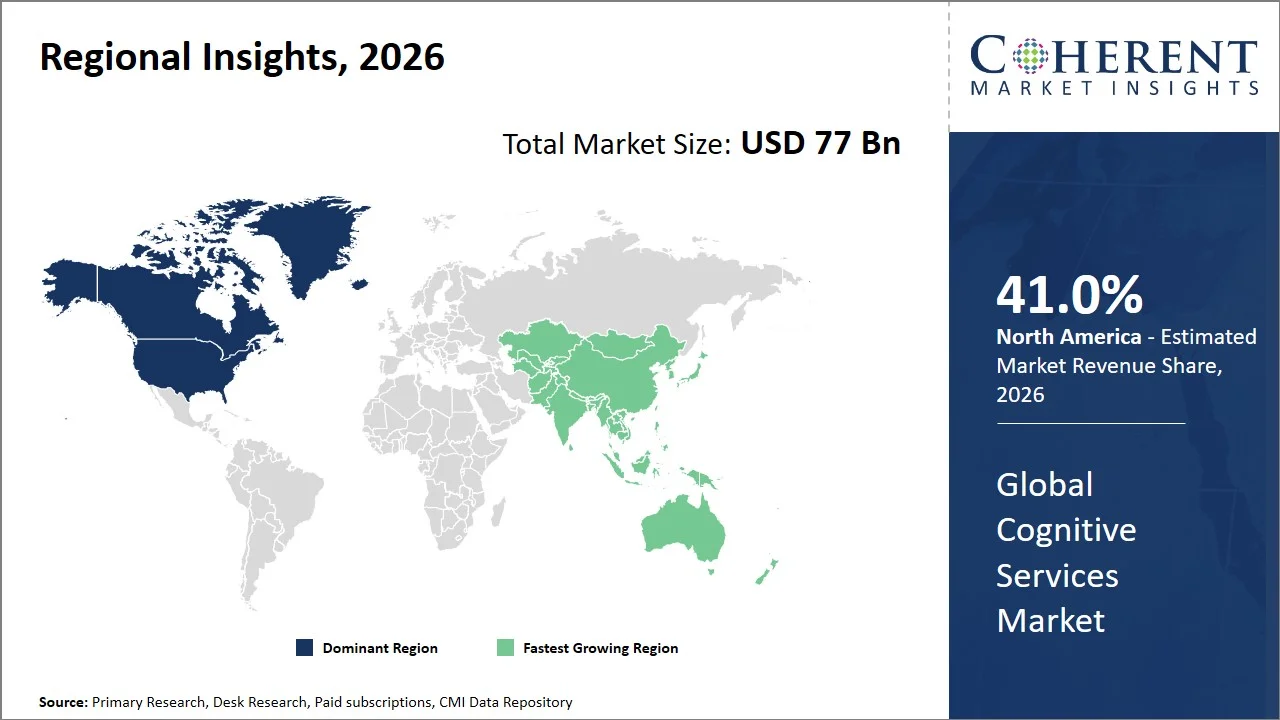
- North America is expected to dominate the cognitive services market in 2026 with a market share of 41.0 %. Increasing use of cognitive services in healthcare diagnostics in North America is driving the growth of the regional market. On June 11, 2026, Abridge unveiled the first AI-native clinician intelligence platform organized around the patient, built for clinicians, and designed to help health systems coordinate the clinical, financial, and evidence-based decisions that shape every moment of care. (Source: Abridge)
- Asia Pacific is expected to account for 28.0 % share in 2026 and is projected to record the fastest growth over the forecast period. Growing development of AI platforms in Asia Pacific is driving the growth of the regional market. On July 16, 2025, Blaize Holdings, Inc. announced it had entered into a Strategic Cooperation Agreement with Starshine Computing Power Technology Limited. Pursuant to the Agreement, Blaize and Starshine are entering into a strategic partnership to develop business opportunities for the sale of Blaize’s hybrid AI platform and other products and services through Starshine in the Asia Pacific region. (Source: Blaize)
- Rapid Adoption of Generative AI-Powered Cognitive Services: Cognitive service platforms are being embedded with generative artificial intelligence capabilities to accelerate content creation, code generation, knowledge management, and client engagement. Enterprises are moving beyond basic AI models to multimodal systems that comprehend and generate text, images, audio, and video, dramatically extending the field of cognitive applications. Growth of Industry-Specific Cognitive AI Solutions: Vendors are building specific cognitive services for verticals such as healthcare, banking, manufacturing, retail and government. These industry-specific solutions leverage data, regulatory requirements and process intelligence in the domain, providing higher accuracy, faster deployment and better business results than generic AI models.
Segmental Insights
Why Does Natural Language Processing Dominate the Global Cognitive Services Market?
The natural language processing segment is expected to account for 36.0% of the global cognitive services market share in 2026. Natural language processing is driving the global cognitive services market by helping organizations derive actionable insights and automate interactions from huge amount of unstructured text and speech data generated from customer service, social media, enterprise documents, email and digital communications. NLP is the most widely embraced part of cognitive technology due to its broad applicability in practically every business.
On May 27, 2026, IBM announced important new updates to Watsonx Orchestrate, including increased natural language proessing capabilities for process automation, enterprise search, document analysis and conversational AI. The platform allows enterprises to automate knowledge demanding operations with natural language interactions instead of rule-based solutions. (Source: IBM)
- Current Industry Events of 2026
- Market Size Estimation
- Regional Breakdown
- Competitive Landscape
- Customer Intelligence
- Segmental Analysis
- Pricing Analysis
- Key Market Drivers, Challenges & Future Trends
- Customized Insights Section
Why is Cloud the Most Preferred Deployment Mode?
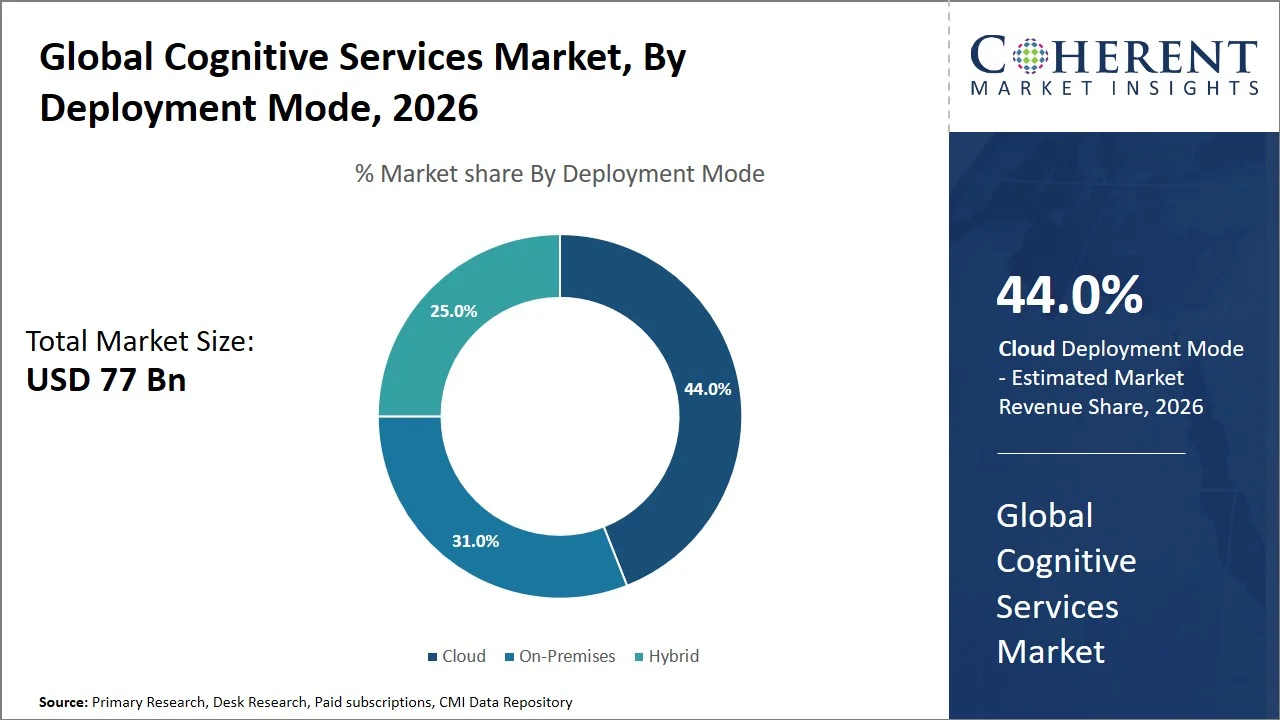
The cloud segment is expected to account for 44.0% of the global cognitive services market share in 2026. The global cognitive services market is more chosen for implementation in cloud as it offers scalable, cost-effective, and on-demand access to advanced AI capabilities, allowing enterprises to quickly deploy cognitive services without large upfront infrastructure investments. It also enables continuous model updates, high-performance computing resources and smooth integration with enterprise applications to speed AI adoption for enterprises of all sizes.
On June 12, 2026, Tata Consultancy Services expanded its collaboration with Oracle by launching India’s first Oracle AI Data Platform Lab and Center of Excellence (CoE) in Kolkata, India. The new facility is designed to help organizations shape the next wave of AI-powered enterprise transformation. (Source: Tata Consultancy Services)
Customer Experience Management Dominates the Global Cognitive Services Market
The customer experience management segment is expected to account for 26.0% of the global cognitive services market share in 2026. Customer experience management is driving the global cognitive services market as organizations are heavily investing in AI-powered chatbots, virtual assistants, sentiment analysis, and personalized recommendation engines to increase customer engagement, improve service efficiency, and deliver highly personalized experiences across digital channels. This directly affects client satisfaction, retention and revenue generation, making it the dominant application segment.
On March 10, 2026, Salesforce introduced Agentforce Contact Center, the only contact center solution that unifies voice, digital channels, CRM data, and AI agents natively in a single system, enabling customer self-service at scale, seamless AI-to-human handoffs, and real-time visibility across every interaction. (Source: Salesforce)
Currents Events and their Impact
Current Events | Description and its Impact |
European Union AI Act |
|
Digital Personal Data Protection Rules, 2025 (India) |
|
(Source: EU AI Act, Press Information Bureau)
Cognitive Services Market Dynamics

Market Drivers
Growing enterprise adoption of AI and machine learning technologies
The rising adoption of AI and machine learning technologies by enterprises is a major growth driver for the global cognitive services market, as businesses across various sectors are increasingly harnessing AI-based solutions to automate processes, improve decision-making, enhance customer experiences and derive actionable insights from large amounts of structured and unstructured data. The growing use of machine learning, natural language processing, computer vision and predictive analytics in corporate processes drives the need for scalable cognitive services for greater operational efficiency, innovation and competitive edge.
On July 24, 2025, Microsoft shared over 1,000 client transformation stories around AI and machine learning deployments across industries. Organizations such as Finastra used Microsoft 365 Copilot, Azure AI and machine learning solutions to automate workflows, boost analytics, customize customer interactions and increase employee productivity. (Source: Microsoft)
Increasing demand for intelligent automation and digital transformation
The worldwide cognitive services market is witnessing a considerable increase due to the growing demand for intelligent automation and digital transformation. Companies are seeking AI-enabled automation to improve business processes, cut operating costs, and boost productivity. Cognitive services like Natural Language Processing, Speech Recognition, Computer vision and Predictive Analytics are slowly becoming a part of the enterprise workflow to automate repetitive tasks, improve operational efficiency and enable data-driven decision making. Thus, cognitive services are becoming an essential part of the modern-day digital transformation initiatives.
On April 1, 2026, HCLTech announced the launch of AI Force 2.0, the next evolution of its proprietary enterprise AI platform. The new version integrates agentic intelligence with generative AI to help enterprises accelerate and augment workflows across software and data engineering, IT operations and enterprise business processes. (Source: Ericsson)
Emerging Trends
- Expansion of Edge AI and Real-Time Cognitive Processing: Companies are expanding the use of cognitive services at the network edge to reduce latency, boost responsiveness, and safeguard data privacy. Demand for cognitive processing skills is being driven by real-time computer vision, speech recognition, predictive maintenance and autonomous decision-making applications that are closer to devices, sensors and operating settings.
- Rising Focus on Responsible, Explainable, and Secure AI: As cognitive services become ingrained in business decision making, there is growing focus on AI governance, model transparency, bias mitigation and regulatory compliance. Vendors are heavily investing in explainable AI, data protection processes and ethical AI frameworks to build trust and comply with the growing demands of global regulators, while delivering trustworthy and accountable AI implementations.
Regional Insights
Why is North America a Strong Market for Cognitive Services?
North America is expected to account for a market share of 41.0% in 2026. North America continues to be the innovation hub for cognitive services, with a concentration of hyperscale cloud providers and AI platform developers. Microsoft sped up enterprise rollout of its Azure AI Services and Copilot ecosystem across healthcare, financial services, government and more in 2025-2026. Amazon Web Services boosted Amazon Bedrock and AI-powered cognitive APIs for enterprise automation. Healthcare providers, banks, retailers and other large organizations are rapidly deploying customer support, document intelligence, speech analytics and predictive decision-making platforms powered by generative AI. This is turning the region into a leader in real-world cognitive services implementation, not just AI research.
Moreover, use of cognitive services in medical diagnostics is further driving the growth of the regional market. On April 29, 2026, Aidoc, a global leader in clinical AI, has raised USD 150 million in Series E funding led by Growth Equity at Goldman Sachs Alternatives. The round had participation from General Catalyst, SoftBank Vision Fund 2, and NVentures (NVIDIA’s venture capital arm). The round brings total funding to over USD 500 million, less than a year after a growth round led by General Catalyst and Square Peg. (Source: Aidoc)
Why Does the Asia Pacific Cognitive Services Market Exhibit High Growth?
Asia Pacific is projected to account for 28.0% of the global cognitive services market and is expected to register the fastest growth. In Asia Pacific, national AI strategies and large-scale digital transformation programs are driving fast use of cognitive services. China, Japan, South Korea, Singapore and India are rapidly integrating AI-powered language models, intelligent customer service platforms and computer vision applications into the public and private sectors. Alibaba Cloud, Tencent Cloud, Baidu AI Cloud and several regional vendors stepped up enterprise-grade cognitive AI offerings and governments accelerated smart city, digital government and AI-enabled healthcare projects that rely heavily on NLP, speech recognition and intelligent analytics capabilities. On February 17, 2026, Bharat1, a India-based artificial intelligence infrastructure company, announced that it will build a “Humanity-First AI City in Bengaluru”, a city-scale research and infrastructure initiative designed to advance foundational Agentic and Physical AI systems in real-world environments. (Source: Bharat1)
Global Cognitive Services Market Outlook for Key Countries
Why is the U.S. Emerging as a Major Hub in the Cognitive Services Market?
In the U.S., there is substantial enterprise adoption of generative AI and cognitive automation technologies. Companies like Microsoft, Google, Amazon, IBM, Salesforce, Oracle and others are adding cognitive capabilities to commercial software that powers automated customer service, intelligent search, code creation, fraud detection and knowledge management. Healthcare companies adopted AI-powered clinical documentation tools, financial institutions used intelligent risk analysis platforms, and federal agencies adopted secure AI assistants to process documents and improve operational efficiency at an accelerated pace throughout 2025-2026.
Is China the Next Growth Engine for the Cognitive Services Market?
The China cognitive services market for cognitive services is being formed by the local AI ecosystems led by Baidu, Alibaba, Tencent, Huawei and iFlytek. Enterprises were increasingly deploying big language models and AI-powered digital assistants for banking, e-commerce, manufacturing and government applications by 2025-2026. Baidu’s ERNIE ecosystem, Alibaba Cloud’s Tongyi AI platform and iFlytek’s speech recognition technologies have acquired notable traction, with particular success in Chinese-language NLP, smart customer service, intelligent document processing and AI-powered digitalization of the public sector.
Germany Cognitive Services Market Analysis and Trends
The cognitive services market is in Germany driven strongly by industry 4.0 and smart manufacturing needs. Automotive and industrial leaders are progressively embedding cognitive AI solutions into manufacturing operations, predictive maintenance systems, quality inspection processes and supply chain optimization. Companies such as SAP expanded enterprise AI capabilities across ERP and business applications. Manufacturers applied computer vision and machine learning technologies to improve production efficiency, automate inspection workflows and enable intelligent decision-making across industrial environments.
U.K. Cognitive Services Market Analysis and Trends
The U.K. is now a leading hub in Europe for the use of corporate AI, particularly in the financial services, healthcare and professional services industries. Financial institutions are leveraging cognitive services for fraud detection, customer engagement, regulatory compliance and risk analytics and healthcare organizations are using AI-powered clinical documentation and patient interaction solutions. Spending on generative AI applications skyrocketed during 2025-2026 as firms integrated cognitive technology into contact centers, knowledge management systems, and digital transformation initiatives.
Japan Cognitive Services Market Analysis and Trends
The Japan cognitive services market is marked by the intersection of AI with robotic, advanced manufacturing and aging-population assistance projects. Organizations are rapidly deploying technologies such as speech recognition, machine translation, computer vision and intelligent automation to boost productivity and manage manpower shortages. Japanese firms speeded up deployment of AI-powered customer service agents, industrial inspection systems, and systems to support healthcare, while IT giants beefed up cognitive AI for automotive, electronics, and smart factories.
Global Cognitive Services Market - Enterprise AI API Calls Processed Annually
Region | Enterprise AI API Calls Processed Annually (Trillion Calls) |
North America | 980 |
Europe | 620 |
Asia Pacific | 820 |
Latin America | 145 |
Middle East & Africa | 115 |
How is the Rapid Adoption of Generative AI Across Enterprises Creating New Growth Opportunities in the Cognitive Services Market?
The cognitive services market is experiencing significant growth opportunities as generative AI is rapidly adopted across enterprises, driving the demand for advanced natural language processing, conversational AI, intelligent document processing, content generation, code generation and knowledge management solutions. Across industries, companies are embedding generative AI into customer service, marketing, software development, healthcare, finance and business productivity processes to automate complicated activities, improve decision-making and enhance operational efficiency. The rapid adoption of these is fueling the demand for cloud-based cognitive APIs, AI platforms and multimodal AI services that can interpret and generate text, images, audio and video, accelerating innovation and enabling new income streams for cognitive service providers.
On June 3, 2026, Microsoft announced that three leading IT companies, Infosys, TCS and Wipro, have each scaled their Microsoft 365 Copilot licenses to over 100,000 employees, taking the collective commitment past 300,000 seats in under six months. (Source: Microsoft)
Market Players, Key Development, and Competitive Intelligence
Key Developments
- On June 15, 2026, Salesforce announced it has signed a definitive agreement to acquire Fin, an industry-leading customer agent company. Under the terms of the agreement, Salesforce will acquire Fin for approximately USD 3.6 billion, subject to customary purchase price adjustments.
- On March 20, 2025, Oracle announced the launch of Oracle AI Agent Studio for Fusion Applications, a comprehensive platform for creating, extending, deploying, and managing AI agents and agent teams across the enterprise. Part of Oracle Fusion Cloud Applications Suite, the new AI Agent Studio provides easy-to-use tools for customers and partners to create customized AI agents that address complex business needs and can help drive new levels of productivity.
Competitive Landscape
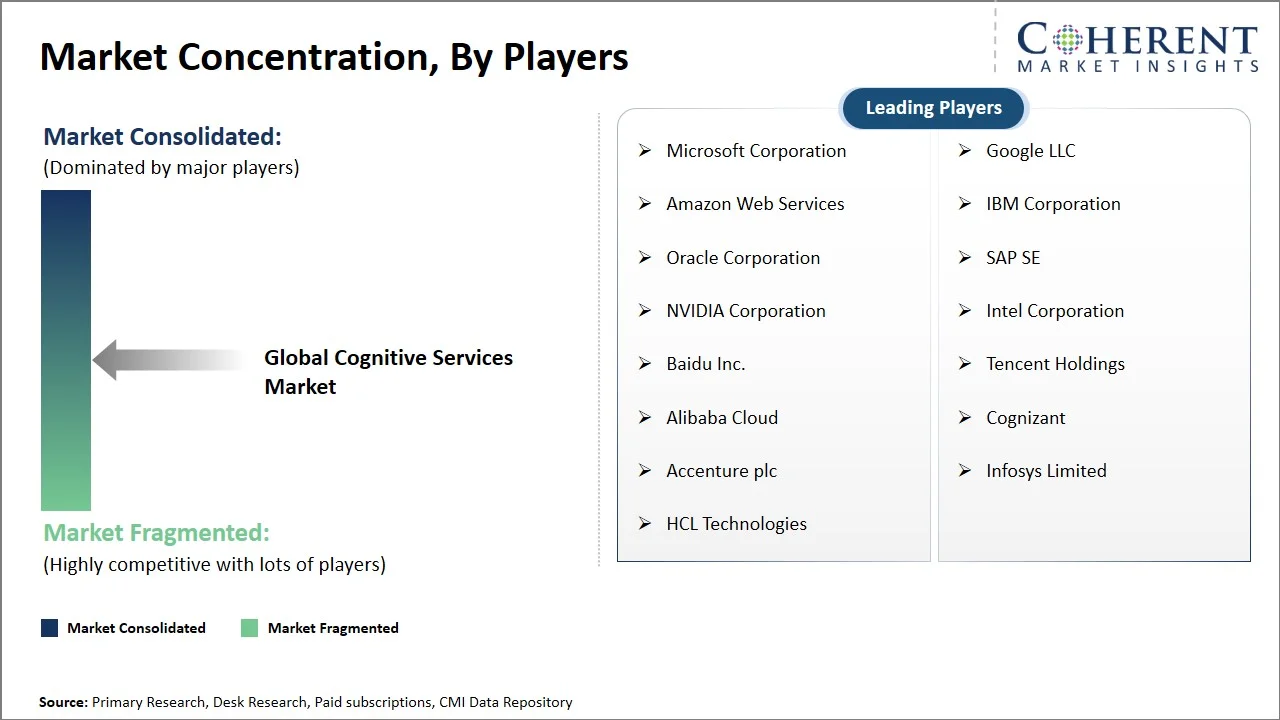
The worldwide cognitive services industry is highly competitive and the leading cloud providers, corporate software firms and AI platform suppliers are consistently improving their cognitive capabilities through innovation, collaborations and acquisitions. The market leadership is dominated by companies like Microsoft, Amazon Web Services, Google, IBM, Oracle, SAP, Salesforce, Nvidia, Alibaba Cloud, Baidu, etc. which have expansive portfolios covering natural language processing, speech recognition, computer vision, generative AI and machine learning services. Industry-specific AI solutions, proprietary foundation models, multimodal AI capabilities and seamless connectivity with corporate applications and cloud ecosystems are increasingly becoming drivers of competitive advantage.
Market Report Scope
Cognitive Services Market Report Coverage
| Report Coverage | Details | ||
|---|---|---|---|
| Base Year: | 2025 | Market Size in 2026: | USD 77 Bn |
| Historical Data for: | 2020 To 2024 | Forecast Period: | 2026 To 2033 |
| Forecast Period 2026 to 2033 CAGR: | 27% | 2033 Value Projection: | USD 310 Bn |
| Geographies covered: |
| ||
| Segments covered: |
| ||
| Companies covered: | Microsoft Corporation, Google LLC, Amazon Web Services, IBM Corporation, Oracle Corporation, SAP SE, NVIDIA Corporation, Intel Corporation, Baidu Inc., Tencent Holdings, Alibaba Cloud, Cognizant, Accenture plc, Infosys Limited, and HCL Technologies | ||
| Growth Drivers: |
| ||
Analyst Opinion (Expert Opinion)
- Globally, the cognitive services market is likely to remain very appealing, as cognitive services are increasingly entrenched into enterprise digital transformation initiatives. While data privacy, regulatory compliance and AI governance issues are expected to continue, ongoing investments in responsible AI frameworks and enterprise AI infrastructure are expected to support long-term industry growth.
- The future of the cognitive services market is expected to be driven by generative AI, agentic AI, multimodal intelligence and edge computing technologies. Healthcare, financial services, manufacturing, retail, government and education are projected to witness greater adoption as firms look to automate knowledge-intensive operations and improve their decision-making capabilities. Continued innovation in foundation models, real-time AI processing, domain-specific cognitive services, and explainable AI solutions are likely to unlock new business opportunities, while the increasing integration of cognitive capabilities into daily enterprise workflows is expected to drive market expansion in the years to come.
Speak to the analyst
Want personalized insights?
Take the findings above to one of our principal consultants, or have the report rebuilt around the segments, geographies and competitors you actually track.
Market Segmentation
- Service Type Insights (Revenue, USD Billion, 2021 - 2033)
- Natural Language Processing
- Machine Learning Services
- Computer Vision
- Others
- Deployment Mode Insights (Revenue, USD Billion, 2021 - 2033)
- Cloud
- On-Premises
- Hybrid
- Application Insights (Revenue, USD Billion, 2021 - 2033)
- Customer Experience Management
- Risk and Compliance Management
- Fraud Detection
- Predictive Maintenance
- Business Intelligence
- Workforce Optimization
- Healthcare Diagnostics
- Intelligent Process Automation
- End User Insights (Revenue, USD Billion, 2021 - 2033)
- BFSI
- Healthcare and Life Sciences
- Retail and E-commerce
- Manufacturing
- IT and Telecommunications
- Government & Defense
- Media and Entertainment
- Energy and Utilities
- Transportation and Logistics
- Regional Insights (Revenue, USD Billion, 2021 - 2033)
- North America
- U.S.
- Canada
- Latin America
- Brazil
- Argentina
- Mexico
- Rest of Latin America
- Europe
- Germany
- U.K.
- Spain
- France
- Italy
- Russia
- Rest of Europe
- Asia Pacific
- China
- India
- Japan
- Australia
- South Korea
- ASEAN
- Rest of Asia Pacific
- Middle East
- GCC Countries
- Israel
- Rest of Middle East
- Africa
- South Africa
- North Africa
- Central Africa
- North America
- Key Players Insights
- Microsoft Corporation
- Google LLC
- Amazon Web Services
- IBM Corporation
- Oracle Corporation
- SAP SE
- NVIDIA Corporation
- Intel Corporation
- Baidu Inc.
- Tencent Holdings
- Alibaba Cloud
- Cognizant
- Accenture plc
- Infosys Limited
- HCL Technologies
Sources
Primary Research Interviews
- AI & Machine Learning Solution Providers
- Cloud Platform & Infrastructure Vendors
- Enterprise IT Decision Makers & CIOs
- Cognitive Services End-Users (Healthcare, BFSI, Retail)
Magazines
- MIT Technology Review
- AI Business Magazine
- Wired (AI & Technology Edition)
- IEEE Spectrum
Journals
- Journal of Artificial Intelligence Research (JAIR)
- IEEE Transactions on Neural Networks and Learning Systems
- Journal of Machine Learning Research (JMLR)
Associations:
- Association for the Advancement of Artificial Intelligence (AAAI)
- Computing Research Association (CRA)
- International Association of Artificial Intelligence (IAAI)
- Cloud Native Computing Foundation (CNCF)
Public Domain Sources
- U.S. National Institute of Standards and Technology (NIST)
- European Commission - Artificial Intelligence Policy Portal
- World Economic Forum (WEF) - AI & Cognitive Computing Reports
- U.S. Department of Commerce - Technology & Innovation Reports
Proprietary Elements
- CMI Data Analytics Tool
- Proprietary CMI Existing Repository of Information for the last 10 years
Get access to 250+ pages report
Every segment, forecast, competitor profile and data table behind the analysis above — available for instant download.
- ESOMAR Member
- ISO 9001:2015 Certified
- D-U-N-S Registered
- GDPR & CCPA Compliant
Missing comfort of reading report in your local language? Find your preferred language:
Transform your Strategy with Exclusive Trending Reports
Frequently Asked Questions
The global cognitive services market is expected to stand at USD 77 Bn in 2026 and is expected to reach USD 310 Bn by 2033.
The CAGR of the global cognitive services market is projected to be 27% from 2026 to 2033.
Growing enterprise adoption of AI and machine learning technologies and increasing demand for intelligent automation and digital transformation are the major factors driving the growth of the global cognitive services market.
High implementation and integration costs and data privacy and security concerns are the major factors hampering the growth of the global cognitive services market.
In terms of service type, the natural language processing segment is estimated to dominate the market revenue share in 2026.
They enable personalized interactions, intelligent virtual assistants, and real-time customer support automation.
Computer vision enables systems to analyze images and videos for identification, inspection, and monitoring applications.