

Automotive Cloud Market Analysis & Forecast
The global Automotive Cloud Market size is estimated to be valued at USD 40.12 Bn in 2026 and is expected to reach USD 143.74 Bn by 2033, exhibiting a compound annual growth rate (CAGR) of 20.0% from 2026 to 2033.
Key Takeaways
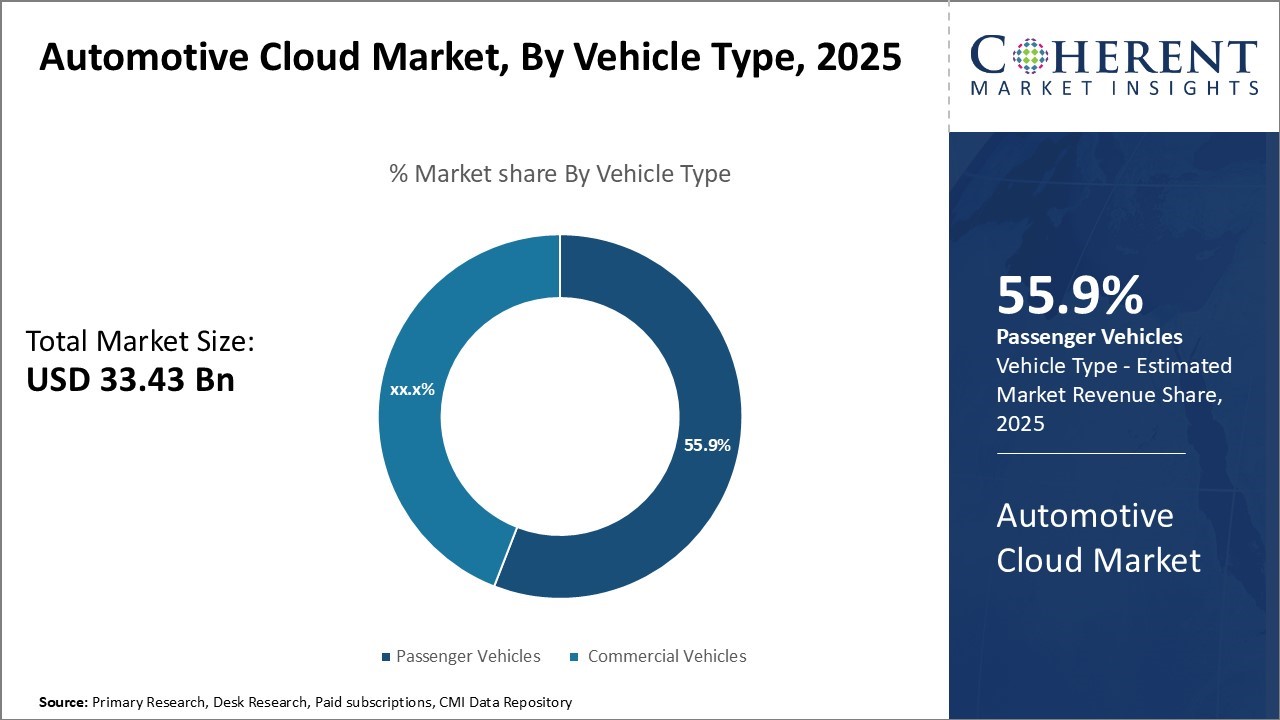
- By Vehicle Type, the Passenger Vehicles segment is projected to lead the global Automotive Cloud Market outlook with a 56.9% share in 2026.
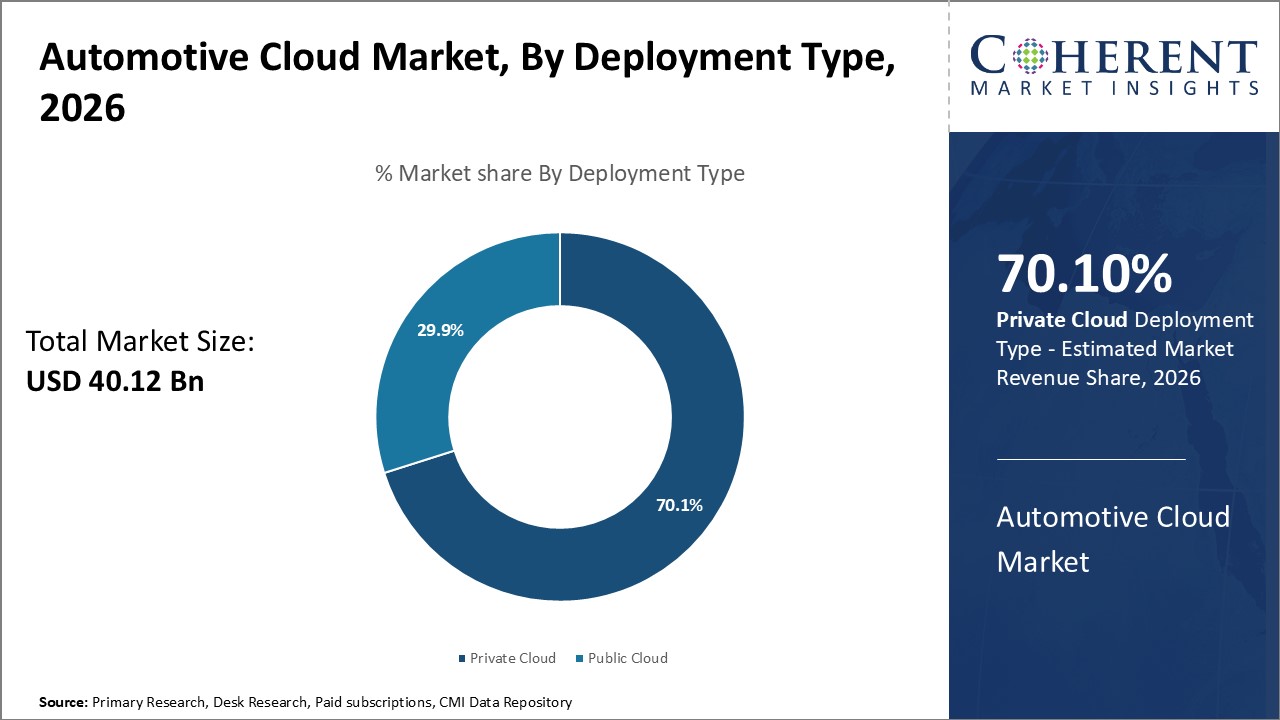
- By Deployment Type, the Private Cloud segment is expected to dominate the market with a 70.1% share in 2026.
- By Application, The Infotainment Systems Segment is anticipated to fuel adoption, accounting for 26.8% of the market share in 2026.
- By Region, Asia Pacific is forecasted to hold the largest market share at 42.0% in 2026.
Market Overview
The Automotive Cloud Market value is expected to witness significant growth over the forecast period. The growth is attributed to increasing connectivity in vehicles and growing demand for personalized in-vehicle experience. Major automakers such as Amazon Web Services, Inc., Apple (US), Blackberry Limited, etc. are focusing on enhancing customer experience through vehicle connectivity features and advanced infotainment systems driven by Internet of Things (IoT) and cloud platforms. Cloud computing enables the seamless integration of these systems and facilitates remote access to various vehicle functionalities. The growing demand for in-vehicle entertainment and comfort is also driving the need for advanced cloud-based applications and services.
Current Events and Its Impact on the Automotive Cloud Market
Event | Description and Impact |
Geopolitical Trade Conflicts |
|
Technological Advancements |
|
Strategic Industry Partnerships |
|
Role of Emerging Technologies
Connected Vehicle Ecosystems: New automotive cloud platforms link cars with roadside devices and mobile apps in real time. This network serves up over-the-air software patches, runs remote health checks, and tailors each journey with live driver preferences.
Autonomous Driving Enablement: Clouds now host the heavy-duty computing that sorts mountains of LIDAR and camera files for self-driving cars. On-the-spot choices come from AI models stored in the cloud, speeding research teams toward cars that drive themselves.
Cloud-Based Infotainment Systems: Carmakers team with tech giants to turn the cabin into a mini-streaming theatre. Passengers find their favorite shows, social feeds, and smart helpers ready on every trip, plus fresh features thanks to OTA tweaks.
Digital Supply Chain Optimization: Factories lean on cloud dashboards to trace every part from supplier dock to dealer lot. Shared, live data with OEMs, material makers, and truck companies sharpens production, trims stockroom piles, and speeds new models to showrooms. Cybersecurity
Enhancements: Growing connectivity calls for cloud-born shields against hackers, not afterthoughts. Solutions-center on strong encryption, purpose-built secure gateways, and watchful intrusion alarms crafted just for cars on the network.
Mobility-as-a-Service (MaaS): Cloud technologies are enabling shared mobility platforms by offering scalable infrastructure for ride-sharing, car subscription, and fleet management. Features like real-time vehicle tracking, route optimization, and automated billing are all cloud-driven.
- Current Industry Events of 2026
- Market Size Estimation
- Regional Breakdown
- Competitive Landscape
- Customer Intelligence
- Segmental Analysis
- Pricing Analysis
- Key Market Drivers, Challenges & Future Trends
- Customized Insights Section
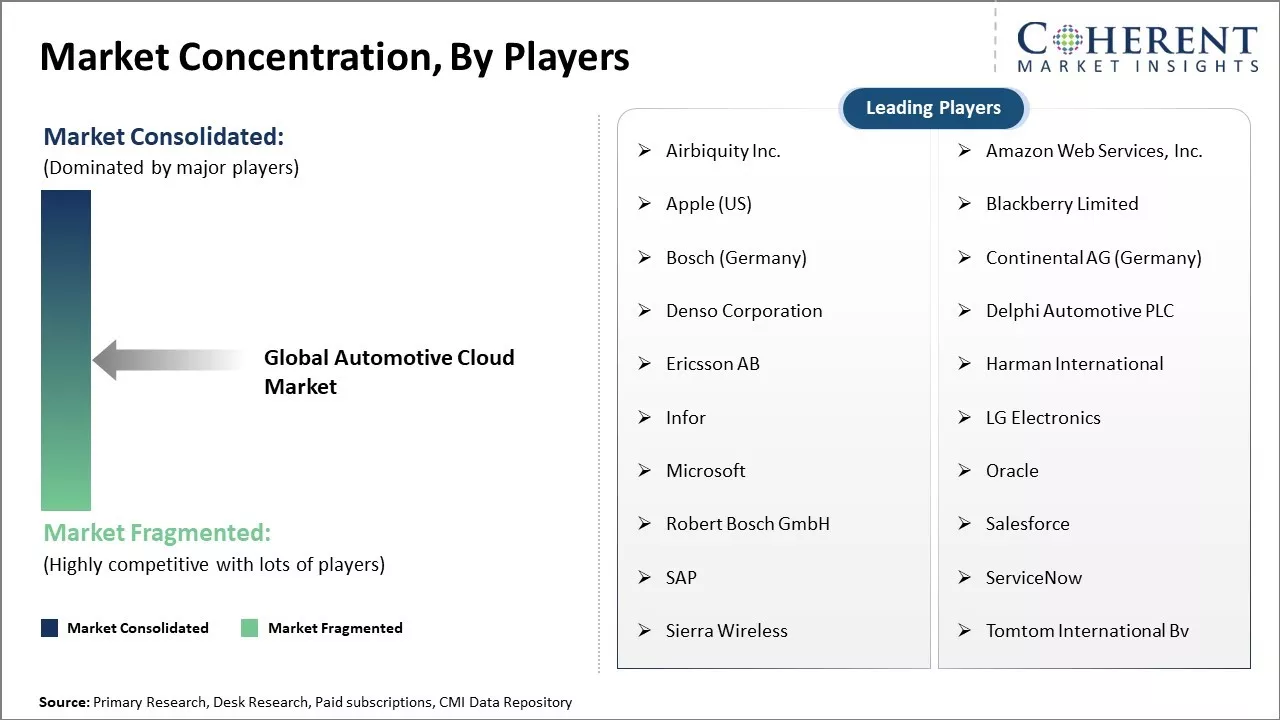
Market Concentration and Competitive Landscape
Drivers of the Market
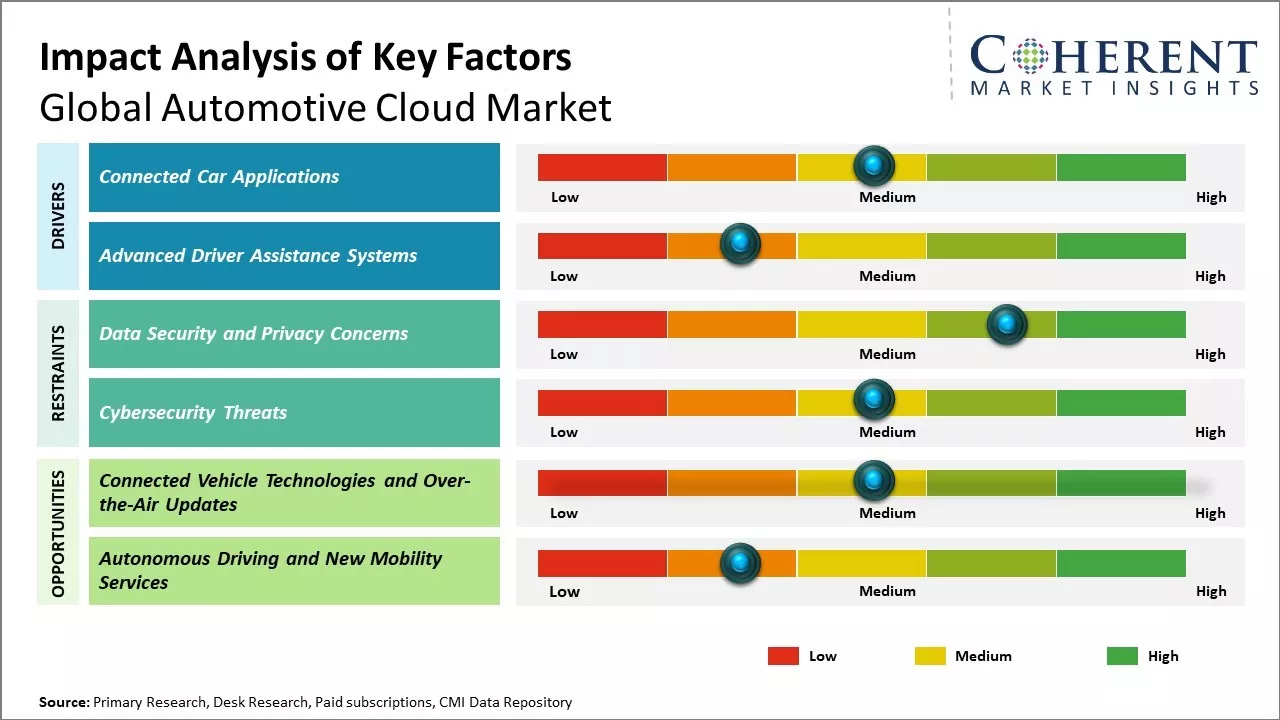
- Connected Car Applications
The demand for connected vehicles features and applications is growing rapidly across the globe. With internet connectivity built into vehicles, drivers can now access real-time information such as weather updates, traffic conditions, location-based services, and others while on the move. Cloud platforms enable automakers to develop and deploy these connected services effectively. Using the cloud, new features can be added over-the-air through seamless software updates without requiring the driver to visit a service center. This gives automakers an opportunity to enhance the driver experience on a continuous basis and also extract valuable usage data.
Connectivity opens up possibilities for advanced mobility services involving infotainment, telematics, autonomous driving and more. As drivers experience the conveniences of connectivity, they will expect newer and better-connected services in the future. This helps the cloud gain more importance in developing and managing connected vehicle ecosystems.
For instance, in November 2023, Salesforce cloud-based software company that provides businesses with tools to manage customer relationships, sales operations, and marketing campaigns, introduced new innovations in its Automotive Cloud, aimed at empowering automotive companies to leverage data and AI to deliver more personalized in-car experiences, streamline fleet management, and simplify auto lending and leasing processes.
- Advanced Driver Assistance Systems
Automakers are increasingly focusing on incorporating advanced driver assistance systems and autonomous driving capabilities in their vehicles. The development of such complex technologies requiring huge computational power is best supported by cloud platforms. Cloud infrastructure offers limitless scalability and processing capabilities for tasks like analyzing data from multiple sensors and cameras in real-time. It also ensures seamless software updates for Advanced Driver Assistance Systems (ADAS) algorithms based on latest road conditions, geography and other parameters.
Moreover, cloud networks allow information exchange between vehicles and the outside world, an important factor for autonomous driving. With shared experiences, autonomous cars can deliver safer performance over time. The rise of mobility as a service further accelerates the need for advanced data-driven technologies using cloud computing. As self-driving vehicles become a reality, their effective management through automated cloud platforms will be crucial for success. This is likely to drive significant growth in automotive Cloud services.
Market Opportunities: Connected Vehicle Technologies and Over-the-Air Updates
The rising demand for connected vehicle technologies and over-the-air updates provides an opportunity for cloud service providers to partner with automakers. There is also a need for customized cloud solutions that can scale across global vehicle fleets. The push towards autonomous driving and new mobility services will further drive the need for cloud-based applications for mapping, navigation, and vehicle-to-everything.
Segmental Insights
Global Automotive Cloud Market Insights, by Vehicle Type
In terms of vehicle type, passenger vehicles are expected to contribute 56.9% Automotive Cloud Market share owing to consumers' growing demand for in-vehicle comfort, connectivity, and entertainment features. As automotive technology continues to evolve at a rapid pace, passengers have come to expect seamless integration of their mobile devices and online content into the vehicle experience.
The automotive cloud enables critical infotainment functions such as satellite navigation, voice assistance, music and media streaming that enhance convenience on the go. It allows over-the-air updates to improve the in-car experience over time. With the automotive cloud, passengers gain on-demand access to next-generation features like augmented reality heads-up displays without needing to visit a service center. This level of personalization and constant innovation is fueling adoption of connected passenger vehicles and driving the growth of this segment.
Global Automotive Cloud Market Insights, by Deployment Type
In terms of deployment type, private cloud is expected to contribute 70.1% share of the Automotive Cloud Market demand owing to heightened concerns about cybersecurity and data privacy in automotive systems. As vehicles become more connected, there is increased vulnerability to external threats like hacking and privacy breaches if sensitive drive and passenger data is hosted on a shared public cloud platform. Automakers recognize the need to establish robust safeguards around consumer information transmitted over the air.
Private cloud infrastructure located on the manufacturer's secured internal servers provides centralized control and multi-layered protection against such risks. It ensures customer trust in new mobility technologies. By mitigating issues surrounding unauthorized access and leakage of private travel patterns, infotainment preferences etc., private cloud addresses a major adoption barrier and thus sees higher preference over public deployment alternatives.
Global Automotive Cloud Market Insights, by Applications
In terms of application, infotainment systems is expected to contribute 26.8% share of the Automotive Cloud Market value driven by the rising indispensability of in-car entertainment and communication services. Modern drivers and passengers expect intuitively designed onboard multimedia and seamless integration of their favorite content and apps into the car cabin experience.
The cloud architecture facilitates the rapid development and deployment of these value-added infotainment features. It enables dynamic over-the-air upgrades to navigation databases, new audio/video streaming options and smartphone mirroring capabilities. Further, as vehicles transition to become mobility platforms, future application areas around augmented reality, ride-sharing connectivity, and autonomous driving will amplify the automotive cloud usage.
Thus, the diverse possibilities under the broad infotainment category boosts adoption across vehicle segments and cloud deployment models to drive segment leadership in this sphere.
Global Automotive Cloud Market - Regional Insights
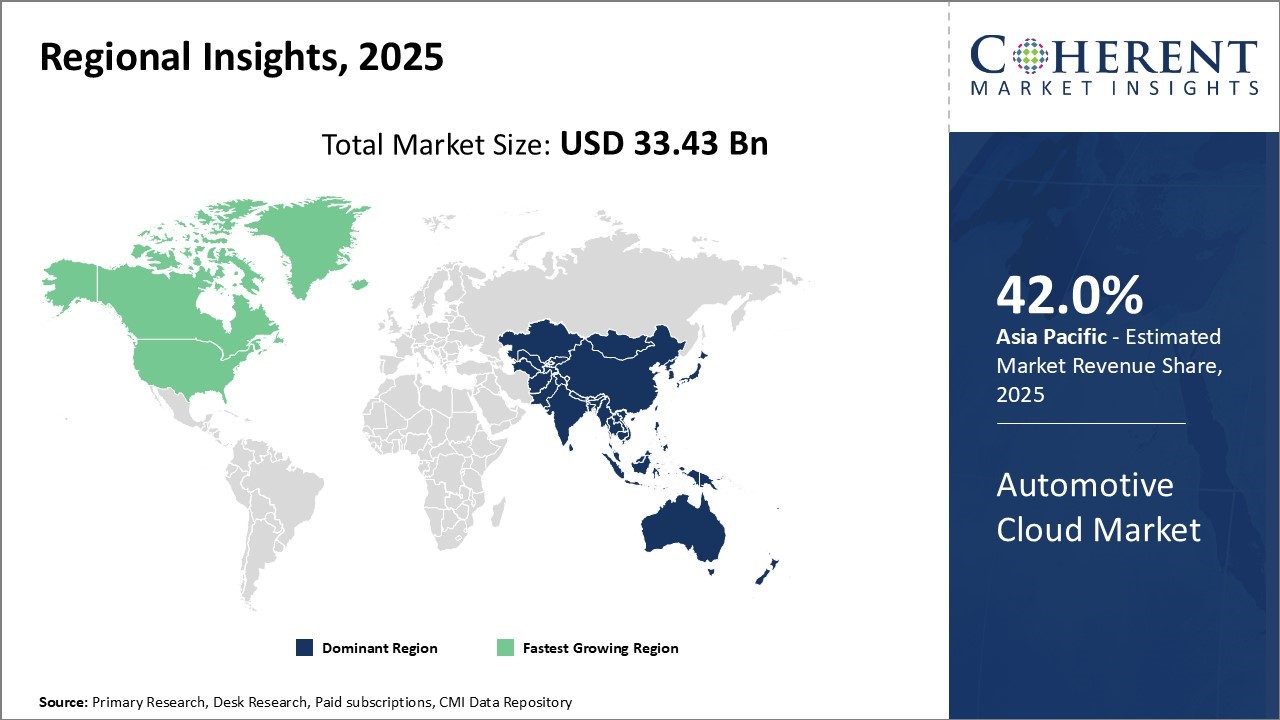
Asia Pacific Automotive Cloud Market Analysis and Trends
Asia Pacific is projected to dominate the global automotive cloud market with an estimated 42.0% Automotive Cloud Market trend share in 2026, driven primarily by the rapid integration of connected and autonomous vehicle technologies across key markets such as China, Japan, and South Korea.
The region's vast population base, rising disposable income, and growing middle class have accelerated the adoption of advanced automotive technologies and cloud-based platforms. Strong government initiatives supporting smart mobility and digital transformation, along with investments from domestic tech firms and automakers, are further solidifying Asia Pacific’s leading position in this space.
North America Automotive Cloud Market Analysis and Trends
North America is emerging as the fastest growing region in the global automotive cloud market, fueled by high adoption of cloud-based solutions across the automotive value chain. The region benefits from a robust technological infrastructure, strong economic conditions, and a highly developed automotive manufacturing ecosystem led by companies such as Ford, General Motors, and Tesla.
Additionally, the presence of major cloud providers and software companies like Microsoft, Amazon Web Services (AWS), and Google Cloud has accelerated integration efforts. Supportive regulations and strategic collaborations between OEMs and tech firms are enabling scalable deployment of cloud technologies in connected and autonomous vehicles.
Dominating Countries in the Automotive Cloud Market
China Automotive Cloud Market Analysis and Trends
China leads Asia Pacific’s automotive cloud market with substantial investments in smart transportation and next-generation mobility. The government’s strategic focus on connected and electric vehicles, combined with the rise of domestic cloud providers such as Alibaba Cloud and Tencent Cloud, has accelerated deployment across major urban hubs.
Additionally, joint ventures between Chinese OEMs and international cloud companies are enabling scalable and localized solutions that cater to both commercial and passenger vehicle segments.
United States Automotive Cloud Market Analysis and Trends
The U.S. plays a pivotal role in driving North America's automotive cloud market, thanks to its advanced cloud ecosystem and innovation-driven automotive industry. Automakers are increasingly integrating cloud platforms to enable vehicle-to-everything (V2X) communication, real-time telematics, and predictive maintenance solutions.
Federal and state-level support for autonomous vehicle testing and smart infrastructure is further accelerating the adoption of cloud solutions in the sector. Strategic alliances between tech companies and automakers continue to reinforce the U.S.’s leadership in automotive cloud innovation.
Market Report Scope
Automotive Cloud Market Report Coverage
| Report Coverage | Details | ||
|---|---|---|---|
| Base Year: | 2025 | Market Size in 2026: | USD 40.12 Bn |
| Historical Data for: | 2020 To 2024 | Forecast Period: | 2026 To 2033 |
| Forecast Period 2026 to 2033 CAGR: | 20.0% | 2033 Value Projection: | USD 143.74 Bn |
| Geographies covered: |
| ||
| Segments covered: |
| ||
| Companies covered: | Airbiquity Inc., Amazon Web Services, Inc., Apple (US), Blackberry Limited, Bosch (Germany), Continental AG (Germany), Denso Corporation, Delphi Automotive PLC, Ericsson AB, Harman International, Infor, LG Electronics, Microsoft, Oracle, Robert Bosch GmbH, Salesforce, SAP, ServiceNow, Sierra Wireless, and Tomtom International Bv | ||
| Growth Drivers: |
| ||
| Restraints & Challenges: |
| ||
Analyst Viewpoint
- The Automotive Cloud Market is undergoing rapid transformation, driven by the rising demand for connected and autonomous vehicles across global markets.
- Automakers are increasingly adopting cloud computing to enable seamless integration of in-vehicle systems, enhance performance, and deliver personalized user experiences.
- Cloud platforms are critical for supporting real-time data processing, OTA (Over-the-Air) updates, and predictive diagnostics in modern vehicles.
- The integration of AI, machine learning, and big data analytics is accelerating innovation within the automotive cloud ecosystem, creating smarter and more adaptive services.
- Key restraints include persistent concerns around data security, privacy, and the technical complexity of migrating legacy automotive systems to cloud-native infrastructures.
Key Developments
- In January 2025, BMW extended its strategic collaboration with Amazon Web Services (AWS) to integrate AI-powered diagnostics and predictive maintenance features into its cloud-based vehicle platform. The initiative aims to enhance real-time vehicle performance monitoring across BMW’s global fleet.
- In December 2024, Volkswagen Group announced a partnership with Google Cloud to develop advanced voice-enabled infotainment systems. The collaboration leverages Google’s natural language processing (NLP) models to enable more intuitive and responsive in-car voice assistants.
- In October 2024, Bosch launched its Mobility Cloud Services suite, offering cloud-based fleet management, predictive maintenance, and over-the-air (OTA) capabilities to OEMs and mobility providers. The platform is designed to support the shift toward connected and software-defined vehicles.
- In September 2024, Tesla upgraded its over-the-air software delivery infrastructure to support faster regional rollouts and reduced downtime. The enhancement includes a more resilient cloud-based backend to handle high-volume updates across multiple geographies.
Market Segmentation
- Vehicle Type Insights (Revenue, USD Bn, 2021 - 2033)
- Passenger Vehicles
- Commercial Vehicles
- Deployment Type Insights (Revenue, USD Bn, 2021 - 2033)
- Private Cloud
- Public Cloud
- Application Insights (Revenue, USD Bn, 2021 - 2033)
- Infotainment Systems
- Telematics
- Fleet Management
- Over the air Systems
- Advanced driver-assistance systems
- Others
- Regional Insights (Revenue, USD Bn, 2021 - 2033)
- North America
- U.S.
- Canada
- Latin America
- Brazil
- Argentina
- Mexico
- Rest of Latin America
- Europe
- Germany
- U.K.
- Spain
- France
- Italy
- Russia
- Rest of Europe
- Asia Pacific
- China
- India
- Japan
- Australia
- South Korea
- ASEAN
- Rest of Asia Pacific
- Middle East & Africa
- GCC Countries
- Israel
- South Africa
- Rest of Middle East & Africa
- Key Players Insights
- Airbiquity Inc.
- Amazon Web Services, Inc.
- Apple (US)
- Blackberry Limited
- Bosch (Germany)
- Continental AG (Germany)
- Denso Corporation
- Delphi Automotive PLC
- Ericsson AB
- Harman International
- Infor
- LG Electronics
- Microsoft
- Oracle
- Robert Bosch GmbH
- Salesforce
- SAP
- ServiceNow
- Sierra Wireless
- Tomtom International Bv
Sources
Primary Research Interviews
- AWS Automotive Solutions Architects
- Microsoft Azure IoT & Automotive Team
- Google Cloud Automotive Strategists
- Toyota Connected Vehicle Division Heads
- Others
Databases
- Bloomberg Terminal Market Analytics
- IBISWorld Connected Car Reports
- S&P Global Mobility Insights
- Others
Magazines
- Automotive News (Cloud Integration Special Issues)
- Connected Car Tech Magazine
- Cloud Computing Quarterly (Automotive Editions)
- Others
Journals
- IEEE Transactions on Vehicular Technology
- Journal of Cloud Computing: Advances, Systems and Applications
- SAE International Journal of Connected and Automated Vehicles
- Others
Newspapers
- The Wall Street Journal (Tech & Automotive Sections)
- Financial Times (Emerging Mobility Columns)
- Reuters Automotive Innovation Briefings
- Others
Associations
- SAE International (Cloud-Vehicle Integration Consortium)
- Cloud Security Alliance (Automotive Working Group)
- 5G Automotive Association (5GAA)
- Others
Public Domain Sources
- U.S. Department of Transportation Telematics Reports
- European Union Commission Mobility Cloud Guidelines
- NHTSA Vehicle Connectivity Whitepapers
- Others
Proprietary Elements
- CMI Data Analytics Tool
- Proprietary CMI Existing Repository of Information for Last 8 Years
*Definition: The global automotive cloud market involves using cloud computing technologies for automotive services and applications. It allows automotive enterprises and consumers to access data storage and sharing, analytics tools, mobile applications, and others through cloud-based servers rather than local servers or personal devices. As connected car technologies continue to evolve and more vehicles become integrated with internet capabilities, the automotive cloud market provides scalable solutions for remote vehicle diagnostics, navigation and infotainment, telematics, over-the-air updates.
Get access to 250+ pages report
Every segment, forecast, competitor profile and data table behind the analysis above — available for instant download.
- ESOMAR Member
- ISO 9001:2015 Certified
- D-U-N-S Registered
- GDPR & CCPA Compliant
Missing comfort of reading report in your local language? Find your preferred language:
Transform your Strategy with Exclusive Trending Reports
Frequently Asked Questions
The Automotive Cloud Market size is estimated to be valued at USD 40.12 Bn in 2026, and is expected to reach USD 143.74 Bn by 2033.
The CAGR of the global Market is projected to be 20.0% from 2026 to 2033.
Connected car applications and advanced driver assistance systems are the major factors driving the growth of the automotive cloud industry.
Data security and privacy concerns and cybersecurity threats are the major factors hampering the growth of the market.
In terms of Vehicle Type, Passenger Vehicles, estimated to dominate the market revenue share 2026.
Airbiquity Inc., Amazon Web Services, Inc., Apple (US), Blackberry Limited, Bosch (Germany), Continental AG (Germany), Denso Corporation, Delphi Automotive PLC, Ericsson AB, Harman International, Infor, LG Electronics, Microsoft, Oracle, Robert Bosch GmbH, Salesforce, SAP, ServiceNow, Sierra Wireless, and Tomtom International Bv are the major players.
Asia Pacific is expected to lead the global market.