

Electronic Trial Master File (eTMF) Market Size and Trends Forecast – 2026 to 2033
The Electronic Trial Master File (eTMF) market is estimated to be valued at USD 2.36 Bn in 2026 and is expected to reach USD 5.48 Bn by 2033, exhibiting a compound annual growth rate (CAGR) of 12.8% from 2026 to 2033.
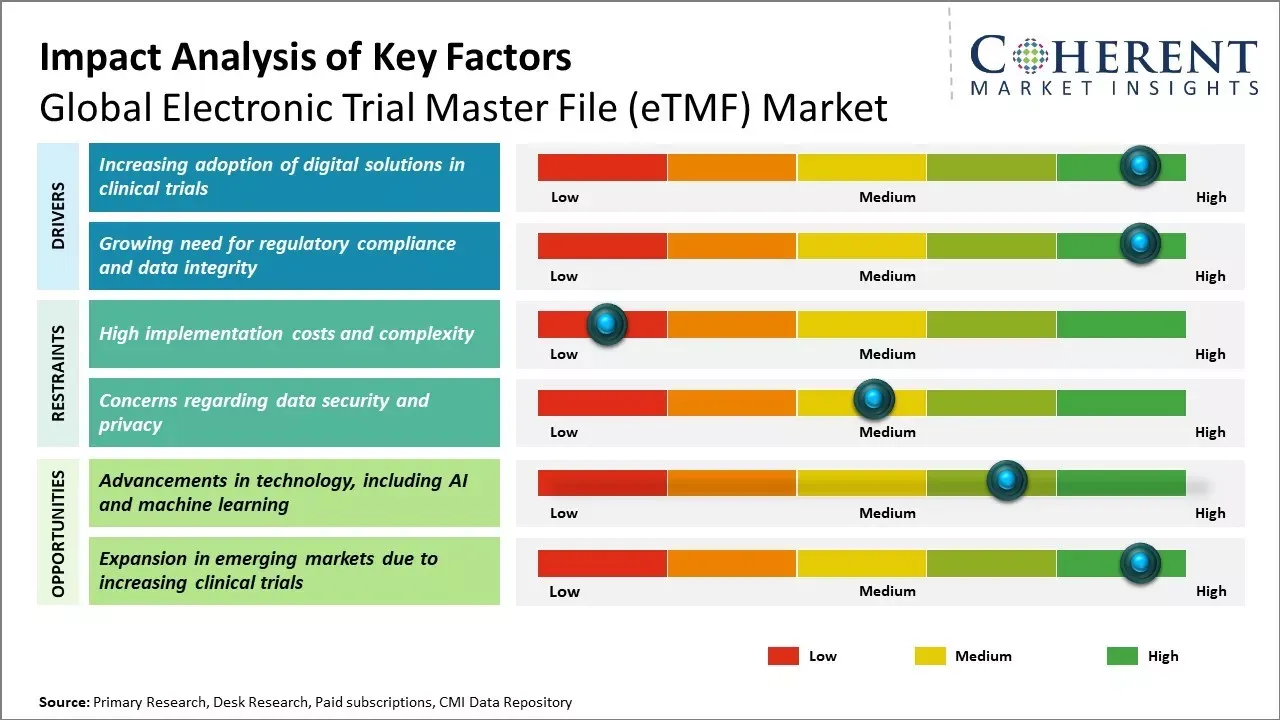
Key Takeaways of the Electronic Trial Master File (eTMF) Market
- By deployment mode, the cloud-based segment is expected to account for 63.6% of the market share in 2026.
- By functionality, the document management segment is estimated to contribute the highest market share of 41.8% in 2026.
- In terms of end user, the pharmaceutical companies segment is estimated to contribute the highest market share of 50% in 2026.
- North America remains the dominant player in the Electronic Trial Master File (eTMF) market and is estimated to account for 35. 9% of the global market share in 2026.
Market Overview
With regulatory compliance becoming increasingly important in clinical trials, there has been huge demand for electronic systems that facilitate regulatory submission and audit preparation. These systems make document management and information retrieval more efficient across global clinical trial sites due to rising adoption of digitalization among pharmaceutical and clinical research organizations.
However, global electronic trial master file (eTMF) market growth can be hampered due to high implementation costs and complexity.
Market Concentration and Competitive Landscape
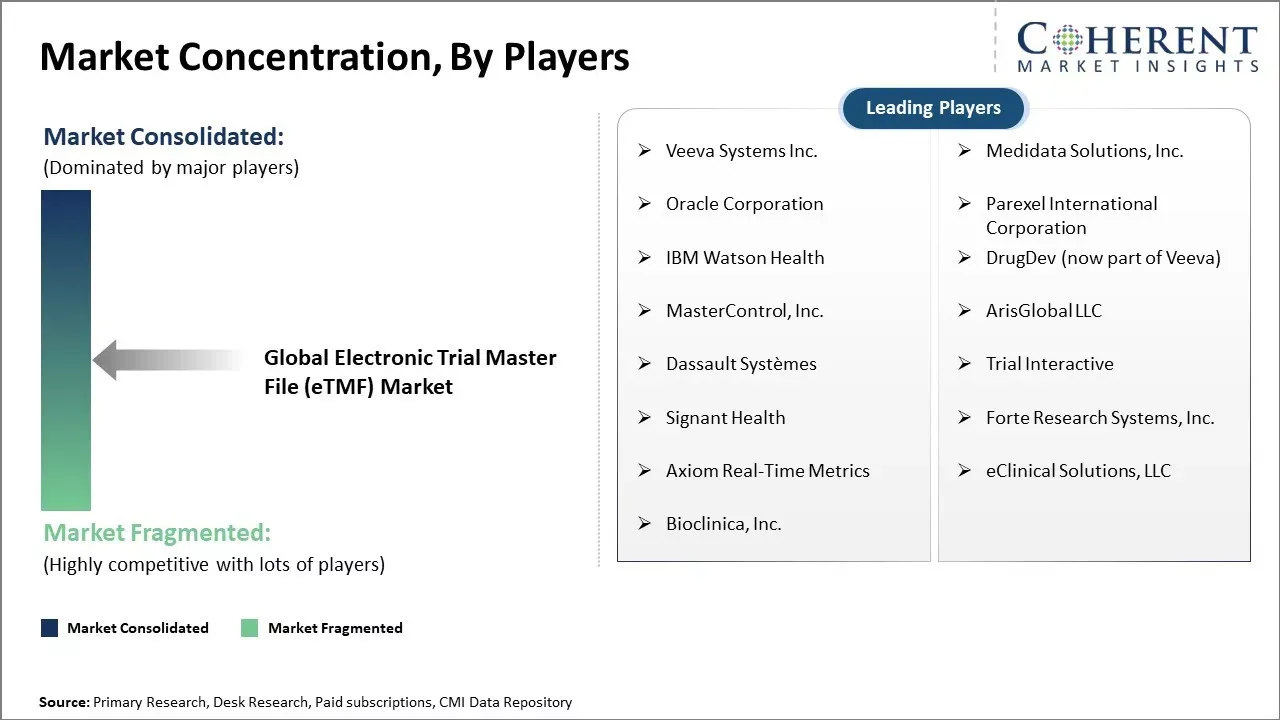
- Leading companies in the Electronic Trial Master File (eTMF) market, such as Veeva Systems, Phlexglobal, and IQVIA, dominate the industry with comprehensive cloud-based platforms and integrated clinical solutions. For instance, Veeva Systems continuously updates its eTMF solutions to align with evolving global regulatory frameworks (e.g., U.S. Food and Drug Administration 21 CFR Part 11, EU Annex 11), offering clients real-time inspection-readiness and automated audit trails.
- Mid-tier companies in the eTMF space prioritize cost-effectiveness and process efficiency. These firms often serve small-to-medium-sized biotech and pharma companies looking for regulatory compliance without the high investment in proprietary systems. Many also form strategic partnerships with regional CROs and utilize offshore development teams to control costs. For example, companies like MasterControl and ePharmaSolutions target mid-size sponsors by offering customizable, scalable eTMF tools that meet GCP compliance while remaining budget-friendly.
Current Events and Its Impact
Current Events | Description and its impact |
Regulatory Modernization Initiatives |
|
Technological Disruptions |
|
- Current Industry Events of 2026
- Market Size Estimation
- Regional Breakdown
- Competitive Landscape
- Customer Intelligence
- Segmental Analysis
- Pricing Analysis
- Key Market Drivers, Challenges & Future Trends
- Customized Insights Section
Increasing Adoption of Digital Solutions in Clinical Trials
Pharmaceutical and life sciences industry has undergone tremendous transformation due to advancement of digital technologies. Clinical trials which were traditionally carried out are now transitioning towards digital solutions. There has been risk of important documents being misplaced or lost which could potentially jeopardize patient safety as well delay development timelines.
For instance, as per a study by the Applied Clinincal Trials, in June 2025, USD 1.05 million was invested in AI/ML use by activity assessed, teams experienced an average time reduction of 18% using AI/ML, and overall, respondents reported a positive outlook on the use of AI/ML in drug development.
Growing Need for Regulatory Compliance and Data Integrity
Managing clinical trials in adherence to rigorous regulatory standards and maintaining the highest level of data integrity is crucial in drug development process. Documents could be misplaced, data transcription errors might occur while transferring information between paper to systems. Regulatory audits involving huge volumes of paper files are challenging and delays in document retrieval impacted audit outcomes. With globalization of clinical trials, demonstrating compliance to authorities across country-specific regulations was challenging with paperwork.
Segmental Insights
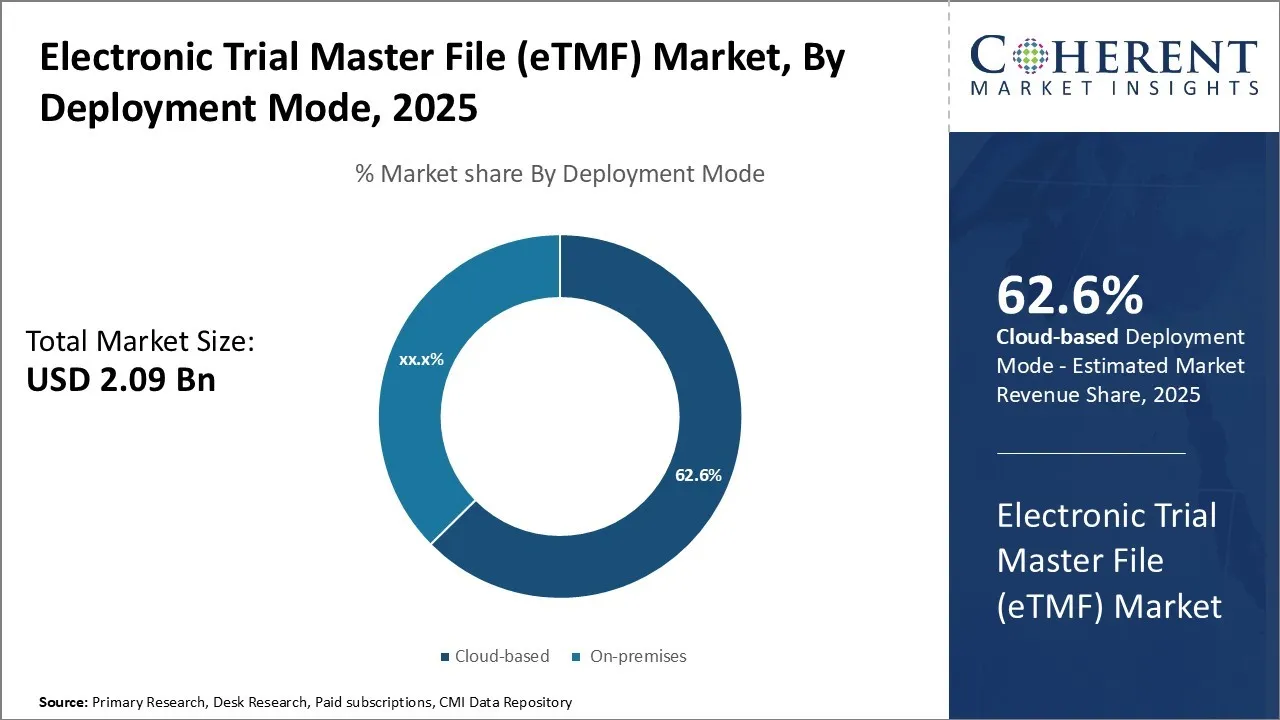
Electronic Trial Master File (eTMF) Market Insights, by Deployment Mode - Flexibility and Scalability Boosts Adoption of Cloud-Based eTMF Solutions
In terms of deployment mode, the cloud-based segment is estimated to contribute the highest market share of 63.6% in 2026, owing to its flexibility and scalability.
Cloud-based eTMF solutions allow life sciences organizations, especially smaller companies and CROs, to avoid large upfront infrastructure costs associated with on-premise implementations. These pay an annual or monthly subscription fee for cloud-hosted services. This capital expenditure model makes eTMF technology more accessible for cost-sensitive customers.
-market-by-functionality.webp "Electronic Trial Master File (eTMF) Market, By Product Type")
Electronic Trial Master File (eTMF) Market Insights, by Functionality - Standardization of Workflows Boosts the Demand for Document Management Functionality
In terms of functionality, the document management segment is estimated to contribute the highest market share of 41.8% in 2026, due to the need for standardized, compliant processes around document control.
Clinical trials and product development projects involve numerous documents whose integrity and traceability must be assured according to regulatory standards. Paper-based systems are prone to errors of document misfiling, lost revisions, and inconsistent naming conventions that undermine data quality.
Electronic Trial Master File (eTMF) Market Insights, by End User - Compliance Demands Boosts eTMF Adoption in Pharmaceutical Companies
In terms of end user, the pharmaceutical companies segment is estimated to contribute the highest market share of 50% in 2026, owing to stringent regulations within the industry.
Global pharmaceutical manufacturers face intense scrutiny from public health authorities to demonstrate safety and efficacy of new products. Computerized systems that assure proper conduct of clinical trials and regulatory compliance have therefore become business-critical for these organizations.
Emerging Innovations in the Electronic Trial Master File (eTMF) Market
- Increased Integration of Automation and Artificial Intelligence
Application: The application of machine learning and artificial intelligence (AI) in eTMF has grown significantly. These technologies have been used more and more to automate repetitive processes including document redaction, metadata tagging, and classification. Faster document processing, less human errors, and more overall clinical trial document management efficiency are the outcomes of this automation.
Example: In November 2024, Veeva Systems announced Vault CRM Bot and Vault CRM voice control, two new GenAI capabilities in Vault CRM. Unveiled at Veeva Commercial Summit Europe, CRM Bot and Voice Control join a host of new innovations coming to Vault CRM next year. With these new capabilities, companies can deploy AI that will have immediate value by boosting field productivity.
- Blockchain-Based Audit Trails for Enhanced Data Integrity
Application: Another emerging innovation is the use of Blockchain technology to create immutable, time-stamped audit trails within eTMF systems. Regulatory agencies like the U.S. Food and Drug Administration (FDA) emphasize the importance of traceability and unaltered data. Blockchain allows every modification to a document or metadata field to be permanently recorded and time-stamped, making tampering nearly impossible. This is especially crucial in decentralized clinical trials where multiple stakeholders access and modify trial documents across locations.
Example: Startups and R&D teams are piloting Blockchain-enabled eTMF systems where each transaction whether a document upload, review, or approval is securely recorded in a distributed ledger. Companies like Triall are exploring this to enhance transparency and regulatory trust in multi-site and remote clinical trials.
Impact of AI on the Electronic Trial Master File (eTMF) Market
Electronic Trial Master File (eTMF) management in clinical trials is being revolutionized by AI-powered solutions.
- Predictive analytics: AI programs look at past trial data to predict possible deviations, hazards, and bottlenecks. By identifying patterns and trends, these systems enable proactive decision-making, enabling stakeholders to address issues before they become more serious.
- Natural Language Processing (NLP): Systems that use NLP extract valuable information from documents' unstructured text. This includes information classification, sentiment analysis, and key term identification. NLP enhances document indexing, searchability, and trend analysis.
- Automated Document Categorization: By using AI-based algorithms to automatically classify and tag documents according to their content, the amount of manual labor needed to properly arrange documents inside the eTMF is reduced. This ensures that documents are arranged correctly, which enhances accessibility and organization.
Regional Insights
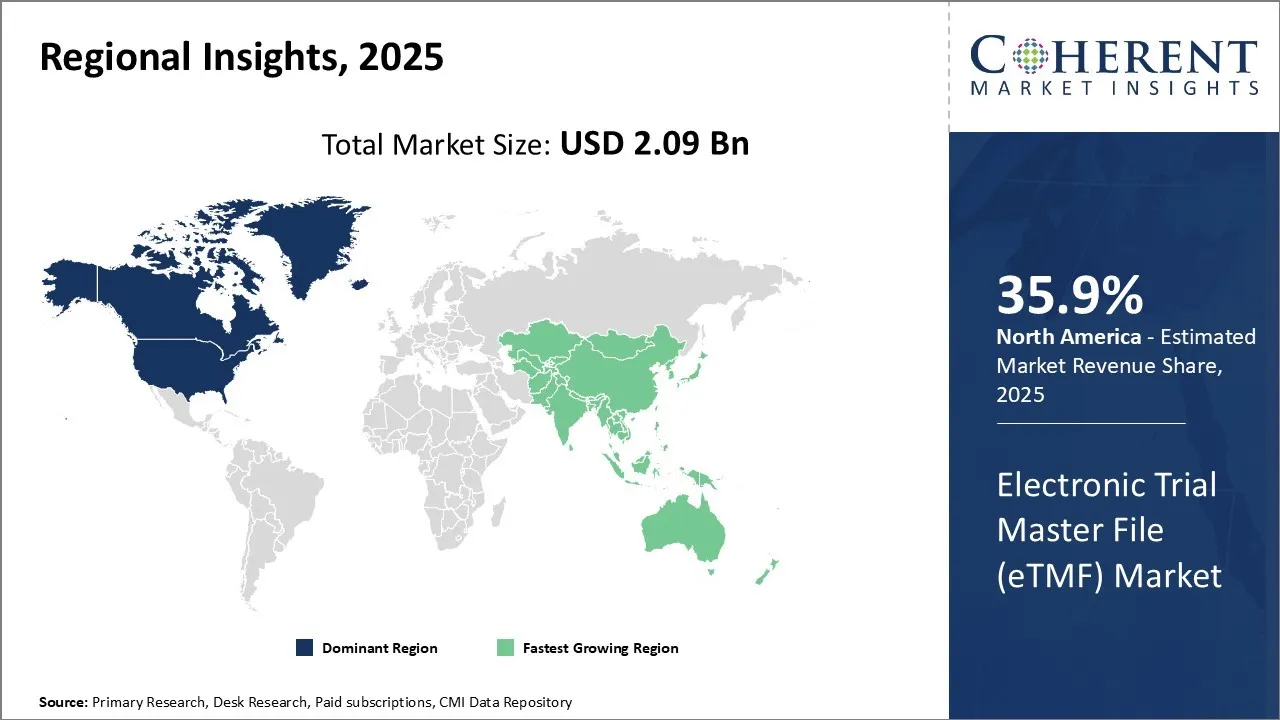
North America Electronic Trial Master File (eTMF) Market Analysis and Trends
North America has firmly established itself as the dominant region in the global electronic trial master file (eTMF) market with an estimated market share of 35.9% in 2026. With well-developed healthcare infrastructure and stringent regulations regarding clinical trials, the U.S. and Canada have emerged as key hubs for pharmaceutical R&D activities.
For instance, as per an article published by Novotech CRO, it is estimated that by 2026, artificial intelligence will manage 50% of trial data tasks, cutting timelines by 20% and improving data precision. This AI-driven efficiency will enable faster insights and decision-making in complex global trials.
Asia Pacific Electronic Trial Master File (eTMF) Market Analysis and Trends
Asia Pacific region is poised to be the fastest growing market for electronic trial master file (eTMF). Several developing nations like China, India, and South Korea are increasingly becoming global clinical trial destinations, owing to lower costs and a large patient pool.
For instance, according to a report by the Clinical Leader, clinical trials in Australia are also 30%-40% less expensive than in the U.S. and Europe, and this cost differential spans the entire research process, from centralized and local laboratories to doctor and hospital costs. Australia also offers a diverse patient population and a top-notch medical infrastructure system.
U.S Electronic Trial Master File (eTMF) Market Analysis and Trends
In the U.S., leading eTMF providers like Veeva Systems, Phlexglobal, and IQVIA hold significant market share, serving major pharmaceutical companies and contract research organizations (CROs).
These companies continuously invest in R&D to comply with stringent U.S. Food and Drug Administration regulations such as 21 CFR Part 11, focusing on features like automated audit trails, real-time inspection readiness, and enhanced security protocols. Their platforms are widely adopted due to proven scalability, regulatory compliance, and integration with broader clinical trial management systems.
China Electronic Trial Master File (eTMF) Market Analysis and Trends
China’s rapidly expanding pharmaceutical R&D sector and increasing number of clinical trials conducted domestically are major drivers for eTMF adoption. The National Medical Products Administration (NMPA) has modernized regulations to align more closely with international standards, pushing Chinese sponsors and CROs to adopt electronic document management systems to enhance compliance and efficiency. Furthermore, government initiatives supporting innovation and digital health infrastructure contribute to increased investment in eTMF technologies, positioning China as a high-growth market.
Japan Electronic Trial Master File (eTMF) Market Analysis and Trends
Japan’s pharmaceutical industry prioritizes high-quality clinical data management and rapid time-to-market for new therapies, driving demand for sophisticated eTMF solutions. The Japanese regulatory authority, Pharmaceuticals and Medical Devices Agency (PMDA), mandates rigorous documentation standards, prompting local companies to adopt electronic systems that streamline trial master file management and inspection readiness. Additionally, Japan’s increasing participation in global multi-regional clinical trials fuels the need for interoperable and compliant eTMF platforms.
Canada Electronic Trial Master File (eTMF) Market Analysis and Trends
Canada’s growing clinical research sector is increasingly adopting eTMF systems driven by Health Canada’s stringent requirements for data integrity and audit readiness. With a strong focus on patient safety and compliance, Canadian sponsors and CROs prioritize eTMF solutions that ensure secure, tamper-proof documentation and facilitate regulatory inspections.
Pricing Analysis
Small to Mid-Sized Companies
- Prices typically range from USD 1,000 to USD 5,000 per month depending on usage and features. Basic packages may cost as low as USD 500/month but usually have limited capacity or functionality.
Large Enterprises and CROs
- Costs can reach USD 10,000 to USD 50,000+ per month for comprehensive, fully integrated platforms with enterprise-level support, custom configurations, and multi-user licenses.
- Examples
- Veeva Systems typically charges on a per-user and per-study basis, with enterprise agreements reflecting high customization and integration, making it a premium-priced solution.
- Mid-tier providers like MasterControl and Phlexglobal offer more flexible pricing, catering to mid-sized biotechs and smaller CROs by scaling features and storage based on client needs.
- Examples
Market Report Scope
Electronic Trial Master File (eTMF) Market Report Coverage
| Report Coverage | Details | ||
|---|---|---|---|
| Base Year: | 2025 | Market Size in 2026: | USD USD 2.36 Bn |
| Historical Data for: | 2020 To 2024 | Forecast Period: | 2026 To 2033 |
| Forecast Period 2026 to 2033 CAGR: | 12.8% | 2033 Value Projection: | USD USD 5.48 Bn |
| Geographies covered: |
| ||
| Segments covered: |
| ||
| Companies covered: | Veeva Systems Inc., Medidata Solutions, Inc., Oracle Corporation, Parexel International Corporation, IBM Watson Health, DrugDev (now part of Veeva), MasterControl, Inc., ArisGlobal LLC, Dassault Systèmes, Trial Interactive, Signant Health, Forte Research Systems, Inc., Axiom Real-Time Metrics, eClinical Solutions, LLC, and Bioclinica, Inc. | ||
| Growth Drivers: |
| ||
| Restraints & Challenges: |
| ||
Global Electronic Trial Master File (eTMF) Industry News
- In April 2025, Veeva Systems announced Veeva SiteVault CTMS, a clinical trial management system for research sites that is integrated with SiteVault eISF and SiteVault eConsent to allow sites to comprehensively manage clinical trials within one main system. Integration with sponsors using Veeva’s Clinical Platform gives sites seamless bidirectional data flow to sponsors to reduce manual processes and increase efficiency.
- In February 2025, Oracle Life Sciences was named a ‘Leader’ in the Everest Group Life Sciences Clinical Trial Management System (CTMS) Products PEAK Matrix Assessment 2024. This designation underscores Oracle’s ongoing commitment to transforming clinical trial management through innovative and cost-effective solutions designed to support healthcare systems and life sciences organizations worldwide.
- In May 2025, the CDISC + TMF Europe Interchange, held recently in Geneva, brought together industry leaders, experts, and innovators to discuss the evolving landscape of clinical trials, with a specific Trial Master File (TMF) management track. This year marked 25 years since the Clinical Data Interchange Standards Consortium (CDISC) formed, with the event highlighting several themes and hot topics clearly shared across the industry as a whole.
- In April 2025, Medidata Solutions announced the release of Medidata Rave eTMF 2025.1.0, introducing several new features and enhancements.
Analyst Views
- Global electronic trial master file (eTMF) market growth is propelled by rising clinical trial activities outsourced to CROs and their growing focus on improving operational efficiency. Stringent regulatory requirements demanding proper documentation archiving and remote access to clinical documents can drive the market growth.
- North America is expected to dominate the market during the forecast period. Higher clinical research spending and stringent regulatory requirements drives majority of CROs and pharmaceutical companies in the region to digitize their processes. Europe is also a prominent region in the global electronic trial master file (eTMF) market due to ongoing drug development activities.
- Asia Pacific region is expected to be fastest growing region and is anticipated to offer most promising opportunities for eTMF vendors due to rapid expansion of clinical trials outsourcing activities in countries like China and India.
- Clinical trials are happening all over the world, and eTMF systems must keep up with different countries’ rules or they’ll fall behind. At the same time, AI is changing everything systems without smart tools to spot risks and use real-world data won’t last long. The future belongs to those who combine global rules with AI power. Everyone else will be left behind.
- Data privacy concerns and regulatory variations across regions can experience challenges to eTMF companies worldwide. Security issues relating to storing sensitive patient data in the cloud can hamper the market growth. Growing awareness about the advantages of electronic archiving of clinical documents compared to traditional paper-based system can offer lucrative opportunities for eTMF solutions.
Speak to the analyst
Want personalized insights?
Take the findings above to one of our principal consultants, or have the report rebuilt around the segments, geographies and competitors you actually track.
Market Segmentation
- By Deployment Mode Insights (Revenue, US$ Bn, 2021 - 2033)
- Cloud-based
- On-premises
- By Functionality Insights (Revenue, US$ Bn, 2021 - 2033)
- Document Management
- Workflow Management
- Reporting and Analytics
- Others
- By End User Insights (Revenue, US$ Bn, 2021 - 2033)
- Pharmaceutical Companies
- Biotechnology Companies
- Contract Research Organizations (CROs)
- Academic Research Institutions
- Regional Insights (Revenue, US$ Bn, 2021 - 2033)
- North America
- U.S.
- Canada
- Latin America
- Brazil
- Argentina
- Mexico
- Rest of Latin America
- Europe
- Germany
- U.K.
- Spain
- France
- Italy
- Russia
- Rest of Europe
- Asia Pacific
- China
- India
- Japan
- Australia
- South Korea
- ASEAN
- Rest of Asia Pacific
- Middle East
- GCC Countries
- Israel
- Rest of Middle East
- Africa
- South Africa
- North Africa
- Central Africa
- North America
- Key Players Insights
- Veeva Systems Inc.
- Medidata Solutions, Inc.
- Oracle Corporation
- Parexel International Corporation
- IBM Watson Health
- DrugDev (now part of Veeva)
- MasterControl, Inc.
- ArisGlobal LLC
- Dassault Systèmes
- Trial Interactive
- Signant Health
- Forte Research Systems, Inc.
- Axiom Real-Time Metrics
- eClinical Solutions, LLC
- Bioclinica, Inc.
Sources
Primary Research Interviews:
- eTMF Software Providers (e.g., Veeva Systems, Phlexglobal, Medidata Solutions, SureClinical, ArisGlobal)
- Clinical Trial Managers and CRA Leads at CROs (e.g., IQVIA, ICON, Labcorp, Parexel)
- Regulatory Affairs Specialists and Quality Assurance Professionals
- Clinical Operations Heads in pharmaceutical and biotech companies
- IT Directors and Data Compliance Officers in Life Sciences
Magazines
- Applied Clinical Trials
- Outsourcing-Pharma
- Pharmaceutical Executive
- Contract Pharma
- Clinical Leader
- PharmaVOICE
- Others
Journals
- Journal of Clinical Research Best Practices
- Therapeutic Innovation & Regulatory Science
- Journal of Pharmaceutical Innovation
- Contemporary Clinical Trials
- Journal of Biomedical Informatics
- Others (e.g., Regulatory Focus, Journal of GXP Compliance)
Newspapers
- The Wall Street Journal (Healthcare & Pharma section)
- Financial Times (Global pharma market coverage)
- The Economic Times (Indian clinical research & pharma news)
- Business Standard
- STAT News (biotech-focused news)
- Others
Associations
- Drug Information Association (DIA)
- Society for Clinical Research Sites (SCRS)
- Association of Clinical Research Professionals (ACRP)
- TransCelerate BioPharma Inc.
- Regulatory Affairs Professionals Society (RAPS)
- Others (e.g., CDISC, SCDM)
Public Domain Sources
- U.S. Food and Drug Administration (FDA) – eTMF regulatory guidance
- European Medicines Agency (EMA)
- National Institutes of Health (NIH)
- WHO ICTRP (International Clinical Trials Registry Platform)
- World Bank Open Data – healthcare infrastructure indicators
- Others
Proprietary Elements
- CMI Data Analytics Tool – Electronic Trial Master File (eTMF) Market
- CMI Existing Repository of Information for the Last 8 Years
*Definition: Global electronic trial master file (eTMF) market provides a centralized, cloud-based platform for organizations to electronically organize, store, manage, track, and access all essential documentation for clinical trials in a digital format. eTMF systems help optimize clinical trials by facilitating compliance with regulatory guidelines, improving collaboration between research sites and sponsors, and enhancing the overall efficiency of clinical development programs.
Get access to 250+ pages report
Every segment, forecast, competitor profile and data table behind the analysis above — available for instant download.
- ESOMAR Member
- ISO 9001:2015 Certified
- D-U-N-S Registered
- GDPR & CCPA Compliant
Missing comfort of reading report in your local language? Find your preferred language:
Transform your Strategy with Exclusive Trending Reports
Frequently Asked Questions
The Electronic Trial Master File (eTMF) market is estimated to be valued at USD 2.36 Billion in 2026, and is expected to reach USD 5.48 Billion by 2033.
The CAGR of the Electronic Trial Master File (eTMF) market is projected to be 12.8% from 2026 to 2033.
Increasing adoption of digital solutions in clinical trials and growing need for regulatory compliance and data integrity are the major factors driving the growth of the global electronic trial master file (eTMF) market.
High implementation costs and complexity and concerns regarding data security and privacy are the major factors hampering the growth of the global electronic trial master file (eTMF) market.
In terms of deployment mode, the cloud-based segment is estimated to dominate the market in 2026.
Veeva Systems Inc., Medidata Solutions, Inc., Oracle Corporation, Parexel International Corporation, IBM Watson Health, DrugDev (now part of Veeva), MasterControl, Inc., ArisGlobal LLC, Dassault Systèmes, Trial Interactive, Signant Health, Forte Research Systems, Inc., Axiom Real-Time Metrics, eClinical Solutions, LLC, and Bioclinica, Inc. are the major players in the global electronic trial master file (eTMF) market.
North America is expected to lead the global electronic trial master file (eTMF) market in 2026.