

Container As A Service Market Size and Forecast — 2026 - 2033
The Global Container As A Service Market size is estimated to be valued at USD 4.8 billion in 2026 and is expected to reach USD 12.6 billion by 2033, exhibiting a compound annual growth rate (CAGR) of 14.7% from 2026 to 2033.
Overview
Container as a Service (CaaS) is a cloud computing service model that allows developers and organizations to upload, run, manage, and scale containerized applications using container technologies like Docker and orchestration tools such as Kubernetes. It provides a platform where users can easily deploy containers without managing the underlying infrastructure. CaaS offers features like automated scaling, container networking, load balancing, and security management. Cloud providers such as Google Cloud, Amazon Web Services, and Microsoft Azure offer CaaS solutions. This model helps developers focus on building and deploying applications while the service provider manages servers, virtualization, and container orchestration.
Key Takeaways
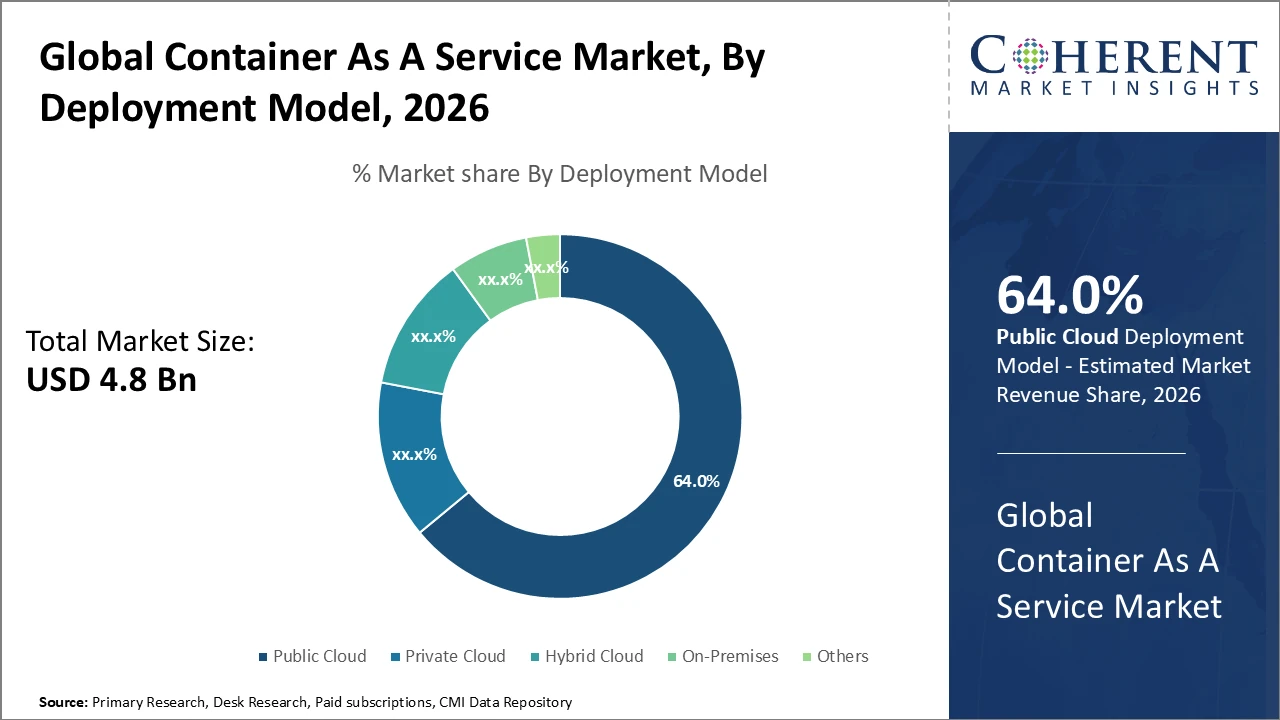
Public Cloud dominates the deployment model segment, holding 64% of the Container As A Service market due to its scalable and cost-effective infrastructure. Hybrid Cloud is the fastest-growing subsegment, driven by enterprises seeking greater control and compliance flexibility.
Managed Services lead the service type segment with 56% market share, supported by rising demand for fully outsourced, end-to-end container lifecycle management. Orchestration Services are gaining momentum, largely fueled by Kubernetes adoption across industries.
The BFSI industry is the largest end-user, capturing 30% market share due to regulatory-driven cloud adoption and modernization initiatives. Healthcare is the fastest-growing subsegment, driven by digital health and compliance requirements.
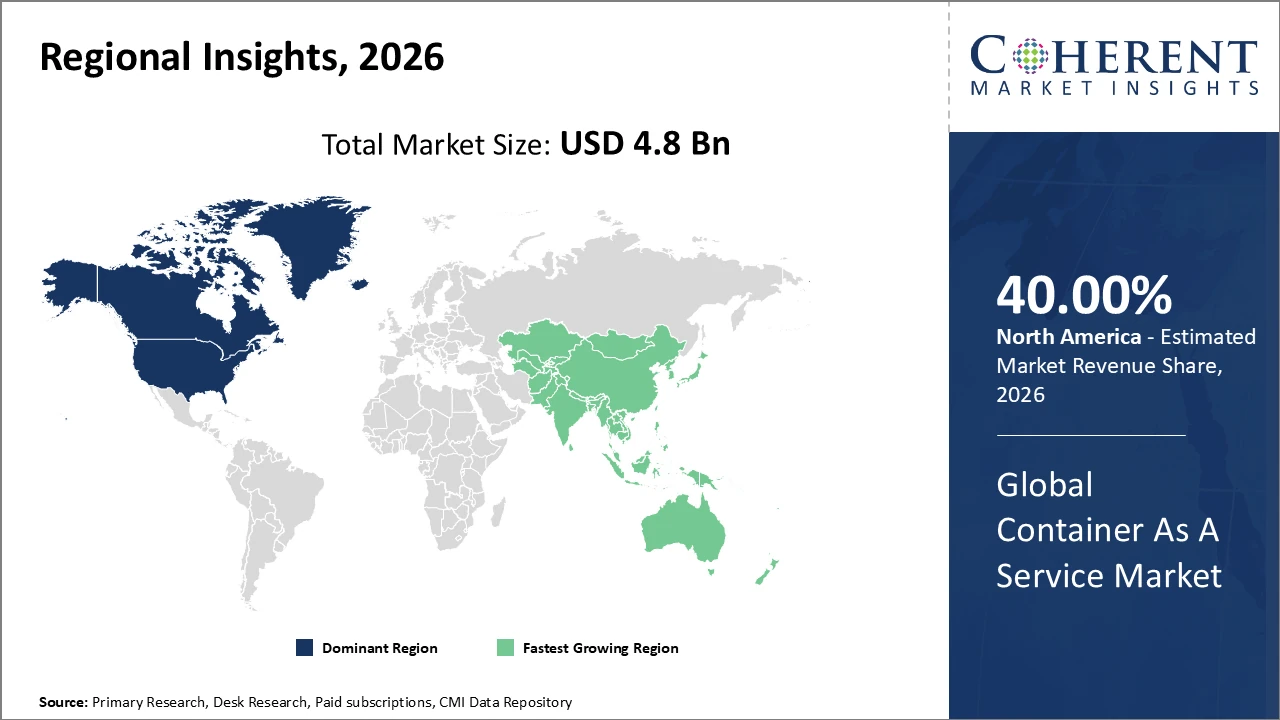
North America dominates regionally with over 40% market share, supported by mature cloud infrastructure and early digitalization adoption. Asia Pacific is the fastest-growing region with a CAGR above 18%, driven by expanding IT services in China and India and supportive government policies.
Container As A Service Market Segmentation Analysis
Container As A Service Market Insights, By Deployment Model
Public Cloud dominates the Container As A Service market with a 64% share, driven by its ability to deliver highly scalable, cost-efficient container orchestration services across multiple industries. Its elasticity allows enterprises to dynamically allocate resources during peak workloads, supporting rapid business growth and operational efficiency. Hybrid Cloud is the fastest-growing subsegment, fueled by the need for flexible workload placement and regulatory compliance, enabling organizations to leverage both public and private environments effectively. Private Cloud offers enhanced security and control for regulated sectors, while On-Premises solutions support legacy infrastructure integration.
Container As A Service Market Insights, By Service Type
Managed Services hold a 56% share of the Container As A Service market, driven by growing demand for fully outsourced container lifecycle management. These services simplify container orchestration, allowing enterprises to focus on core business activities and accelerate time-to-market. Orchestration Services, primarily Kubernetes-based, are the fastest-growing segment due to increased container adoption and the need for automated deployment, scaling, and workload management. Container Security services are gaining traction as organizations invest in securing container environments to meet stringent compliance requirements. Support & Maintenance services ensure ongoing performance and stability, while other services include consulting and integration solutions that facilitate container adoption.
Container As A Service Market Insights, By End-User Industry
The BFSI industry leads the Container As A Service market with a 30% share, leveraging CaaS to enable agile application development and ensure regulatory compliance, particularly in North America and Europe. Between 2024 and 2026, digital transformation initiatives in BFSI drove a 28% increase in container adoption. Healthcare is the fastest-growing segment, fueled by telemedicine expansion, electronic health record digitization, and strict data privacy regulations requiring secure containerized environments. IT & Telecom follows closely, driven by cloud-native service development. Retail, Manufacturing, and Government sectors are increasingly adopting CaaS for operational efficiency and scalability, with government projects emphasizing modernization and cloud integration.
Container As A Service Market Trends
Container As A Service market trends emphasize container orchestration standardization and security automation.
Kubernetes dominates as the leading orchestration platform, shaping service offerings and driving market revenue. Enterprises using Kubernetes reported 35% faster application time-to-market in 2025.
Adoption of multi-cloud strategies is increasing, enhancing system robustness and reducing vendor lock-in, with a 40% rise in multi-cloud container deployments between 2024 and 2026.
Integration of edge computing with container services enables real-time processing at the network edge, particularly benefiting telecom and IoT applications.
Security automation and standardized orchestration are key growth drivers across industries.
Container As A Service Market Insights, By Geography
North America Container As A Service Market Analysis and Trends
In North America, the Container As A Service market is dominated by mature cloud infrastructure, early adoption of container technologies, and strong IT investment. The United States plays a pivotal role, driven by government initiatives supporting cloud migration, digital innovation, and enterprise modernization programs. Major market players, including Microsoft and AWS, have established extensive regional operations, offering advanced container orchestration, managed services, and hybrid cloud solutions. Their presence enhances competition, accelerates technology adoption, and drives business growth. Additionally, North America’s focus on compliance, security, and scalable digital solutions positions the region as a leading contributor to global CaaS market revenue and innovation.
Asia Pacific Container As A Service Market Analysis and Trends
Asia Pacific demonstrates the fastest growth in the Container As A Service market, with a CAGR exceeding 18%, driven by rapid expansion of the IT services sector in countries such as China and India. Government initiatives promoting digital economies, cloud adoption, and smart infrastructure further accelerate container deployment across enterprises. Businesses in the region increasingly adopt CaaS solutions to achieve scalability, operational efficiency, and cost optimization, particularly in emerging industries and large-scale IT operations. The combination of supportive policies, rising technology investment, and growing demand for agile, cloud-native applications positions Asia Pacific as a high-growth region in the global CaaS market.
Container As A Service Market Outlook for Key Countries
USA Container As A Service Market Analysis and Trends
The USA’s Container As A Service market is highly competitive, led by major players including Amazon Web Services, Microsoft Azure, and Google Cloud, known for continuous innovation and solution expansion. In 2025, enterprise container adoption surpassed 50%, driven by aggressive digital transformation initiatives across sectors. Federal programs such as the Cloud Smart Policy promote cloud agility, security compliance, and standardized deployment, particularly benefiting regulated industries like government, healthcare, and finance. Strong infrastructure, early technology adoption, and investment in managed and orchestration services support rapid CaaS growth, positioning the United States as a benchmark for global market trends and revenue generation.
Germany Container As A Service Market Analysis and Trends
Germany represents a key market for Container As A Service in Europe, driven by its strong industrial base and early adoption of cloud-native technologies. Enterprises across automotive, manufacturing, and finance sectors leverage CaaS to enhance application scalability, operational efficiency, and regulatory compliance. In 2025, over 40% of large enterprises in Germany adopted containerized solutions, reflecting rapid digital transformation initiatives. The country benefits from supportive government policies promoting Industry 4.0 and cloud integration, as well as the presence of major CaaS providers offering managed and orchestration services. Security, automation, and hybrid deployment models are emerging as central trends shaping market growth.
Analyst Opinion
The surge in container adoption across BFSI, healthcare, and telecom sectors is driving CaaS market growth. In 2025, over 60% of new software deployments in the U.S. were cloud-native, highlighting increased use of container orchestration platforms. Integration within hybrid cloud environments is expanding use cases and market size.
Supply-side factors include increased managed container service capacity and competitive pricing. Several cloud providers reduced CaaS prices by up to 15% in 2024, leading to a 22% rise in SME subscriptions and influencing market share redistribution.
Cross-border data flows and managed service agreements are growing, especially from Asia Pacific to North America and Europe. In 2026, managed container contracts from Asian enterprises to North American providers increased by 30%, reflecting global interconnectivity.
Nano-level dynamics, such as adoption of container-native security tools and automation frameworks, are improving operational efficiency. In 2025, automated container deployments reduced deployment times by 40%, enhancing resource utilization and decreasing downtime.
- Current Industry Events of 2026
- Market Size Estimation
- Regional Breakdown
- Competitive Landscape
- Customer Intelligence
- Segmental Analysis
- Pricing Analysis
- Key Market Drivers, Challenges & Future Trends
- Customized Insights Section
Market Scope
| Report Coverage | Details | ||
|---|---|---|---|
| Base Year: | 2025 | Market Size in 2026: | USD 4.8 billion |
| Historical Data for: | 2020 To 2024 | Forecast Period: | 2026 To 2033 |
| Forecast Period 2026 to 2033 CAGR: | 14.7% | 2033 Value Projection: | USD 12.6 billion |
| Geographies covered: |
| ||
| Segments covered: |
| ||
| Companies covered: | Vmware, Microsoft, Amazon Web Services, IBM, Red Hat, Cisco Systems, Rancher Labs, Oracle, Alibaba Cloud, Huawei | ||
| Growth Drivers: |
| ||
Container As A Service Market Growth Factors
The first key growth driver for the Container As A Service market is the rising demand for scalability and rapid application deployment as part of digital transformation initiatives. Container platforms offer unmatched flexibility, contributing to a 32% increase in enterprise cloud container adoption in 2025. Advancements in container security, including automated vulnerability scanning, are addressing historical concerns and encouraging broader enterprise adoption. Supportive government regulations on cloud security and data privacy in North America and Europe enable regulated industries like healthcare to embrace CaaS solutions. Additionally, economic pressures to reduce IT operational costs have driven a 15% expense reduction for businesses using managed CaaS platforms in 2024.
Container As A Service Market Development
In 2025, Amazon Web Services (AWS) enhanced its Elastic Container Service (ECS) by integrating advanced Kubernetes features and automated scaling capabilities. This upgrade allowed enterprises across North America and Europe to deploy containerized applications more efficiently, resulting in a 20% increase in enterprise adoption and reinforcing AWS’s position in the CaaS market.
Key Players
Leading Companies of the Market
VMware
Microsoft
Amazon Web Services
IBM
Red Hat
Cisco Systems
Rancher Labs
Oracle
Alibaba Cloud
Huawei
Several leading companies have pursued aggressive growth strategies through strategic alliances and enhanced service development. For instance, VMware’s collaboration with Amazon Web Services expanded its hybrid cloud CaaS offerings, leading to a 25% year-over-year revenue increase in 2025. Similarly, Microsoft accelerated market penetration by bundling Azure Kubernetes Service subscriptions with developer tools, facilitating faster customer acquisition and strengthening its leadership position in the CaaS market. These initiatives highlight how partnerships and integrated service offerings are driving revenue growth, broadening enterprise adoption, and reinforcing competitive positioning in the rapidly evolving Container As A Service landscape.
Container As A Service Market Future Outlook
The Container As A Service market is expected to experience robust growth over the next several years, driven by increasing adoption of cloud-native technologies, hybrid cloud deployments, and multi-cloud strategies. Rising demand for scalable, cost-efficient application deployment and enhanced container security will continue to propel enterprise adoption across BFSI, healthcare, IT, and telecom sectors. Integration with edge computing and AI-powered automation is anticipated to further expand use cases, enabling real-time processing and optimized resource management. Additionally, government policies promoting digital transformation and cloud compliance will support growth, positioning CaaS as a critical component of modern enterprise IT infrastructure globally.
Container As A Service Market Historical Analysis
The Container As A Service market has witnessed significant growth over the past decade, fueled by the widespread adoption of cloud-native architectures and containerization technologies. Early adoption was driven by IT and telecom sectors seeking agile, scalable deployment solutions, with Kubernetes emerging as the standard orchestration platform. Between 2018 and 2024, enterprises increasingly embraced managed container services to reduce operational complexity and accelerate application delivery, while hybrid and multi-cloud deployments gained traction. Key players like AWS, Microsoft, and Google led innovation, expanding service portfolios and global reach. This historical growth laid the foundation for the market’s rapid expansion into regulated industries and emerging regions.
Sources
Primary Research Interviews:
IT managers and cloud architects at enterprises
DevOps and software development teams
Cloud service providers and managed service consultants
Data center operators and infrastructure specialists
Magazines:
Cloud Computing Magazine – Container Platforms & Enterprise Adoption
InfoWorld – DevOps, Kubernetes, and Cloud Infrastructure
TechTarget – Cloud & Container Solutions
Container Journal – Industry Trends & Case Studies
Journals:
Journal of Cloud Computing – Containerization and Enterprise IT
IEEE Transactions on Cloud Computing – Container Orchestration Studies
International Journal of Computer Applications – CaaS and Cloud Architecture
Journal of Systems and Software – Container-based Application Management
Newspapers:
The Wall Street Journal – Cloud Computing & Enterprise IT
Financial Times – Technology & Cloud Infrastructure
Reuters – Cloud Services & Container Adoption
Bloomberg – Enterprise IT and Container Solutions
Nikkei Asia – Cloud and Digital Infrastructure Trends
Associations:
Cloud Native Computing Foundation (CNCF)
Open Container Initiative (OCI)
International Association of Cloud & Managed Service Providers (IACMSP)
Get access to 250+ pages report
Every segment, forecast, competitor profile and data table behind the analysis above — available for instant download.
- ESOMAR Member
- ISO 9001:2015 Certified
- D-U-N-S Registered
- GDPR & CCPA Compliant
Missing comfort of reading report in your local language? Find your preferred language:
Transform your Strategy with Exclusive Trending Reports
Frequently Asked Questions
The dominant players include VMware, Microsoft, Amazon Web Services (AWS), Oracle, and IBM, with additional contributions from Red Hat and Docker Inc. These companies expand their market share through continuous innovation, strategic partnerships, and comprehensive container management solutions.
The Container As A Service market is projected to grow from USD 4.8 billion in 2026 to USD 12.6 billion by 2033, reflecting a CAGR of 14.7% over the forecast period.
The BFSI industry holds the largest growth opportunity, commanding 30% market share due to regulatory compliance pressures, modernization initiatives, and increased digital transformation investments.
Trends will focus on Kubernetes standardization, automated container security, multi-cloud adoption, and integration with edge computing for real-time processing and optimized resource management.
The market is highly competitive, emphasizing innovation, pricing strategies, and comprehensive service portfolios. Key challenges include ensuring container security, managing hybrid cloud complexities, and adhering to regulatory requirements.
Companies leverage strategic partnerships, bundled cloud platform offerings, aggressive pricing models, and service expansion to increase market penetration, accelerate adoption, and strengthen customer loyalty.