

Bug Tracking Software Market Size and Forecast — 2026-2033
Overview
A bug tracking system, also known as defect tracking system, is a software tool that tracks reported programming bugs in software development projects. It might also be regarded as a Deployment Model of issue tracking system. Database, which is a major component of bug tracking software, records all facts about known bugs. Moreover, a bug tracking system permits administrators to configure the product according to the status, either delete the bug or move the bug to another status.
One of the key factors driving the global bug tracking system market is increased spending in the development of novel software testing programs. A bug tracking system is an integral part of any software testing program. Advanced testing technologies such as automated testing system are expected to bolster the growth of bug tracking software market worldwide. Implementation of bug tracking system in the initial stage itself will reduce the time and cost required to address the issues. This in turn has resulted in the swift growth of global bug tracking software market.
Bug Tracking Software Market Size and Forecast – 2026 – 2033
The Bug Tracking Software Market size is estimated to be valued at USD 2.11 billion in 2026 and is expected to reach USD 4.97 billion by 2033, exhibiting a compound annual growth rate (CAGR) of 13.0% from 2026 to 2033.
Key Takeaways
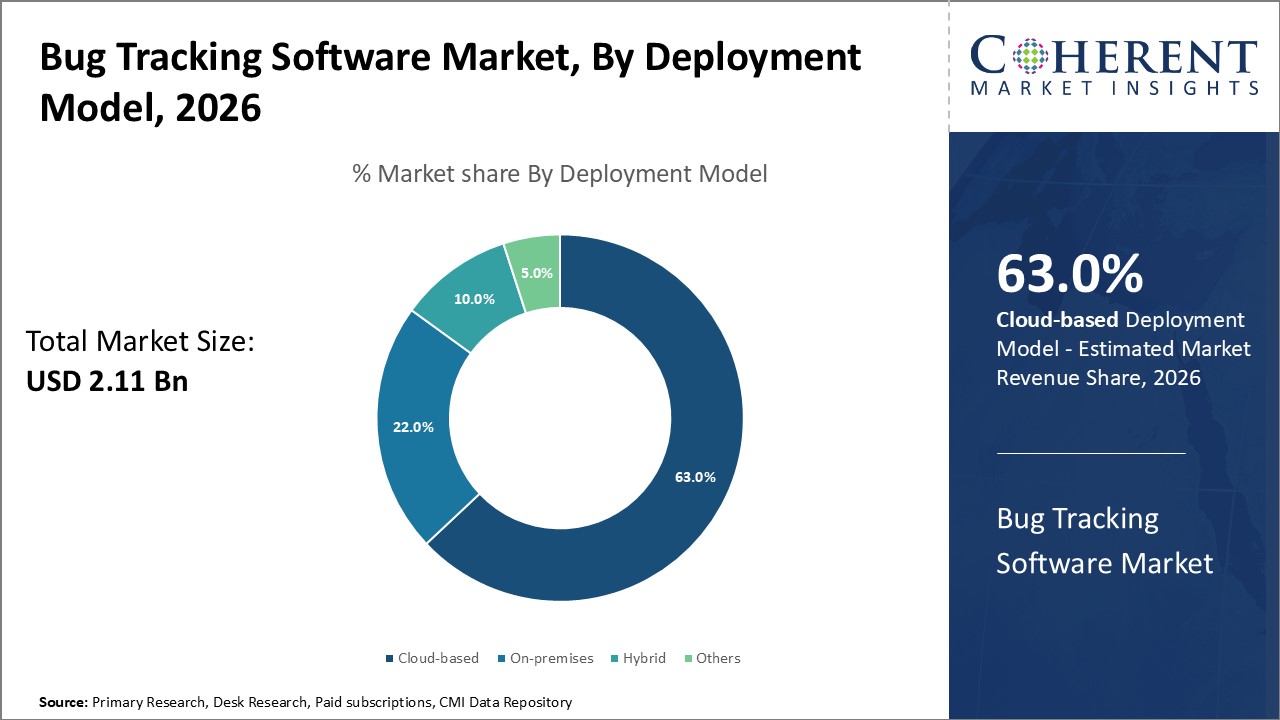
Deployment Model Segment: Cloud-based bug tracking software dominates with 63% market share, benefiting from scalable infrastructure and cost advantages; On-premises solutions maintain relevance in highly regulated industries requiring strict data control.
End-User Industry Segment: IT & Telecom emerges as the leading user, reflecting extensive software development activity; Healthcare and BFSI sectors grow rapidly driven by compliance and security requirements.
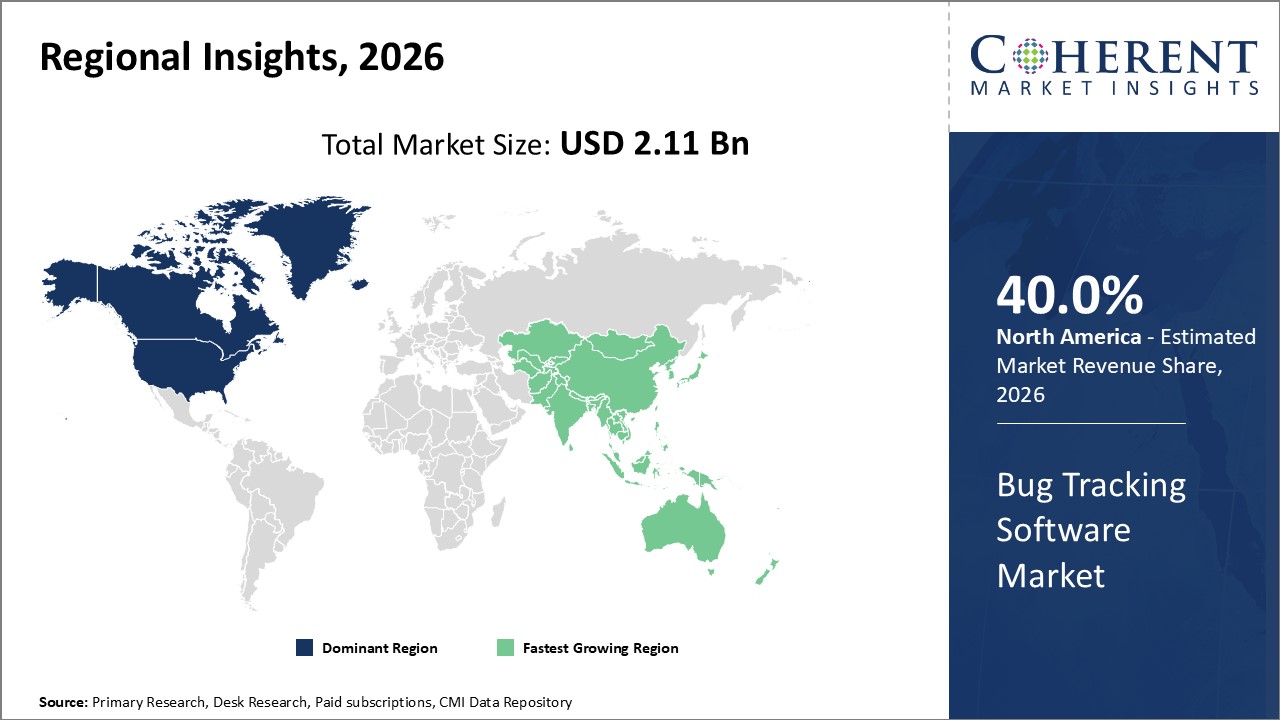
Regional Insight: North America holds the dominant industry size with over 40% market share, driven by high technology adoption and strong vendor presence; Asia Pacific demonstrates the highest CAGR at 15.3%, fueled by expanding IT services and startups ecosystem.
Market Revenue: Increased integration capabilities and AI-driven functionalities are major contributors to business growth and expanding market revenue pools across regions.
Bug Tracking Software Market – Segmentation Analysis
Bug Tracking Software Market Insights, By Deployment Model
In terms of deployment model, the market is segmented into Cloud-based, On-premises, Hybrid, and Others. Among these, Cloud-based dominates the market share with 62%, driven by scalability, cost-effectiveness, and remote accessibility, making it the preferred model across startups and enterprises alike. Cloud solutions offer continuous updates and seamless collaboration which significantly enhance market growth.
Bug Tracking Software Market Insights, By Application
The market by application type is segmented into Web-based, Mobile-based, Desktop-based, and Others. Web-based applications currently hold the commanding market share, attributed to the rise in browser-based software and SaaS platforms, offering universal accessibility and integration ease.
Bug Tracking Software Market Insights, By End-User Industry
In terms of end-user industry, the market is segmented into IT & Telecom, Healthcare, BFSI, Retail & E-commerce, Manufacturing, Government & Defense, and Others. IT & Telecom dominate the market share, accounting for the largest portion of industry share due to the sector's vast software deployment and high demand for rapid issue mitigation.
Bug Tracking Software Market Insights, By Geography
North America Bug Tracking Software Market Analysis and Trends
In North America, the dominance in the Bug Tracking Software market is driven by the United States and Canada, accounting for over 40% of the market share. The region benefits from a mature IT landscape, high cloud adoption rates, robust software development ecosystems, and significant investment in R&D. U.S.-based companies are particularly active in deploying AI-enhanced bug tracking solutions, maintaining the region’s leadership. Government initiatives supporting digital transformation and stringent software compliance standards further boost demand.
Asia Pacific Bug Tracking Software Market Analysis and Trends
Asia Pacific, on the other hand, is growing at the quickest rate, with a CAGR of about 15.3%. Growing startup ecosystems, a rise in software development activity in nations like China and India, and pro-digital innovation government policies all contribute to this quick growth. Here, businesses like Freshworks and Zoho have made big impressions and helped to significantly increase market sales. Its dominant growth trajectory is supported by the region's growing supply of tech talent and growing use of cloud services.
Bug Tracking Software Market Outlook for Key Countries
United States Bug Tracking Software Market Analysis and Trends
The USA's Bug Tracking Software market is a powerhouse due to its massive enterprise base focusing on digital transformation, Agile adoption, and strong R&D investments. Major players headquartered or operating extensively here, like Atlassian Corporation Plc and Microsoft, create a highly competitive ecosystem. The country witnessed a 10% increase in cloud-based bug tracking adoption in 2025, influenced by the rise of DevOps practices. Government regulations on cybersecurity and software compliance also stimulate demand for robust issue-tracking tools, positioning the USA as the largest contributor to global market revenue.
India Bug Tracking Software Market Analysis and Trends
India's Bug Tracking Software market has shown unprecedented acceleration with a thriving IT services sector and the proliferation of SaaS startups. The country has seen a compound annual growth spurt in bug tracking adoption, emphasizing cloud and mobile-based applications. Domestic players and global vendors alike are intensifying product localization and partnerships with service providers, driving accessibility and market penetration. Government programs like Digital India and Startup India have fostered innovation-friendly environments, expanding the industry scope rapidly through 2026 and beyond.
Analyst Opinion
The expansion of cloud computing infrastructure and SaaS delivery models significantly drives the bug tracking software market’s revenue by enabling scalable, cost-effective deployment. In 2025, over 61% of new bug tracking software licenses were cloud-based, reflecting a strong preference for flexible usage and subscription models across SMEs and enterprises alike. This trend aligns with increased cloud adoption reported by leading cloud providers indicating over 31% year-over-year subscription growth.
Integration capabilities with CI/CD pipelines and DevOps toolchains are key demand-side drivers contributing to market growth. Recent surveys of software developers in 2026 show that nearly 76% prioritize bug tracking systems that seamlessly integrate with platforms like Jenkins and GitHub Actions, directly impacting the industry size through enhanced operational efficiency and faster issue resolution cycles.
Adoption rates vary significantly by industry vertical, with IT services, fintech, and healthcare sectors demonstrating the highest penetration due to stringent quality assurance and regulatory compliance mandates. For instance, the healthcare software bug tracking segment recorded a 16% year-over-year increase in 2025, supported by escalating software validation requirements from regulatory bodies.
Pricing dynamics remain competitive but show a gradual shift toward value-based pricing models with tiered feature offerings and user scalability options. Export data from 2025 reveals that companies with flexible pricing models expanded their market share by capturing emerging markets, particularly in APAC and Latin America, reflecting adjusted affordability and localized business approaches.
- Current Industry Events of 2026
- Market Size Estimation
- Regional Breakdown
- Competitive Landscape
- Customer Intelligence
- Segmental Analysis
- Pricing Analysis
- Key Market Drivers, Challenges & Future Trends
- Customized Insights Section
Market Scope
| Report Coverage | Details | ||
|---|---|---|---|
| Base Year: | 2025 | Market Size in 2026: | USD 2.11 billion |
| Historical Data for: | 2020 To 2024 | Forecast Period: | 2026 To 2033 |
| Forecast Period 2026 to 2033 CAGR: | 13.0% | 2033 Value Projection: | USD 4.97 billion |
| Geographies covered: |
| ||
| Segments covered: |
| ||
| Companies covered: | Atlassian Corporation Plc, Microsoft Corporation, Bugzilla, JetBrains s.r.o, FogBugz, Tracker, Zoho Corporation, Freshworks Inc., Rally Software, GitLab Inc., Monday.com Ltd., Wrike, Inc | ||
| Growth Drivers: |
| ||
Growth factors
The increasing adoption of Agile and DevOps methodologies fosters rapid cycles of software delivery, inherently escalating the need for sophisticated bug tracking tools capable of real-time tracking and collaboration. As of 2025, over 86% of enterprises transitioned to Agile frameworks, supporting robust market growth.
Technological advancements, especially AI and ML integration for predictive bug detection and auto-triaging, enhance the precision and efficiency of bug tracking software. Implementation of such features led to a 31% improvement in defect resolution accuracy reported by users in a 2026 study.
Regulatory compliance and quality assurance in sectors like healthcare, BFSI, and automotive drive stringent tracking standards, incentivizing adoption. Healthcare software vendors reported a surge in software audit requests, prompting 18% higher investments in bug tracking systems in 2025.
The rise of remote working environments and distributed development teams increases demand for cloud-based bug tracking solutions. Cloud deployment accounted for the majority (64%) market share in 2026, highlighting the shift towards accessible, collaborative tools.
Bug Tracking Software Market Development
- In June 2026, The Brihanmumbai Municipal Corporation (BMC) introduced My Pothole Quick Fix, a new mobile application that allows citizens to report potholes to the civic organization in an effort to address the problem of pothole scourge in Mumbai during the rainy season. The "MyBMC pothole fix it" app, which was released previously to solve pothole problems, has been improved in the current edition.
Market Trends
The shift toward hybrid deployment models is gaining momentum as enterprises seek to balance data security with cloud flexibility, with hybrid solutions growing their share by 13% in early 2026 deployments alone. AI-powered bug prediction continues to revolutionize the market, with companies like Wrike and Sentry pioneering automated triage systems that cut overall testing time by approximately 24%. The integration of bug tracking software with productivity suites and project management tools further enhances cross-functional visibility, evidenced by Monday.com’s 2025 user base increase of 26%, underscoring increasing demand for end-to-end workflow platforms. These emerging trends signify a notable market shift toward intelligent, integrated, and adaptive bug tracking ecosystems, positioning the industry for robust future expansion.
Key Players
Atlassian Corporation Plc
Microsoft Corporation
Bugzilla
JetBrains s.r.o
FogBugz
Tracker
Freshworks Inc.
Rally Software
GitLab Inc.
Monday.com Ltd.
Leading players deploy multi-pronged growth strategies, including frequent product updates integrating AI-enhanced bug detection and prioritization algorithms. For example, Atlassian’s 2025 update introduced a predictive analytics feature that reduced average bug resolution times by 18%.
Strategic acquisitions remain vital; Microsoft’s acquisition of GitHub’s issue tracking enhancements in early 2026 expanded its integration portfolio, directly increasing its footprint in software developer ecosystems.
Partnerships with cloud providers and expanding reseller networks in emerging markets facilitate broader adoption; Zoho's strategic partnerships in APAC contributed to 20% revenue growth in the region during 2025.
Bug Tracking Software Market Future Outlook
The market for bug tracking software has a bright future ahead of it, with projections showing strong growth propelled by rising demand for effective defect management in development processes, rapid digital transformation, and growing software complexity. The market is anticipated to nearly double in size between 2026 and 2033, reaching over USD 822 million, with a compound annual growth rate (CAGR) of roughly 8–13%, depending on the methodology and area. The broad use of cloud-based deployment due to its affordability and scalability, the incorporation of AI and machine learning to improve predictive analytics, and the ongoing uptake of agile and DevOps approaches are some of the major trends influencing the market. Due to its robust technology infrastructure and significant software vendor investment, North America leads the globe in adoption, and the growing usage of open-source technologies fosters the expansion of SMEs globally. Throughout the software lifecycle, bug tracking solutions will continue to be essential for cooperation, accountability, and quick problem solving as companies work to improve software quality and conform to changing requirements.
Historical Analysis
Historically, the Bug Tracking Software Market evolved from manual issue logging systems to highly automated, cloud-based solutions, paralleling advancements in software development practices. Early tools were primarily used for tracking defects within small teams, but as software projects became more complex and distributed, centralized platforms enabling collaboration, workflow automation, and real-time reporting emerged as industry standards. The rise of agile and DevOps methodologies further accelerated adoption, as development lifecycles demanded rapid feedback and iterative testing. Over recent years, integration capabilities, multi-platform support, and AI-driven analytics became critical, with vendors positioned bug tracking as essential for quality assurance, compliance, and competitive differentiation in modern software environments.
Sources
Primary Research interviews:
DevOps Engineers
Product Managers
IT Project Managers
Databases:
PitchBook
IEEE Xplore Digital Library
ACM Digital Library
Magazines:
Computerworld
Software Development Times (SD Times)
PC Magazine
Journals:
Empirical Software Engineering
IEEE Software
Software Quality Journal
Newspapers:
The Wall Street Journal (Technology section)
The New York Times (Technology section)
The Economic Times (Technology section)
Associations:
IEEE Computer Society
Association for Computing Machinery (ACM)
International Software Testing Qualifications Board (ISTQB)
Project Management Institute (PMI)
Get access to 250+ pages report
Every segment, forecast, competitor profile and data table behind the analysis above — available for instant download.
- ESOMAR Member
- ISO 9001:2015 Certified
- D-U-N-S Registered
- GDPR & CCPA Compliant
Missing comfort of reading report in your local language? Find your preferred language:
Transform your Strategy with Exclusive Trending Reports
Frequently Asked Questions
The dominant market players include Atlassian Corporation Plc, Microsoft Corporation, Bugzilla, JetBrains s.r.o, and Zoho Corporation, known for their innovative pricing models, integration abilities, and expansive regional footprints.
The market size is projected to grow from USD 2.11 billion in 2026 to USD 4.97 billion by 2033, driven by increased digital transformation initiatives and the rise in Agile and DevOps adoption.
IT & Telecom remains the largest end-user segment, while sectors like Healthcare and BFSI show substantial growth opportunities fueled by regulatory compliance and quality assurance needs.
Trends will focus on hybrid deployments, AI-integrated bug tracking solutions, and deeper integration with project management tools, accelerating automated workflows and real-time collaboration.
The competitive landscape is dynamic, with companies emphasizing product innovation, strategic partnerships, and market expansion while addressing market challenges like pricing pressures and evolving customer requirements.
Market players utilize subscription-based pricing, freemium offerings, cloud-based delivery models, frequent feature updates, and acquisitions to enhance capabilities and expand market share.