

Internet Security Software Market Size and Forecast — 2026-2033
The Global Internet Security Software Market size is estimated to be valued at USD 30.97 billion in 2026 and is expected to reach USD 65.94 billion by 2033, exhibiting a compound annual growth rate (CAGR) of 11.4% from 2026 to 2033, reflecting robust market revenue expansion and growing industry share in cybersecurity.
Overview
Internet security software comprises digital tools and programs that protect computers, mobile devices, and networks from online threats such as malware, phishing, ransomware, and unauthorized access. These products include antivirus programs, firewalls, endpoint protection platforms, and intrusion detection systems. Advanced software solutions now integrate artificial intelligence and machine learning for real-time threat analysis and automated response.
Cloud-based deployment and cross-device synchronization are common features. Internet security software may also include VPNs, password managers, and data encryption utilities. The focus is on safeguarding user privacy, preventing data breaches, and maintaining secure digital environments for individuals and organizations.
Key Takeaways
In the Security Type segment, Endpoint Security leads, driven by greater adoption in endpoint-heavy industries such as healthcare and BFSI, accounting for over 35% of industry share.
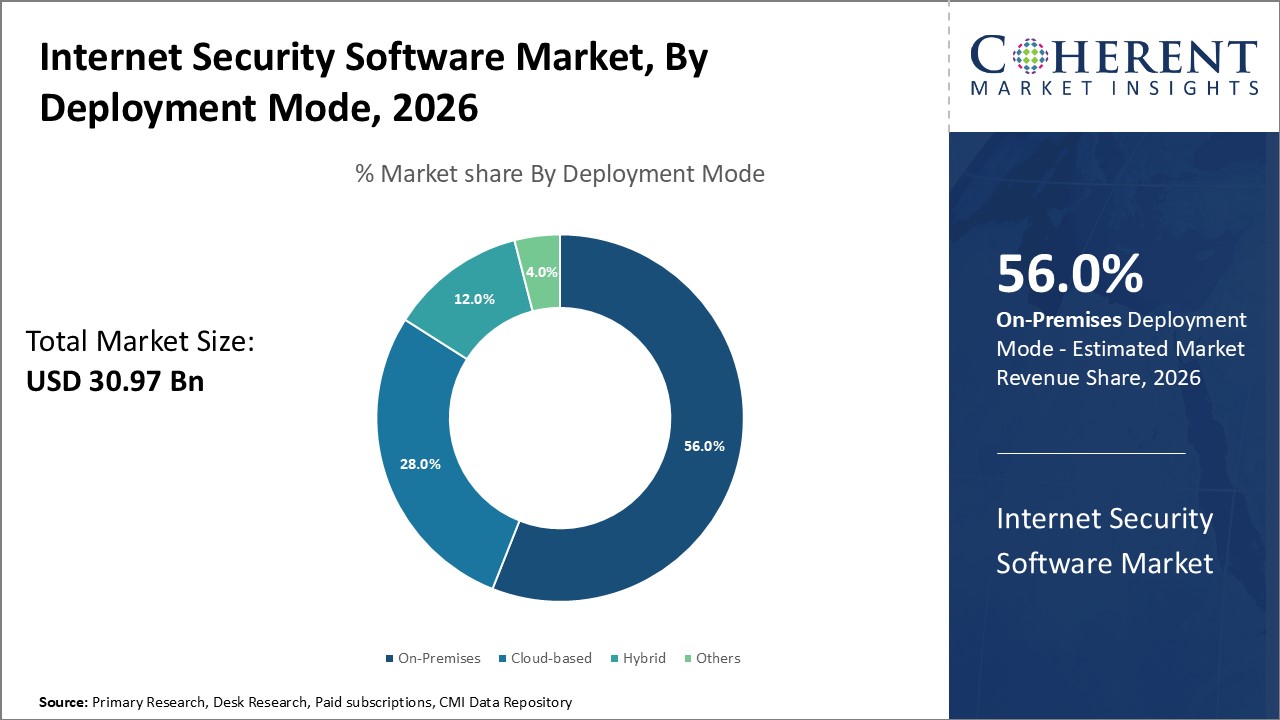
The on-premises deployment mode is dominating the market share due to scalability and cost efficiency in the evolving digital ecosystem.
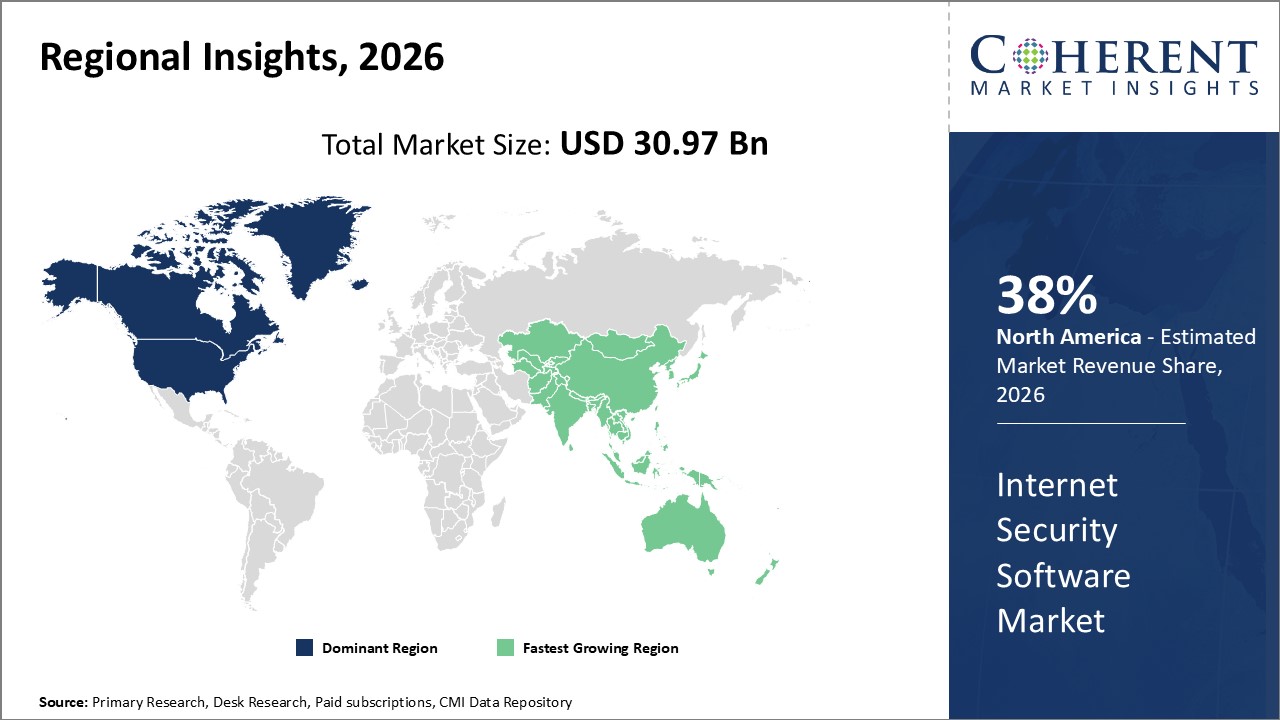
North America continues to dominate the internet security software market revenues with approximately 38% market share, attributable to widespread digital infrastructure and significant cybersecurity investments.
Asia Pacific is the fastest-growing regional market, exhibiting a CAGR of 14.5%, backed by government initiatives in India and China to strengthen cybersecurity frameworks and burgeoning demand from SMEs.
Internet Security Software Market Segmentation Analysis
Internet Security Software Market Insights, By Deployment Mode
In terms of Deployment Mode, On-premise dominates the market share with 56%. On-premise solutions continue to be preferred by large enterprises due to data sovereignty and regulatory compliance, despite the rising prominence of cloud models. However, Cloud-based deployment is the fastest-growing subsegment, driven by scalability, lower upfront costs, and rapid deployment capabilities favored by SMEs and startups. Hybrid deployment offers a balanced approach, combining on-premise control with cloud flexibility, suitable for industries undergoing digital transformation.
Internet Security Software Market Insights, By Security Type
Endpoint Security holds the largest share at 34%, fueled by the expanding number of devices and remote work practices, increasing vulnerability points. The fastest-growing subsegment is Cloud Security, which addresses rising cloud adoption and multi-cloud environments requiring adaptive protective measures. Network Security remains vital for traditional perimeter defense, while Application Security sees steady demand with increasing app development. ‘Others’ include emerging technologies like identity and access management, which are gradually gaining prominence.
Internet Security Software Market Insights, By End-User
BFSI is the dominating segment owing to heightened security mandates and continual innovation in fraud detection technologies. The fastest-growing subsegment is Healthcare, driven by the digitization of health records and telemedicine acceleration requiring stringent data protection. IT & Telecom sustains significant investments as backbone infrastructure providers, whereas the Government segments prioritize national security and critical infrastructure protection. ‘Others’ consist of emerging sectors such as education and energy, gradually embracing comprehensive internet security solutions.
Internet Security Software Market Trends
Recent market trends in internet security software emphasize the integration of artificial intelligence and machine learning to enhance threat prediction and mitigation capabilities.
For example, incident response automation reduced breach recovery times by up to 41% in 2025, according to enterprise deployment case studies.
Moreover, growing adoption of zero-trust security frameworks is reshaping architecture designs, especially in government and BFSI verticals.
Alongside, the rise of hybrid cloud environments is accelerating demand for adaptive security models, reflecting a palpable market shift towards flexible security architectures.
Internet Security Software Market Insights, By Geography
North America Internet Security Software Market Analysis and Trends
In North America, the dominance in the Internet Security Software market is driven by robust digital infrastructure, widespread cloud adoption among large enterprises, and significant cybersecurity budget allocations. The U.S. alone contributes over 70% to the regional market share, bolstered by high-profile incidents prompting immediate investments in cybersecurity software. Leading companies like Palo Alto Networks and Fortinet have cemented their presence here, actively collaborating with public and private sectors to reinforce market revenue.
Asia Pacific Internet Security Software Market Analysis and Trends
Meanwhile, Asia Pacific exhibits the fastest growth with a CAGR of 14.5%, propelled by increasing digitization efforts in countries such as India and China. Initiatives towards smart cities and digital identity frameworks have created substantial traction for internet security software. Government investments paired with a burgeoning SME ecosystem intensify demand, further encouraging international market players to expand operations regionally.
Internet Security Software Market Outlook for Key Countries
USA Internet Security Software Market Analysis and Trends
The U.S. market holds a critical position due to its technological leadership and the stringent regulatory environment. Initiatives like the Cybersecurity and Infrastructure Security Agency (CISA) mandates have elevated corporate compliance, with over 80% of enterprises increasing cybersecurity expenditure in 2025. Leading players such as Symantec and McAfee maintain significant customer bases, with innovation in AI-powered threat intelligence shaping business growth. The country also fosters a vibrant startup ecosystem focusing on next-generation security models, thereby strengthening industry trends.
India Internet Security Software Market Analysis and Trends
India’s market reflects rapid digital adoption propelled by government programs such as Digital India and increased cloud service uptake. Enterprises are prioritizing endpoint and cloud security solutions to safeguard expanding digital touchpoints, reflected in a 20% YoY growth in internet security software revenue in 2025. Companies like Trend Micro and Sophos have broadened partnerships with local IT service providers, facilitating market penetration and catering to the growing SME sector. The ongoing focus on cybersecurity workforce development and regulatory evolution encourages sustainable market expansion in the country.
Analyst Opinion
Increasing demand for AI-driven threat detection tools is a primary market driver. In 2025, enterprises leveraging machine learning algorithms for anomaly detection reduced cyber breach incidents by approximately 31%, demonstrating how AI integration enhances real-time threat mitigation and supports market growth for internet security software solutions.
Expansion in cloud adoption across industries has propelled the need for scalable internet security software, especially in the SaaS security segment, which accounted for nearly 41% of the market share in 2026. A leading Indian IT firm recorded a 26% reduction in security incidents post-deployment of advanced cloud security tools in early 2026, emphasizing the demand-side dynamics fueling market expansion.
The surge in ransomware attacks, which increased by 151% globally during 2025, underscores the urgency for enhanced internet security software. This micro market indicator has led to a 21% rise in demand for endpoint security solutions, directly impacting the market's revenue trajectory and growth strategies.
Government initiatives towards digital transformation coupled with stringent data protection regulations like GDPR and CCPA have compelled organizations to prioritize internet security investments. As an example, GDPR enforcement in Europe contributed to an 18% uplift in compliance-driven adoption of internet security software in 2026, reinforcing market size and forecast reliability.
- Current Industry Events of 2026
- Market Size Estimation
- Regional Breakdown
- Competitive Landscape
- Customer Intelligence
- Segmental Analysis
- Pricing Analysis
- Key Market Drivers, Challenges & Future Trends
- Customized Insights Section
Market Scope
| Report Coverage | Details | ||
|---|---|---|---|
| Base Year: | 2025 | Market Size in 2026: | USD 30.97 billion |
| Historical Data for: | 2020 To 2024 | Forecast Period: | 2026 To 2033 |
| Forecast Period 2026 to 2033 CAGR: | 11.4% | 2033 Value Projection: | USD 65.94 billion |
| Geographies covered: |
| ||
| Segments covered: |
| ||
| Companies covered: | Symantec Corporation, McAfee, LLC, Trend Micro Incorporated, Palo Alto Networks, Inc., Check Point Software Technologies Ltd., Fortinet, Inc., Cisco Systems, Inc., Kaspersky Lab, IBM Corporation, Sophos Group plc, FireEye, Inc. | ||
| Growth Drivers: |
| ||
Internet Security Software Market Growth Factors
The escalating frequency and sophistication of cyberattacks remain the foremost growth driver for internet security software market expansion. The number of cyberattacks targeting small and medium-sized enterprises (SMEs) grew by 40% in 2025, emphasizing the need for enhanced protection. Secondly, digital transformation across industries necessitates integration of advanced security frameworks, fueling demand for cloud-based and hybrid security deployment models. Thirdly, regulatory compliance mandates globally incentivize businesses to invest heavily in reliable internet security solutions to avoid penalties, as evidenced by the 22% increase in security budgets following updated cyber laws in the EU. Finally, the growing adoption of remote work models after 2023 persists as a critical market driver, with endpoint security software witnessing a 25% spike in enterprise deployments to manage dispersed workforce risks.
Internet Security Software Market Development
In September 2026, CrowdStrike released the Falcon Fall 2026 (Agentic Security Platform) update, introducing seven mission-ready AI agents for key security workflows, an agentic threat intelligence system, and expanded capabilities across identity, data protection, patch management, and managed detection/response.
In April 2026, AT&T partnered with Palo Alto Networks to launch AT&T Dynamic Defense™, a cloud-delivered security solution designed to protect businesses from cyber threats. The joint solution integrates AT&T's network infrastructure with Palo Alto Networks' AI-powered security platform, Prisma Access. It provides real-time threat prevention, automated risk response, and AI-driven operations for robust protection of data, applications, and users across a business's network.
Key Players
Leading Companies of the Market
Symantec Corporation
McAfee, LLC
Trend Micro Incorporated
Palo Alto Networks, Inc.
Check Point Software Technologies Ltd.
Fortinet, Inc.
Cisco Systems, Inc.
Kaspersky Lab
IBM Corporation
Sophos Group plc
FireEye, Inc.
Several market players expanded their global footprint in 2025 through strategic acquisitions and product diversification. For instance, Palo Alto Networks' acquisition of an AI-based security startup in mid-2025 resulted in a 16% increase in their threat intelligence capabilities, enhancing their market company positioning. Meanwhile, Fortinet leveraged cloud integration strategies to grow its customer base by over 21% in North America, driving business growth and increasing market share significantly.
Internet Security Software Market Future Outlook
The future of internet security software lies in automation, AI, and zero-trust architecture. Vendors are expected to focus on proactive threat hunting, behavioral analysis, and unified security management across devices and networks. With the expansion of 5G and IoT ecosystems, adaptive and scalable cloud-based security solutions will dominate. Privacy protection, compliance management, and data encryption will become integral parts of next-generation security suites. Continuous innovation will be essential to counter evolving cyber threats, making security software a central element in safeguarding digital transformation initiatives across industries.
Internet Security Software Market Historical Analysis
Internet security software has evolved from simple antivirus programs in the 1990s to sophisticated multi-layered defense systems protecting against malware, phishing, and data breaches. The rise of e-commerce, social media, and online banking led to increased cyber threats, prompting rapid technological innovation. Over time, endpoint protection platforms, firewalls, and encryption tools became integral components of enterprise IT systems. The transition to cloud computing and remote work environments accelerated demand for comprehensive security suites with real-time threat intelligence and behavioral analytics. Historical growth was driven by increasing digitalization and the global surge in cybercrime incidents.
Sources
Primary Research interviews:
Cybersecurity Analysts
IT System Administrators
Network Security Engineers
Data Protection Officers
Magazines:
Cyber Defense Magazine
SC Media
Infosecurity Magazine
Dark Reading
Journals:
Computers & Security
Journal of Cybersecurity
Information Systems Security Journal
IEEE Security & Privacy
Newspapers:
The Economic Times (Technology)
The Hindu Business Line (IT)
The Guardian (Technology)
The New York Times (Cybersecurity)
Associations:
Information Systems Security Association (ISSA)
(ISC)² – International Information System Security Certification Consortium
ISACA
Cyber Threat Alliance (CTA)
Get access to 250+ pages report
Every segment, forecast, competitor profile and data table behind the analysis above — available for instant download.
- ESOMAR Member
- ISO 9001:2015 Certified
- D-U-N-S Registered
- GDPR & CCPA Compliant
Missing comfort of reading report in your local language? Find your preferred language:
Transform your Strategy with Exclusive Trending Reports
Frequently Asked Questions
The market is led by key entities such as Symantec Corporation, McAfee LLC, and Palo Alto Networks, known for their continual innovation and strategic acquisitions enhancing their market share.
The market is projected to grow from USD 30.97 billion in 2026 to USD 65.94 billion by 2033, showcasing a CAGR of 11.4%, reflecting strong market growth and expanding demand.
The BFSI segment holds the largest opportunity due to its stringent compliance requirements and increased cyberattack risks, driving significant demand for advanced security software solutions.
Trends indicate a growing shift towards AI-powered, cloud-integrated, and zero-trust-based security architectures, with automation playing a critical role in incident response efficiencies.
The landscape is highly competitive with companies focusing on innovation, strategic partnerships, and technology integration to address rising market challenges such as evolving threat types and regulatory compliance pressures.
Key strategies include mergers and acquisitions, geographic expansion, product differentiation focusing on AI and cloud functionalities, and tailored cybersecurity solutions for varied verticals.