

Benefits Administration Service Market Size and Forecast — 2026-2033
The Global Benefits Administration Service Market is estimated to be valued at US$ 1019.8 Mn in 2026 and is expected to reach US$ 1,719.7 Mn by 2033, exhibiting a compound annual growth rate (CAGR) of 9.1% from 2026 to 2033.
Key Takeaways of the Global Benefits Administration Service Market:
- The core benefits administration segment is expected to lead the market holding a share of 40.6% in 2026, owing to strong demand for healthcare benefit plans.
- The employers segment is projected to dominate with a share of 47.2% in 2026, as employers seek out specialized administrators to gain control over rising benefits expenses.
- North America is estimated to lead the market with a share of 41.2% in 2026, owing to the well-established market ecosystem.
- Asia Pacific, holding a share of 17.4% in 2026, is projected to be the fastest growing region, fueled by the rapid digital transformation of HR functions.
Market Overview:
The global benefits administration service market is steadily growing, largely fueled by organizations wanting smoother HR operations and better employee experiences. With the rise of remote and hybrid work setups, businesses are increasingly leaning on cloud-based platforms. For instance, as per APPS RUN THE WORLD, ADP, a provider of payroll services & HR services, currently holds around 11.1% of the market share and continues to expand its service suite to meet evolving client needs.
Current Events and Their Impact
Current Events | Description and its impact |
Legislative and Regulatory Changes |
|
Technological Advancements |
|
Insights, by Service Type
Global Benefits Administration Service Market Insights, by Service Type - Core Benefits Administration Leads Due to Robust Healthcare Needs
The core benefits administration segment is expected to contribute the largest share of 40.6% in the global benefits administration service market in 2026. This is primarily due to strong demand for healthcare benefit plans from employers and their employees. Core administration handles the bulk of health insurance responsibilities like medical, dental, and vision claims processing. It also oversees eligibility, enrollment activities, COBRA administration, and FSA/HSA account management.
As populations age and chronic conditions rise in many nations, healthcare costs continue placing immense financial burdens on individuals, families, and private companies. Employers try mitigating these expenses by providing robust benefits packages. However, administering varied plans across a large and diverse workforce comes with significant complexities and expenses. Outsourcing core benefits to specialized administrators removes these headaches while lowering overhead.
Regulatory compliance around benefits also grows more intricate each year. Ensuring plans follow all ACA, HIPAA, COBRA, and other mandates without error protects employers from hefty fines. Specialists stay on top of changing rules through in-house legal and compliance teams. They leverage technology and expertise to seamlessly integrate new provisions into clients' programs.
Core administration demands deep experience managing massive amounts of sensitive medical data with rigorous security and privacy protocols. Only the largest, most sophisticated administrators can afford sophisticated systems and security. They offer scalability, service consistency, and data protections that most in-house benefits departments lack. For these reasons, employers overwhelmingly rely on external partners to shoulder core benefits administration burdens.
Insights, by End User
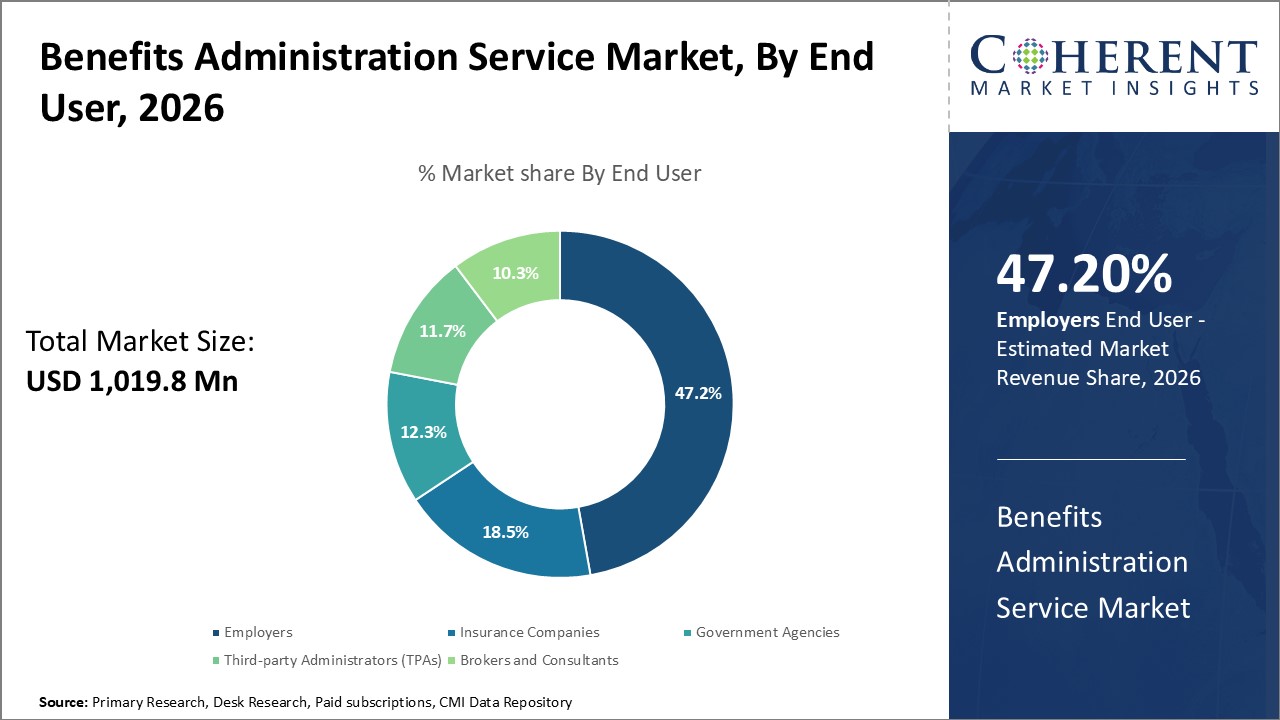
Global Benefits Administration Service Market Insights, by End User - Employers Lead Due to Cost Control and Compliance Needs
The employers segment is expected to generate the highest demand within the global benefits administration service market, holding a share of 47.2% in 2026. Employers seek out specialized administrators to gain control over rising benefits expenses while mitigating compliance risks. Steep healthcare costs consume ever-larger portions of corporate budgets. At the same time, complex regulations surround welfare benefits and impose steep penalties for lapses.
Outsourcing benefits administration to experts gives employers powerful cost management tools. Sophisticated vendors apply analytics to medical and pharmacy claims data, flagging overuse and waste. They design custom wellness programs to boost workforce health status over time. Employers invest in such value-added services expecting multi-year savings that offset outsourcing fees.
Compliance presents another major concern, as benefits rules vary significantly between jurisdictions and continuously evolve. Keeping programs ACA-compliant alone involves constant attention. Employers depend on administrators’ legal and regulatory tracking to ensure plans remain lawful. Vendors also take responsibility for glitches or violations, reducing liability for self-insured companies.
Finally, administration consumes internal resources that could drive other priorities. Large global employers particularly appreciate administrators’ standardized platform accessible worldwide. Outsourcing frees leadership to focus on core missions instead of benefits minutiae. For all these compelling advantages, employers drive the highest demand in benefits administration outsourcing.
Role of Artificial Intelligence (AI)
Artificial Intelligence (AI) is bringing both personalization and precision into the HR space. From AI-driven chatbots that assist employees with benefits queries in real time, to predictive analytics that help HR teams anticipate enrollment trends and optimize benefits packages—AI is making the process smarter, faster, and more human-centric. For instance, Workday uses machine learning algorithms to tailor benefit recommendations based on individual employee data, such as age, job level, and health history. In a notable move, Alight Solutions integrated AI capabilities into its platform in late 2024 to improve decision support tools for users—helping them navigate complex benefits scenarios like dependent eligibility or choosing between health plans.
Regional Insights
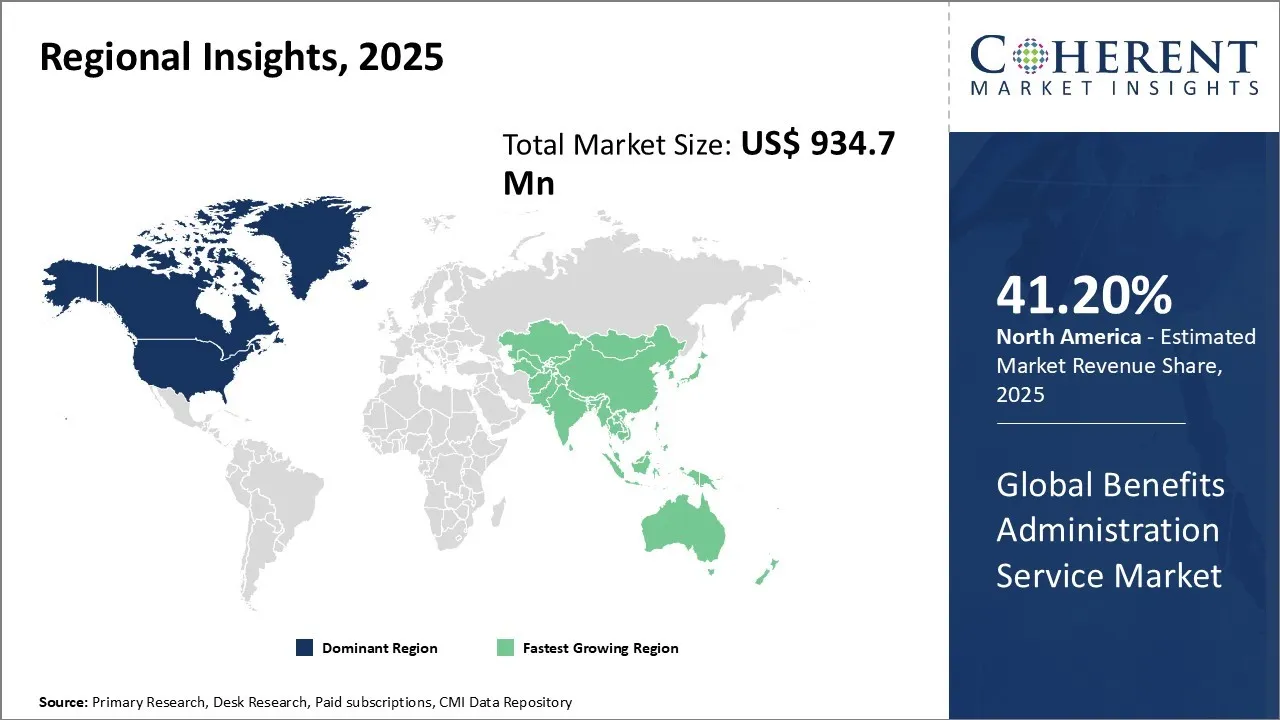
North America Benefits Administration Service Market Analysis and Trends
North America, holding a share of 41.2% in 2026, is expected to dominate the benefits administration service market, which can be attributed to the well-established market ecosystem. Several major players based in the U.S. and Canada offer a wide range of benefits administration solutions catered to the diverse needs of enterprises across industries.
For example, Benefitfocus based in the U.S. provides a cloud-based benefits management platform helping clients reduce administration costs and improve employee experience. Similarly, WageWorks, which was acquired by HealthEquity in 2019, contributes to the market leadership through its vast portfolio of healthcare and commuter accounts.
Asia Pacific Benefits Administration Service Market Analysis and Trends
The Asia Pacific region, holding a share of 17.4% in 2026, is expected to exhibit the fastest growth in the benefits administration service market, fueled by the rapid digital transformation of HR functions across the region. Countries like India, China, Australia, and Singapore are seeing rising demand for streamlined benefits administration from both large domestic enterprises and multinational companies. For example, WTW (formerly Willis Towers Watson), through its India offices, manages benefits programs for several large corporates in Asia Pacific.
The availability of low-cost skilled resources and a large customer base present opportunities for global as well as regional players. Vendors are developing cost-effective, customized solutions targeted towards the requirements of Asia Pacific's culturally diverse workforce.
Benefits Administration Service Market Outlook for Key Countries
U.S. Benefits Administration Service Market Analysis and Trends
The U.S. benefits administration service market continues to be the largest globally, backed by the country's massive private sector comprising large multinational corporations. While large employers principally manage benefits in-house, an increasing number are outsourcing elements like enrollment, billing, and vendor management to streamline operations. This augurs well for the growth of specialized third-party administrators in the country. Regional players like Unum, Limelight Health, and Payflex also play an important role through localized offerings.
U.K. Benefits Administration Service Market Analysis and Trends
In the U.K., benefits administration remains a crucial function for employers to attract and retain talent. Service providers help organizations design customized, tech-enabled solutions aligned with the country's regulatory framework around healthcare, pensions, and other benefits. For example, Barnett Waddingham provides advisory and outsourcing services across different benefits solutions targeting the distinct needs of SMEs and large enterprises.
Germany Benefits Administration Service Market Analysis and Trends
Germany's benefits administration service providers leverage the country's robust digital foundation to deliver digitized, employee-centric solutions. Companies like Franz Haniel & Cie GmbH utilize Mercer's consulting capabilities as well as its proprietary Marsh Benepoint technology platform for streamlined benefits management across locations.
India Benefits Administration Service Market Analysis and Trends
Strong economic growth and positive foreign investment policies are fueling the formalization of India's workforce. This is translating to rising demand for sophisticated benefits delivery by domestic as well as multinational corporations. Leading insurers are offering innovative, cost-effective domestic portfolio aligned with the needs of India's young employee base as well as digital natives. For instance, SGS India provides end-to-end payroll and benefits outsourcing services to blue-chip clients in banking, IT and manufacturing sectors.
China Benefits Administration Service Market Analysis and Trends
Robust GDP expansion is enabling large state-owned enterprises as well as private sectors giants in China to invest substantially in competitive employee value propositions. This presents a major opportunity for benefits administration solution providers to deploy technology-led services catering to the unique characteristics of China's diverse workforce across regions. International firms like Aon China and Blue Cross China leverage local talent and partner ecosystem to deliver region-specific solutions.
Market Players, Key Development, and Competitive Intelligence
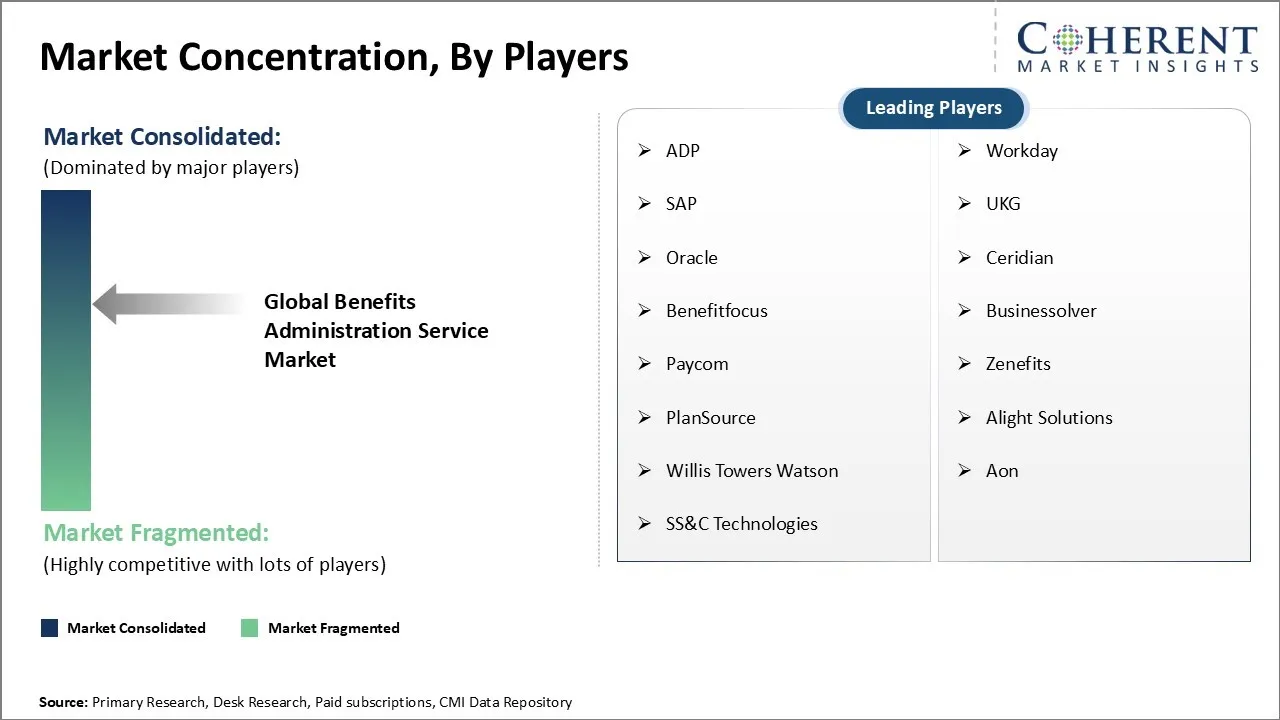
Key Developments:
- In February 2025, Alight, Inc., a cloud-based human capital and technology-enabled services provider, announced the first major release of Alight Worklife for 2025. The release enhanced Alight’s core health, wealth, wellbeing, navigation, and absence management solutions, transforming employee benefits interactions and strengthening the Alight Benefits Advantage value proposition for employers.
- In April 2024, Aon plc, a global professional services firm, acquired NFP, a middle market property and casualty broker, benefits consultant, wealth manager and retirement plan advisor. This acquisition expanded Aon's presence in the large and fast-growing middle-market segment.
- In July 2023, UKG Inc., a provider of HR, payroll, and workforce management solutions, acquired Immedis, a global payroll provider with technology and services supporting over 160 countries.
- In July 2023, UKG Inc. launched UKG One View, a multi-country payroll experience with AI-powered perpetual validation engine and continuous workforce management integration to provide a real-time view across all employees
Top Strategies Followed by Global Benefits Administration Service Market Players
- Established Players: Industry leaders, such as ADP, Paychex, WageWorks, and BenefitMall, invest over 5% of their annual revenues in R&D. This allows them to develop technologically advanced products and services that enhance the employee benefits experience. In addition, strategic partnerships are crucial for large companies to strengthen their market position globally.
- For instance, ADP has collaborated with technology giants like Samsung and Microsoft to integrate benefits administration features into their enterprise solutions. Such alliances help expand the customer reach of ADP's offerings.
- Mid-level Players: Mid-level players often pursue a cost-effective approach and provide quality benefits administration at competitive pricing. This targets the large segment of price-sensitive small and medium enterprises.
- For example, Mosaic offers customized solutions tailored for businesses with fewer than 500 employees and aims to reduce the overall cost of benefits administration by 20-30%.
- Small-scale Players: Small players focus on niche market specialization and leverage new-age technologies.
- Benefits by Design caters exclusively to the health and wellness industry. It has partnered with wellness solution providers to build an integrated platform for benefits tailored to employees' activity goals and health outcomes.
- Current Industry Events of 2026
- Market Size Estimation
- Regional Breakdown
- Competitive Landscape
- Customer Intelligence
- Segmental Analysis
- Pricing Analysis
- Key Market Drivers, Challenges & Future Trends
- Customized Insights Section
Market Report Scope
Benefits Administration Service Market Report Coverage
| Report Coverage | Details | ||
|---|---|---|---|
| Base Year: | 2025 | Market Size in 2026: | USD 1019.8 Mn |
| Historical Data for: | 2020 To 2024 | Forecast Period: | 2026 To 2033 |
| Forecast Period 2026 to 2033 CAGR: | 9.1% | 2033 Value Projection: | USD 1,719.7 Mn |
| Geographies covered: |
| ||
| Segments covered: |
| ||
| Companies covered: | ADP, Workday, SAP, UKG, Oracle, Ceridian, Benefitfocus, Businessolver, Paycom, Zenefits, PlanSource, Alight Solutions, Willis Towers Watson, Aon, and SS&C Technologies | ||
| Growth Drivers: |
| ||
| Restraints & Challenges: |
| ||
Market Dynamics
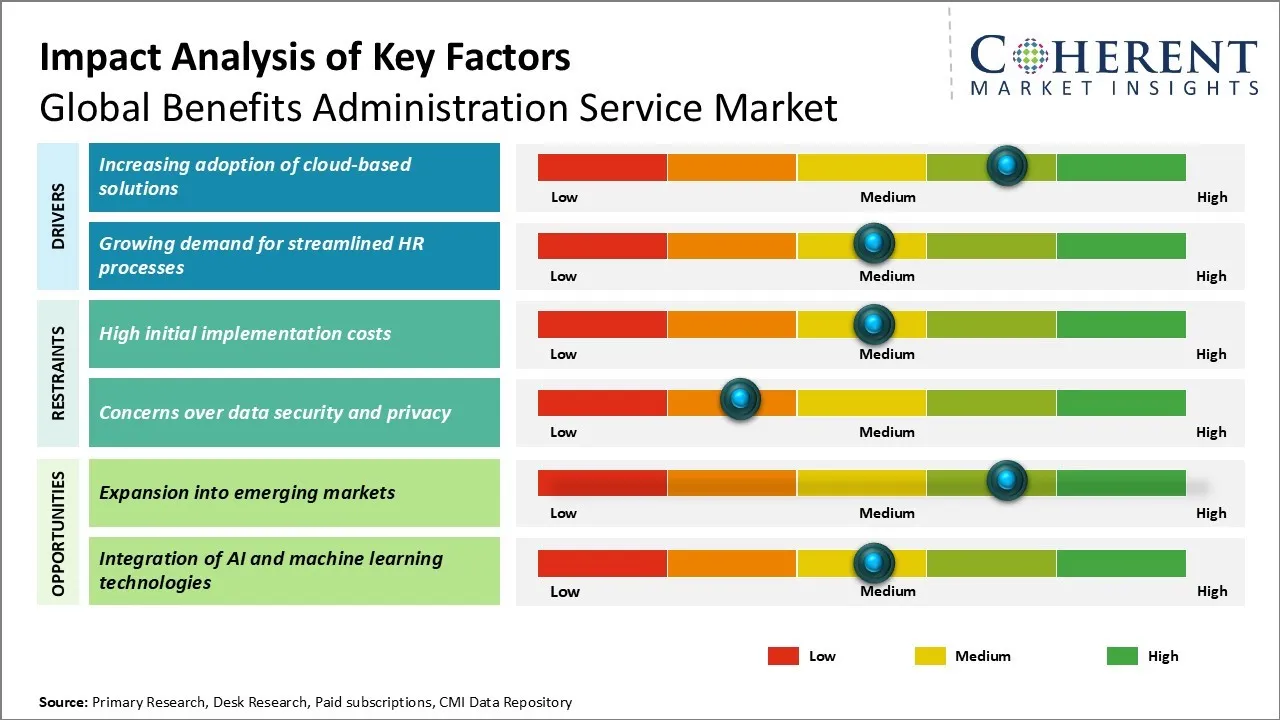
Global Benefits Administration Service Market Driver - Increasing adoption of cloud-based solutions
One of the key drivers for the global benefits administration service market is the increasing adoption of cloud-based solutions by enterprises across different industry verticals. Cloud technology offers a flexible, scalable, and cost-effective platform for enterprises to manage and administer complex employee benefits programs. With cloud-based benefits administration services, enterprises can reduce their capital expenditure on hardware, software, implementation, and support while focusing only on a pay-per-use pricing model. Small and medium businesses especially find cloud solutions attractive as it allows them to implement robust benefits administration processes without heavy upfront investments.
Global Benefits Administration Service Market Opportunity - Expansion into Emerging Markets
One of the key opportunities for the global benefits administration service market is the potential for expansion into emerging markets. While developed economies have well established benefits administration systems in place, the markets in developing regions are still at a nascent stage with significant room for growth. Countries such as India, China, Brazil, Mexico, etc. are witnessing substantial economic development and improving income levels. This is leading to a surge in demand for employee benefits programs. Global providers could look at tapping into these emerging markets by offering customizable, cloud-based and multilingual solutions.
Analyst Opinion (Expert Opinion)
- The benefits administration service market is gaining serious traction, and it is not just a trend—it is a structural shift in how companies manage employee engagement and compliance. The market’s significant growth is not surprising given the increasing complexity of employee benefits in a multi-generational workforce. Employers are no longer just offering health insurance; they are bundling in financial wellness tools, mental health support, fertility benefits, and more. That is where benefits administration services step in—to simplify the chaos.
- The role of data analytics in shaping these offerings is especially interesting. Platforms like Workday and Businessolver are leveraging AI and behavioral analytics to suggest personalized benefits based on demographics and past enrollment behavior.
- North America continues to dominate the market, largely because of early tech adoption and regulatory requirements like Affordable Care Act (ACA) compliance. BigCommerce-style digital-first HR ecosystems are being adopted by regional conglomerates, setting the stage for scalable and intelligent benefits delivery.
Speak to the analyst
Want personalized insights?
Take the findings above to one of our principal consultants, or have the report rebuilt around the segments, geographies and competitors you actually track.
Market Segmentation
- Service Type Insights (Revenue, US$ Mn, 2021 - 2033)
- Core Benefits Administration
- Ancillary Benefits Administration
- Living Quarters Trailers
- Integrated Benefits Administration
- End User Insights (Revenue, US$ Mn, 2021 - 2033)
- Employers
- Insurance Companies
- Government Agencies
- Third-party Administrators (TPAs)
- Brokers and Consultants
- Regional Insights (Revenue, US$ Mn, 2021 - 2033)
- North America
- U.S.
- Canada
- Latin America
- Brazil
- Argentina
- Mexico
- Rest of Latin America
- Europe
- Germany
- U.K.
- Spain
- France
- Italy
- Russia
- Rest of Europe
- Asia Pacific
- China
- India
- Japan
- Australia
- South Korea
- ASEAN
- Rest of Asia Pacific
- Middle East
- GCC Countries
- Israel
- Rest of Middle East
- Africa
- South Africa
- North Africa
- Central Africa
- North America
- Key Players Insights
- ADP
- Workday
- SAP
- UKG
- Oracle
- Ceridian
- Benefitfocus
- Businessolver
- Paycom
- Zenefits
- PlanSource
- Alight Solutions
- Willis Towers Watson
- Aon
- SS&C Technologies
Sources
Primary Research Interviews:
Stakeholders:
- HR and Payroll Managers at Large Enterprises
- Benefits Technology Vendors (e.g., ADP, Workday, Ceridian, etc.)
- Employee Wellness Consultants
- Enterprise Software Integration Specialists
- Third-Party Benefits Administrators and Brokers
- Corporate Finance and Risk Management Officers
Databases:
- U.S. Bureau of Labor Statistics (BLS)
- European Labour Authority (ELA)
- Asia-Pacific Business Insights Database (APBID)
- World HR Systems Data Hub
- Canadian Occupational and Workforce Statistics Bureau (COWSB)
Magazines:
- HR Tech Weekly
- Employee Benefits Journal
- People Management Insights
- Global HR Strategy Magazine
- Workforce Optimization Review
Journals:
- Journal of Human Resource and Benefits Management
- International Journal of Payroll & Workforce Systems
- Employee Experience & Benefits Technology Journal
- Journal of Corporate Health & Administration
- Future of Work and Enterprise Systems
Newspapers:
- The HR Times
- People First Daily
- The Economic Review (US)
- Business Line Global
- The Workplace Post (UK)
Associations:
- International Association of Employee Benefit Plans (IAEBP)
- Global HR Tech Alliance (GHRTA)
- American Payroll Association (APA)
- National Employee Benefits Council (NEBC)
- Asia-Pacific Workforce Strategy Forum (APWSF)
Public Domain Sources:
- U.S. Census Bureau
- EUROSTAT
- United Nations International Labour Organization (ILO)
- World Bank
- ResearchGate
Proprietary Elements:
- CMI Data Analytics Tool, Proprietary CMI Existing Repository of Information for Last 8 Years
Get access to 250+ pages report
Every segment, forecast, competitor profile and data table behind the analysis above — available for instant download.
- ESOMAR Member
- ISO 9001:2015 Certified
- D-U-N-S Registered
- GDPR & CCPA Compliant
Missing comfort of reading report in your local language? Find your preferred language:
Transform your Strategy with Exclusive Trending Reports
Frequently Asked Questions
The global benefits administration service market is estimated to be valued at US$ 1019.8 Mn in 2026 and is expected to reach US$ 1,719.7 Mn by 2033.
The CAGR of the global benefits administration service market is projected to be 9.1% from 2026 to 2033.
Increasing adoption of cloud-based solutions and growing demand for streamlined HR processes are the major factors driving the growth of the global benefits administration service market.
High initial implementation costs and concerns over data security and privacy are the major factors hampering the growth of the global benefits administration service market.
In terms of service type, the core benefits administration segment is estimated to dominate the market revenue share in 2026.
ADP, Workday, SAP, UKG, Oracle, Ceridian, Benefitfocus, Businessolver, Paycom, Zenefits, PlanSource, Alight Solutions, Willis Towers Watson, Aon, and SS&C Technologies are the major players.
North America is expected to lead the global benefits administration service market in 2026, holding a share of 41.2%.