

Global Compact Electric Construction Equipment Market Size and Forecast – 2026-2033
The global compact electric construction equipment market is estimated to be valued at USD 3.65 Bn in 2026 and is expected to reach USD 8.22 Bn by 2033, exhibiting a compound annual growth rate (CAGR) of 12.3% from 2026 to 2033.
Key Takeaways of the Global Compact Electric Construction Equipment Market
- The excavators segment leads the market holding an estimated share of 24.9 % in 2026.
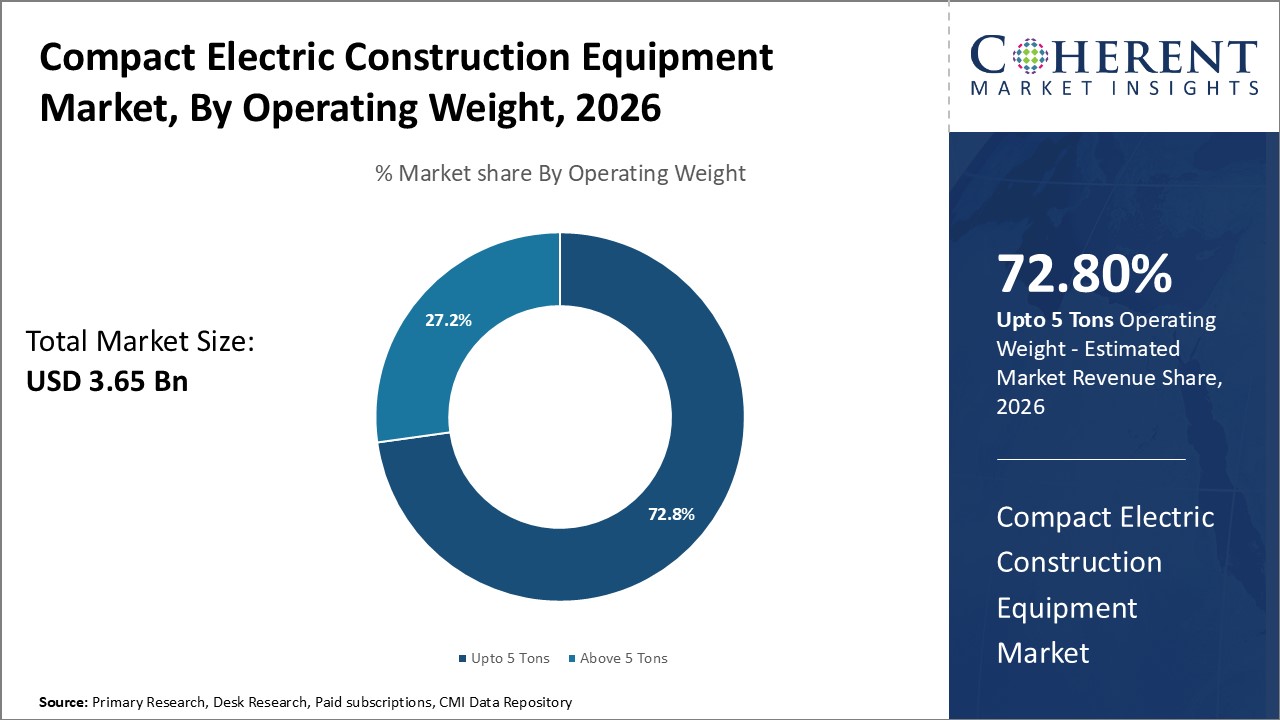
- The upto 5 tons segment is projected to dominate with a share of 72.8 % in 2026.
- The landscaping segment is estimated to lead the market with a share of 33% in 2026.
- Asia Pacific is estimated to lead the market with a share of 39.6 % in 2026.
- North America, holding a share of 27.5% in 2026, and it is projected to be the fastest growing region.
Market Overview
The market is seeing the rising demand for compact electric construction equipment because of strict environmental regulations and a global push towards reducing carbon emissions. Also, innovations in battery technology and electrification of machinery are increasing operational performance and cost-effectiveness. The use of IoT and automation further supports the move towards smart construction sites, accelerating the uptake of electric alternatives over traditional fossil-fuel-powered equipment.
Current Events and their Impact
Current Events | Description and its Impact |
EU Batteries Regulation (Reg. (EU) 2023/1542) |
|
U.S. Inflation Reduction Act (IRA) clean-energy provisions |
|
Rising wholesale electricity prices and volatility (Europe & selected markets) |
|
Segmental Insights
- Current Industry Events of 2026
- Market Size Estimation
- Regional Breakdown
- Competitive Landscape
- Customer Intelligence
- Segmental Analysis
- Pricing Analysis
- Key Market Drivers, Challenges & Future Trends
- Customized Insights Section
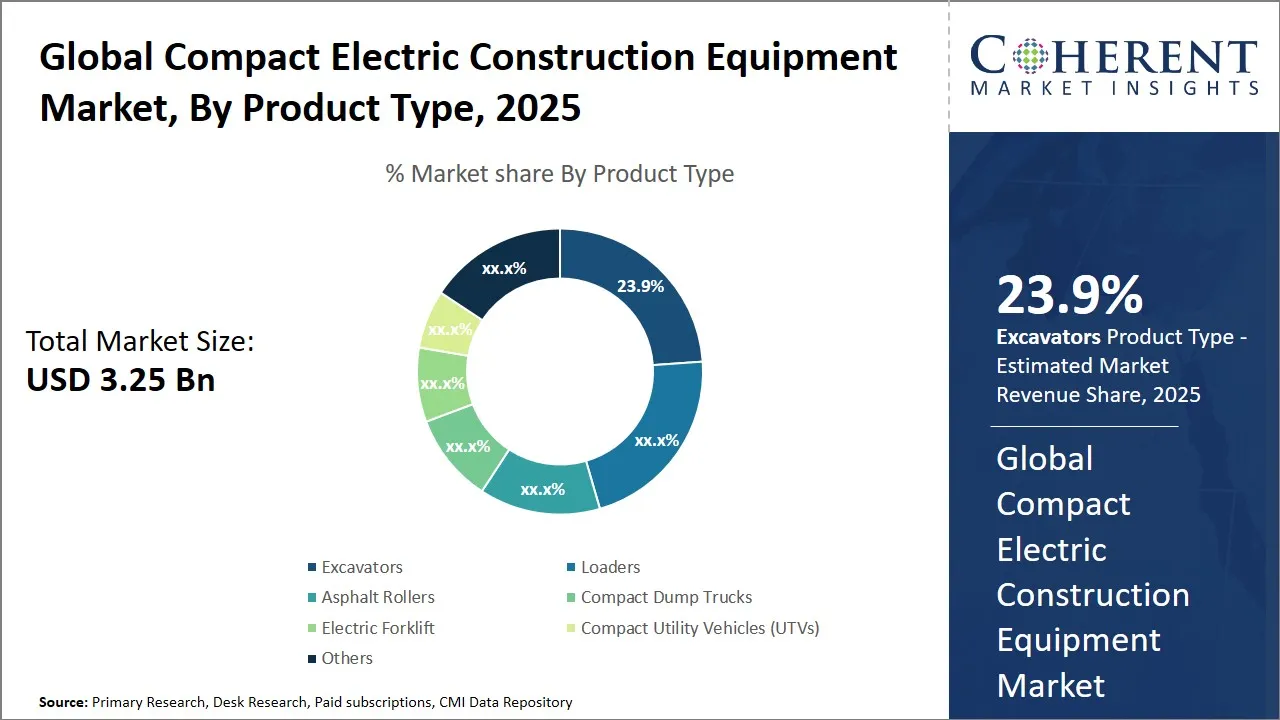
Global Compact Electric Construction Equipment Market Insights, By Product Type – Leading Role of Excavators in Compact Electric Construction Equipment is Driven by Versatility and Efficiency
Excavators dominate the global compact electric construction equipment market, holding an estimated 24.9% of the market share in 2026 because of their unmatched versatility across digging, lifting, and material handling tasks. The electrification of excavators improves their utility in urban and eco-sensitive sites by delivering zero local emissions and low noise, aligning with stringent global environmental regulations. Their reduced maintenance requirements and lower operating costs make them the go-to choice for contractors prioritizing uptime and sustainability.
Compact electric excavators also offer better maneuverability, operating efficiently in confined or indoor environments. Advances in battery density and fast-charging technologies are increasing work cycles and improving productivity. For instance, Volvo CE’s ECR25 Electric compact excavator, adopted by France’s Colas Group, shows how electric models are changing urban construction by reducing emissions and noise on city projects.
Global Compact Electric Construction Equipment Market Insights, By Operating Weight – Dominance of Compact Equipment Up to 5 Tons is Because of its Flexibility and Urban Construction Trends
The upto 5 tons segment is projected to hold 72.8% share in 2026, because of its flexibility and compatibility with urban construction requirements. These lighter electric machines add power with compactness, making them suited for confined city projects and infrastructure maintenance. Their ease of transport and quick setup significantly reduce logistical overheads, while their low ground impact and quiet operation meet urban and residential noise restrictions.
As cities chase net-zero goals, compact electric models under 5 tons are becoming the preferred option for sustainable operations. Optimized battery systems and lighter materials offer cost-effectiveness and extended runtime. An example is Bobcat’s E10e electric mini excavator, used a lot in European cities for indoor demolition and basement work due to its ability to operate in enclosed, ventilation-limited environments.
Global Compact Electric Construction Equipment Market Insights, By Application – Landscaping Application is Driving Market Surge through Electrification and Precision
Landscaping is anticipated to lead with a 33% of the market share in 2026 because of the growing shift toward eco-friendly, precise, and low-impact equipment. Electric compact machines like mini-excavators and loaders offer silent, emission-free operation, making them suited for residential gardens, parks, and green infrastructure projects. Their smooth torque response and precise control reduces surface disturbance and improve operational accuracy, aligning with sustainability-focused urban design trends.
Supportive regulations and cost savings from reduced fuel and maintenance also add to adoption in this segment. Municipal projects increasingly choose electric models to maintain green spaces without pollution. For instance, JCB’s 19C-1E electric mini excavator is used by U.K. councils for park and urban landscaping projects.
Pricing Analysis of the Compact Electric Construction Equipment Market
Equipment Type | Example Model/Range | Price (USD) |
Mini electric excavator (~1.2 t) | Electric Mini Excavator 1.9 t | ~USD 19,600 |
Mini electric excavator (entry level) | Fast Delivery Electric Mini Excavator | ~USD 30,000 |
Compact electric wheel/loader (electrified premium) | 1 t Small Electric Excavator | ~USD 143,120 |
Compact wheel loader (diesel/standard version for reference) | Mini Crawler Excavator 1.5 t | ~USD 83,093–USD 102,942 |
Regional Insights

Asia Pacific Compact Electric Construction Equipment Market Analysis and Trends
Asia Pacific, holding a share of 39.6% in 2026, is expected to dominate the global compact electric construction equipment market because of strong industrialization, rapid urbanization, and expansive infrastructure development projects. The region sees a well-established manufacturing ecosystem, especially in countries like China, Japan, and South Korea, which house big blue-chip companies investing heavily in innovation and sustainable technologies.
Government policies promoting green construction practices and incentives for electric vehicle adoption further propel market penetration. Also, the availability of skilled labor and competitive production costs make the region’s leadership stronger. Big players such as Hitachi Construction Machinery, Kobelco Construction Machinery, and SANY Group are at the forefront, contributing with a range of compact electric machinery designed to meet diverse construction needs.
North America Compact Electric Construction Equipment Market Analysis and Trends
North America, holding an estimated share of 27.5% in 2026, is seeing the fastest growth in the compact electric construction equipment market, driven by accelerating sustainability mandates and infrastructure modernization initiatives. Federal and state governments across the U.S. and Canada are offering incentives, tax credits, and grant programs under frameworks such as the Inflation Reduction Act (IRA) to promote the adoption of zero-emission machinery. The region’s large-scale infrastructure projects, including urban redevelopment and renewable energy construction, are using low-emission equipment to meet environmental compliance goals.
Furthermore, the expansion of electrified rental fleets by major equipment leasing companies and rising awareness of total cost savings from electric models—through reduced fuel and maintenance expenses—are key demand catalysts. North America’s strong technological ecosystem and growing charging infrastructure facilitate the use of battery-electric machines into existing fleets. Leading OEMs like Caterpillar, John Deere, and CASE Construction Equipment are actively introducing compact electric excavators, loaders, and backhoes made for regional requirements, reinforcing North America’s position as a major adopter and innovation hub in the transition toward sustainable construction practices.
Global Compact Electric Construction Equipment Market Outlook for Key Countries
China Compact Electric Construction Equipment Market Analysis and Trends
China compact electric construction equipment market is a powerhouse largely due to vast infrastructure projects including urbanization and transportation networks. The government's commitment to green technology and electrification policies makes a favorable environment. Domestic manufacturers like SANY and XCMG are important, advancing electric compact excavators and loaders with strong R&D backing. Their expansive distribution and service networks ensure high adoption, making China a central hub for innovation and deployment in compact electric construction equipment.
U.S. Compact Electric Construction Equipment Market Analysis and Trends
The U.S. compact electric construction equipment market sees a mature construction ecosystem with a growing push towards sustainability. Regulatory bodies and local authorities push the use of electric machinery to reduce emissions on job sites. Key companies such as JLG Industries and Bobcat Company drive the market with a range of compact electric equipment made for urban construction and renovation projects. The ongoing modernization of urban infrastructure makes demand, while partnerships with technology firms enhance product features like telematics and machine automation.
Japan Compact Electric Construction Equipment Market Analysis and Trends
Japan continues to lead in using advanced robotics and automation within compact electric construction equipment. The country’s focus on reducing environmental impact complements government incentives supporting electric machinery adoption. Manufacturers like Hitachi Construction Machinery and Komatsu are making highly efficient, lightweight electric compact machines made for Japan’s unique construction demands and limited space work sites. Their use of IoT technologies improves machine performance and operational safety, shaping the future of compact electric equipment in the region.
Germany Compact Electric Construction Equipment Market Analysis and Trends
Germany compact electric construction equipment market grows because of strict environmental policies and strong industrial engineering traditions. The country emphasizes energy-efficient construction solutions, aided by government subsidies aimed at decarbonizing the construction sector. German companies such as Wacker Neuson and Liebherr are recognized for their innovation in battery technologies and electric compact machinery. Their products deliver high reliability and sustainability benefits, meeting the requirements of both public infrastructure projects and private sector construction activities throughout Europe.
India Compact Electric Construction Equipment Market Analysis and Trends
India compact electric construction equipment market sees a lot of growth because of big infrastructure development plans and increasing adoption of green technologies. Government initiatives pushing electric mobility and reducing pollution in urban areas are gradually making demand. Indian and international players like JCB and Tata Hitachi are focusing on making cost-effective compact electric construction equipment designed to withstand local working conditions. The growing construction ecosystem, combined with policy support, sets a foundation for accelerated market penetration in the near future.
Market Players, Key Development, and Competitive Intelligence
Key Developments
- In September 2025, Komatsu Europe unveiled its latest innovation, the PC33E-6 a new 3-ton class electric mini excavator equipped with a lithium-ion battery.
- In February 2025, JCB launched the new electric 8008E CTS micro excavator, expanding its zero-emission mini excavator line-up. The 8008E CTS shares its structure and control lever functionality with the diesel-powered 8008 CTS but uses an electric motor and proven battery technology.
- In August 2024, CASE Construction Equipment expanded its EV toolbox for municipal crews, utility teams, urban construction and other contractors with the commercial release of its 580EV, the industry’s first electric backhoe loader.
- In October 2022, Heavy equipment manufacturer, Caterpillar Inc., expanded its electrification offering with the introduction of four new battery-electric machine prototypes as well as a battery prototype for off-highway applications.
Top Strategies Followed by Compact Electric Construction Equipment Market Players
- Established industry leaders distinguish themselves through huge investments in research and development (R&D), wanting to innovate high-performance, reliable, and energy-efficient equipment that meets evolving customer demands.
- Volvo Construction Equipment has invested significantly in its Electric Machines range (ECR25 Electric, L25 Electric), integrating proprietary battery packs and digital fleet-management tools to improve uptime and efficiency across European and North American markets.
- Mid-level players in the compact electric construction equipment market use a strategy centered on offering cost-effective solutions that strike a delicate balance between quality and affordability.
- XCMG Group (China) introduced a low-cost electric mini excavator lineup with modular battery systems, providing competitive pricing for Asia Pacific and emerging markets while maintaining acceptable performance standards.
- Small-scale players tactically make specialized niches within the highly competitive market by focusing on innovation and distinctive product features that address specific customer needs or operational environments.
- Green Machine Equipment (U.S.) focuses on battery-electric skid-steers and mini loaders for indoor demolition and maintenance projects, standing out from bigger OEMs by targeting zero-emission, confined-space operations.
Market Report Scope
Compact Electric Construction Equipment Market Report Coverage
| Report Coverage | Details | ||
|---|---|---|---|
| Base Year: | 2025 | Market Size in 2026: | USD 3.65 Bn |
| Historical Data for: | 2020 To 2024 | Forecast Period: | 2026 To 2033 |
| Forecast Period 2026 to 2033 CAGR: | 12.3% | 2033 Value Projection: | USD 8.22 Bn |
| Geographies covered: |
| ||
| Segments covered: |
| ||
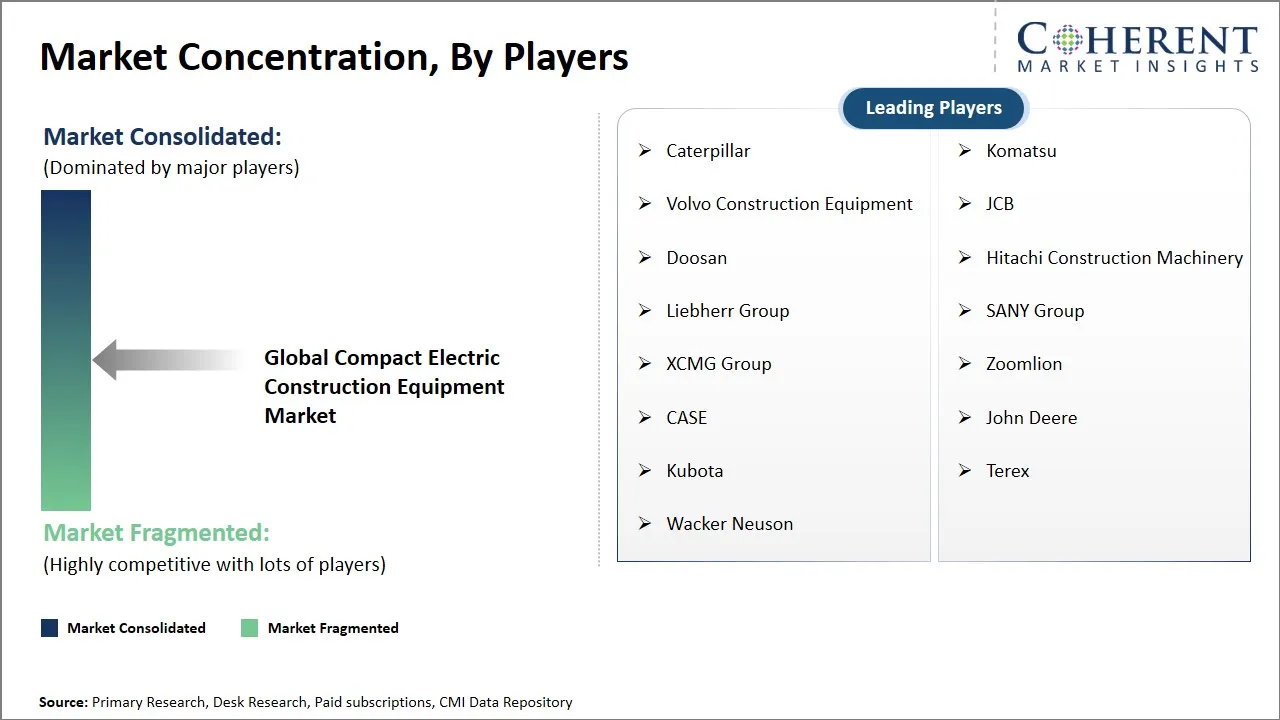
| Companies covered: | Caterpillar, Komatsu, Volvo Construction Equipment, JCB, Doosan, Hitachi Construction Machinery, Liebherr Group, SANY Group, XCMG Group, Zoomlion, CASE, John Deere, Kubota, Terex, and Wacker Neuson | ||
| Growth Drivers: |
| ||
| Restraints & Challenges: |
| ||
Market Dynamics
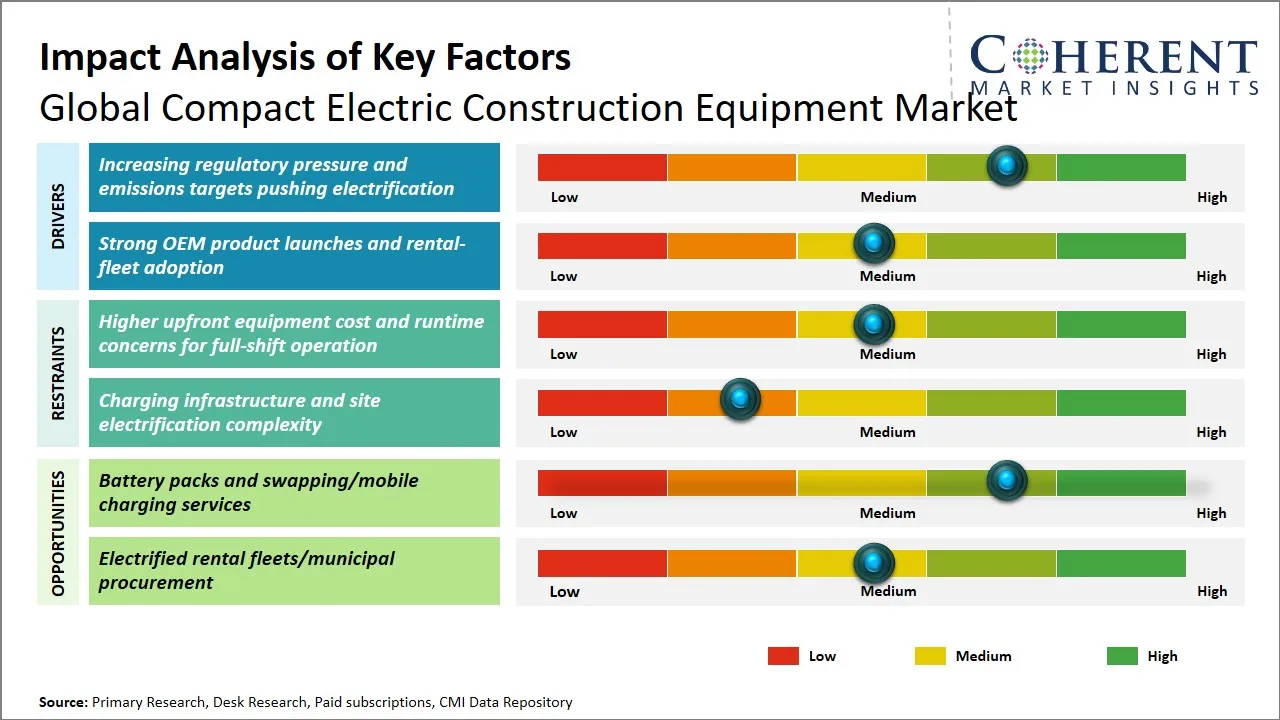
Global Compact Electric Construction Equipment Market Driver – Increasing Regulatory Pressure and Emissions Targets Pushing Electrification
Stringent emission regulations and sustainability mandates worldwide are accelerating the shift toward electric compact equipment. Governments are enforcing tighter carbon limits and incentivizing low-emission machinery through tax rebates, grants, and procurement policies. Urban projects increasingly require quiet, zero-emission machinery to meet green construction standards. The European Union’s Stage V emission standards and the U.S. Inflation Reduction Act (IRA) are prompting OEMs like Caterpillar and Volvo CE to expand electric excavator and loader portfolios to comply with decarbonization goals.
Global Compact Electric Construction Equipment Market Opportunity – Advancement in Battery Packs and Mobile Charging Services
Rapid progress in battery technology and charging solutions is unlocking major growth opportunities. High-density lithium-ion batteries now deliver longer runtime and faster charging, while battery swapping and mobile charging units minimize downtime on job sites. These innovations enhance productivity and make electric models more viable for continuous operations. Volvo CE and Portable Electric collaborated to deploy mobile charging stations for construction fleets in North America, enabling efficient on-site recharging of compact electric loaders and excavators.
Analyst Opinion (Expert Opinion)
- Despite long-term operational savings, the steep initial investment for electric equipment—driven by expensive battery systems and limited economies of scale—continues to deter widespread adoption. Many contractors still see electric machinery as a costly experiment rather than a practical replacement for diesel units.
- The pace of electrification in construction is far greater than of the development of supporting infrastructure. A lack of fast-charging stations and mobile energy solutions, especially at remote or temporary job sites, highly limits the market’s growth potential and reliability perception.
- While compact models perform better in controlled environments, their limited runtime and lower power output create doubts about scalability. Until battery density and charging technology catch up, electric equipment will struggle to meet the heavy-duty demands of larger construction projects.
Speak to the analyst
Want personalized insights?
Take the findings above to one of our principal consultants, or have the report rebuilt around the segments, geographies and competitors you actually track.
Market Segmentation
- Product Type Insights (Revenue, USD Bn, 2021 - 2033)
- Excavators
- Loaders
- Asphalt Rollers
- Compact Dump Trucks
- Electric Forklift
- Compact Utility Vehicles (UTVs)
- Others
- Operating Weight Insights (Revenue, USD Bn, 2021 - 2033)
- Upto 5 Tons
- Above 5 Tons
- Application Insights (Revenue, USD Bn, 2021 - 2033)
- Landscaping
- Material Loading and Handling
- Digging and Trenching
- Others
- Regional Insights (Revenue, USD Bn, 2021 - 2033)
- North America
- U.S.
- Canada
- Latin America
- Brazil
- Argentina
- Mexico
- Rest of Latin America
- Europe
- Germany
- U.K.
- Spain
- France
- Italy
- Russia
- Rest of Europe
- Asia Pacific
- China
- India
- Japan
- Australia
- South Korea
- ASEAN
- Rest of Asia Pacific
- Middle East
- GCC Countries
- Israel
- Rest of Middle East
- Africa
- South Africa
- North Africa
- Central Africa
- North America
- Key Players Insights
- Caterpillar
- Komatsu
- Volvo Construction Equipment
- JCB
- Doosan
- Hitachi Construction Machinery
- Liebherr Group
- SANY Group
- XCMG Group
- Zoomlion
- CASE
- John Deere
- Kubota
- Terex
- Wacker Neuson
Sources
Primary Research Interviews
Stakeholders
- Construction Companies and Contractors
- Compact Equipment Manufacturers and Suppliers
- Architects and Structural Engineers engaged in sustainable and urban construction projects
- Real Estate Developers and Green Infrastructure Project Managers
- Equipment Leasing Firms specializing in compact and electric machinery
- Sustainability Experts and Energy Transition Consultants (focused on zero-emission construction)
Databases
- Eurostat
- U.S. Census
- Construction Global
- OECD
- Energy Efficiency and Electric Mobility (E3M) Database
- Global Construction Equipment Insight (GCEI) Repository
Magazines
- Construction Today
- Equipment World
- Building Design + Construction (BD+C)
- Sustainable Construction Review
- Compact Equipment Digest
Journals
- Journal of Construction Engineering and Management
- Construction and Building Materials Journal
- Journal of Cleaner Production
- Automation in Construction Journal
- Journal of Building Engineering
Newspapers
- The Construction Index
- Construction Week Online
- The Guardian (U.K.)
- The Economic Times (India)
- Engineering News-Record (ENR)
Associations
- Association of Equipment Manufacturers (AEM)
- National Association of Home Builders (NAHB)
- European Construction Industry Federation (FIEC)
- American Rental Association (ARA)
- International Council on Clean Transportation (ICCT)
Public Domain Sources
- U.S. Census Bureau
- EUROSTAT
- United Nations Economic Commission for Europe (UNECE)
- World Bank
- International Energy Agency (IEA)
- ResearchGate
Proprietary Elements
- CMI Data Analytics Tool, Proprietary CMI Existing Repository of Information for Last 8 Years
Get access to 250+ pages report
Every segment, forecast, competitor profile and data table behind the analysis above — available for instant download.
- ESOMAR Member
- ISO 9001:2015 Certified
- D-U-N-S Registered
- GDPR & CCPA Compliant
Missing comfort of reading report in your local language? Find your preferred language:
Transform your Strategy with Exclusive Trending Reports
Frequently Asked Questions
The global compact electric construction equipment market is estimated to be valued at USD 3.65 billion in 2026 and is expected to reach USD 8.22 billion by 2033.
The CAGR of the global compact electric construction equipment market is projected to be 12.3% from 2026 to 2033.
Increasing regulatory pressure and emissions targets pushing electrification and strong OEM product launches and rental-fleet adoption are the major factors driving the growth of the global compact electric construction equipment market.
Higher upfront equipment cost and runtime concerns for full-shift operation and charging infrastructure and site electrification complexity are the major factors hampering the growth of the global compact electric construction equipment market.
In terms of product type, the excavators segment is estimated to dominate the market revenue share in 2026.
High-density batteries, battery swapping systems, and mobile charging units are reshaping equipment usage.
Electric equipment offer reduced operating costs, quieter performance, lower emissions, and less maintenance downtime.