

Global Concrete Machinery Market Size and Forecast – 2026 - 2033
The Global Concrete Machinery Market is estimated to be valued at USD 20.80 Bn in 2026 and is expected to reach USD 28.11 Bn by 2033, exhibiting a compound annual growth rate (CAGR) of 4.4% from 2026 to 2033.
Key Takeaways of the Concrete Machinery Market
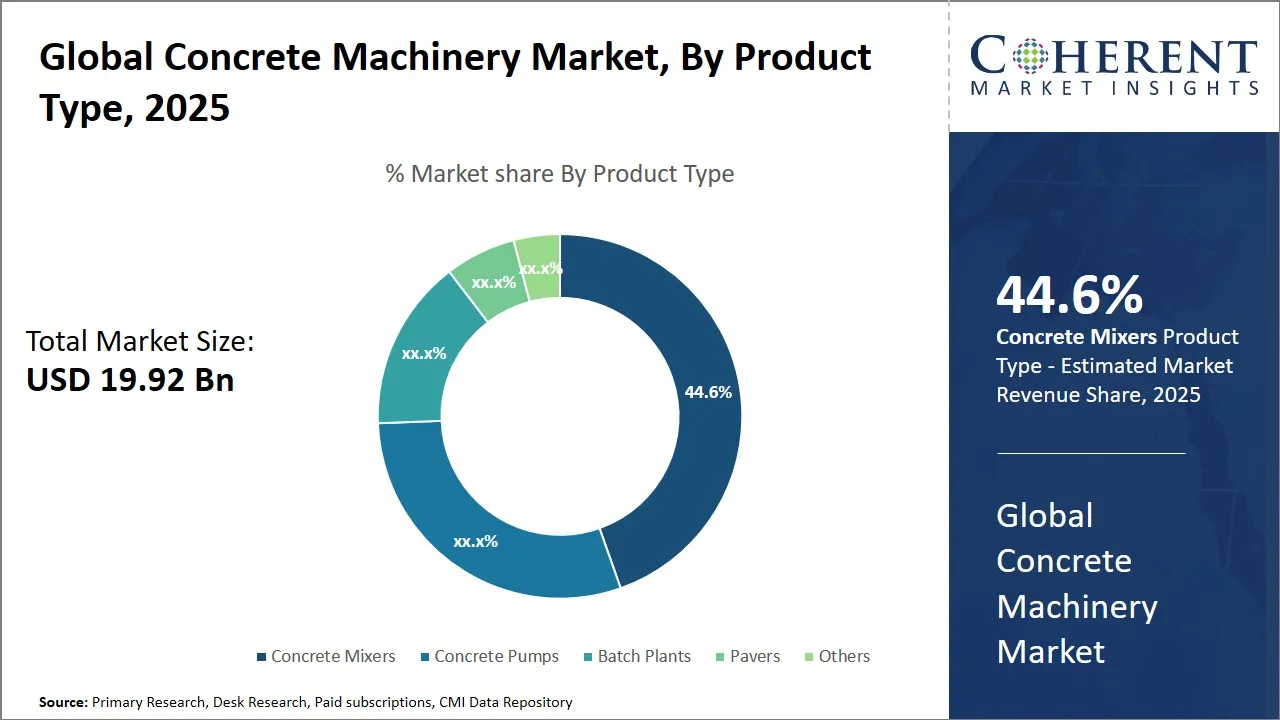
- The concrete mixers segment leads the market holding an estimated share of 45.6 % in 2026.
- The concrete pumps is the second-leading segment, holding a share of 30.8 % in 2026.
- Asia Pacific is estimated to lead the market with a share of 45.2 % in 2026.
- Middle East, holding a share of 7.8% in 2026, is projected to be the fastest growing region.
Market Overview
The market is seeing a strong focus on technological advancements such as automation and IoT integration in concrete machinery, improving operational efficiency and reducing labor costs. Also, sustainability is becoming a key driver, and manufacturers are developing eco-friendly and energy-efficient equipment to meet strict environmental regulations and fulfil the growing demand for green construction practices.
Current Events and Its Impact
Current Events | Description and its impact |
Geopolitical and Trade Developments |
|
Economic and Infrastructure Trends |
|
Segmental Insights
- Current Industry Events of 2026
- Market Size Estimation
- Regional Breakdown
- Competitive Landscape
- Customer Intelligence
- Segmental Analysis
- Pricing Analysis
- Key Market Drivers, Challenges & Future Trends
- Customized Insights Section
Global Concrete Machinery Market Insights, by Product Type – Robust Infrastructure Development Fuels Demand for Concrete Mixers
Concrete Mixers are projected to contribute the highest share of 45.6% in the market in 2026. The surge in infrastructure development across both emerging and developed economies acts as a primary growth driver for this segment. Concrete mixers are indispensable in delivering consistent concrete mixtures, which are essential for constructing roads, bridges, commercial buildings, and residential complexes.
Urbanization trends are further amplifying the demand for concrete mixers, as cities expand and modernize their infrastructure. Rapid population growth necessitates accelerated construction activities, making efficient concrete mixing equipment a critical requirement on project sites. The ability of concrete mixers to provide uniformity and reduce construction timelines makes them favored equipment among contractors.
Technological advancements also play a significant role in driving this segment. Innovations such as automated and mobile concrete mixers have enhanced operational efficiency and ease of transportation, catering to the dynamic needs of construction projects. These advancements reduce labor costs and improve mixing precision, providing a competitive edge in the concrete mixers segment.
Pricing Analysis of the Concrete Machinery Market
Equipment Type | Capacity / Type | Typical Price Range (USD) | Estimated Avg Price (USD) |
Concrete Mixers (small) | 25–50 m³/h | USD 33,800–48,000 | USD 41,900 |
Concrete Mixers (medium) | 60–90 m³/h | USD 70,000–160,000 | USD 115,000 |
Concrete Mixers (large) | 100–180 m³/h | USD 130,000–250,000+ | USD 190,000 |
Mobile Batch Plants | 25–100 m³/h | USD 38,000–120,000 | USD 79,000 |
Stationary Batch Plants | 25–180 m³/h | USD 33,000–210,000 | USD 121,500 |
Trailer Concrete Pumps | 15–40 m³/h | USD 50,000 (Approx.) | USD 50,000 |
Regional Insights
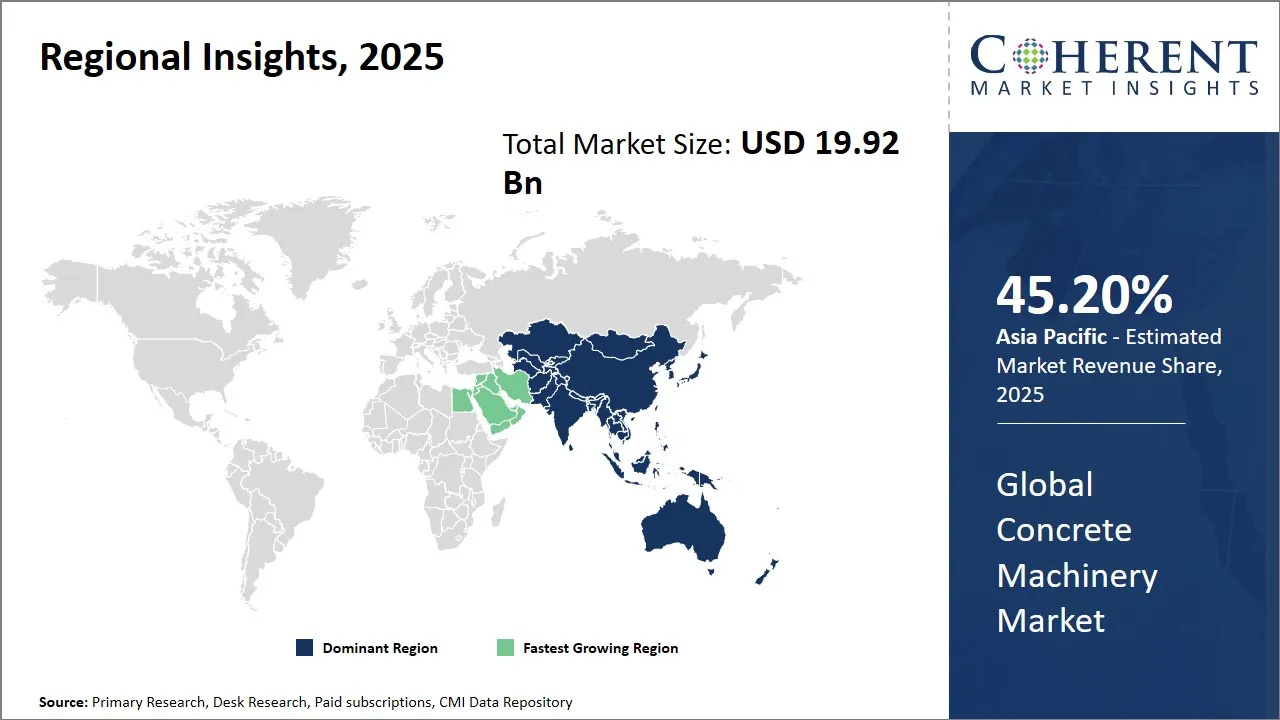
Asia Pacific Concrete Machinery Market Analysis and Trends
Asia Pacific, holding a share of 45.2% in 2026, is set to dominate the global concrete machinery market, driven by rapid urbanization, infrastructural development, and extensive industrialization across key countries such as China, Japan, India, and South Korea. The region benefits from large-scale government investments in infrastructure projects, including smart cities, highways, and residential complexes, which fuel the demand for advanced concrete machinery. The presence of a robust manufacturing ecosystem and easy availability of raw materials further supports the market’s growth.
Leading companies such as Sany Heavy Industry (China), Zoomlion (China), and Kobelco Construction Machinery (Japan) have significant operations here, contributing high-quality machinery and innovative solutions tailored for diverse construction needs. For instance, SANY has developed and deployed concrete pumps and batching plants integrated with 5G technology and IoT-based diagnostics. The emphasis on mechanization and automation in construction methodologies combined with supportive government policies like China's Belt and Road Initiative enhances trade and supply chain efficiency within the Asia Pacific, keeping the region at the forefront of market leadership.
Middle East Concrete Machinery Market Analysis and Trends
The Middle East, holding an estimated share of 7.8% in 2026, exhibits the fastest growth in the global concrete machinery market, spurred by rapidly expanding infrastructure projects, rising urbanization, and diversification of economies away from oil dependence. Countries like the UAE and Saudi Arabia are investing heavily in large infrastructure and commercial projects, stadiums, and transportation networks, creating a fertile environment for concrete machinery consumption.
The region benefits from government incentives and foreign investments aimed at developing a sustainable construction sector, coupled with international trade agreements that facilitate the import of advanced construction equipment. Moreover, companies such as Liebherr (Germany), Caterpillar (USA), and XCMG (China) play pivotal roles by establishing regional offices and aftersales service hubs, ensuring accessibility of advanced machinery and maintenance support. For instance, in October 2023, Construction machinery manufacturer, XCMG Machinery, launched its Saudi Arabia subsidiary company in Riyadh, to anchor the establishment of a more comprehensive sales and service network locally and further boost the integration into Saudi Arabia’s development.
Global Concrete Machinery Market Outlook for Key Countries
China Concrete Machinery Market Analysis and Trends
China stands as a powerhouse in concrete machinery, fueled by its huge infrastructure projects and fast urban expansion. The country hosts some of the world’s largest concrete machinery manufacturers such as Sany Heavy Industry and Zoomlion, which are not only dominant domestically but are also expanding their global footprint. China's government initiatives aimed at modernizing construction practices and enhancing sustainability standards encourage adoption of technologically advanced equipment, including high-capacity mixers and batching plants. The ecosystem is further supported by integration of Industry 4.0 technologies improving operational efficiencies, placing China as a critical hub for innovation and manufacturing excellence within the global market.
U.S. Concrete Machinery Market Analysis and Trends
The U.S. is characterized by mature industry presence and a strong adoption of technologically sophisticated concrete machinery. Government infrastructure funding programs promote renovation and expansion of existing roadways, bridges, and public amenities. Firms such as Caterpillar, CTB Inc., and Oshkosh Corporation are significant market players, known for delivering reliable, high-performance machinery suited to the stringent regulatory and environmental standards prevalent in the country. Innovation with a focus on machinery automation, energy efficiency, and emissions control aligns with broad environmental policies and sustainability goals, shaping demand patterns. The U.S. construction sector’s emphasis on durable and precision machinery ensures steady modernization and replacement cycles, maintaining the market’s vitality.
Germany Concrete Machinery Market Analysis and Trends
Germany concrete machinery market benefits from the country’s strong engineering tradition and its role as a European industrial leader. German companies like Liebherr and Wirtgen Group bring sophisticated, precision-built machinery to the market, supporting diverse construction applications from residential to large-scale infrastructure. The government’s robust support for sustainable construction and digitalization in building methods incentivizes the deployment of advanced concrete machinery solutions with features such as automated batching and real-time data monitoring. Germany’s strategic location within the EU facilitates efficient trade flows and aligns the country with broader regional construction innovations and standards, thus reinforcing its importance as both an end-user and exporter of concrete machinery.
India Concrete Machinery Market Analysis and Trends
India is propelled by substantial infrastructure projects and expanding urbanization driven by government initiatives such as the Smart Cities Mission and the National Infrastructure Pipeline. The demand for concrete machinery is rising in response to growth in affordable housing, transportation networks, and industrial developments. Domestic and international players like JCB India, Schwing Stetter, and Tata Hitachi contribute actively, focusing on cost-effective yet durable machinery suited for diverse regional requirements. Indian government policies encouraging “Make in India” and infrastructure financing boost equipment availability and local manufacturing capabilities. The market ecosystem is evolving with growing investments in digital technology and machinery automation to enhance construction productivity and reduce labor dependency.
UAE Concrete Machinery Market Analysis and Trends
The UAE exemplifies a rapidly developing construction hub in the Middle East, marked by iconic architectural projects and infrastructure diversification in cities like Dubai and Abu Dhabi. The government’s vision to become a global logistics and tourism center drives continuous investments in infrastructure. Major players such as Liebherr, Caterpillar, and local distributors ensure availability of cutting-edge concrete batching plants and mixers capable of meeting demanding project specifications. Favorable trade policies, free zones, and the presence of global logistics networks accelerate equipment import and after-sales service. Moreover, the UAE’s emphasis on sustainability and smart construction practices encourages the use of innovative, energy-efficient concrete machinery, amplifying productivity and project lifecycle efficiencies in this growth-oriented market.
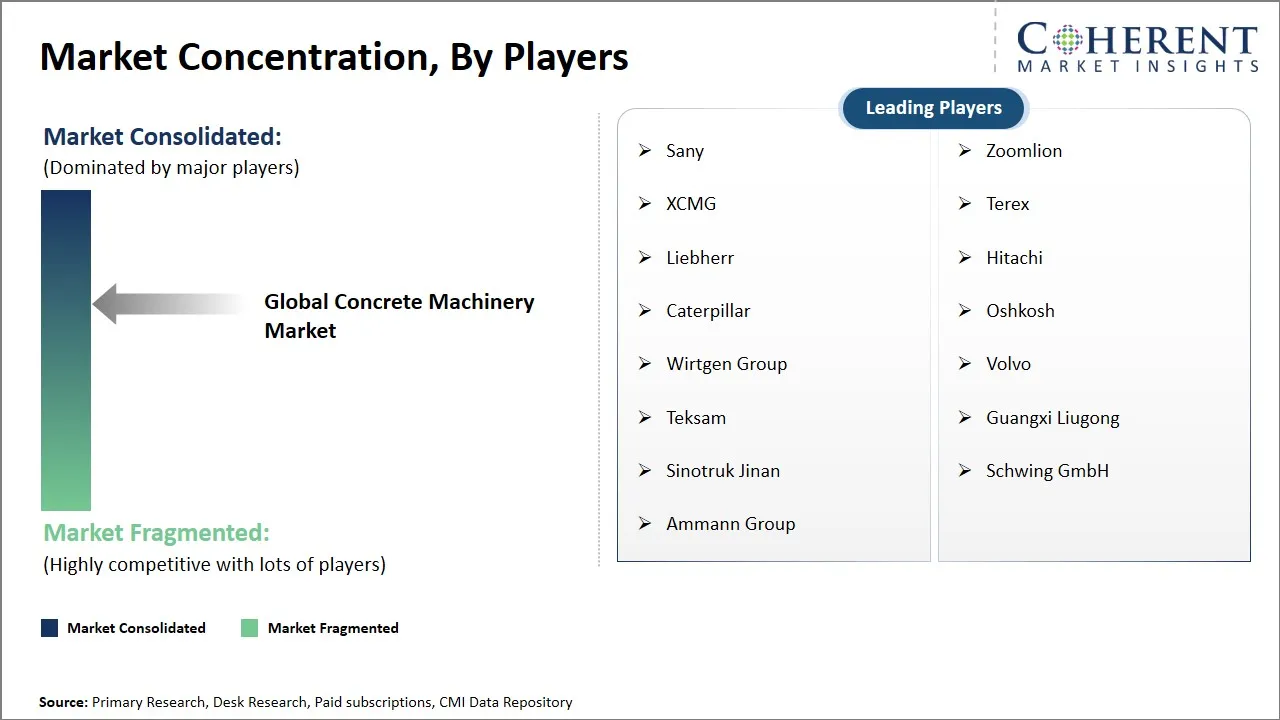
Market Players, Key Development, and Competitive Intelligence
Key Developments
- In June 2025, Putzmeister, a provider of concrete equipment and pumping solutions, launched its BSA 1405 D Classic - Stationary Concrete Pump through an on-ground customer engagement campaign — the “Putzmeister Concrete Dastak Roadshow”.
- In April 2025, Volvo Trucks and Putzmeister revealed one of the world’s largest battery-electric concrete boom pump trucks at the Bauma exhibition in Munich, Germany. The zero-exhaust emission battery-electric concrete pump with a reach of 42 meters was to be delivered to the Sweden-based construction company Swerock.
- In February 2025, Quikrete Holdings, Inc. acquired all of the common stock of Summit Materials, Inc. (“Summit”). As a result, Summit became a privately held subsidiary of Quikrete, and Summit’s common stock ceased trading on the NYSE and is no longer listed on any public market.
- In January 2025, ITOCHU Corporation concluded a memorandum of collaboration with Mitsubishi UBE Cement Corporation and the Australia-based company, MCi Carbon Pty Ltd. MCi owns a mineral carbonation technology which combines CO2 with waste concrete, steel slag (by-product of iron-making processes) and minerals such as serpentinite and is available for cement alternatives and raw materials for concrete.
Top Strategies Followed by Concrete Machinery Market Players
- Established players dominate the market through significant investments in research and development, aiming to innovate high-performance products that cater to evolving construction needs. These companies prioritize the integration of advanced technologies such as automation, IoT, and sustainable machinery to boost efficiency and reduce environmental impact, thereby setting new industry standards.
- Zoomlion makes heavy investment in R&D to lead in automation and sustainability. For instance, in 2024, Zoomlion launched the ZLJ5440THBEV — the world’s first pure electric truck-mounted concrete pump.
- Mid-level players in the concrete machinery market typically focus on delivering cost-effective solutions that strike a careful balance between quality and affordability. Recognizing the price sensitivity of a substantial segment of customers, especially in developing regions, these companies design machinery that meets essential performance criteria without incurring the premium costs associated with cutting-edge innovations.
- Aimix offers low-cost, modular concrete batching plants tailored for small to mid-sized construction firms. In 2025, Aimix rolled out the AJ-35 mobile batching plant, optimized for emerging markets with low fuel usage and simple controls.
- Small-scale players carve out niche positions within the global concrete machinery ecosystem by concentrating on specialized features or innovative products that larger companies might overlook. These manufacturers often adopt cutting-edge technologies, such as compact designs, energy-efficient systems, or modular machinery, to differentiate themselves and stay competitive despite limited resources.
- Teksam specializes in custom concrete pipe and precast machinery for municipal and utility markets.
Market Report Scope
Concrete Machinery Market Report Coverage
| Report Coverage | Details | ||
|---|---|---|---|
| Base Year: | 2025 | Market Size in 2026: | USD 20.80 Bn |
| Historical Data for: | 2020 To 2024 | Forecast Period: | 2026 To 2033 |
| Forecast Period 2026 to 2033 CAGR: | 4.4% | 2033 Value Projection: | USD 28.11 Bn |
| Geographies covered: |
| ||
| Segments covered: |
| ||
| Companies covered: | Sany, Zoomlion, XCMG, Terex, Liebherr, Hitachi, Caterpillar, Oshkosh, Wirtgen Group, Volvo, Teksam, Guangxi Liugong, Sinotruk Jinan, Schwing GmbH, and Ammann Group | ||
| Growth Drivers: |
| ||
| Restraints & Challenges: |
| ||
Market Dynamics
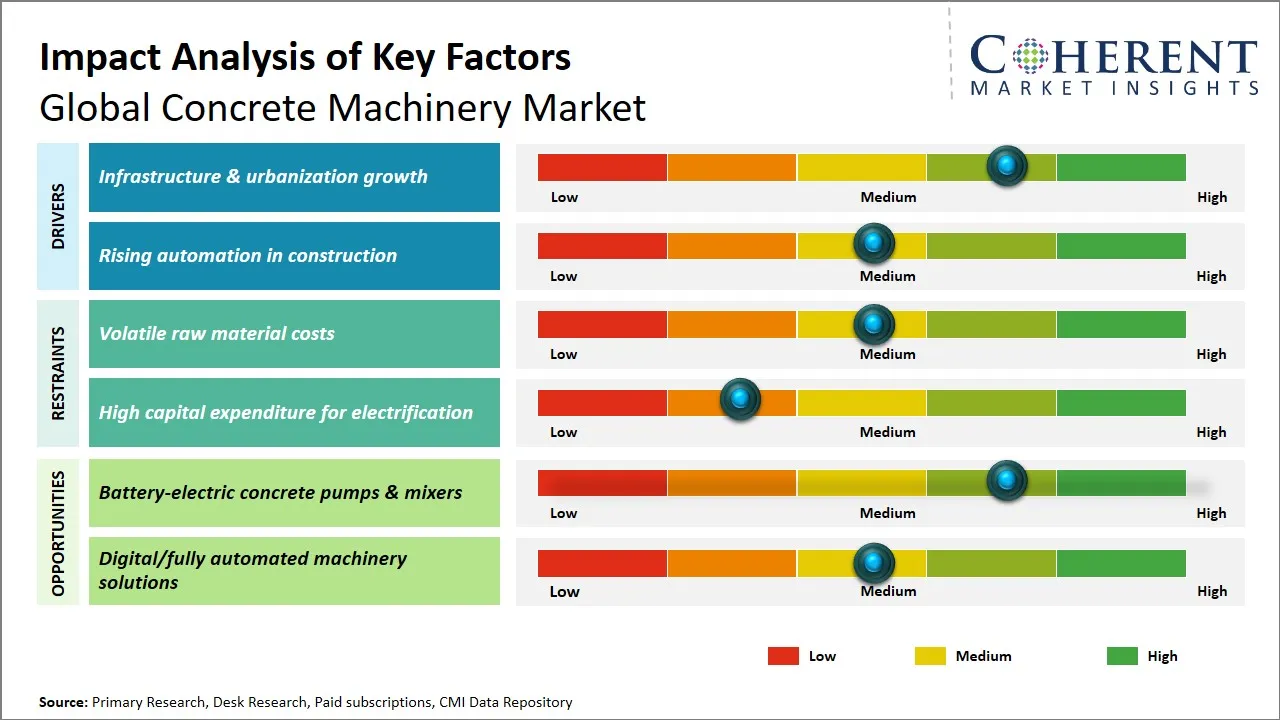
Global Concrete Machinery Market Driver – Infrastructure & Urbanization Growth
As cities expand and governments prioritize large-scale construction projects such as highways, bridges, residential complexes, and commercial buildings, the demand for efficient and advanced concrete machinery intensifies. For instance, the Indian government is investing over USD1.4 trillion in infrastructure through the PM Gati Shakti Master Plan, targeting roads, metros, logistics hubs, and housing by 2030.Urban populations require expanded housing, transportation networks, and public amenities, all of which rely heavily on concrete as a primary construction material. This surge in construction activities propels the adoption of innovative concrete mixing, batching, and placing equipment designed to enhance productivity, reduce labor costs, and ensure consistent quality.
Furthermore, government investments aimed at modernizing infrastructure to support growing urban centers contribute to a sustained need for reliable concrete machinery. Consequently, these intertwined factors of rapid urban growth and infrastructure expansion strongly stimulate demand and innovation within the concrete machinery industry.
Global Concrete Machinery Market Opportunity – Adoption of Battery-Electric Concrete Pumps and Mixers
As sustainability and environmental regulations become more stringent worldwide, construction companies are actively seeking greener alternatives to traditional diesel-powered machinery. Battery-electric concrete pumps and mixers present a promising solution by reducing carbon emissions, noise pollution, and fuel consumption on construction sites. For instance, CIFA Energya E9 is a hybrid (diesel-electric) and fully battery-electric truck-mounted concrete mixer designed for urban use. This shift aligns with the broader industry trend toward eco-friendly and energy-efficient equipment, driven by both regulatory mandates and corporate social responsibility initiatives.
Moreover, advancements in battery technology, including improvements in energy density and faster charging capabilities, are enhancing the operational efficiency and reliability of these electric machines. This makes them increasingly viable for a wide range of construction applications, from urban infrastructure projects to large-scale commercial developments. Additionally, battery-electric concrete machinery offers lower maintenance costs and reduced operational downtime compared to conventional engines, which can lead to significant cost savings for contractors. The integration of smart technologies, such as IoT-enabled battery management systems, further optimizes performance and extends equipment lifespan.
Analyst Opinion (Expert Opinion)
- With cities enforcing zero-emission mandates, battery-electric concrete mixers and pumps are no longer fringe innovations—they're fast becoming essential for urban projects. Early adopters like CIFA and Zoomlion are setting the pace, and lagging players risk obsolescence in electrified job sites.
- The fusion of 5G, AI, and telematics in concrete machinery is enabling real-time diagnostics, predictive maintenance, and remote operation. This shift is transforming equipment from mechanical assets to intelligent, networked systems—especially valuable in large-scale infrastructure projects.
- Demand is rising for compact, modular batching plants with automated controls and low power use. These systems appeal to both mature and emerging markets by offering plug-and-play scalability and reducing setup time, labor costs, and material waste.
Speak to the analyst
Want personalized insights?
Take the findings above to one of our principal consultants, or have the report rebuilt around the segments, geographies and competitors you actually track.
Market Segmentation
- Product Type Insights (Revenue, USD Bn, 2021 - 2033)
- Concrete Mixers
- Concrete Pumps
- Batch Plants
- Pavers
- Others
- Regional Insights (Revenue, USD Bn, 2021 - 2033)
- North America
- U.S.
- Canada
- Latin America
- Brazil
- Argentina
- Mexico
- Rest of Latin America
- Europe
- Germany
- U.K.
- Spain
- France
- Italy
- Russia
- Rest of Europe
- Asia Pacific
- China
- India
- Japan
- Australia
- South Korea
- ASEAN
- Rest of Asia Pacific
- Middle East
- GCC Countries
- Israel
- Rest of Middle East
- Africa
- South Africa
- North Africa
- Central Africa
- North America
- Key Players Insights
- Sany
- Zoomlion
- XCMG
- Terex
- Liebherr
- Hitachi
- Caterpillar
- Oshkosh
- Wirtgen Group
- Volvo
- Teksam
- Guangxi Liugong
- Sinotruk Jinan
- Schwing GmbH
- Ammann Group
Sources
Primary Research Interviews
Stakeholders
- Construction Companies and Contractors (e.g., Project Managers, Site Supervisors)
- Formwork Manufacturers and Suppliers
- Architects and Structural Engineers involved in large-scale infrastructure projects
- Real Estate Developers and Building Construction Companies
- Equipment Leasing Firms specializing in formwork solutions
- Sustainability Experts and Green Building Consultants (if focusing on eco-friendly formwork systems)
Databases
- Eurostat
- U.S. Census
- Construction Global
- OECD
Magazines
- Construction Today
- Concrete Construction Magazine
- Building Design + Construction (BD+C)
- Formwork Construction Magazine
Journals
- Journal of Construction Engineering and Management
- Construction and Building Materials Journal
- Automation in Construction Journal
- Journal of Building Engineering
Newspapers
- The Construction Index
- Construction Week Online
- The Guardian (UK)
- The Economic Times (India)
Associations
- International Concrete Repair Institute (ICRI)
- The Concrete Society (UK)
- National Association of Home Builders (NAHB)
- The Formwork Association (UK)
- American Concrete Institute (ACI)
Public Domain Sources
- U.S. Census Bureau
- EUROSTAT
- United Nations Economic Commission for Europe (UNECE)
- World Bank
- ResearchGate
Proprietary Elements
- CMI Data Analytics Tool, Proprietary CMI Existing Repository of information for last 8 years
Get access to 250+ pages report
Every segment, forecast, competitor profile and data table behind the analysis above — available for instant download.
- ESOMAR Member
- ISO 9001:2015 Certified
- D-U-N-S Registered
- GDPR & CCPA Compliant
Missing comfort of reading report in your local language? Find your preferred language:
Transform your Strategy with Exclusive Trending Reports
Frequently Asked Questions
The global concrete machinery market is estimated to be valued at USD 20.80 billion in 2026 and is expected to reach USD 28.11 billion by 2033.
The CAGR of global concrete machinery market is projected to be 4.4% from 2026 to 2033.
Infrastructure & urbanization growth and Rising automation in construction are the major factors driving the growth of global concrete machinery market.
Volatile raw material costs and high capital expenditure for electrification are the major factors hampering the growth of global concrete machinery market.
In terms of Product Type, Concrete Mixers are estimated to dominate the market revenue share in 2026.
Sany, Zoomlion, XCMG, Terex, Liebherr, Hitachi, Caterpillar, Oshkosh, Wirtgen Group, Volvo, Teksam, Guangxi Liugong, Sinotruk Jinan, Schwing GmbH, and Ammann Group are the major players in the global concrete machinery market
Asia Pacific is expected to lead the global concrete machinery market in 2026.