

Global Crypto Wallet Market Size and Forecast – 2026 To 2033
The global crypto wallet market is expected to grow from USD 19 Bn in 2026 to USD 100 Bn by 2033, registering a compound annual growth rate (CAGR) of 18.2% from 2026 to 2033. The global crypto wallet market is driven by rising adoption of decentralized finance applications. On August 27, 2025, Aave Labs launched Aave Horizon, a new lending market on Ethereum where institutions or other qualified users borrow stablecoins against real-world assets (RWAs).
Key Takeaways of the Global Crypto Wallet Market
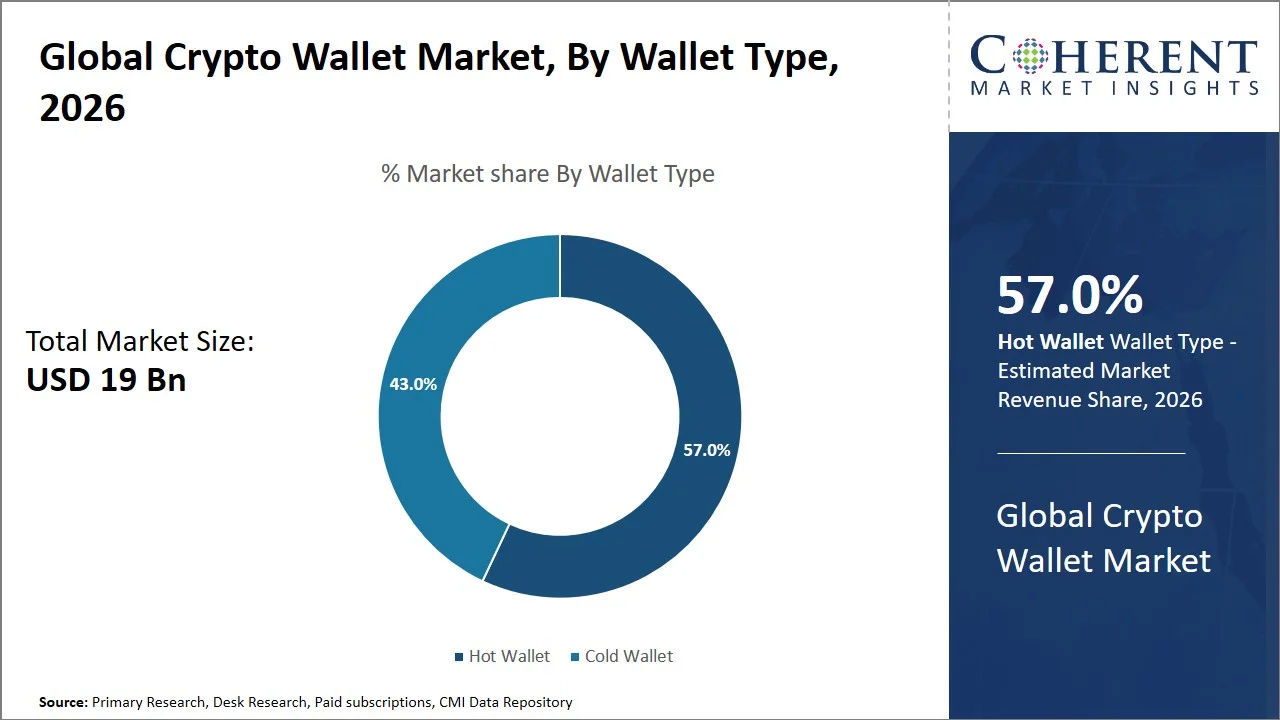
- The Hot Wallet segment is expected to account for 57.0 % of the global crypto wallet market share in 2026. Growing use of NFTs and tokenized digital assets is driving the growth of the segment. On December 15, 2025, J.P. Morgan Asset Management announced the launch of its first tokenized money market fund, My OnChain Net Yield Fund, available on the public Ethereum blockchain.
- The Android segment is estimated to capture 36.0 % of the market share in 2026. Increasing smartphone and internet penetration is majorly driving the growth of the segment. On February 19, 2025, Samsung introduced the Galaxy A06 5G, offering 5G experience at an inexpensive price.
- The Individual Consumer segment is estimated to capture 62.0 % of the market share in 2026. Increasing integration of wallets with payment and financial services is driving the growth of the segment. On July 30, 2025, Coinbase and JPMorgan Chase announced a partnership that enables Chase customers to connect their bank accounts with Coinbase and use Chase credit cards to purchase cryptocurrency.
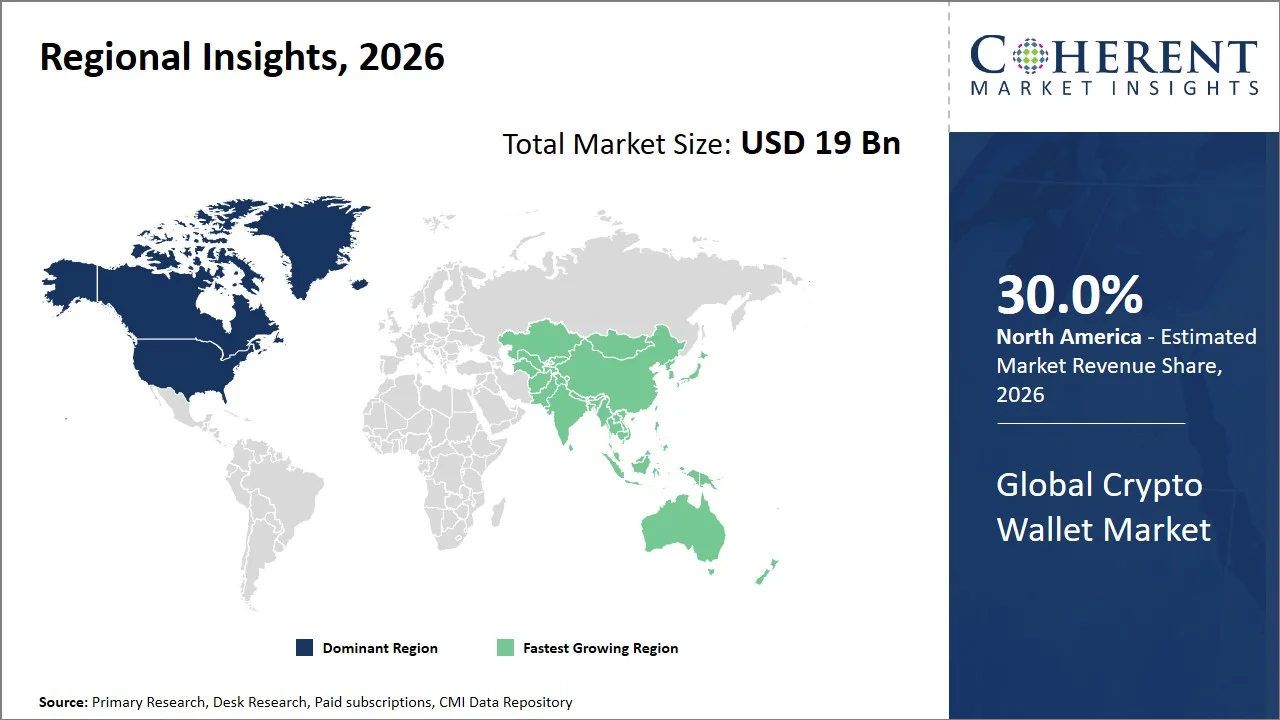
- North America is expected to dominate the crypto wallet market in 2026 with a market share of 30.0 %. Growing integration of artificial intelligence for fraud and transaction monitoring in North America is driving the growth of the regional market. On January 13, 2025, Chainalysis acquired Alterya, an AI powered fraud detection company whose technology was already monitoring more than USD 8 billion in crypto and fiat transactions per month and protecting approximately 100 million end users through relationships with companies including Coinbase, Binance, and Block.
- Asia Pacific is expected to account for 22.0 % share in 2026. Growth of embedded crypto wallets within fintech applications across Asia Pacific is driving the growth of the regional market. On august 12, 2026, Anchorpoint Financial, the joint venture established by Standard Chartered, Animoca Brands and Hong Kong Telecommunications, began the first phase of its Hong Kong dollar backed stablecoin HKD At Par, initially targeting institutional distributors and professional investors.
Segmental Insights
Why Does Hot Wallet Dominate the Global Crypto Wallet Market?
The hot wallet segment is expected to account for 57.0% of the global crypto wallet market share in 2026. Hot wallets are the best option for those who trade cryptocurrencies often, make payments, use decentralized financial apps, and transfer coins, since they allow you to instantly access your digital currencies from internet connected devices. They employ smartphones, online browsers, cryptocurrency exchanges and decentralized applications to minimize the technological hurdles to handling digital currencies; and features like rapid transactions, multi asset support and simple account recovery make it easy for retail customers. The growing popularity of stablecoins and decentralized applications for everyday digital transactions highlights the need for wallets that provide constant connectivity and rapid transaction processing. On September 30, 2025, Phantom launched Phantom Cash, adding a dollar backed stablecoin and payment functionality directly to its self custody wallet. The product was built with Stripe and Bridge and combines a native onramp, branded spending card, and virtual accounts.
- Current Industry Events of 2026
- Market Size Estimation
- Regional Breakdown
- Competitive Landscape
- Customer Intelligence
- Segmental Analysis
- Pricing Analysis
- Key Market Drivers, Challenges & Future Trends
- Customized Insights Section
Why is Android the Most Preferred Operating System?
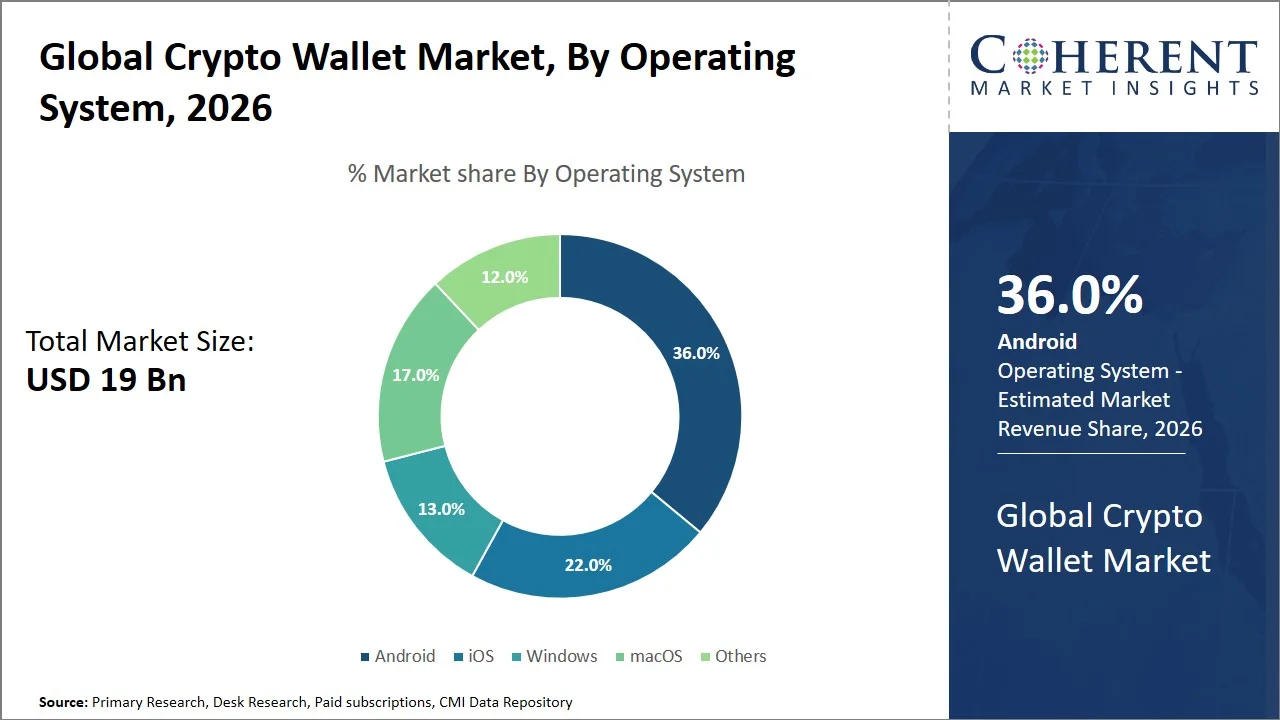
The android segment is expected to account for 36.0% of the global crypto wallet market share in 2026. Android is widely available, has a big global installed base and is widely compatible with bitcoin apps, exchanges, decentralized apps and mobile payment systems. Its open ecosystem also enables wallet providers to plug in features such as biometric verification, QR code transactions, decentralized application connection, and multi-chain asset management on a wide range of smartphones including inexpensive devices in emerging areas. The combination of device availability, app compatibility, and flexible wallet integration makes Android especially useful for customers who want easy access to digital resources. On September 11, 2025, Trust Wallet announced the release of biometric login and enhanced QR synchronization between the mobile app and browser extension, allowing users to authenticate more easily and keep their accounts more safe.
Individual Consumer Dominates the Global Crypto Wallet Market
The individual consumer segment is expected to account for 62.0% of the global crypto wallet market share in 2026. Wallet activity from individual consumers is a key source of wallet activity since cryptocurrency ownership is increasingly being utilized for personal investing, trading, peer to peer transfers, payments and digital asset management. Such mobile wallet applications have allowed users to buy, store, transfer and monitor multiple cryptocurrencies without requiring specialized technical knowledge. Features such as biometric authentication, simple recovery options and integration with cryptocurrency exchanges have improved accessibility. Therefore, the increasing engagement of retail in stablecoins, decentralized finance, and crypto assets is supporting the significant demand for user-centric wallets. On December 18, 2025, Trust Wallet surpassed 220 million users worldwide, as it expanded its consumer offering beyond simple asset storage with Stablecoin Earn, tokenized equities, perpetual trading, multi-account support and improved swap capabilities.
Current Events and their Impact
Current Events | Description and its Impact |
United States – GENIUS Act, 2025. |
|
India - Virtual Digital Asset Service Provider Registration Revisions, 2025 |
|
Crypto Wallet Market Dynamics
Market Drivers
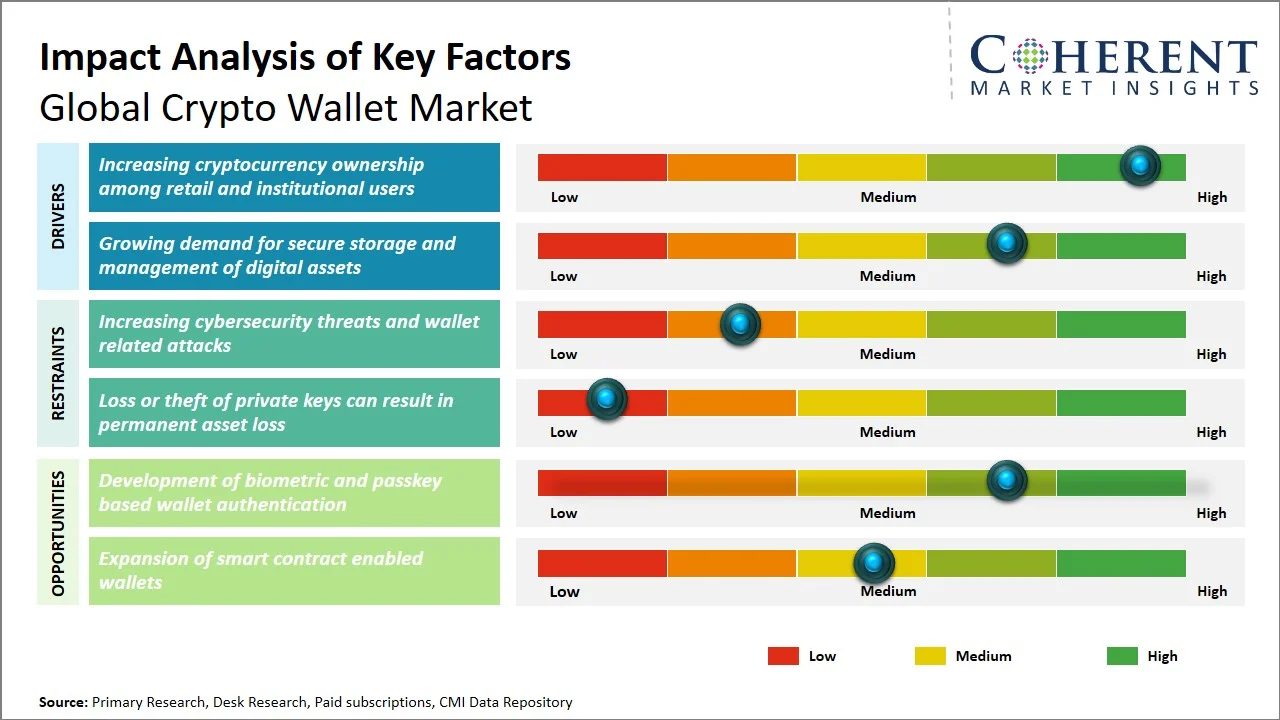
- Increasing cryptocurrency ownership among retail and institutional users: Retail and institutional users are buying more bitcoin, leading to demand for wallets that are simple to use and trusted to store, move and manage digital currencies. Retail investors use wallets to hold cryptocurrencies, stablecoins and other tokenized assets. Institutions need solutions with secure custody, transaction controls, portfolio management and compliance capabilities. The rise in the number of users of both custodial and self custody wallet solutions is being driven by the explosion of bitcoin use cases for investment, payments, decentralized finance and tokenization. On December 8, 2025, Robinhood stated it has USD 51 billion of cryptocurrency assets and traded USD 232 billion of crypto notional amounts in the twelve months until the third quarter of 2025, growing its U.S. and European crypto offerings.
- Growing demand for secure storage and management of digital assets: The growing concerns about cyber attacks, loss of private keys, phishing, and hacking of transactions are driving the need for wallets with greater security and asset management features. To combat security challenges, providers are implementing features such as multi factor authentication, biometric verification, hardware based key storage, transaction approval controls, multi signature functionality and recovery methods. The increasing relevance and diversity of digital assets possessed by individuals is also driving broader adoption of wallets that enable secure custody plus portfolio tracking and managed transaction processing. On October 23, 2025, Ledger released the Nano Gen5 and its revamped Ledger Wallet. The Nano Gen5 brings together a Secure Element, secure touchscreen, Clear Signing, Transaction Check, Bluetooth and NFC to help users safeguard themselves while managing assets across different networks.
Emerging Trends
- Growing adoption of smart contract wallets: Smart contract wallets are gaining traction rapidly, as they can automate transaction rules, enable account recovery, allow spending limits, and provide more flexible transaction management than traditional externally owned accounts, improving usability for decentralized finance and web3 applications.
- Increasing integration of passkeys and biometric authentication: Wallet providers are increasingly adopting passkeys, fingerprint recognition, facial recognition and device-based authentication to reduce reliance on manually managed passwords and seed phrases, making secure wallet access easier for mainstream users.
- Expansion of stablecoin focused wallet applications: The wider adoption of stablecoins for cross border payments, remittances, merchant transactions and digital commerce is driving wallet providers to build faster multi currency transaction capabilities, cheaper payment functions and greater integration with payment platforms.
- Rise of multi chain and interoperability focused wallets: Users want wallets that are able to manage assets across multiple blockchains from one interface, forcing providers to add cross-chain functionality, dApp connectivity, network switching and broader token support to reduce fragmentation in blockchain ecosystems.
Regional Insights
Why is North America a Strong Market for Crypto Wallet?
North America is expected to account for a market share of 30.0% in 2026. The main driver in North America is institutional integration of crypto into conventional financial infrastructure, not just retail speculation. The region accounted for 26% of global crypto transaction traffic in Chainalysis’ 2025 study, and transfers greater than USD 10 million made up 45% of the transaction value, highlighting the necessity for institutional custody and wallet infrastructure. Regulated digital asset exposure is in demand following the launch of spot bitcoin exchange traded instruments in the US in Jan 2024. The move by firms such as BlackRock, Fidelity, Coinbase and Gemini has enhanced the connectivity between traditional investment platforms and crypto custody. Another big player is Canada, where the average Canadian crypto activity between July 2023 and June 2024 has been over USD 119 billion in transaction value. These advancements are driving demand for institutional wallets, custody platforms, wallet infrastructure APIs and safe transaction authorization solutions.
Why Does Asia Pacific Crypto Wallet Market Exhibit High Growth?
Asia Pacific is expected to register the fastest growth with a CAGR of 19.6% over the forecast period. Asia Pacific is projected to account for 22.0% of the global crypto wallet market in 2026. Asia Pacific is seeing a convergence of high mobile usage, stablecoin activity, remittance demand and fast-growing digital asset ecosystems. Transactions of crypto assets on the blockchain in the region rose 69% year-on-year between June 2024 and June 2025, the highest regional growth rate identified by the OECD. Chainalysis said on-chain value received increased 99% in India, 103% in Indonesia, 100% in South Korea, 120% in Japan and 55% in Vietnam during the corresponding 12-month period. Stablecoins are becoming critical for cross border settlement and remittances and APAC is gradually becoming a significant stablecoin adoption area. Japan is also developing infrastructure for yen-backed stablecoins, South Korea has seen significant trading activity in stablecoins, and Hong Kong has established a licensing framework for stablecoin issuers, which creates more opportunities for wallets that support regulated stablecoins and multi-chain transactions.
Global Crypto Wallet Market Outlook for Key Countries
Why is U.S. Emerging as a Major Hub in the Crypto Wallet Market?
Crypto wallets will combine with institutional investment products, conventional financial institutions and tokenized assets to move the U.S. forward. Spot bitcoin exchange traded products went live in January 2024, providing investors with access to bitcoin thru familiar regulated investment structures. BlackRock’s iShares Bitcoin Trust quickly emerged as a major institutional vehicle, and the firm has been expanding its digital asset and tokenization capabilities at the same time. Coinbase, Gemini and other U.S. platforms are also providing custodial infrastructure that takes out the technical burden of private key management for consumers and institutions. For example, over the 12 months to June 2025, U.S. customers purchased about USD 2.7 trillion of bitcoin on centralized exchanges with USD, along with USD 1.5 trillion of ether and USD 454 billion of USDT, highlighting the scale of demand for accessible digital asset management infrastructure. The sector is also being pushed toward more transparent legislation for stablecoins and digital currencies with the passage of the GENIUS Act in 2025 and ongoing congressional work on the CLARITY Act.
Is China the Next Growth Engine for the Crypto Wallet Market?
Mainland authorities still ban private cryptocurrency trade but are pushing to build out blockchain and central bank digital currency infrastructure, offering a different growth route for China. Hence, the e-CNY ecosystem is driving demand for digital wallet technology thru a state-controlled paradigm rather than traditional bitcoin or ether wallets. Total e-CNY transaction value is expected to surpass USD 2.3 trillion by late 2025, with activity having surged more than 800% since 2023. In January 2026, commercial banks were permitted to pay interest on e-CNY wallet balances, turning the wallet from a simple digital cash instrument into a more integrated deposit and financial services platform. Hong Kong is a unique path for the wider Chinese ecosystem, with regulated stablecoin infrastructure and crypto licensing attracting fintech investment, with over USD 1.5 billion raised by Hong Kong fintech companies in July 2025 for cryptocurrency, stablecoin and blockchain payment projects.
India Crypto Wallet Market Analysis and Trends
At the grassroots level, India is witnessing an extraordinary rate of acceptance of cryptocurrencies, especially among retail users who are investing, trading, and saving using digital currencies rather than using institutional goods predominantly. India’s top ranking in the 2025 Chainalysis Global Crypto Adoption Index, above the United States, Pakistan, Vietnam and Brazil, reflects the extent of consumer participation. Chainalysis also observed a 99% year on year rise in India’s on chain value received till June 2025, ranking India as one of the fastest growing major APAC markets. The country’s significant number of smartphone users, developing fintech sector, familiarity with digital payments, and increasing adoption of stablecoins and decentralized applications create a good environment for mobile and self custody wallets. Meanwhile, regulations by India’s Financial Intelligence Unit for registration of virtual digital asset service providers are pushing wallet and exchange operators serving Indian consumers to boost customer identification, transaction monitoring and compliance infrastructure.
Vietnam Crypto Wallet Market Analysis and Trends
Demand for crypto wallets is significant in Vietnam, where cryptocurrency adoption is tightly linked to retail engagement, digital investment and cross border financial transactions among a highly digitally engaged population. In the 2025 Chainalysis Global Crypto Adoption Index, Vietnam came in fourth place, while Chainalysis observed 55% year-on-year growth in on-chain value received in the country to June 2025. The OECD also underlined that the period’s crypto financial inflows represented 55% of Vietnam’s GDP, reflecting the significant role digital currencies play in the country’s financial activities. Another impetus for growth is taking shape thru regulatory changes with Vietnam shifting toward a formal virtual asset framework and government officials working on laws around crypto asset issuers and service providers. SSI Digital is also advancing the construction of local infrastructure by educating over 200 specialized people and investing in equipment and software for a potential regulated virtual asset trading platform.
Brazil Crypto Wallet Market Analysis and Trends
In Brazil, cryptocurrencies and stablecoins are increasingly being used for practical things like payments and cross-border transfers, and to hedge against local currency volatility, not simply for speculative speculation. Brazil ranks fifth in the Chainalysis Global Crypto Adoption Index for 2025. Officials said that more than 90% of Brazilian crypto activity was in stablecoins, therefore having wallets that support stablecoins is very important for everyday use and cross-border payments. Brazil is also one of the most active crypto markets in Latin America, as the region registered a crypto transaction volume of almost USD 1.5 trillion from July 2022 to June 2025. Globally, the country’s financial sector is increasingly incorporating crypto into regulated infrastructure. Brazil has extended financial sector regulation to crypto activities thru a new framework, which can encourage banks, payment companies, exchanges and custodians to adopt compliant wallet and custody technologies.
Global Crypto Wallet Market - Cryptocurrency Ownership Rate By Country (2025)
Country | Cryptocurrency Ownership Rate |
United Arab Emirates | 31.0% |
Türkiye | 25.6% |
Singapore | 24.4% |
Vietnam | 21.2% |
Brazil | 20.6% |
South Africa | 19.6% |
Argentina | 18.9% |
Thailand | 17.6% |
United States | 15.5% |
Saudi Arabia | 15.0% |
How is Development of Biometric and Passkey Based Wallet Authentication Creating New Growth Opportunities in the Crypto Wallet Market?
Development of biometric and passkey based authentication is creating a direct opportunity to simplify self custody by replacing seed phrase and password heavy onboarding with device level authentication. Coinbase Smart Wallet, for example, allows users to access wallets through passkeys stored through services such as Apple iCloud Keychain and Google Password Manager, with fingerprint, face recognition, or device PIN verification and cross device access, while MetaMask has introduced passkey based biometric unlocking through Touch ID and other supported device biometrics. Coinbase’s smart wallet architecture also supports passkey owners within an ERC 4337 account, allowing authentication to be incorporated directly into programmable wallet infrastructure. This is particularly significant for wallet providers targeting mainstream users because it can reduce seed phrase handling during onboarding while creating opportunities for embedded wallets inside games, decentralized applications, payment platforms, and consumer fintech applications.
On December 11, 2025, MetaMask enabled support for passkeys on its browser extension, allowing users with supported accounts to unlock their wallets using Touch ID or other device biometrics, rather than entering in a password each time. The approach is based on the device’s biometric verification to authorize the passkey, but the passkey itself is only tied to MetaMask, thus reducing the exposure of reusable passwords and traditional login credentials.
Market Players, Key Development, and Competitive Landscape
Key Developments
- On February 11, 2025, Tether made a strategic investment in Zengo to strengthen Zengo's blockchain-agnostic wallet infrastructure and expand support for Tether stablecoins across major blockchain ecosystems. The transaction is significant because it connects a self-custody wallet based on multi-party computation technology with one of the world's largest stablecoin ecosystems.
- On January 16, 2025, Phantom raised USD 150 million in a series c round co-led by Sequoia Capital and Paradigm at a USD 3 billion valuation, with the company stating that the capital would be used to accelerate its transformation from a crypto wallet into a broader consumer finance platform.
Competitive Landscape
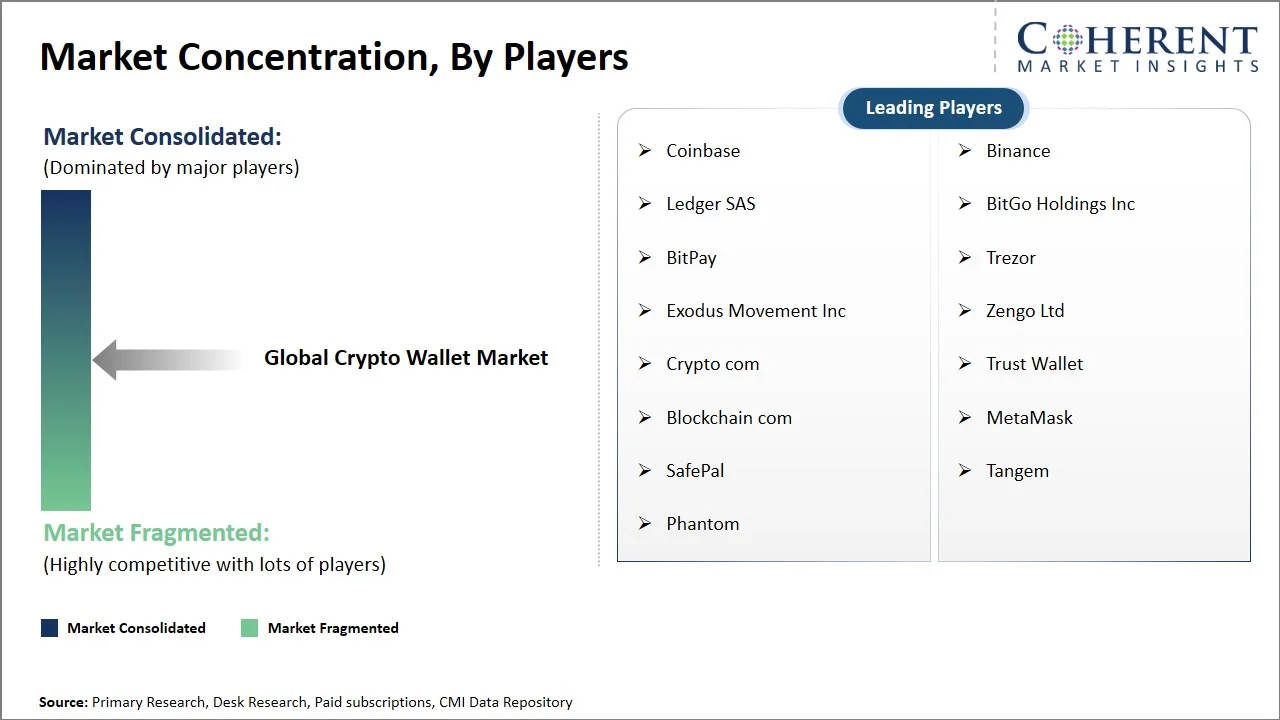
The competitive landscape is shifting from basic cryptocurrency storage toward wallets that control the complete on chain user experience, with Coinbase, MetaMask, Ledger, Trust Wallet, Phantom, and other major providers competing through different strategies. Coinbase is pushing smart wallets that use passkeys instead of recovery phrases and can be created directly inside applications, while its Base ecosystem combines wallet access with swaps, transfers, decentralized applications, and on chain activity. Ledger is focusing on hardware-based signature for security, and broadening into direct decentralized application connectivity and cash-to-stablecoin on-ramps, as evidenced by the Nano Gen5 and Ledger Wallet announced in 2025.
While the larger industry is progressively going toward account abstraction, session keys, passkeys and embedded wallets that remove seed phrase complexity, MetaMask remains mainly focused on decentralized application connection and multi chain access. Coinbase Institutional has specifically identified simplified onboarding and application integrated wallets as major competitive themes, indicating that wallet providers are increasingly competing for ownership of the user interface rather than simply providing key storage.
Market Report Scope
Crypto Wallet Market Report Coverage
| Report Coverage | Details | ||
|---|---|---|---|
| Base Year: | 2025 | Market Size in 2026: | USD 19 Bn |
| Historical Data for: | 2020 To 2024 | Forecast Period: | 2026 To 2033 |
| Forecast Period 2026 to 2033 CAGR: | 18.2% | 2033 Value Projection: | USD 100 Bn |
| Geographies covered: |
| ||
| Segments covered: |
| ||
| Companies covered: | Coinbase, Binance, Ledger SAS, BitGo Holdings Inc, BitPay, Trezor, Exodus Movement Inc, Zengo Ltd, Crypto com, Trust Wallet, Blockchain com, MetaMask, SafePal, Tangem, Phantom | ||
| Growth Drivers: |
| ||
| Restraints & Challenges: |
| ||
Analyst Opinion (Expert Opinion)
- The future of the industry is expected to move toward smart and programmable wallets rather than conventional externally owned account wallets, particularly as account abstraction, passkeys, session keys, and transaction batching become more mature. Wallets are likely to become invisible infrastructure embedded inside trading platforms, games, social applications, payment applications, and tokenized asset platforms, with Coinbase Smart Wallet already demonstrating how users can create wallets directly from applications without installing a separate wallet extension.
- The strongest opportunity is expected to be concentrated in smart wallets, stablecoin payments, and embedded wallets, with the United States, India, and high adoption markets across Asia Pacific offering particularly attractive application opportunities. With asset managers and corporations taking up more and more digitized assets, institutional custody should continue to be a high-value segment. Ledger’s focus on institutional treasury security and the ongoing expansion of regulated digital asset investment products suggest that demand will increasingly extend beyond individual crypto traders.
- To gain advantage, market players need to focus on security without making things difficult for users. Passkey based recovery, hardware backed signing, transaction simulation, spending controls, automated fraud detection, stablecoin on ramps, and direct decentralized application connectivity should be integrated into a single experience, while regional compliance capabilities should be built into the wallet architecture from the beginning. Ledger's move toward direct decentralized application connections and Coinbase's passkey based onboarding illustrate the type of product integration that can differentiate providers as wallets evolve from storage tools into full digital asset operating interfaces.
Speak to the analyst
Want personalized insights?
Take the findings above to one of our principal consultants, or have the report rebuilt around the segments, geographies and competitors you actually track.
Market Segmentation
- Wallet Type Insights (Revenue, USD Billion, 2021 - 2033)
- Hot Wallet
- Cold Wallet
- Operating System Insights (Revenue, USD Billion, 2021 - 2033)
- Android
- iOS
- Windows
- macOS
- Others
- End User Insights (Revenue, USD Billion, 2021 - 2033)
- Individual Consumer
- Commercial
- Regional Insights (Revenue, USD Billion, 2021 - 2033)
- North America
- U.S.
- Canada
- Latin America
- Brazil
- Argentina
- Mexico
- Rest of Latin America
- Europe
- Germany
- U.K.
- Spain
- France
- Italy
- Russia
- Rest of Europe
- Asia Pacific
- China
- India
- Japan
- Australia
- South Korea
- ASEAN
- Rest of Asia Pacific
- Middle East
- GCC Countries
- Israel
- Rest of Middle East
- Africa
- South Africa
- North Africa
- Central Africa
- North America
- Key Players Insights
- Coinbase
- Binance
- Ledger SAS
- BitGo Holdings Inc
- BitPay
- Trezor
- Exodus Movement Inc
- Zengo Ltd
- Crypto com
- Trust Wallet
- Blockchain com
- MetaMask
- SafePal
- Tangem
- Phantom
Sources
Primary Research Interviews
- Security and Hardware Wallet Specialists
- Digital Asset Custody and Wallet Specialists
Journals
- Journal of Financial Regulation and Compliance
- Computers & Security
- Finance Research Letters
Associations
- IEEE Standards Association
- Global Blockchain Business Council
Public Domain Sources
- U.S. Department of the Treasury
- European Commission
Proprietary Elements
- CMI Data Analytics Tool
- Proprietary CMI Existing Repository of Information for the Last 10 Years
Get access to 250+ pages report
Every segment, forecast, competitor profile and data table behind the analysis above — available for instant download.
- ESOMAR Member
- ISO 9001:2015 Certified
- D-U-N-S Registered
- GDPR & CCPA Compliant
Missing comfort of reading report in your local language? Find your preferred language:
Transform your Strategy with Exclusive Trending Reports
Frequently Asked Questions
The global crypto wallet market is expected to stand at USD 19 Bn in 2026 and is expected to reach USD 100 Bn by 2033.
The CAGR of the global crypto wallet market is projected to be 18.2% from 2026 to 2033.
A smart wallet is a programmable blockchain account that can support features such as automated transactions, recovery mechanisms, spending limits, and transaction batching.
Stablecoins are increasing wallet usage by enabling digital payments, remittances, trading, and cross border transfers with reduced exposure to cryptocurrency price volatility.
Self custody allows users to control their private keys and digital assets directly without depending entirely on a centralized custodian.
An embedded crypto wallet is integrated directly into another application or platform, allowing users to access blockchain functionality without separately installing or managing a conventional wallet.
Increasing cryptocurrency ownership among retail and institutional users and Growing demand for secure storage and management of digital assets are the major factors driving the growth of the global crypto wallet market.