

Global Daytime Running Lamp Market Size and Forecast – 2026 To 2033
The global daytime running lamp market is expected to grow from USD 2.95 Bn in 2026 to USD 5.10 Bn by 2033, registering a compound annual growth rate (CAGR) of 8% from 2026 to 2033. The global daytime running lamp market is driven by the increasing introduction of stringent vehicle safety regulations across major economies. On October 28, 2025, the United Kingdom Department for Transport launched a national review of vehicle lighting regulations as part of its new Road Safety Strategy.
Key Takeaways of the Global Daytime Running Lamp Market
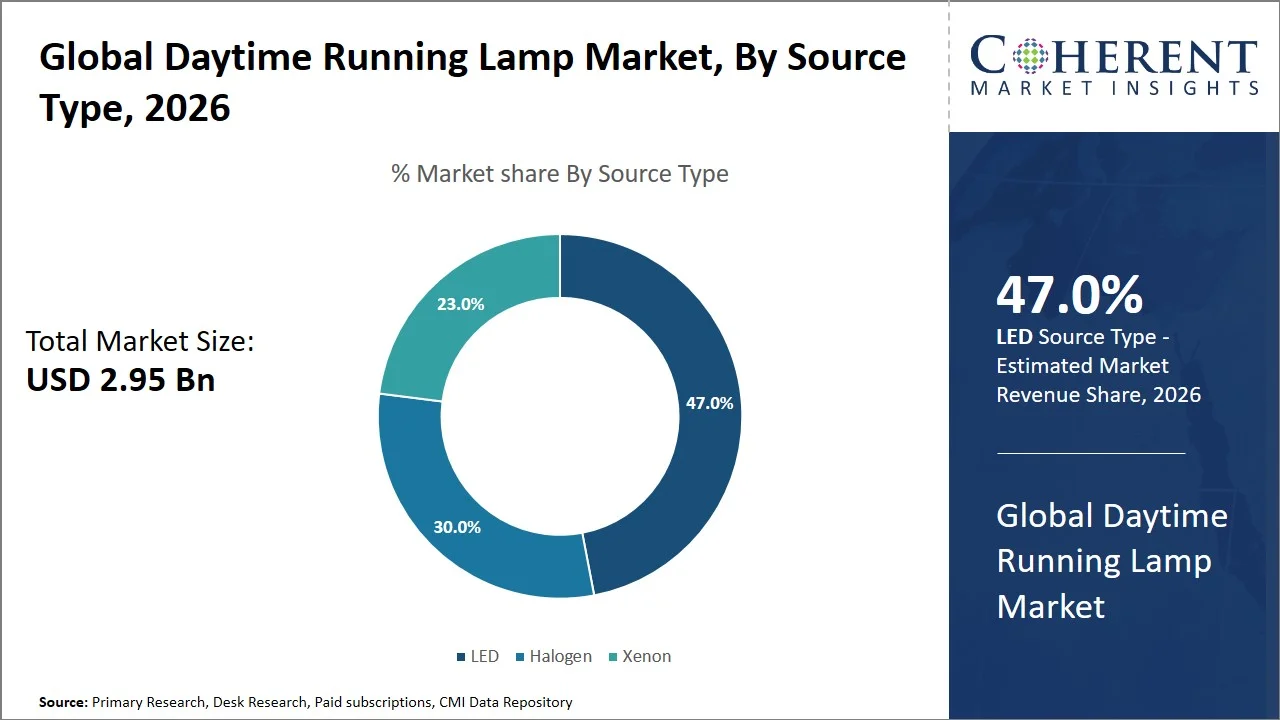
- The LED segment is expected to account for 47.0 % of the global daytime running lamp market share in 2026. Growing demand for premium automotive lighting is driving the growth of the segment. On January 29, 2026, Mercedes-Benz extended its digital illumination and high-resolution daytime running lamp capacity across its luxury line by introducing MicroLED headlamp technology in its new premium cars.
- The conventional segment is estimated to capture 53.0 % of the market share in 2026. Increasing consumer preference for energy efficient lighting systems is a major factor driving the growth of the segment. On April 2, 2026, Marelli unveiled its Thin Corner-to-Corner Headlamp with h-Digi MicroLED technology at Auto China 2026, providing lower power consumption and more luminous efficiency for next-generation electric vehicles.
- The passenger cars segment is estimated to capture 48.0 % of the market share in 2026. Expansion of passenger electric vehicle manufacturing is driving the growth of the segment. On August 4, 2025, VinFast officially inaugurated its electric vehicle (EV) assembly plant at the SIPCOT Industrial Park in Thoothukudi, Tamil Nadu, India.
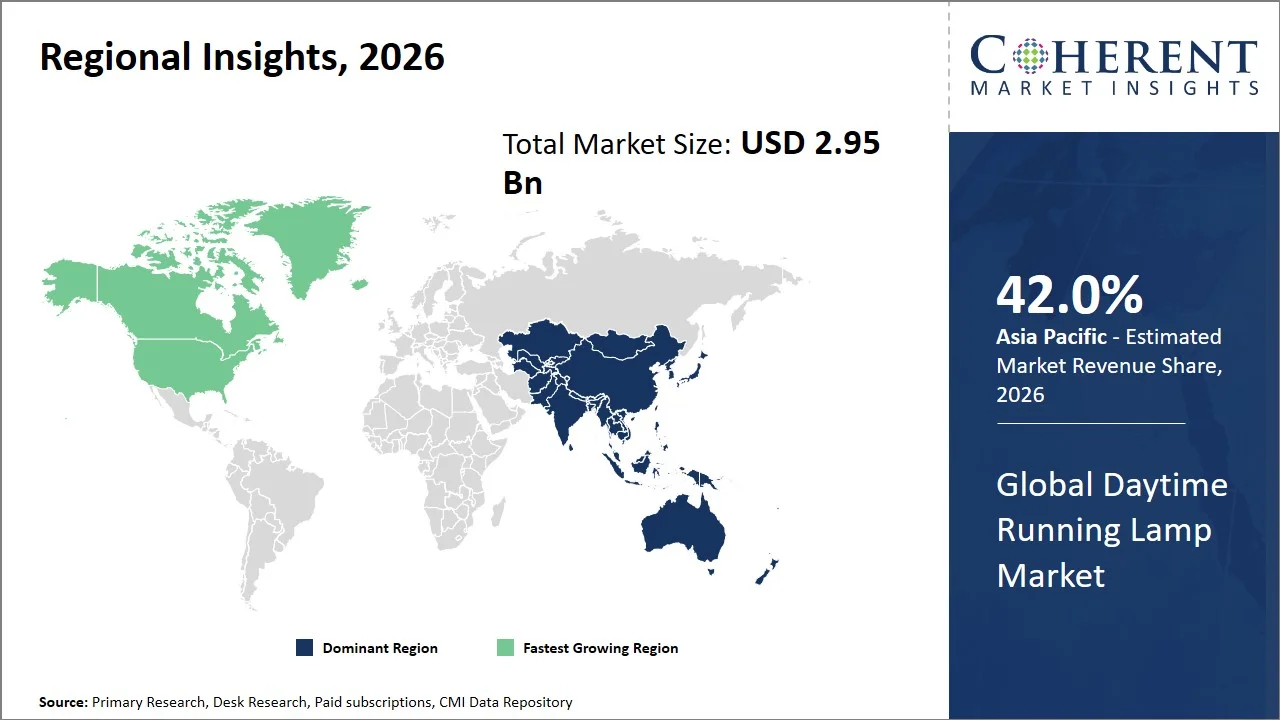
- Asia Pacific is expected to dominate the daytime running lamp market in 2026 with a market share of 42.0 %. Rising integration of matrix LED and digital lighting across Asia Pacific is primarily driving the growth of the regional market. On May 27, 2026, Huawei Intelligent Automotive Solution unveiled the next-generation AITO M9 in China featuring a full-color intelligent lighting projection system, 3D matrix lighting technology, and advanced digital exterior lighting integrated with Huawei ADS 5 autonomous driving functions.
- North America is expected to account for 24.0 % share in 2026 and is projected to record the fastest growth over the forecast period. Development of connected vehicle lighting technologies in North America is driving the growth of the regional market. On September 9, 2025, Valeo and Ennostar announced a collaboration on smart automotive exterior displays to enhance V2X communication and road safety. They declared plans to demonstrate their first product at IAA Mobility 2025, using Ennostar’s Mini LED technology embedded in Valeo’s external HD digital signaling system.
- Expansion of Energy Efficient Lighting in Electric Vehicles: The growing production of electric vehicles is boosting the demand for ultra-efficient LED daytime running lamps with lower power consumption that reduce energy losses and help maximize driving range while complying with global vehicle safety and lighting regulations.
- Adoption of Software Controlled and Connected Lighting Technologies: Automotive lighting systems are shifting towards software controlled platforms with integrated sensors, electronic control units and connectivity capabilities, enabling dynamic lighting features, remote diagnostics, over-the-air updates and smooth integration with advanced driver assistance systems and connected vehicle ecosystems.
Segmental Insights
Why Does LED Dominate the Global Daytime Running Lamp Market?
The LED segment is expected to account for 47.0% of the global daytime running lamp market share in 2026. The primary reason for the popularity of LED daytime running lights in the automobile industry is the increased usage of energy-efficient lighting technologies. LEDs consume significantly less power than conventional halogen or xenon lamps, but deliver improved brightness, longer life and lower maintenance. These benefits are especially applicable for current passenger automobiles and electric vehicles where the decrease of energy consumption and enhancement of the whole vehicle efficiency are primary objectives. LED technology also enables smaller lamp designs and unique lighting signatures that can assist automakers enhance vehicle safety and brand awareness. On October 7, 2025, FORVIA HELLA launched its FlatLight Daytime Running Light technology. The lighting system is 40% more energy efficient and 80% lighter than conventional daytime running lamp systems and reduces installation depth to just five millimeters for next-generation vehicles.
- Current Industry Events of 2026
- Market Size Estimation
- Regional Breakdown
- Competitive Landscape
- Customer Intelligence
- Segmental Analysis
- Pricing Analysis
- Key Market Drivers, Challenges & Future Trends
- Customized Insights Section
Why is Conventional the Most Preferred Technology Type?
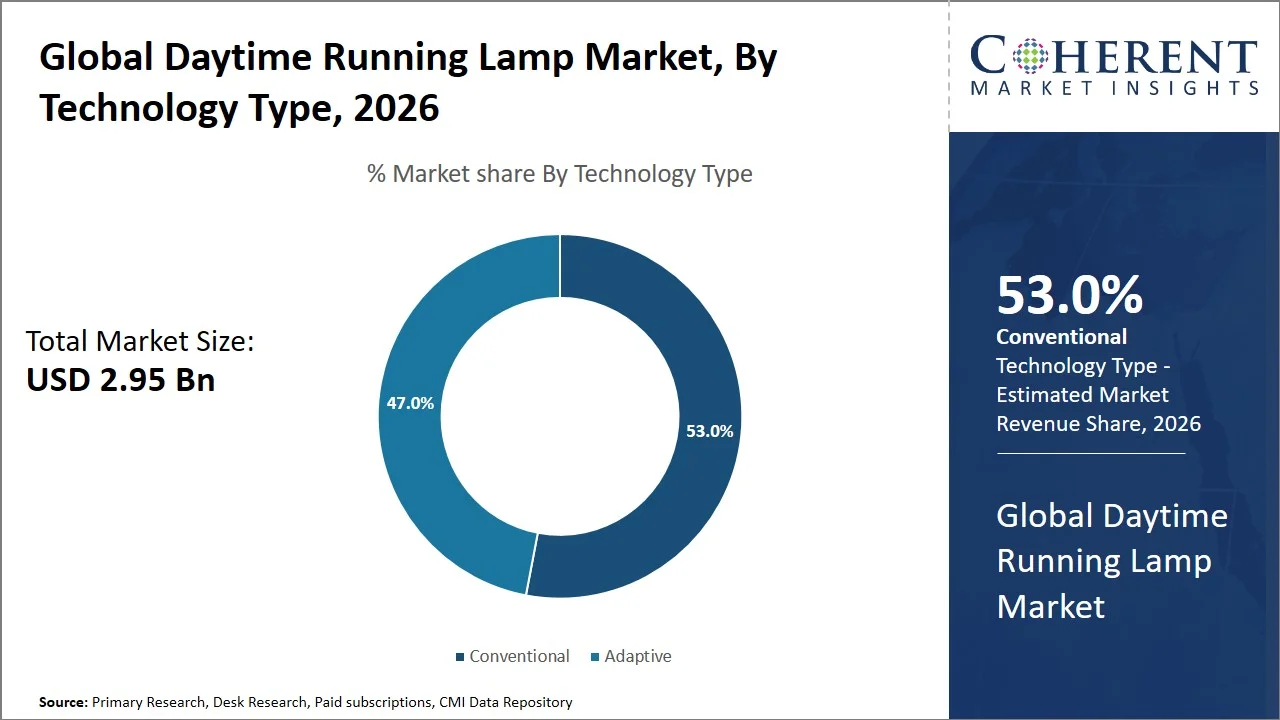
The conventional segment is expected to account for 53.0% of the global daytime running lamp market share in 2026. Conventional daytime running lamp technology is preferred for its cost effectiveness and broad applicability to existing vehicle platforms. Traditional systems feature a simpler electronic design and are therefore simpler, cheaper to build, integrate and maintain than adaptive lighting solutions. This makes them an attractive alternative for large volume passenger vehicles and commercial fleets, particularly in price sensitive markets where manufacturers put a premium on affordability, proven reliability and compliance with standard vehicle lighting regulations rather unique adaptive features. On November 15, 2025, Tata Motors launched the 2025 Tata Sierra, equipped with LED daytime running lamps as standard on the base variant, but advanced lighting features such as follow-me-home headlamps and other premium features were reserved for higher trims. High-volume passenger vehicles still use conventional DRL systems.
Passenger Cars Dominates the Global Daytime Running Lamp Market
The passenger cars segment is expected to account for 48.0% of the global daytime running lamp market share in 2026. The high volume passenger vehicle manufacturing especially is the major factor supporting the dominating position of this sector in the daytime running lamp market. Passenger automobiles are the largest segment of worldwide vehicle manufacture and are increasingly equipped with daytime running lamps as standard equipment to comply with safety rules and to meet consumer expectations for modern appearance. The growing production of electric vehicles, sport utility vehicles and premium passenger cars has further expedited the use of sophisticated LED daytime running lamps, as manufacturers look to improve vehicle visibility, energy economy and distinctive exterior styling. On January 14, 2026, Opel introduced the new Opel Astra and Astra Sports Tourer with the latest Intelli-Lux HD lighting system with more than 50,000 individually controlled LED elements, offering the most modern daytime running lamp and lighting technologies to a high-volume passenger car platform.
Currents Events and their Impact
Current Events | Description and its Impact |
United Nations UNECE Regulation No 48 Revision Updates (2024–2025) |
|
European Union General Safety Regulation (EU) 2019/2144 Full Implementation (2024 onward) |
|
Global Daytime Running Lamp Market - Regional Production Capacity Of Automotive Lighting Manufacturers
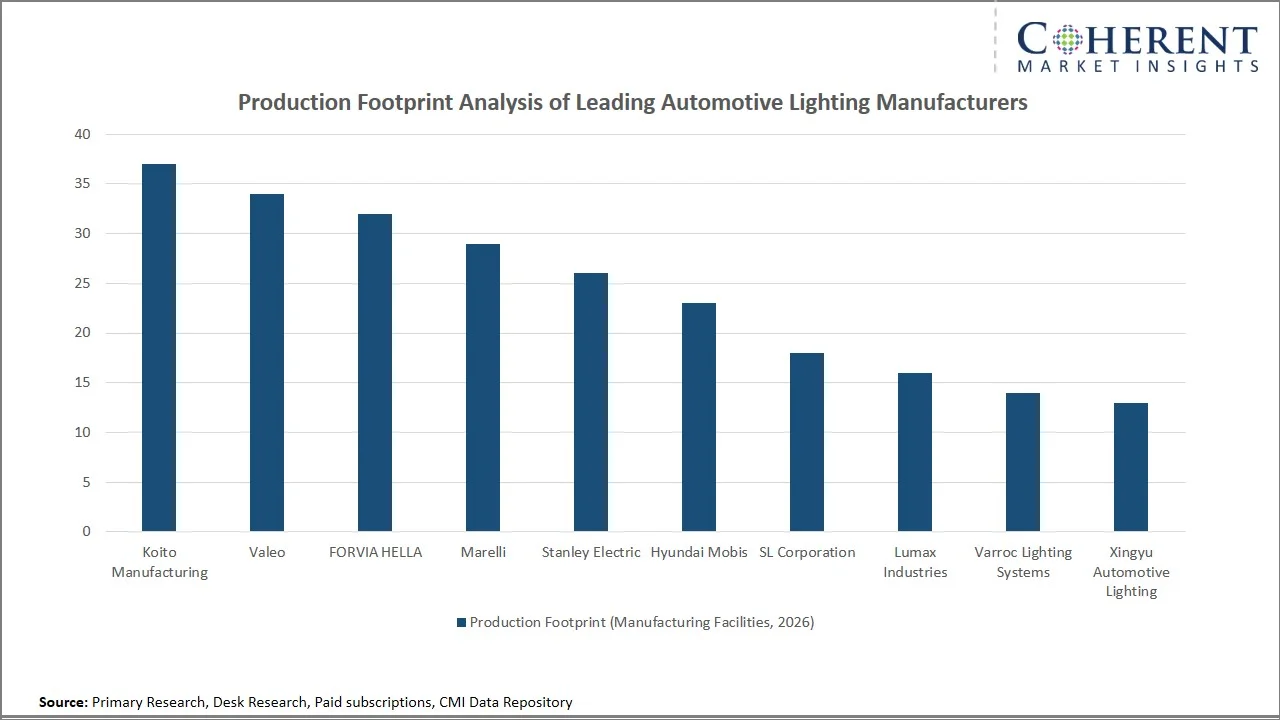
Regional production capacity near major automobile manufacturing hubs is developing to reduce logistics costs, create more resilient supply chains and cater to the rising demand for LED and intelligent lighting systems. In 2024-2026, Koito Manufacturing and Marelli, among other key manufacturers, extended their production capacity in India and the Americas, while Europe concentrated on producing advanced digital lighting and China expanded high-volume production for local EV manufacturers. Key points include:
- Asia Pacific (2026) - Marelli and Motherson have started operations at their new automobile lighting plant in Sanand, Gujarat to manufacture advanced exterior lighting systems such as LED headlamps and Daytime Running Lamps for Indian OEMs
- China (2025) - Production capacity around domestic OEMs such as BYD, Geely, Changan, SAIC Motor and GAC continued to develop with suppliers such as Xingyu, HASCO Vision, Koito China, Valeo China and Marelli China increasing localized production of LED and digital lighting systems
- India (2025) - Koito Manufacturing’s Gujarat plant reached the yearly capacity target of 500,000 headlights and 500,000 rear combination lamps for makers such as Maruti Suzuki and Tata Motors
- North America (2026) - Koito expanded its Mexico production facility to increase annual headlamp capacity to 3 million units and rear combination lamp capacity to 1.8 million units to supply Toyota, Ford, General Motors, Honda, Nissan and Mazda
- Latin America (2025) - Koito expanded its own lighting plant in Brazil and increased its annual production capacity to 850,000 headlamps and 850,000 rear combo lamps in support of local vehicle manufacture
- Europe (2025) - FORVIA HELLA expanded its European manufacturing network to provide complex lighting technologies such as Front Phygital Shield, matrix LED and digital lighting systems for luxury automobile makers
Daytime Running Lamp Market Dynamics
Market Drivers
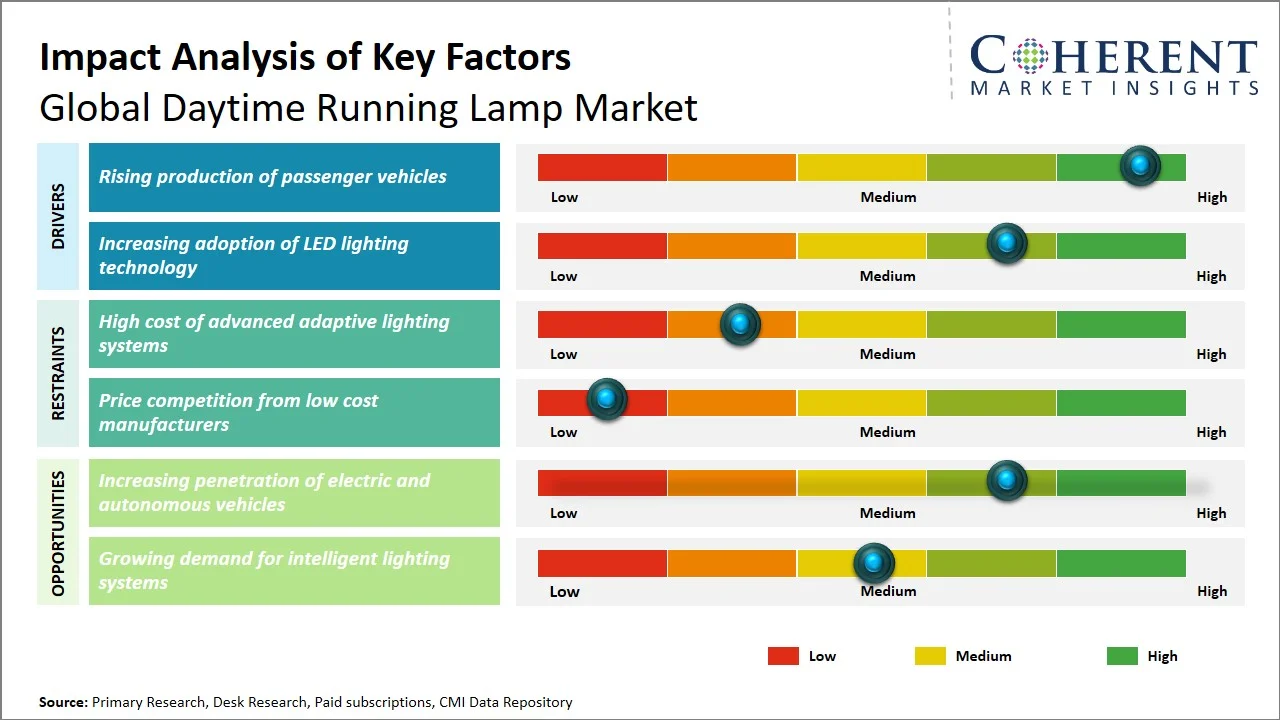
- Rising Production of Passenger Vehicles: The rising production of passenger vehicles worldwide is a significant factor boosting the demand for daytime running lamps. Manufacturers are increasingly equipping daytime running lamps as standard to meet vehicle safety regulations and improve road visibility. The integration of enhanced daytime running lamps has been further driven by increasing consumer demand for sport utility vehicles, premium sedans and electric passenger cars with manufacturers concentrating on enhancing vehicle safety, styling and brand differentiation across new model introductions. On April 23, 2026, Maruti Suzuki India Limited announced it has achieved its highest-ever annual production volume of 2.34 million units in FY 2025-26. This makes Maruti Suzuki the only OEM in India to achieve such record production volume of passenger vehicles. In addition, Maruti Suzuki became the only company among Suzuki Motor Corporation’s global automobile manufacturing facilities, to achieve this landmark volume.
- Increasing Adoption of LED Lighting Technology: The adoption of LED lighting technology is a major growth driver for the daytime running lamp market owing to its benefits such as better energy efficiency, longer service life, enhanced brightness and compact design compared to traditional lighting technologies. LED daytime running lamps also give more design freedom, letting manufacturers create unique illumination signatures while consuming less electricity and requiring less maintenance, making them the go-to choice for both conventional and electric vehicles. On February 5, 2025, FORVIA HELLA expanded its SlimLine product family, which is geared towards the commercial vehicle sector, with a new LED combination lamp, which is now available for the first time worldwide in the brand-defining rectangular design language of the SlimLine series.
Emerging Trends
- Integration of Intelligent LED and Adaptive Lighting Systems: Automakers are increasingly incorporating intelligent LED daytime running lamps with adaptive lighting capabilities (changing brightness and lighting patterns based on ambient light levels, vehicle speed and inputs from driver assistance systems) to enhance road safety, vehicle aesthetics and support next generation lighting architectures.
- Growing Demand for Customizable Lighting Signatures: Vehicle manufacturers are increasingly adopting distinctive daytime running lamp designs as a key branding element, to create unique lighting signatures to enhance vehicle recognition, support premium positioning, and differentiate electric and luxury vehicle models in fiercely competitive automotive markets.
Global Daytime Running Lamp Market - Production Footprint Analysis of Leading Automotive Lighting Manufacturers
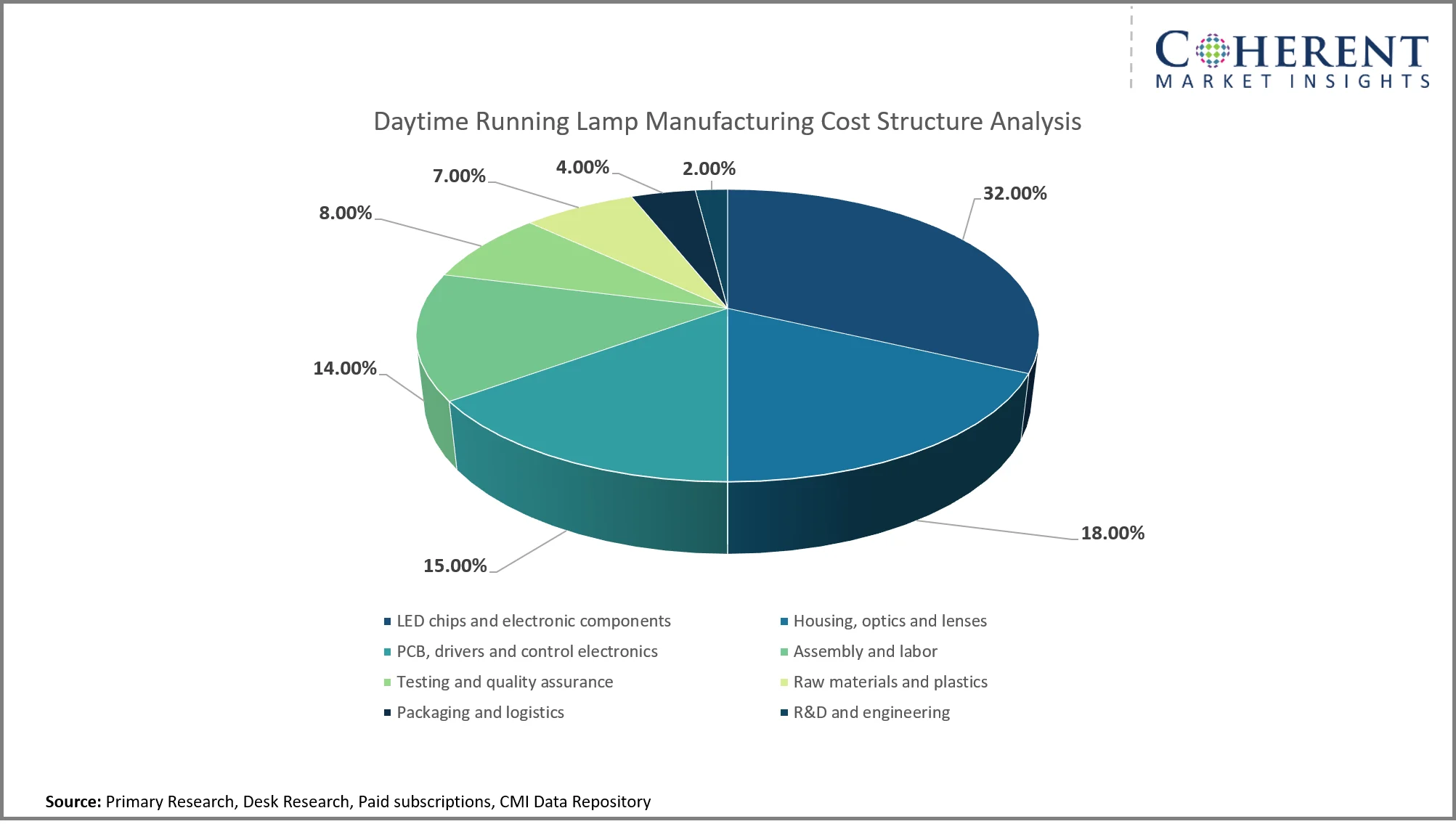
Global Daytime Running Lamp Market - Daytime Running Lamp Manufacturing Cost Structure Analysis
Regional Insights
Why is Asia Pacific a Strong Market for Daytime Running Lamps?
Asia Pacific is expected to account for a market share of 42.0% in 2026. The Asia Pacific region is the leading region in the global daytime running lamp market since it is the largest automotive manufacturing hub and the hub of electric car manufacture in the world. China is stepping up the fitting of LED daytime running lamps for BYD, Geely, Changan, NIO, XPeng and Li Auto models, while Japan continues to be a source of innovative lighting tech via Koito Manufacturing and Stanley Electric for Toyota, Honda, Nissan, Mazda and Subaru. Hyundai Motor Group and Kia have strengthened the adoption of distinctive LED lighting signatures across models including the Ioniq 5, EV9, Tucson, and Sportage through lighting solutions supplied by Hyundai Mobis and SL Corporation, contributing to increased demand for advanced automotive lighting technologies across the South Korean market.
India has rolled out factory-fitted LED daytime running lights across passenger vehicles from Tata Motors, Mahindra, Maruti Suzuki, Hyundai Motor India and Kia India, while regional suppliers are ramping up localized production under automotive manufacturing initiatives. Asia Pacific is the most prominent region for daytime running lamp development, with the presence of major automotive lighting manufacturers, robust export-oriented vehicle manufacturing and continuing investment in smart LED technology.
Why Does the North America Daytime Running Lamp Market Exhibit High Growth?
North America is projected to account for 24.0% of the global daytime running lamp market and is expected to register the fastest growth. North America is still a strategically important market as vehicle manufacturers are rapidly deploying advanced daytime running lamp technologies in passenger cars, pickup trucks, and electric vehicles.
Tesla's characteristic LED daytime running light designs on the Model 3, Model Y, Model S, Model X and Cybertruck have become part of the company's vehicle identity, while Ford has introduced unique C-clamp LED illumination to the F-150 Lightning, Mustang Mach-E, Explorer and Expedition. General Motors has implemented high-end LED daytime running lamps on its Cadillac, Chevrolet, GMC and Buick lines, including the Cadillac Lyriq and Chevrolet Equinox EV. Stellantis continues to roll out advanced lighting systems on the Jeep Wagoneer, Grand Cherokee, Dodge Hornet and Ram models, while Rivian is adding continuous LED lighting bars across the R1T and R1S. The region is backed by automotive lighting manufacturers, like Flex-N-Gate, Valeo North America, Marelli and Hella, which are still investing in intelligent lighting modules for local car production.
Global Daytime Running Lamp Market Outlook for Key Countries
Why is China Emerging as a Major Hub in the Daytime Running Lamp Market?
China holds the largest market share in the daytime running lamp market owing to the largest automotive manufacturing capacity and is the leader in the electric car manufacturing. Domestic manufacturers, including BYD, Geely, Changan, SAIC Motor, GAC Aion, NIO, XPeng, Leapmotor and Li Auto, have widely implemented LED daytime running lamps with continuous light bars, animated welcome sequences and distinctive brand specific lighting signatures for new vehicle debuts. Other international manufacturers, like Volkswagen, BMW, Mercedes-Benz, Toyota and Tesla, also produce vehicles with sophisticated daytime running lights in their Chinese factories for the home market and for export. Automotive lighting suppliers like HASCO Vision Technology, Koito China, Marelli China and Valeo China are increasing manufacturing capacities to cater to the rising demand from OEMs, while government backing for intelligent connected vehicles is pushing the adoption of software-driven lighting technologies.
Is the U.S. the Next Growth Engine for the Daytime Running Lamp Market?
The U.S. continues to see significant demand for daytime running lamps, driven by increased adoption of premium automobiles, electric vehicles, and large sport utility vehicles with advanced LED lighting systems. Tesla has made unique daytime running lamp designs a signature look across its vehicle portfolio, while Ford continues to deploy innovative LED lighting across the Bronco, Mustang Mach-E, F-Series and Lincoln premium cars. General Motors has rolled out advanced lighting technology across Cadillac electric vehicles, including the Escalade IQ, Lyriq and Celestiq, with interactive lighting capabilities and premium LED signatures. Rivian has differentiated its electric pickup trucks and sport utility vehicles with unique oval daytime running lamp arrangements, while Lucid Motors uses full width LED lighting elements across the Lucid Air. Federal lighting regulations remain in place and American manufacturers continue to introduce products to encourage innovation in technology, all to the benefit of the U.S. auto industry.
Germany Daytime Running Lamp Market Analysis and Trends
Germany is still one of the world’s top centers for premium automotive lighting innovation, backed by luxury car manufacturers and highly specialized lighting suppliers. On the EQS, EQE and S-Class, Mercedes-Benz is banking on Digital Light and special LED daytime running lights, while BMW continues to roll out illuminated kidney grille designs and characteristic daytime running lights across the Neue Klasse platform. Audi incorporates its iconic LED daytime running lamp signatures and digital lighting technology throughout the A6 e-tron, Q6 e-tron and Q8 e-tron, while Porsche features sophisticated four-point LED daytime running lamps across Taycan, Macan Electric and Cayenne. German lighting providers such as Hella, ZKW Group and OSRAM are still working on intelligent matrix LED systems, software-controlled lighting modules and digital light technologies that are widely used by premium car manufacturers all across Europe and in global export markets.
Japan Daytime Running Lamp Market Analysis and Trends
Japan has a very competitive position due to its mix of globally recognized car manufacturers and world leading automotive lighting suppliers. Toyota now employs advanced LED daytime running lamps on the Prius, Crown, Camry, Land Cruiser, and bZ series, while Honda is integrating current lighting signatures throughout the CR-V, Civic, Accord, and Prologue. Nissan continues to use iconic boomerang style daytime running lamps on the Ariya, X-Trail and Qashqai, while Mazda uses distinctive LED illumination across the CX-60, CX-80 and Mazda3. Subaru has extended LED daytime running lamps to the Crosstrek, Outback and Solterra in its lineup. Koito Manufacturing and Stanley Electric are world leaders in the supply of modern automotive lighting systems to many international vehicle manufacturers, and continue to reinforce Japan’s leadership in the development of lighting technology.
India Daytime Running Lamp Market Analysis and Trends
With the adoption of LED lighting by manufacturers in both the mainstream and premium passenger vehicle sectors increasing, India has become one of the fastest growing markets for daytime running lamps. Tata Motors has embraced trademark LED daytime running lamps on vehicles like Nexon, Curvv, Harrier, Safari and Punch EV, while Mahindra has implemented innovative C-shaped and vertical LED daytime running lamps on the XUV700, Scorpio N, BE 6 and XEV 9e. Hyundai Motor India has equipped the Creta, Alcazar, Venue, Verna and Ioniq 5 with modern LED daytime running lamps. Kia India has spread comparable technology across the Seltos, Sonet, Syros and EV6. Also, premium Nexa models like Grand Vitara, Invicto and Fronx have got LED daytime running lamps from Maruti Suzuki, which is an indication of increasing consumer demand for modern styling on vehicles.
Global Daytime Running Lamp Market - Software-Defined Vehicle Impact On Exterior Lighting Technologies
Exterior Lighting Function | Conventional Vehicle (2024) | Software-Defined Vehicle (2026) |
Daytime running lamp control | Fixed ON/OFF operation | Software-controlled adaptive operation |
Lighting signature | Factory-defined and permanent | OTA-updatable customizable lighting signatures |
Matrix LED management | Limited ECU-based control | Centralized domain controller management |
Adaptive lighting | Hardware-dependent | Real-time software optimization using vehicle sensors |
Light intensity adjustment | Basic ambient light sensing | AI-assisted dynamic brightness optimization |
Vehicle-to-vehicle communication | Minimal integration | Lighting integrated with V2V communication |
Vehicle-to-infrastructure communication | Individual ECU monitoring | Digital lighting supports V2I interaction |
Autonomous driving support | Minimal integration | Lighting synchronized with ADAS and autonomous functions |
Diagnostic capability | Workshop-based diagnostics | Continuous remote diagnostics through OTA connectivity |
Software updates | Hardware replacement required | Over-the-air software updates |
Global Daytime Running Lamp Market - Premium Vehicle Lighting Feature Comparison By Automotive Brand
Automotive Brand | Flagship Premium Lighting Technology | Daytime Running Lamp Design | Adaptive Lighting | Digital / Matrix Lighting | Customizable Light Signature |
Mercedes-Benz | DIGITAL LIGHT with MicroLED | Star Signature LED DRL | Yes | Yes | Yes |
BMW | Adaptive Matrix LED | Twin Icon LED DRL | Yes | Yes | Yes |
Audi | Digital Matrix LED | Digital Signature DRL | Yes | Yes | Yes |
Volvo | Pixel LED Headlamps | Thor's Hammer LED DRL | Yes | Yes | Limited |
Lexus | BladeScan Adaptive High Beam | L-Shaped LED DRL | Yes | No | No |
Porsche | HD Matrix LED | Four-Point LED DRL | Yes | Yes | Yes |
Genesis | MLA (Micro Lens Array) LED | Two-Line LED DRL | Yes | Yes | Limited |
Lucid Motors | Micro Lens LED | Full-Width LED DRL | Yes | Yes | Yes |
Tesla | Matrix LED Headlamps | Signature LED DRL | Yes | Yes | Limited |
NIO | Intelligent Matrix LED | Continuous LED DRL | Yes | Yes | Yes |
How is the Increasing Penetration of Electric and Autonomous Vehicles Creating New Growth Opportunities in the Daytime Running Lamp Market?
The growing rise of electric and autonomous vehicle platforms is generating new growth prospects by boosting demand for smart daytime running lamps that function as both safety components and digital communication interfaces. Manufacturers including Tesla, Mercedes-Benz, BMW, NIO, XPeng, Lucid and Rivian are adding full-width LED light bars, customizable lighting signatures and software-controlled daytime running lamps that define car types and can be updated with over-the-air feature updates. Car makers working on self-driving cars are also adding sophisticated light displays to communicate information about the car’s status, the mode of operation and even pedestrian awareness, taking daytime running lights beyond visibility. As software-defined vehicles become the standard for next-generation electrical and electronic architectures, lighting suppliers are seeing opportunities to create adaptive LED modules, integrated control units, and smart lighting solutions that can integrate seamlessly with advanced driver assistance systems, vehicle sensors, and connected mobility platforms.
On March 16, 2026, Uber Technologies, Inc. and NVIDIA announced an expansion of their autonomous vehicle partnership. The companies, supported by their growing roster of automaker partners, plan to launch a global fleet of entirely NVIDIA software-driven autonomous vehicles.
Market Players, Key Development, and Competitive Landscape
Key Developments
- On April 2, 2026, Marelli announced that it will showcase its latest advanced automotive lighting technologies at Auto China 2026 in Beijing from April 24 to May 3, 2026. At the event, Marelli demonstrated how lighting is evolving into a software‑defined platform enabling design differentiation and brand expression, intelligent interaction and digital communication as well as safety.
- On July 31, 2024, Audi introduced the A6 e-tron with second-generation Digital LED Daytime Running Lamps, allowing customers to select multiple digital light signatures through the vehicle interface, marking one of Audi's most advanced programmable DRL implementations.
Competitive Landscape
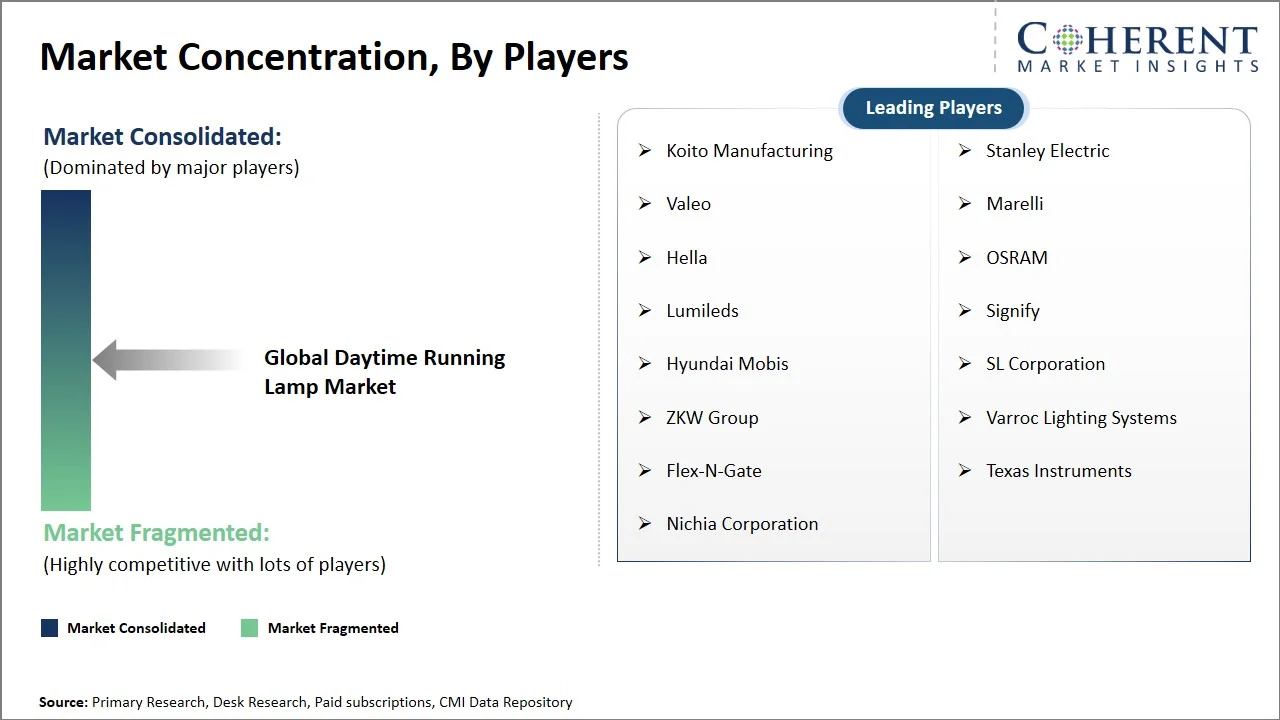
The global daytime running lamp market is characterized by fierce competition among well-established automotive lighting manufacturers and vehicle component suppliers competing via technological innovation, long-term original equipment manufacturer contracts, and regional manufacturing expansion. Companies such as Koito Manufacturing, Stanley Electric, Valeo, Marelli, Hella, ZKW Group, Hyundai Mobis, SL Corporation, Varroc Lighting Systems and Flex-N-Gate are investing in high-efficiency LED modules, digital lighting platforms and software-controlled lighting systems designed for the electrical architectures of modern vehicles. Suppliers are developing unique lighting signatures, integrated electronic control units and intelligent lighting modules for electric and premium vehicle platforms, increasing the importance of strategic alliances with automobile manufacturers.
Market Report Scope
Daytime Running Lamp Market Report Coverage
| Report Coverage | Details | ||
|---|---|---|---|
| Base Year: | 2025 | Market Size in 2026: | USD 2.95 Bn |
| Historical Data for: | 2020 To 2024 | Forecast Period: | 2026 To 2033 |
| Forecast Period 2026 to 2033 CAGR: | 8% | 2033 Value Projection: | USD 5.10 Bn |
| Geographies covered: |
| ||
| Segments covered: |
| ||
| Companies covered: | Koito Manufacturing, Stanley Electric, Valeo, Marelli, Hella, OSRAM, Lumileds, Signify, Hyundai Mobis, SL Corporation, ZKW Group, Varroc Lighting Systems, Flex-N-Gate, Texas Instruments, and Nichia Corporation | ||
| Growth Drivers: |
| ||
| Restraints & Challenges: |
| ||
Analyst Opinion (Expert Opinion)
- Competitive advantage in the daytime running lamp industry is shifting from the capacity to supply standalone lamp assemblies to the ability to deliver integrated lighting platforms. Greater emphasis is being placed on software-controlled lighting, compact electronic architectures, and distinctive vehicle lighting signatures that can be efficiently scaled across multiple vehicle platforms with minimal or no redesign. As auto manufacturers continue to move to software-defined vehicles, providers with competence in electronics integration, thermal management, and intelligent LED technologies are well positioned to improve their market position.
- Market consolidation will be driven by strategic alliances between automotive lighting suppliers, semiconductor companies and original equipment manufacturers. Competitive difference will likely be driven by advancements in digital lighting, programmable LED systems and sophisticated control software, rather than conventional hardware upgrades alone. With the increasing standardization and electronic integration of global automotive platforms, those companies that can combine lighting technology with advanced driver assistance systems, vehicle connectivity and over-the-air software functionality are likely to take a larger share of future vehicle programs.
- Future growth for the daytime running lamp market will be driven by the expansion of software-defined cars, zonal electronic designs and intelligent lighting ecosystems, rather than incremental improvements to conventional lighting hardware. Digital LED technologies, micro-LED integration, programmable light signatures and communication-enabled exterior lighting are expected to become standard on premium and mid-range vehicles as automakers look to differentiate their products and meet increasingly stringent safety requirements.
Speak to the analyst
Want personalized insights?
Take the findings above to one of our principal consultants, or have the report rebuilt around the segments, geographies and competitors you actually track.
Market Segmentation
- Source Type Insights (Revenue, USD Billion, 2021 - 2033)
- LED
- Halogen
- Xenon
- Technology Type Insights (Revenue, USD Billion, 2021 - 2033)
- Conventional
- Adaptive
- Vehicle Type Insights (Revenue, USD Billion, 2021 – 2033)
- Passenger Cars
- Light Commercial Vehicles
- Heavy Commercial Vehicles
- Sales Channel Insights (Revenue, USD Billion, 2021 - 2033)
- OEM
- Aftermarket
- Regional Insights (Revenue, USD Billion, 2021 - 2033)
- North America
- U.S.
- Canada
- Latin America
- Brazil
- Argentina
- Mexico
- Rest of Latin America
- Europe
- Germany
- U.K.
- Spain
- France
- Italy
- Russia
- Rest of Europe
- Asia Pacific
- China
- India
- Japan
- Australia
- South Korea
- ASEAN
- Rest of Asia Pacific
- Middle East
- GCC Countries
- Israel
- Rest of Middle East
- Africa
- South Africa
- North Africa
- Central Africa
- North America
- Key Players Insights
- Koito Manufacturing
- Stanley Electric
- Valeo
- Marelli
- Hella
- OSRAM
- Lumileds
- Signify
- Hyundai Mobis
- SL Corporation
- ZKW Group
- Varroc Lighting Systems
- Flex-N-Gate
- Texas Instruments
- Nichia Corporation
Sources
Primary Research Interviews
- Automotive Lighting Manufacturers
- OEM (Original Equipment Manufacturers) Representatives
- Automotive Component Distributors & Suppliers
- Electric Vehicle (EV) Technology Experts
Magazines
- Automotive World Magazine
- SAE Automotive Engineering International
- Automotive Design & Production Magazine
- Light & Engineering Magazine
Journals
- Journal of Automobile Engineering
- International Journal of Automotive Technology
- Journal of Transportation Safety & Security
Associations
- European Automobile Manufacturers' Association (ACEA)
- International Organization of Motor Vehicle Manufacturers (OICA)
- Automotive Lighting Manufacturers Association (ALMA)
- Society of Automotive Engineers (SAE International)
Public Domain Sources
- U.S. National Highway Traffic Safety Administration (NHTSA)
- European Commission – Road Safety Reports
- United Nations Economic Commission for Europe (UNECE) – Vehicle Regulations
- International Energy Agency (IEA) – Electric Vehicle Outlook Reports
Proprietary Elements
- CMI Data Analytics Tool
- Proprietary CMI Existing Repository of Information for the Last 10 Years
Get access to 250+ pages report
Every segment, forecast, competitor profile and data table behind the analysis above — available for instant download.
- ESOMAR Member
- ISO 9001:2015 Certified
- D-U-N-S Registered
- GDPR & CCPA Compliant
Missing comfort of reading report in your local language? Find your preferred language:
Transform your Strategy with Exclusive Trending Reports
Frequently Asked Questions
The global daytime running lamp market is expected to stand at USD 2.95 Bn in 2026 and is expected to reach USD 5.10 Bn by 2033.
The CAGR of the global daytime running lamp market is projected to be 8% from 2026 to 2033.
Rising production of passenger vehicles and increasing adoption of LED lighting technology are the major factors driving the growth of the global daytime running lamp market.
High cost of advanced adaptive lighting systems and price competition from low cost manufacturers are the major factors hampering the growth of the global daytime running lamp market.
In terms of source type, the LED segment is estimated to dominate the market revenue share in 2026.
They provide energy efficient illumination while supporting distinctive vehicle styling and extended driving range.
They are increasing the demand for programmable and electronically controlled lighting systems.