

Global Deception Technology Market Size and Forecast: 2026-2033
The Global Deception Technology Market is estimated to be valued at USD 3.36 Bn in 2026 and is expected to reach USD 8.30 Bn by 2033, exhibiting a compound annual growth rate (CAGR) of 13.8% from 2026 to 2033.
Key Takeaways of the Deception Technology Market
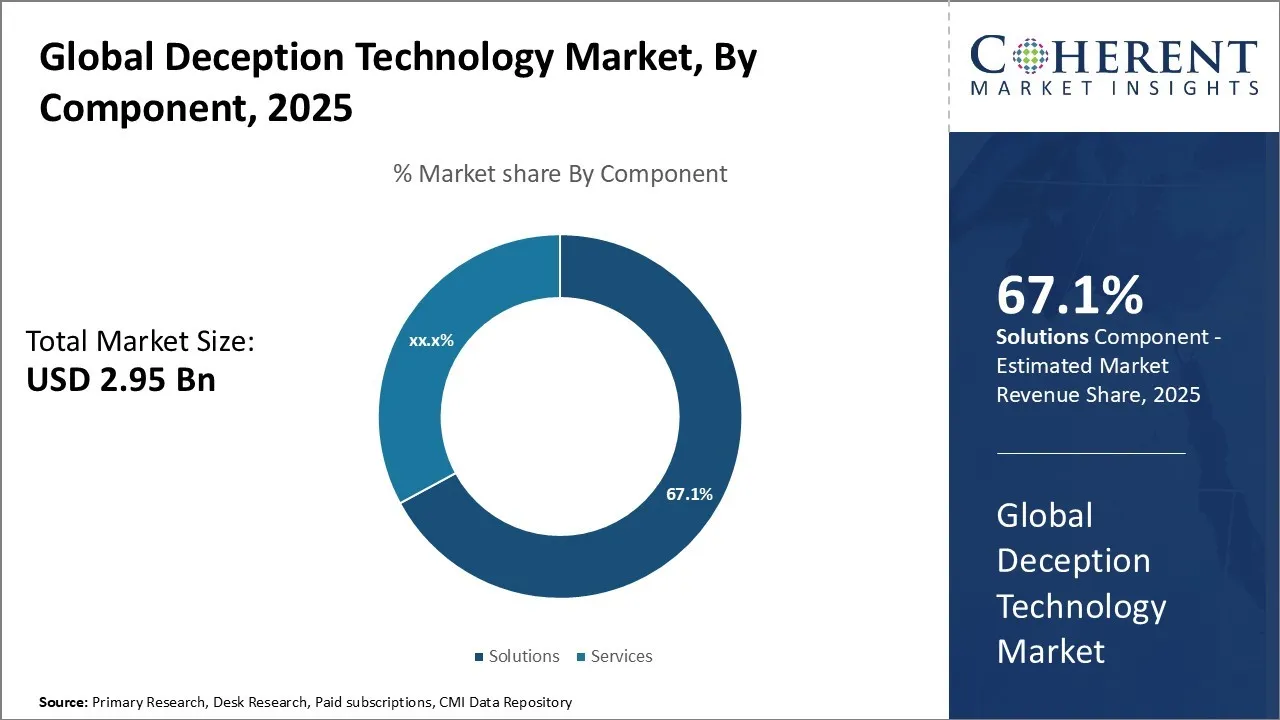
- The solutions segment leads the market holding an estimated share of 68.1% in 2026.
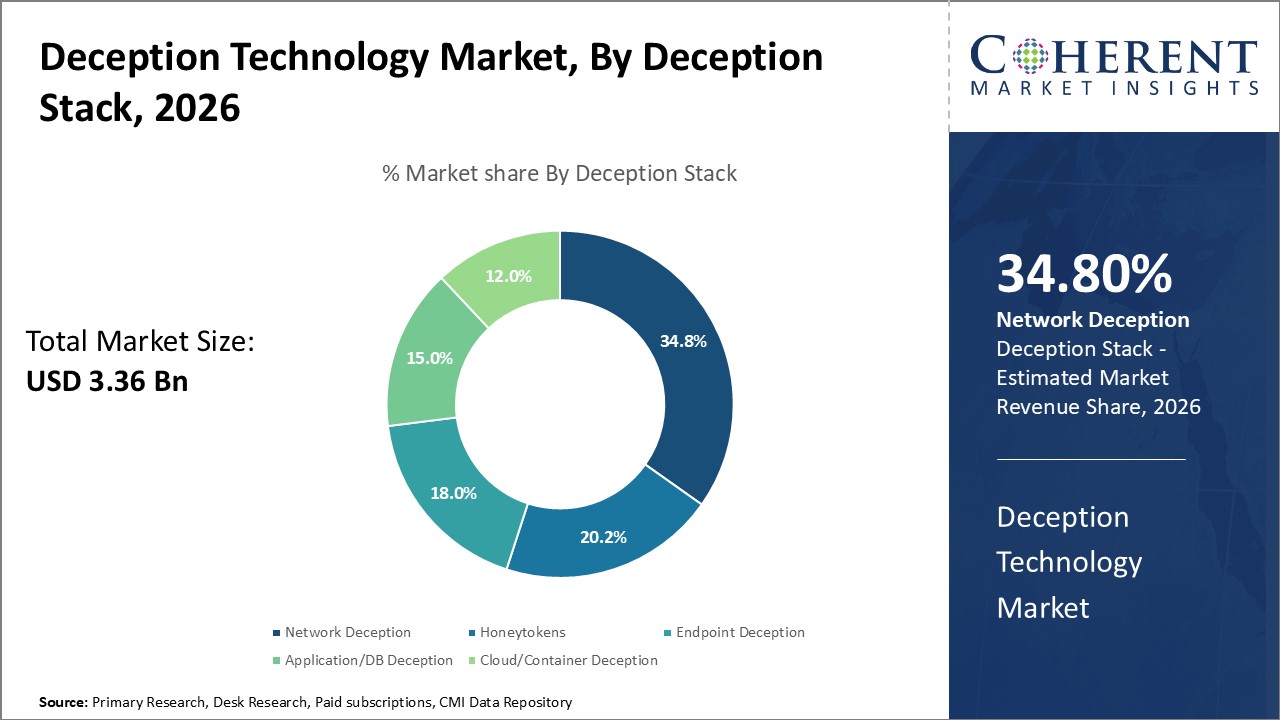
- The Network deception leads the market holding an estimated share of 34.8% in 2026.
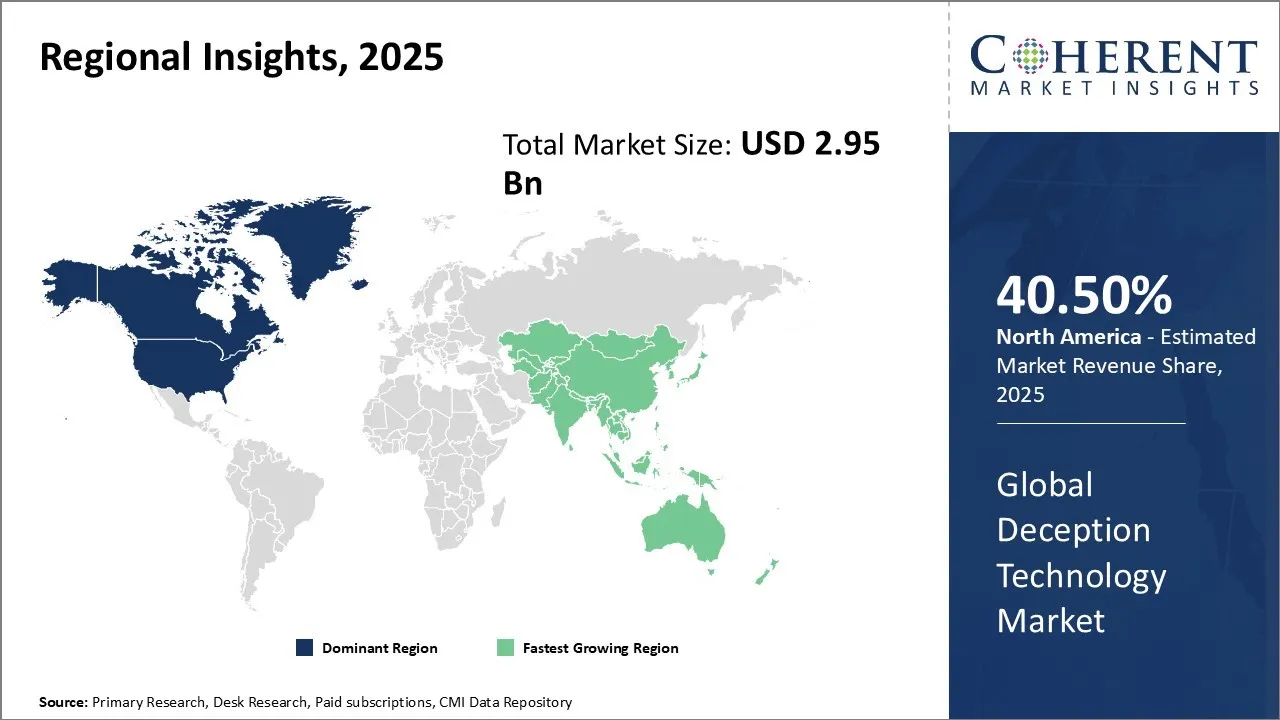
- North America is estimated to lead the market with a share of 40. 5% in 2026.
- Asia Pacific, holding a share of 23. 4% in 2026, is projected to be the fastest growing region.
Market Overview
A key market trend driving this expansion is the rising sophistication of cyberattacks, which compels enterprises to deploy more proactive and adaptive security measures like deception technology. Also, advancements in AI and machine learning are improving deception platforms' effectiveness, making possible real-time threat intelligence and faster incident response. The growing integration of these technologies in sectors such as finance, healthcare, and government adds to market growth.
Current Events | Description and its impact |
Darktrace acquired Cado Security (Mar 2025) |
|
Sophos acquired Secureworks (Feb 2025) |
|
OpenAI led funding in Adaptive Security (Apr 2025) |
|
Segmental Insights
- Current Industry Events of 2026
- Market Size Estimation
- Regional Breakdown
- Competitive Landscape
- Customer Intelligence
- Segmental Analysis
- Pricing Analysis
- Key Market Drivers, Challenges & Future Trends
- Customized Insights Section
Global Deception Technology Market Insights, By Component – Solutions Leads Owing to Advanced Threat Detection Capabilities and Ease of Integration
The solutions segment is expected to hold 68.1% shared in the global deception technology market in 2026. Deception technology solutions give organizations a sophisticated approach to cybersecurity by creating decoy assets and traps that mimic real IT infrastructure, thereby luring attackers away from valuable resources. Cyberattacks are becoming more complex, such as advanced persistent threats (APTs) and zero-day exploits. Traditional security methods often fail to promptly detect these sophisticated threats, whereas deception solutions provide real-time attack intelligence by monitoring attacker behaviors and gathering actionable insights.
Furthermore, the growing adoption of cloud computing, IoT, and digital transformation initiatives has expanded the attack surface, making organizations more vulnerable. Deception solutions are able to protect these environments because of their flexibility and adaptability. Many solutions can be easily integrated with existing security infrastructures such as SIEM (Security Information and Event Management), SOAR (Security Orchestration, Automation, and Response), and endpoint security platforms.
To add, organizations are greatly focusing on compliance and regulatory requirements concerning data privacy and cybersecurity. Deception technology solutions help meet these strict guidelines by providing improved visibility and audit trails regarding unauthorized access attempts. Enterprises in industries such as financial services, healthcare, and government sectors have been early adopters of these solutions because of the sensitive nature of their data and the high costs associated with security breaches. For instance, Attivo Networks’ ThreatDefend platform, which has been widely deployed by financial institutions and government agencies in North America and Asia Pacific.
Global Deception Technology Market Insights, By Deception Stack – Network Deception Leads Due to Its Comprehensive Protection of Critical Network Assets and Early Threat Identification
Network Deception remains the largest and most significant segment within the deception stack landscape, holding an estimated share 34.8% in 2026. This segment is crucial given that the network serves as the gateway for almost all digital communications, data transfers, and remote access activities. Preventing unauthorized network intrusions effectively curbs the spread of malware and lateral movement of attackers inside a corporate environment, making network deception indispensable.
One of the primary drivers of Network Deception’s prominence is its ability to create dynamic decoy networks and fake assets such as routers, switches, and servers that appear indistinguishable from legitimate infrastructure. These decoys act as bait to intelligently divert malicious actors, enabling organizations to detect reconnaissance attempts and compromises early in their attack lifecycle.
In organizations where complex hybrid networks exist, encompassing on-premises, cloud, and virtual environments, Network Deception technologies provide unified visibility and control, which is critical for threat hunting and incident response teams. By deploying honeypots, deceptive IP addresses, and lures distributed strategically across the network, these solutions generate alerts upon interaction with deceptive elements, helping security teams prioritize genuine threats over benign network noise.
Moreover, the proliferation of remote work arrangements has expanded the network perimeter, introducing multiple new entry points and increasing vulnerability to cyberattacks such as phishing, ransomware, and insider threats. Network Deception’s capability to simulate realistic network components enhances defense-in-depth strategies by strengthening perimeter security and monitoring lateral network traffic. Consequently, organizations are investing heavily in network-level deception to maintain secure environments amid evolving remote access challenges.
Additionally, regulatory requirements aimed at protecting critical infrastructure and sensitive data encourage enterprises to adopt Network Deception for continuous monitoring and early breach detection. Critical sectors such as energy, government, and finance emphasize network security due to the potentially catastrophic impact of attacks, further fueling demand for this segment.
Impact of Artificial Intelligence on the Deception Technology Market
Artificial Intelligence is rapidly transforming deception technology from static, manually configured traps into dynamic, adaptive defense ecosystems. AI algorithms can automatically deploy, customize, and relocate decoys in response to attacker behaviors, reducing the operational overhead for security teams. Machine learning models analyze attacker patterns in real time, enabling decoys to “mimic” legitimate systems more convincingly and adjust their responses to mislead intruders. This adaptability significantly increases the dwell time of attackers within the deception environment, allowing defenders to gather detailed intelligence on attack vectors, tools, and intent. AI also enhances integration with other security layers, such as SIEM, SOAR, and XDR platforms, enabling automated response workflows triggered by deception alerts.
An example is SentinelOne’s integration of Attivo Networks’ deception platform with its AI-driven Singularity XDR after the 2022 acquisition. This integration uses AI to correlate deception-triggered events with endpoint and identity data, providing context-rich incident reports and automated remediation actions.
Regional Insights
North America Deception Technology Market Analysis and Trends
North America, holding an estimated share of 40.50% in 2026, dominates the global deception technology market, driven by a highly mature cybersecurity ecosystem complemented by significant investments from both private and public sectors. The presence of large-scale enterprises and government agencies prioritizing advanced threat detection fuels demand for deception technologies. U.S.-based companies such as Attivo Networks, TrapX Security, and Illusive Networks are leading innovators contributing to product development and market penetration.
Moreover, stringent regulatory frameworks—such as the U.S. Cybersecurity Information Sharing Act (CISA)—and increasing cyber threats elevate the critical need for sophisticated deception solutions. Strong collaboration between industry players, academia, and government defense agencies further supports innovation and extensive adoption of deception platforms across North America.
Asia Pacific Deception Technology Market Analysis and Trends
The Asia Pacific, holding a projected share of 23.4% in 2026, exhibits the fastest growth largely due to expanding digital infrastructure, rapid industrialization, and increasing cyberattacks targeting enterprises and government entities. Countries such as China, India, Japan, and Australia are aggressively upgrading their cybersecurity frameworks, reflecting heightened awareness and investment.
Government initiatives encouraging digital transformation, like India’s Digital India program and China’s Cybersecurity Law, create conducive environments for adopting advanced security technologies including deception. The burgeoning tech startup ecosystem in this region also fuels innovation, with companies like Tencent, NSFOCUS, and CyCraft offering locally tailored deception technology solutions. Additionally, growing international trade and cross-border collaborations in technology development bolster market expansion in Asia Pacific.
Global Deception Technology Market Outlook for Key Countries
U.S. Deception Technology Market Analysis and Trends
The U.S. continues to lead the adoption of deception technology due to an extensive presence of cybersecurity vendors and robust defense spending. Large enterprises across finance, healthcare, and government sectors demand sophisticated solutions to counter increasingly sophisticated cyber threats. Companies such as Attivo Networks and TrapX Security have pioneered deception-as-a-service offerings, enabling rapid deployment and scalability. The high focus on proactive threat hunting and real-time breach detection drives innovation and sets the pace for global adoption.
China Deception Technology Market Analysis and Trends
China has gained remarkable momentum, driven by government policies focused on cybersecurity infrastructure and digital sovereignty. Domestic players like NSFOCUS and Venustech are integrating deception technology into broader security platforms to meet stringent regulatory requirements. The significant expansion of cloud computing, IoT, and industrial internet sectors creates escalating security needs, prompting enterprises to explore deception-based threat detection and response to protect critical assets.
India Deception Technology Market Analysis and Trends
India rapid digitalization and increased cyber threat landscape propel growth in deception technology adoption. The government’s Digital India and National Cyber Security Strategy initiatives encourage enterprises to strengthen cybersecurity postures. Indian startups and cybersecurity service providers, including Paladion and Lucideus, are incorporating deception tactics in managed security services. Collaborative efforts between public and private sectors support the creation of tailored solutions suitable for both large enterprises and SMBs looking to mitigate risks from advanced persistent threats (APTs).
Germany Deception Technology Market Analysis and Trends
Germany remains at the forefront of European cybersecurity innovation, boosted by stringent data protection regulations and a strong manufacturing industry vulnerable to industrial espionage. German companies such as Cynet and Rohde & Schwarz Cybersecurity actively contribute to deception technology enhancements, focusing on integration with existing security orchestration tools. Government-driven initiatives supporting Industry 4.0 also emphasize cyber resilience, steering German enterprises to increasingly rely on deception solutions for early threat detection and response.
Australia Deception Technology Market Analysis and Trends
Australia demonstrates rapid adoption influenced by rising cybercrime rates and strategic government investments in national cybersecurity capabilities. Initiatives like the Australian Cyber Security Strategy promote awareness and technology adoption across critical infrastructure sectors. Companies such as TaaS Security and CyberCX are integrating deception technologies within broader managed detection and response (MDR) services tailored to local market needs. Cross-sector collaboration between government agencies and private enterprises further accelerates the implementation of deception solutions to secure vital digital assets.
Market Players, Key Development, and Competitive Intelligence
Key Developments
- In May 2024, CounterCraft, the adversary-generated threat intelligence solution powered by deception, and Carahsoft Technology Corp., the Trusted Government IT Solutions Provider, announced a partnership. Under the agreement, Carahsoft serves as CounterCraft’s Master Government Aggregator, making the company’s modern, adversary-generated threat detection available to the Public Sector through Carahsoft’s reseller partners and NASA Solutions for Enterprise-Wide Procurement (SEWP) V, Information Technology Enterprise Solutions – Software 2 (ITES-SW2), National Association of State Procurement Officials (NASPO) ValuePoint and OMNIA Partners contracts.
- In December 2022, Proofpoint completed its acquisition of Illusive, a leader and pioneer in Identity Threat Detection and Response (ITDR). The acquisition helped the company strengthen its threat and information protection platforms.
- In May 2022, SentinelOne, an autonomous cybersecurity platform company, completed the acquisition of Attivo Networks. With this acquisition, SentinelOne extended Singularity XDR capabilities to identity-based threats across endpoint, cloud workloads, IoT devices, mobile, and data.
- In January 2022, Commvault acquired TrapX, a cyber deception firm, to improve Commvault customers’ capability to proactively detect, defend, and recover from unknown threats.
Top Strategies Followed by Deception Technology Market Players
- Established players, often large multinational corporations, lead the competitive landscape by heavily investing in research and development (R&D).
- SentinelOne’s R&D spend surged to USD 267 million in 2025, marking a 22.4% increase from 2024 and reflecting its commitment to innovation in AI-driven cybersecurity technologies.
- Mid-level companies in the deception technology space adopt more pragmatic strategies, aiming to capture market segments that are price-sensitive but still demand quality.
- Rapid7 integrated deception technology via its InsightIDR platform, offering deception capabilities alongside SIEM, endpoint, and cloud threat detection.
- Small-scale players and startups in the deception technology market carve out their niche by targeting specialized market needs through innovation and agility.
- Penten developed Deception.ai, an AI-powered solution that automates the design and deployment of realistic fake networks and user behaviors. It simulates human-like activities (e.g., email exchange, document edits) to create highly convincing decoys.
Market Report Scope
Deception Technology Market Report Coverage
| Report Coverage | Details | ||
|---|---|---|---|
| Base Year: | 2025 | Market Size in 2026: | USD 3.36 Bn |
| Historical Data for: | 2020 To 2024 | Forecast Period: | 2026 To 2033 |
| Forecast Period 2026 to 2033 CAGR: | 13.8% | 2033 Value Projection: | USD 8.30 Bn |
| Geographies covered: |
| ||
| Segments covered: |
| ||
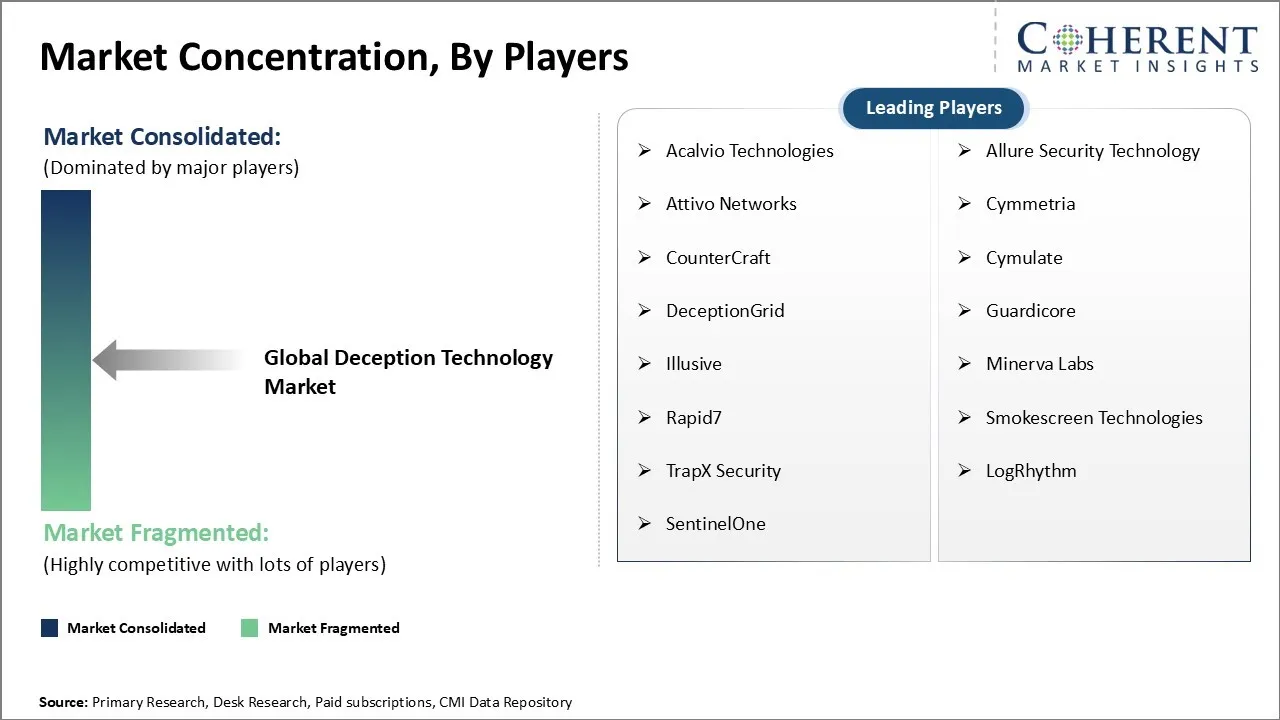
| Companies covered: | Acalvio Technologies, Allure Security Technology, Attivo Networks, Cymmetria, CounterCraft, Cymulate, DeceptionGrid, Guardicore, Illusive, Minerva Labs, Rapid7, Smokescreen Technologies, TrapX Security, LogRhythm, SentinelOne | ||
| Growth Drivers: |
| ||
| Restraints & Challenges: |
| ||
Market Dynamics
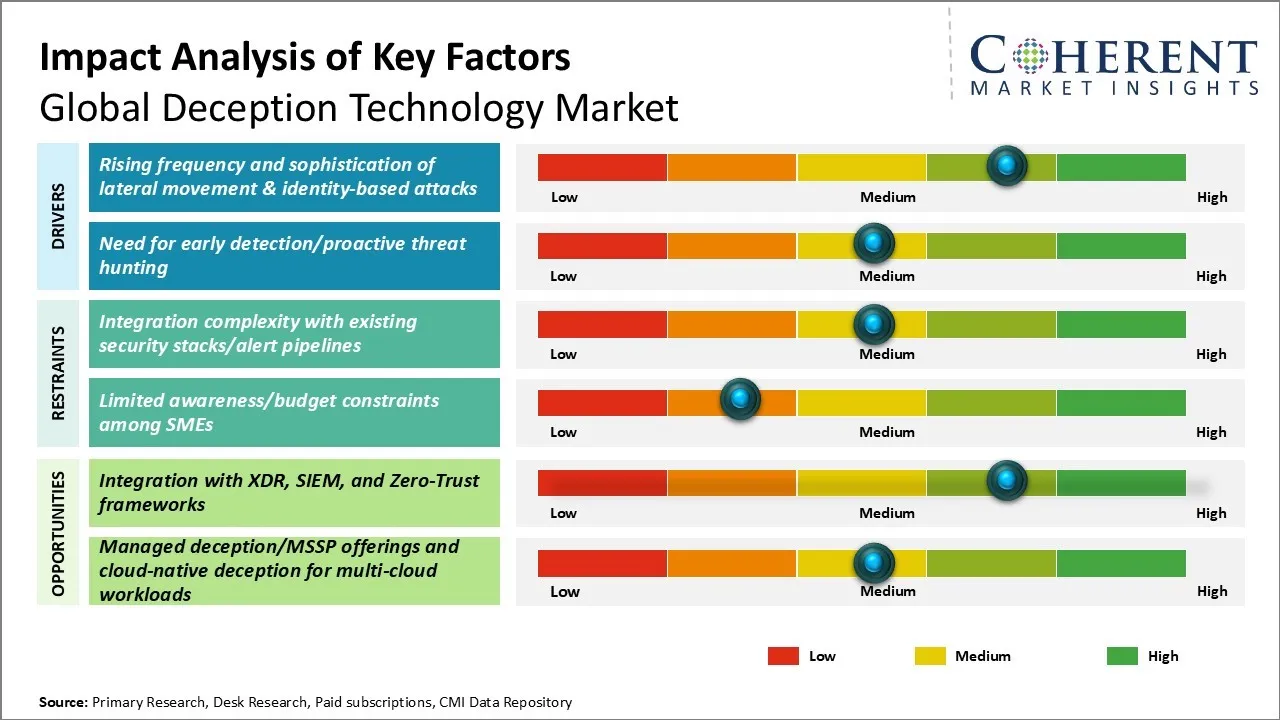
Global Deception Technology Market Driver – Rising Frequency and Sophistication of Lateral Movement & Identity-Based Attacks
As threat actors evolve their tactics, they increasingly employ stealthy techniques to navigate through compromised networks, leveraging legitimate credentials and escalating privileges to avoid traditional detection mechanisms. These advanced attack vectors enable intruders to move laterally within enterprise environments, accessing critical assets and sensitive information without raising immediate alarms. In 2023, Mandiant reported a surge in credential theft and lateral movement in ransomware incidents, with attackers increasingly using tools like Cobalt Strike and Mimikatz to pivot between systems after initial compromise.
Conventional security tools often struggle to detect such subtle activities, creating a pressing need for more proactive defense measures. Deception technology addresses this gap by deploying a variety of decoys, traps, and breadcrumbs that lure attackers away from real assets, enabling early detection and response to malicious lateral movements. Additionally, identity-based attacks that exploit compromised or synthetic identities for unauthorized access are becoming more prevalent, further highlighting the necessity of innovative security solutions that can identify and mitigate these evolving threats effectively.
Global Deception Technology Market Opportunity – Integration with XDR, SIEM, and Zero-Trust Frameworks
The global deception technology market presents a significant growth opportunity through its seamless integration with Extended Detection and Response (XDR), Security Information and Event Management (SIEM), and Zero-Trust security frameworks. As cyber threats become increasingly sophisticated, organizations demand more proactive and intelligent security solutions that can detect and respond to breaches in real time. Deception technology, with its ability to create decoy assets and environments, complements these advanced security platforms by providing enriched threat intelligence and early warning indicators that enhance overall threat detection capabilities.
The integration with XDR platforms enables comprehensive visibility across multiple security layers, empowering security teams to correlate decoy alerts with other cyber signals and orchestrate faster, automated threat responses. After acquiring Attivo Networks in 2022, SentinelOne integrated Attivo’s deception and identity protection capabilities directly into its Singularity XDR platform. This allows deception alerts (such as interactions with decoy credentials or fake endpoints) to automatically feed into the XDR’s threat correlation engine, trigger Zero-Trust policy enforcement, and even isolate compromised devices in real-time. Similarly, coupling deception technology with SIEM systems enhances the contextual analysis of security events by injecting high-fidelity deception data, which reduces false positives and optimizes incident investigation workflows.
Analyst Opinion (Expert Opinion)
- NIS2 Directive and U.S. CIRCIA reporting requirements are pushing deception technology vendors to add more robust audit trails, forensic logging, and compliance-ready reporting features. These capabilities help organizations not only detect threats but also demonstrate due diligence during regulatory inspections.
- With data protection laws like GDPR and India’s DPDP Act influencing technology adoption, deception solutions are increasingly designed to ensure that decoy assets avoid containing any real personal data. Vendors are adopting “privacy-by-design” deception frameworks that meet both cybersecurity and regulatory expectations without risking compliance violations.
- The convergence of deception technology with XDR, SIEM, and Zero-Trust architectures is being guided by regulatory emphasis on layered security. These integrations allow security teams to align deception alerts with incident reporting standards (such as ISO 27035) and fulfill mandatory breach notification requirements more efficiently.
Speak to the analyst
Want personalized insights?
Take the findings above to one of our principal consultants, or have the report rebuilt around the segments, geographies and competitors you actually track.
Market Segmentation
- Component Insights (Revenue, USD Bn, 2021 - 2033)
- Solutions
- Services
- Deception Stack Insights (Revenue, USD Bn, 2021 - 2033)
- Network Deception
- Honeytokens
- Endpoint Deception
- Application/DB Deception
- Cloud/Container Deception
- Regional Insights (Revenue, USD Bn, 2021 - 2033)
- North America
- U.S.
- Canada
- Latin America
- Brazil
- Argentina
- Mexico
- Rest of Latin America
- Europe
- Germany
- U.K.
- Spain
- France
- Italy
- Russia
- Rest of Europe
- Asia Pacific
- China
- India
- Japan
- Australia
- South Korea
- ASEAN
- Rest of Asia Pacific
- Middle East
- GCC Countries
- Israel
- Rest of Middle East
- Africa
- South Africa
- North Africa
- Central Africa
- North America
- Key Players Insights
- Acalvio Technologies
- Allure Security Technology
- Attivo Networks
- Cymmetria
- CounterCraft
- Cymulate
- DeceptionGrid
- Guardicore
- Illusive
- Minerva Labs
- Rapid7
- Smokescreen Technologies
- TrapX Security
- LogRhythm
- SentinelOne
Sources
Primary Research Interviews
Stakeholders
- Chief Information Security Officers (CISOs) and Security Leads (enterprises across BFSI, healthcare, retail, manufacturing)
- SOC Managers / Threat Hunting Teams / Incident Response Leads
- Managed Security Service Providers (MSSPs) and Managed Detection & Response (MDR) vendors
- Deception technology vendors and product managers
- Cloud service security teams and Cloud Security Architects
- Identity & Access Management (IAM) providers and consultants
- Government / defense cyber units and CERTs (e.g., national CERTs)
- Large enterprise security architects and procurement leads
Databases
- NIST (National Institute of Standards and Technology) publications and datasets
- CISA advisories and incident trend data (Cybersecurity & Infrastructure Security Agency)
- MITRE (ATT&CK framework, technique telemetry)
- OECD digital security statistics and policy reports
- Gartner / IDC / Forrester market datasets (proprietary sources commonly referenced in market analysis)
Magazines
- Dark Reading
- SC Media / SC Magazine
- The Hacker News (enterprise security coverage)
- CyberScoop
- Infosecurity Magazine
Journals
- IEEE Transactions on Information Forensics and Security
- Journal of Cybersecurity (Oxford Academic)
- Computers & Security (Elsevier)
- ACM Digital Library papers on deception and honeypot systems
Newspapers
- The Wall Street Journal (technology/cybersecurity coverage)
- Financial Times (cybersecurity industry & M&A)
- The Economic Times (India) — technology & enterprise security sections
- The Guardian — technology/cyber pages (when relevant to policy/regulatory items)
Associations
- ISACA
- SANS Institute (research, whitepapers, training output)
- ENISA (European Union Agency for Cybersecurity)
- International Information System Security Certification Consortium and local CERTs/CSIRTs
Public Domain Sources
- MITRE ATT&CK knowledge base (tactics, techniques, procedure data)
- CISA vulnerability and incident reports (open advisories)
- National CERT reports and public breach advisories (various countries)
- Academic preprint servers (arXiv) for emerging research on deception & AI
- Open-source vendor repositories, GitHub projects (deception tools, frameworks)
Proprietary Elements
- CMI Data Analytics Tool, Proprietary CMI Existing Repository of information for last 8 years
Get access to 250+ pages report
Every segment, forecast, competitor profile and data table behind the analysis above — available for instant download.
- ESOMAR Member
- ISO 9001:2015 Certified
- D-U-N-S Registered
- GDPR & CCPA Compliant
Missing comfort of reading report in your local language? Find your preferred language:
Transform your Strategy with Exclusive Trending Reports
Frequently Asked Questions
The global deception technology market is estimated to be valued at USD 3.36 Bn in 2026 and is expected to reach USD 8.30 Bn by 2033.
The CAGR of global deception technology market is projected to be 13.8% from 2026 to 2033.
Rising frequency and sophistication of lateral movement & identity-based attacks and need for early detection/proactive threat hunting are the major factors driving the growth of global deception technology market.
Integration complexity with existing security stacks/alert pipelines and limited awareness/budget constraints among SMEs are the major factors hampering the growth of the global deception technology market.
In terms of Component, Solutions segment is estimated to dominate the market revenue share in 2026.
Acalvio Technologies, Allure Security Technology, Attivo Networks, Cymmetria, CounterCraft, Cymulate, DeceptionGrid, Guardicore, Illusive, Minerva Labs, Rapid7, Smokescreen Technologies, TrapX Security, LogRhythm, and SentinelOne are the major players.
North America is expected to lead the global deception technology market in 2026.