

Global Deer Milk Market Size and Forecast – 2026 To 2033
The Global Deer Milk Market is estimated to be valued at USD 312.6 Mn in 2026 and is expected to reach USD 558.4 Mn by 2033, registering a compound annual growth rate (CAGR) of 8.7% from 2026 to 2033. The increase in this growth suggests that consumers are more interested in niche dairy products, driven by a growing awareness of health benefits and a preference for natural and nutrient-dense milk alternatives. Deer milk's rich protein, calcium, vitamin and mineral content is making it commercially significant in premium nutrition, senior health, beauty from within supplements and specialty functional food formats.
For instance, as accessed in June 2026, Nutrideer positioned CerviPep as a world-first deer milk peptide platform derived from New Zealand red deer milk powder, targeting functional applications such as healthy ageing, immune support, sleep health, and bioactive nutrition. This highlights the market’s shift from basic deer milk consumption toward high-value functional ingredients and specialty supplement formats. (Source: Nutrideer)
Key Takeaways of the Global Deer Milk Market
- The deer milk powder segment is expected to account for 39.6 % of the global deer milk market share in 2026, supported by longer shelf life, formulation flexibility, and commercial suitability for nutrition brands. In June 2026, Pāmu Milk’s official product catalogue listed Pāmu Deer Milk – Premium Deer Milk Powder, a New Zealand-made deer milk powder that is powdered and sealed to maintain quality, with commercial quantities available for business buyers.(Source: Pāmu)
- The nutraceuticals & dietary supplements segment is expected to hold 29.7 % of the market share in 2026, as deer milk’s protein, calcium, and bioactive profile supports healthy ageing and functional nutrition positioning. In March 2023, Massey University reported that regular Pāmu Deer Milk consumption improved nutritional status, muscle mass, and physical performance in women aged 65 and above.
- The B2B ingredient supply segment is expected to capture 44.7 % of the global deer milk market share in 2026, reflecting the market’s dependence on controlled sourcing, seasonal production planning, and bulk supply alignment with brand demand.
- Asia Pacific is expected to dominate with 42.6 % of the market share in 2026, supported by New Zealand’s specialized deer farming base, export infrastructure, and established use of deer-derived products across premium nutrition and wellness channels. In December 2024, Deer Industry New Zealand highlighted deer dairying expansion, including Pāmu’s Aratiatia operation where about 300 hinds were expected to be milked in the season.
- North America is expected to hold 22.1 % of the market share in 2026 and emerge as the fastest-growing region, helped by premium protein adoption, specialty retail formats, and stronger awareness of New Zealand-based deer products. In March 2025, Farmers Weekly reported that New Zealand venison exports to North America exceeded US$ 45.0 million using an assumed exchange rate of US$ 0.57, for the year ended December 2024, marking nearly 15% year-on-year growth.
- Beauty nutrition crossover gains momentum: Deer milk is moving beyond food and supplements into premium skincare, creating a higher-margin pathway for ingredient suppliers and brand owners. In September 2025, Deer Milking NZ reported small localized trials where daily ingestion of 2–5g deer milk powder showed visible improvements in inflammatory skin conditions after seven days.
- Premium functional innovation widens addressable demand: The global deer milk market is gaining traction as brands position deer milk as a premium functional dairy ingredient rather than a conventional milk product. Deer milk contains higher levels of protein, fat, calcium, zinc, iodine, branched-chain fatty acids, and alpha-linolenic acid compared with several other ruminant milks, supporting its use in high-nutrition applications.
Segmental Insights
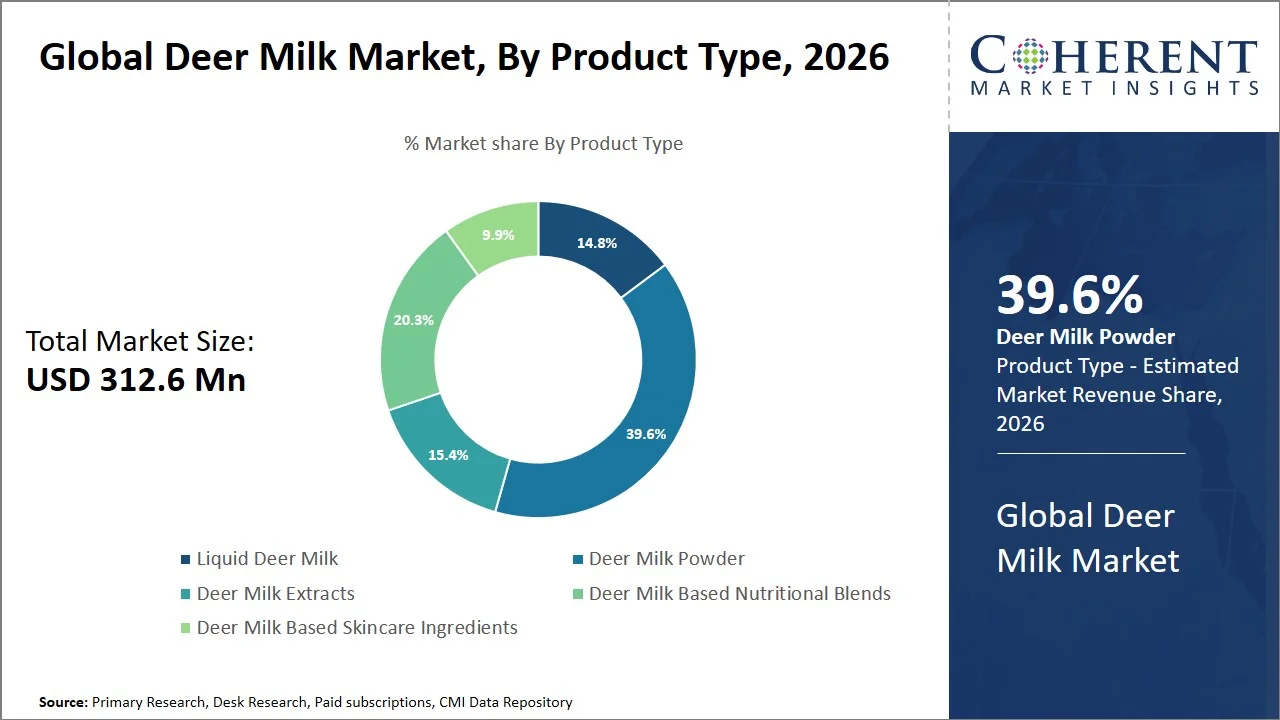
Why Does the Deer Milk Powder Segment Dominate the Global Deer Milk Market?
Deer milk powder is expected to dominate the global deer milk market with 39.6% share in 2026, mainly because powder format solves the core commercialization challenge of deer milk: limited production volume and short fresh-milk shelf life. Powdered deer milk is easier to store, transport, dose, and incorporate into finished products such as sachets, premium tins, blended dairy powders, functional drinks, and wellness formulations. Demand is supported by consumers seeking concentrated nutrition in convenient formats, while supply-side adoption benefits from drying, sealing, and portion-controlled packaging technologies that reduce wastage and extend export reach. Its end-use relevance is strongest in premium nutrition, senior wellness, gifting formats, and specialty health products. In June 2026, Pāmu’s official product portfolio featured Pāmu Formulated Milk Powder with Deer Milk in 25g single-serve sachets packed in a premium tin, supporting powder-led product innovation. (Source: Pāmu)
- Current Industry Events of 2026
- Market Size Estimation
- Regional Breakdown
- Competitive Landscape
- Customer Intelligence
- Segmental Analysis
- Pricing Analysis
- Key Market Drivers, Challenges & Future Trends
- Customized Insights Section
Why Do Nutraceuticals & Dietary Supplements Represent the Largest Application Segment in the Market?
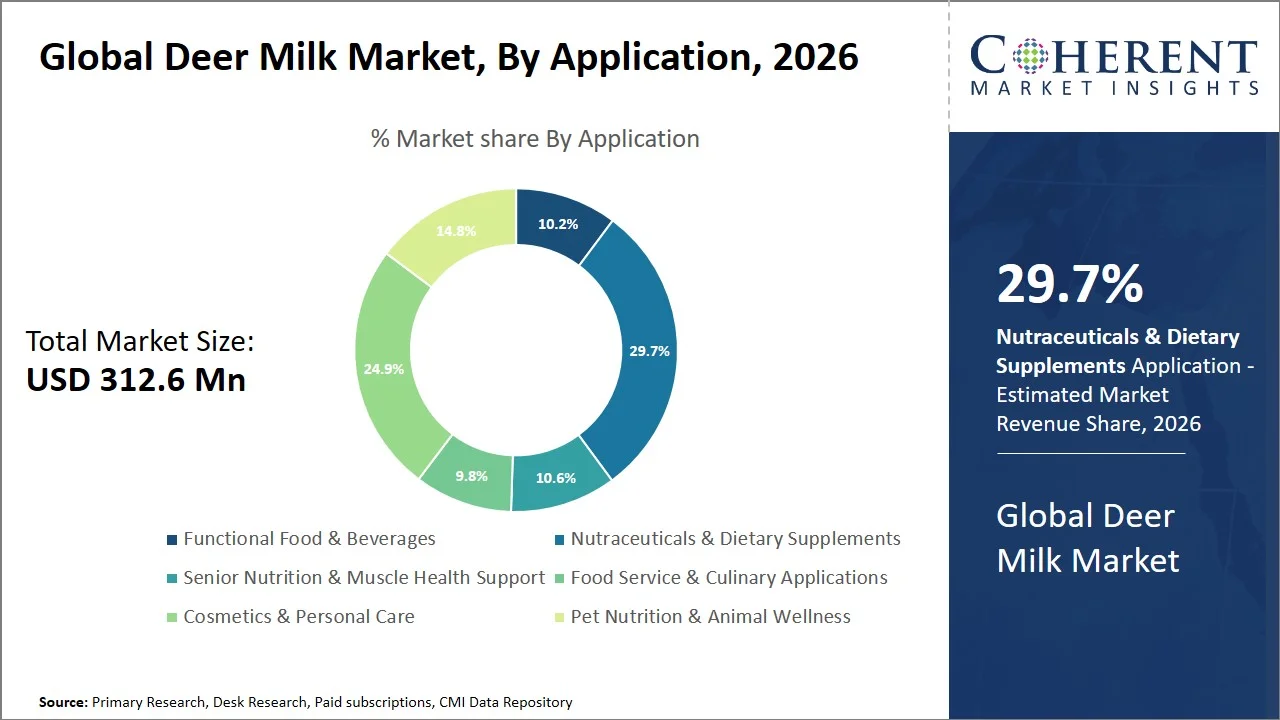
Nutraceuticals & dietary supplements are expected to represent the largest application segment with 29.7% share in 2026, as deer milk is positioned less as a commodity dairy product and more as a high-value functional nutrition ingredient. Its naturally concentrated protein, calcium, minerals, and bioactive components align well with formulations targeting vitality, bone support, healthy ageing, beauty-from-within, and general wellness. Demand is also supported by Asia Pacific consumers’ familiarity with deer-derived health products and willingness to pay for rare, premium functional ingredients. On the supply side, powdered formats allow deer milk to be blended with collagen, vitamins, honey, DHA, and antioxidants for differentiated supplement concepts. In February 2022, NutraIngredients-Asia reported that Pāmu developed two powdered oral supplements using deer milk as the main functional ingredient for beauty and general wellness applications.
Why Does B2B Ingredient Supply Dominate the Deer Milk Market?
B2B ingredient supply is expected to dominate the deer milk market with 44.7% share in 2026, because the category remains highly specialized, supply-constrained, and formulation-led. Most commercial demand comes from brands, processors, supplement companies, premium food developers, and personal care manufacturers that require reliable ingredient sourcing rather than mass retail milk availability. Deer milk production requires controlled herd management, seasonal planning, quality assurance, and advance contracting, making B2B channels more efficient than fragmented consumer distribution. This model also allows suppliers to match limited production with higher-margin applications such as nutraceutical powders, skincare ingredients, and functional food concepts. In April 2026, Otago Daily Times reported that Pāmu paused deer milk harvesting for the 2025–26 season to balance supply with current demand, highlighting the importance of planned B2B supply discipline in this niche market.
Currents Events and their Impact
Current Events | Description and its Impact |
New Zealand Food Export Exemption Rules Take Effect (September 2025 onwards) |
|
China Implements Updated Milk Powder Food Safety Standard GB 19644-2024 (February 2025 onwards) |
|
European Union Maintains Strict Novel Food and Animal-Origin Dairy Access Controls (2024 onwards) |
|
Australia Revises Infant Formula Rules while New Zealand Maintains Separate Requirements (September 2024 onwards) |
|
Global Deer Milk Market Dynamics
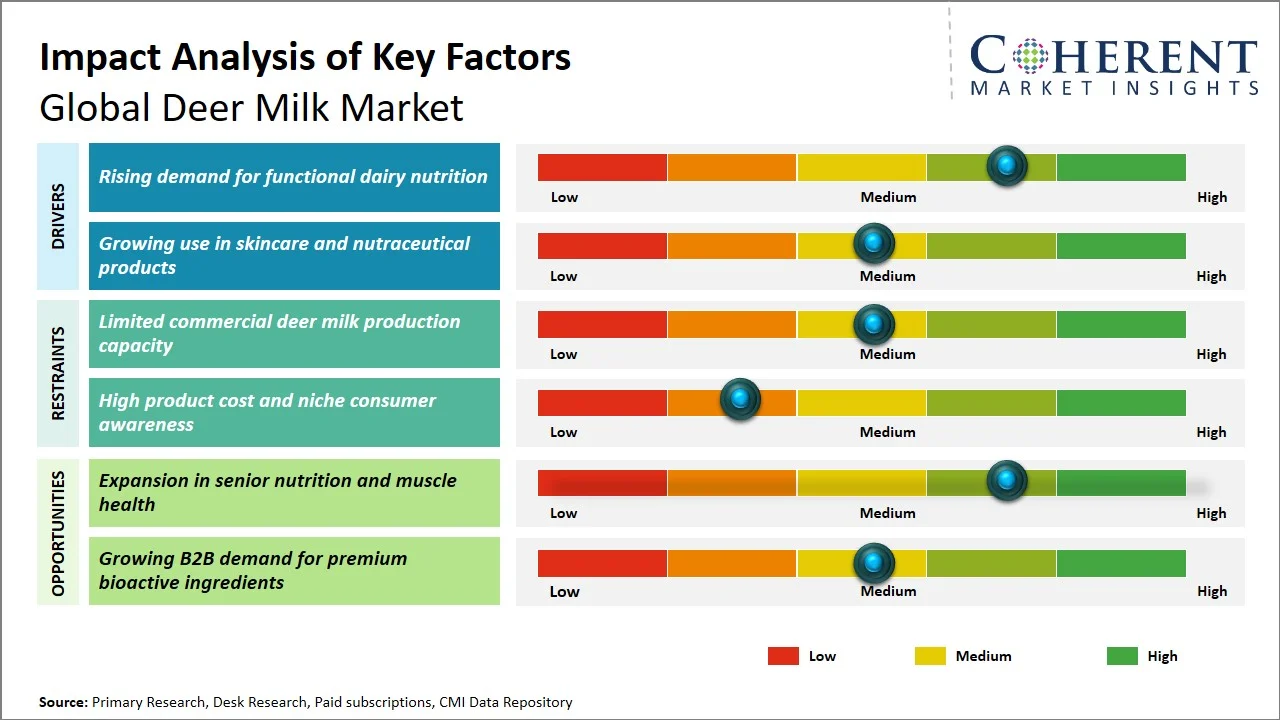
Market Drivers
- Rising demand for functional dairy nutrition: Deer milk is gaining commercial relevance as a premium functional dairy ingredient because it offers concentrated nutrition, including protein, calcium, phosphorus, energy, and vitamin A, while being positioned as a lower-lactose alternative to conventional cow milk. This may appeal to senior nutrition, recovery nutrition, health drinks and high-end dairy powders because of the differentiation in nutritional value consumers will pay for. In addition to consumer demand, the growth driver is also the rising acceptance and validation from various industries in the specialty functional food market for deer milk. In April 2026, Pāmu reported that it is "reworking its deer milk harvesting schedules in New Zealand to better respond to market demand and commercial supply requirements" in the Otago Daily Times, which noted an increasing trend towards structured adoption of deer milk in functional dairy supply chains.
- Growing use in skincare and nutraceutical products: Deer milk is increasingly being adopted beyond traditional dairy formats, particularly in skincare and nutraceutical applications where rare, bioactive, and naturally derived ingredients command premium pricing. with a high protein, vitamin, mineral and peptide content, this allows brands to create product positioning that relates to hydration, nourishing the skin, supporting anti-ageing and beauty-from-within. This expands the revenue opportunity for deer milk producers, as it opens up the opportunity for cosmetics and supplements to earn a higher profit margin than liquid milk products. It also promotes ingredient suppliers to develop and promote powder, extract and peptide-based products for formulation. In May 2025, Now To Love highlighted Kōtia as a New Zealand deer milk skincare range using deer milk peptide complexes, with reported benefits linked to moisture, elasticity, fine lines, pigmentation, and dark circles.
Emerging Trends
- Shift toward formulated powder and portion-controlled formats: The global deer milk market is trending to more controllable formats like powder, portion, sachets, tins, blends, fortified formats and away from fresh deer milk. The trend is significant commercially because only a small proportion of deer produce milk and it is seasonal, hence the shelf-stable products are more viable for distribution around the world and premium positioning. Powder format is also a solution to allow manufacturers to control dosage, mix deer milk with other nutrients and minimize losses related to cold-chain dependency. This is key to increased uptake of senior nutrition, functional foods, beauty supplements and specialist retail channels.
- Demand-led production planning and premium supply discipline: Deer milk commercialization is gaining a more demand-led approach, meaning that producers are making their harvesting, contracting and processing decisions according to the confirmed customer demand. This trend has been driven by the fact that overproduction can be a limitation to pricing power in this niche dairy category and that variability in supply can create a challenge to brand and formulation commitments. This means suppliers should focus on advance contracts, high dollar end-use applications, and regular season production as opposed to the low dollar mass market dairy volume.
Regional Insights
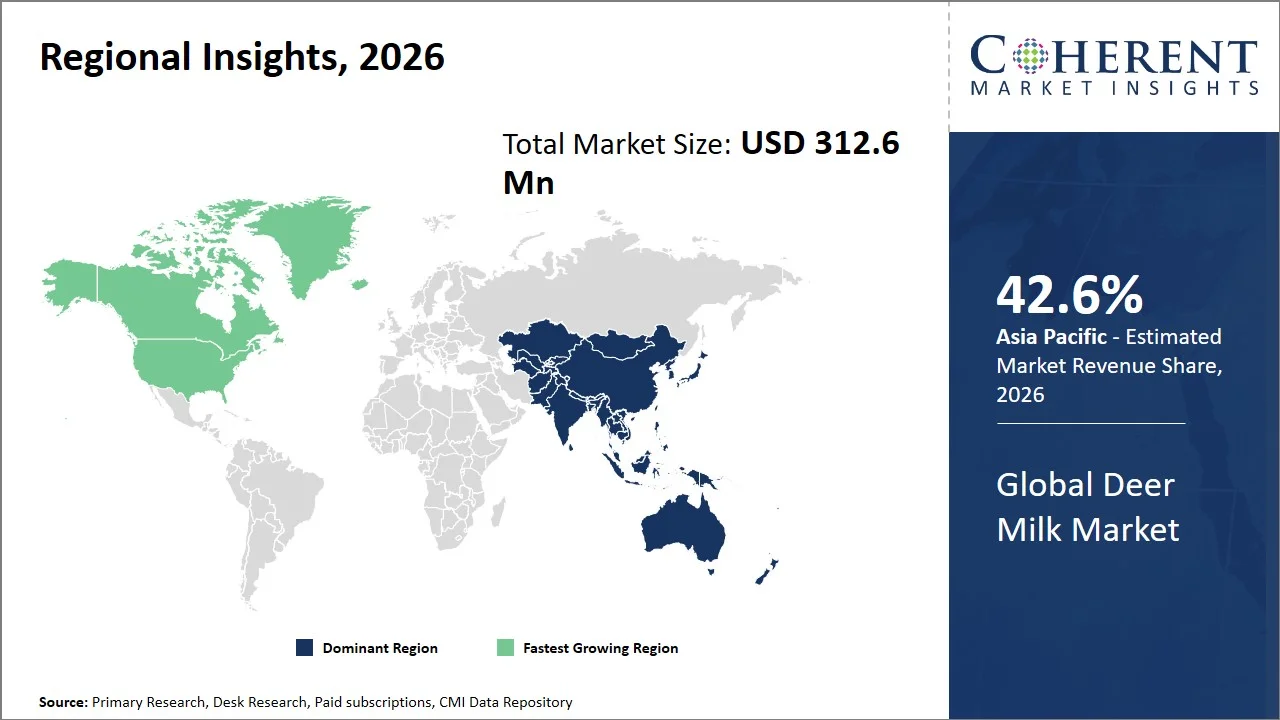
Why Does the Asia Pacific Region Dominate the Global Deer Milk Market?
Asia Pacific is expected to dominate the global deer milk market with a 42.6% share in 2026, supported by the region’s strong deer farming base, premium dairy innovation, traditional acceptance of deer derived nutrition, and expanding demand for high value functional milk ingredients. New Zealand plays a central role in commercializing deer milk through advanced farming, spray drying, clinical nutrition research, and export-oriented specialty dairy production. China and Mongolia further strengthen regional relevance through cultural familiarity with deer and reindeer-based products, while India adds scale through its growing premium dairy and nutraceutical consumer base. The region’s leadership is also supported by applications in senior nutrition, functional foods, cosmetics, and specialty culinary products. For instance, in May 2024, High Value Nutrition highlighted that support from New Zealand Trade and Enterprise helped bring innovative sheep and deer milk products to market and expand their reach across domestic and global deer milk market. This demonstrates Asia Pacific’s strength in specialty dairy innovation export readiness and commercialization of high value deer milk ingredients for nutrition focused applications.
Why is the North America Region Emerging as the Fastest-Growing Region in the Global Deer Milk Market?
North America is projected to be the fastest growing region in the global deer milk market with a 22.1% share in 2026, driven by rising consumer interest in high protein dairy, senior nutrition, functional foods, lactose friendly dairy formats, and premium wellness ingredients. Although commercial deer milk penetration remains niche, the region offers strong growth potential due to its mature supplement industry, advanced nutraceutical formulation base, premium retail channels, and high consumer willingness to try differentiated animal milk proteins. Deer milk’s positioning around protein density, calcium content, digestive support, and healthy aging aligns well with North American demand for functional dairy products. A recent instance showing this broader demand shift is Dairy Farmers of America’s January 2026 launch of Alta Dena Protein milk in the U.S., offering 15 grams of real dairy protein per serving and lactose free positioning. (Source: Dairy Farmers of America)
Global Deer Milk Market Outlook for Key Countries
Why is China Shaping Premium Deer Milk Nutrition Adoption?
China is an important market for deer milk because of its cultural familiarity with deer derived health products, strong premium dairy consumption, and growing demand for adult and senior nutrition. Deer milk can be positioned in China as a high value dairy ingredient for healthy aging, bone health, immunity, and specialty nutrition products. The market also benefits from consumers’ willingness to pay for imported premium dairy and functional formulations. China’s nutraceutical and dairy sectors increasingly focus on products that combine nutritional science with traditional wellness concepts, creating a favorable environment for deer milk powder and deer milk-based blends. For instance, in May 2024, High Value Nutrition highlighted that support from New Zealand Trade and Enterprise helped introduce and scale innovative sheep and deer milk products across both domestic and international markets. This supports the broader demand case for nutrient dense specialty milk ingredients such as deer milk.
Why is India an Important Premium Dairy Demand Market for Deer Milk?
India is relevant to the deer milk market as a high potential demand market rather than a large commercial supply base. The country has a massive dairy consumption ecosystem, expanding organized dairy processing, increasing interest in fortified dairy products, and rising demand for nutrition focused products among urban consumers. Deer milk can find opportunities in premium nutraceuticals, senior nutrition, specialty powders, and high protein wellness formulations, especially through B2B ingredient supply and online premium nutrition channels. India’s growing middle class and increasing attention to functional foods support the entry of niche dairy ingredients with strong nutritional positioning.
Why is Austria Relevant to Premium Deer Milk Ingredient Adoption in Europe?
Austria is important to the deer milk market due to its premium dairy processing ecosystem, strong organic dairy credentials, grassland-based production model, and advanced European food innovation environment. The country’s dairy sector is supported by strong quality systems, organic production, hay milk positioning, and export-oriented value-added processing. These characteristics make Austria suitable for the adoption of niche dairy ingredients such as deer milk in premium nutrition, gourmet dairy, and functional food applications. For instance, in November 2025, SalzburgMilch partnered with SIG to launch products in SIG DomeMini carton bottles from June 2026, strengthening innovation across specialty milk, protein drinks, meal replacements, and premium dairy formats.
Why is Mongolia Important for Traditional Reindeer Milk Knowledge and Niche Supply Heritage?
Mongolia is important to the deer milk market because of its traditional reindeer herding culture and long-standing use of reindeer milk in local diets. Although Mongolia is not yet a major commercial deer milk exporter, it provides cultural and ethnographic relevance to the broader deer and reindeer milk category. Reindeer milk is associated with traditional food practices, cheese, milk tea, and localized dairy knowledge among Dukha communities in northern Mongolia. This heritage strengthens the authenticity narrative for deer milk and reindeer milk as nutrient dense specialty dairy products. A recent instance is the September 2024 Reindeer Herding and Resilience project workshop in East Taiga Mongolia, where Sámi, Dukha, and Evenki youth documented traditional knowledge and practical skills related to reindeer milking.
Why is New Zealand Emerging as a Leader in Commercial Deer Milk Product Development?
New Zealand is the most important country in the commercial deer milk market because it has moved deer milk from a niche concept to a scientifically supported and commercially available specialty dairy ingredient. The country benefits from established deer farming expertise, pasture-based livestock systems, advanced dairy processing, export capabilities, and strong research collaboration across universities, farms, and food innovation platforms. New Zealand suppliers are developing deer milk for nutraceuticals, functional beverages, beauty from within products, sleep support, gut health, immunity, and premium food applications. For example, Deer Milking New Zealand commercialized CerviPep, a high-value nutrition ingredient produced from 100% pure deer milk powder sourced from Peel Forest Estate in South Canterbury, New Zealand. The company positions it for nutraceutical capsules, functional beverages, beauty products, and advanced gut health formulations.
Technology Adoption Landscape in the Global Deer Milk Market
Technology | Key Features | Clinical Advantage | Market Relevance |
Specialized deer milking systems | Welfare-led milking infrastructure, low-stress animal handling, controlled collection cycles, and small-batch harvesting designed for deer rather than conventional dairy animals. | Helps preserve milk quality and reduce contamination risk by improving collection consistency and animal comfort. | Critical for scaling deer milk supply because deer are not traditionally milked animals. Adoption supports premium sourcing claims, farm-level traceability, and consistent raw material availability. Pāmu’s development involved new milk systems and specialized processing for delicate deer milk. |
Spray drying and powder stabilization | Converts liquid deer milk into shelf-stable powder using controlled drying, moisture reduction, and powder handling systems. | Enables stable nutritional delivery by protecting protein- and mineral-rich content in a longer-life format. | One of the most important commercialization technologies, as powder reduces cold-chain dependence and supports exports, supplements, sachets, and B2B ingredient supply. Pāmu has invested in a specialist spray drying facility at Innovation Waikato Park. |
Functional formulation and fortification technology | Blending deer milk powder with complementary ingredients such as lactase, collagen, vitamins, probiotics, and other dairy bases. | Enhances digestive comfort, protein delivery, skin nutrition, and targeted wellness benefits depending on formulation. | Helps brands move beyond plain deer milk into nutraceuticals, beauty nutrition, senior nutrition, and functional dairy blends. Pāmu’s formulated milk powder includes lactase to support lactose breakdown and improve consumer comfort. |
Bioactive profiling and nutritional testing | Laboratory testing for protein, calcium, phosphorus, vitamin A, lactoferrin, fat profile, microbiology, and batch-level composition. | Supports evidence-based positioning for skeletal health, immune support, ageing nutrition, and product safety. | Essential for regulatory confidence, premium claims, B2B specifications, and export documentation. Pāmu states that more than 2,700 tests have been completed on its milk and over 280 nutritional tests on deer milk powder. |
Bioactive peptide and cosmetic formulation systems | Processing deer milk into skincare-compatible ingredients, peptide complexes, creams, serums, masks, and beauty supplements. | Supports hydration, nourishment, skin barrier support, and anti-ageing positioning through naturally occurring proteins, vitamins, and minerals. | Expands deer milk from food into higher-margin beauty and personal care applications. Deer milk is being used in cosmetic products and supplement formats, including beauty-focused powder products with collagen and vitamins. |
Clinical research and evidence-generation platforms | Human nutrition trials, sensory studies, product testing, and application research with universities and food science partners. | Builds scientific credibility for benefits such as improved nutritional status, muscle support, and healthy ageing applications. | Supports premium pricing, medical nutrition positioning, and institutional acceptance. High-Value Nutrition noted research into deer milk’s nutritional status and physical function benefits in older adults, supporting commercialization of targeted functional dairy products. |
How is the use of bioactive deer milk ingredients in functional supplements and pet wellness boosting the global deer milk market?
The development of bioactive deer milk powders and peptide-based formulations is creating new growth opportunities in the global deer milk market. Instead of depending only on liquid milk consumption, suppliers can convert deer milk into high-value functional ingredients for healthy ageing, immunity, vitality, skin health, and pet wellness products. This improves commercial scalability because powder and peptide formats are easier to export, formulate, dose, and position in premium supplement categories. It also allows brands to target multiple end-use markets, including human nutraceuticals, beauty-from-within products, and animal wellness.
Market Players, Key Development, and Competitive Intelligence
Key Developments
- In May 2025, Deer Milking New Zealand advanced its deer milk ingredient commercialization pipeline by positioning deer milk as a premium bioactive-rich ingredient for human and animal health applications. The company highlighted commercialization across sleep support supplements, Nutrideer pet supplements, and bulk deer milk powder for international OEMs targeting bone, sleep, immune, and skin health applications.
- In April 2025, the International Dairy Federation opened the IDF Dairy Innovation Awards 2025 to recognize innovation across farming, processing, animal health, packaging, nutrition, and sustainability in the global dairy sector.
Competitive Landscape
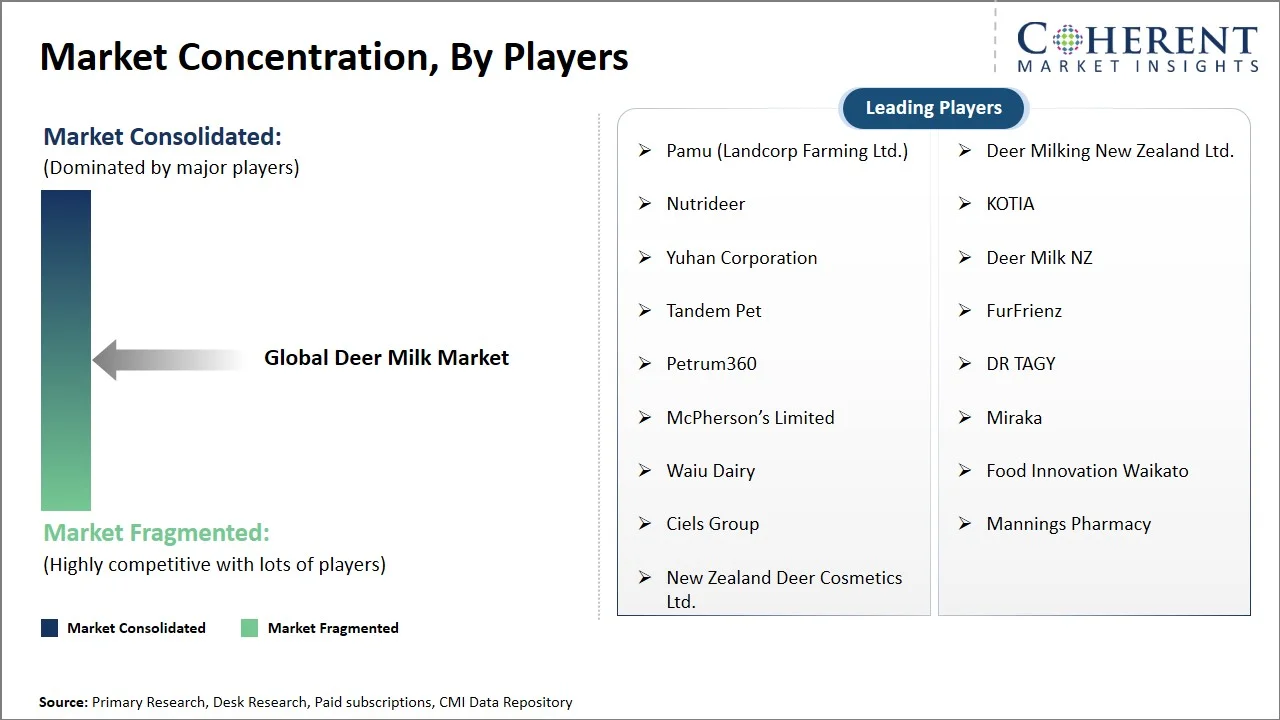
The global deer milk market is a niche and emerging market, with a small number of specialized players competing through product innovation, premium positioning, controlled sourcing, and export-led distribution. Companies are focusing on converting limited deer milk supply into high-value products such as milk powder, nutritional blends, skincare ingredients, supplements, and pet wellness formulations. Competition is expected to increase as brands invest in functional dairy innovation, traceable sourcing, and premium health-focused applications.
Key focus areas include
- Development of deer milk powder and shelf-stable formats to improve storage, export potential, and product scalability
- Expansion into nutraceuticals, senior nutrition, skincare, and pet wellness to capture higher-margin applications
- Focus on bioactive ingredients, peptides, and functional blends for immunity, sleep support, skin health, and healthy ageing
- Strengthening supply-chain traceability and quality standards to build trust among B2B buyers and premium consumers
- Partnerships with food technology, nutrition, and skincare companies to widen application development and product commercialization
- Export market expansion across Asia Pacific, North America, and Europe through premium dairy and wellness channels
Market Report Scope
Deer Milk Market Report Coverage
| Report Coverage | Details | ||
|---|---|---|---|
| Base Year: | 2025 | Market Size in 2026: | USD 312.6 Mn |
| Historical Data for: | 2020 To 2024 | Forecast Period: | 2026 To 2033 |
| Forecast Period 2026 to 2033 CAGR: | 8.7% | 2033 Value Projection: | USD 558.4 Mn |
| Geographies covered: |
| ||
| Segments covered: |
| ||
| Companies covered: | Pamu (Landcorp Farming Ltd.), Deer Milking New Zealand Ltd., Nutrideer, KOTIA, Yuhan Corporation, Deer Milk NZ, Tandem Pet, FurFrienz, Petrum360, DR TAGY, McPherson’s Limited, Miraka, Waiu Dairy, Food Innovation Waikato, Ciels Group, Mannings Pharmacy, and New Zealand Deer Cosmetics Ltd. | ||
| Growth Drivers: |
| ||
| Restraints & Challenges: |
| ||
Analyst Opinion (Expert Opinion)
- The global deer milk market is expected to witness steady long-term growth as deer milk moves from a niche specialty dairy product to a premium functional ingredient. Its strong nutritional profile, rarity, and positioning in wellness-led consumption are expected to support adoption across high-value formats such as milk powder, nutritional blends, supplements, skincare ingredients, and pet wellness products. However, limited raw milk availability and seasonal production will keep the market premium and supply-disciplined.
- The strongest opportunities are likely to be in deer milk powder, nutraceuticals and B2B ingredient supply where shelf-stable formats offer easier export, formulation flexibility and better commercial scalability. Deer farming in New Zealand is a very strong base, and the acceptance of functional dairy products in New Zealand is likely to keep the Asia Pacific region as the core production and demand hub, while North America is likely to gain traction through premium wellness, ageing nutrition and specialty supplement channels.
- Competitive advantage for market players lies in the development of bioactive ingredients, powder stabilization, peptide-based formulations, traceable sourcing and premium product positioning. Companies that can combine controlled supply, scientific validation, regulatory compliance, and application-specific innovation for nutrition, beauty, and wellness brands will be better placed to capture demand in this global deer milk market .
Speak to the analyst
Want personalized insights?
Take the findings above to one of our principal consultants, or have the report rebuilt around the segments, geographies and competitors you actually track.
Market Segmentation
- Product Type Insights (Revenue, USD Mn, 2021 - 2033)
- Liquid Deer Milk
- Deer Milk Powder
- Deer Milk Extracts
- Deer Milk Based Nutritional Blends
- Deer Milk Based Skincare Ingredients
- Application Insights (Revenue, USD Mn, 2021 - 2033)
- Functional Food & Beverages
- Nutraceuticals & Dietary Supplements
- Senior Nutrition & Muscle Health Support
- Food Service & Culinary Applications
- Cosmetics & Personal Care
- Pet Nutrition & Animal Wellness
- Packaging Type Insights (Revenue, USD Mn, 2021 - 2033)
- Bottles
- Sachets
- Pouches
- Cans or Tins
- Jars
- Bulk Packs
- Distribution Channel Insights (Revenue, USD Mn, 2021 - 2033)
- B2B Ingredient Supply
- Online Retail
- Specialty Health & Nutrition Stores
- Supermarkets or Hypermarkets
- Pharmacies & Wellness Stores
- Direct to Consumer Sales
- Regional Insights (Revenue, USD Mn, 2021 - 2033)
- North America
- U.S.
- Canada
- Latin America
- Brazil
- Argentina
- Mexico
- Rest of Latin America
- Europe
- Germany
- U.K.
- Spain
- France
- Italy
- Russia
- Rest of Europe
- Asia Pacific
- China
- India
- Japan
- Australia
- South Korea
- ASEAN
- Rest of Asia Pacific
- Middle East
- GCC Countries
- Israel
- Rest of Middle East
- Africa
- South Africa
- North Africa
- Central Africa
- North America
- Key Players Insights
- Pamu (Landcorp Farming Ltd.)
- Deer Milking New Zealand Ltd.
- Nutrideer
- KOTIA
- Yuhan Corporation
- Deer Milk NZ
- Tandem Pet
- FurFrienz
- Petrum360
- DR TAGY
- McPherson’s Limited
- Miraka
- Waiu Dairy
- Food Innovation Waikato
- Ciels Group
- Mannings Pharmacy
- New Zealand Deer Cosmetics Ltd.
Sources
Primary Research Interviews
- Deer milk producers and deer dairy farm operators involved in milk collection and herd management
- Specialty dairy processors producing deer milk powder, nutritional blends, and shelf-stable formats
- Nutraceutical formulators and product development managers using deer milk-based ingredients
- Skincare and personal care R&D teams working with milk-derived bioactive ingredients
- B2B ingredient distributors and export managers handling specialty dairy ingredients
- Food technologists, dairy scientists, and nutrition researchers studying deer milk composition and applications
- Retail buyers and category managers from premium wellness, nutrition, and specialty dairy channels
Stakeholders
- Deer milk producers and specialty dairy companies
- Deer farming companies and raw milk collection partners
- Dairy powder processors and spray-drying facilities
- Nutraceutical and dietary supplement manufacturers
- Skincare and personal care product manufacturers
- Pet nutrition and animal wellness product companies
- B2B ingredient suppliers and distributors
- Exporters, importers, and specialty dairy trading companies
- Packaging suppliers for sachets, pouches, jars, tins, and bulk packs
End-use Sectors
- Functional food and beverage companies
- Nutraceutical and dietary supplement brands
- Senior nutrition and healthy ageing product companies
- Cosmetics and personal care brands
- Pet nutrition and animal wellness companies
- Specialty health and wellness retailers
- Premium dairy and gourmet food retailers
- Online wellness and direct-to-consumer platforms
- Food service and specialty culinary users
Regulatory & Food Safety Bodies
- Ministry for Primary Industries, New Zealand
- Food Standards Australia New Zealand
- European Commission – Novel Food and food safety regulations
- European Food Safety Authority
- U.S. Food and Drug Administration – Center for Food Safety and Applied Nutrition
- China State Administration for Market Regulation
- National Health Commission of China
- Codex Alimentarius Commission
- Food Safety and Standards Authority of India
- Health Canada – Food and Nutrition Directorate
Databases
- FAOSTAT
- UN Comtrade Database
- International Trade Centre Trade Map
- Stats NZ – Export and agriculture statistics
- New Zealand Ministry for Primary Industries export data
- Eurostat
- USDA Foreign Agricultural Service GAIN Reports
- World Bank Indicators
- OECD Agriculture Statistics
- China Customs Statistics
- FDA Food Facility Registration database
Magazines
- Dairy Industries International
Dairy Reporter
- FoodNavigator-Asia
- NutraIngredients-Asia
- Natural Products Insider
- Cosmetics & Toiletries
- Personal Care Magazine
- PetfoodIndustry
- Food Technology Magazine
- New Food Magazine
Journals
- International Dairy Journal
- Journal of Dairy Science
- Dairy Science & Technology
- Food Chemistry
- Foods
- Nutrients
- Journal of Functional Foods
- Frontiers in Nutrition
- Journal of Cosmetic Dermatology
- Animals
Associations
- Deer Industry New Zealand
- New Zealand Deer Farmers Association
- International Dairy Federation
- Dairy Companies Association of New Zealand
- Natural Health Products New Zealand
- Cosmetics New Zealand
- Personal Care Products Council
- Pet Food Association of New Zealand
- American Dairy Products Institute
- European Dairy Association
Public Domain Sources
- New Zealand Ministry for Primary Industries – dairy export, animal products, and food safety regulations
- Food Standards Australia New Zealand – food standards and novel food requirements
- European Commission – Novel Food Catalogue and food import regulations
- EFSA – food safety and nutrition-related scientific opinions
- Codex Alimentarius – milk, dairy, food hygiene, and labelling standards
- FAO – livestock, dairy, and food systems data
- World Bank – trade, income, and consumption indicators
- USDA FAS – dairy trade and country-level food regulatory updates
- Stats NZ – agriculture, export, and trade statistics
- China SAMR and National Health Commission – milk powder and food safety standards
Proprietary Elements
- CMI Data Analytics Tool, Proprietary CMI Existing Repository of information for last 10 years
Get access to 250+ pages report
Every segment, forecast, competitor profile and data table behind the analysis above — available for instant download.
- ESOMAR Member
- ISO 9001:2015 Certified
- D-U-N-S Registered
- GDPR & CCPA Compliant
Missing comfort of reading report in your local language? Find your preferred language:
Transform your Strategy with Exclusive Trending Reports
Frequently Asked Questions
The CAGR of the global deer milk market is projected to be 8.7% from 2026 to 2033.
The market is driven by rising demand for premium functional dairy products, increasing interest in high-protein and nutrient-rich milk ingredients, and expanding use of deer milk in nutrition, healthy ageing, immunity, and specialty wellness applications.
The global deer milk market is estimated to be valued at USD 312.6 million in 2026 and is expected to reach USD 558.4 million by 2033.
In terms of product type, deer milk powder is estimated to dominate the market revenue share in 2026.
Rising demand for functional dairy nutrition and growing use in skincare and nutraceutical products are the major factors driving the growth of the global deer milk market.
Limited commercial deer milk production capacity and high product cost and niche consumer awareness are the major factors hampering the growth of the global deer milk market.
Asia Pacific is expected to lead the global deer milk market in 2026.