

Global Food Additives Market Size and Share Analysis – Growth Trends and Forecasts (2026-2033)
The food additives market is estimated to be valued at USD 135.44 Bn in 2026 and is expected to reach USD 203.65 Bn by 2033, exhibiting a compound annual growth rate (CAGR) of 6.0% from 2026 to 2033.
Key Takeaways
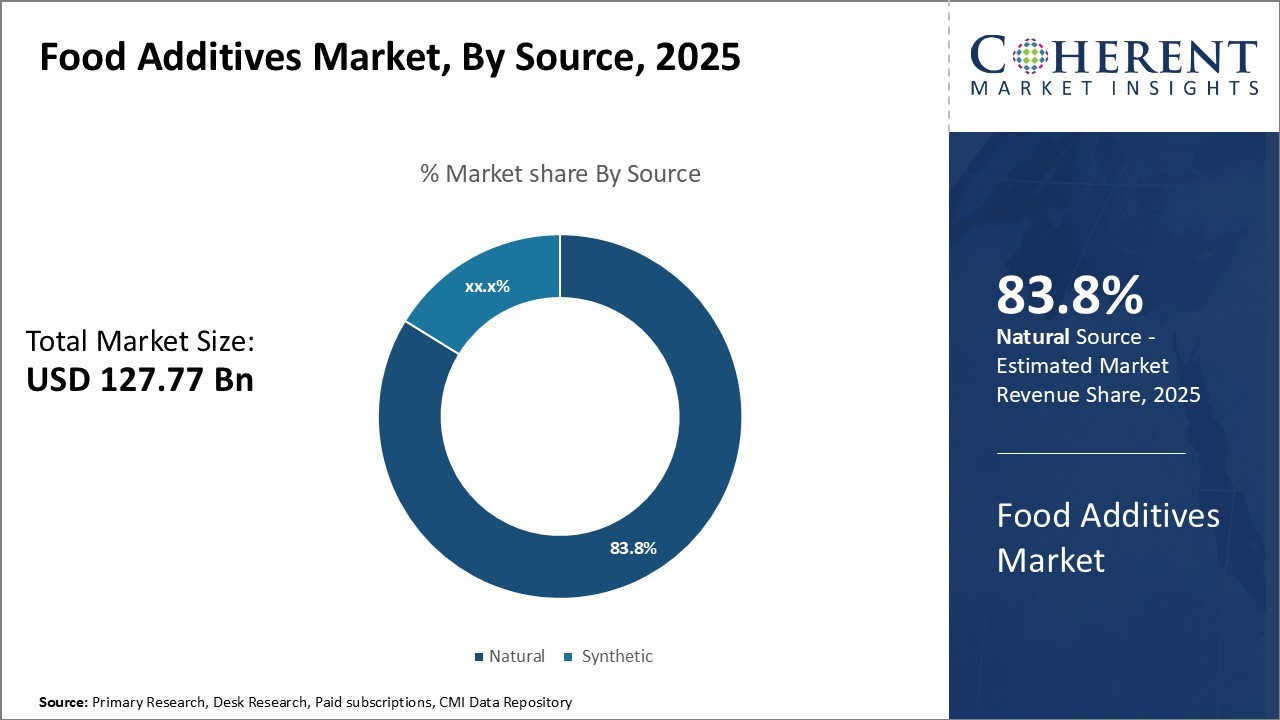
- In terms of Source, Natural Source Segment is expected to contribute 84.8% share of the market in 2026. This is due to increasing consumer preference for clean label and organic products.
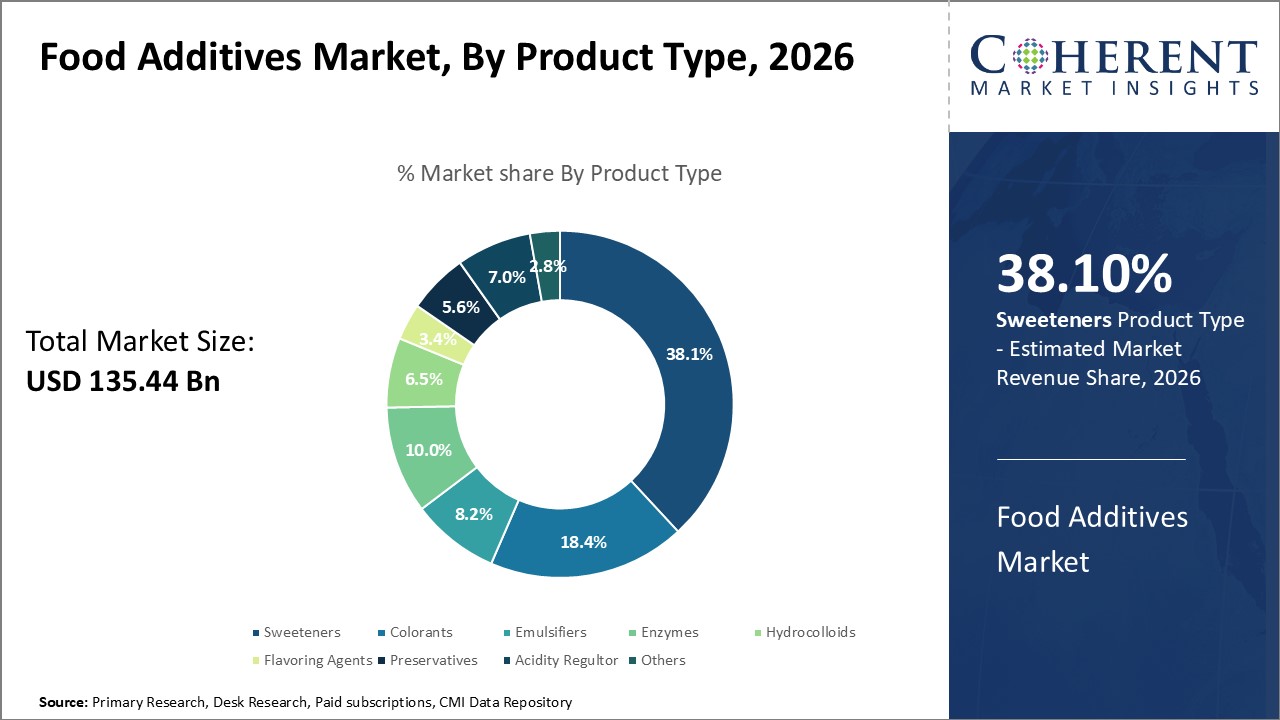
- In terms of Product Type, Sweeteners Segment is expected to contribute 38.1% share of the market in 2026. This is due to increasing sugar reduction demands and versatility across food categories.
- In terms of application, Bakery & confectionery segment is expected to contribute 42.7% share of the market in 2026. This is due to continual indulgence demands and sweet treat innovations.
- North America is expected to account for 39.3% of the market share in 2026. This is due to well-established food processing industry and habit of consuming packaged and processed food among population.
Market Overview
The market has been witnessing consistent growth over the past few years owing to rise in demand for convenience and packaged food products across both developed and developing countries worldwide. Factors such as increasing global population, changing consumer food preferences, and growing demand for processed and packaged food have been driving the demand for various types of food additives. Additionally, rapid urbanization and rising disposable income levels have also boosted the sales of packaged food, thereby driving the food additives market growth. However, increasing awareness about the ill effects of chemical food preservatives and additives and growing demand for clean label and organic products are expected to hamper the market growth over the forecast period.
Current Events and Its Impact on Food Additives Market
Current Events | Description and its impact |
Corbion Launches Verdad Ovvio 410, Clean-Label All-Natural Food Preservative |
|
FDA Clears Gardenia Blue for Use as a Natural Food Coloring |
|
Pricing Analysis
The cost of food additives is very varied depending on the type of additive, whether synthetic or naturally derived, its functional attribute, and the regional supply base. During 2024–2025, the standard price range of artificial food additives (e.g., preservatives, colorants, artificial food sweeteners) is quite consistent due to well-established processes of production and broad availability and typically falls between $3 and $10 per kg. However, the costs of natural and clean-label additives (such as plant-based colorants, enzymes, and natural preservatives) increased from $10 to $50 per kg or more, depending on purity, method of production, and origin.
This cost difference is a reflection of growing demand for organic and clean-label food products, especially in Europe and North America, where the public increasingly prefers less processed and healthier foods. Rising inflation pressure on raw materials like locust bean gum, guar gum, and natural extracts and higher energy and transport costs have contributed to production cost escalation and, consequently, end prices.
Large food additive categories that are experiencing dramatic pricing adjustments are natural antioxidants (such as rosemary and green tea extract) and natural colorants (such as beetroot red and spirulina), being more expensive due to complex extraction processes and limited supply bases. On the other hand, mass additives like emulsifiers, preservatives, and flavor enhancers still have relatively competitive prices due to manufacturing economies of scale.
In the future, prices of food additives are expected to remain volatile depending on raw material availability, regulatory shifts in direction toward clean label, and consumer trend in developed and emerging countries.
- Current Industry Events of 2026
- Market Size Estimation
- Regional Breakdown
- Competitive Landscape
- Customer Intelligence
- Segmental Analysis
- Pricing Analysis
- Key Market Drivers, Challenges & Future Trends
- Customized Insights Section
Role of Artificial Intelligence (AI) in the Food Additives Market
Artificial Intelligence (AI) is playing an important role in shaping the food additives sector by accelerating innovation, improving product safety, and maximizing supply chain effectiveness. In 2024–2025, AI is being used widely by food businesses and ingredient providers to develop new additive formulations based on shifting consumer trends towards clean-label, organic, and plant-based products.
AI-based algorithms are able to sift through huge sets of data on consumer trends, nutrition science, and market research to make forecasts on demand for certain kinds of additives—e.g., natural sweeteners or coloring agents—so that companies can target R&D spend effectively. For example, machine learning techniques are enabling scientists to discover alternative natural chemicals that replicate the performance of artificial preservatives without affecting safety or shelf life.
Predictive analytics and computer vision are implemented in quality control on AI-driven platforms to monitor real-time production parameters, ensuring uniform additive quality and regulatory adherence. This has been found especially critical for global players to contend with varying food safety regulations across geographic territories.
In addition, AI streamlines supply chain optimization by forecasting raw material supply and price to allow companies to hedge risks of ingredient shortages or price variations. AI also facilitates sustainability tracking through lifecycle analysis and carbon footprint quantification of additives.
With clean-label and personalized nutrition trends remaining in vogue, AI will remain a pivotal pillar technology—facilitating faster, lower-cost innovation of new, safe, and consumer-relevant food additives across global markets.
Market Concentration and Competitive Landscape
Market Drivers
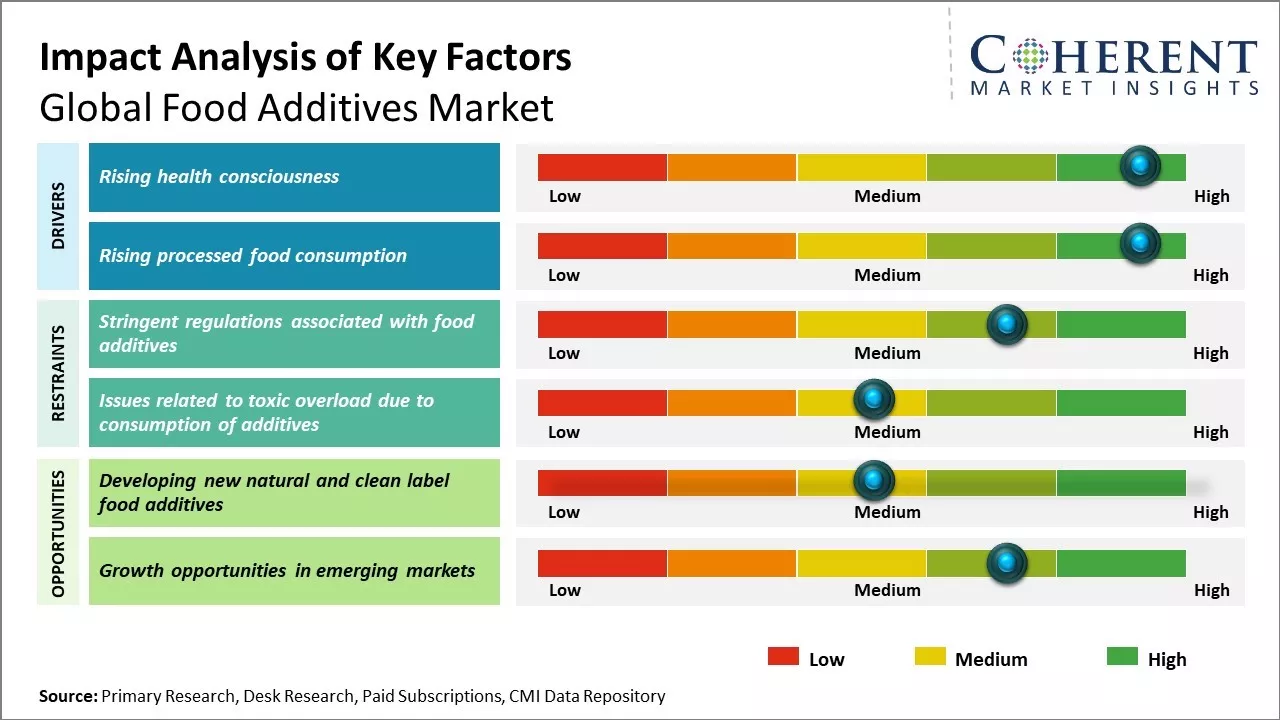
- Rising health consciousness
With growing awareness about health, consumers are increasingly demanding food and beverage products that are natural, clean labelled, and healthy. People are more informed about ingredients in packaged food and their potential negative impact on health. This is fueling the demand for food additives that can help manufacturers substitute artificial flavors, colors and preservatives with natural varieties.
Companies are under pressure to remove synthetic ingredients and switch to plant-based, organic and GMO-free food additives. The clean label trend is pushing food processors to find cost-effective and sustainable solutions to meet consumer aspirations for wholesome and nourishing products without compromising on taste and appearance. This consumer propensity towards naturalness and wellness will continue driving innovations in the food additive landscape, with increased spending on products featuring natural colors, flavors, texturizers and other attributes.
In 2025, the FDA approved gardenia (genipin) blue, a natural dye derived from the gardenia fruit, used in beverages, candies, and teas. This marked the fourth natural colorant approved within just two months—alongside butterfly pea flower and algal extracts—part of a broader initiative to phase out synthetic food dyes.
- Rising processed food consumption
As lifestyle changes lead to less time available for cooking homemade meals from scratch, the consumption of packaged and ready-to-eat food items is witnessing a strong growth worldwide. Working professionals and millennial population are favoring convenience foods that can be easily prepared or consumed on-the-go. Rapid urbanization is also contributing to this rise in demand for processed food, with busy urban dwellers heavily dependent on store-bought food products for their daily nutrition.
In order to ensure a longer shelf-life, improve sensory qualities and provide required consistency across batches, food additive usage becomes critical for processed food manufacturers. Food additives allow the production of products that closely resemble freshly made food in terms of taste, texture, and appearance while remaining shelf-stable for weeks or months.
Their functionality helps address the performance, safety, and quality challenges arising from large-scale processed food production. Hence, food additive suppliers stand to benefit tremendously from the soaring processed food business in both developing and developed nations.
Market Challenges: Stringent regulations associated with food additives
Stringent regulations associated with food additives are definitely restraining the growth of the global food additives market. Governments across the world are becoming increasingly vigilant about the kinds of additives permitted for use in food products and are imposing stricter norms for approval. This is driven by rising health consciousness among consumers and growing research linking certain additives to health issues like cancer, obesity, gastrointestinal disorders etc.
Market Opportunities: Developing new natural and clean label food additives
Developing new natural and clean label food additives can provide significant opportunities in the global food additives market. Consumers are increasingly demanding food products with simple and familiar ingredient lists, without artificial elements. This is a major trend seen worldwide according to reports from the UN Food and Agriculture Organization. People want to make informed choices about what they consume and try to avoid ingredients that sound highly processed or artificial.
Food companies are responding to these shifting preferences by innovating new types of natural and plant-based additives. Examples include plant-derived emulsifiers to replace hydrocolloids, natural extracts that act as preservatives and antioxidants, and herb and spice oils that provide flavor without synthetic sources.
Segmental Insights
Food Additives Market Insights, By Source
In terms of source, natural is expected to contribute 84.8% share of the market in 2026, owing to increasing consumer preference for clean label and organic products. As consumers have become more health conscious, they are actively seeking out products containing natural ingredients over synthetic alternatives.
This growing demand has significantly boosted the natural food additives segment. Customers see natural as meaning safer and more nutritious, stemming from the perception that natural equals closer to how nature intended. Food producers have responded to this demand by highlighting natural ingredients on their packaging and marketing campaigns to attract conscious buyers.
Regulatory pushes have also favored the natural segment. Stricter rules have been placed on synthetic compounds used in processed foods due to safety concerns. Facing increased scrutiny, manufacturers are turning to natural substitutes that are perceived as cleaner and pose fewer health risks. Nations worldwide have loosened restrictions on natural additives while tightening screws on synthetic options. Such policy shifts have streamlined adoption of natural ingredients across international markets.
Advancements in extraction and stabilization technologies have further spurred the natural segment's expansion. Previously, natural compounds were more expensive and difficult to work with compared to synthetic alternatives due to instability issues. However, innovations have allowed additives like natural colors and flavors to better retain qualities during processing, packaging, and shelf life. Their price points have also decreased versus synthetic analogs, raising appeal among cost-conscious producers.
Food Additives Market Insights, By Product Type
In terms of product type, sweeteners are expected to contribute 38.1% share of the market in 2026, due to increasing sugar reduction demands and versatility across food categories. The sweeteners segment occupies the top spot owing to growing needs for sugar reduction solutions. With obesity and diabetes epidemics fueled by excess sugar intake, health-conscious buyers are seeking lower sugar options. Food companies are responding to avoid alienating these health-driven shoppers by developing reduced and zero sugar variations of their products.
Sweeteners allow manufacturers to slash sugar content while maintaining flavor profiles. They are thus favored as sugar substitutes for reducing calorie and carbohydrate levels. High-intensity sweeteners in particular deliver the sweet taste with just a fraction of sugar's calories. Zero-calorie sweeteners satisfy indulgence cravings of dieters and diabetics looking for sugar-free alternatives.
Versatility is another key factor spurring sweeteners' prominent share. They can be easily incorporated across various food types from beverages to dairy without affecting other ingredient balances as sugar traditionally does. Their diverse applications ease product development and expansion into new categories compared to additives with more specific usage scopes. These attributes have helped establish sweeteners as essential tools for responding to evolving consumer nutrition demands.
Food Additives Market Insights, By Application
In terms of application, bakery & confectionery is expected to contribute 42.7% share of the market in 2026, driven by continual indulgence demands and sweet treat innovations. Even as priorities around health and wellness increase, the human need for taste enjoyment remains. Baked goods and sweets provide an affordable indulgence to satisfy cravings while bringing people together through sharing treats. Their comfort attributes have underpinned the segment's leadership position.
The baking industry consistently rolls out new product lines to capture shifting preferences and keep the customer experience fresh. Clean label, specialty, and artisan varieties attract those looking for premium, less processed options. Lower sugar innovations appeal to the health-conscious set without compromising on flavor. Seasonal and holiday-themed launches create excitement year-round.
Superior marketing also drives the baking slice. Compelling in-store and digital campaigns coupled with celebrity endorsements stoke customers' sweet tooth. Holiday eating traditions reinforce consumption. Bakeries strategically sample new items to pique interest, while convenient packaging encourages on-the-go indulgence.
Ongoing innovation and promotional avenues maintain consumers' appetite for sweet bakery goods, sustaining strong demand for relevant additives. In summary, the market forecast indicates additive suppliers will continue prioritizing these priority segments to capitalize on their growth potentials based on underlying consumer trends.
Food Additives Market - Regional Insights
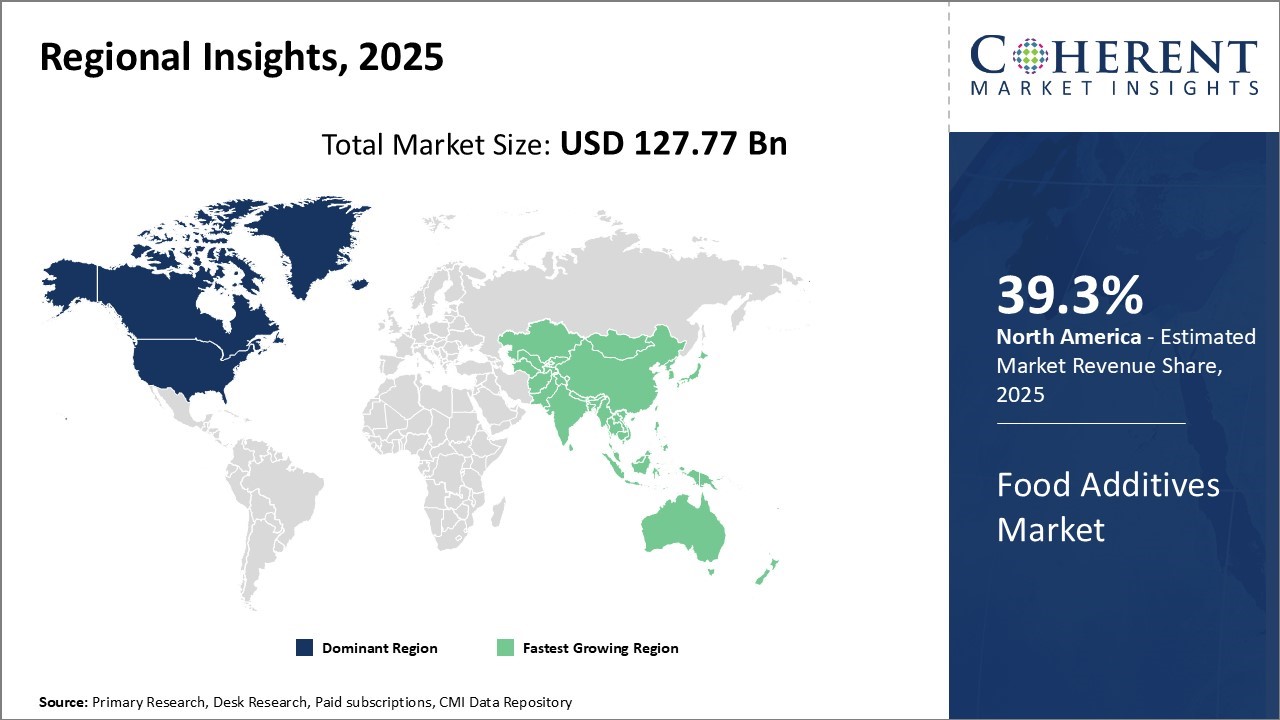
North America Food Additives Market Analysis and Trends
North America represents the largest regional market for food additives. The region is expected to account for 39.3% of the market share in 2026. The U.S. accounts for the bulk of the demand driven by a well-established food processing industry and habit of consuming packaged and processed food among population. Growth in snacking and beverages categories along with rising culture of eating out is positively influencing the market.
Presence of major global food additive manufacturers has created a conducive supply chain infrastructure to cater to the demand from food manufacturers. However, increasing health awareness and scrutiny around perceived health issues related to certain food additive categories is prompting companies to shift focus towards natural varieties.
Asia Pacific Food Additives Market Analysis and Trends
Asia Pacific is anticipated to be the fastest growing region over the forecast period for the food additives market. Rapidly growing population, economic development, and changing food consumption patterns in developing nations like India and China offer immense opportunities. Rising disposable incomes is driving the demand for packed food products.
This has propelled the growth of the organized food processing industry in the region. Both domestic and international food companies are investing heavily in capacities to meet the rising demand. Considerable imports of processed food from North America and Europe have also augmented the growth of the Asia Pacific food additives market.
Governments in Asia Pacific countries are supporting the industry by easing regulations and offering incentives to global ingredient suppliers. The regional market is anticipated to witness surge in demand across the emulsifiers, acidulants, and color additive categories.
Food Additives Market Dominating Countries
United States Food Additives Market Analysis and Trend
United States is the market leader in the world food additives market due to its highly evolved food processing industry and high level of demand for packaged foods and convenience foods. High consumer consciousness, sophisticated R&D infrastructure, and stringent FDA guidelines drive the application of traditional as well as clean-label additives in various industries like dairy, beverages, bakery, and ready-to-eat food.
China Food Additives Market Analysis and Trend
China is among the most dynamic drivers of the food additives market, fueled by vigorous urbanization, development of disposable income, and increasing demand for processed and functional foods. Domestic capacity for manufacturing, mass production of food, and export-led development of ingredients like MSG, sweeteners, and preservatives make China a leader in the Asia-Pacific region.
Germany Food Additives Market Analysis and Trend
Germany leads the European market with its strong regulatory framework and emphasis on food quality and safety. Natural and organic food additives have a high demand growing rapidly due to consumers' liking for clean-label products. Germany is also a center of innovation when it comes to flavor enhancers, natural colorants, and health-positive additives.
Japan Food Additives Market Analysis and Trend
Japan has a highly evolved food market with heavy emphasis on functionality, health, and food safety. It is a key market for specialist additives like enzyme-based preservatives, amino acids, and natural flavorings. Functional food additives' market is also driven further by aging populations and nutritional benefits.
Market Report Scope
Food Additives Market Report Coverage
| Report Coverage | Details | ||
|---|---|---|---|
| Base Year: | 2025 | Market Size in 2026: | USD 135.44 Bn |
| Historical Data for: | 2020 To 2024 | Forecast Period: | 2026 To 2033 |
| Forecast Period 2026 to 2033 CAGR: | 6.0% | 2033 Value Projection: | USD 203.65 Bn |
| Geographies covered: |
| ||
| Segments covered: |
| ||
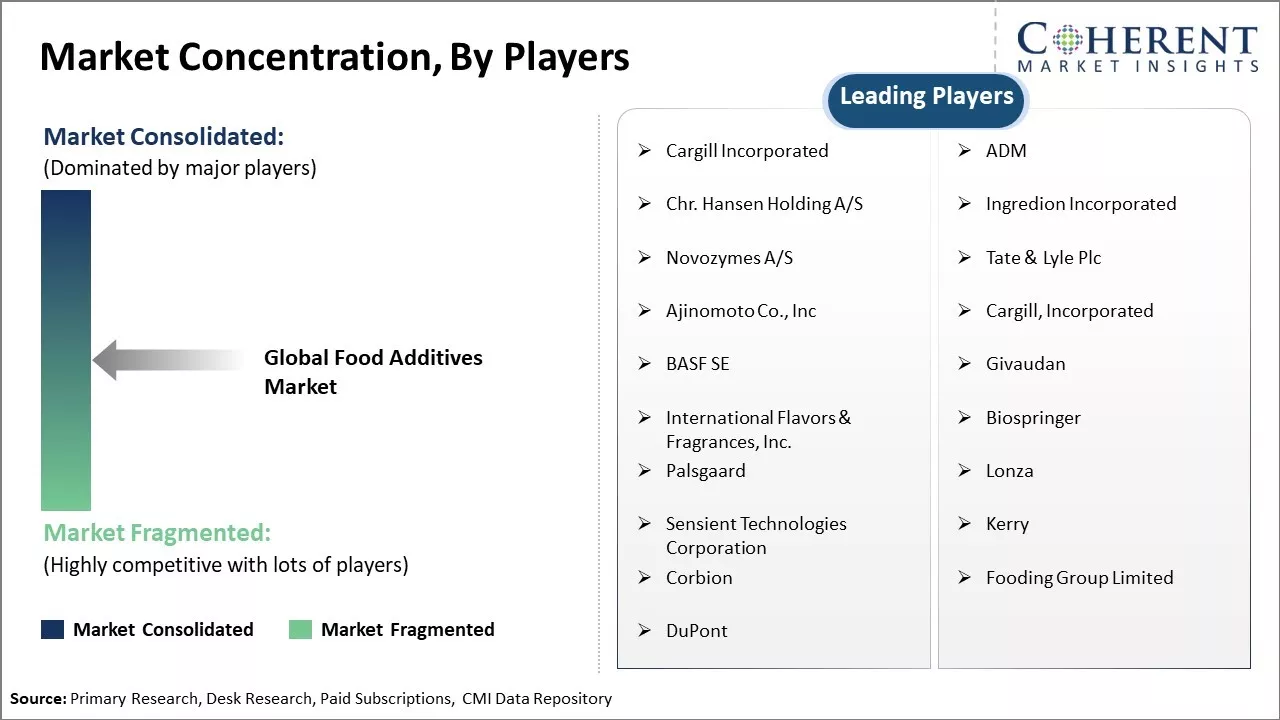
| Companies covered: | Cargill Incorporated, ADM, Chr. Hansen Holding A/S, Ingredion Incorporated, Novozymes A/S, Tate & Lyle Plc, Ajinomoto Co., Inc, Cargill, Incorporated, BASF SE, Givaudan, International Flavors & Fragrances, Inc., Biospringer, Palsgaard, Lonza, Sensient Technologies Corporation, Kerry, Corbion, Fooding Group Limited, DuPont | ||
| Growth Drivers: |
| ||
| Restraints & Challenges: |
| ||
Food Additives Industry News
- In May 2025, the U.S. Food and Drug Administration approved three novel natural food color additives—Galdieria extract blue, butterfly pea flower extract, and calcium phosphate—from red algae, flowers, and mineral sources. This effort is part of an overall FDA-HHS strategy initiated by Secretary Robert F. Kennedy Jr. to phase out synthetic petroleum-based dyes.
- In 2024, Ingredion introduced its Novation Indulge 2940; a non‑GMO native corn starch intended for clean‑label formulation requirements. It serves as a plant‑based texturizer substitute for modified starches, providing desirable gelling and texture in dairy, desserts, and alternative dairy—always with consumer demand for straightforward, familiar ingredients.
Key Takeaways from Analyst
- The food additives market shows strong promise for growth, driven by rising demand for processed and packaged food amid busy consumer lifestyles. The market has seen steady expansion across developing regions where the rate of urbanization is rapidly increasing. Additionally, the food additives market in dairy processing is gaining traction, as additives such as stabilizers, emulsifiers, and preservatives are increasingly used to enhance texture, shelf life, and nutritional value of dairy products.
- Changing consumer preference towards natural ingredients and increasing awareness about the harmful effects of artificial preservatives and colors pose a challenge for the growth of conventional additives. Stiff regulations around certain chemicals is another restraint.
- Nonetheless, this also brings an opportunity for manufacturers to invest in developing clean label and organic alternatives using natural sources. Ongoing R&D focus on multi-functional ingredients offering nutrition and extended shelf-life can help capture new markets.
- Suppliers will need to customize their portfolios and strengthen formulations tailored for specialty requirements of different food categories. Adapting to an evolving regulatory environment and changing customer priorities will remain important for sustaining leadership in the coming years.
Market Segmentation
- Source Insights (Revenue, USD Bn, 2021 - 2033)
- Natural
- Synthetic
- Product Type Insights (Revenue, USD Bn, 2021 - 2033)
- Acidity Regulators
- Colorants
- Emulsifiers
- Enzymes
- Hydrocolloids
- Flavoring Agents
- Preservatives
- Sweeteners
- Others
- Application Insights (Revenue, USD Bn, 2021 - 2033)
- Bakery & confectionery
- Beverages
- Convenience Foods
- Dairy & Frozen Desserts
- Others
- Regional Insights (Revenue, USD Bn, 2021 - 2033)
- North America
- U.S.
- Canada
- Latin America
- Brazil
- Argentina
- Mexico
- Rest of Latin America
- Europe
- Germany
- U.K.
- Spain
- France
- Italy
- Russia
- Rest of Europe
- Asia Pacific
- China
- India
- Japan
- Australia
- South Korea
- ASEAN
- Rest of Asia Pacific
- Middle East & Africa
- GCC Countries
- Israel
- Rest of Middle East & Africa
- Key Players Insights
- Cargill Incorporated
- ADM
- Chr. Hansen Holding A/S
- Ingredion Incorporated
- Novozymes A/S
- Tate & Lyle Plc
- Ajinomoto Co., Inc.
- Cargill, Incorporated
- BASF SE
- Givaudan
- International Flavors & Fragrances, Inc.
- Biospringer
- Palsgaard
- Lonza
- Sensient Technologies Corporation
- Kerry
- Corbion
- Fooding Group Limited
- DuPont
Sources
Primary Research Interviews
- Food additive manufacturers and suppliers
- Food processing companies executives
- Regulatory affairs specialists in food industry
- Food technology researchers and scientists
- Others
Databases
- FDA Food Additive Database
- EFSA (European Food Safety Authority) Database
- Mintel Global New Products Database
- Euromonitor International Database
- Others
Magazines
- Food Processing Magazine
- Food Technology Magazine
- Prepared Foods Magazine
- Food Manufacturing Magazine
- Food Business Magazine
- Others
Journals
- Food Additives & Contaminants Journal
- Journal of Food Science
- Food Chemistry Journal
- Others
Newspapers
- Food Chemical News
- Food Business News
- Nutraceuticals World
- Food Navigator
- Food Safety News
- Others
Associations
- International Food Additives Council (IFAC)
- Food and Drug Administration (FDA)
- European Food Safety Authority (EFSA)
- Institute of Food Technologists (IFT)
- Grocery Manufacturers Association (GMA)
- Others
Public Domain Sources
- WHO/FAO Joint Expert Committee on Food Additives (JECFA)
- Codex Alimentarius Commission
- U.S. Department of Agriculture (USDA)
- European Commission Health and Food Safety
- Others
Proprietary Elements
- CMI Data Analytics Tool
- Proprietary CMI Existing Repository of information for last 8 years
Get access to 250+ pages report
Every segment, forecast, competitor profile and data table behind the analysis above — available for instant download.
- ESOMAR Member
- ISO 9001:2015 Certified
- D-U-N-S Registered
- GDPR & CCPA Compliant
Missing comfort of reading report in your local language? Find your preferred language:
Transform your Strategy with Exclusive Trending Reports
Frequently Asked Questions
The Food Additives Market size is estimated to be valued at USD 135.44 Bn in 2026, and is expected to reach USD 203.65 Bn by 2033.
The CAGR of the global Market is projected to be 6.0% from 2026 to 2033.
Rising health consciousness and rising processed food consumption are the major factors driving the growth of the global market.
Stringent regulations associated with food additives and Issues related to toxic overload due to consumption of additives are the major factors hampering the growth of the global market.
Biotechnology is enabling sustainable production of food additives by using microbial fermentation and genetically engineered organisms to produce natural colors, flavors, enzymes, and preservatives with lower environmental impact.
Probiotics and prebiotics hold strong potential as functional food additives due to their proven health benefits, such as improving gut health and immunity, and are increasingly incorporated into beverages, dairy, and snacks.
Globally, regulatory bodies are tightening limits on synthetic food additives and encouraging the use of natural alternatives, with region-specific maximum levels increasingly reflecting consumer health concerns and clean-label movements.