

Digital Slide Scanners Market Size and Forecast – 2026-2033
The Global Digital Slide Scanners Market is estimated to be valued at USD 192.9 Mn in 2026 and is expected to reach USD 454.4 Mn by 2033, exhibiting a compound annual growth rate (CAGR) of 13.0% from 2026 to 2033.
Key Takeaways of the Global Digital Slide Scanners Market:
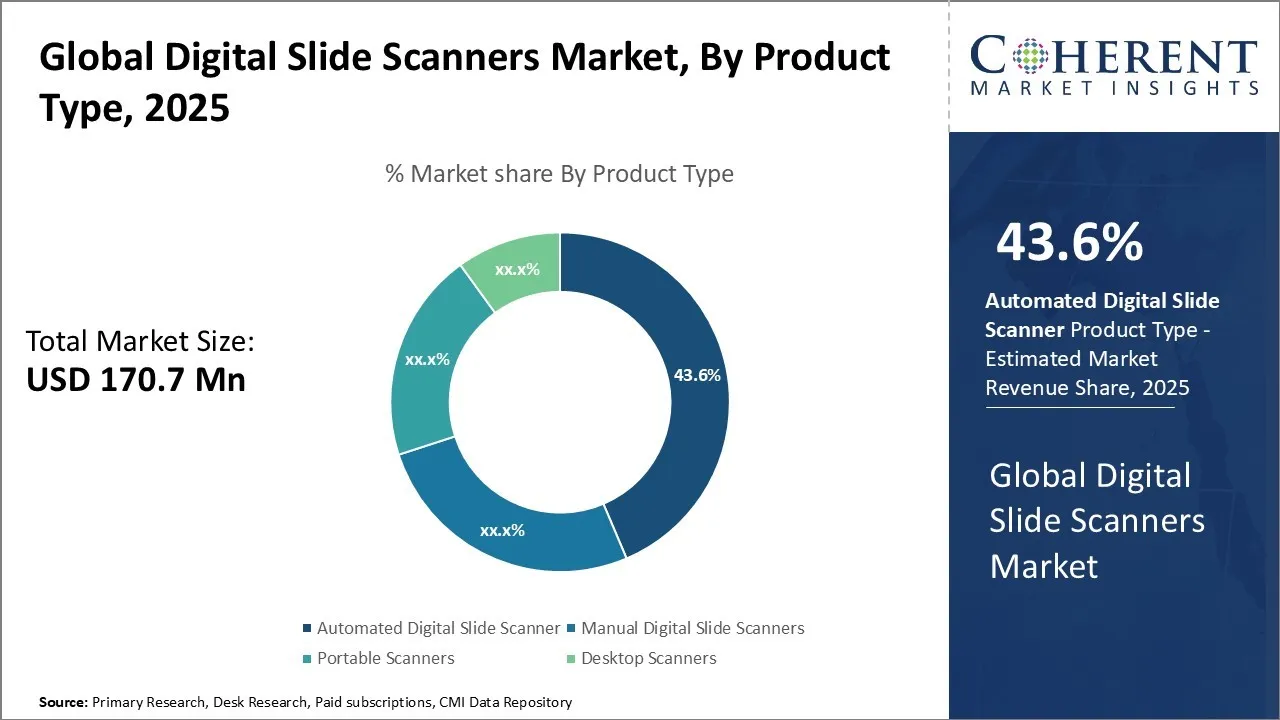
- By product type, the automated digital slide scanner segment is projected to account for the largest market share of 44.6% in 2026, driven by increasing demand for high-throughput pathology scanning solutions.
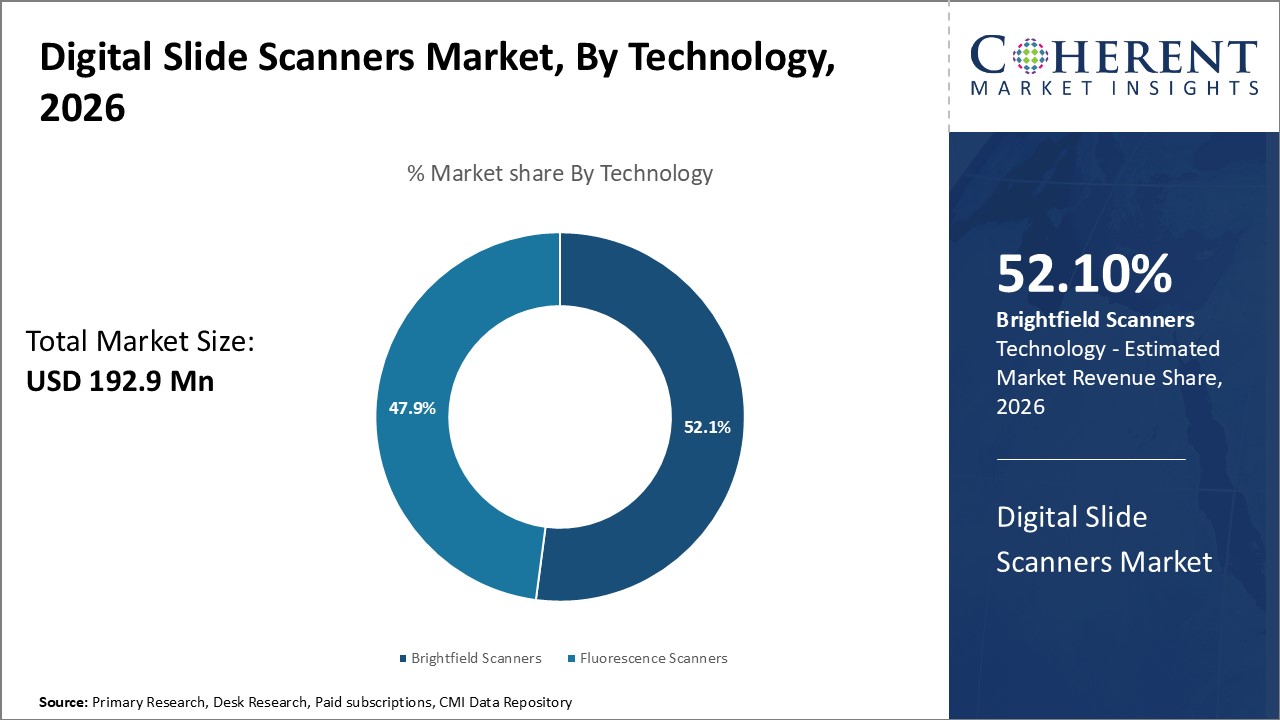
- By technology, the brightfield scanners segment is expected to dominate with a 52.1% share in 2026, while the fluorescence scanners segment is witnessing rapid growth, supported by advancements in fluorescence microscopy.
- By capacity, scanner in 1–60 slides capacity are set to lead the market with a 44.3% share in 2026, primarily catering to the operational needs of individual pathology laboratories.
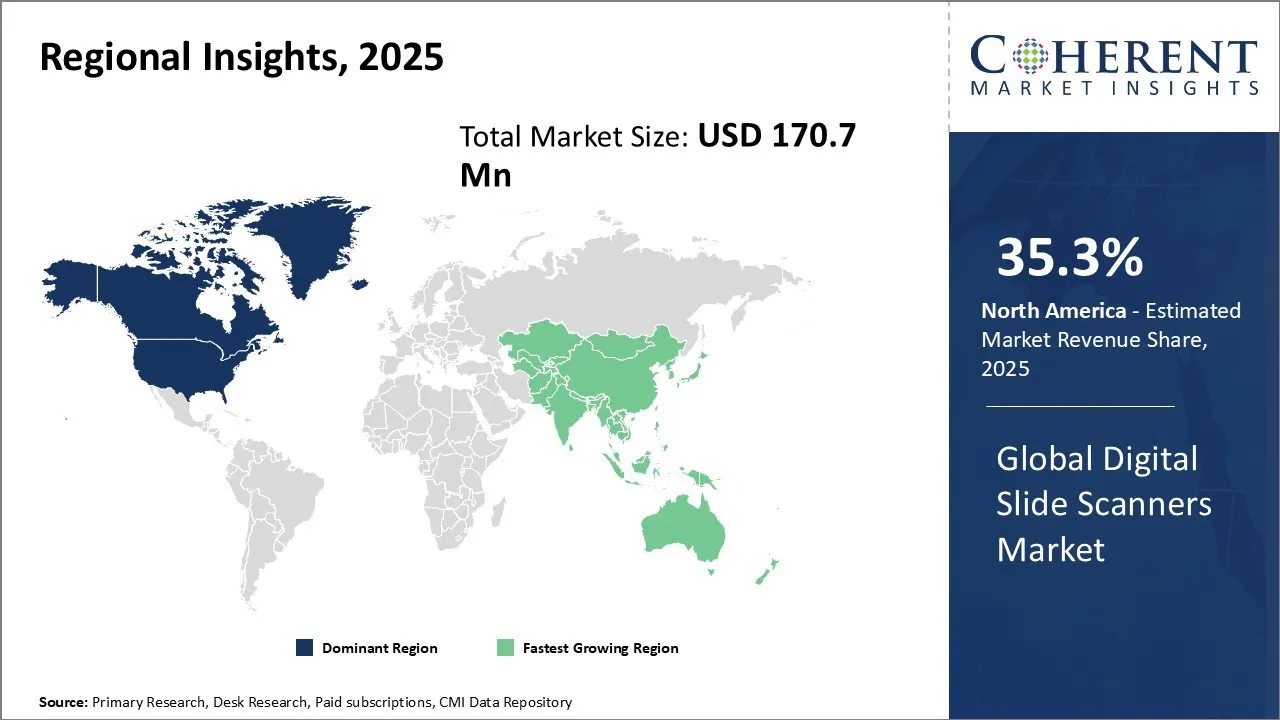
- Regionally, North America is expected to retain the largest market share at 35.3% in 2026, whereas Asia Pacific is forecasted to be the fastest-growing region, capturing 30.3% of the market by 2026.
Market Overview:
The market is expected to witness significant growth during the forecast period. This is owing to the increasing adoption of digital pathology as it provides fast and accurate diagnostics. Digitization of slides enables multi-user access and improved collaboration. In addition, digital slides storage helps reduce storage costs and has environmental benefits. Rising prevalence of chronic diseases is also driving the demand for digital slide scanners in disease diagnosis. Furthermore, ongoing technological advancements including the integration of deep learning and artificial intelligence are expected to augment the adoption of digital slide scanners.
Currents Events and Their Impact
Current Events | Description and its impact |
Expansion of Compact Digital Slide Scanners |
|
Adoption of Digital Pathology in Clinical Labs |
|
Segmental Analysis
- Current Industry Events of 2026
- Market Size Estimation
- Regional Breakdown
- Competitive Landscape
- Customer Intelligence
- Segmental Analysis
- Pricing Analysis
- Key Market Drivers, Challenges & Future Trends
- Customized Insights Section
Digital Slide Scanners Market Insights, By Product Type - Growing Demand for High-throughput Scanning Drives Automated Digital Slide Scanners
In terms of product type, the automated digital slide scanner segment is expected to contribute the highest share of the market with 44.6% in 2026 owing to growing demand for high-throughput pathology scanning. Automated scanners offer significant advantages over manual scanners such as higher scanning speed, simultaneous multi-slide scanning, and integrated computer systems for digital image analysis. Their high throughput abilities allow pathology laboratories to efficiently handle rising workload without increasing staff.
Growing clinical workload due to aging population and rising disease incidence have increased the need for faster turnaround times in diagnosis. Automated scanners help meet these demands and allow labs to scan several hundred slides per hour. Their walk-away scanning function frees up pathologists and technicians to focus on other tasks. Integration with laboratory information systems also streamlines workflow and enables computer-aided review of scanned images.
Digital Slide Scanners Market Insights, By Technology - Advancements in Fluorescence Technology Boosts Fluorescence Scanners
In terms of technology, the brightfield scanners segment is expected to contribute the highest share of the market with 52.1% in 2026. The dominance of this segment is also attributed to the cost-effectiveness and operational simplicity of brightfield scanning technology. These scanners offer efficient whole slide imaging (WSI) with minimal training required, which is particularly appealing for high-throughput laboratories and pathology departments transitioning from analog to digital workflows.
Moreover, the increasing implementation of digital pathology in cancer diagnostics, particularly in developed markets, continues to fuel demand for brightfield scanners. Technological advancements such as improved scanning speeds, enhanced image storage systems, and AI-assisted analysis further bolster the adoption of brightfield scanners across hospitals, diagnostic labs, and research institutions.
Digital Slide Scanners Market Insights, By Capacity - Smaller Capacity Scanners Dominate Due to Needs of Individual Laboratories
In terms of capacity, the scanner in 1-60 slides capacity segment is expected to contribute the highest share of the market with 44.3% in 2026 due to needs of individual pathology laboratories. Most hospital and clinical labs only require scanning few slides at a time for their daily workload and patient case load. Scanners with smaller 1-60 slide capacities are better suited for their space and budget requirements compared to high-end, large capacity scanners. They offer a good balance of cost and performance for individual labs. Some key advantages of these smaller scanners include compact desktop footprint, lower price point, and ease of use suited for occasional or regular daily scanning loads. Therefore, they remain the top choice for majority of hospitals, physician offices, and research institutes globally.
Regional Insights
North America Digital Slide Scanners Market Analysis and Trends
In North America, the dominance in the digital slide scanners market with an estimated share of 35.3% in 2026 can be attributed to robust healthcare infrastructure and rapid digitalization across hospitals and laboratories in the region. The presence of leading original equipment manufacturers (OEMs) such as Leica Biosystems, 3DHISTECH, and Hamamatsu Photonics has propelled market growth.
For instance, in July 2024, AGFA HealthCare, a global leader in medical imaging, in partnership with Corista, a digital pathology software company, launched its integrated digital pathology solution—Enterprise Imaging for Pathology powered by Corista DP3—in North America.
Asia Pacific Digital Slide Scanners Market Analysis and Trends
The Asia Pacific region is expected to exhibit the fastest growth with a share of 30.3% in 2026 on account of rising healthcare expenditure, increasing focus on improving diagnostic capabilities, and growing base of industry players like Nikon and Olympus expanding their footprint. Countries like China, India, and South Korea are witnessing heavy investments in healthcare innovation and precision medicine, driving the need for advanced pathology tools. In addition, favorable government policies supporting technology adoption in healthcare are projected to keep Asia Pacific at the forefront of the digital slide scanners market evolution in the coming years.
Digital Slide Scanners Market Outlook for Key Countries
U.S. Digital Slide Scanners Market Analysis and Trends
The U.S. digital slide scanners market is witnessing strong growth, driven by the rising adoption of digital pathology, advancements in whole slide imaging, and increasing demand for remote diagnostics. Hospitals, research institutes, and pathology labs are rapidly integrating scanners to improve diagnostic accuracy and workflow efficiency. For instance, the United States and Canadian Academy of Pathology (USCAP) has installed a Hamamatsu NanoZoomer S20 digital slide scanner at its Palm Springs Interactive Learning Center, starting September 2024. This upgrade enables the scanning and sharing of whole slide images across all courses and through the USCAP eLearning Center.
China Digital Slide Scanners Market Analysis and Trends
China digital slide scanners market continues rapid expansion on the back of heavy Chinese government funding in biomedical research and precision medicine. Domestic players like Sunquest are also emerging as significant contenders with their cost-effective scanners. For instance, in February 2023, Chinese manufacturer, KFBIO, received regulatory approval for its KF-PRO-005-DX digital pathology system, becoming the third Chinese-developed system approved for clinical diagnostic use. This milestone reflects China's growing technological capabilities in this sector.
Germany Digital Slide Scanners Market Analysis and Trends
Germany represents a cornerstone of the Europe digital slide scanners market, with detailed market outlook analysis by product and application available in industry reports. The country's robust healthcare system and technological innovation drive market expansion. German company, ZEISS, is prominently featured among major digital slide scanner manufacturers, contributing to the country's significant market position. The Europe digital slide scanners market benefits from stringent regulations and strong focus on sustainability initiatives.
U.K. Digital Slide Scanners Market Analysis and Trends
Driven by the National Health Service (NHS) strategy to embrace digital pathology networks, the U.K. digital slide scanners market has witnessed growing momentum. The NHS partnerships with technology providers are aiding nationwide rollout of whole slide imaging solutions. Simultaneously, private pathology groups are making headway with cloud-based innovations centered on AI and multiplexed staining.
End User Feedback and Unmet Needs in the Global Digital Slide Scanners Market
End user feedback is crucial in driving innovation in digital slide scanners. Healthcare professionals often highlight the need for enhanced image quality and faster processing to boost diagnostic efficiency. A key challenge remains interoperability, with many scanners struggling to integrate seamlessly with existing Laboratory Information Systems (LIS), disrupting workflow. Despite increased adoption, pathologists frequently report workflow inefficiencies with digital systems. According to a July 2022 study published in Frontiers in Medicine, most pathologists still view traditional microscopy as the benchmark for diagnostic accuracy, speed, and overall efficiency. Affordability is another unmet need, especially for small labs and educational institutions, with users seeking cost-effective yet functional solutions. Additionally, users highlight the importance of robust training and ongoing technical support to ensure optimal use and smooth operation. Addressing these pain points is essential for boosting adoption and user satisfaction.
Market Players, Key Developments, and Competitive Intelligence
Key Developments:
- On April 9, 2025, Hamamatsu Photonics, a global leader in imaging technology, launched the NanoZoomer S540MD Slide scanner system (C17400-21MDEU), designed to meet the needs of clinical pathology labs. This high-throughput system can scan up to 540 slides in a single run, offering continuous loading for added efficiency. With advanced workflow optimization, exceptional image quality, and compatibility with industry-standard slide racks, the S540MD enhances productivity in high-volume laboratories.
- In September 2024, Vieworks, a leading bioimaging company, launched the LUCEON 510, a high-speed slide scanner for digital pathology. The company debuted its new technology at the European Congress of Pathology (ECP) 2024 in Florence, showcasing its advancements in the field.
- In July 2024 Grundium, a provider of digital pathology solutions, introduced the Ocus M 40, its first multi-slide scanner capable of scanning up to four slides at once. This scanner combines increased capacity with Grundium's compact design, meeting the needs of pathology professionals.
- In June 2023, Evident, a scientific solutions company, launched the SLIDEVIEW DX VS-M1, a high-speed whole slide imaging system designed to assist pathologists with fast, accurate diagnoses. It provides microscope-quality images using True Color LED light sources for precise color reproduction and advanced digital technology. The system scans over 80 slides per hour with real-time autofocus, and its user-friendly interface, including a large touchscreen and virtual slide tray, ensures efficient workflow in busy labs.
Top Strategies Followed by Global Digital Slide Scanners Market Players
- Established Players: Leading companies in the digital slide scanners market heavily invest in research and development to produce innovative products. This allows them to introduce high-performance scanners with advanced imaging technologies like whole slide imaging and AI integration.
- For instance, in May 2024, GE HealthCare, a leading medical technology innovator, and Tampa General Hospital (TGH), academic health systems, expanded their long-term partnership to deploy GE’s advanced imaging and ultrasound technologies across TGH Imaging’s outpatient facilities in Florida. The collaboration aims to enhance diagnostic speed and accuracy, leading to improved treatment planning and patient outcomes.
- Mid-Level Players: Mid-sized companies pursue strategies focused on price competitiveness. Companies like Olympus and Roche focus on producing quality scanners at affordable prices to appeal to healthcare facilities working with limited budgets.
- For instance, in March 2023, Agilent Technologies, a global leader in life sciences, diagnostics, partnered with Hamamatsu Photonics, a global leader in imaging technology, to integrate the NanoZoomer Slide Scanner, including the S360MD system, into its digital pathology platform. This collaboration enhances Agilent’s open, scalable, and agnostic workflow designed to support precision medicine. Amid rising diagnostic demands and remote work trends, the partnership aims to boost lab efficiency and diagnostic speed.
- Small-Scale Players: Small-scale players typically adopt niche specialization, targeting specific segments of the digital slide scanners market with unique features or innovative products. This strategy allows them to carve out a distinct identity in a crowded marketplace.
- For Instance, in April 2021, ZEISS, a technology company, launched the Axioscan 7, a next-generation slide scanner that builds on the success of the Axio Scan.Z1. It offers faster scan speeds, expanded imaging modes, advanced fluorescence capabilities, and an enhanced user experience.
Market Report Scope
Digital Slide Scanners Market Report Coverage
| Report Coverage | Details | ||
|---|---|---|---|
| Base Year: | 2025 | Market Size in 2026: | USD 192.9 Mn |
| Historical Data for: | 2020 To 2024 | Forecast Period: | 2026 To 2033 |
| Forecast Period 2026 to 2033 CAGR: | 13.0% | 2033 Value Projection: | USD 454.4 Mn |
| Geographies covered: |
| ||
| Segments covered: |
| ||
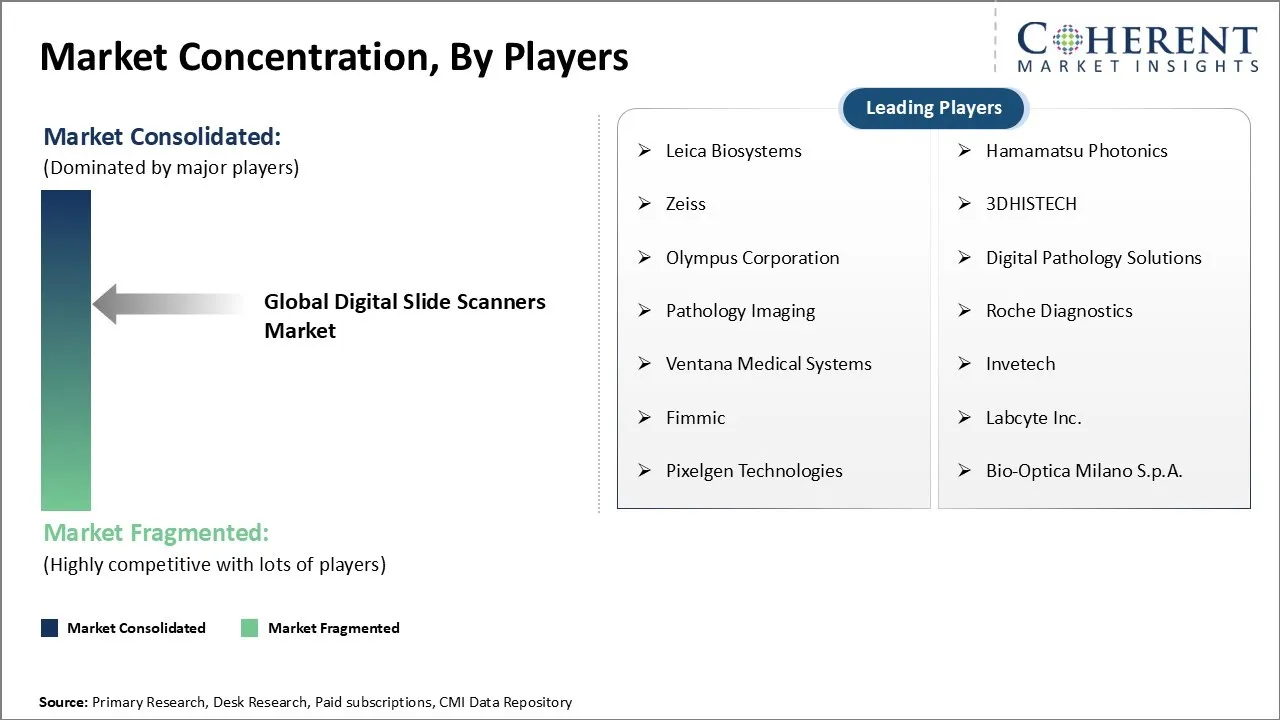
| Companies covered: | Leica Biosystems, Hamamatsu Photonics, Zeiss, 3DHISTECH, Olympus Corporation, Digital Pathology Solutions, Pathology Imaging, Roche Diagnostics, Ventana Medical Systems, Invetech, Fimmic, Labcyte Inc., Pixelgen Technologies, and Bio-Optica Milano S.p.A. | ||
| Growth Drivers: |
| ||
| Restraints & Challenges: |
| ||
Digital Slide Scanners Market Dynamics
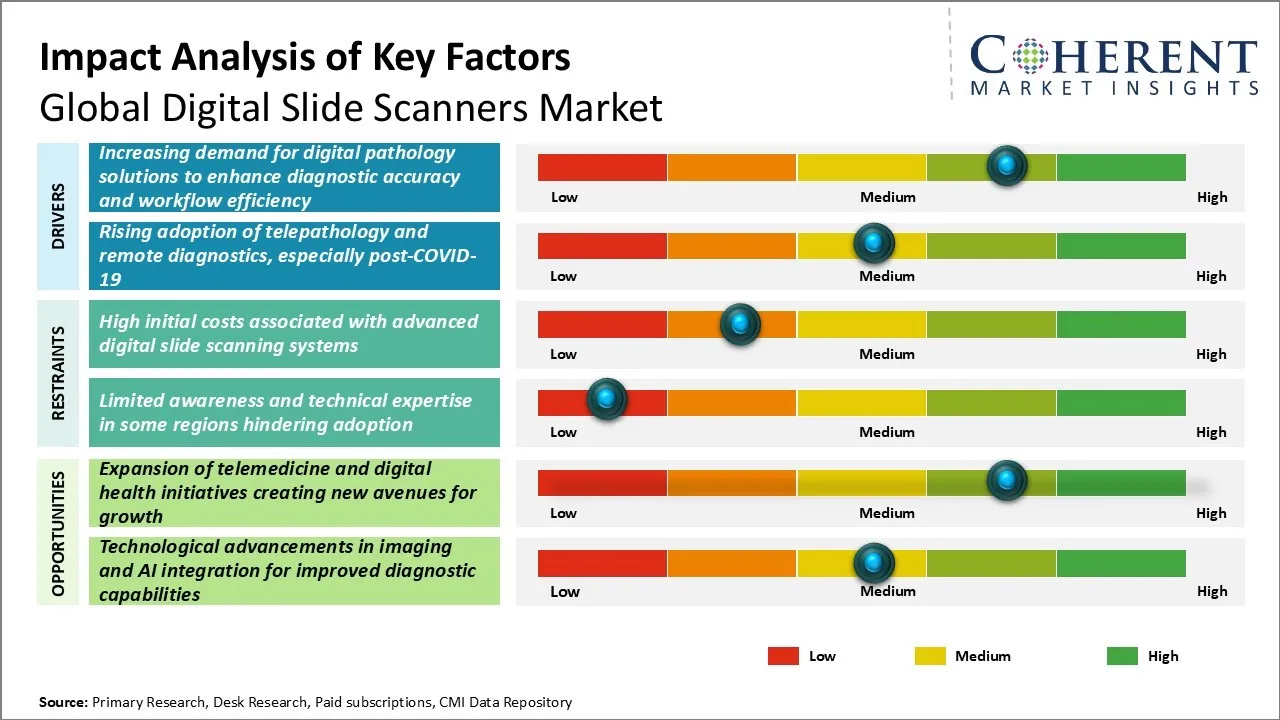
Digital Slide Scanners Market Driver - Increasing demand for digital pathology solutions to enhance diagnostic accuracy and workflow efficiency
With the advancement of technology, digital pathology is gaining popularity over conventional glass slides. The traditional method of examining glass slides under a microscope is time-consuming and prone to errors. Digital slide scanners allow pathologists to scan and digitize glass slides and examine them digitally on computer screens. This helps enhance diagnostic accuracy as digital images can be magnified more than conventional microscopy and multiple pathologists can examine the same slides remotely and collaboratively.
Digital slides also improve workflow efficiency in laboratories as they can be stored digitally and don't take up physical storage space like glass slides. Multiple users can access the same digitized slides simultaneously. For instance, in March 2025, Philips, a global leader in health technology, and Ibex Medical Analytics expanded their partnership to advance AI-enabled digital pathology solutions. The latest release of Philips IntelliSite Pathology Solution (PIPS) enhances interoperability and supports more efficient, accurate cancer diagnostics. This collaboration addresses the global shortage of pathologists and rising cancer cases, aiming to streamline workflows and improve patient care outcomes.
Digital Slide Scanners Market Opportunity - Expansion of telemedicine and digital health initiatives creating new avenues for growth for market
One of the major opportunities for the global digital slide scanners market is the expansion of telemedicine and digital health initiatives across the globe. With the growth of teleradiology and telepathology practices, digital whole slide imaging is proving very useful for virtual consultations and second opinions. The ability to digitally share high quality pathology slides over internet in real time is supporting improved healthcare access for remote and underserved regions. It is also helping establish international networks of pathology experts for complex cases. With governments and private organizations increasing their focus on remote healthcare delivery through initiatives like telehealth and digital healthcare infrastructure development, the demand for digital slide scanners is expected to witness a strong boost. This will create new avenues for growth for players in the global digital slide scanners market.
For instance, in January 2025, Roche, a global pioneer in pharmaceuticals and diagnostics, announced an additional 510(k) FDA clearance for its Roche Digital Pathology Dx system, now including the high-capacity VENTANA DP 600 slide scanner. This expands on the prior June 2024 clearance, which covered the DP 200 scanner, workflow software, and display. The DP 600 enables high-resolution imaging of stained tissue samples to support cancer diagnosis and treatment planning, further advancing digital transformation in pathology labs and improving healthcare efficiency.
Analyst Opinion (Expert Opinion)
- The global digital slide scanners market is experiencing robust growth, fueled by the rising adoption of digital pathology, especially in cancer diagnostics and research applications. Technological advancements—such as AI-powered image analysis, high-throughput scanning systems, and cloud-based storage solutions—are significantly improving diagnostic accuracy and workflow efficiency. Regulatory support, including recent USFDA clearances (e.g., Roche’s VENTANA DP 600 in 2025), is accelerating market penetration in clinical settings. Emerging opportunities lie in the expansion of telepathology in remote and underserved regions, while key challenges include high implementation costs, data security concerns, and integration complexities with legacy lab systems.
- Recent industry events such as the Digital Pathology & AI Congress (USA and Europe editions), the USCAP Annual Meeting, and the Pathology Visions Conference have played pivotal roles in showcasing innovations and shaping global adoption trends. Initiatives like the NHS’s digital pathology rollout in the UK and Japan’s national cancer screening modernization highlight how public and private collaborations are driving digital transformation. Moreover, Roche’s USFDA-cleared digital pathology ecosystem and Philips’ enterprise imaging solutions exemplify how major players are enabling scalable and clinically validated deployments, setting the tone for the next phase of market expansion.
Speak to the analyst
Want personalized insights?
Take the findings above to one of our principal consultants, or have the report rebuilt around the segments, geographies and competitors you actually track.
Market Segmentation
Product Type Insights (Revenue, USD Mn, 2021 - 2033)
- Automated Digital Slide Scanner
- Manual Digital Slide Scanners
- Portable Scanners
- Desktop Scanners
Technology Insights (Revenue, USD Mn, 2021 - 2033)
- Brightfield Scanners
- Fluorescence Scanners
Capacity Insights (Revenue, USD Mn, 2021 - 2033)
- Scanner in 1-60 slides capacity
- Scanner in 61-299 slides capacity
- Scanner in 300 slides capacity
Application Insights (Revenue, USD Mn, 2021 - 2033)
- Clinical Diagnostics
- Scientific Research
- Medical Diagnostics
End User Insights (Revenue, USD Mn, 2021 - 2033)
- Hospitals & Clinical Pathology Labs
- Biopharmaceutical & Biotech Companies
- Academic & Research Institutes
- Others
Regional Insights (Revenue, USD Mn, 2021 - 2033)
- North America
- U.S.
- Canada
- Latin America
- Brazil
- Argentina
- Mexico
- Rest of Latin America
- Europe
- Germany
- U.K.
- Spain
- France
- Italy
- Russia
- Rest of Europe
- Asia Pacific
- China
- India
- Japan
- Australia
- South Korea
- ASEAN
- Rest of Asia Pacific
- Middle East
- GCC Countries
- Israel
- Rest of Middle East
- Africa
- South Africa
- North Africa
- Central Africa
Key Players Insights
- Leica Biosystems
- Hamamatsu Photonics
- Zeiss
- 3DHISTECH
- Olympus Corporation
- Digital Pathology Solutions
- Pathology Imaging
- Roche Diagnostics
- Ventana Medical Systems
- Invetech
- Fimmic
- Labcyte Inc.
- Pixelgen Technologies
- Bio-Optica Milano S.p.A.
Sources
Primary Research Interviews:
- Pathologists and laboratory technicians
- Hospital IT administrators
- Medical device manufacturers
- Academic and research institutions
Databases:
- OECD Health Statistics
- WHO Global Health Observatory
- UN Comtrade Database
Magazines:
- Digital Pathology Today
- Lab Manager Magazine
- Medical Device and Diagnostics Industry (MD+DI)
Journals:
- Journal of Pathology Informatics
- Diagnostic Pathology
- Journal of Biomedical Optics
Newspapers:
- The New York Times
- The Guardian
- The Times of India
Associations:
- Digital Pathology Association (DPA)
- European Society for Digital and Integrative Pathology (ESDIP)
- College of American Pathologists (CAP)
Public Domain Sources:
- U.S. Food and Drug Administration (FDA)
- European Medicines Agency (EMA)
- National Institutes of Health (NIH)
- World Health Organization (WHO)
Proprietary Elements:
- CMI Data Analytics Tool: Proprietary analytics tool to analyze real-time market trends, consumer behavior, and technology adoption in dark factories.
- Proprietary CMI Existing Repository of Information for Last 8 Years
Get access to 250+ pages report
Every segment, forecast, competitor profile and data table behind the analysis above — available for instant download.
- ESOMAR Member
- ISO 9001:2015 Certified
- D-U-N-S Registered
- GDPR & CCPA Compliant
Missing comfort of reading report in your local language? Find your preferred language:
Transform your Strategy with Exclusive Trending Reports
Frequently Asked Questions
The global digital slide scanners market is estimated to be valued at USD 170.7 Mn in 2025 and is expected to reach USD 397.1 Mn by 2032.
The CAGR of the global digital slide scanners market is projected to be 12.82% from 2025 to 2032.
Increasing demand for digital pathology solutions to enhance diagnostic accuracy and workflow efficiency and rising adoption of telepathology and remote diagnostics, especially post-COVID-19 are the major factors driving the growth of the global digital slide scanners market.
High initial costs associated with advanced digital slide scanning systems and limited awareness and technical expertise in some regions hindering adoption are the major factors hampering the growth of the global digital slide scanners market.
In terms of product type, the automated digital slide scanner segment is estimated to dominate the market revenue share in 2025.
Leica Biosystems, Hamamatsu Photonics, Zeiss, 3DHISTECH, Olympus Corporation, Digital Pathology Solutions, Pathology Imaging, Roche Diagnostics, Ventana Medical Systems, Invetech, Fimmic, Labcyte Inc., Pixelgen Technologies, and Bio-Optica Milano S.p.A. are the major players.
North America is expected to lead the global digital slide scanners market in 2025.