

Global Edge Security Market Size and Forecast – 2026-2033
The global edge security market is estimated to be valued at USD 33.40 Bn in 2026 and is expected to reach USD 126.12 Bn by 2033, exhibiting a compound annual growth rate (CAGR) of 20.9% from 2026 to 2033.
Key Takeaways of the Global Edge Security Market
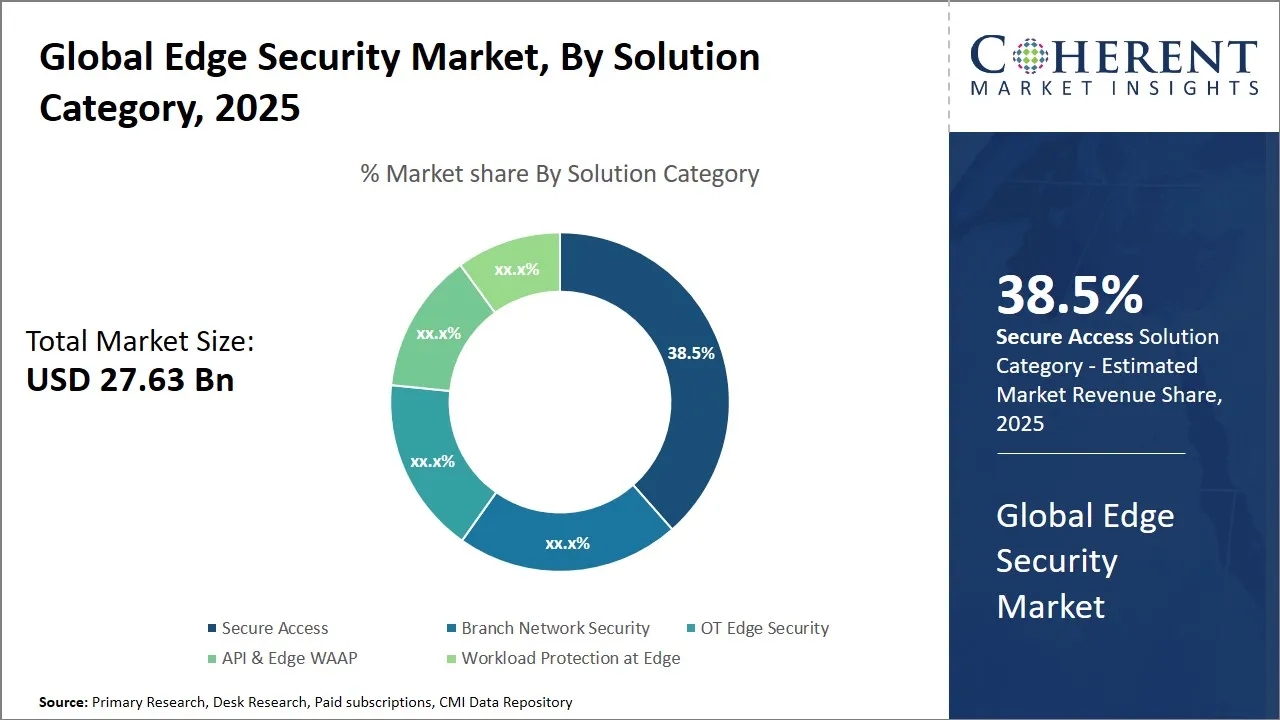
- The secure access segment leads the market holding an estimated share of 39.5 % in 2026.
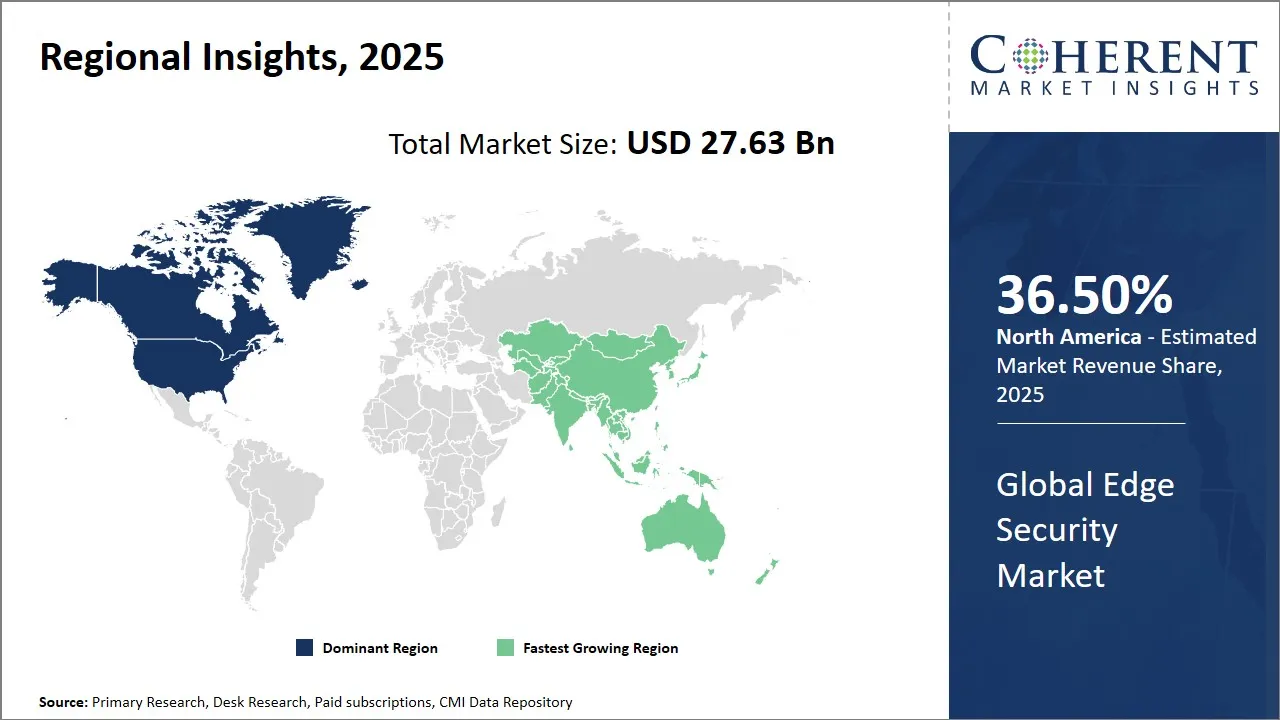
- North America is estimated to lead the market with a share of 36.5 % in 2026
- Asia Pacific, holding an estimated share of 29.2 % in 2026, is projected to be the fastest growing region.
Market Overview
A market trends indicate a significant shift towards integrating artificial intelligence and machine learning with edge security platforms to enhance real-time threat detection and response capabilities. Additionally, the rise of 5G technology and connected devices further intensifies the need for decentralized security frameworks, enabling faster data processing and improved protection against sophisticated cyberattacks. Vendors focusing on scalable, flexible, and automated edge security solutions are poised to capture a substantial market share moving forward.
Current Events and Its Impact
Current Events | Description and its Impact |
Geopolitical & Regulatory Developments |
|
Technology & Infrastructure Trends |
|
Segmental Insights
- Current Industry Events of 2026
- Market Size Estimation
- Regional Breakdown
- Competitive Landscape
- Customer Intelligence
- Segmental Analysis
- Pricing Analysis
- Key Market Drivers, Challenges & Future Trends
- Customized Insights Section
Global Edge Security Market Insights, by Solution Category – Rising Demand for Robust Identity and Access Management Drives Secure Access Segment Growth
The secure access segment is projected to hold 39.5% of the market share in 2026. As organizations embrace digital transformation, the perimeter of traditional IT environments is rapidly dissolving, giving rise to a more distributed and dynamic network infrastructure. This shift creates significant challenges in controlling and monitoring user access to critical applications and data, making secure access solutions indispensable.
One of the main growth drivers for this segment is the widespread adoption of zero trust security frameworks, which prioritize strict verification of every user and device attempting to access enterprise resources regardless of their location. Secure access technologies such as Multi-Factor Authentication (MFA), Single Sign-On (SSO), and adaptive access controls play a crucial role in enforcing zero trust principles, thereby enhancing security postures and reducing the risk of unauthorized access, insider threats, and data breaches. In August 2025, AT&T Business and Cisco jointly launched a cloud-delivered Secure Access Service Edge (SASE) solution for U.S. enterprises. The platform integrates Zero Trust Network Access (ZTNA), Multi-Factor Authentication (MFA), and secure SD-WAN to provide seamless yet robust access management for distributed workforces.
Additionally, the surge in remote working models and cloud adoption has magnified the importance of secure access solutions. As employees and third-party partners connect to corporate networks from diverse locations using various devices, enterprises demand seamless yet highly secure methods to authenticate and authorize access. This drives the deployment of Secure Access Service Edge (SASE) architectures and cloud-native access management platforms that combine network security and identity services for improved performance and security.
Regulatory compliance requirements also propel the adoption of secure access solutions. Various industry regulations mandate stringent access controls to protect sensitive information, encouraging organizations to invest heavily in technologies that provide detailed access logs, real-time monitoring, and automated policy enforcement capabilities.
Impact of AI on the Edge Security Market
Artificial Intelligence (AI) is transforming edge security by enabling faster, more adaptive threat detection and response in distributed environments. At the edge, traditional signature-based defenses struggle to keep pace with the volume of traffic and diversity of endpoints, particularly across IoT/OT networks and 5G/MEC deployments. AI-driven models enhance anomaly detection, automate policy enforcement, and support predictive analytics to stop attacks before they propagate. This shift is particularly critical as enterprises adopt Zero Trust and SASE frameworks, where AI strengthens user and device behavior analysis to verify trust continuously.
A real-world example comes from Zscaler’s acquisition of Red Canary in 2025, where advanced AI-driven detection and response capabilities were integrated into its cloud-native edge security platform.
Regional Insights
North America Edge Security Market Analysis and Trends
The North America region is projected to lead the market with a 36.5% share in 2026, driven by a mature technology ecosystem, robust government initiatives, and the strong presence of key industry players. The region benefits from extensive investments in cybersecurity infrastructure and stringent regulatory frameworks that emphasize data privacy and protection, such as Health Insurance Portability and Accountability Act (HIPAA) and California Consumer Privacy Act (CCPA). Additionally, the high adoption rate of IoT devices and edge computing solutions by enterprises and government agencies accelerates the demand for edge security solutions. Major companies such as Cisco Systems, Palo Alto Networks, and Fortinet maintain substantial market presence here, focusing on developing integrated edge security platforms that address cloud-edge hybrid environments. North America also benefits from a well-established supply chain and extensive R&D activities that continuously foster innovation within the edge security domain.
Asia Pacific Edge Security Market Analysis and Trends
Asia Pacific, holding an estimated share of 29.2% in 2026, exhibits the fastest growth in the global edge security market, underpinned by rapid digital transformation initiatives, expanding IoT applications, and increasing cyber threats in emerging economies. Government policies in countries like China, India, South Korea, and Japan emphasize cybersecurity enhancement through national strategies and large-scale smart city projects, which drive the market demand. The region is witnessing significant investments in edge computing infrastructure to support real-time data processing and analytics at the network edge. The growing number of startups and technology firms specializing in edge security solutions, including Huawei, Tencent, and Samsung SDS, contribute to accelerating market expansion. Furthermore, trade dynamics such as improving telecommunications infrastructure and cross-border collaborations are propelling the adoption of advanced security technologies at the edge.
Global Edge Security Market Outlook for Key Countries
U.S. Edge Security Market Analysis and Trends
The U.S. stands at the forefront due to high technological adoption and stringent cybersecurity regulations. Leading players such as Cisco, Palo Alto Networks, and Check Point Software Technologies drive innovation by offering comprehensive edge security solutions tailored for enterprises and critical infrastructure sectors. The U.S. government’s emphasis on safeguarding national security and critical infrastructure through initiatives like the Cybersecurity and Infrastructure Security Agency (CISA) bolsters the demand for advanced edge security products. The country’s extensive cloud and IoT ecosystems further necessitate robust security solutions at the edge.
China Edge Security Market Analysis and Trends
China’s growth is fueled by strong government backing of digital infrastructure and smart city developments, supported by policies like the Cybersecurity Law and Digital China strategy. Huawei and Tencent dominate with integrated cybersecurity offerings that are embedded in wider digital transformation programs. The expansive manufacturing and telecommunications sectors also push the demand for edge security to protect industrial IoT and 5G-enabled edge devices. China's evolving trade policies and focus on self-reliance in technology amplify investments in domestic edge security capabilities.
Germany Edge Security Market Analysis and Trends
Germany continues to lead within Europe, driven by its industrial strength and proactive regulatory framework, including the Bundesdatenschutzgesetz (Federal Data Protection Act) that advocates robust data security measures. The country’s significant automotive and manufacturing industries adopt edge security to protect Operational Technology (OT) and IoT assets. Key German companies such as Siemens and SAP contribute through advanced industrial cybersecurity products that integrate edge security mechanisms. Germany’s participation in EU-wide cybersecurity initiatives also strengthens the growth ecosystem for edge security.
India Edge Security Market Analysis and Trends
India is rapidly expanding due to government programs like Digital India and Smart Cities Mission that promote digital services and connected infrastructure requiring secure edge environments. Domestic demand is enhanced by a growing startup culture and initiatives supporting cybersecurity innovation. Leading global players such as Cisco and Fortinet maintain a strong presence, while local firms like Quick Heal also focus on edge security solutions tailored for building digital resilience across enterprises and public services. The country’s emphasis on data localization and cybersecurity frameworks creates a dynamic market environment.
Japan Edge Security Market Analysis and Trends
Japan edge security market grows on the basis of its advanced technology infrastructure and stringent cybersecurity regulations. The government’s Cybersecurity Strategy emphasizes protection across critical infrastructures, fueling the demand for edge security solutions in sectors like manufacturing, transportation, and healthcare. Major corporations including NEC, Fujitsu, and NTT Data contribute by delivering tailored edge security technologies integrated with AI and machine learning capabilities. Japan’s collaboration between government, industry, and academia fosters innovation and deployment of next-generation security solutions at the network edge.
Market Players, Key Development, and Competitive Intelligence
Key Developments
- In August 2025, AT&T Business and Cisco, joined forces to introduce the new AT&T Secure Access Service Edge (SASE) with Cisco, a comprehensive, cloud-delivered networking and security solution. This collaboration underscores AT&T and Cisco’s shared vision to build innovative, scalable, and secure solutions that address the challenges of today’s dynamic digital landscape.
- In August 2025, Zscaler, Inc., the leader in cloud security, completed its acquisition of Red Canary. Together, the companies will deliver unified Security Operations, combining sophisticated exposure management with agentic AI-driven threat management.
- In April 2025, Rakuten Mobile Inc., Japan’s newest and most modern mobile network, and Cloudflare, Inc., the leading connectivity cloud company, today announced a strategic partnership to deliver Zero Trust as a managed service to its corporate clients. Through the new Managed Security Service Provider (MSSP) partnership, Rakuten Mobile and Cloudflare will support Japanese corporate clients’ security measures and accelerate safe, seamless digital transformations.
- In March 2025, Cloudflare, Inc., the leading connectivity cloud company, expanded end-to-end support for post-quantum cryptography to its Zero Trust Network Access solution.
Top Strategies Followed by the Edge Security Market Players
- Established players invest heavily in research and development (R&D) to innovate high-performance and scalable edge security products that meet the evolving needs of industries such as telecommunications, manufacturing, and healthcare.
- In April 2025, Palo Alto Networks rolled out major enhancements to its Prisma SASE platform, including advanced secure browser capabilities and tighter AI-driven threat prevention.
- Mid-level players in the global edge security market adopt a different approach, focusing primarily on offering cost-effective solutions that strike a balance between quality and affordability.
- Fortinet, while a strong global brand, actively competes in mid-market segments by offering integrated FortiSASE and FortiGate Secure SD-WAN bundles, which combine multiple security functions into cost-effective appliances and cloud subscriptions.
- Small-scale players, often operating with limited resources, differentiate themselves by carving out niche segments within the broader edge security market.
- Red Canary, before being acquired by Zscaler, carved out a niche by specializing in Managed Detection and Response (MDR) services.
Market Report Scope
Edge Security Market Report Coverage
| Report Coverage | Details | ||
|---|---|---|---|
| Base Year: | 2025 | Market Size in 2026: | USD 33.40 Bn |
| Historical Data for: | 2020 To 2024 | Forecast Period: | 2026 To 2033 |
| Forecast Period 2026 to 2033 CAGR: | 20.9% | 2033 Value Projection: | USD 126.12 Bn |
| Geographies covered: |
| ||
| Segments covered: |
| ||
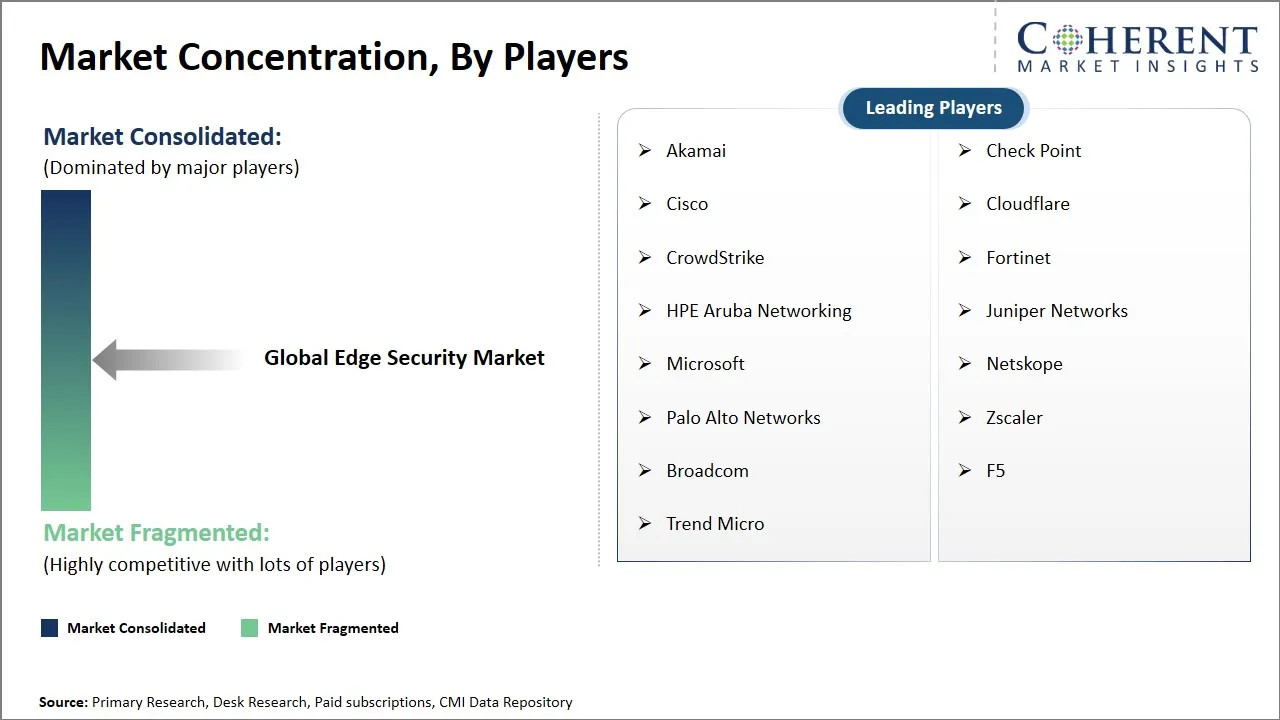
| Companies covered: | Akamai, Check Point, Cisco, Cloudflare, CrowdStrike, Fortinet, HPE Aruba Networking, Juniper Networks, Microsoft, Netskope, Palo Alto Networks, Zscaler, Broadcom, F5, and Trend Micro | ||
| Growth Drivers: |
| ||
| Restraints & Challenges: |
| ||
Market Dynamics
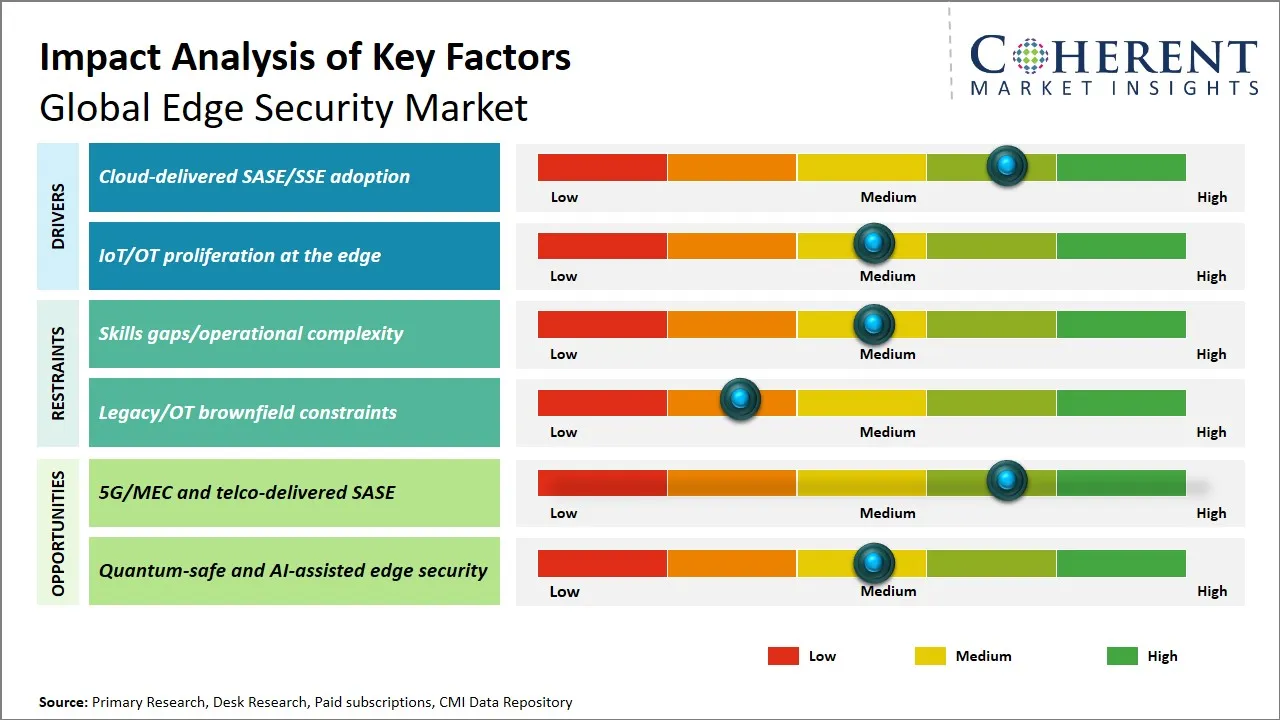
Global Edge Security Market Driver – Cloud-Delivered SASE/SSE Adoption
The increasing shift toward cloud-based infrastructures and the widespread adoption of remote work models have significantly propelled the demand for cloud-delivered Secure Access Service Edge (SASE) and Security Service Edge (SSE) solutions within the edge security landscape. These frameworks integrate comprehensive networking and security functions, such as secure web gateways, zero-trust network access, and firewall-as-a-service, delivering them from the cloud to provide seamless, scalable protection at the network edge.
As enterprises continue to embrace digital transformation, the traditional perimeter-based security model is becoming obsolete, driving organizations to adopt SASE/SSE paradigms that ensure consistent security policies across distributed, heterogeneous environments. In August 2025, AT&T Business and Cisco launched a co-branded, cloud-delivered SASE solution for U.S. enterprises. The platform delivers secure access, Zero Trust, and SD-WAN capabilities from the cloud, reflecting the accelerating adoption of SASE/SSE as organizations shift security enforcement closer to users and devices. This approach not only reduces latency by bringing security controls closer to end users and devices but also simplifies management through centralized, cloud-native platforms.
Global Edge Security Market Opportunity – 5G/MEC and Telco-Delivered SASE
As enterprises and service providers increasingly adopt 5G, the surge in connected devices and data traffic at the edge requires novel security architectures that can dynamically protect distributed networks and endpoints. Telco-delivered Secure Access Service Edge (SASE) solutions, which converge network security functions with wide-area networking capabilities, are uniquely positioned to capitalize on this trend by offering scalable, cloud-native security services directly integrated into 5G and MEC infrastructure. Furthermore, the deployment of SASE via telecom operators leverages their extensive edge presence and existing relationships with enterprises, facilitating faster market penetration and tailored security offerings optimized for vertical-specific latency and compliance requirements.
In April 2025, Cloudflare partnered with Rakuten Mobile in Japan to offer a managed Zero Trust service integrated with Rakuten’s 5G infrastructure. This collaboration leverages Multi-Access Edge Computing (MEC) to deliver low-latency, AI-enhanced edge security, highlighting how telecom operators can bundle SASE with 5G networks as a new growth opportunity. The convergence of 5G, MEC, and telco-delivered SASE also accelerates the adoption of advanced use cases such as automated threat detection, zero-trust network access, and real-time data analytics, making edge security more adaptive and resilient in an evolving cyber threat landscape.
Analyst Opinion (Expert Opinion)
- The integration of AI/ML into edge security platforms is reshaping real-time anomaly detection, predictive analytics, and automated incident response. Vendors embedding AI into SASE/SSE stacks will set new benchmarks for proactive defense.
- With vendors like Cloudflare introducing quantum-resistant Zero Trust security, post-quantum cryptography is rapidly moving from theory to practice. Early adoption at the edge is becoming a differentiator for enterprises managing sensitive, long-lived data.
- The convergence of 5G, MEC, and edge-native SASE solutions is creating opportunities for telcos to deliver security-as-a-service with ultra-low latency. Partnerships between network operators and security vendors are expected to accelerate, particularly in Asia Pacific.
Speak to the analyst
Want personalized insights?
Take the findings above to one of our principal consultants, or have the report rebuilt around the segments, geographies and competitors you actually track.
Market Segmentation
- Solution Category Insights (Revenue, USD Bn, 2021 - 2033)
- Secure Access
- Branch Network Security
- OT Edge Security
- API & Edge WAAP
- Workload Protection at Edge
- Regional Insights (Revenue, USD Bn, 2021 - 2033)
- North America
- U.S.
- Canada
- Latin America
- Brazil
- Argentina
- Mexico
- Rest of Latin America
- Europe
- Germany
- U.K.
- Spain
- France
- Italy
- Russia
- Rest of Europe
- Asia Pacific
- China
- India
- Japan
- Australia
- South Korea
- ASEAN
- Rest of Asia Pacific
- Middle East
- GCC Countries
- Israel
- Rest of Middle East
- Africa
- South Africa
- North Africa
- Central Africa
- North America
- Key Players Insights
- Akamai
- Check Point
- Cisco
- Cloudflare
- CrowdStrike
- Fortinet
- HPE Aruba Networking
- Juniper Networks
- Microsoft
- Netskope
- Palo Alto Networks
- Zscaler
- Broadcom
- F5
- Trend Micro
Sources
Primary Research Interviews
Stakeholders
- Chief Information Security Officers (CISOs) from Fortune 500 enterprises
- Cloud Service Providers
- Edge Infrastructure Vendors
- Network Operators and Telecom Providers (5G/MEC stakeholders)
- IoT/OT Security Experts from manufacturing and energy sectors
- Cybersecurity Consultants and Managed Security Service Providers (MSSPs)
- Regulators and Policy Advisors on Data Protection and Cybersecurity
Databases
- Eurostat
- U.S. Department of Homeland Security Cybersecurity Reports
- OECD Digital Economy Data
- National Institute of Standards and Technology (NIST) Cybersecurity Framework Repository
- APAC Cybersecurity Observatory Database
Magazines
- Cybersecurity Today
- Network World
- Information Security Magazine
- Telecoms.com Security Insights
- Edge Computing World Magazine
Journals
- IEEE Transactions on Information Forensics and Security
- Journal of Cybersecurity
- Computers & Security Journal
- International Journal of Information Security
- ACM Digital Threats Research Journal
Newspapers
- The Wall Street Journal – Cybersecurity Section
- The Economic Times (India) – Technology & Security
- Financial Times – Digital & Security
- Nikkei Asia – Technology and Security Trends
- The Guardian (UK) – Cybersecurity Reports
Associations
- Cloud Security Alliance (CSA)
- Internet Security Alliance (ISA)
- European Union Agency for Cybersecurity (ENISA)
- National Cyber Security Alliance (NCSA)
- Global Forum on Cyber Expertise (GFCE)
Public Domain Sources
- U.S. Cybersecurity & Infrastructure Security Agency (CISA) Reports
- EUROSTAT – Digital Economy Indicators
- United Nations International Telecommunication Union (ITU)
- World Bank – Digital Development Data
- ResearchGate (Cybersecurity Research Papers)
Proprietary Elements
- CMI Data Analytics Tool
- Proprietary CMI Existing Repository of information for last 8 years
Get access to 250+ pages report
Every segment, forecast, competitor profile and data table behind the analysis above — available for instant download.
- ESOMAR Member
- ISO 9001:2015 Certified
- D-U-N-S Registered
- GDPR & CCPA Compliant
Missing comfort of reading report in your local language? Find your preferred language:
Transform your Strategy with Exclusive Trending Reports
Frequently Asked Questions
The global edge security market is estimated to be valued at USD 33.40 billion in 2026 and is expected to reach USD 126.12 billion by 2033.
The CAGR of the global edge security market is projected to be 20.9% from 2026 to 2033.
Cloud-delivered SASE/SSE adoption and IoT/OT proliferation at the edge are the major factors driving the growth of the global edge security market.
Skills gaps/operational complexity and Legacy/OT brownfield constraints are the major factors hampering the growth of the global edge security market.
In terms of solution category, the secure access segment is estimated to dominate the market revenue share in 2026.
Edge security refers to protecting data, devices, and applications at the network’s edge — closer to where data is generated, accessed, or consumed.
Key components include SASE/SSE solutions, SD-WAN security, IoT/OT edge protection, WAAP/API security, and data/workload protection.