

Global Electric Brake Booster Market Size and Forecast – 2026 To 2033
The global electric brake booster market is expected to grow from USD 9.75 Bn in 2026 to USD 23.50 Bn by 2033, registering a compound annual growth rate (CAGR) of 9.6% from 2026 to 2033. The global electric brake booster market is driven by the growing demand for improved braking efficiency and response time. On January 6, 2025, ZF announced that it had secured a significant business win with a global manufacturer. Featuring the Electro-Mechanical Brake and by-wire technology on the rear brakes, the project will also include ZF’s Integrated Brake Control and traditional front calipers, creating a “hybrid” braking system of by-wire and hydraulics that offers increased flexibility to the manufacturer. (Source: ZF)
Key Takeaways of the Global Electric Brake Booster Market
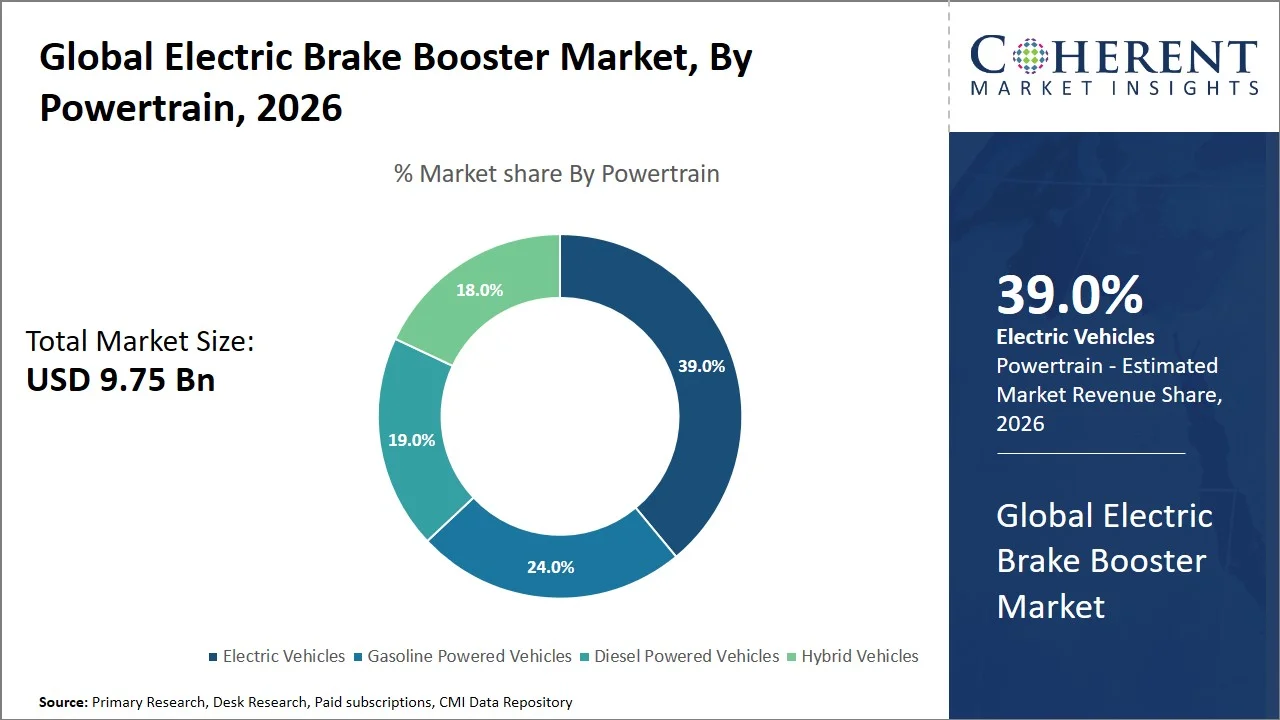
- The electric vehicles segment is expected to account for 39.0 % of the global electric brake booster market share in 2026. Expansion of regenerative braking technologies is a primary factor pushing the growth of the segment. On August 5, 2024, ZF introduced its Braking and e-Drive Synergy Program, integrating braking control with electric driveline systems to maximize energy recuperation during deceleration. (Source: ZF)
- The passenger vehicle segment is estimated to capture 53.0 % of the market share in 2026. The growing integration of smart vehicle technologies and regenerative braking systems is boosting the demand for the passenger vehicle segment. On January 4, 2024, Sonatus announced the launch of Sonatus Updater, a comprehensive product for managing over-the-air (OTA) updates suited for the rapidly evolving software content in vehicles today and the future. (Source: Sonatus)
- The electro hydraulic brake booster segment is estimated to capture 51.0 % of the market share in 2026. Growing production of hybrid and electric vehicles is expected to drive the demand for the segment. Growth in hybrid powertrain vehicles is pushing the demand for electronic ignition systems. On June 3, 2025, Tata Motors launched the Harrier.ev, India’s most powerful, most capable, and most intelligent SUV yet. (Source: Tata Motors)
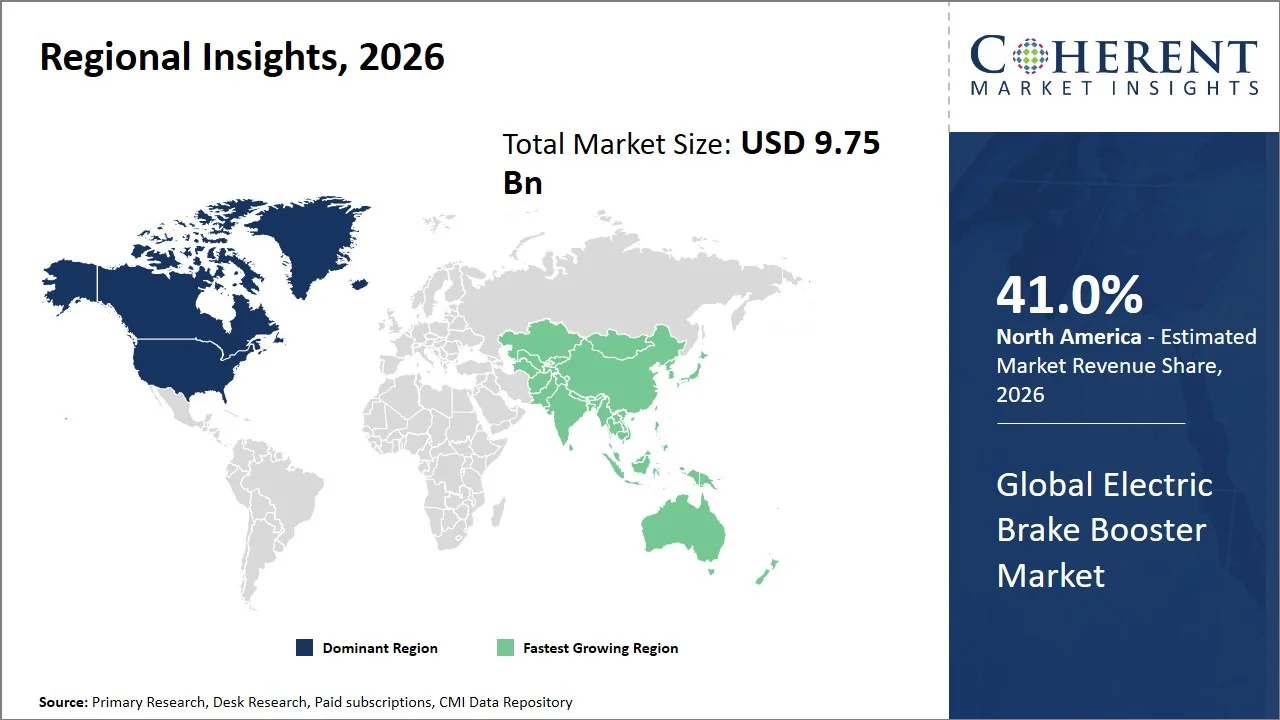
- North America is expected to dominate the electric brake booster market in 2026 with a market share of 41.0 %. Major auto producers in the region are ramping up production to meet demand, which is directly driving the demand for ignition systems. On October 23, 2025, Ford announced plans to significantly increase F-150 and F-Series Super Duty truck production to meet strong customer demand and recover production losses. (Source: Ford)
- Asia Pacific is expected to account for 26.0 % share in 2026 and is projected to record the fastest growth over the forecast period. The development of motor cores for improving the power efficiency of automobiles is also witnessing expansion in the Asia Pacific region. On March 19, 2026, DENSO CORPORATION announced it has invested in Next Core Technologies, Inc. with the aim of jointly developing in the field of motor cores. (Source: DENSO CORPORATION)
- Shift Toward Brake-by-Wire Systems in EVs and ADAS Vehicles: The global electric brake booster market is fast transforming with the increase in electric vehicles (EVs), hybrid vehicles, and advance driver assistance systems (ADAS). Automakers are increasingly favoring electric brake boosters over classic vacuum brake boosters because of their faster response times, greater braking precision and easier integration with autonomous driving technology.
- Increasing Adoption of Autonomous and Connected Vehicle Technologies: Rising autonomous vehicle and driving capabilities are making electric brake boosters an important safety component. These systems provide quick electronically controlled braking, supporting applications such as automatic emergency braking (AEB), adaptive cruise control, lane-keeping assistance and collision avoidance systems.
Segmental Insights
Why Do Electric Vehicles Dominate the Global Electric Brake Booster Market?
The electric vehicles segment is expected to account for 39.0% of the global electric brake booster market share in 2026. Electric vehicles dominate the global electric brake booster market as they do not generate engine vacuum pressure like conventional internal combustion vehicles, thus making electric brake boosters a must have for efficient braking performance. Moreover, EVs are highly dependent on sophisticated electronic brake integration for regenerative braking, ADAS features, and self-driving functions, which is fueling the demand for smart electric brake booster systems. On April 18, 2025, Subaru Corporation unveiled the all-new 2026 Subaru Trailseeker (U.S. model) and 2026 Subaru Solterra at the 2025 New York International Auto Show. (Source: Subaru)
- Current Industry Events of 2026
- Market Size Estimation
- Regional Breakdown
- Competitive Landscape
- Customer Intelligence
- Segmental Analysis
- Pricing Analysis
- Key Market Drivers, Challenges & Future Trends
- Customized Insights Section
Why is Passenger Vehicle the Most Preferred Vehicle?
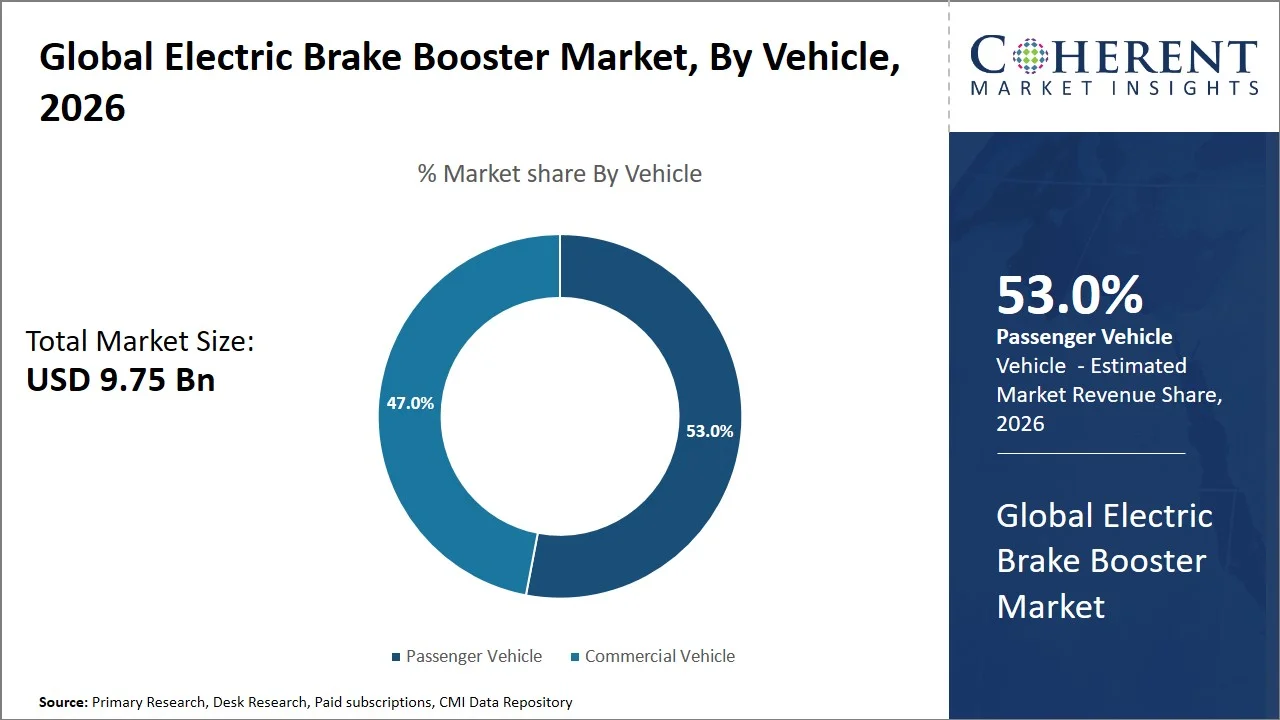
The passenger vehicle segment is expected to account for 53.0% of the global electric brake booster market share in 2026. The passenger car industry is highly desired due to its enormous volume of manufacturing worldwide and increasing consumer demand for better safety, comfort and driving performance features. Increasing penetration of electric vehicles and advanced driver assistance systems (ADAS) in passenger cars is further propelling the adoption of electric brake booster systems in this sector. On January 29, 2026, Toyota Motor Corporation achieved record global sales of 11.3 million vehicles, with strong demand for passenger models like the RAV4, Corolla, and Camry. (Source: The Economic Times)
Electro Hydraulic Brake Booster Dominates the Global Electric Brake Booster Market
The electro hydraulic brake booster segment is expected to account for 51.0% of the global electric brake booster market share in 2026. Electro-hydraulic brake boosters are the most popular type in the global electric brake booster market due to their better and accurate braking performance, especially in electric and hybrid vehicles with modern safety systems. Modern automotive manufacturers significantly prefer them because of their capacity to enable regenerative braking, automatic emergency braking, and autonomous driving systems. On January 30, 2025, a Bosch development team successfully tested the new hydraulic brake-by-wire system from Bosch for the first time on public roads. This solution completely eliminates the mechanical connection between the brake pedal and the brake system. (Source: Bosch)
Currents Events and their Impact
Current Events | Description and its Impact |
UNECE New EV Braking Regulations (2025) |
|
National Highway Traffic Safety Administration FMVSS No. 305a |
|
(Source: UNECE, National Highway Traffic Safety Administration)
Electric Brake Booster Market Dynamics
Market Drivers
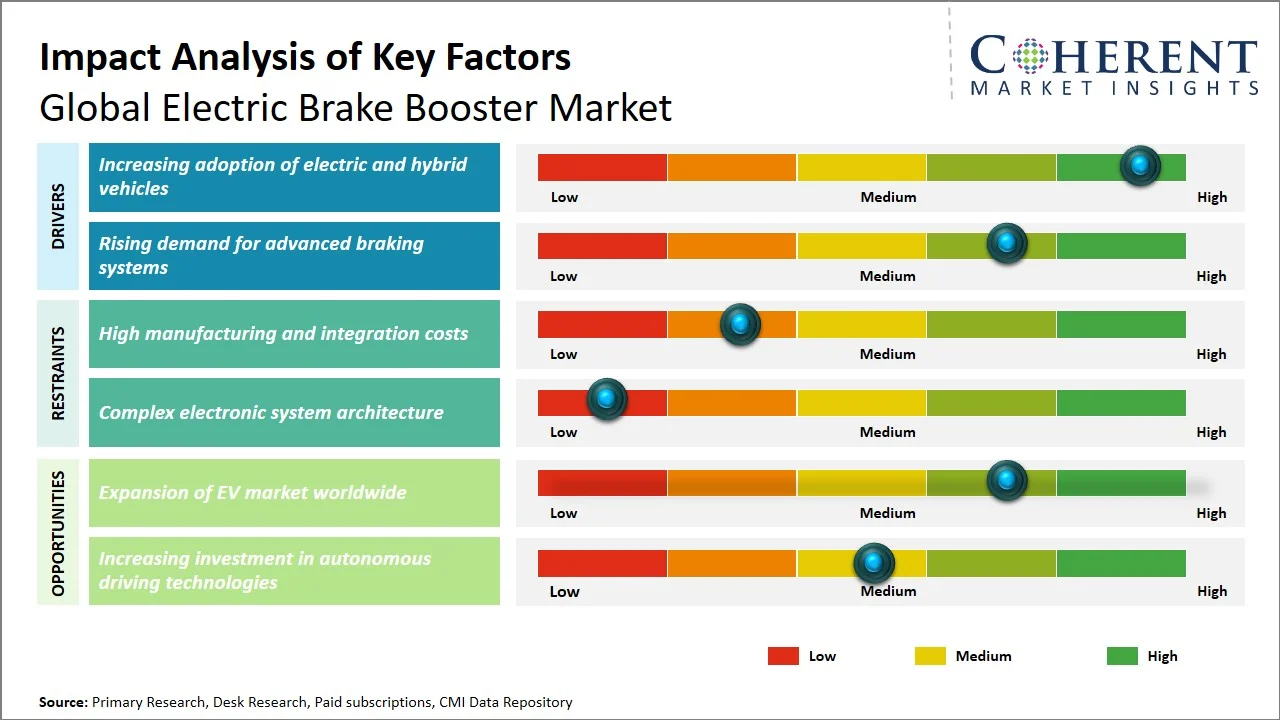
Increasing adoption of electric and hybrid vehicles
Rising adoption of electric and hybrid vehicles is considerably driving the demand for electric brake boosters as these vehicles don’t use traditional engine vacuum systems for braking assistance. Automakers are increasingly using modern electronic braking systems to enable regenerative braking, increase energy efficiency and better interoperability with ADAS and autonomous driving technology. On March 3, 2024, Skoda Auto revealed the name of its battery-electric city SUV crossover, along with a design study showing a first glimpse of the new model. (Source: Skoda)
Rising demand for advanced braking systems
The electric brake booster market is growing due to the rising demand for advanced braking systems as customers and regulators are becoming more aware of vehicle safety, faster brake reaction, and driver control. A modern vehicle, equipped with ADAS, automated emergency braking and autonomous features, needs an electronically controlled braking system that is accurate and reliable.
On May 4, 2026, Brembo announced that Sensify, the new standard in intelligent braking, has entered production for a leading global vehicle manufacturer. Sensify is fitted as standard on 100% of the vehicles in the program, confirming the platform’s readiness for full industrial deployment. (Source: Brembo Group)
Emerging Trends
- Rising Demand for Energy-Efficient and Compact Components: Manufacturers are focused on lightweight, compact and energy-efficient brake booster designs to improve the vehicle efficiency and increase the EV battery range. Electric brake boosters do not depend on the engine vacuum system, thus they are perfect for fully electric and hybrid vehicles.
- Strong Market Growth in Asia Pacific and Strategic Supplier Partnerships: Leading automotive vendors and OEMs are seeking strategic partnerships, mergers and technology collaborations to expedite innovation in electronic braking systems and strengthen the supply chains of next-generation mobility platforms.
Regional Insights
Why is North America a Strong Market for Electric Brake Boosters?
North America is expected to account for a market share of 41.0% in 2026. Rapid EV platform expansion and stringent car safety standards are propelling North America’s electric brake booster industry. In the U.S., manufacturers such as Tesla and General Motors are rapidly incorporating brake-by-wire and electro-hydraulic braking systems on EV platforms, including the Silverado EV and Cadillac Lyriq. The region also is experiencing increasing demand for ADAS-enabled braking systems driven by NHTSA safety initiatives and expanding deployment of autonomous driving technology.
In addition, increasing investments by the automakers in the region is also driving the market growth. On June 10, 2025, General Motors announced plans to invest about USD 4 billion over the next two years in its domestic manufacturing plants to increase U.S. production of both gas and electric vehicles. The new investment will give GM the ability to assemble more than two million vehicles per year in the U.S. This announcement comes on the heels of the company’s recently announced plan to invest USD 888 million in the Tonawanda Propulsion plant near Buffalo, New York, U.S. to support GM’s next-generation V-8 engine. (Source: General Motors)
Why Does the Asia Pacific Electric Brake Booster Market Exhibit High Growth?
Asia Pacific is projected to account for 26.0% of the global electric brake booster market and is expected to register the fastest growth. Asia Pacific is the largest producer of electric brake boosters in the world because to its large EV manufacturing ecosystem and robust government-backed electrification regulations. China alone makes up a large proportion of the worldwide EV sales with companies such as BYD and NIO incorporating innovative electronic braking modules into next-generation EVs. On the other hand, Japan and South Korea are substantially investing in autonomous vehicle technologies, which is driving the demand for intelligent brake booster systems.
In addition, the Asia Pacific electric brake booster market is likely to benefit from technological breakthroughs in engine development. On October 16, 2025, Denso Corporation announced that it will exhibit at the “Japan Mobility Show 2025” held at Tokyo, Japan. Under the theme “Changing the Shape of the Future with Technology: Community Meets Mobility,” Denso will present technologies that create new value for society, starting with the evolution of the automobile and expanding connections with cities and people. (Source: Denso Corporation)
Global Electric Brake Booster Market Outlook for Key Countries
Why is the U.S. Emerging as a Major Hub in the Electric Brake Booster Market?
The U.S. electric brake booster market is growing with the increasing use of EVs and introduction of federal safety standards that promote improved braking technologies. Ford Motor Company and Rivian are among the carmakers that are adding electric brake boosters to electric pickup trucks and SUVs to increase the effectiveness of regenerative braking systems and automated emergency braking. Furthermore, increased investments in autonomous mobility testing in the U.S. are also anticipated to raise the need for electronically controlled braking systems.
Is China the Next Growth Engine for the Electric Brake Booster Market?
China is the largest electric brake booster market in the world due to its leading EV production capacity and strong new energy vehicle (NEV) policies. Automakers like XPeng and Geely are fitting their vehicles with integrated electro-hydraulic braking systems to accommodate ADAS and intelligent driving features. China’s Ministry of Industry and Information Technology (MIIT) is forging ahead with legislation around smart vehicles, helping to accelerate the deployment of brake-by-wire technology across domestic vehicle platforms.
Germany Electric Brake Booster Market Analysis and Trends
Germany, with its premium car manufacturers and Tier-1 suppliers, continues to be a key innovation center for electric brake boosters. Companies such as Robert Bosch GmbH and ZF Friedrichshafen are developing next-generation integrated braking systems for luxury EVs offered by BMW and Mercedes-Benz. Germany’s emphasis on autonomous driving certification and high-performance car safety is fueling the demand for accurate electronic braking solutions.
India is emerging as a fast-growing electric brake booster market due to rising EV localization and increasing passenger vehicle manufacturing. In India, domestic manufacturers such as Tata Motors and Mahindra Electric are adding electric braking technology to small electric vehicles (EVs) and electric SUVs to improve safety and energy efficiency. The implementation of sophisticated braking systems in electric and hybrid vehicles is being encouraged by government efforts such as FAME-II and Bharat NCAP safety requirements.
Electric Brake Booster Market - Vehicle Safety Regulations Mandating ADAS/Braking Systems
Country/ Authority | Regulation / Act | Key Mandated ADAS / Braking Requirements |
European Union | EU General Safety Regulation (GSR2) – Regulation (EU) 2019/2144 | Mandatory AEB (Autonomous Emergency Braking), Lane Keep Assist, ISA, Driver Monitoring, Pedestrian & Cyclist detection |
Euro NCAP 2025–2026 Safety Protocols | Higher scoring for AEB, collision avoidance, lane support, emergency braking response performance | |
U.S. | FMVSS No. 127 (NHTSA AEB Rule) | Mandatory Automatic Emergency Braking with pedestrian detection + high-speed crash avoidance braking |
United Nations (UNECE WP.29) | UNECE Regulations (AEBS – R152, ELKS, ACPE updates) | Mandatory Advanced Emergency Braking Systems (AEBS), emergency lane keeping, steering & braking integration systems |
India | AIS / Bharat NCAP + ADAS adoption roadmap | Increasing push for AEB, lane assist, driver monitoring in M1 & N1 vehicles; stronger safety scoring system |
Australia | AEB Mandatory Vehicle Safety Standards | Requires car-to-car AEB + pedestrian detection systems in all new vehicles |
How is Expansion of the EV Market Worldwide Creating New Growth Opportunities in the Electric Brake Booster Market?
The electric vehicle (EV) market is growing at a quick pace all over the world and this is creating a lucrative growth opportunity for the electric brake booster market as EVs require electronically controlled braking systems rather than traditional vacuum-based boosters. As automakers ramp up production of battery electric and hybrid vehicles that include regenerative braking, ADAS and autonomous driving technologies, demand is rising for compact, energy-efficient, high-response electric brake booster systems for both passenger car and commercial vehicle platforms. On May 25, 2026, Ferrari presented its first fully electric car, the Luce. Ferrari aims to appeal to families with deep pockets, offering them comfortable seats, high-end tech and a 600-liter trunk. (Source: Ferrari)
Market Players, Key Development, and Competitive Intelligence
Key Developments
- On July 16, 2025, Astemo Ltd. announced a USD 100 million investment in its U.K. facility to expand EV component production, including electrified chassis systems and braking-related technologies for next-generation vehicles.
- On April 15, 2025, Nexteer Automotive launched its Electro-Mechanical Brake (EMB) system, an advanced Brake-by-Wire (BbW) solution that enhances safety, comfort, serviceability and supports software-defined chassis integration. The company leveraged its technology building blocks to create a modular, high-precision braking system and strategically expanded into Motion-by-Wire chassis control.
Competitive Landscape
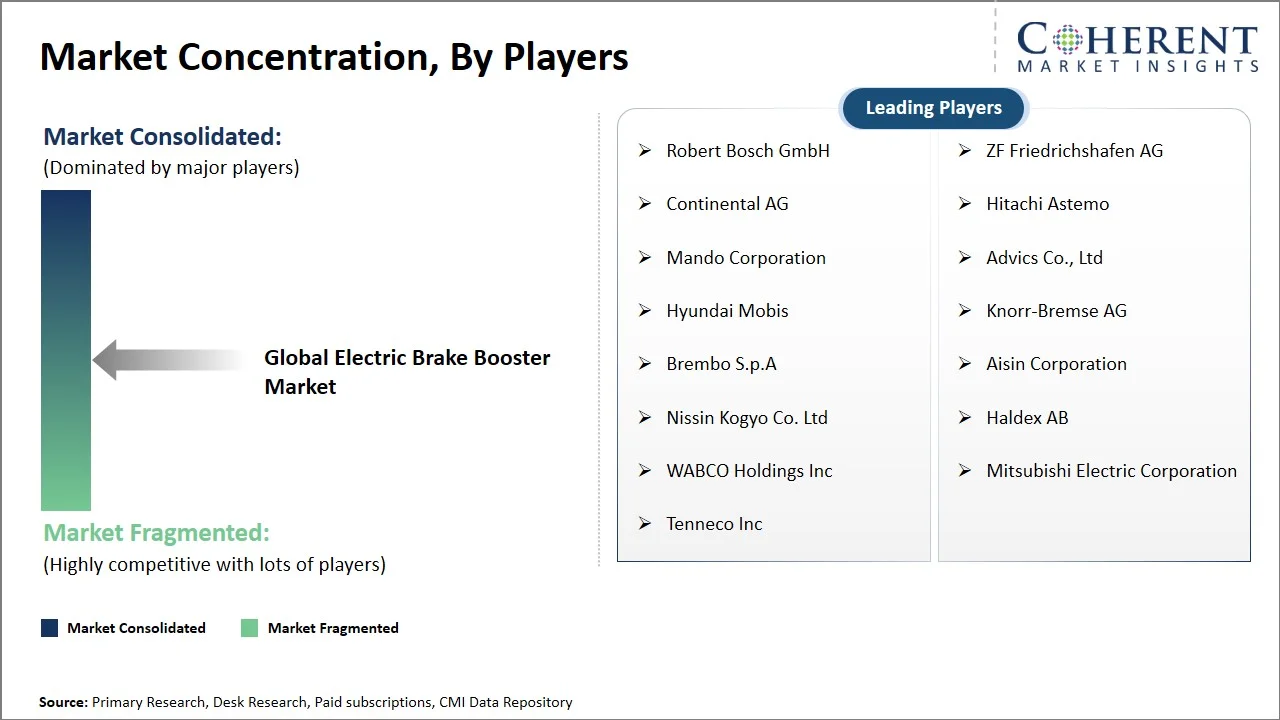
The global electric brake booster market is marked by fierce competition between leading automotive technology suppliers and OEM-centric component makers. Companies such as Robert Bosch GmbH, ZF Friedrichshafen, Continental AG, Hitachi Astemo and Mando Corporation are investing extensively in brake by wire technologies, integrated braking modules and intelligent safety systems. They are broadly adopting strategic partnerships with EV manufacturers, building new production facilities and constant research and development efforts to enhance their market position and technology capabilities.
Market Report Scope
Electric Brake Booster Market Report Coverage
| Report Coverage | Details | ||
|---|---|---|---|
| Base Year: | 2025 | Market Size in 2026: | USD 9.75 Bn |
| Historical Data for: | 2020 To 2024 | Forecast Period: | 2026 To 2033 |
| Forecast Period 2026 to 2033 CAGR: | 9.6% | 2033 Value Projection: | USD 23.50 Bn |
| Geographies covered: |
| ||
| Segments covered: |
| ||
| Companies covered: | Robert Bosch GmbH, ZF Friedrichshafen AG, Continental AG, Hitachi Astemo, Mando Corporation, Advics Co., Ltd, Hyundai Mobis, Knorr-Bremse AG, Brembo S.p.A, Aisin Corporation, Nissin Kogyo Co. Ltd, Haldex AB, WABCO Holdings Inc, Mitsubishi Electric Corporation, and Tenneco Inc | ||
| Growth Drivers: |
| ||
| Restraints & Challenges: |
| ||
Analyst Opinion (Expert Opinion)
- The swift shift towards electric mobility and software-defined vehicles are likely to be the key drivers for the electric brake booster industry. The greater integration of ADAS, autonomous driving technology and regenerative braking systems is being seen as a major motivator for long-term market expansion. Moreover, stringent vehicle safety and braking efficiency regulations are predicted to further fuel the use of electro-hydraulic and brake-by-wire systems in the developed and developing automotive markets.
- The electric brake booster market is anticipated to grow robustly in the future owing to the increasing prevalence of EVs, the development of autonomous vehicle technologies and the increasing demand for intelligent braking systems. Next-generation passenger and commercial cars are likely to see increased adoption of fully integrated brake-by-wire systems, particularly in China, the U.S. and Germany. Ongoing innovation in lightweight electronic braking components and AI-enabled car safety systems are also expected to offer new revenue streams for automotive suppliers over the next few years.
Speak to the analyst
Want personalized insights?
Take the findings above to one of our principal consultants, or have the report rebuilt around the segments, geographies and competitors you actually track.
Market Segmentation
- Powertrain Insights (Revenue, USD Billion, 2021 - 2033)
- Electric Vehicles
- Gasoline Powered Vehicles
- Diesel Powered Vehicles
- Hybrid Vehicles
- Vehicle Insights (Revenue, USD Billion, 2021 - 2033)
- Passenger Vehicle
- Commercial Vehicle
- Brake Boost Type Insights (Revenue, USD Billion, 2021 - 2033)
- Electro Hydraulic Brake Booster
- Electro Mechanical Brake Booster
- Vacuum Brake Booster
- Regional Insights (Revenue, USD Billion, 2021 - 2033)
- North America
- U.S.
- Canada
- Latin America
- Brazil
- Argentina
- Mexico
- Rest of Latin America
- Europe
- Germany
- U.K.
- Spain
- France
- Italy
- Russia
- Rest of Europe
- Asia Pacific
- China
- India
- Japan
- Australia
- South Korea
- ASEAN
- Rest of Asia Pacific
- Middle East
- GCC Countries
- Israel
- Rest of Middle East
- Africa
- South Africa
- North Africa
- Central Africa
- North America
- Key Players Insights
- Robert Bosch GmbH
- ZF Friedrichshafen AG
- Continental AG
- Hitachi Astemo
- Mando Corporation
- Advics Co., Ltd
- Hyundai Mobis
- Knorr-Bremse AG
- Brembo S.p.A
- Aisin Corporation
- Nissin Kogyo Co. Ltd
- Haldex AB
- WABCO Holdings Inc
- Mitsubishi Electric Corporation
- Tenneco Inc
Sources
Primary Research Interviews
- Automotive brake system manufacturers and OEMs
- Electric brake booster component suppliers
- Automotive industry analysts and experts
- Electric vehicle manufacturers
Magazines
- Automotive Engineering International
- SAE International Magazine
- Brake & Front-End Magazine
- Electric Vehicle Magazine
Journals
- International Journal of Automotive Technology
- Journal of Automobile Engineering
- Electric Vehicle Research Journal
Associations
- Society of Automotive Engineers (SAE International)
- Automotive Aftermarket Suppliers Association (AASA)
- Electric Drive Transportation Association (EDTA)
- International Organization of Motor Vehicle Manufacturers (OICA)
Public Domain Sources
- U.S. Department of Transportation (DOT) publications
- European Automobile Manufacturers' Association (ACEA) reports
- National Highway Traffic Safety Administration (NHTSA) data
- International Energy Agency (IEA) electric vehicle reports
Proprietary Elements
- CMI Data Analytics Tool
- Proprietary CMI Existing Repository of information for last 10 years
Get access to 250+ pages report
Every segment, forecast, competitor profile and data table behind the analysis above — available for instant download.
- ESOMAR Member
- ISO 9001:2015 Certified
- D-U-N-S Registered
- GDPR & CCPA Compliant
Missing comfort of reading report in your local language? Find your preferred language:
Transform your Strategy with Exclusive Trending Reports
Frequently Asked Questions
The global electric brake booster market is expected to stand at USD 9.75 Bn in 2026 and is expected to reach USD 23.50 Bn by 2033.
The CAGR of the global electric brake booster market is projected to be 9.6% from 2026 to 2033.
Increasing adoption of electric and hybrid vehicles and rising demand for advanced braking systems are the major factors driving the growth of the global electric brake booster market.
High manufacturing and integration costs and complex electronic system architecture are the major factors hampering the growth of the global electric brake booster market.
In terms of powertrain, the electric vehicles segment is estimated to dominate the market revenue share in 2026.
Unlike vacuum boosters, electric brake boosters use electrical energy instead of engine vacuum pressure.
Electric brake boosters complement regenerative braking by ensuring smooth transition between braking modes.