

Global Email Encryption Software Market and Forecast – 2026 to 2033
Coherent Market Insights estimates that the global email encryption software market is expected to reach USD 5 Bn in 2026 and will expand to USD 14 Bn by 2033, registering a CAGR of 14% between 2026 and 2033.
Key Takeaways of the Email Encryption Software Market
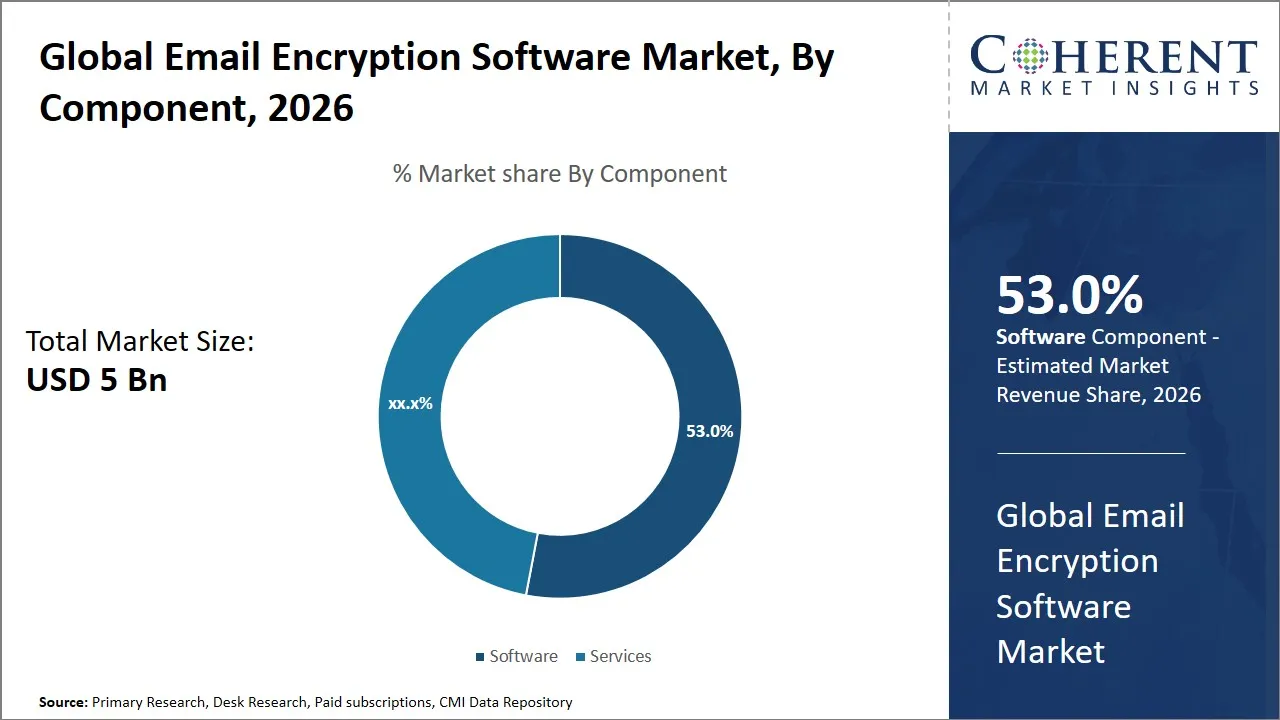
- The software segment is estimated to account for 53% of the email encryption software market share in 2026.
- The end-to-end encryption segment is expected to capture 38% of the market share in 2026.
- The cloud segment is projected to hold 40% of the global email encryption software market share in 2026.
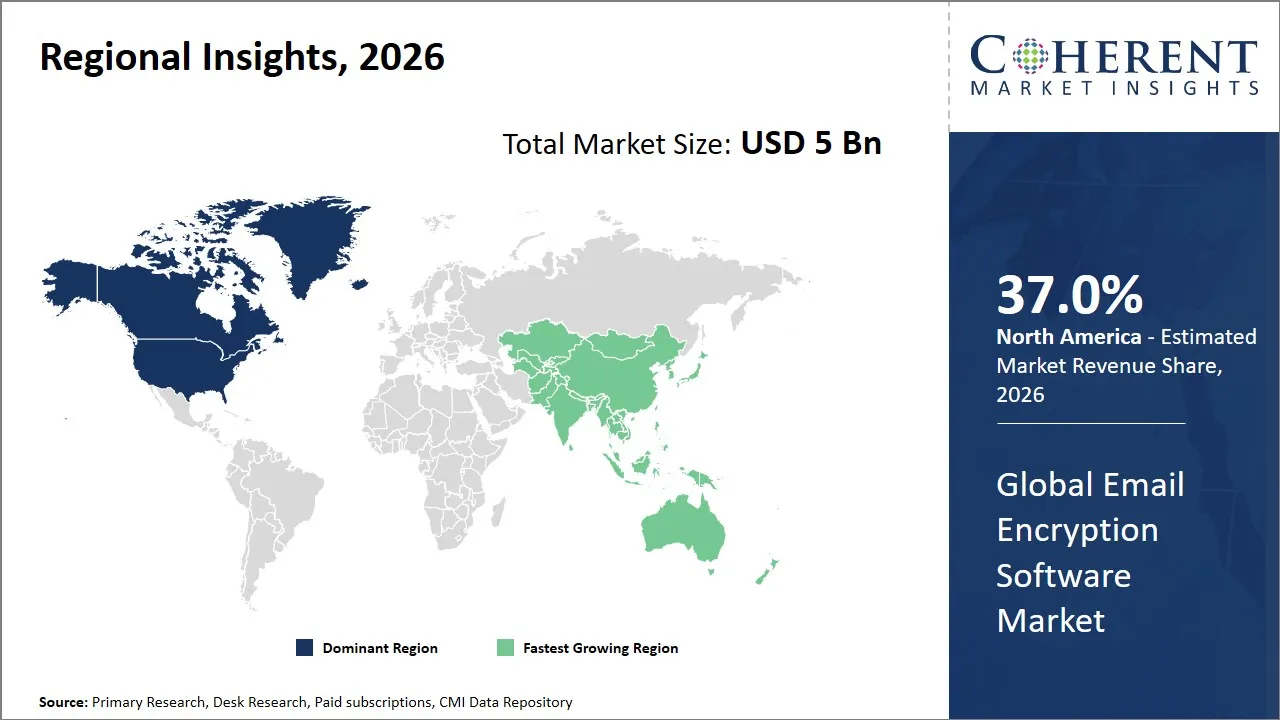
- North America will dominate the email encryption software market in 2025 with an estimated 37%
- Asia Pacific will hold 24% share in 2026 and is expected to record the fastest growth over the forecast period.
Currents Events and Its Impacts
Current Events | Description and its Impact |
Trustifi Finance Procurement |
|
Segmental Insights
- Current Industry Events of 2026
- Market Size Estimation
- Regional Breakdown
- Competitive Landscape
- Customer Intelligence
- Segmental Analysis
- Pricing Analysis
- Key Market Drivers, Challenges & Future Trends
- Customized Insights Section
Why is the Software Segment Expected to Dominate the Global Email Encryption Software Market in 2026?
The software segment is expected to account for 53.0% of the global email encryption software market share in 2026. Security begins where data protection becomes essential. Built into encryption workflows, programs apply math-based methods to maintain message privacy, accuracy, and verification. While external offerings may include setup help, oversight, or advice, applications supply the primary tools organizations depend on for trusted messaging. Function follows design when reliability matters most.
End-to-End Encryption Segment Dominates the Global Email Encryption Software Market
The end-to-end encryption segment is expected to hold 38.0% of the email encryption software market share in 2026. A major reason behind rising adoption lies in its strong defense against intercepted data, focusing on security risks tied to emails in transit. Messages become unreadable upon leaving the sender’s system, staying locked until they reach the intended receiver. With this method, weak spots along the delivery route cease to exist. Protection stays intact from start to finish, avoiding exposure at intermediate stages.
Why is Cloud the Most Preferred Deployment Mode in the Email Encryption Software Market?
The cloud segment is expected to capture 40.0% of the market share in 2026. A primary factor behind the increase stems from evident advantages, attracting attention from organizations of any size seeking adaptable, scalable security approaches. Distinguished by ease of integration, companies implement message protection through cloud encryption without facing high upfront expenses linked to hardware or on-site infrastructure, significantly lowering entry barriers. Though often overlooked, the shift simplifies deployment while maintaining reliability across diverse operational environments.
Email Encryption Failure & Misconfiguration Risks
Risk Category | Metric | Statistic |
Silent Encryption Failures (Cloud Platforms) | % of breached domains with ineffective DMARC | 79% |
Email Encryption Usability Failures | % of users who abandoned encryption setup due to complexity | 66% |
Cross-Platform Interoperability Technical Risk | % increased technical risk in multi-system email environments | 53% |
Email Client Decryption Failures | % of users failing basic decryption tasks due to incompatible email clients | 70% |
Misconfigured Email Security Policies (General) | % of domains still without enforced DMARC | ~50% (nearly half) |
Regional Insights
North America Email Encryption Software Market Analysis and Trends
The North America region is projected to lead the market with a 37% share in 2026. Advancement stems from sophisticated technology environments working alongside strict rules focused on safeguarding information. Multiple providers in cybersecurity operate within this space, where industries such as banking, medical services, and public administration widely adopt protective tools; solid digital foundations support expansion. Rules set by federal authorities, including those under HIPAA, along with adherence to data safeguards, increase demand for protected messaging systems.
Major firms - among them Cisco Systems, Symantec (now part of Broadcom), and Microsoft - have built substantial influence through bundled encryption offerings linked to wider defense platforms, reinforcing their position. Awareness runs high across business units regarding online dangers, which leads to greater integration of encoding methods into daily operations.
Asia Pacific Email Encryption Software Market Analysis and Trends
The Asia Pacific region is expected to exhibit the fastest growth in the market contributing 24% share in 2026. Expansion stems from swift shifts toward digital systems, more frequent cyber threats, one reason being stricter rules around safeguarding information.
In nations including India, China, and parts of Southeast Asia, efforts gain ground in strengthening online defenses, a reaction seen alongside wider web access and reliance on cloud platforms. Supportive regulations that push advancements in cyber resilience also play a role, especially when tied to international data handling standards. Not only do global vendors operate widely, but regional players like Trend Micro of Japan and India's Quick Heal also contribute to stronger local access, aligning services more closely with what users require. In parallel, sectors including banking, finance, and technology are allocating larger budgets - driven by a growing emphasis on protecting digital communication.
Global Email Encryption Software Market Outlook for Key Countries
Why is the U.S. Emerging as a Major Hub in the Email Encryption Software Market?
Despite its maturity, the U.S. firms like Cisco, Microsoft, and Proofproint continue refining email security methods. Driven by rules tied to laws including the HIPAA Privacy Rule and FISMA, government oversight keeps demand steady in both state-run and commercial operations. Organizational needs center on flexible solutions that meet strict regulatory standards without sacrificing performance in online-based systems. Innovation continues through sustained R&D efforts, yielding refined cryptographic methods alongside improved interface designs in widely adopted platforms.
Germany Email Encryption Software Market Analysis and Trends
Stringent EU data rules, especially GDPR, form the backbone of Germany's approach to digital privacy. Because of these regulations, companies increasingly rely on encrypted messaging systems. Firms in manufacturing, finance, and vehicle production place high value on protecting client and operational details. Instead of opting for generic solutions, many choose specialized platforms that meet regional compliance needs. Local experts including Hornetsecurity collaborate alongside global names such as Sophos to deliver these safeguards. Rather than merely reacting, public programs encourage proactive defense measures through education campaigns. Additional investments flow into modernizing networks with built-in security features, indirectly boosting reliance on protected mail channels.
Is China the Next Growth Engine for the Email Encryption Software Market?
Amid shifting digital policies, China's email encryption sector evolves quickly under state-driven cybersecurity demands. With data control a priority, firms across finance, online trade, and administration adopt stronger encryption methods. Local providers like Venustech and 3721 SecureTech deliver tailored tools aligned with regional legal standards. Expansion of cloud infrastructure adds momentum, supported by nationwide digitization projects. Joint efforts between official bodies and private developers shape the direction of secure messaging systems.
Japan Email Encryption Software Market Analysis and Trends
At the forefront of advanced cybersecurity, Japan draws strength from long-standing expertise in technology and manufacturing. Because industries provide solid support, companies focus on protecting critical data using encryption methods. Instead of rigid rules, common guidelines influence corporate approaches to online threats. Global operations enable organizations like Trend Micro to offer integrated solutions where secure communication is essential. Advancement continues not through standalone products but by evolving current infrastructures over time. Progress thrives where innovation meets disciplined execution behind the scenes.
India Email Encryption Software Market Analysis and Trends
Across India, growing digital risks have prompted heightened focus on cyber protection. Because of initiatives like the National Cyber Security Policy, expansion in this area persists without slowing. As IT operations grow, reliance on cloud infrastructure spreads through enterprises. Protected email solutions become necessary more often under these conditions.
Frequently, companies like Quick Heal Technologies focus on localized software whereas organizations including Microsoft and Cisco provide wide-reaching options. Blending area knowledge with international frameworks now appears across many systems. Regulations that prioritize individual information protection in finance and healthcare influence what technologies get adopted. With adherence growing more central, the use of encoded communication expands into various sectors.
Market Players, Key Development, and Competitive Intelligence
Key Developments
- On September 2, 2025, Turnium Technology Group Inc. and 01 Quantum Inc announced the signing of a global strategic alliance to deliver quantum-safe email encryption solutions.
- On November 18, 2024, Echoworx launched its new Google Workspace add-on. This development responds to the increasing need for contemporary, cloud-based security solutions, particularly as Google Workspace caters to over 6 million business users worldwide.
Top Strategies Followed by Global Email Encryption Software Market Players
Player Type | Strategic Focus | Example |
Established Market Leaders | Google Update | In April 2025, Google updated Gmail for its' Workspace customers adding end-to-end encrypted (E2EE) messaging. The feature allows Google Workspace customers to send an E2EE secure email to any inbox. |
Mid-Level Players | Fortinet Platform Enhancement | In June 2025, Fortinet announced enhancements to its data and productivity security portfolio, expanding FortiMail with the launch of the FortiMail Workspace Security suite. These new capabilities establish FortiMail as the broadest and most customizable email security platform and extend protection beyond email to include browser and collaboration security. |
Small-Scale Players | Cosmian Platform Launch | In February 2025, Cosmian launched client‑side encryption solutions for Gmail, bringing encryption directly into familiar user interfaces for privacy‑conscious customers. |
Market Report Scope
Email Encryption Software Market Report Coverage
| Report Coverage | Details | ||
|---|---|---|---|
| Base Year: | 2025 | Market Size in 2026: | USD 5 Bn |
| Historical Data for: | 2020 To 2024 | Forecast Period: | 2026 To 2033 |
| Forecast Period 2026 to 2033 CAGR: | 14% | 2033 Value Projection: | USD 14 Bn |
| Geographies covered: |
| ||
| Segments covered: |
| ||
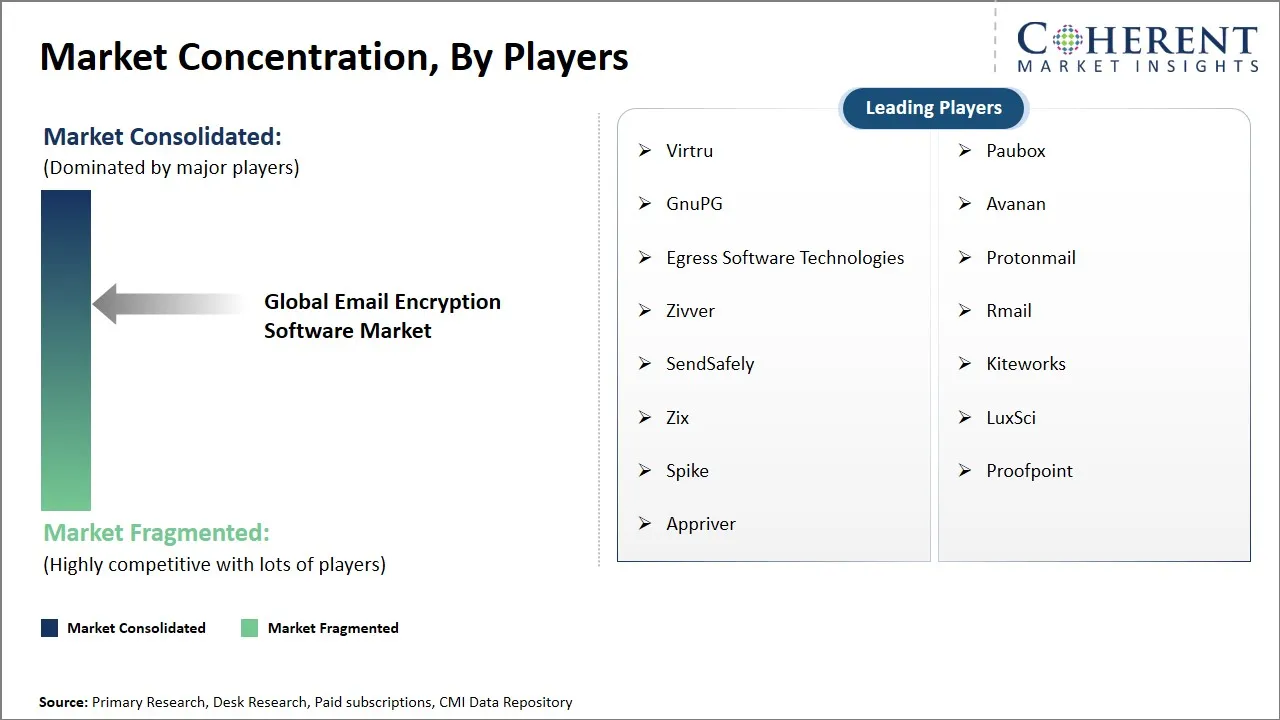
| Companies covered: | Virtru, Paubox, GnuPG, Avanan, Egress Software Technologies, Protonmail, Zivver, Rmail, SendSafely, Kiteworks, Zix, LuxSci, Spike, Proofpoint, and Appriver | ||
| Growth Drivers: |
| ||
| Restraints & Challenges: |
| ||
Global Email Encryption Software Market Dynamics
Global Email Encryption Software Market Driver - Increasing Threats of Cybersecurity
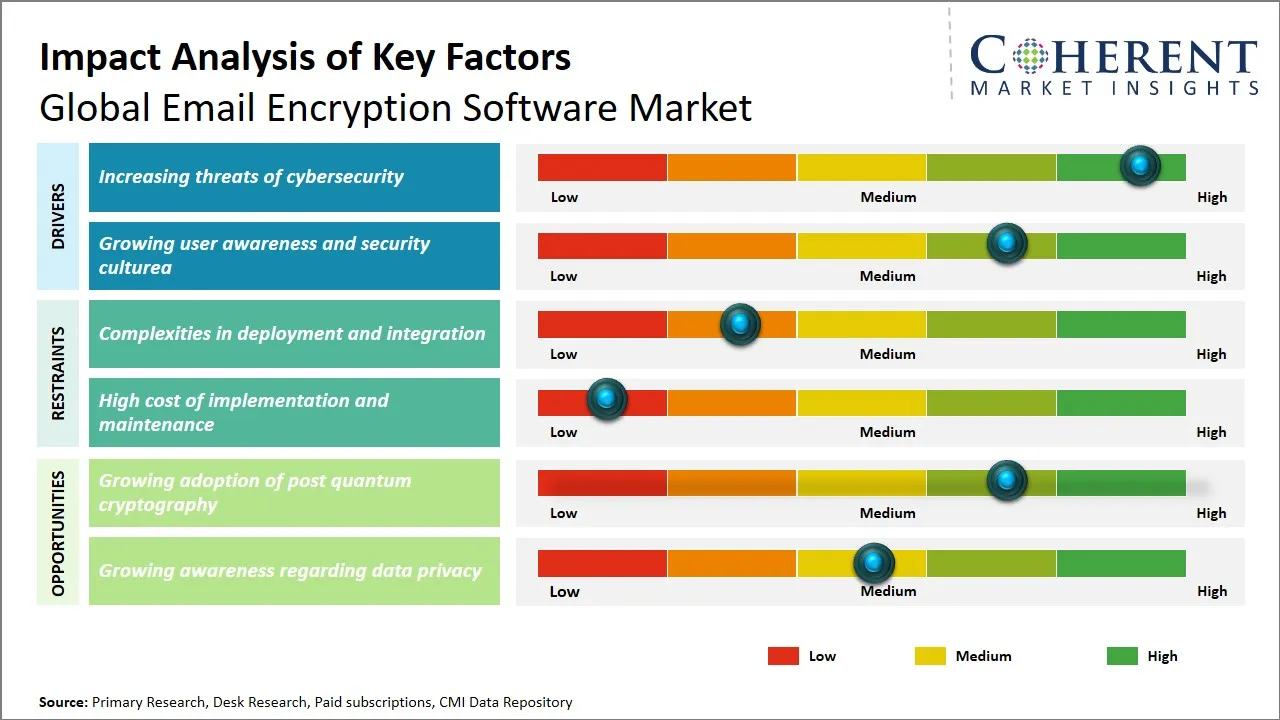
A rise in complex cyber threats has increased attention on protecting stored details, especially through messages sent online, often aimed at by attackers. As correspondence through mail is common for private and work-related matters, valuable material like account numbers, creative concepts, or internal plans faces ongoing dangers such as deception attempts or harmful programs. As risks evolve, institutions find stronger safeguards necessary, leading many to rely on tools that encode electronic letters to block unwanted viewing and leaks.
For instance, on December 9, 2025, Cybersecurity and Infrastructure Security Agency (CISA), Federal Bureau of Investigation (FBI), National Security Agency (NSA), Department of Energy (DOE), Environmental Protection Agency (EPA), Department of Defense’s Cyber Crime Center (DC3), and a coalition of global partners issued a joint cybersecurity advisory titled “Pro-Russia Hacktivists Conduct Opportunistic Attacks Against U.S. and Global Critical Infrastructure.” The advisory calls on critical infrastructure organizations to take immediate action to mitigate the risk of being targeted by pro-Russia hacktivist groups, which are actively engaging in opportunistic, low-sophistication malicious cyber activity across multiple sectors.
Global Email Encryption Software Market Opportunity - Growing Adoption of Post Quantum Cryptography
With rising attention on quantum computing risks and evolution of quantum sensors, email encryption tools may see notable change through post-quantum cryptography uptake. Because older encryption techniques could fail under quantum processing strength, businesses in many fields begin testing new defensive approaches. Secure messaging relies heavily on encrypted emails; these now align more closely with next-generation safeguards shaped by upcoming threats. Instead of waiting, technology providers adjust frameworks so systems withstand possible breaches from powerful machines later.
Analyst Opinion (Expert Opinion)
- Growth appears likely in email encryption software worldwide during the coming ten years, since businesses focus more on security due to escalating online risks, rules about data handling, and widespread remote operations. Forecasters expect high yearly increases, often above 10%, as companies act against dangers like deceptive emails, fraud targeting corporate accounts, and malware locking files, while moving toward cloud-hosted tools and using smart systems that automate protection tasks.
- Still, some hurdles persist: setup difficulties and pricing create barriers for small firms, despite active spending by major organizations and tightly governed areas including banking and medical services adopting advanced safeguards. One factor shaping progress lies beyond technology itself.
Speak to the analyst
Want personalized insights?
Take the findings above to one of our principal consultants, or have the report rebuilt around the segments, geographies and competitors you actually track.
Market Segmentation
- Component Insights (Revenue, USD Bn, 2021 - 2033)
- Software
- Services
- Encryption Type Insights (Revenue, USD Bn, 2021 - 2033)
- End to End Encryption
- Gateway
- Client-Side Encryption
- Hybrid Encryption Models
- Deployment Insights (Revenue, USD Bn, 2021 - 2033)
- Cloud
- On Premises
- Hybrid
- End User Insights (Revenue, USD Bn, 2021 - 2033)
- BFSI
- IT and Telecom
- Government and Defense
- Healthcare
- Retail
- Manufacturing
- Education
- Others
- Regional Insights (Revenue, USD Bn, 2021 - 2033)
- North America
- U.S.
- Canada
- Latin America
- Brazil
- Argentina
- Mexico
- Rest of Latin America
- Europe
- Germany
- U.K.
- Spain
- France
- Italy
- Russia
- Rest of Europe
- Asia Pacific
- China
- India
- Japan
- Australia
- South Korea
- ASEAN
- Rest of Asia Pacific
- Middle East
- GCC Countries
- Israel
- Rest of Middle East
- Africa
- South Africa
- North Africa
- Central Africa
- North America
- Key Players Insights
- Virtru
- Paubox
- GnuPG
- Avanan
- Egress Software Technologies
- Protonmail
- Zivver
- Rmail
- SendSafely
- Kiteworks
- Zix
- LuxSci
- Spike
- Proofpoint
- Appriver
Sources
Primary Research Interviews
- Email Security Solution Providers
- IT Security Managers and CISOs
- Enterprise Software Procurement Managers
- Cybersecurity Consultants
Magazines
- SC Magazine
- Cybersecurity Magazine
- InfoSecurity Magazine
- Dark Reading
Journals
- Journal of Information Security and Applications
- Computers & Security
- International Journal of Information Management
Newspapers
- The Wall Street Journal (Technology Section)
- Financial Times (Digital Business)
- Reuters Technology News
- Bloomberg Technology
Associations
- International Association of Privacy Professionals (IAPP)
- Cloud Security Alliance (CSA)
- Information Systems Security Association (ISSA)
- Cybersecurity and Infrastructure Security Agency (CISA)
Public Domain Sources
- Federal Trade Commission (FTC) Reports
- National Institute of Standards and Technology (NIST)
- European Union Agency for Cybersecurity (ENISA)
- SEC Filing Database
Proprietary Elements
- CMI Data Analytics Tools
- Proprietary CMI Existing Repository of information for last 8 years
Get access to 250+ pages report
Every segment, forecast, competitor profile and data table behind the analysis above — available for instant download.
- ESOMAR Member
- ISO 9001:2015 Certified
- D-U-N-S Registered
- GDPR & CCPA Compliant
Missing comfort of reading report in your local language? Find your preferred language:
Transform your Strategy with Exclusive Trending Reports
Frequently Asked Questions
The global email encryption software market stood at USD 5.00 Bn in 2026 and is expected to reach USD 14.00 Bn by 2033.
The CAGR of global email encryption software market is projected to be 14.00% from 2026 to 2033.
Increasing threats of cybersecurity and growing user awareness and security culture are the major factors driving the growth of the global email encryption software market.
Complexities in deployment and integration and high cost of implementation and maintenance are the major factors hampering the growth of the global email encryption software market.
In terms of component, software is estimated to dominate the market revenue share in 2026.
Regulations like GDPR and HIPAA significantly boost adoption by mandating secure data transmission.
AI enhances encryption software by automating threat detection and preventing email-based attacks such as phishing.