

Europe and Asia Pacific Smart Nurse Call Automated System Market Forecast – 2026 To 2033
The Europe and Asia Pacific smart nurse call automated system market is expected to grow from USD 1,571.1 Mn in 2026 to USD 3,617.4 Mn by 2033, registering a compound annual growth rate (CAGR) of 12.7% from 2026 to 2033. The Europe and Asia Pacific smart nurse call automated system market is poised for significant expansion, fueled by the accelerating digital transformation of healthcare systems and the increasing adoption of smart hospital technologies, which are enhancing clinical communication, patient safety, and workflow efficiency through integrated connected care solutions.
According to the European Commission's Digital Decade eHealth Indicator Study (2024), the EU-27 achieved an average eHealth maturity score of 83%, reflecting the widespread adoption of digital health services and electronic health records across healthcare providers. This continued digital transformation is creating a favorable environment for the deployment of smart nurse call automated systems.
Key Takeaways of the Europe and Asia Pacific Smart Nurse Call Automated System Market
- Nurse call intercoms are projected to hold a market share of 36.5% of the Europe and Asia Pacific smart nurse call automated system market share in 2026, making it the dominant product type segment, owing to their ability to enable real-time caregiver communication, faster response times, and seamless integration with hospital information systems. The segment continues to benefit from government-led smart hospital initiatives across Asia Pacific. For instance, Singapore's Ministry of Health (MOH) established the Woodlands Health Campus as a Smart Hospital, incorporating AI-enabled workflows, digital bedside systems, and integrated nurse communication technologies to enhance patient care and operational efficiency.
- Wired nurse call systems are projected to hold 46.2% of the Europe and Asia Pacific smart nurse call automated system market share in 2026, making it the dominant type segment, due to their high reliability, uninterrupted connectivity, and widespread deployment across acute care hospitals. The segment is further supported by government initiatives promoting digital healthcare infrastructure. For instance, Japan's Ministry of Health, Labour and Welfare (MHLW) is advancing the Medical DX (Digital Transformation) Vision, which encourages hospitals to implement interoperable digital infrastructure and connected healthcare systems, supporting the deployment of reliable communication technologies, including nurse call systems.
- Fall detection and prevention is projected to hold 36.2% of the Europe and Asia Pacific smart nurse call automated system market share in 2026, making it the dominant application segment, driven by the increasing emphasis on patient safety, elderly care, and reducing inpatient falls. For instance, NHS England's National Patient Safety Strategy identifies inpatient falls as a national patient safety priority and promotes the adoption of digital technologies and standardized safety interventions to reduce preventable harm, supporting the implementation of advanced nurse call and fall prevention solutions across hospitals.
Segmental Insights
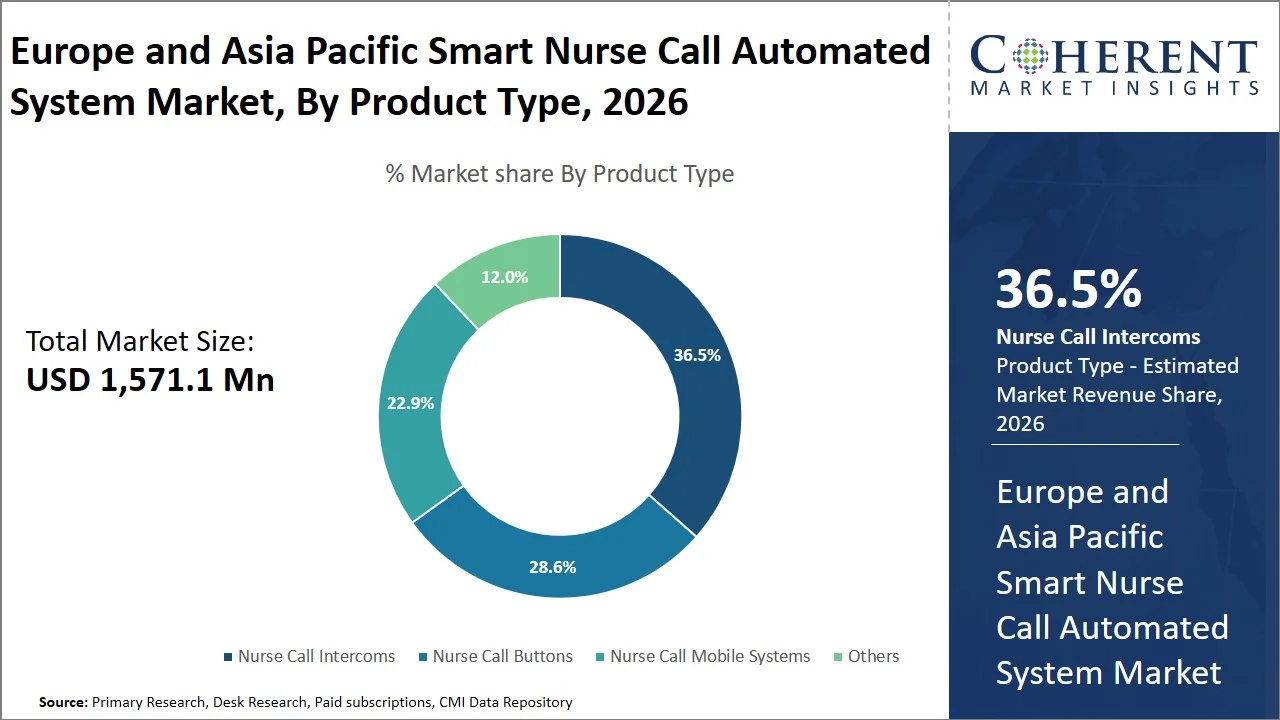
Why Do Nurse Call Intercoms Dominate the Europe and Asia Pacific Smart Nurse Call Automated System Market?
Nurse call intercoms are projected to hold a market share of 36.5% in 2026, due to their reliability of delivering a stable two-way audio transmission for quicker caregiver response and better patient monitoring. Mobility of smart nurse call intercoms with integration to the smartphone app, hospital sensors, medical equipment, patient monitoring and healthcare management software platform drives efficiency in the overall system for smart hospital development. For instance, Ascom Telligence Nurse Call System combines audio IP-based voice functionality, touch screen-enabled station solutions as well as a perfect and seamless clinical communications and mobile workflow solution, enabling seamless patient care coordination across healthcare facilities.
- Current Industry Events of 2026
- Market Size Estimation
- Regional Breakdown
- Competitive Landscape
- Customer Intelligence
- Segmental Analysis
- Pricing Analysis
- Key Market Drivers, Challenges & Future Trends
- Customized Insights Section
Why Do Wired Nurse Call Systems Represent the Largest Type Segment in the Europe and Asia Pacific Smart Nurse Call Automated System Market?
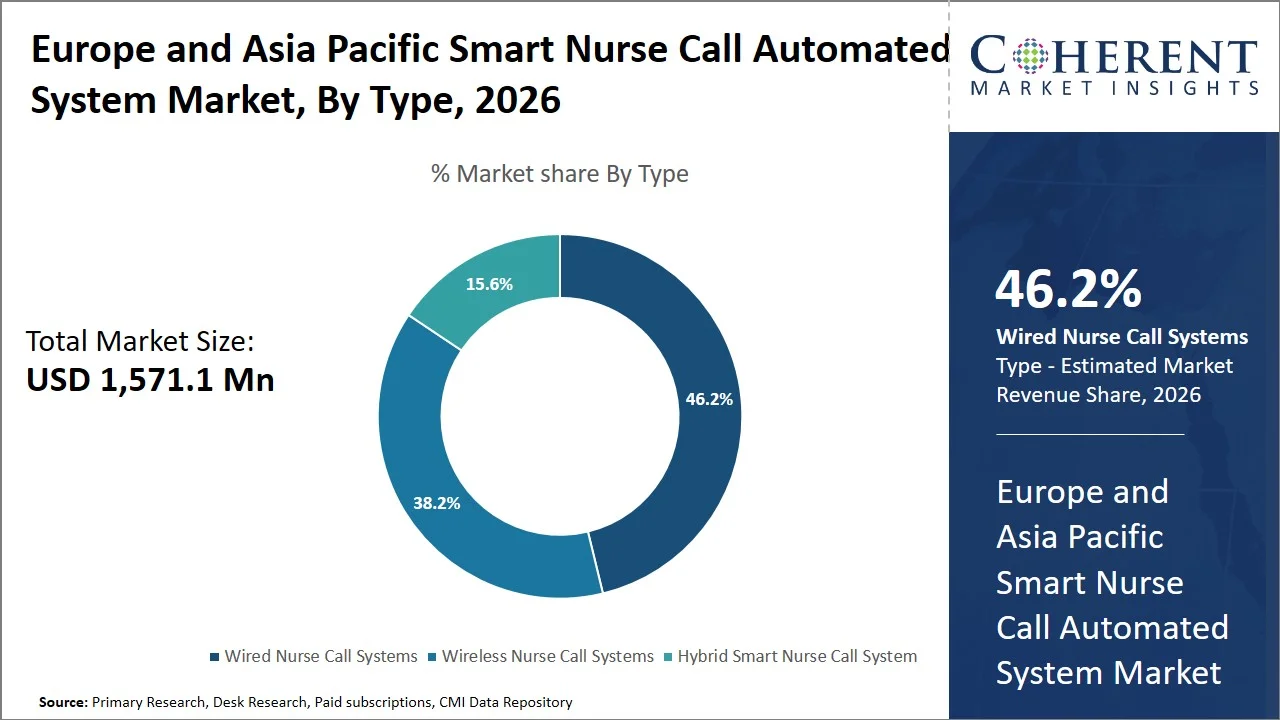
Wired nurse call systems are projected to hold 46.2% of the market share in 2026, because they provide stable communication, continuous connectivity, and data privacy. These systems are commonly used in healthcare setups due to a constant connection that provide seamless integration into established hospitals and have less signal obstruction. For instance, DIN VDE 0834 certified Schrack Seconet’s wired Nurse Call solution VISOCALL IP offers failure-safe communication, voice connection, and integrated solutions with a HIS (Hospital Information System), thus underlining the preference for a wired Nurse Call solution in an acute environment.
Fall Detection and Prevention Segment Dominates the Europe and Asia Pacific Smart Nurse Call Automated System Market
Fall detection and prevention segment is expected to hold 36.2% of the Europe and Asia Pacific smart nurse call automated system market share in 2026, attributed to the growing patient safety consciousness and the pressing need to minimize falls experienced by elderly inpatient patients. The integration of smart nurse call systems with motion sensors, connected wearability, as well as automatic alerting systems allows swift intervention by caregivers thereby enhance the clinical as well as reduce complication due to falls. For instance, in March 2021, Tunstall Healthcare released Tunstall GO, a new telecare technology solution featuring the latest in mobile technology such as two-way voice calls, GPS location assistance for locating service users, automatically detects fall incidents and alerts a pre-specified person for quick response, all of which provide around the clock protection. The introduction of Tunstall GO supports the on-going demand for sophisticated fall detection to be built into nurse call systems and connected care ecosystems.
Current Events and their Impact
Current Events | Description and its Impact |
European Health Data Space (EHDS) Regulation Enters into Force (March 2025) |
|
Japan Expands Medical DX Implementation Under the Medical DX Roadmap (April 2025) |
|
Europe and Asia Pacific Smart Nurse Call Automated System Market Dynamics
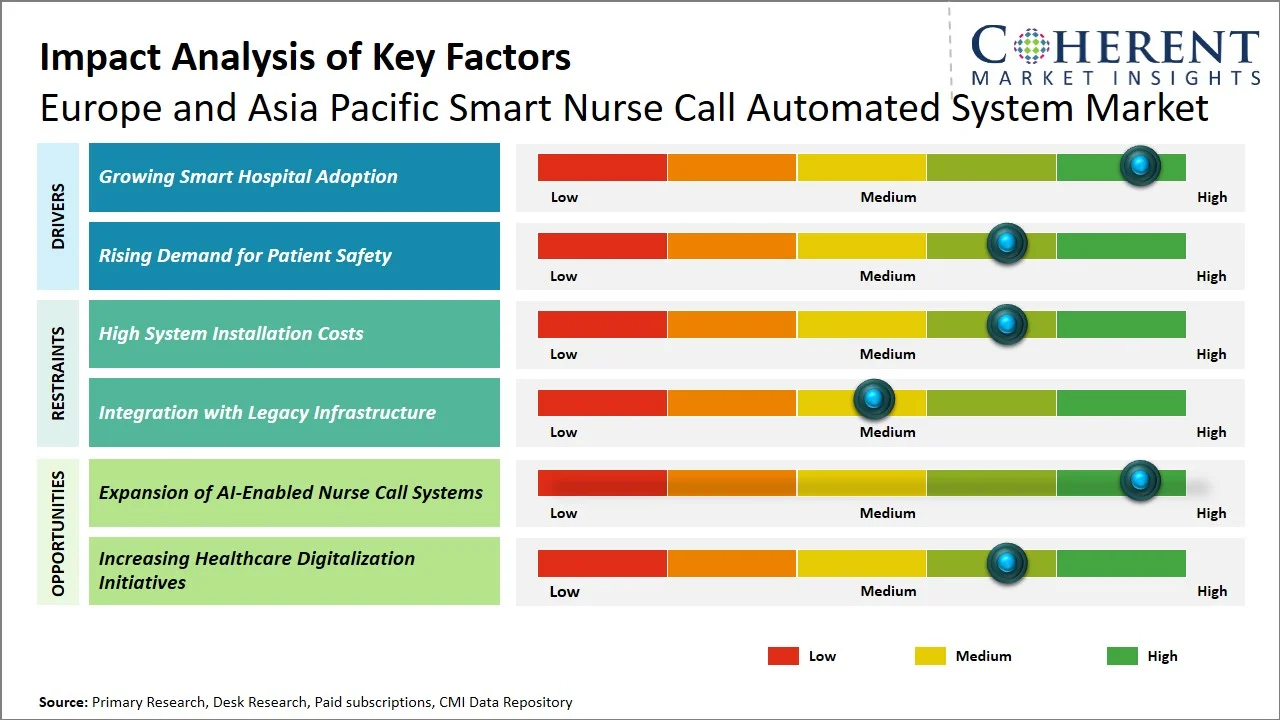
Market Drivers
Growing Smart Hospital Adoption
The increasing adoption of smart hospital infrastructure across Europe and Asia Pacific is accelerating the deployment of smart nurse call automated systems, as healthcare providers prioritize connected care, real-time communication, and workflow automation to improve patient outcomes and operational efficiency. Integration with IoT, electronic health records (EHRs), and patient monitoring platforms is further strengthening the role of intelligent nurse call solutions in digitally enabled hospitals. For instance, in January 2025, Australia's government launched the AUD 1 billion Health Technology Modernisation Program (HTMP) to modernize digital health infrastructure across public hospitals, supporting the adoption of interoperable healthcare technologies and connected clinical systems.
Rising Demand for Patient Safety
The growing emphasis on patient safety and reducing adverse events is driving the adoption of smart nurse call automated systems across Europe and Asia Pacific. Healthcare providers are increasingly implementing intelligent nurse call solutions integrated with fall detection, patient monitoring, and clinical communication platforms to enable faster caregiver response and improve patient outcomes. For instance, in September 2025, the Australian Commission on Safety and Quality in Health Care (ACSQHC) released the National Safety and Quality Health Service (NSQHS) Standards (Third Edition), strengthening requirements for effective communication, comprehensive care, and digital systems that support timely clinical response and patient safety across healthcare facilities.
Growing Adoption of Connected Care and Clinical Workflow Automation
The increasing focus on connected care and clinical workflow automation is driving the adoption of smart nurse call automated systems across Europe and Asia Pacific. Hospitals are integrating nurse call platforms with electronic health records (EHRs), mobile caregiver applications, and patient monitoring systems to enhance care coordination, reduce response times, and improve staff productivity. For instance, in July 2025, NHS England published the 10-Year Health Plan for England, which prioritizes digitally enabled care delivery and the adoption of interoperable technologies across NHS hospitals to support integrated clinical workflows and improve patient outcomes.
Emerging Trends
Growing Adoption of Robotic Nurse Assistants
Healthcare providers are increasingly deploying robotic nurse assistants to support routine clinical tasks such as medication delivery, patient transport, and logistics. The integration of these robots with smart nurse call systems enables automated task assignment, reduces caregiver workload, and allows nursing staff to focus on higher-value patient care activities.
Evolution of Intelligent Nurse Call Systems
Traditional nurse call systems are evolving into intelligent clinical communication platforms that integrate with electronic health records (EHRs), patient monitoring devices, mobile applications, and hospital information systems. This transformation is enabling real-time care coordination, automated alert escalation, and data-driven clinical workflows, improving both operational efficiency and patient outcomes.
Rising Adoption of Cloud-Based Nurse Call Platforms
Healthcare facilities are increasingly transitioning from conventional on-premise nurse call systems to cloud-based platforms that offer centralized management, remote system monitoring, software updates, and scalable deployment. Cloud-enabled architectures also facilitate seamless integration with mobile caregiver applications and other digital health solutions, improving operational flexibility and reducing IT maintenance requirements.
Evolution of Smart Nurse Call Systems Across Healthcare Facilities
Generation | Key Features | Primary Technologies | Clinical Benefit |
Traditional Nurse Call | Basic bedside call button | Wired communication | Basic patient assistance |
IP-Based Nurse Call | Voice communication, centralized monitoring | IP networking | Faster caregiver response |
Smart Nurse Call | Mobile alerts, workflow automation | IoT, EHR integration | Improved care coordination |
AI-Enabled Nurse Call | Predictive alerts, intelligent routing | AI, RTLS, Analytics | Enhanced patient safety & staff efficiency |
How is the expansion of AI-enabled nurse call systems creating new growth opportunities in the Europe and Asia Pacific smart nurse call automated system market?
The growth of AI-enabled nurse call solutions coincides with increasing use of smart technologies in the healthcare industry to accelerate clinician workflow communication, automate workflow prioritization, and promote the safety of patient health. Capabilities within an intelligent nurse call solution include smart alerting, intelligence- based calls and in real time analytics. They promote faster and quicker caregiver responses, more efficient task allocation and is necessary for healthcare facilities striving toward smarter hospitals. For instance, in June 2026, Korea’s Ministry of Health and Welfare announced the investment of USD 8.3 million (KRW 12 billion) toward its AI-based care system support program. The effort is designed to integrate artificial intelligence (AI) into care applications in hospitals across South Korea to monitor patients remotely, eliminate tedious administrative tasks and assist with overall clinical care, which may ultimately accelerate the deployment of a connected care/smart nurse call. (Source: MPR International GmbH)
Market Players, Key Development, and Competitive Intelligence
Key Developments
- In August 2025, TigerConnect announced the acquisition of eVideon, a provider of hospital smart room technology and digital patient engagement solutions. The acquisition integrates eVideon's smart room capabilities with TigerConnect's clinical collaboration platform, creating a more connected care environment that enhances nurse workflows, streamlines clinical communication, and improves patient engagement. By combining real-time communication with smart room technologies, the company aims to support more efficient care coordination, faster response times, and enhanced patient experiences across healthcare facilities.
- In May 2024, Ascom Holding AG was selected by Premier, Inc., a leading U.S. healthcare group purchasing organization (GPO), as an approved supplier for its clinical workflow and nurse call solutions. Effective May 1, 2024, the agreement enables Premier's member hospitals and healthcare providers to procure Ascom's communication technologies through pre-negotiated contracts, facilitating wider adoption of smart nurse call systems and connected care solutions while improving clinical communication and workflow efficiency.
Competitive Landscape
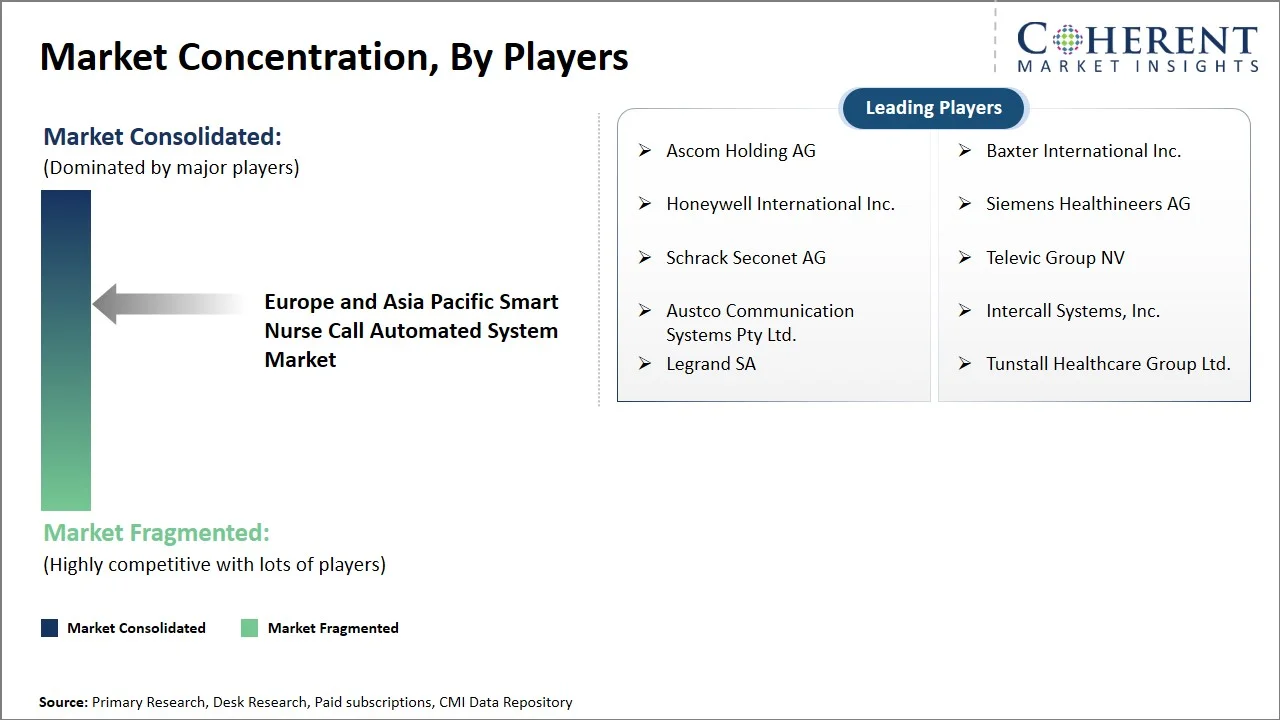
The Europe and Asia Pacific smart nurse call automated system market is moderately consolidated, with leading companies competing through advanced clinical communication platforms, AI-enabled workflow automation, and integrated smart hospital solutions. Market participants are focused on enhancing interoperability by integrating nurse call systems with electronic health records (EHRs), patient monitoring devices, mobile caregiver applications, and real-time location systems (RTLS). Strategic partnerships, acquisitions, and continuous product innovation remain key competitive strategies to strengthen market presence and address the evolving demand for connected care solutions. Key focus areas include:
- Expansion of AI-Enabled Clinical Communication and Workflow Automation
- Integration with Electronic Health Records (EHRs), RTLS, and Patient Monitoring Systems
- Development of Cloud-Based and Mobile-Enabled Nurse Call Solutions
- Strategic Partnerships and Smart Hospital Digitalization Initiatives
- Innovation in Predictive Patient Monitoring and Intelligent Alert Management
Market Report Scope
Europe and Asia Pacific Smart Nurse Call Automated System Market Report Coverage
| Report Coverage | Details | ||
|---|---|---|---|
| Base Year: | 2025 | Market Size in 2026: | USD 1,571.1 Mn |
| Historical Data for: | 2020 To 2024 | Forecast Period: | 2026 To 2033 |
| Forecast Period 2026 to 2033 CAGR: | 12.7% | 2033 Value Projection: | USD 3,617.4 Mn |
| Segments covered: |
| ||
| Companies covered: | Ascom Holding AG, Baxter International Inc., Honeywell International Inc., Siemens Healthineers AG, Schrack Seconet AG, Televic Group NV, Austco Communication Systems Pty Ltd., Intercall Systems, Inc., Legrand SA, Tunstall Healthcare Group Ltd. | ||
| Growth Drivers: |
| ||
| Restraints & Challenges: |
| ||
Analyst Opinion (Expert Opinion)
- In the coming years, the Europe and Asia Pacific smart nurse call automated system market will be shaped by the transition from conventional nurse call systems to intelligent, interoperable clinical communication platforms that leverage artificial intelligence (AI), Internet of Things (IoT), cloud computing, and real-time location systems (RTLS). As hospitals accelerate digital transformation and smart hospital initiatives, nurse call systems will increasingly function as central hubs for patient monitoring, caregiver communication, and workflow automation, improving patient safety and operational efficiency.
- Most opportunities can be foreseen within AI-enabled nurse call systems for fall detection and prevention applications, particularly in Japan and Germany. Japan's rapidly aging population and strong government support for healthcare digitalization, coupled with Germany's extensive smart hospital modernization initiatives, are expected to drive substantial demand for intelligent nurse communication solutions integrated with patient monitoring and electronic health records.
- To strengthen their competitive position, market players should prioritize the development of interoperable, AI-enabled, and cloud-based nurse call platforms that seamlessly integrate with electronic health records (EHRs), hospital information systems (HIS), mobile caregiver applications, and RTLS. Companies should also strengthen strategic partnerships with healthcare providers, digital health technology firms, and system integrators while offering scalable and cybersecurity-compliant solutions tailored to the varying infrastructure needs of hospitals and long-term care facilities across Europe and Asia Pacific.
Speak to the analyst
Want personalized insights?
Take the findings above to one of our principal consultants, or have the report rebuilt around the segments, geographies and competitors you actually track.
Market Segmentation
- Product Type Insights (Revenue, USD Mn, 2021 - 2033)
- Nurse Call Intercoms
- Nurse Call Buttons
- Nurse Call Mobile Systems
- Others
- Type Insights (Revenue, USD Mn, 2021 - 2033)
- Wired Nurse Call Systems
- Wireless Nurse Call Systems
- Hybrid Smart Nurse Call System
- Application Insights (Revenue, USD Mn, 2021 - 2033)
- Fall Detection and Prevention
- Workflow Optimization
- Alarms and Communications
- Others
- End User Insights (Revenue, USD Mn, 2021 - 2033)
- Hospitals
- Long Term Care Facilities
- Nursing Homes
- Others
Sources
Primary Research Interviews
- Executives from smart nurse call system and clinical communication solution providers
- Hospital administrators and nursing informatics leaders
- Clinical engineering and biomedical equipment specialists
- Smart hospital and healthcare digital transformation consultants
- Healthcare IT system integration experts
- Medical device distributors and channel partners
- Long-term care facility and ambulatory care center administrators
Stakeholders
- Smart nurse call system manufacturers
- Healthcare communication and workflow solution providers
- Hospital Information System (HIS) and Electronic Health Record (EHR) vendors
- Real-Time Location System (RTLS) technology providers
- IoT and AI-enabled healthcare technology companies
- Hospitals and integrated healthcare networks
- Long-term care facilities and rehabilitation centers
- Ambulatory surgery centers (ASCs)
- Government healthcare agencies
- System integrators and managed healthcare IT service providers
- End-use Sectors
- Hospitals
- Long-term Care Facilities
- Ambulatory Surgery Centers
- Rehabilitation Centers
- Specialty Clinics
- Regulatory & Health Bodies
- European Commission – Directorate-General for Health and Food Safety (DG SANTE)
- European Health Data Space (EHDS)
- National Health Service (NHS) England
- Medicines and Healthcare products Regulatory Agency (MHRA), UK
- National Institute for Health and Care Excellence (NICE), UK
- Ministry of Health (MOH), Singapore
- Ministry of Health, Labour and Welfare (MHLW), Japan
- Australian Commission on Safety and Quality in Health Care (ACSQHC)
- Therapeutic Goods Administration (TGA), Australia
- Korea Ministry of Health and Welfare (MOHW)
Databases
- European Commission Health & Food Safety Portal
- European Health Data Space (EHDS) Portal
- NHS England Digital
- NHS Digital Standards Directory
- Australian Institute of Health and Welfare (AIHW)
- Australian Digital Health Agency (ADHA)
- Ministry of Health Singapore
- Digital Agency, Japan
- ClinicalTrials.gov
- OECD Health Statistics
Magazines
- Healthcare IT News
- HealthTech Magazine
- HIMSS Healthcare Innovation
- Digital Health
- Hospital Management
- Medical Device Network
Journals
- Journal of Medical Systems
- Journal of Biomedical Informatics
- International Journal of Medical Informatics
- BMC Health Services Research
- Journal of Healthcare Engineering
- Journal of Nursing Management
Associations
- Healthcare Information and Management Systems Society (HIMSS)
- European Hospital and Healthcare Federation (HOPE)
- European Society for Quality in Healthcare (ESQH)
- Asia eHealth Information Network (AeHIN)
- International Hospital Federation (IHF)
- International Medical Informatics Association (IMIA)
Public Domain Sources
- European Commission
- European Health Data Space (EHDS)
- National Health Service (NHS) England
- Ministry of Health (MOH), Singapore
- Ministry of Health, Labour and Welfare (MHLW), Japan
- Australian Commission on Safety and Quality in Health Care (ACSQHC)
- Australian Digital Health Agency (ADHA)
- Korea Ministry of Health and Welfare (MOHW)
- OECD Health Statistics
- World Health Organization (WHO)
Proprietary Elements
- CMI Data Analytics Tool
- Proprietary CMI Existing Repository of information for last 10 years.
Get access to 250+ pages report
Every segment, forecast, competitor profile and data table behind the analysis above — available for instant download.
- ESOMAR Member
- ISO 9001:2015 Certified
- D-U-N-S Registered
- GDPR & CCPA Compliant
Missing comfort of reading report in your local language? Find your preferred language:
Transform your Strategy with Exclusive Trending Reports
Frequently Asked Questions
The Europe and Asia Pacific smart nurse call automated system market is estimated to be valued at USD 1,571.1 Mn in 2026 and is expected to reach USD 3,617.4 Mn by 2033.
Nurse call intercoms dominate due to their ability to provide reliable real-time voice communication, faster caregiver response, and seamless integration with hospital communication and clinical workflow systems.
A smart nurse call automated system is an advanced clinical communication platform that connects patients and caregivers through automated alerts, real-time communication, and integration with hospital digital systems.
The CAGR of the Europe and Asia Pacific smart nurse call automated system market is projected to be 12.7% from 2026 to 2033.
Growing smart hospital adoption, and rising demand for patient safety are the major factors driving the growth of the Europe and Asia Pacific smart nurse call automated system market.
High system installation costs, and integration with legacy infrastructure are the major factors hampering the growth of the Europe and Asia Pacific smart nurse call automated system market.
In terms of end user, hospitals are estimated to dominate the market revenue share in 2026.