

Medication Management System Market Size and Share Analysis - 2026 To 2033
The Medication Management System Market size is anticipated to grow at a CAGR of 8.8%, from USD 8.1 Bn in 2026 to approximately USD 14.6 Bn by 2033. The market growth is primarily driven by the rising adoption of automated medication dispensing systems, increasing demand for reducing medication errors, growing integration of electronic health records and clinical decision-support tools, and the expanding use of digital medication management solutions across hospitals, pharmacies, and long-term care facilities. The growing focus on patient safety, workflow automation, regulatory compliance, and real-time medication tracking is further supporting the adoption of medication management systems worldwide. According to the U.S. Centers for Disease Control and Prevention (CDC), adverse drug events result in more than 1.5 million emergency department visits annually in the U.S., while nearly 500,000 patients require hospitalization.
Key Takeaways
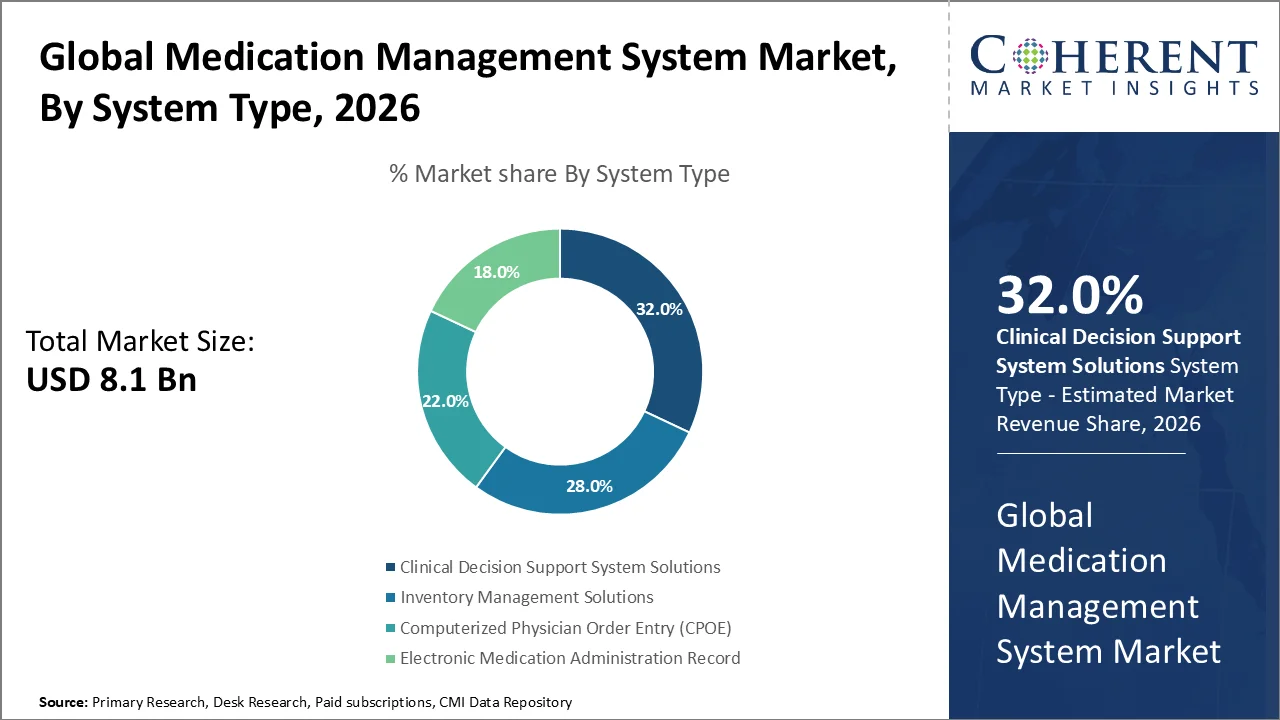
- The clinical decision support system solutions segment is likely to dominate the market with approximately 32.0% in 2026. The segment’s growth is owing to the increasing use of drug–drug interaction alerts, allergy checks, dosage verification, contraindication screening, and AI-assisted prescribing support.
- The cloud-based solution segment is set to lead with approximately 42.0% in 2026. The segment’s growth is owing to subscription-based deployment, lower on-site infrastructure requirements, remote system access, scalability, automatic software updates, and easier integration across multiple healthcare facilities. According to the Assistant Secretary for Technology Policy of the United States, in 2024, 81% of hospitals have adopted applications for providing patient access, while 70% of hospitals have adopted application access through FHIR.
- The hospitals segment is anticipated to dominate the market with approximately 28.0% in 2026. The segment’s growth is owing to high medication volumes, complex inpatient medication workflows, rising investments in automated dispensing and electronic administration systems, and the need to integrate prescribing, pharmacy inventory, patient records, and medication monitoring. In 2024, nearly 99% of U.S. hospitals enabled patients to electronically view their health information, 96% enabled downloading, and 92% offered secure provider messaging, reflecting the advanced digital infrastructure supporting hospital-based medication management systems.
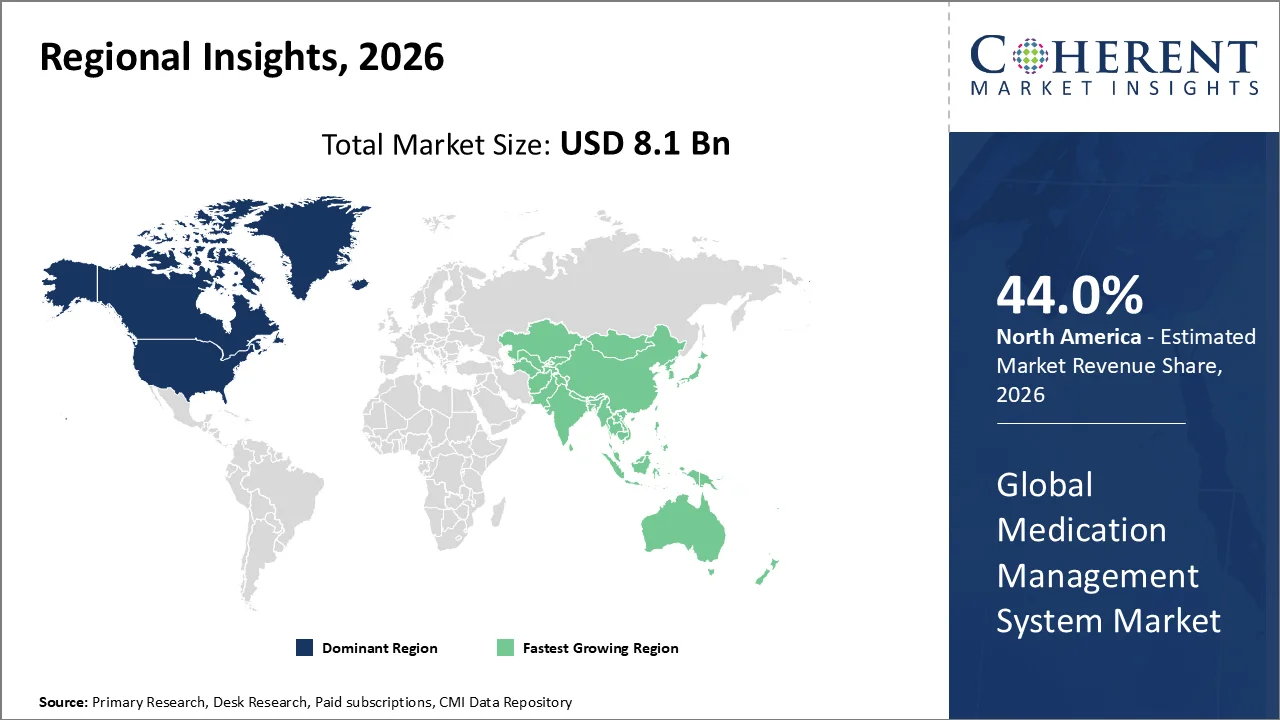
- North America is likely to dominate the medication management system market with approximately 44.0% in 2026. The region’s growth is owing to the widespread adoption of automated dispensing cabinets, electronic prescribing, barcode medication verification, integrated hospital pharmacy platforms, and regulatory initiatives supporting interoperable medication workflows. The U.S. government through its HTI-4 Final Rule of 2025 came up with new standards for electronic prescriptions, real-time prescription benefit checks, and electronic prior authorizations that were expected to result in labor cost savings of USD 19 Bn in ten years.
Market Drivers
Rising Focus on Medication Safety is Accelerating the Adoption of Medication Management Systems
Integrated medication management is being used by healthcare providers to minimize medical errors during the processes of prescription, distribution, administration, and monitoring. Through the use of computerized physician order entry, clinical decision support, electronic medication administration records, and barcode verification technology, healthcare organizations can identify wrong dosage, drug interaction, allergic reactions, duplicating drugs, and administration errors before harming patients.
According to the Agency for Healthcare Research and Quality Network of Patient Safety Databases Chartbook 2024, medication-related incidents constituted 25% of all reported patient safety events. Medication-related incidents occurring during administration accounted for around 36%, whereas those happening during prescribing made up 27%.
In May 2026, Wolters Kluwer Health implemented its Medi-Span medication decision support solution at The Christie NHS Foundation Trust, representing its first deployment within the U.K. National Health Service.
Growing Polypharmacy and Chronic Disease Burden are Increasing Medication-Coordination Requirements
The increased incidences of chronic conditions and the increased use of medications among older patients have led to the need for managing the medications appropriately. Patients on several prescription drugs require medication reconciliation, medication interaction evaluation, adherence monitoring, medication reminder services, dosing schedules, among others. Worldwide research conducted in the year 2026 revealed that 50.4% of older patients suffer from polypharmacy and the risks of developing negative health conditions increases progressively as the medication burden increases.
In June 2026, Aaniie, Inc. announced the expansion of capabilities of its Medication Documentation Record in its Aaniie Care product line. These include eMAR, real-time documentation of medication refusal and exceptions, medication task tracking, multi-level clinical review, and audit records.
Current Events and Their Impact on the Medication Management System Market
Current Event | Description and its Impact |
CMS Proposes Electronic Prior Authorization Standards for Prescription Drugs (April 2026) |
|
European Health Data Space Establishes an EU-Wide Framework for Electronic Prescriptions (March 2025) |
|
- Current Industry Events of 2026
- Market Size Estimation
- Regional Breakdown
- Competitive Landscape
- Customer Intelligence
- Segmental Analysis
- Pricing Analysis
- Key Market Drivers, Challenges & Future Trends
- Customized Insights Section
Segmental Insights
Why Are Clinical Decision Support System Solutions Acquiring the Largest Share?
On the basis of system type, the clinical decision support system solutions segment is projected to account for the largest medication management system market share of approximately 32.0% in 2026. The segment’s growth is owing to the increasing use of real-time drug–drug interaction alerts, allergy screening, dose-range checking, duplicate-therapy detection, contraindication warnings, and patient-specific prescribing recommendations.
The U.S. Assistant Secretary for Technology Policy reported in September 2025 that 71% of U.S. hospitals used predictive AI integrated with their electronic health record systems in 2024, up from 66% in 2023.
In March 2026, FDB (First Databank) announced the general availability of FDB MedProof MCP, an AI-native clinical decision support infrastructure developed specifically for medication-related workflows.
Why Are Cloud-Based Solutions Acquiring the Largest Share?
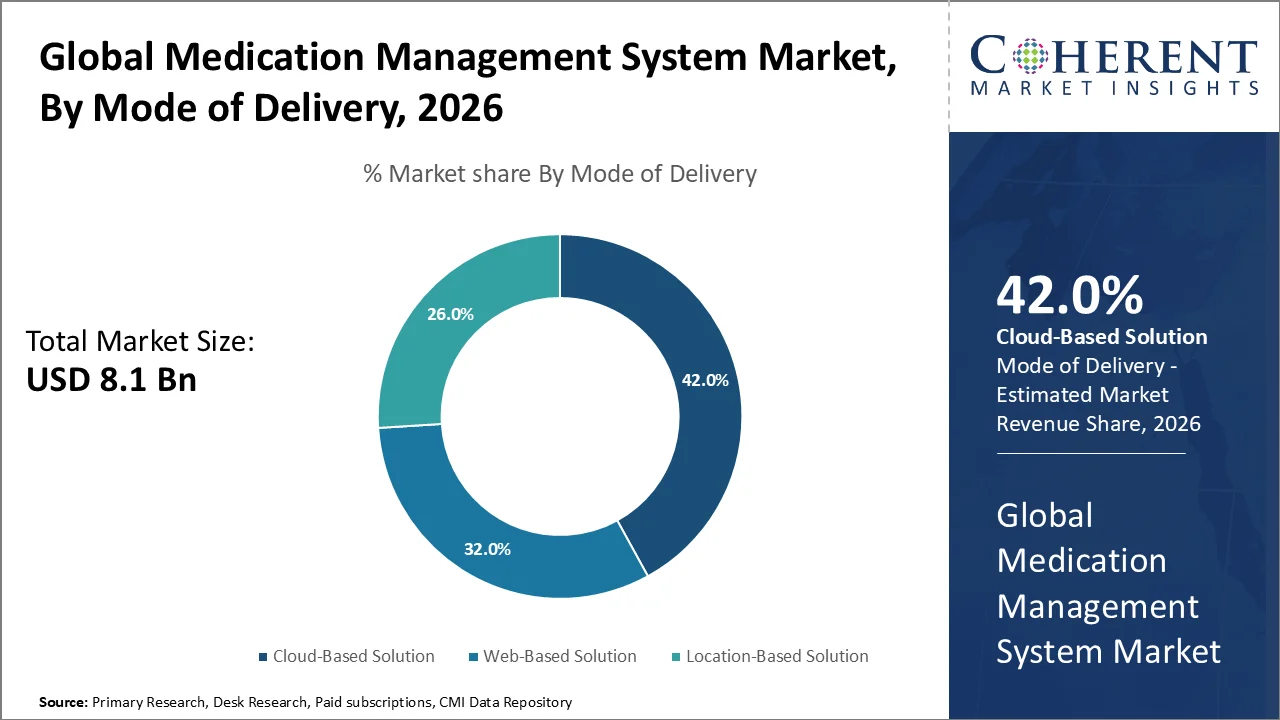
On the basis of mode of delivery, the cloud-based solution segment is expected to lead with approximately 42.0% of the medication management system market in 2026. The segment’s growth is owing to centralized data access, lower on-site infrastructure requirements, rapid software deployment, remote system maintenance, scalability across multiple facilities, and easier connectivity between hospitals, pharmacies, laboratories, and other healthcare providers.
The U.S. Assistant Secretary for Technology Policy reported in February 2026 that 60% of hospitals frequently sent clinical information through state, regional, or local health information exchanges in 2025, compared with 53% in 2023. The share frequently using national networks for sending information also increased to 60% in 2025, while 59% frequently received information through EHR vendor-based networks.
In December 2025, Omnicell, Inc. launched Omnicell Titan XT, a next-generation automated medication dispensing system powered by OmniSphere, the company’s cloud-based and HITRUST-certified medication management platform.
Hospitals Hold the Largest Market Share
On the basis of end user, the hospitals segment is anticipated to dominate the medication management system market with approximately 28.0% in 2026. The segment’s growth is owing to high patient admissions, complex inpatient medication regimens, large pharmacy inventories, and the need to coordinate medication ordering, verification, dispensing, administration, reconciliation, and monitoring across several clinical departments. According to the American Hospital Association’s 2025 Fast Facts, the U.S. had 6,093 hospitals, more than 913,000 staffed hospital beds, and approximately 34.4 million hospital admissions.
In March 2026, Baxter International Inc. introduced the IV Verify Line Labeling System, an automated medication-labeling solution designed for use in hospitals and other high-acuity healthcare settings.
Medication Management System Market Trends
- Increased usage of real-time prescription benefit and electronic prior-authorization tools has been useful in allowing prescribers to check the prescription benefit, cost for patients, alternative medications within formulary, and prior-authorization needs at the point of care. By 2025, about 973,463 prescribers had produced 1 billion real-time prescription benefits, helping patients save in excess of USD 55 million. Prior authorizations for medication were completed in about 18 seconds among 83 medicines.
- The growing trend of computerized medication-order verification has led to the reduction in manual workload in the pharmacy and enabled pharmacists to concentrate on the more challenging prescriptions. In July 2025, the American Society of Health-System Pharmacists found out that almost 75% of the hospitals in the United States used the EHR system for automated verification of eligible orders.
- The rising integration of artificial intelligence into clinical pharmacy workflows is strengthening medication-risk detection, clinical documentation, drug-information review, and patient-specific decision support. In a 2025 health-system implementation highlighted by ASHP, an AI-supported workflow increased delirium detection by more than fourfold, while another pharmacy deployment generated approximately 20% of pharmacists’ clinical-note content within the first month.
Regional Insights
North America Dominates Owing to Advanced E-Prescribing Infrastructure and High Hospital Automation Adoption
North America is likely to account for approximately 44.0% of the medication management system market in 2026. The region’s dominance is owing to the widespread use of electronic prescribing, automated dispensing cabinets, computerized medication ordering, barcode-based verification, clinical decision support, and interoperable pharmacy networks across the U.S. and Canada.
The National Council for Prescription Drug Programs reported in July 2026 that approximately 2.64 billion electronic prescriptions were filled in the U.S. during 2025, including 323.2 million electronic prescriptions for controlled substances.
Asia Pacific Medication Management System Market Trends
Asia Pacific is expected to be the fastest-growing regional market, registering a projected CAGR of approximately 11.5% from 2026 to 2033. The growth is owing to expanding hospital digitalization, government-supported electronic health records, rising cloud-platform adoption, and increasing implementation of electronic prescribing and medication-information exchange systems.
In Singapore, the government is investing approximately SGD 1.5 billion over ten years to develop and implement the Next Generation Electronic Medical Record system across the public healthcare sector.
Mature Health IT Infrastructure and Medication Interoperability Initiatives are Accelerating the Medication Management System Market in the U.S.
The U.S. medication management system market is witnessing strong growth owing to the widespread adoption of certified electronic health records, expanding health information exchange networks, and rising demand for automated medication reconciliation across hospitals, pharmacies, and ambulatory care providers.
In April 2026, U.S.-based healthcare software company AdvancedMD launched its integrated Electronic Medication Administration Record (eMAR) solution for behavioral health facilities, substance-use disorder treatment centers, long-term care providers, and specialty clinical organizations.
China Medication Management System Market Trends
China is expected to witness strong growth in the medication management system market owing to the expansion of nationally connected electronic prescription platforms, internet hospitals, digital pharmacy services, and home-delivery systems for prescription medicines.
In July 2026, China’s National Healthcare Security Administration announced plans to expand the country’s national drug traceability code system beyond medical-insurance fund supervision into pharmaceutical innovation, corporate financing, medication reminders, and digital access to drug-label information.
Who are the Major Companies in Medication Management System Industry
Some of the major key players in Medication Management System Market are Becton, Dickinson and Company, McKesson Corporation, Allscripts Healthcare Solutions, Inc., Omnicell, Inc., Cerner Corporation, Siemens Healthcare, Genoa Healthcare Inc., Swisslog Healthcare, GE Healthcare, and QuadraMed Affinity Corporation.
Key News
- In May 2026, Becton, Dickinson and Company (BD) announced a strategic partnership with Wellstar Health System to integrate BD Pyxis Pro medication-dispensing technologies with BD Alaris infusion systems across Wellstar’s hospitals and care facilities.
- In May 2025, Omnicell, Inc. announced the launch of its MedTrack RFID product line and new intelligent inventory-management software for operating rooms and outpatient clinics.
Market Report Scope
Medication Management System Market Report Coverage
| Report Coverage | Details | ||
|---|---|---|---|
| Base Year: | 2025 | Market Size in 2026: | USD 8.1 Bn |
| Historical Data for: | 2020 To 2024 | Forecast Period: | 2026 To 2033 |
| Forecast Period 2026 to 2033 CAGR: | 8.8% | 2033 Value Projection: | USD 14.6 Bn |
| Geographies covered: |
| ||
| Segments covered: |
| ||
| Companies covered: | Becton, Dickinson and Company, McKesson Corporation, Allscripts Healthcare Solutions, Inc., Omnicell, Inc., Cerner Corporation, Siemens Healthcare, Genoa Healthcare Inc., Swisslog Healthcare, GE Healthcare, and QuadraMed Affinity Corporation. | ||
| Growth Drivers: |
| ||
| Restraints & Challenges: |
| ||
Analyst Opinion
- The medication management system market is entering a standards-driven replacement cycle as governments require more structured electronic prescribing, formulary, benefit, and medication-history exchange. CMS requires the NCPDP Formulary and Benefit Standard Version 60 and Real-Time Prescription Benefit Standard Version 13 from January 2027, followed by exclusive use of NCPDP SCRIPT Version 2023011 from January 2028. These requirements are expected to accelerate upgrades of prescribing, prior-authorization, clinical decision-support, and pharmacy-management platforms.
- Clinical decision support and medication analytics are likely to become the principal competitive differentiators for system vendors. In January 2026, the FDA issued final guidance clarifying which clinical decision-support functions are regulated as medical devices and which may qualify as non-device software. Meanwhile, ASHP reported that 87.3% of hospitals use basic analytics from clinical decision support, smart pumps, or dispensing automation, whereas only 5.7% use advanced AI, machine learning, or predictive analytics. This gap indicates considerable growth potential for AI-enabled medication-risk detection and personalized prescribing support.
- Medication management automation is increasingly becoming an operational necessity rather than an optional hospital investment. ASHP reported in June 2025 that 64% of U.S. hospitals experienced shortages of entry-level pharmacy technicians, while more than half reported insufficient clinical pharmacy specialists. These workforce constraints are expected to strengthen demand for automated dispensing, medication reconciliation, inventory management, order verification, electronic administration records, and workflow analytics that allow pharmacists to concentrate on higher-value clinical activities.
Speak to the analyst
Want personalized insights?
Take the findings above to one of our principal consultants, or have the report rebuilt around the segments, geographies and competitors you actually track.
Market Segmentation
- By System Type (Revenue, USD Bn, 2021-2033)
- Inventory Management Solutions
- Computerized Physician Order Entry (CPOE)
- Clinical Decision Support System Solutions
- Electronic Medication Administration Record
- By Mode of Delivery (Revenue, USD Bn, 2021-2033)
- Location Based Solution
- Web-based Solution
- Cloud-based Solution
- By End User (Revenue, USD Bn, 2021-2033)
- Hospitals
- Retail Pharmacies
- Home based care
- By Region (Revenue, USD Bn, 2021-2033)
- North America
- U.S.
- Canada
- Latin America
- Brazil
- Mexico
- Argentina
- Rest of Latin America
- Europe
- Germany
- U.K.
- France
- Italy
- Spain
- Russia
- Rest of Europe
- Asia Pacific
- China
- India
- Japan
- Australia
- South Korea
- ASEAN
- Rest of Asia Pacific
- Middle East
- GCC
- Israel
- Rest of Middle East
- Africa
- South Africa
- Central Africa
- North Africa
- North America
Sources
Primary Research Interviews
- Hospital chief information officers and chief medical information officers
- Hospital pharmacy directors and clinical pharmacists
- Medication safety officers and nursing informatics professionals
- Electronic health record and e-prescribing solution providers
- Automated dispensing and pharmacy inventory system manufacturers
- Retail pharmacy chains and community pharmacy operators
- Home healthcare and long-term care service providers
- Healthcare IT procurement managers and system integration specialists
- Key opinion leaders in medication safety and clinical informatics
Databases
- World Health Organization Global Health Observatory
- World Bank Open Data
- Organisation for Economic Co-operation and Development Health Statistics
- U.S. Centers for Medicare & Medicaid Services Data
- U.S. Food and Drug Administration Databases
- Assistant Secretary for Technology Policy/HealthIT.gov Data
- Eurostat Health Database
- European Medicines Agency Database
- Australian Institute of Health and Welfare
- National Health Commission of China
Magazines
- Healthcare IT News
- Becker’s Hospital Review
- Pharmacy Times
- Drug Topics
- HealthTech Magazine
- Modern Healthcare
- Hospital Pharmacy Europe
- The Pharmaceutical Journal
Journals
- Journal of the American Medical Informatics Association
- International Journal of Medical Informatics
- Journal of Patient Safety
- BMJ Quality & Safety
- Research in Social and Administrative Pharmacy
- American Journal of Health-System Pharmacy
- Journal of Medical Systems
- BMC Medical Informatics and Decision Making
Newspapers
- The New York Times
- The Wall Street Journal
- Financial Times
- The Guardian
- Reuters
- The Economic Times
- China Daily
Associations
- American Society of Health-System Pharmacists
- Healthcare Information and Management Systems Society
- National Council for Prescription Drug Programs
- American Medical Informatics Association
- Institute for Safe Medication Practices
- European Association of Hospital Pharmacists
- International Pharmaceutical Federation
- National Community Pharmacists Association
- American Pharmacists Association
Public Domain Sources
- Company annual reports and investor presentations
- Government healthcare digitization and interoperability publications
- Hospital electronic health record adoption reports
- Medication-error and patient-safety databases
- Electronic prescribing and prior-authorization regulations
- Drug shortage and pharmaceutical supply-chain reports
- Clinical decision support and healthcare software guidelines
- Public procurement and hospital technology tender documents
- University and hospital medication-safety research publications
- Company product launches, partnerships, and press releases
Proprietary Elements
- CMI Data Analytics Tool
- Proprietary CMI Existing Repository of Information for the Last 10 Years
Get access to 250+ pages report
Every segment, forecast, competitor profile and data table behind the analysis above — available for instant download.
- ESOMAR Member
- ISO 9001:2015 Certified
- D-U-N-S Registered
- GDPR & CCPA Compliant
Missing comfort of reading report in your local language? Find your preferred language:
Transform your Strategy with Exclusive Trending Reports
Frequently Asked Questions
The Medication Management System Market is expected to reach approximately USD 14.6 Bn by 2033, increasing from USD 8.1 Bn in 2026.
Major players operating in the global Medication Management System Market include Becton, Dickinson and Company, McKesson Corporation, Allscripts Healthcare Solutions, Inc., Omnicell, Inc., Cerner Corporation, Siemens Healthcare, Genoa Healthcare Inc., Swisslog Healthcare, GE Healthcare, and QuadraMed Affinity Corporation.
High implementation and maintenance costs, data privacy and cybersecurity concerns, limited interoperability, legacy-system integration challenges, and resistance to changes in clinical workflows are the key factors hampering market growth.
The increasing adoption of automated medication dispensing systems, rising focus on reducing medication errors, growing use of electronic prescribing, and integration of clinical decision support and electronic medication administration records are driving market growth.
The Medication Management System Market is anticipated to grow at a CAGR of 8.8% between 2026 and 2033.
North America is expected to dominate the global Medication Management System Market with approximately 44.0% of the market share in 2026, owing to its advanced electronic prescribing infrastructure, hospital automation, clinical decision support adoption, and interoperable pharmacy networks.
Asia Pacific is expected to be the fastest-growing regional market, registering a projected CAGR of approximately 11.5% from 2026 to 2033. Growth is supported by hospital digitalization, government-backed electronic health records, cloud adoption, and electronic prescription initiatives.