

Global Fantasy Football Market Size and Forecast – 2026 To 2033
The global fantasy football market is estimated to be valued at USD 4.68 Bn in 2026 and is expected to reach USD 10.54 Bn by 2033, growing at a compound annual growth rate (CAGR) of 12.3% from 2026 to 2033. This expansion reflects the growing integration of fantasy football into digital sports entertainment ecosystems, supported by increasing mobile adoption, real-time sports data availability, and deeper fan interaction with football content.
Fantasy platforms are increasingly evolving from simple roster-management tools into interactive engagement platforms combining live statistics, personalized recommendations, social competition, and premium analytics. In July 2025, the Premier League launched new fan-facing digital platforms featuring personalized content, live statistics, match updates, and enhanced integration with Fantasy Premier League, demonstrating how major sports organizations are investing in digital fan-engagement infrastructure that supports continued fantasy football adoption.
Key Takeaways of the Global Fantasy Football Market
- Season-long Fantasy Football is estimated to expand at an 11.5% CAGR during 2026–2033 and hold 48.7% of the global fantasy football market in 2026, reflecting weekly roster decisions, private-league continuity, social competition, and full-season retention. In August 2025, ESPN refreshed Fantasy Football with redesigned matchup views, player cards, waiver reminders, and auto-reactivation for league managers, reinforcing investment in recurring season-long engagement.
- Mobile Applications are estimated to record a 13.1% CAGR during 2026–2033 and capture 68.4% of the global fantasy football market in 2026, as lineup changes, injury monitoring, waiver activity, notifications, and live scoring increasingly happen on smartphones. In August 2025, Yahoo Sports refreshed the Yahoo Fantasy app with faster navigation, denser matchup visibility, and streamlined lineup management, demonstrating product development centered on mobile-first fantasy participation.
- Contest and Platform Fees are estimated to grow at a 12.7% CAGR during 2026–2033 and account for 35.8% of the global fantasy football market in 2026, as paid-entry mechanics convert engagement into recurring transaction revenue. In February 2026, DraftKings’ annual filing stated that DFS revenue is generated from contest entry fees net of prizes and customer incentives, directly validating fee-based monetization in competitive fantasy formats.
- North America is estimated to advance at an 11.4% CAGR during 2026–2033 and represent 46.8% of the global fantasy football market in 2026, supported by the NFL’s entrenched media ecosystem, mature fantasy operators, and established paid-play infrastructure. In July 2026, the Fantasy Sports & Gaming Association reported that 31% of U.S. adults had participated in fantasy sports or sports betting during the prior year, indicating a broad monetizable audience.
- Europe is estimated to post a 14.0% CAGR during 2026–2033 and hold 25.6% of the global fantasy football market in 2026, making it the fastest-growing region as NFL fandom, localized media access, international games, and digital sports communities widen the addressable player pool. In May 2025, the NFL announced regular-season games across Dublin, London, Berlin, and Madrid for 2025, expanding sustained fan engagement across major European markets.
Segmental Insights
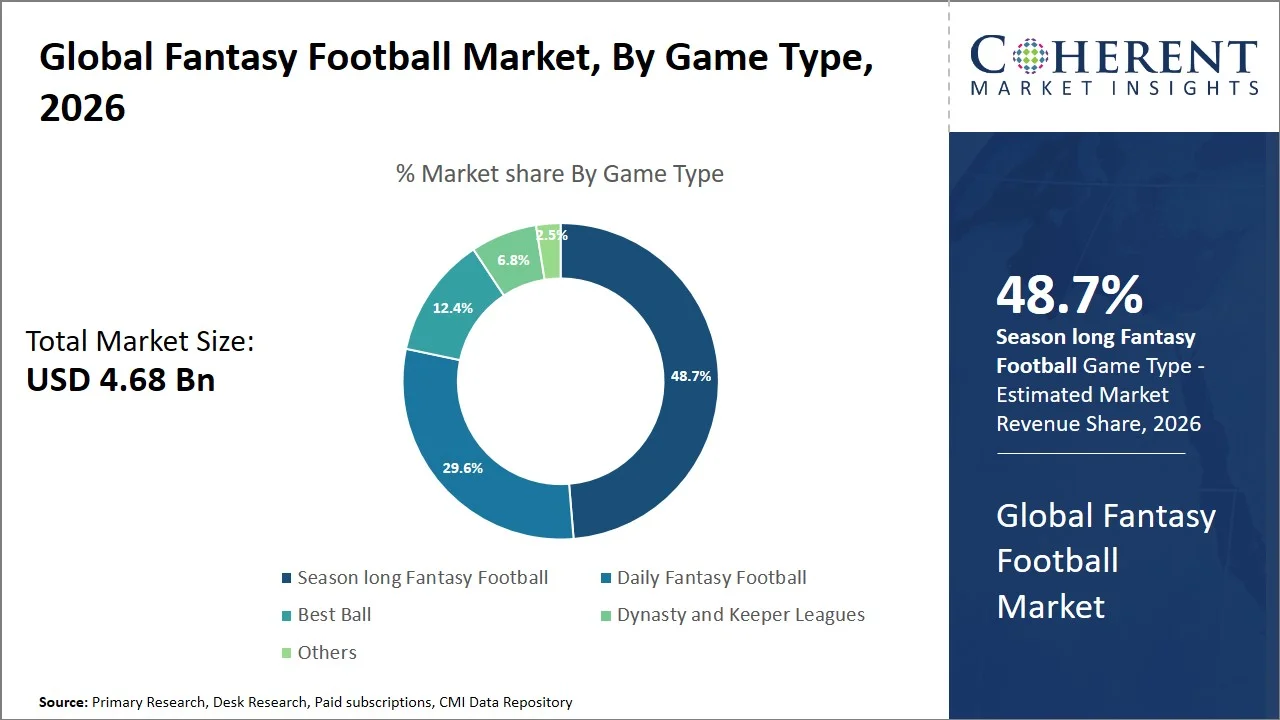
Why Does Season-long Fantasy Football Dominate the Global Fantasy Football Market?
Season-long Fantasy Football is expected to lead with 48.7% market share in 2026 the game-type category because it creates a persistent league relationship across an entire football schedule rather than concentrating engagement into isolated contests. Commissioner settings, recurring private leagues, waivers, trades, standings, playoffs, and historical records make the format particularly sticky for friend groups, workplace leagues, and long-running communities. On the supply side, mature league-management engines let operators support customizable scoring, keeper rules, draft formats, and commissioner controls at scale, while content providers can monetize draft preparation and weekly decision support throughout the season. This gives platforms a longer retention window and more opportunities to cross-sell premium tools. In April 2026, Sleeper highlighted its season-long fantasy football platform with integrated league chat, commissioner controls, fantasy-focused live scoring, and native apps across major devices, reinforcing the format’s infrastructure depth and social utility.
- Current Industry Events of 2026
- Market Size Estimation
- Regional Breakdown
- Competitive Landscape
- Customer Intelligence
- Segmental Analysis
- Pricing Analysis
- Key Market Drivers, Challenges & Future Trends
- Customized Insights Section
Why Do Mobile Applications Represent the Largest Platform Segment in the Global Fantasy Football Market?
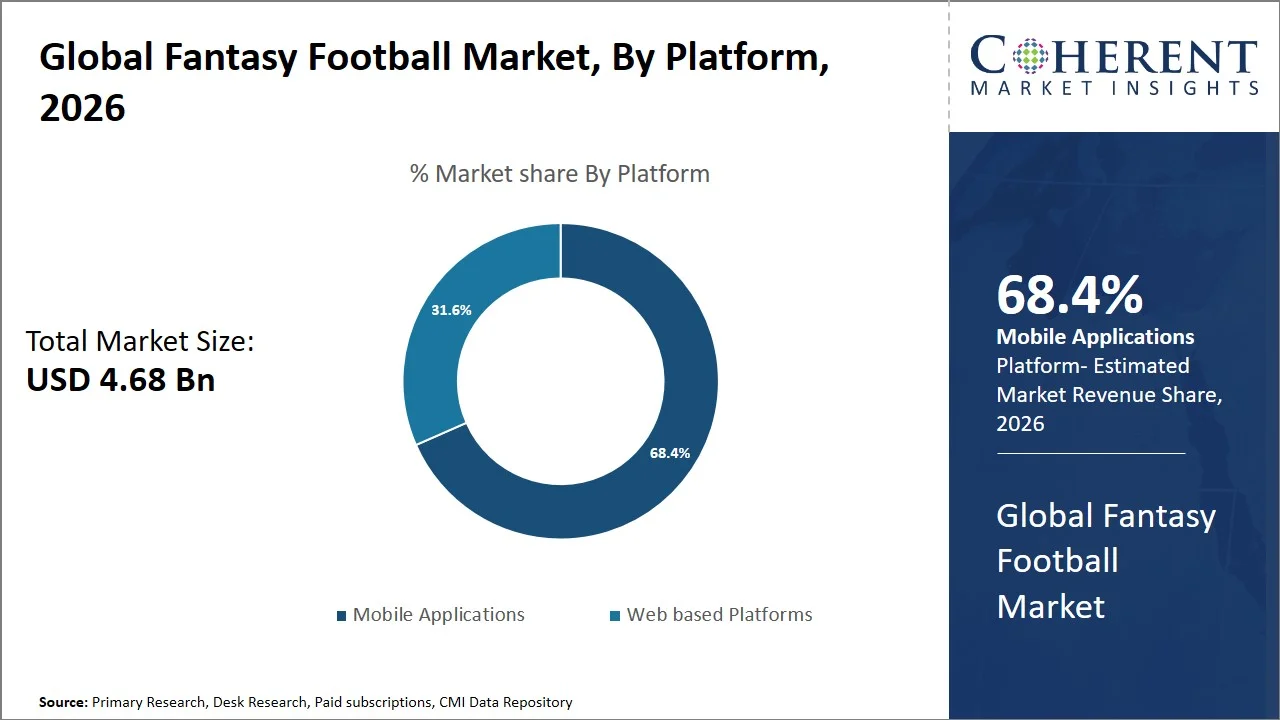
Mobile Applications are expected to represent the largest platform category with expected market share 68.4% in 2026 because fantasy football increasingly functions as a second-screen activity that must remain accessible while users watch games, travel, or move between multiple leagues. Native apps can preserve login state, deliver device-level alerts, surface synchronized rosters, and reduce the number of steps required to reach draft, matchup, waiver, and trade workflows. This favors app-based providers that can combine league management, research tools, personalized recommendations, and premium services in one interface. For users managing several teams, mobile consolidation also reduces switching friction between hosts and data sources, strengthening repeat usage. In July 2025, Fantasy Life unveiled a new platform funded alongside its seed round, featuring a mobile-first experience, cross-game fantasy dashboards, expanded tools, and premium offerings, demonstrating how suppliers are designing fantasy products around mobile operating behavior rather than treating smartphones as simplified web access.
Why Do Contest and Platform Fees Dominate the Revenue Model of the Global Fantasy Football Market?
Contest and Platform Fees are expected to lead the revenue-model category with share 35.8% in 2026 because they monetize the user’s core transaction entering or participating in a fantasy contest while allowing operators to vary pricing by contest size, prize structure, skill level, and frequency. This model can support guaranteed prize pools and differentiated entry tiers without relying entirely on advertising cycles or universal subscriptions. Its commercial viability, however, depends on payment processing, wallet controls, contest administration, geolocation, tax handling, and jurisdiction-specific compliance, making operational infrastructure as important as user acquisition. High-intent DFS, best-ball, and prize-oriented fantasy users are especially relevant because their participation can generate repeated fee events across a season. In February 2026, Flutter Entertainment’s 2025 Annual Report discussed the tax treatment and operational consequences of fantasy sports entry fees at FanDuel, underscoring how entry-fee economics remain embedded in the commercial and compliance architecture of paid fantasy platforms.
Current Events and their Impact
Current Event | Description and Its Impact |
|
California DOJ Legal Opinion on Daily Fantasy Sports – July 2025 |
| |
New York Gaming Commission Settlement on Unpermitted Fantasy Contests – March 2025 |
| |
India Confirms National Online Money Gaming Prohibition Framework – March 2026 |
| |
Global Fantasy Football Market Dynamics
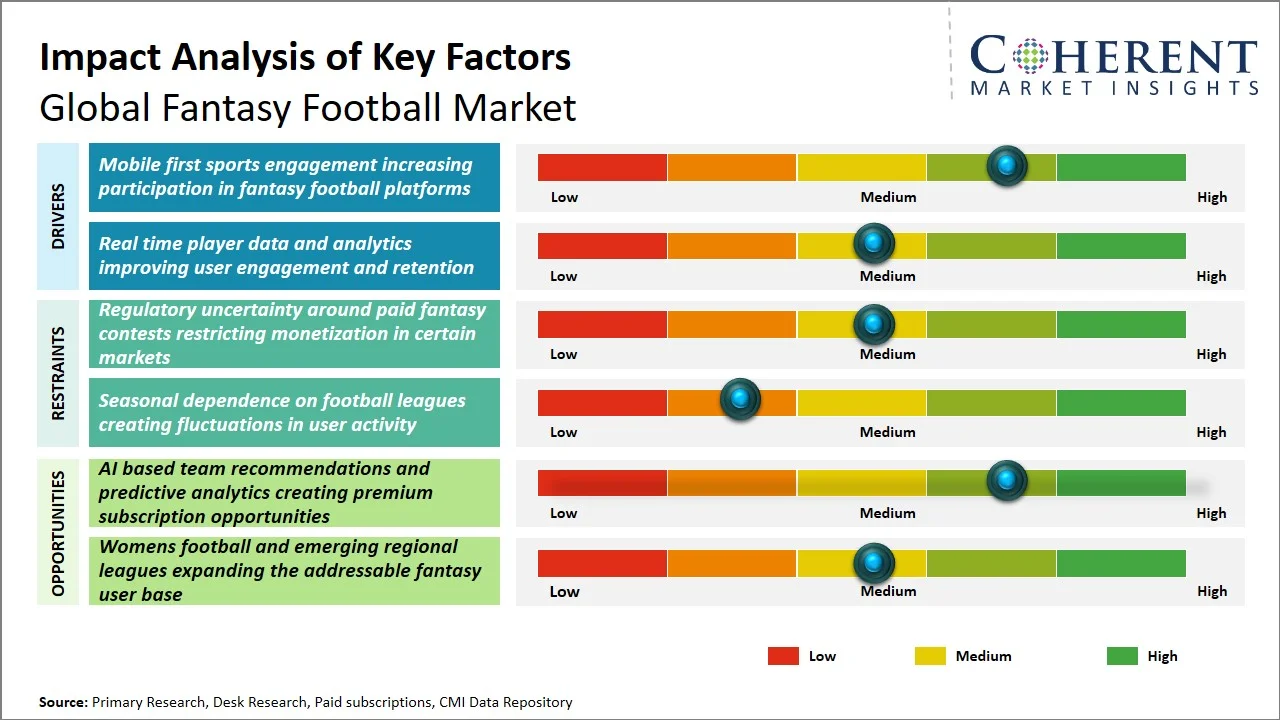
Key Market Drivers
- Mobile first sports engagement increasing participation in fantasy football platforms: Mobile-first sports engagement is increasing participation in fantasy football platforms because smartphones turn fantasy management from a scheduled desktop activity into an always-available companion to live games. Drafting, waiver claims, trade responses, injury checks, lineup changes, league chat, and score tracking can occur within the same interface, lowering participation friction and increasing weekly touchpoints. Platform operators, fantasy-content providers, subscription tools, advertisers, and contest organizers benefit because higher interaction frequency creates more opportunities for premium conversion, sponsorship exposure, and in-app monetization. Mobile design also simplifies onboarding for casual users who may not commit to complex web-based league administration. In July 2025, RotoWire launched its redesigned Football Draft Kit app for iOS and Android with mobile-first draft planning, real-time draft assistance, a simulator, league sync, and in-season strategy tools, illustrating continued investment in smartphone-centered fantasy management.
- Real time player data and analytics improving user engagement and retention: Real-time player data and analytics are improving user engagement and retention by shortening the gap between an on-field development and the fantasy decision it influences. Live statistics, injury updates, projections, matchup context, roster availability, and expert signals give managers reasons to revisit platforms before, during, and after games. Fantasy operators can use these inputs to strengthen scoring, waiver research, start/sit decisions, and premium advisory services, while analytics vendors gain recurring subscription and licensing opportunities. The strategic advantage comes from converting fragmented football information into timely, league-specific actions rather than simply displaying more data. In November 2024, FantasyPros introduced Coach AI, combining up-to-the-minute player statistics and projections with expert analysis and personalized recommendations based on a user’s league and team, demonstrating how continuously refreshed analytics can become an embedded decision-support layer.
Emerging Market Trends
- Cross-Platform League Portability Is Weakening Host Lock-In: Cross-platform league portability is reshaping fantasy football by allowing users to manage league data, rosters, scoring rules, and analytics across multiple platforms. This creates opportunities for independent analytics providers and companion tools to capture decision-making moments such as drafts, trades, waiver selections, and lineup changes. Platform operators are increasingly required to improve data portability, APIs, and premium functionality to retain multi-league users. Providers that combine interoperability with secure data handling can strengthen their position in the evolving fantasy ecosystem.
- Creator-Led Fantasy Communities Are Becoming Distribution Channels: Creator-led fantasy communities are emerging as powerful acquisition and engagement channels, enabling analysts, podcasters, streamers, and football influencers to build leagues, premium experiences, and subscriber-driven competitions. This approach shifts user acquisition from traditional marketing toward trusted communities with existing fan relationships. Fantasy platforms offering customizable league tools, referral programs, and creator monetization features can benefit, while traditional operators may face higher retention challenges. The market is expected to see increasing convergence between fantasy platforms, sports content, and community-based experiences.
Regional Insights
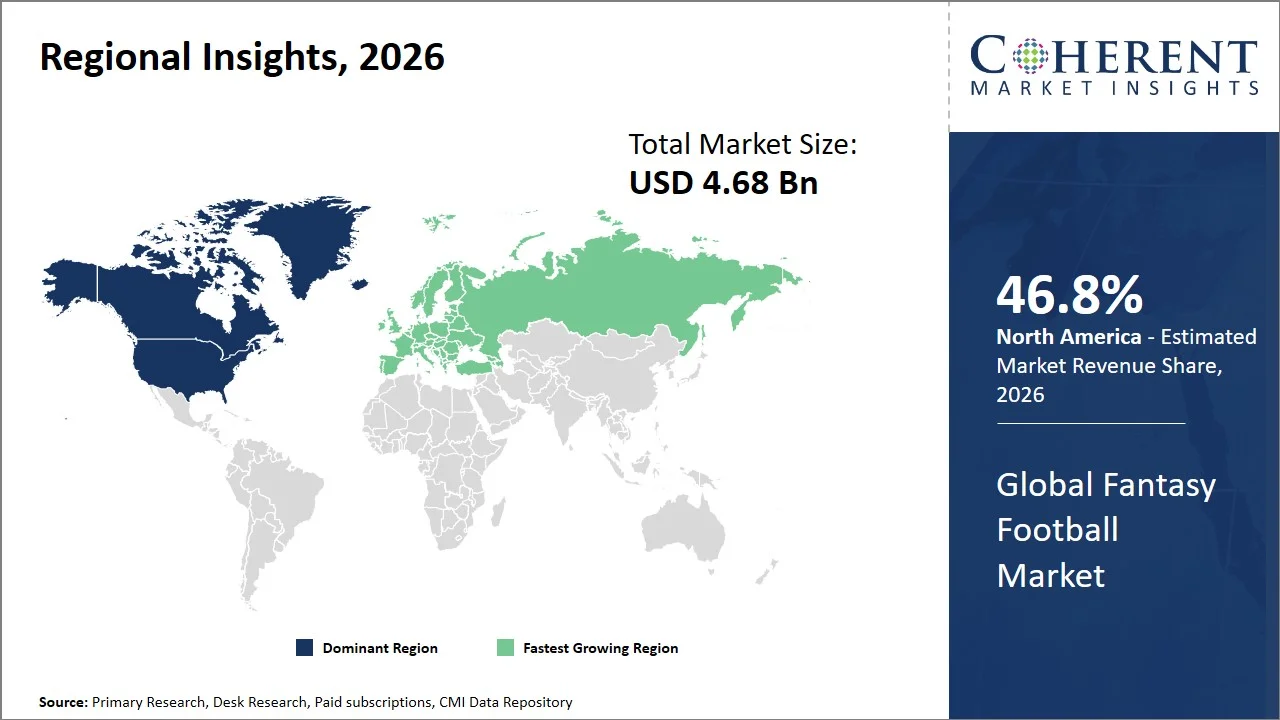
Why Does North America Dominate the Global Fantasy Football Market?
North America is expected to account for 46.8% of the global fantasy football market in 2026 because the region combines entrenched season-long league habits with a mature ecosystem of commissioner platforms, premium analytics, DFS products, sports media, and subscription tools. Fantasy participation is embedded in the weekly NFL viewing cycle, giving operators repeated engagement opportunities around drafts, waivers, injuries, trades, and live scoring. The region also benefits from extensive sports-data infrastructure and a large base of specialist content providers, allowing platforms to differentiate through decision support rather than basic scoring alone. State-by-state rules create compliance complexity for paid formats, but they also favor operators with strong geolocation and product-governance capabilities. In August 2024, PFF upgraded its Live Draft Assistant with league synchronization, real-time pick recommendations, availability predictions, and keeper support, illustrating the sophistication of North America’s fantasy-support ecosystem.
Why Is Europe Emerging as the Fastest-Growing Region in the Global Fantasy Football Market?
Europe is expected to hold 25.6% of the global fantasy football market in 2026 and emerge as the fastest-growing region as fantasy participation benefits from two reinforcing ecosystems: established football-based fantasy behavior and expanding consumption of American football. Cross-border streaming, localized sports media, international games, and mobile-first fan communities make it easier for users to follow players and competitions outside domestic leagues, which is essential for fantasy participation. Europe also offers room for localized scoring formats, multilingual content, free-to-play acquisition, and subscription analytics tailored to newer users. Growth therefore depends less on replicating the U.S. market and more on adapting fantasy experiences to varied national sports cultures. In January 2025, DAZN signed an eight-year global media partnership with the European League of Football and committed to distribute all 101 games of the 2025 season, expanding year-round American football availability across Europe.
Why Is the U.S. a Key Market for the Global Fantasy Football Market?
The U.S. is a key market for the global fantasy football market because fantasy play is tightly connected to the NFL calendar, sports-media consumption, workplace and social leagues, and an established culture of draft-day participation. The country supports the deepest range of formats, from free season-long leagues and dynasty competitions to premium commissioner products and paid contests, giving operators multiple monetization paths. A dense supplier base of sports-data companies, analysts, podcasts, newsletters, and simulation tools also reduces user friction by making draft preparation and weekly roster decisions easier. For commercial providers, the U.S. offers strong recurring demand but requires careful state-level compliance for prize-based formats. In July 2025, CBS Sports opened its Fantasy Football Today Open Challenge across 24 twelve-team head-to-head leagues, with mobile-device participation permitted, demonstrating the continued institutionalization of organized fantasy competition.
Why Is the U.K. Important in the Global Fantasy Football Market?
The U.K. is important in the global fantasy football market because it combines long-standing familiarity with fantasy management through domestic football with a steadily expanding American football audience. This lowers the educational barrier for roster-based games while live NFL coverage gives users the weekly player information needed for season-long and daily fantasy decisions. London’s role as a recurring host of NFL regular-season games also strengthens team affinity, sponsorship activation, and media attention beyond the Super Bowl window. Commercially, operators can use free leagues and content-led acquisition before introducing premium analytics or advanced formats to experienced users. In August 2025, Sky Sports announced a new three-year NFL agreement that increased the number of live games available in the U.K. and Ireland and included every London and European game, materially widening the live-content foundation that supports fantasy engagement.
Why Is Germany a Strategic Country in the Global Fantasy Football Market?
Germany is a strategic country in the global fantasy football market because American football has developed a broader media and event footprint alongside Germany’s mature digital sports-consumption market. Consistent access to NFL broadcasts helps fantasy users follow injuries, depth charts, player form, and weekly matchups, while domestic interest in American football creates a larger funnel for first-time fantasy participants. Germany is also attractive for subscription-led fantasy tools because consumers are accustomed to paid streaming ecosystems and data-rich sports coverage. Local-language analysis, simplified onboarding, and free-to-play leagues can help convert spectators into fantasy managers before more advanced formats are introduced. In March 2026, RTL Group’s full-year results confirmed that its German sports-rights portfolio includes NFL matches, including the Super Bowl, through 2028, providing continuity of mainstream exposure that can support sustained fantasy-football participation.
Why Is India Important in the Global Fantasy Football Market?
India is important in the global fantasy football market because consumers already have strong familiarity with mobile fantasy-sports mechanics, leaderboard competition, player selection, and app-based sports engagement. That behavioral familiarity lowers the learning curve for football-focused fantasy products, particularly among digitally active users who follow international leagues and major global tournaments. The strongest commercial opportunity is likely to come from free-to-play, sponsor-backed, media-linked, and subscription-content models that can build engagement without relying solely on entry-fee contests. Local-language content and simplified roster guidance can further broaden participation beyond highly experienced fantasy users. In August 2024, the Premier League established a dedicated Disney Star Fantasy Premier League broadcaster league for India, automatically placing eligible India-based FPL managers into the country-specific public league without an entry fee, showing how broadcaster integration can localize acquisition and participation.
Why Is Australia an Important Growth Market for the Global Fantasy Football Market?
Australia is an important growth market for the global fantasy football market because fantasy team management is already embedded in the country’s digital sports culture, particularly through Australian football competitions that train users to evaluate player statistics, prices, trades, and weekly performance. This familiarity creates a transferable audience for NFL and other football-related fantasy formats, especially among younger sports fans using mobile apps and subscription sports media. Australia also offers a commercially attractive environment for premium research, draft tools, and community leagues because users are accustomed to data-intensive fantasy decision making. Product localization should emphasize convenient time-zone alerts, mobile roster management, and cross-code sports content. In December 2024, the AFL announced a ground-up rebuild of its Fantasy Draft experience for 2025, including a new website and app, improved draft boards, league chat, and expanded commissioner settings, demonstrating continuing investment in advanced fantasy-product infrastructure.
Technology Adoption Landscape in the Global Fantasy Football Market
Technology | Adoption Level | Key Application Area | Business Impact |
Low-Latency Live Sports-Data APIs | High | Live scoring, player statistics, injury and game-event updates | Reduces scoring delays and supports responsive fantasy experiences during live games. |
Configurable Fantasy Scoring and Rules Engines | High | PPR, standard, dynasty, keeper, custom roster and commissioner settings | Allows one platform architecture to support multiple league structures while reducing manual administration. |
Predictive Player Projection and Lineup Recommendation Models | Medium | Draft rankings, start/sit decisions, waiver prioritization and matchup analysis | Supports premium decision tools and personalization while increasing the commercial value of proprietary analytics. |
Event-Triggered Push Notification Orchestration | High | Injury alerts, lineup deadlines, waiver activity and scoring events | Increases timely return visits and reduces missed roster actions without requiring continuous app monitoring. |
Automated Collusion, Fraud and Account-Abuse Detection | Medium | Paid contests, account monitoring and abnormal participation patterns | Protects contest integrity, reduces operational risk and strengthens trust in prize-based fantasy environments. |
Jurisdictional Geolocation, Age and Identity Control Systems | Medium | Eligibility screening for paid fantasy contests | Enables jurisdiction-specific access control and lowers regulatory exposure, although implementation adds compliance and technology costs. |
How Are College Football Fantasy Formats Creating New Growth Opportunities in the Global Fantasy Football Market?
College football fantasy formats create an underdeveloped opportunity to extend fantasy participation beyond professional-league calendars and capture highly engaged university, alumni, and conference fan communities. The commercial case is attractive because college football offers deep team affiliation, frequent roster turnover, recruiting narratives, transfer activity, and a large pool of players that can support differentiated draft and waiver strategies. Platforms can capture the opportunity through season-long leagues, campus and alumni competitions, premium research tools, sponsor-supported games, and media integrations tailored to college audiences. Participation requires broader player-data coverage, reliable depth-chart and injury intelligence, flexible roster rules, rights and licensing discipline, and technology capable of handling rapid player movement between programs. Established fantasy operators can leverage existing user accounts and league engines, while specialist entrants may compete through superior college-specific content and analytics. Success will depend on simplifying a more complex player universe without stripping away the depth that makes college football distinctive.
Market Players, Key Development, and Competitive Landscape
Key Developments
- In August 2026, USA TODAY Sports launched USA TODAY Sports Fantasy, a subscription-based NFL fantasy platform combining expert coverage with projections, league synchronization, start/sit guidance, waiver support, and personalized roster tools across web and mobile. This is important for the global fantasy football market because it demonstrates how established sports-media audiences can be converted into recurring paid fantasy-tool users rather than monetized solely through advertising and editorial traffic.
- In June 2026, Fantasy Sports Entertainment & Productions announced the launch of Draft Nation, an annual fantasy football draft event scheduled around National Fantasy Football Draft Day and designed to bring leagues together for in-person drafting, contests, and fan activities. This is important for the global fantasy football market because it extends fantasy participation into experiential entertainment, creating incremental opportunities around events, sponsorship, hospitality, and organized league communities beyond digital platform usage.
- In February 2024, First Pick Labs acquired Sideline Software, the company behind MyFantasyLeague.com, bringing the long-established fantasy football commissioner platform together with Draft Hero’s fantasy software capabilities. This is important for the global fantasy football market because the transaction illustrates strategic consolidation around specialized league-management infrastructure, established commissioner relationships, developer APIs, and customizable fantasy functionality rather than competition based only on mass-market consumer scale.
Competitive Landscape
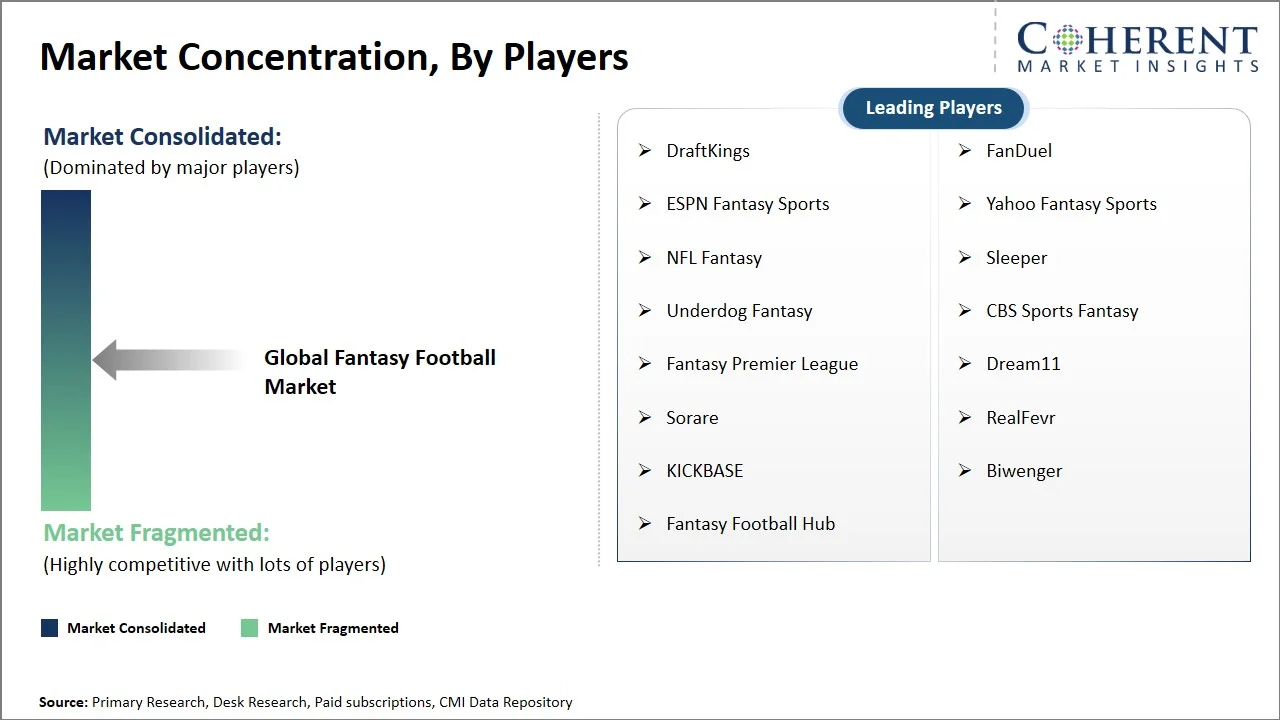
The global fantasy football market is moderately consolidated at the primary league-hosting layer but fragmented across analytics, commissioner software, content, data services, specialized game formats, and engagement tools. Large platforms benefit from established league networks and repeat user behavior, while specialist providers can capture specific decision points such as draft preparation, player analysis, or league administration. Competition increasingly centers on platform reliability, customization depth, data quality, user experience, monetization design, and regulatory adaptability.
Key focus areas include
- Draft and peak-game reliability: Maintaining stable performance during concentrated draft windows and live football periods is a fundamental competitive requirement.
- Scoring and league customization: Flexible roster structures, scoring rules, keeper settings, and commissioner controls broaden addressable user groups.
- Data accuracy and timeliness: reliable player status, statistics, projections, depth charts, and injury information influence platform credibility.
- Premium-value differentiation: Subscription products must deliver decision utility that users can distinguish from freely available fantasy content.
- Regulatory adaptability: Modular contest configurations, eligibility controls, and market-specific compliance processes are increasingly important for paid formats.
- User retention economics: Preserving league histories, rivalries, records, and recurring commissioner relationships can lower reacquisition requirements.
- Integration capability: Open APIs and compatibility with external content, data, and analytics services can strengthen platform ecosystems without requiring every capability to be built internally.
Market Report Scope
Fantasy Football Market Report Coverage
| Report Coverage | Details | ||
|---|---|---|---|
| Base Year: | 2025 | Market Size in 2026: | USD 4.68 Bn |
| Historical Data for: | 2020 To 2024 | Forecast Period: | 2026 To 2033 |
| Forecast Period 2026 to 2033 CAGR: | 12.3% | 2033 Value Projection: | USD 10.54 Bn |
| Geographies covered: |
| ||
| Segments covered: |
| ||
| Companies covered: | DraftKings, FanDuel, ESPN Fantasy Sports, Yahoo Fantasy Sports, NFL Fantasy, Sleeper, Underdog Fantasy, CBS Sports Fantasy, Fantasy Premier League, Dream11, Sorare, RealFevr, KICKBASE, Biwenger, Fantasy Football Hub | ||
| Growth Drivers: |
| ||
| Restraints & Challenges: |
| ||
Analyst Opinion (Expert Opinion)
- The next phase of fantasy football competition is likely to place greater value on persistent user identity, league history, and relationship continuity than on simply hosting another seasonal game. Platforms capable of preserving rivalries, commissioner records, behavioral preferences, historical transactions, and accumulated league context can build a deeper retention moat. Market leadership may therefore shift toward providers that treat a fantasy league as a long-lived digital asset rather than a contest that resets commercially every season.
- A potentially disruptive change is the gradual movement of fantasy functionality closer to sports rights holders, broadcasters, and first-party fan environments. If these organizations increasingly control interactive experiences alongside content distribution, standalone fantasy destinations could face higher customer-acquisition costs and weaker control over premium sports audiences. Independent providers will need differentiated intellectual property, specialist functionality, or infrastructure capabilities that make them valuable partners rather than interchangeable consumer destinations.
- Market participants should prioritize resilient rules engines, redundant data infrastructure, secure identity management, modular compliance controls, and premium functionality with clearly demonstrable user value. Margin discipline will become important where acquisition incentives, licensed data, content, and promotional spending escalate simultaneously. Providers should diversify critical technology and data dependencies, strengthen retention among high-intent league organizers, and avoid disproportionate investment in visually impressive features that do not materially improve recurring usage, willingness to pay, or league continuity.
Speak to the analyst
Want personalized insights?
Take the findings above to one of our principal consultants, or have the report rebuilt around the segments, geographies and competitors you actually track.
Market Segmentation
- Game Type Insights (Revenue, USD Bn, 2021 - 2033)
- Season long Fantasy Football
- Daily Fantasy Football
- Best Ball
- Dynasty and Keeper Leagues
- Others
- Platform Insights (Revenue, USD Bn, 2021 - 2033)
- Mobile Applications
- Web based Platforms
- Revenue Model Insights (Revenue, USD Bn, 2021 - 2033)
- Contest and Platform Fees
- Advertising and Sponsorship
- Subscription Revenue
- In app Purchases and Premium Features
- Data Affiliate and Other Revenue
- User Type Insights (Revenue, USD Bn, 2021 - 2033)
- Individual Users
- Commercial and Enterprise Users
- Regional Insights (Revenue, USD Bn, 2021 - 2033)
- North America
- U.S.
- Canada
- Latin America
- Brazil
- Argentina
- Mexico
- Rest of Latin America
- Europe
- Germany
- U.K.
- Spain
- France
- Italy
- Russia
- Rest of Europe
- Asia Pacific
- China
- India
- Japan
- Australia
- South Korea
- ASEAN
- Rest of Asia Pacific
- Middle East
- GCC Countries
- Israel
- Rest of Middle East
- Africa
- South Africa
- North Africa
- Central Africa
- North America
- Key Players Insights
- DraftKings
- FanDuel
- ESPN Fantasy Sports
- Yahoo Fantasy Sports
- NFL Fantasy
- Sleeper
- Underdog Fantasy
- CBS Sports Fantasy
- Fantasy Premier League
- Dream11
- Sorare
- RealFevr
- KICKBASE
- Biwenger
- Fantasy Football Hub
Sources
Primary Research Interviews
- Fantasy football platform operators, game developers, sports-tech providers, fantasy analysts, league commissioners, data providers, and sports-media companies
- Professional fantasy players, casual users, dynasty league managers, daily fantasy participants, content creators, and community administrators
- Product managers, growth managers, monetization teams, partnerships executives, compliance teams, and digital sports engagement specialists
Stakeholders
- Fantasy football platforms, mobile application providers, web-based fantasy operators, daily fantasy sports providers, and league-management software companies
- Sports leagues, broadcasters, sports-media networks, player-data providers, analytics companies, advertisers, sponsors, and technology partners
- Fantasy communities, influencers, subscription-content providers, e-commerce partners, and digital sports ecosystems
End-use Segments
- Individual Users: season-long leagues, daily fantasy contests, dynasty leagues, best-ball formats, private leagues, and social fantasy competitions
- Commercial Users: sports media companies, advertisers, sponsors, fantasy operators, broadcasters, and enterprise engagement platforms
- Content & Analytics Applications: player projections, live statistics, draft tools, lineup recommendations, injury updates, and fantasy intelligence services
- Digital Entertainment Platforms: mobile apps, web platforms, streaming integrations, and fan-engagement ecosystems
Regulatory and Government Bodies
- State gaming commissions and regulatory authorities governing fantasy sports and online gaming frameworks
- U.S. state-level gaming regulators, including New York State Gaming Commission and relevant state authorities
- European national gambling regulators and digital-content compliance authorities
- Government authorities responsible for online gaming, consumer protection, advertising, taxation, and data privacy regulations
- Sports governing organizations and league authorities influencing fantasy-data access and licensing frameworks
Databases
- Fantasy Sports & Gaming Association (FSGA) research, industry statistics, and participation insights
- Annual reports, investor presentations, and regulatory filings of fantasy sports operators and sports technology companies
- Company websites, product databases, app-store analytics, and platform performance disclosures
- Sports league databases, official player statistics platforms, and licensed sports-data providers
- Similarweb, Sensor Tower, App Annie/data.ai, and digital engagement databases for application usage trends
- U.S. SEC filings, company financial disclosures, and public regulatory documents
Magazines and Journals
- Sports Business Journal
- Sportico
- Front Office Sports
- The Athletic
- ESPN Business & Sports Media Reports
- SportsPro
- Fantasy Sports & Gaming Association publications
- Digital sports technology, gaming, and fan-engagement research publications
Associations
- Fantasy Sports & Gaming Association (FSGA)
- Fantasy Sports Gaming Association industry groups
- National Football League (NFL) and international football league organizations
- Sports Media Association and digital sports industry associations
- Gaming and interactive entertainment associations
- The FSGA provides industry research covering fantasy sports participation, consumer behavior, platform trends, and market developments.
Public Domain Sources
- Fantasy sports participation trends, user demographics, engagement patterns, and platform adoption
- Season-long fantasy, daily fantasy, dynasty leagues, best-ball formats, and emerging game-model adoption
- Mobile application usage, digital sports consumption, live-data integration, analytics adoption, and personalization trends
- Fantasy platform monetization models including contest fees, subscriptions, advertising, sponsorships, and premium features
- Sports-media partnerships, league integrations, content distribution, community growth, and fan-engagement strategies
- Regulatory developments affecting paid fantasy contests, online gaming compliance, advertising, and market access
Key Standards and Regulations
- Fantasy Sports Regulations: State-level legal frameworks governing paid fantasy contests, contest structures, licensing requirements, and operator compliance
- Online Gaming & Consumer Protection Rules: Requirements covering user eligibility, responsible gaming practices, transparency, and consumer safeguards
- Data Privacy Regulations: GDPR, CCPA, and applicable privacy frameworks governing user information, tracking, personalization, and digital services
- Advertising & Sponsorship Guidelines: Regulations governing sports advertising, promotional offers, influencer partnerships, and consumer communication
- Payment & Financial Compliance Requirements: Standards covering digital payments, prize distribution, taxation, and transaction security
Proprietary Elements
- CMI Data Analytics Tool, Proprietary CMI Existing Repository of information for last 10 years.
Get access to 250+ pages report
Every segment, forecast, competitor profile and data table behind the analysis above — available for instant download.
- ESOMAR Member
- ISO 9001:2015 Certified
- D-U-N-S Registered
- GDPR & CCPA Compliant
Missing comfort of reading report in your local language? Find your preferred language:
Transform your Strategy with Exclusive Trending Reports
Frequently Asked Questions
The CAGR of global fantasy football market is projected to be 12.3% from 2026 to 2033.
The global fantasy football market is estimated to be valued at USD 4.68 billion in 2026 and is expected to reach USD 10.54 billion by 2033
Technology is transforming the global fantasy football market through advanced player analytics, automated recommendations, live data integration, personalized insights, and mobile-based engagement tools that improve decision-making, user experience, and platform retention.
Major revenue opportunities in the global fantasy football market include contest and platform fees, subscription-based premium tools, advertising and sponsorship integrations, in-app features, and data-driven fantasy services that enhance user engagement and monetization.
Companies entering the global fantasy football market should evaluate regulatory requirements, fantasy format selection, mobile platform capabilities, sports-data partnerships, user acquisition strategies, localization needs, and the ability to provide differentiated analytics or community-driven experiences.
In terms of game type, season long fantasy football is estimated to dominate the market revenue share in 2026.
Regulatory uncertainty around paid fantasy contests restricting monetization in certain markets and Seasonal dependence on football leagues creating fluctuations in user activity are the major factor hampering the growth of global fantasy football market.