

Global Fidget Toys Market Size & Forecast – 2026 To 2033
The Global Fidget Toys Market is estimated to be valued at USD 4,328.6 Mn in 2026 and is expected to reach USD 7,134.7 Mn by 2033, exhibiting a compound annual growth rate (CAGR) of 7.40% from 2026 to 2033. Market expansion is supported by the growing use of tactile products for recreational play, sensory engagement, focus support, classroom activities, desk-based relaxation, and portable entertainment. Demand is also broadening beyond children as teenagers and adults increasingly purchase magnetic cubes, stress balls, putty, rings, and discreet desk fidgets.
In February 2025, researchers from the University of California evaluated fidget-ball use among adults with attention deficit hyperactivity disorder (ADHD), demonstrating growing scientific interest in adult self-regulation applications, although the findings did not establish consistent therapeutic benefits. Fun In Motion Toys also reports that its Shashibo magnetic fidget puzzle has attracted more than five million users worldwide, indicating strong crossover demand for products combining sensory play, puzzles, collectability, and stress-relief positioning.
Key Takeaways of the Global Fidget Toys Market
- Fidget spinners are expected to lead the global fidget toys market with a 29.8 % share in 2026 because their instantly understood spinning action, pocket-size format, broad price range, and strong visual appeal support impulse purchases and repeat gifting. In January 2026, Mattel introduced its first autistic Barbie with a functioning finger-clip fidget spinner, embedding the format within a globally recognized play franchise.
- The 3 to 12 years segment is expected to represent 45.6 % of the market share in 2026, reflecting parental spending on tactile play, classroom concentration aids, travel entertainment, and sensory regulation tools. In December 2024, LEGO expanded its sensory-inclusion initiatives and confirmed that certified stores provide sensory bags containing three fidget tools, making fidget products more visible within family-oriented retail environments.
- Plastic is expected to account for 44.8 % of the global fidget toys market in 2026 because it supports low-cost molding, bright colors, lightweight portability, varied textures, and rapid production across spinners, cubes, and pop-style products. In April 2025, the European Commission proposed stronger toy-safety rules banning harmful chemicals including PFAS, endocrine disruptors, and bisphenols, increasing the commercial importance of compliant plastic formulations and traceable sourcing.
- North America is expected to hold 31.6 % of the global fidget toys market in 2026, supported by mature specialty retail, large e-commerce platforms, strong awareness of sensory play, and rapid commercialization of social-media-led toy concepts. In June 2026, Goliath launched Clickeez Series 3 through Five Below and Amazon before a nationwide rollout after shipping more than 10 million units globally in under a year.
- Asia Pacific is expected to be the fastest-growing region and hold 29.9 % of the market share in 2026, benefiting from deep toy-manufacturing capacity, expanding online retail, short product-development cycles, and growing wellness-oriented play consumption. In January 2025, the HKTDC Hong Kong Toys & Games Fair and concurrent events attracted over 80,000 buyers from 119 countries and regions, strengthening sourcing, distribution, and cross-border commercialization.
- Therapeutic Mainstreaming: Fidget toys are moving from novelty purchases toward everyday self-regulation products used at home, in schools, during travel, and in workplace settings. This shift expands the addressable customer base while requiring brands to communicate benefits responsibly. Companies that combine discreet design, sensory variety, durability, and age-appropriate guidance can secure stronger trust with parents, educators, therapists, and adult users.
- Collectible Social Play: Small-format fidget products are increasingly designed around characters, interchangeable components, wearable features, tactile sounds, and shareable unboxing experiences. This changes competition from single-product utility toward portfolio-based engagement. Manufacturers can improve repeat purchasing through series launches and customization, while retailers benefit from low-ticket impulse placement. However, rapid trend cycles require tighter inventory control, anti-counterfeit measures, and faster creative refreshes.
Segmental Insights
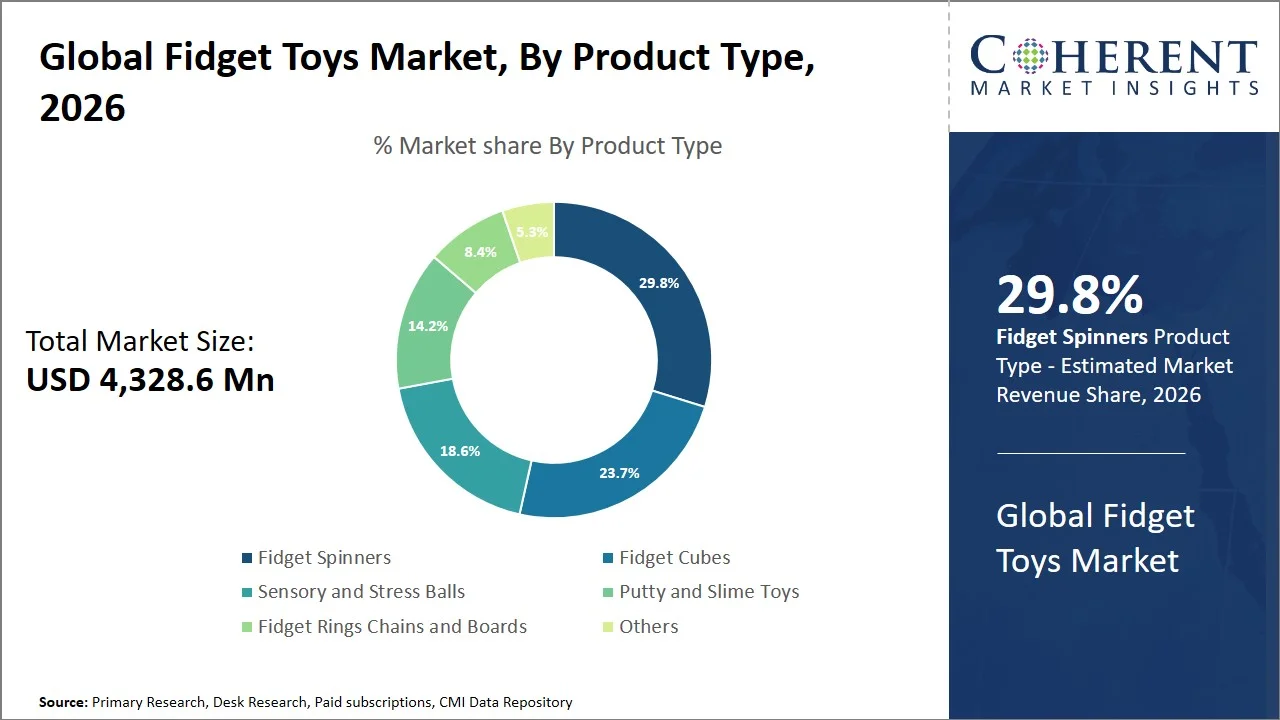
Why Do Fidget Spinners Dominate the Global Fidget Toys Market?
Fidget spinners are expected to hold 29.8% of the global fidget toys market in 2026 because their one-handed rotational mechanism delivers immediate tactile feedback without instructions, batteries, or digital connectivity. The format suits school rewards, travel kits, desk use, party favors, and low-value impulse displays, giving retailers broad placement flexibility. Standardized bearings and molded outer frames also enable manufacturers to produce basic, illuminated, character-themed, and premium variants using similar assembly processes. This lowers assortment-development risk while supporting frequent design refreshes. For suppliers, the segment offers scale but places greater importance on bearing quality, component retention, and age grading. In November 2025, the U.S. Consumer Product Safety Commission recalled Anzmtosn magnet fidget spinner sets because loose high-powered magnets violated mandatory toy requirements, highlighting the commercial need for compliant construction and stronger supplier controls.
- Current Industry Events of 2026
- Market Size Estimation
- Regional Breakdown
- Competitive Landscape
- Customer Intelligence
- Segmental Analysis
- Pricing Analysis
- Key Market Drivers, Challenges & Future Trends
- Customized Insights Section
Why Does the 3 to 12 Years Segment Represent the Largest Age Group in the Global Fidget Toys Market?
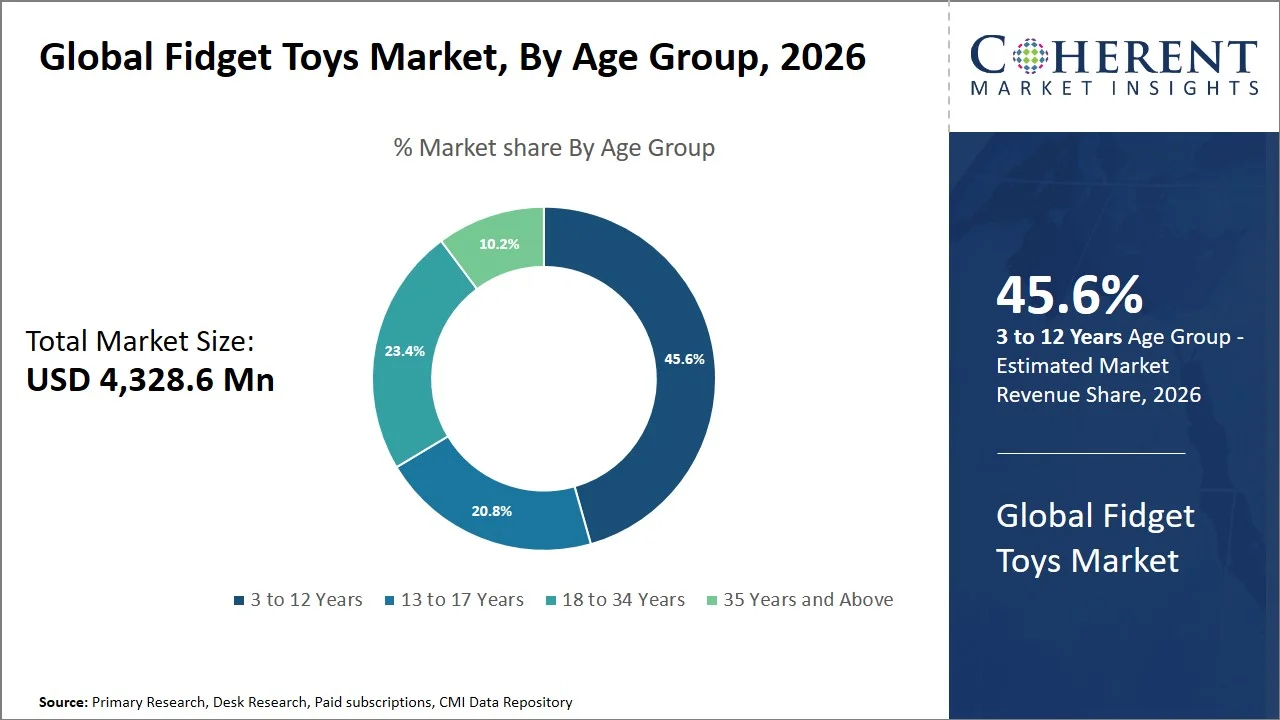
The 3 to 12 years segment is expected to represent 45.6% of the global fidget toys market in 2026 because this group uses tactile products across play, classroom routines, travel, gifting, and supervised sensory activities. Parents and educators typically favor products that combine repetitive hand movement with recognizable learning or emotional-development functions, allowing fidget toys to compete with educational aids rather than only novelty items. Small formats, accessible pricing, bright visual cues, and multi-pack configurations also support classroom rewards and birthday purchases. Manufacturers can strengthen conversion by linking age-appropriate fidget actions with literacy, fine-motor, or social-emotional learning outcomes. In April 2026, Educational Insights introduced Alphabet BubbleBrix for children aged three and above, combining connectable alphabet blocks with pop-style sensory actions for home and classroom learning, demonstrating how suppliers are embedding fidgeting within structured developmental play.
Why Does Plastic Dominate the Material Category of the Global Fidget Toys Market?
Plastic is expected to account for 44.8% of the global fidget toys market in 2026 because it supports precise molding, lightweight portability, bright coloration, complex geometries, and economical mass production across spinners, cubes, boards, articulated figures, and novelty mechanisms. Manufacturers can use established tooling and automated assembly to produce large volumes while varying textures, shapes, and licensed designs without materially changing the core production platform. Plastic components also integrate readily with bearings, buttons, sliders, and printed features, supporting hybrid products at multiple price points. Commercial differentiation will increasingly depend on durability, safer formulations, repair-resistant construction, and responsible material communication. In July 2025, WOL3D launched Vinglits, a range of 3D-printed flexible toys made with biodegradable materials and designed as tactile, fidget-friendly collectibles, illustrating how additive manufacturing can expand plastic-based customization beyond conventional injection-molded formats.
Global Fidget Toys Market Dynamics
Key Market Drivers
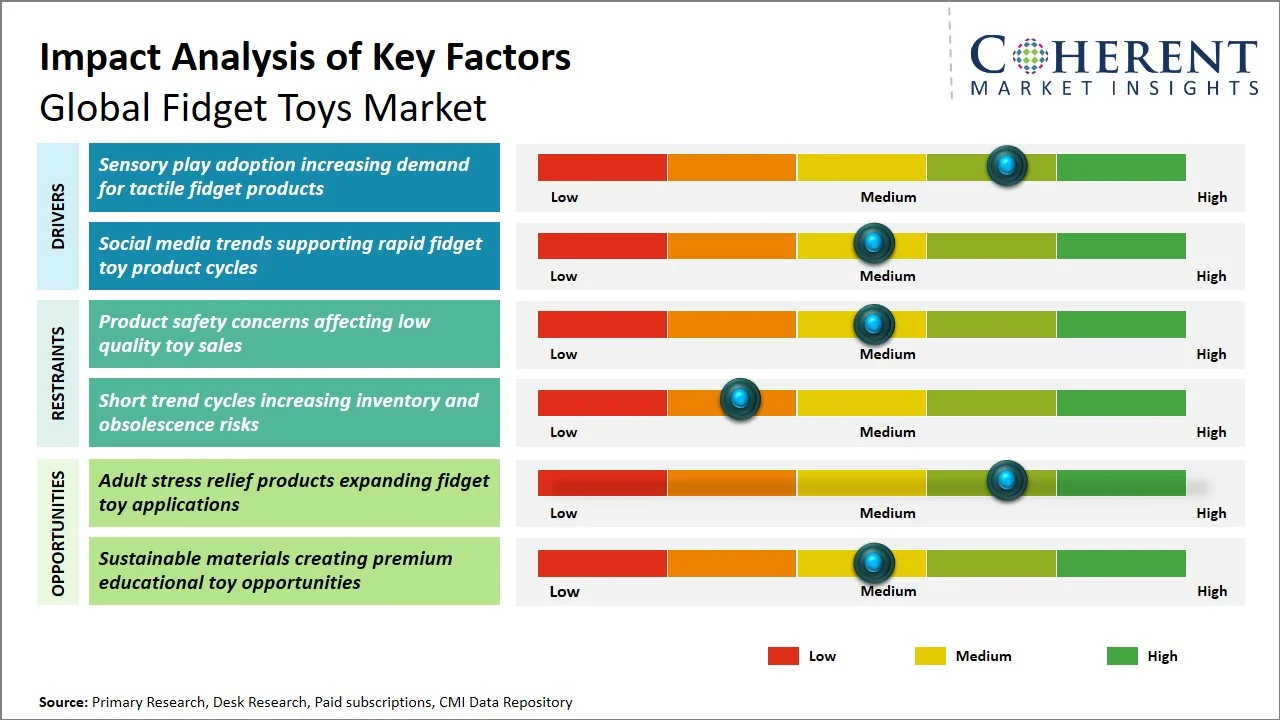
- Sensory Play Adoption Expands Fidget Toys into Guided and Inclusive Use: Sensory play is expanding the fidget toy category from casual entertainment into a more purposeful purchasing area for families, educators, therapists, and disability-support organizations. Textured surfaces, repetitive resistance, simple hand movements, and portable formats allow buyers to select products for calming routines, fine-motor practice, transitions, or inclusive play. This broadens shelf placement beyond traditional toy aisles into educational, therapeutic, and special-needs channels. Manufacturers that document age suitability, material safety, grip accessibility, and sensory characteristics can gain stronger institutional credibility and reduce dependence on short-lived novelty cycles. In November 2025, Easterseals launched its first holiday accessible-toy guide after products were reviewed by parents, occupational therapists, and people with disabilities, highlighting universal-design features such as textured surfaces and easy manipulation. The initiative strengthened the commercial case for professionally evaluated sensory products.
- Social Commerce Accelerates Fidget Toy Product Cycles: Social media is shortening the interval between product discovery, consumer trial, and retail sell-through in the global fidget toys market. Squeezing, clicking, stretching, spinning, and color-changing actions translate effectively into short videos, ASMR content, unboxings, and creator demonstrations, allowing a low-priced item to gain visibility without a conventional advertising campaign. The beneficiaries include specialist brands, marketplace sellers, independent toy stores, and contract manufacturers able to replenish inventory quickly. However, viral exposure also increases forecasting risk because demand may concentrate around one texture, color, or limited edition before suppliers can respond. In June 2026, Circana reported that social commerce and sensory-led content were amplifying U.S. squishy-toy sales, with ASMR, unboxing, and limited-edition discovery influencing purchasing. This reinforces the need for faster product testing, flexible production runs, and real-time channel monitoring.
Emerging Market Trends
- Discreet Fidget Designs for Adults and Professional Settings: Fidget toys are shifting toward discreet designs that can remain on a desk, in a meeting, or during travel without appearing juvenile or distracting. Premium metal, silicone, wearable, and hybrid products are gaining prominence as buyers are valuing controlled sound, compact dimensions, refined finishes, and motions that can be performed with one hand. Over the forecast period, product architecture will become more context-specific, with separate ranges for classrooms, professional settings, commuting, and home relaxation. Successful brands will need to balance tactile satisfaction with social acceptability, durability, and understated packaging, enabling fidget products to compete within stationery, desk-accessory, gifting, and personal-wellness assortments.
- Modular and Collectible Sensory Systems: Single-function items are being replaced in a gradual manner by modular sensory systems where interchangeable textures, click mechanisms, elastic elements, collectible characters or connectable parts are combined. The model extends engagement, as it allows users to change the tactile experience without having to discard the product when it becomes uninteresting. It also brings about revenue change by enabling repeat purchases, accessories, themed series, and upgrades. Low-cost imitators may have a harder time catching up with the fit, finish and cross-product consistency, and IP management of a manufacturer that has invested in strong tooling and component compatibility. Retailers enjoy larger product lines and reduced ancillary buying and have to manage part compatibility and age grading issues effectively. Modularity is expected to be one of the key differentiating paths during the forecast period, especially when brands are able to offer open-ended play along with collection, customization and portability.
Current Events and their Impact
Current Events | Description and its Impact |
UK Toy Safety Regulatory Review – July 2026 |
|
Health Canada Magnet Product Enforcement Notice – January 2025 |
|
Regional Insights
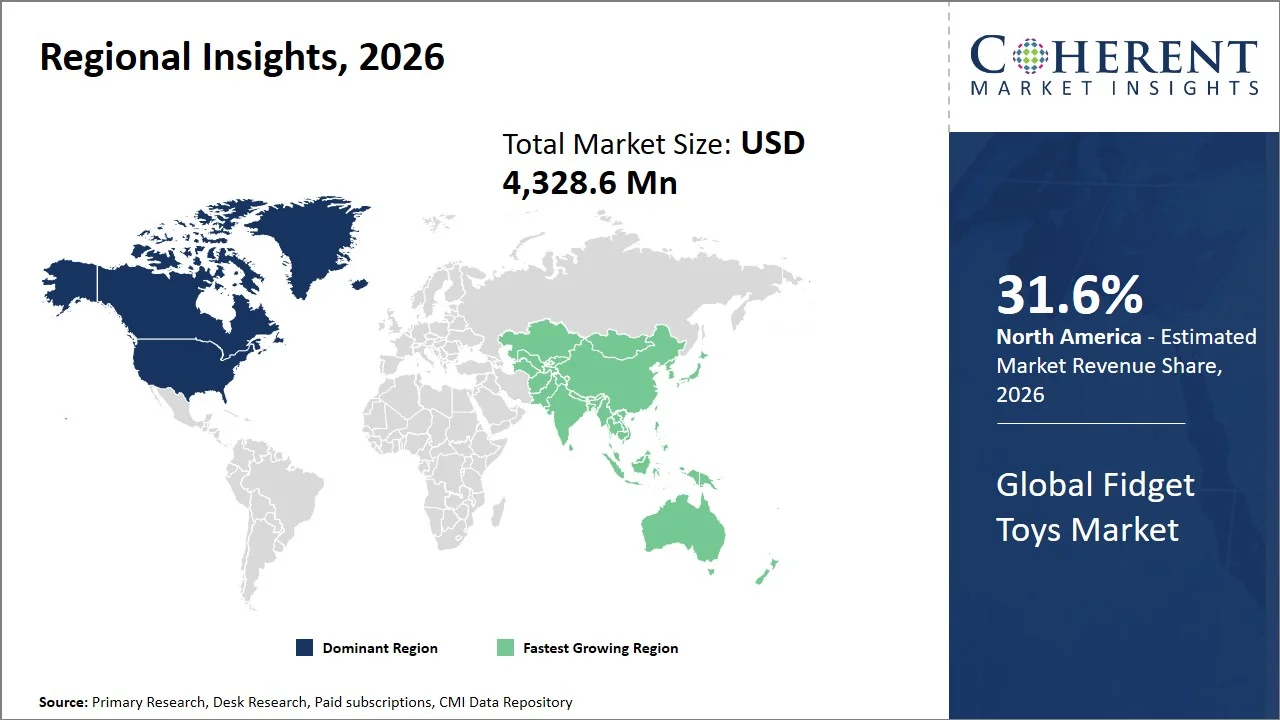
Why Does North America Dominate the Global Fidget Toys Market?
North America is expected to account for 31.6% of the global fidget toys market in 2026, supported by a mature specialty-toy ecosystem, high online purchasing frequency, strong gifting demand, and broad acceptance of sensory products among children, teenagers, and adults. Retailers can rapidly scale spinners, cubes, putty, and stress-relief formats through omnichannel launches, while established brands use licensing and social content to extend product life cycles. The region also benefits from occupational-therapy, classroom, and workplace-wellness channels that position fidget products beyond novelty play. In February 2025, Canada-based Spin Master introduced Kinetic Sand SquishPizza within its 2025 innovation portfolio, combining repeated pressing, shaping, slicing, and tactile play in a mass-retail format. The launch demonstrates how North American suppliers are converting sensory engagement into recognizable themes and repeatable product platforms.
Why is Asia Pacific Emerging as the Fastest-Growing Region in the Global Fidget Toys Market?
Asia Pacific is expected to emerge as the fastest-growing region in the global fidget toys market, representing 29.9% of the market share in 2026. Expansion is supported by concentrated toy manufacturing, flexible contract-production networks, competitive molding and assembly costs, and fast commercialization through marketplaces and social commerce. The region also contains large child and young-adult consumer populations, enabling brands to test inexpensive tactile products before introducing collectible, licensed, or premium variants. Local companies increasingly combine slime, squish, sound, color, and beauty-inspired positioning to improve shelf differentiation. In April 2025, Australia-based Moose Toys launched Gui, a multisensory slime range featuring varied textures, scents, colors, customization, and collectible components. This illustrates Asia Pacific suppliers’ capacity to transform sensory play into trend-led portfolios suited to domestic retail and international distribution.
Global Fidget Toys Market Outlook for Key Countries
Why is the U.S. a Key Market for the Global Fidget Toys Market?
The U.S. represents a major market for fidget toys, supported by a well-established mass retail network, specialty toy stores, strong e-commerce penetration, and high consumer demand for compact and collectible products. Demand extends beyond children, with teenagers and adults increasingly purchasing fidget toys as desk accessories, portable stress-relief tools, and tactile alternatives to screen-based entertainment. U.S. brands also boast excellent prowess in product storytelling, influencer activation, character licensing and quick national rollout, turning micro-format handhelds into macro-scale franchises. Hasbro announced its Nano-mals at North American International Toy Fair in New York in March 2025. The pocket-sized electronic companions are designed as tactile outfits to interact with, keychain-portable, and over 70 sounds. This launch demonstrates U.S. suppliers' incorporation of digital interaction and collectible identity into traditional repetitive-motion play.
Why is India Important in the Global Fidget Toys Market?
India is becoming increasingly important in the global fidget toys market through its large school-age consumer base, expanding organized toy retail, mobile-led shopping behavior, and strengthening domestic manufacturing capabilities. Affordable plastic and silicone formats suit the country’s price-sensitive buyers, while premium malls and specialty chains create space for branded sensory toys, imported products, and licensed collections. Local production can also support shorter replenishment cycles and regionally adapted packaging for school rewards, gifting, stationery outlets, and online marketplaces. In October 2025, Kids India brought domestic and international toy suppliers and buyers together in Mumbai. Its post-show reporting covered more than 170 brands represented by 115 exhibitors and 5,516 visitors from 17 countries, indicating improving commercial infrastructure for discovering, distributing, and manufacturing tactile, educational, lifestyle, and impulse-purchase toy concepts.
Why Does China Support Growth in the Global Fidget Toys Market?
China supports growth in the global fidget toys market through extensive plastic-toy manufacturing clusters, integrated component supply chains, tooling expertise, export infrastructure, and the ability to produce high-volume items across multiple price points. These capabilities are particularly relevant for spinners, cubes, silicone pop products, stress balls, novelty chains, and private-label assortments requiring frequent design changes. Domestic e-commerce and livestream selling also allow manufacturers to test colors, shapes, characters, and packaging before scaling exports. In March 2025, the Shantou Municipal Government reported that Chenghai’s toy cluster had entered Guangdong’s cross-border e-commerce and industrial-cluster pilot program. Chenghai produces nearly half of China’s plastic toys and exports products to more than 140 countries and regions, reinforcing China’s role in product customization, international availability, and rapid inventory replenishment.
Why is Germany a Strategic Country in the Global Fidget Toys Market?
Germany is a strategic country for the global fidget toys market because it combines premium toy retail, rigorous product-quality expectations, influential trade-fair infrastructure, and demand for educational, wellness-oriented, and sustainably positioned play products. German buyers are likely to favor durable construction, documented material compliance, age-appropriate design, and clear functional value rather than undifferentiated novelty items. This creates opportunities for metal fidgets, responsibly sourced wooden products, premium sensory tools, and products designed around mindfulness or emotional regulation. In January 2025, Spielwarenmesse in Nuremberg presented Healthy Heroes as a major toy trend, highlighting products connecting play with relaxation, mindfulness, movement, and emotional wellbeing. The initiative signals that German range planning increasingly evaluates toys through developmental and wellbeing criteria alongside entertainment value and visual appeal.
Why is Brazil an Important Growth Market for the Global Fidget Toys Market?
Brazil is considered an important growth country for the global fidget toys market due to the large consumer base, well-developed toy and stationery network, high social engagement and distribution in other Latin American countries. Sensory balls, slime, tactile educational products, and sensory balls, cubes, and spinners are all low and mid-priced, and are suitable for gifting opportunities, school activities, therapy, and impulse purchases. Adoption outside of the big chains can be reinforced through localized colors, Portuguese packaging, character themes and products designed to cater to independent retailers. During the March 2025 edition of the fair, ABRIN offered inclusive and therapeutic toys, with over 170 exhibitors and around 1,500 launches. The organizer also noted39 the growth of products for the accessibility market and sensory stimulation, as well as those for cognitive development, which demonstrate greater commercialization of function-led products within Brazil's toy industry.
Technology Adoption Landscape in the Global Fidget Toys Market
Technology | Adoption Level | Key Application Area | Business Impact |
Precision injection molding and over molding | High | Plastic spinners, cubes, boards, sliders, and outer housings | Enables high-volume production, consistent dimensions, varied textures, and lower unit costs across mass-market ranges. |
Viscoelastic gel and thermoplastic elastomer formulations | High | Stress balls, squishy products, stretch toys, and soft sensory components | Improves resistance, shape recovery, tactile differentiation, durability, and perceived product quality. |
Miniature bearing and low-friction mechanism systems | High | Fidget spinners, rotating rings, mechanical sliders, and kinetic products | Extends spin duration, reduces noise, improves motion consistency, and supports premium performance positioning. |
Additive manufacturing and rapid prototyping | Medium | Customized shapes, limited editions, ergonomic trials, and production-tool validation | Shortens design cycles, reduces early tooling expenditure, and supports small-batch personalization. |
Embedded light, sound, and haptic modules | Medium | Interactive cubes, illuminated spinners, electronic sensory products, and responsive toys | Adds multisensory engagement and premium pricing potential but raises battery-safety and durability requirements. |
QR-enabled batch traceability and digital compliance records | Low | Product authentication, recall management, safety documentation, and customer instructions | Strengthens supply-chain visibility, simplifies corrective action, and helps distinguish compliant products from counterfeits. |
How are Institutional Sensory Programs Creating New Growth Opportunities in the Global Fidget Toys Market?
Institutional sensory programs remain underdeveloped compared with consumer toy retail, creating an opportunity for suppliers to build structured product systems for schools, occupational-therapy practices, pediatric clinics, travel-support services, and workplace wellbeing programs. These customers require more than isolated novelty items; they need quiet-use options, washable materials, clear age grading, replaceable components, storage formats, and guidance on appropriate environments. Companies can capture this opportunity by assembling task-specific kits for classroom transitions, waiting rooms, fine-motor exercises, calm spaces, and desk-based concentration. Product testing, input from successful professionals, documentation for procurement, consistent replenishment, and channel partnerships with educational and healthcare distributors will be key to commercial success. While specialist sensory brands might have an edge to begin with, as they are aware of what users want, established toy brands can grow larger by sourcing and retail channels. The best will refrain from making medical claims and provide tools that can be customized, documented for safety, and can be bought over and over, standardized between locations, and put into supervised routines.
Market Players, Key Development, and Competitive Landscape
Key Developments
- In October 2025, Ty Inc announced that it had secured a U.S. patent for the proprietary mechanism used in Beanie Bouncers, sensory-friendly plush collectibles designed for kinetic and repetitive play. This is important for the global fidget toys market because it illustrates the convergence of fidget functionality, licensed collectability, active play, and intellectual-property protection within a differentiated product platform.
- In March 2025, Happy Hands World launched a premium collection of therapeutic sensory kits combining tactile tools, wooden components, guided activities, and story-based emotional-learning materials. This is important for the global fidget toys market because it demonstrates how suppliers can move beyond individual toys toward higher-value, structured kits intended for parents, educators, therapists, and neurodivergent children.
Competitive Landscape
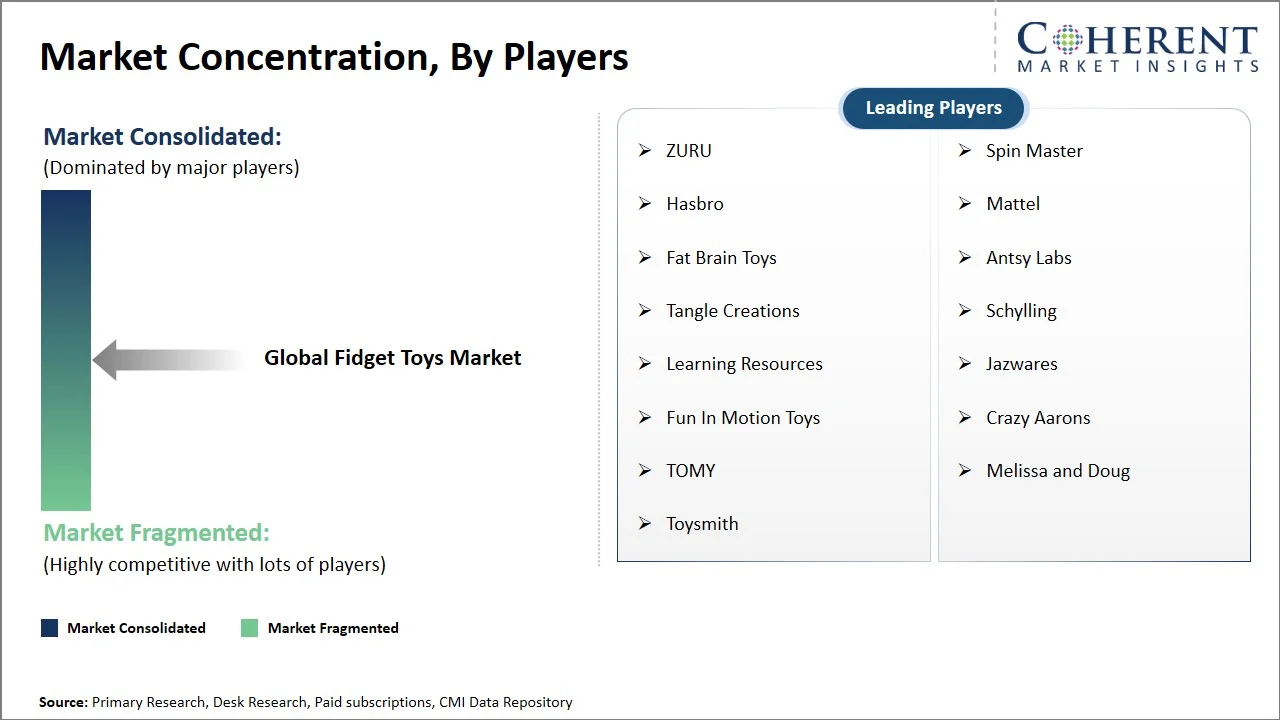
The global fidget toys market is fragmented, comprising established toy groups, sensory-play specialists, educational product companies, novelty suppliers, premium everyday-carry brands, contract manufacturers, private-label vendors, and marketplace-based sellers. Competition extends beyond price because tactile performance, mechanical reliability, material safety, product originality, and retail availability determine whether an item generates repeat purchases. Regional manufacturers remain important in entry-level categories, while specialist companies compete through proprietary mechanisms, distinctive textures, professional positioning, and focused communities. Market leadership is therefore likely to remain fluid, with viral success providing rapid scale but offering limited protection unless supported by intellectual property, quality control, and dependable distribution.
Key focus areas include
- Tactile differentiation: Resistance, texture, sound, motion, and shape recovery influence repeat use and customer reviews.
- Safety assurance: Secure magnets, enclosed batteries, non-toxic materials, and appropriate age grading support market access.
- Speed to market: Short development and replenishment cycles help suppliers respond to rapidly changing preferences.
- Retail and e-commerce reach: Shelf placement, marketplace visibility, creator engagement, and specialty-store relationships determine product discovery.
- Intellectual property: Protected mechanisms, recognizable shapes, licensed characters, and brand identity reduce direct substitution.
- Private-label capability: Flexible manufacturing and low minimum-order quantities allow retailers to introduce exclusive assortments.
- Sustainability positioning: Reduced packaging, recycled inputs, bio-based materials, and longer product life can support premium differentiation.
Market Report Scope
Fidget Toys Market Report Coverage
| Report Coverage | Details | ||
|---|---|---|---|
| Base Year: | 2025 | Market Size in 2026: | USD 4,328.6 Mn |
| Historical Data for: | 2020 To 2024 | Forecast Period: | 2026 To 2033 |
| Forecast Period 2026 to 2033 CAGR: | 7.40% | 2033 Value Projection: | USD 7,134.7 Mn |
| Geographies covered: |
| ||
| Segments covered: |
| ||
| Companies covered: | ZURU, Spin Master, Hasbro, Mattel, Fat Brain Toys, Antsy Labs, Tangle Creations, Schylling, Learning Resources, Jazwares, Fun In Motion Toys, Crazy Aarons, TOMY, Melissa and Doug, and Toysmith | ||
| Growth Drivers: |
| ||
| Restraints & Challenges: |
| ||
Analyst Expert (Analyst Opinion)
- In the global fidget toys market, competitive leadership will gradually shift from companies selling isolated novelty items toward suppliers managing clearly segmented sensory portfolios for different environments, user profiles, and price tiers. Brands capable of moving customers from introductory products to premium, age-progressive, or use-specific ranges will generate greater lifetime value and reduce dependence on individual viral products.
- Counterfeit filtering and product authentication could materially reshape market access. As retailers and marketplaces strengthen seller verification, test-report validation, and traceability requirements, anonymous low-cost suppliers may lose visibility. Companies with controlled tooling, serialized production, protected mechanisms, and verifiable manufacturing records will be better positioned to secure premium listings and international distribution.
- Manufacturers should prioritize quiet mechanisms, durable outer materials, secure internal components, and differentiated tactile performance while building flexible production arrangements for uncertain volumes. Investment should concentrate on adaptable tooling and compliance systems rather than excessive inventory tied to one viral design. Partnerships with specialty retailers, educators, therapists, and regional distributors can improve product credibility and channel resilience.
Speak to the analyst
Want personalized insights?
Take the findings above to one of our principal consultants, or have the report rebuilt around the segments, geographies and competitors you actually track.
Market Segmentation
- Product Type Insights (Revenue, USD Mn, 2021 - 2033)
- Fidget Spinners
- Fidget Cubes
- Sensory and Stress Balls
- Putty and Slime Toys
- Fidget Rings Chains and Boards
- Others
- Age Group Insights (Revenue, USD Mn, 2021 - 2033)
- 3 to 12 Years
- 13 to 17 Years
- 18 to 34 Years
- 35 Years and Above
- Material Insights (Revenue, USD Mn, 2021 - 2033)
- Plastic
- Metal
- Silicone and Rubber
- Wood
- Others
- Distribution Channel Insights (Revenue, USD Mn, 2021 - 2033)
- Online Retail
- Specialty Toy Stores
- Supermarkets and Hypermarkets
- Gift and Stationery Stores
- Others
- Regional Insights (Revenue, USD Mn, 2021 - 2033)
- North America
- U.S.
- Canada
- Latin America
- Brazil
- Argentina
- Mexico
- Rest of Latin America
- Europe
- Germany
- U.K.
- Spain
- France
- Italy
- Russia
- Rest of Europe
- Asia Pacific
- China
- India
- Japan
- Australia
- South Korea
- ASEAN
- Rest of Asia Pacific
- Middle East
- GCC Countries
- Israel
- Rest of Middle East
- Africa
- South Africa
- North Africa
- Central Africa
- North America
- Key Players Insights
- ZURU
- Spin Master
- Hasbro
- Mattel
- Fat Brain Toys
- Antsy Labs
- Tangle Creations
- Schylling
- Learning Resources
- Jazwares
- Fun In Motion Toys
- Crazy Aarons
- TOMY
- Melissa and Doug
- Toysmith
Source
Primary Research Interviews
- Fidget toy manufacturers, material suppliers, distributors, retailers, and e-commerce sellers
- Product development, procurement, quality, compliance, marketing, and sales executives
- Educators, occupational therapists, parents, caregivers, and adult users
Stakeholders
- Fidget spinner, cube, stress ball, slime, putty, sensory board, and ring manufacturers
- Plastic, silicone, rubber, metal, magnet, bearing, and packaging suppliers
- Toy brands, importers, exporters, retailers, marketplaces, schools, and therapy centers
End-use Sectors
- Household recreation, gifting, travel, and collectible play
- Schools, learning centers, sensory rooms, and therapy settings
- Offices, study environments, wellness programs, and promotional merchandise
Regulatory & Government Bodies
- U.S. Consumer Product Safety Commission
- European Commission and European Chemicals Agency
- UK Office for Product Safety and Standards
- Health Canada, Bureau of Indian Standards, China SAMR, ACCC, and Brazil Inmetro
- National customs, consumer-safety, and market-surveillance agencies
Databases
- UN Comtrade, UNCTADstat, and ITC Trade Map
- Eurostat, USITC DataWeb, China Customs, India DGCI&S, and Brazil Comex Stat
- World Bank, OECD, SEC EDGAR, company filings, and product-recall databases
- Retail listings, e-commerce platforms, and consumer-review databases
Magazines and Journals
- The Toy Book
- Toy World
- Licensing Global
- International Journal of Play
- American Journal of Occupational Therapy
- Journal of Attention Disorders
Associations
- The Toy Association
- Toy Industries of Europe
- British Toy & Hobby Association
- China Toy and Juvenile Products Association
- Toy Association of India
- Australian, Canadian, and Japanese toy associations
Public Domain Sources
- Government safety and regulatory authorities
- Toy associations and industry exhibitions
- Customs and trade databases
- Company reports, product catalogues, safety documents, recalls, and press releases
- Retailer and online marketplace product listings
Key Standards and Regulations
- ASTM F963 and U.S. Consumer Product Safety Improvement Act
- EN 71, EU Toy Safety Regulation, and REACH
- ISO 8124 and IEC 62115
- Canada Toys Regulations
- India Toys Quality Control Order and IS 9873
- China GB 6675 and Brazil Inmetro requirements
- Rules covering magnets, batteries, small parts, chemicals, labelling, and age grading
Proprietary Elements
- CMI Data Analytics Tool, Proprietary CMI Existing Repository of information for last 10 years.
Get access to 250+ pages report
Every segment, forecast, competitor profile and data table behind the analysis above — available for instant download.
- ESOMAR Member
- ISO 9001:2015 Certified
- D-U-N-S Registered
- GDPR & CCPA Compliant
Missing comfort of reading report in your local language? Find your preferred language:
Transform your Strategy with Exclusive Trending Reports
Frequently Asked Questions
The CAGR of the global fidget toys market is projected to be 7.40% from 2026 to 2033.
The global fidget toys market is estimated to be valued at USD 4,328.6 million in 2026 and is expected to reach USD 7,134.7 million by 2033.
Primary users include children, teenagers, adults, students, office workers, educators, and individuals seeking tactile recreational products.
Fidget toys are used for recreation as well as sensory engagement, classroom activities, desk-based relaxation, and fine-motor play.
Sensory play adoption increasing demand for tactile fidget products and social media trends supporting rapid fidget toy product cycles are the major factors driving the growth of the global fidget toys market.
Manufacturers can target schools, therapy centers, workplaces, gifting channels, and premium collectible product categories.
Product safety concerns affecting low quality toy sales and short trend cycles increasing inventory and obsolescence risks are the major factors hampering the growth of the global fidget toys market.