

Insulated Food Container Market Size and Forecast: 2026-2033
The Insulated Food Container Market is estimated to be valued at USD 13.3 Bn in 2026 and is expected to reach USD 28.56 Bn by 2033, exhibiting a compound annual growth rate (CAGR) of 10.3% from 2026 to 2033.
Key Takeaways
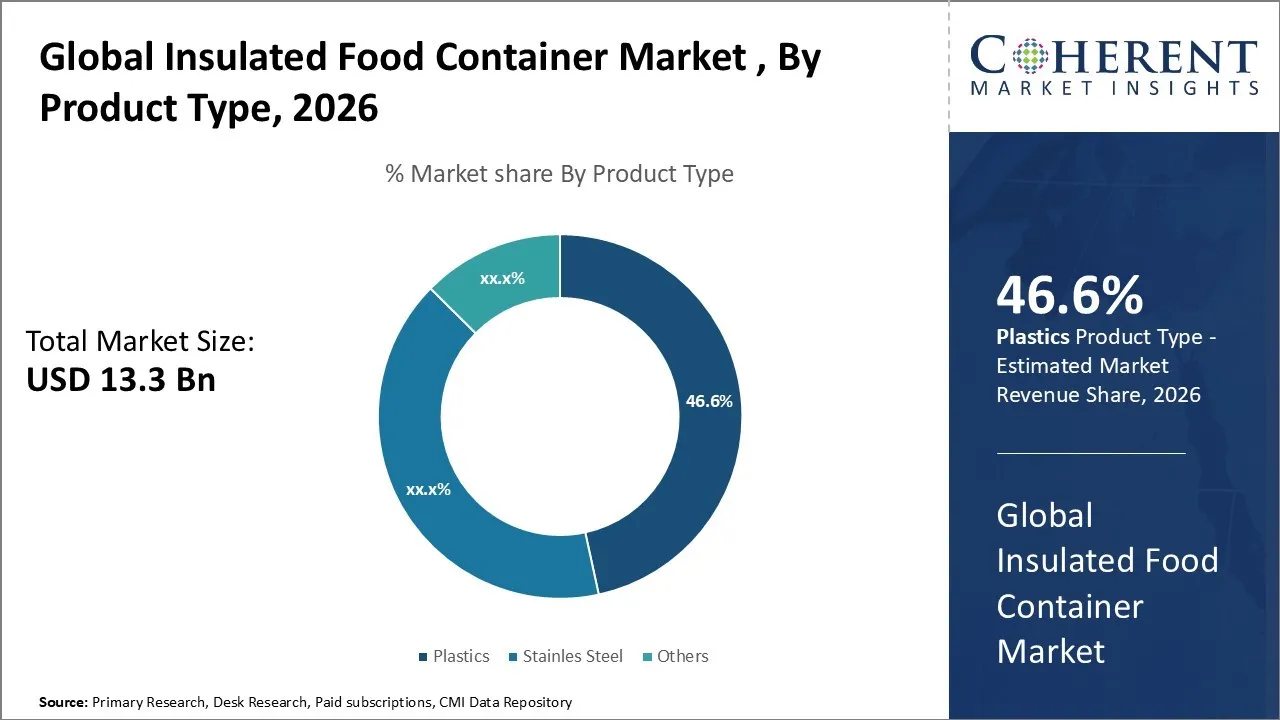
- By Product Type, Plastics hold the largest market share of 46.6% in 2026 owing to its cost‑effectiveness and affordability.
- By Distribution Channel, Hypermarket expected to hold largest market share of 39.6% in 2026 owing to the high offline market share & wide reach.
- By Region, North America dominates the overall market with an estimated share of 38.8% in 2026 owing to the highly developed food delivery & take‑away ecosystem.
Market Overview
The Insulated Food Container Market is growing worldwide as consumers increasingly seek convenient, portable, and temperature-retaining food solutions. Urbanization, hectic lifestyles, and the popularity of meal prepping and food delivery services are driving households, workplaces, and foodservice providers to adopt these containers. Manufacturers actively develop innovative designs, lightweight materials, and sustainable options to satisfy consumer preferences. Hypermarkets, supermarkets, and online retailers distribute these products, while a variety of plastic, stainless steel, and composite containers expands the market’s accessibility and attractiveness.
Current Events and their Impact on the Insulated Food Container Market
Current Events | Description and its impact |
Geopolitical and Trade Dynamics |
|
Economic and Supply Chain Factors |
|
Regulatory and Environmental Policies |
|
Segmental Insights
- Current Industry Events of 2026
- Market Size Estimation
- Regional Breakdown
- Competitive Landscape
- Customer Intelligence
- Segmental Analysis
- Pricing Analysis
- Key Market Drivers, Challenges & Future Trends
- Customized Insights Section
Insulated Food Container Market Insights, By Product Type - Plastics contribute the highest share of the market owing to its growing markets in Asia ‑ pacific & emerging economies
Plastics hold the largest market share of 46.6% in 2026. Plastics drive the growth of the Insulated Food Container Market because they offer affordability, light weight, and versatility. Consumers and manufacturers choose plastic containers for their easy handling, durability, and flexible designs, enabling features like multiple compartments, spill-proof lids, and vibrant colors. The increasing demand for portable meals and food delivery further strengthens their appeal. Manufacturers are also innovating with safe and recyclable plastics, improving functionality while addressing health and environmental concerns, making plastic a key material in this evolving market. For instance, in August 2025, Hydropac launched its Wool Thermal Postal Pockets, replacing its plastic-based solution with a high-performance, eco-friendly alternative.
Insulated Food Container Market Insights, By Distribution Channel - Hospitals contribute the highest share of the market owing to its capturing everyday shoppers
Hypermarket expected to hold largest market share of 39.6% in 2026. Hypermarkets drive the Insulated Food Container Market by providing diverse product selections, competitive prices, and high consumer exposure. Shoppers evaluate multiple brands, materials, and sizes in a single visit, often influenced by in-store promotions and seasonal deals. The option to physically inspect containers for quality and functionality motivates purchases, while one-stop shopping appeals to busy consumers. Manufacturers partner closely with hypermarket chains to expand distribution and enhance brand visibility, positioning hypermarkets as a central force in boosting market sales.
Regional Insights
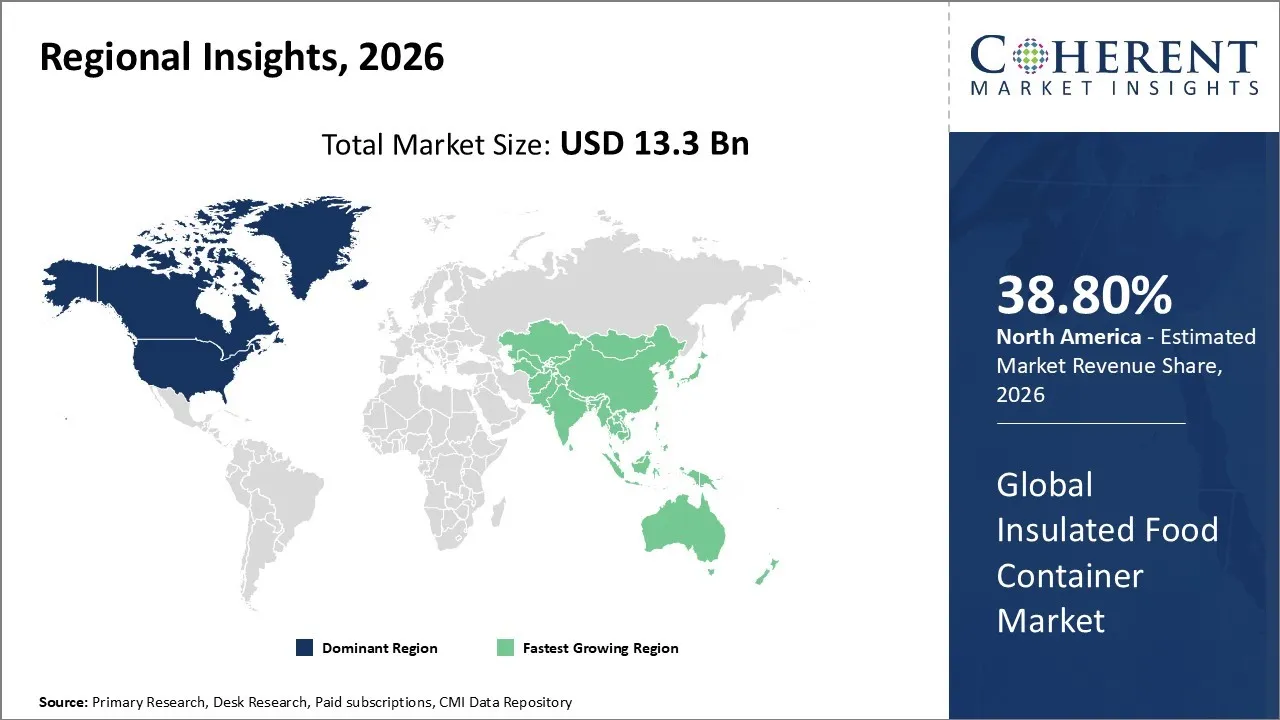
North America Insulated Food Container Market Trends
North America dominates the overall market with an estimated share of 38.8% in 2026. Evolving consumer lifestyles and technological innovations are shaping the North America Insulated Food Container Market. Consumers increasingly adopt insulated containers for portable meals, meal prepping, and food delivery across homes and workplaces. They favor durable, high-quality, and sustainable products, prompting manufacturers to develop advanced materials and eco-friendly designs. Online retailers and hypermarkets expand accessibility and visibility, while innovations like leak-proof lids, multi-compartment layouts, and enhanced insulation meet consumer demands for convenience and performance, actively driving the market’s growth in the region. For instance, in August 2024, Thinkink Packaging launched a new line of Custom Frozen Food Boxes, offering durable, sustainable, and high-quality packaging for the frozen food industry.
Asia Pacific Insulated Food Container Market Trends
Urbanization and shifting lifestyles are driving the growth of the Asia Pacific Insulated Food Container Market, as consumers increasingly seek portable and ready-to-eat meal solutions. They demand convenient, affordable, and durable containers, motivating manufacturers to produce a diverse range of plastic, stainless steel, and composite products. Expanding food delivery services, e-commerce platforms, and modern retail channels improve product accessibility, while rising focus on food safety, hygiene, and eco-friendly, reusable designs pushes manufacturers to innovate, actively shaping a dynamic and fast-evolving market in the region. For instance, in June 2025, UFlex Ltd introduced an FSSAI-compliant single-pellet solution for using recycled PET in food and beverage packaging.
United States Insulated Food Container Market Trends
Consumers adopting on-the-go lifestyles and prioritizing meal prepping, packed lunches, and food delivery are shaping the United States Insulated Food Container Market. They demand durable, high-quality, and user-friendly containers, prompting manufacturers to design innovative products with leak-proof lids, multi-compartment layouts, and improved insulation. Hypermarkets, supermarkets, and e-commerce platforms expand product accessibility and visibility, while increasing consumer focus on sustainable and eco-friendly materials drives manufacturers to innovate, actively making the U.S. market more competitive and responsive to convenience, performance, and environmental expectations. For instance, In February 2026, Stanley launched an insulated pet bowl using the same durable, temperature-locking materials as its drinkware to keep pets’ food fresh and water cool at home or on the go.
China Insulated Food Container Market Trends
Rapid urbanization and shifting consumer lifestyles are driving growth in the China Insulated Food Container Market, as people increasingly seek convenient, portable, and ready-to-eat meal solutions. Consumers demand affordable, durable, and lightweight containers, motivating manufacturers to produce a wide range of plastic, stainless steel, and composite products. Expanding food delivery services, online retail, and modern supermarkets increase product accessibility, while rising focus on food hygiene, safety, and eco-friendly materials pushes manufacturers to innovate, actively shaping China into a dynamic market centered on convenience, quality, and sustainability.
End-user Feedback and Unmet Needs in the Insulated Food Container Market
- Durability and Material Quality: Many users report that some insulated containers dent, crack, or lose thermal efficiency over time. Consumers seek long-lasting, high-quality materials that can withstand daily use, accidental drops, and repeated washing without compromising insulation, appearance, or functionality, highlighting a gap for more robust and premium-grade products.
- Thermal Retention Performance: End-users often find that certain containers fail to maintain temperature for extended periods. Hot foods cool too quickly, and cold items warm up faster than expected. There’s a need for improved insulation technology that consistently preserves food temperature while remaining lightweight and convenient for everyday use.
- Design and Usability: Users express challenges with containers that are bulky, difficult to open, or hard to clean. There is a demand for ergonomic, easy-to-handle designs, including spill-proof lids, compartmentalized sections, and stackable formats, which enhance convenience, portability, and daily usability for lunch, travel, or meal prepping.
Insulated Food Container Market Trend
Rising Demand for Portable and On-the-Go Meals
Consumers increasingly prefer convenient meal solutions due to busy lifestyles, longer commutes, and remote working patterns. This trend drives demand for insulated containers that can maintain food temperature for hours, catering to office workers, students, and travelers. Manufacturers are responding with lightweight, ergonomic designs and multi-compartment containers, combining portability, usability, and thermal retention to suit everyday routines and outdoor activities, making convenience a central factor shaping product innovation and adoption in the market.
Growth of Food Delivery and E-Commerce Platforms
The surge in online food delivery services, meal kits, and grocery e-commerce is creating opportunities for insulated food containers. Containers must ensure safe transportation of hot and cold items, while appealing to both commercial kitchens and end consumers. Manufacturers are developing durable, leak-proof, and aesthetically designed products suitable for delivery, while online retail expands accessibility. This trend emphasizes reliability, branding, and consumer convenience, as the market increasingly relies on digital sales channels to reach a broader audience.
Insulated Food Container Market Opportunity
Innovation in Sustainable and Eco-Friendly Solutions
With growing consumer focus on environmental sustainability, there’s a strong opportunity to develop reusable, recyclable, and biodegradable insulated containers. Brands can differentiate by combining high-performance thermal insulation with eco-conscious materials. Offering green alternatives appeals to environmentally aware consumers and institutional buyers seeking sustainable solutions. This trend also enables manufacturers to align with regulatory guidelines and corporate sustainability goals, positioning themselves as responsible and forward-thinking, while tapping into a segment of the market that increasingly prioritizes safety, health, and environmental responsibility.
Market Report Scope
Insulated Food Container Market Report Coverage
| Report Coverage | Details | ||
|---|---|---|---|
| Base Year: | 2025 | Market Size in 2026: | USD 13.3 Bn |
| Historical Data for: | 2020 To 2024 | Forecast Period: | 2026 To 2033 |
| Forecast Period 2026 to 2033 CAGR: | 10.3% | 2033 Value Projection: | USD 28.56 Bn |
| Geographies covered: |
| ||
| Segments covered: |
| ||
| Companies covered: | Cambro Foodservice Equipment and Supplies, Carlisle FoodService Products, Newell Brands, Zojirushi America Corporation, Stanley, Kuukware, Thermos L.L.C., Hamilton Housewares Pvt. Ltd., Huhtamaki, TokyoPlast, Zojirushi American Corporation, and Tupperware | ||
| Growth Drivers: |
| ||
| Restraints & Challenges: |
| ||
Insulated Food Container Market News
- In May 2025, PlanetBox is expanding its reusable collection to include glass food storage containers, an insulated lunch bag, and other eco-friendly accessories.
- In June 2024, IFCO launched Marina, a smart reusable fish crate designed with the fishing industry to improve protection, efficiency, and sustainability, featuring double-wall insulation to keep seafood fresh longer.
Analyst Opinion (Expert Opinion)
- The insulated food container market is transitioning from commodity kitchenware to a value‑driven consumer goods category shaped by nuanced user expectations and tangible behavior shifts. Penetration is no longer anchored solely in convenience; more than two‑thirds of consumers now choose insulated solutions because they preserve food quality and safety, not just temperature control, with reuse and hygiene increasingly decisive in purchase choice.
- Market performance also reveals a deeper bifurcation between premium performance and mass accessibility. Stainless steel continues to dominate revenue share due to its durability and food‑grade credentials, yet the plastic sub‑segment is the fastest‑growing category as lightweight, affordable options gain traction among office workers, students, and price‑sensitive buyers.
- Furthermore, the rise in food delivery ecosystems is reshaping demand patterns. Adoption by major platforms necessitates containers that reliably support last‑mile food quality, pressuring manufacturers to innovate on leak‑proof seals and multi‑layer insulation rather than incremental design tweaks.
- However, competition intensity has increased materially — over 250 brands compete globally, driving price erosion and commoditization in core segments, while forcing established players to seek differentiation through material innovation, sustainability credentials, and channel partnerships.
Speak to the analyst
Want personalized insights?
Take the findings above to one of our principal consultants, or have the report rebuilt around the segments, geographies and competitors you actually track.
Market Segmentation
- By Product Type
- Stainless Steel
- Plastics
- Others
- By Distribution Channel
- Hypermarket
- Supermarket
- Online
- Others
- By Regional Insights
- North America
- U.S.
- Canada
- Latin America
- Brazil
- Argentina
- Mexico
- Rest of Latin America
- Europe
- Germany
- U.K.
- Spain
- France
- Italy
- Russia
- Rest of Europe
- Asia Pacific
- China
- India
- Japan
- Australia
- South Korea
- ASEAN
- Rest of Asia Pacific
- Middle East
- GCC Countries
- Israel
- Rest of Middle East
- Africa
- South Africa
- North Africa
- Central Africa
- North America
- Key Players Insights
- Cambro Foodservice Equipment and Supplies
- Carlisle FoodService Products
- Newell Brands
- Zojirushi America Corporation
- Stanley
- Kuukware
- Thermos L.L.C.
- Hamilton Housewares Pvt. Ltd.
- Huhtamaki
- TokyoPlast
- Zojirushi American Corporation
- Tupperware
Sources
Primary Research interviews
- Industry stakeholders including manufacturers, distributors, and retailers of insulated food containers
- Product designers and packaging engineers specializing in thermal containers
- Supply chain and logistics experts for food storage products
- End-users, including households and commercial foodservice operators
Databases
- United States Census Bureau Database
- Eurostat Database
- FAOSTAT
- Trade and import-export databases for kitchenware and insulated containers
Magazines
- Kitchenware & Home Appliances Magazine
- Packaging World
- Culinary & Foodservice Trends Magazine
- Housewares Review
Journals
- Journal of Food Engineering
- Packaging Technology and Science
- International Journal of Consumer Studies
- Journal of Applied Polymer Science (for thermal insulation materials)
Newspapers
- The New York Times - Business Section
- The Guardian - Business Section
- The Times of India - Business
- Industry news sections of national newspapers reporting on household appliances and kitchenware
Associations
- International Housewares Association (IHA)
- American Society of Heating, Refrigerating and Air-Conditioning Engineers (ASHRAE) – relevant thermal insulation data
- European Housewares Association (EHA)
- Food Packaging Forum
Public Domain sources
- Government reports on food safety and storage regulations
- Trade statistics from customs and import/export authorities
- Public patents on insulated container technologies
- Sustainability and recycling guidelines for packaging materials
Proprietary Elements
- CMI Data Analytics Tool
- Proprietary CMI Existing Repository of information for last 8 years
Get access to 250+ pages report
Every segment, forecast, competitor profile and data table behind the analysis above — available for instant download.
- ESOMAR Member
- ISO 9001:2015 Certified
- D-U-N-S Registered
- GDPR & CCPA Compliant
Missing comfort of reading report in your local language? Find your preferred language:
Transform your Strategy with Exclusive Trending Reports
Frequently Asked Questions
Global insulated food container market was valued at around USD 28.56 Bn in 2033.
Increasing number of working populations is resulting in huge demand for healthy and fresh food at the workplace, this factor driving the market for the market for the forecast period.
High cost associated with insulated food containers is one of the major factors that is expected to hamper growth of the market over the forecast period.
The expansion in consumption of prepared food, which is given by speedy-service merchants is boosting the sales of insulated food containers which is a key trend in the market.
High cost associated with insulated food containers is one of the major factors that is expected to hamper growth of the market over the forecast period.
Major players operating in the market include Cambro Foodservice Equipment and Supplies, Carlisle FoodService Products, Newell Brands, Zojirushi America Corporation, Stanley, Kuukware, Thermos L.L.C., Hamilton Housewares Pvt. Ltd., Huhtamaki, TokyoPlast, Zojirushi American Corporation, and Tupperware
The market is estimated to grow at around 10.3% CAGR in the forecast period.