

Baby Care Products Market Size and Share Analysis- 2026 To 2033
The Baby Care Products Market size is anticipated to grow at a CAGR of 7.3%, with USD 106.0 Bn in 2026 and is expected to reach USD 173.7 Bn in 2033. The primary drivers are largely defined by the rising expenditure on infant care products, increasing awareness regarding baby hygiene and safety, growing demand for premium and organic baby care products, and expanding availability of baby skincare, toiletries, feeding accessories, and other childcare products through online and offline retail channels. Increasing disposable incomes, growing parental preference for specialized and dermatologically tested products, and constant product innovation by baby care brands are further aiding the growth of the market globally. UNICEF estimates that about 132.4 million babies were born around the world in 2025, according to the United Nations Population Division, which maintains a large, recurring consumer base for diapers, wipes, skincare, bathing, feeding and other baby-care products.
Key Takeaways
- The Baby Food & Beverages segment is likely to dominate the market with 38.6% in 2026. The segment’s growth is owing to the recurring consumption of infant formula/milk products, baby cereals, pureed foods, bottled baby food, and other nutrition products, coupled with increasing parental focus on nutritional quality and convenient feeding solutions. In February 2026, Nestlé reported that its Infant Nutrition and dairy business recorded growth in 2025, with its NAN brand achieving double-digit growth across most geographies, highlighting continued demand for branded infant nutrition products.
- The Supermarkets segment is predicted to be the leading distribution channel in 2026 with an approximate share of 29.0%. The segment’s dominance is due to the availability of multiple baby-care categories under one roof, frequent household purchases, competitive pricing, promotional offers and strong penetration of organized grocery retail. FY2025, P&G said e-commerce was 19% of its total company sales, even as it grew 12% over the year, underscoring that store-based channels still account for the lion’s share of its sales.
- Mass Products segment is anticipated to maintain the dominant position with around 74.0% market share in 2026. High-volume consumption of essential products such as diapers, wipes, baby food, shampoos, soaps and basic skincare products along with greater affordability and distribution across developed and emerging markets is driving the segment growth. Kimberly-Clark posted solid share gains in its Diapers and Pants portfolio in August 2026 – 390 basis points in Indonesia, 80 basis points in China and 70 basis points in Brazil.
- Asia Pacific is expected to lead the global baby care products market with an estimated market share of approximately 44.0% by 2026. The region's growth is driven by the large population of infants, growing middle-class consumer base, increasing penetration of disposable diapers and packaged baby food, growing modern retail infrastructure and rising per child expenditure in India, China, Indonesia, Vietnam and other Southeast Asian markets. In April 2026, Procter & Gamble recorded low-single-digit organic sales growth in Baby Care, led by increased unit volumes mainly in India and Greater China, and the Middle East and Africa.
Market Drivers
Rising Demand for Premium, Science-backed, and Skin-friendly Products is Driving the Baby Care Products Market
Parents are looking for baby care products with skin safety, superior absorbency, hypoallergenic properties, softness and clinically supported formulations. This is prompting manufacturers to go beyond basic functionality with dermatologically tested diapers, gentle skincare formulations, specialized moisturizers and premium bathing products.
In May 2026, P&G stated that during the development of its premium Pampers offering, its teams tested more than 1,500 diapers for key attributes, while the final product was tested against more than 1,000 potentially harmful chemicals and was clinically proven hypoallergenic. This demonstrates the increasing level of product testing and safety differentiation being incorporated into premium baby-care products.
Growing Demand for Infant Nutrition is Accelerating the Baby Care Products Market
Increasing consumption of specialized infant nutrition, formula, cereals, purees, and other convenient baby foods is another major market driver. Parents are increasingly focusing on nutritional quality, age-specific formulations, convenience, and scientifically developed products, thereby strengthening demand for branded baby food and beverages.
In July 2026, Danone reported a 5.2% like-for-like increase in Asia Pacific sales in Q2 2026, supported by competitive growth in Infant Milk Formula in China. This highlighted ongoing demand for premium and specialized infant nutrition in one of the world’s largest baby-product markets.
Current Events and Their Impact on the Baby Care Products Market
Current Event | Description and its Impact |
U.S. FDA Expands Infant Formula Safety Oversight under Operation Stork Speed (2025–2026) |
|
EU Packaging and Packaging Waste Regulation Becomes Applicable (August 2026) |
|
- Current Industry Events of 2026
- Market Size Estimation
- Regional Breakdown
- Competitive Landscape
- Customer Intelligence
- Segmental Analysis
- Pricing Analysis
- Key Market Drivers, Challenges & Future Trends
- Customized Insights Section
Segmental Insights
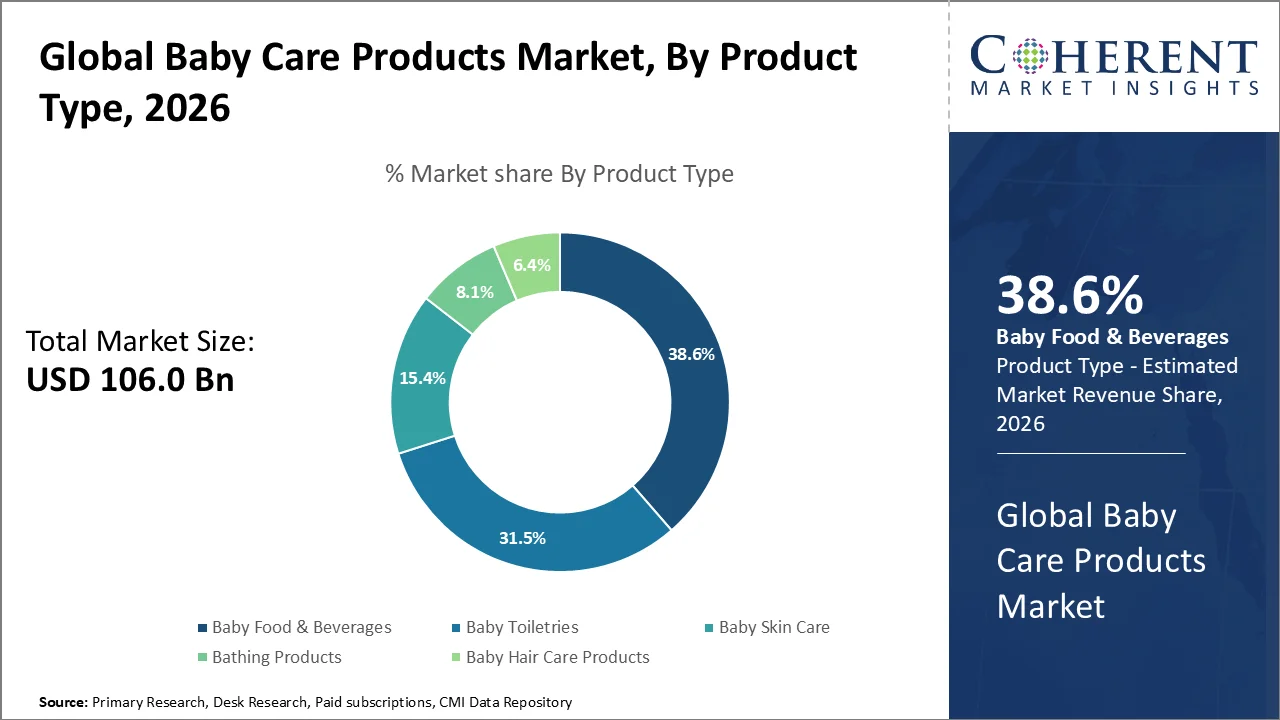
Why is Baby Food & Beverages Acquiring the Largest Share?
On the basis of product, the Baby Food & Beverages segment is projected to account for the largest Baby Care Products Market share of 38.6% in 2026. The segment’s dominance is owing to the recurring consumption of infant formula, baby milk products, cereals, purees, bottled foods, juices, and other age-specific nutritional products. Growing parental focus on balanced infant nutrition, convenience, product safety, and scientifically formulated foods is further supporting demand.
The most recent company performance demonstrates the strength of demand in infant nutrition. Danone said its Specialized Nutrition business achieved like-for-like sales growth of 7.4% in 2025, boosted by strong demand for Infant Milk Formula and Medical Nutrition.
In April 2026 Gerber announced a new and improved formula made with nutrient-dense sorghum for its Puffs and Teether Wheels baby snacks. The new formulation increased whole grains from 2 grams to 5 grams per serving, more than doubling the whole grain content, while maintaining the baby-friendly taste and texture of the products.
Supermarkets Hold the Largest Market Share
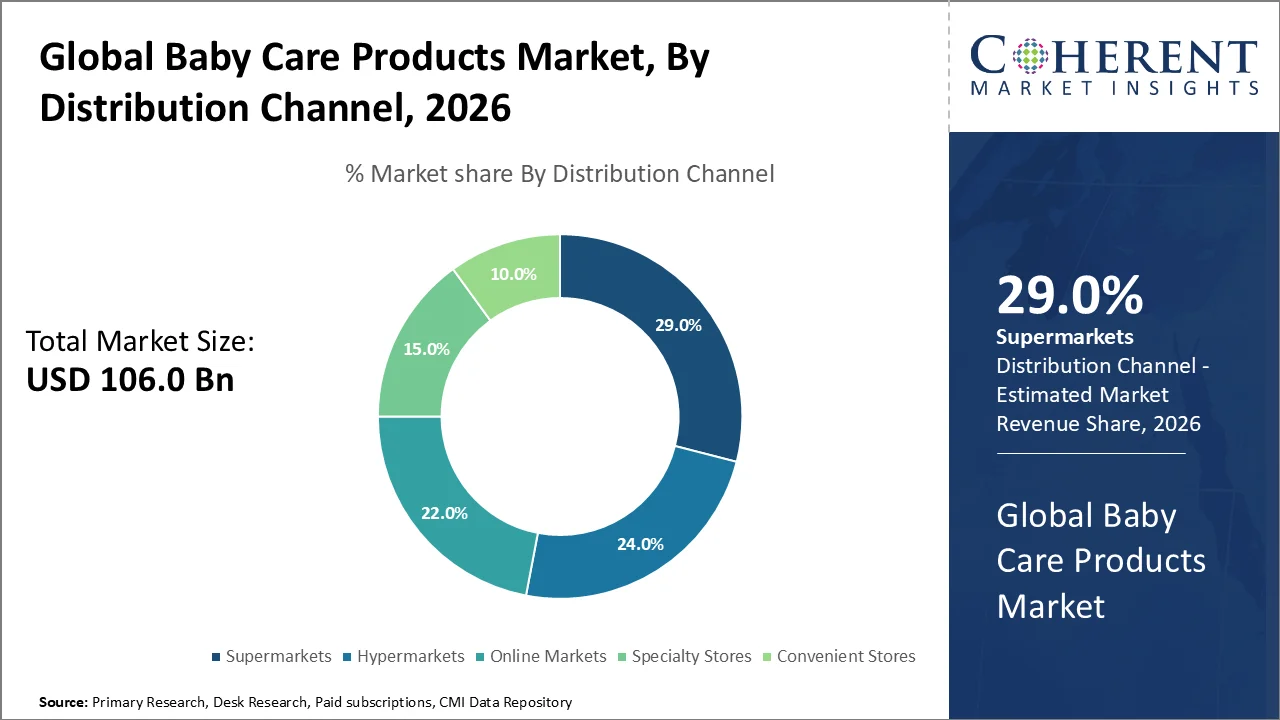
On the basis of distribution channel, the Supermarkets segment is expected to lead with approximately 29.0% share in 2026. The segment’s dominance is owing to the high frequency of household shopping, extensive shelf availability of baby foods, diapers, wipes, skincare, and bathing products, competitive pricing, promotional programs, and consumers’ ability to compare multiple brands and pack sizes during routine grocery purchases.
In May 2026, the retailer reported that its refreshed baby assortment, Baby Boutique, and baby gift displays across 1,000 stores drove a 5% comparable-sales acceleration in the Baby category. These developments highlight the continued importance of large organized retail stores for baby-care product discovery, assortment expansion, competitive pricing, and recurring household purchases.
In January 2026, Tesco launched free F&F Premature Sleepsuits for families with babies born early. The initiative was developed in collaboration with Pampers and complements Tesco’s existing premature-baby diaper offering.
Why are Mass Products Acquiring the Largest Share?
On the basis of category, the Mass Products segment is anticipated to dominate the Baby Care Products Market with approximately 74.0% share in 2026. The segment’s dominance is owing to the high-volume and recurring consumption of essential products such as diapers, wipes, shampoos, soaps, lotions, cereals, and mainstream infant nutrition. Wider affordability, extensive retail availability, larger family consumption volumes, and demand for value-priced products across emerging economies further strengthen this segment.
Recent manufacturer disclosures said price sensitivity is still especially important in baby care. In August 2025, Unicharm said it was seeing a faster shift to lower-priced products in the Asian baby-care market, with consumers favoring affordability and value as household spending was squeezed.
Baby Care Products Market Trends
- Growing demand for science-backed and skin-friendly diapers is driving premiumization in the baby care products market. Kimberly-Clark announced in January 2026 the launch of Huggies Skin Essentials diapers with a proprietary SkinProtect liner that leaves up to five times less mess than the leading store brand. The company also brought the technology to South Korea and helped it to gain 60 basis points of market share in 2025.
- The growing use of functional ingredients like human milk oligosaccharides (HMOs) and probiotics is changing the landscape of premium infant nutrition. Nestlé launched NAN Sinergity in Latin America and the Middle East in June 2025, with more launches planned in Asia. The formulation combines probiotics with six HMOs that are structurally identical to those found in breastmilk. Nestlé said its HMO-containing products were already available in more than 50 countries.
- The growing emphasis on sensitive-skin and dermatologically-oriented baby skincare is prompting companies to move away from traditional lotions and oils to more specialized formulations. Aquaphor launched its first-ever Baby Sensitive Lotion in March 2026, with Provitamin B5, Ceramide NP, glycerin and hyaluronic acid. The company said 72% of parents surveyed had skincare concerns for their babies, such as dry or sensitive skin, pointing to strong demand for specialized baby skincare solutions.
Regional Insights
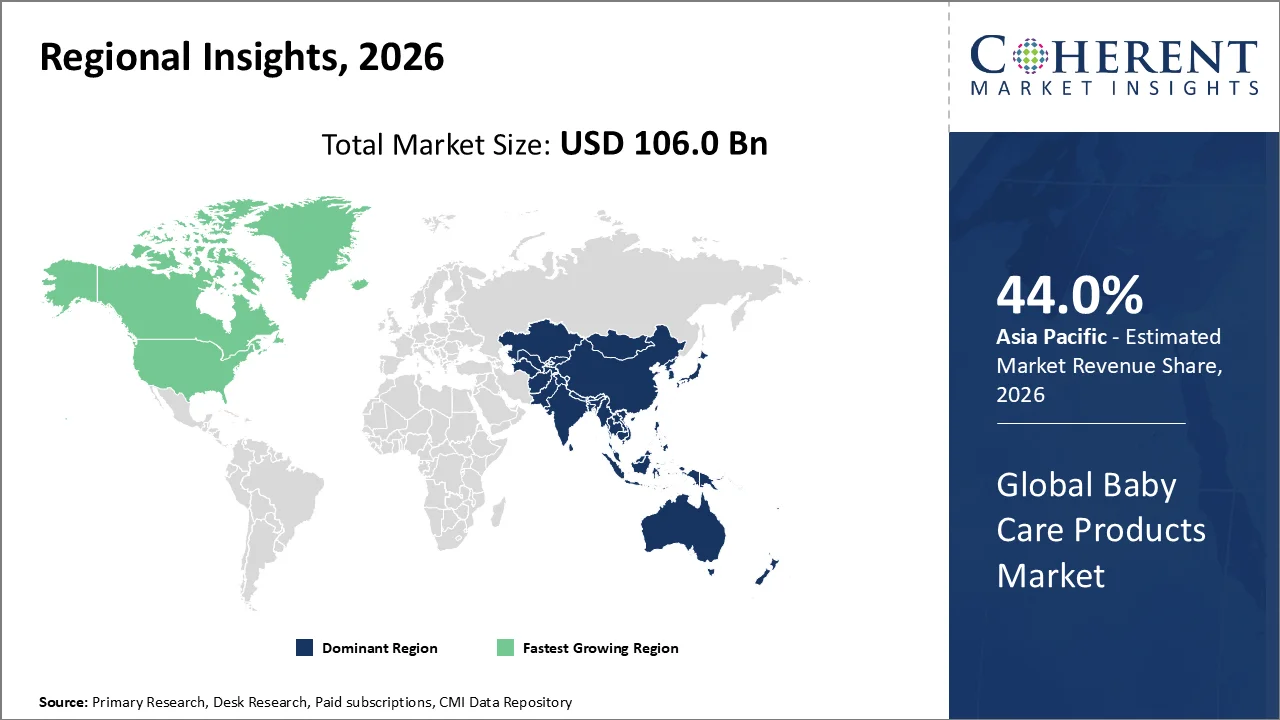
Asia Pacific Dominates Owing to the Large Consumer Base and Strong Expansion of Branded Baby Care Products
The Asia Pacific region accounts for approximately 44.0% of the global Baby Care Products Market share in 2026. The region’s dominance is owing to the large population of infants and toddlers, rising expenditure per child, increasing penetration of branded baby food and hygiene products, and growing demand for premium nursing, skincare, and feeding products across China, India, Japan, South Korea, Australia, and Southeast Asia. The expansion of organized retail and digital commerce is further increasing access to domestic and international baby-care brands.
Recent company results are indicative of the strength of baby-care demand across the region. Pigeon Corporation’s China Business’s net sales amounted to JPY 10.95 billion in the first quarter of 2026, up 16.9% compared to the same period a year earlier. Growth in mainland China was principally driven by nursing bottles, nipples and baby skincare products. The company also said gross merchandise value during its Women’s Day online promotion increased 20% on-year.
In June 2025, LG Unicharm announced new MamyPoko tape and pants-type diapers in South Korea using 100% unbleached sheets and pulp. The products use an unbleached absorbent core and eliminate chemical bleaching of the specified materials, responding to increasing consumer interest in safer and more environmentally conscious baby-care products.
North America Baby Care Products Market Trends
North America is expected to emerge as the fastest-growing region in the Baby Care Products Market over the forecast period. The region’s growth is owing to high expenditure per child, strong demand for premium and clinically differentiated products, increasing adoption of specialized infant nutrition and skincare, rapid product innovation, and well-developed supermarket, specialty-retail, and online distribution networks. A recent baby-care market assessment also identifies Asia Pacific as the largest market and North America as the fastest-growing region.
The latest company data is direct evidence that demand for baby-care products in North America is getting stronger. Pigeon said its baby-care products, particularly nursing bottles and nipples, sold well in North America in 2026. Net sales of its wider Americas and Europe Business were JPY 6.15 billion, up 8.9% year-on-year. Sales of nursing bottles in North America increased substantially following increased promotional activities to attract new customers and raise brand awareness.
In June 2026, Else Nutrition announced a new manufacturing drive to meet growing demand in the U.S. and Canada for its plant-based nutrition products for babies, toddlers, and children. The company stated that previous inventory shortages had constrained sales and that the new production initiative was intended to maintain product availability through summer 2026 and support its Canadian relaunch.
Premium Product Innovation and Strong Branded Diaper Demand are Supporting the Baby Care Products Market in the United States
The U.S. Baby Care Products Market is experiencing ongoing product premiumization with robust demand for high-performance diapers, sensitive-skin products, specialized infant nutrition and convenience-oriented baby-care products. Manufacturers are increasingly competing on absorbency, skin protection, fit, ingredient transparency and differentiated products from premium to value price tiers.
Kimberly-Clark reported that its North America organic sales increased 1.8% in 2026, primarily due to 1.9% volume growth, with Baby & Child Care among the categories driving the increase. The company also reported that its innovation pipeline is being used to refresh its North American portfolio around leak protection, comfort, skin health, and overnight performance.
China Baby Care Products Market Trends
China is expected to remain one of the most important baby-care markets globally, supported by a substantial population of young children, increasing expenditure per child, premiumization of infant formula and diapers, and strong demand for scientifically differentiated baby nutrition and hygiene products.
Despite demographic pressures, the country's shift toward higher-value products and premium formulations is supporting value growth in the category. China had roughly 30 million children under three years of age as of early 2026, representing a sizeable addressable base for diapers, baby food, formula, skincare, and other recurring baby-care products.
Who are the Major Companies in Baby Care Products Industry
Some of the major key players in Baby Care Products Market are Procter & Gamble Co., Kimberly Clark Corp., Johnson and Johnson, Unilever Plc., Abbott Nutrition, Nestle S.A., BABISIL, Cotton Babies, Inc., Danone S.A., The Himalaya Drug Company, Farlin Infant Products Corporation, Avon Healthcare Limited Company, Bonpoint S.A., Dabur International Limited, Burt’s Bees Inc., L’Oreal S.A., etc.
Key News
- In July 2026, L'Oreal-owned CeraVe announced the launch of CeraVe Baby Eczema Relief Cream as part of five new skin-barrier innovations. The baby-specific cream contains the brand's three essential ceramides and targets eczema-prone infant skin, demonstrating expansion into therapeutic and condition-specific baby skincare.
- In June 2026, P&G announced that Pampers Swaddlers diapers are now fragrance-free in the U.S. The reformulation retains the brand's existing absorbency and skin-protection features while removing fragrance, reflecting increasing parental demand for simpler and sensitive-skin-oriented diaper formulations.
Market Report Scope
Baby Care Products Market Report Coverage
| Report Coverage | Details | ||
|---|---|---|---|
| Base Year: | 2025 | Market Size in 2026: | USD 106.0 Bn |
| Historical Data for: | 2020 To 2024 | Forecast Period: | 2026 To 2033 |
| Forecast Period 2026 to 2033 CAGR: | 7.3% | 2033 Value Projection: | USD 173.7 Bn |
| Geographies covered: |
| ||
| Segments covered: |
| ||
| Companies covered: | Procter & Gamble Co., Kimberly Clark Corp., Johnson and Johnson, Unilever Plc., Abbott Nutrition, Nestle S.A., BABISIL, Cotton Babies, Inc., Danone S.A., The Himalaya Drug Company, Farlin Infant Products Corporation, Avon Healthcare Limited Company, Bonpoint S.A., Dabur International Limited, Burt’s Bees Inc., L’Oreal S.A., etc. | ||
| Growth Drivers: |
| ||
| Restraints & Challenges: |
| ||
Analyst Opinion
- The Baby Care Products Market is increasingly shifting from volume-led growth toward premiumization and higher expenditure per child, particularly as birth rates soften in several mature economies. Manufacturers are expanding high-value baby foods, skincare, feeding products, and specialized care solutions to increase revenue per consumer. In Q1 2026, Pigeon Corporation’s net sales increased 9.8% year-on-year to JPY 27.7 billion, supported by strong sales of high-value-added baby-care appliances, baby foods, skincare products, nursing bottles, and nipples.
- Affordability will be as critical as premiumization, driving continued demand for mass market diapers, wipes, toiletries and value packs. In 2026, the National Diaper Bank Network found that 62% of low-income households with children in diapers in the United States experience diaper insecurity, and even in middle-income households, the number is still at 31%. This means there is a significant amount of unmet demand and that competitive pricing, larger pack sizes, private label products and retailer promotions will continue to be the major factors in driving market penetration.
- Product safety, ingredient traceability, and manufacturing quality are expected to become stronger competitive differentiators, particularly in infant nutrition where failures can rapidly affect brand trust. In January 2026, Danone announced the targeted withdrawal of a limited number of infant-formula batches from selected markets following evolving food-safety authority guidance, despite stating that its routine and additional analyses confirmed compliance with applicable safety regulations. The event demonstrates why manufacturers are likely to increase investment in supplier qualification, contaminant monitoring, batch-level traceability, and transparent quality assurance.
Speak to the analyst
Want personalized insights?
Take the findings above to one of our principal consultants, or have the report rebuilt around the segments, geographies and competitors you actually track.
Market Segmentation
- By Product Type (Revenue, USD Bn, 2021-2033)
- Baby Skin Care
- Baby Massage Oil
- Body Lotions
- Creams/Moisturizers
- Talcum Powder
- Baby Hair Care Products
- Baby Shampoo and Conditioner
- Detangles
- Bathing Products
- Soaps
- Bubble Bath/Shower gel
- Baby Toiletries
- Diapers
- Baby Wipes
- Baby Fragrances/Perfumes
- Baby Food & Beverages
- Bottled Baby Food
- Baby Fruit & Vegetable Juices
- Pureed Baby Food
- Baby Food Cereals
- Baby Milk Product
- Baby Food Soups
- Baby Skin Care
- By Distribution Channel (Revenue, USD Bn, 2021-2033)
- Hypermarkets
- Supermarkets
- Specialty Stores
- Convenient Stores
- Online Markets
- By Category (Revenue, USD Bn, 2021-2033)
- Premium Products
- Mass Products
- By Region (Revenue, USD Bn, 2021-2033)
- North America
- U.S.
- Canada
- Latin America
- Brazil
- Mexico
- Argentina
- Rest of Latin America
- Europe
- Germany
- U.K.
- France
- Italy
- Spain
- Russia
- Rest of Europe
- Asia Pacific
- China
- India
- Japan
- Australia
- South Korea
- ASEAN
- Rest of Asia Pacific
- Middle East
- GCC
- Israel
- Rest of Middle East
- Africa
- South Africa
- Central Africa
- North Africa
- North America
Sources
Primary Research Interviews
- Baby care product manufacturers and brand managers
- Infant formula and baby food manufacturers
- Diaper, wipes, and absorbent hygiene product manufacturers
- Baby skincare and personal care product developers
- Pediatricians, dermatologists, and infant nutrition specialists
- Supermarket, hypermarket, pharmacy, and specialty retail procurement managers
- Baby product distributors and wholesalers
- E-commerce category managers and online retailers
- Parents and caregivers of infants and toddlers
- Key opinion leaders (KOLs) in pediatric nutrition, baby hygiene, and infant skincare
Databases
- UNICEF Data
- World Bank
- United Nations Department of Economic and Social Affairs (UN DESA) – Population Division
- World Health Organization (WHO) Global Health Observatory
- Organisation for Economic Co-operation and Development (OECD)
- U.S. Census Bureau
- Eurostat
- UN Comtrade Database
- International Trade Centre (ITC) Trade Map
- U.S. Food and Drug Administration (FDA) Databases
Magazines
- Cosmetics & Toiletries
- Happi Magazine
- Nutraceuticals World
- Progressive Grocer
- Store Brands
- Food Business News
- Nutrition Insight
- Packaging Europe
Journals
- Pediatrics
- Journal of Pediatric Gastroenterology and Nutrition
- Pediatric Dermatology
- International Journal of Cosmetic Science
- Journal of Human Nutrition and Dietetics
- Maternal & Child Nutrition
- Clinical Pediatrics
- Food & Nutrition Research
Newspapers
- The New York Times
- The Wall Street Journal
- Financial Times
- Reuters
- The Guardian
- The Economic Times
- Business Standard
Associations
- Juvenile Products Manufacturers Association (JPMA)
- International Formula Council (IFC)
- National Diaper Bank Network (NDBN)
- Personal Care Products Council (PCPC)
- Cosmetics Europe
- Consumer Brands Association
- European Federation of the Associations of Dietitians (EFAD)
- International Special Dietary Foods Industries (ISDI)
Public Domain Sources
- Company Annual Reports and Investor Presentations
- Company Press Releases and Product Launch Announcements
- U.S. FDA Infant Formula, Food Safety, and Cosmetics Publications
- European Commission Food, Cosmetics, and Packaging Regulations
- UNICEF and WHO Infant Nutrition and Child Health Publications
- Government Birth Rate, Fertility, and Child Population Statistics
- Product Recall and Consumer Safety Databases
- Retailer Annual Reports and Baby Category Expansion Announcements
- Patent Databases such as WIPO, USPTO, EPO, and Google Patents
- Sustainability and Packaging Reports from Baby Care Product Manufacturers
- Publicly Available Clinical and Pediatric Research Publications
Proprietary Elements
- CMI Data Analytics Tool
- Proprietary CMI Existing Repository of Information for the Last 10 Years
Get access to 250+ pages report
Every segment, forecast, competitor profile and data table behind the analysis above — available for instant download.
- ESOMAR Member
- ISO 9001:2015 Certified
- D-U-N-S Registered
- GDPR & CCPA Compliant
Missing comfort of reading report in your local language? Find your preferred language:
Transform your Strategy with Exclusive Trending Reports
Frequently Asked Questions
The Baby Care Products Market is expected to reach USD 173.7 Bn by 2033, increasing from USD 106.0 Bn in 2026.
Major players operating in the global Baby Care Products Market include Procter & Gamble Co., Kimberly Clark Corp., Johnson and Johnson, Unilever Plc., Abbott Nutrition, Nestle S.A., BABISIL, Cotton Babies, Inc., Danone S.A., The Himalaya Drug Company, Farlin Infant Products Corporation, Avon Healthcare Limited Company, Bonpoint S.A., Dabur International Limited, Burt’s Bees Inc., and L’Oreal S.A.
The high product development and compliance costs and declining birth rates in several developed markets are the key factors hampering growth of the Baby Care Products Market.
The increasing demand for premium and specialized baby care products, rising awareness regarding baby hygiene and skin health, growing consumption of infant nutrition products, and increasing parental preference for safe and dermatologically tested products are driving market growth.
The Baby Care Products Market is anticipated to grow at a CAGR of 7.3% between 2026 and 2033.
Among regions, Asia Pacific is expected to dominate the global Baby Care Products Market with approximately 44.0% market share in 2026, supported by a large infant population, expanding middle-class consumer base, increasing penetration of disposable diapers and packaged baby foods, and rising expenditure per child.
North America is expected to emerge as the fastest-growing region over the forecast period, supported by high expenditure per child, strong demand for premium and clinically differentiated products, specialized infant nutrition and skincare adoption, and continued product innovation.