

Mouthwash Market Analysis & Forecast: 2026-2033
Mouthwash Market size is estimated to be valued at USD 2,744.2 Mn in 2026 and is expected to reach USD 4,335.1 Mn in 2033, exhibiting a compound annual growth rate (CAGR) of 6.8% from 2026 to 2033.
Key Takeaways
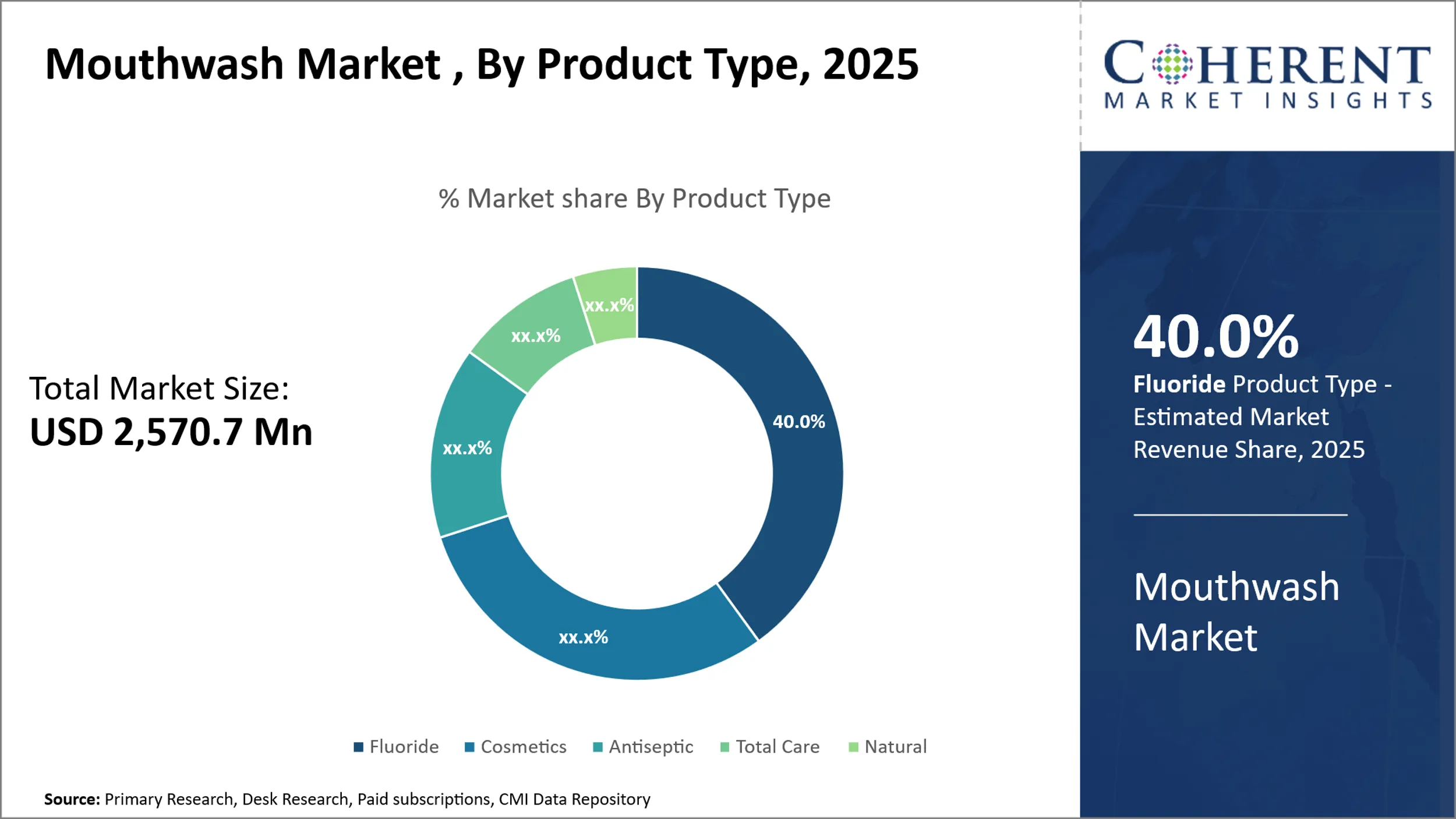
- By Product Type, Fluoride Mouthwash division is projected to lead the global mouthwash market with a 40% share by 2026, owing to its proven effectiveness in cavity prevention and strong endorsement by dental associations worldwide.
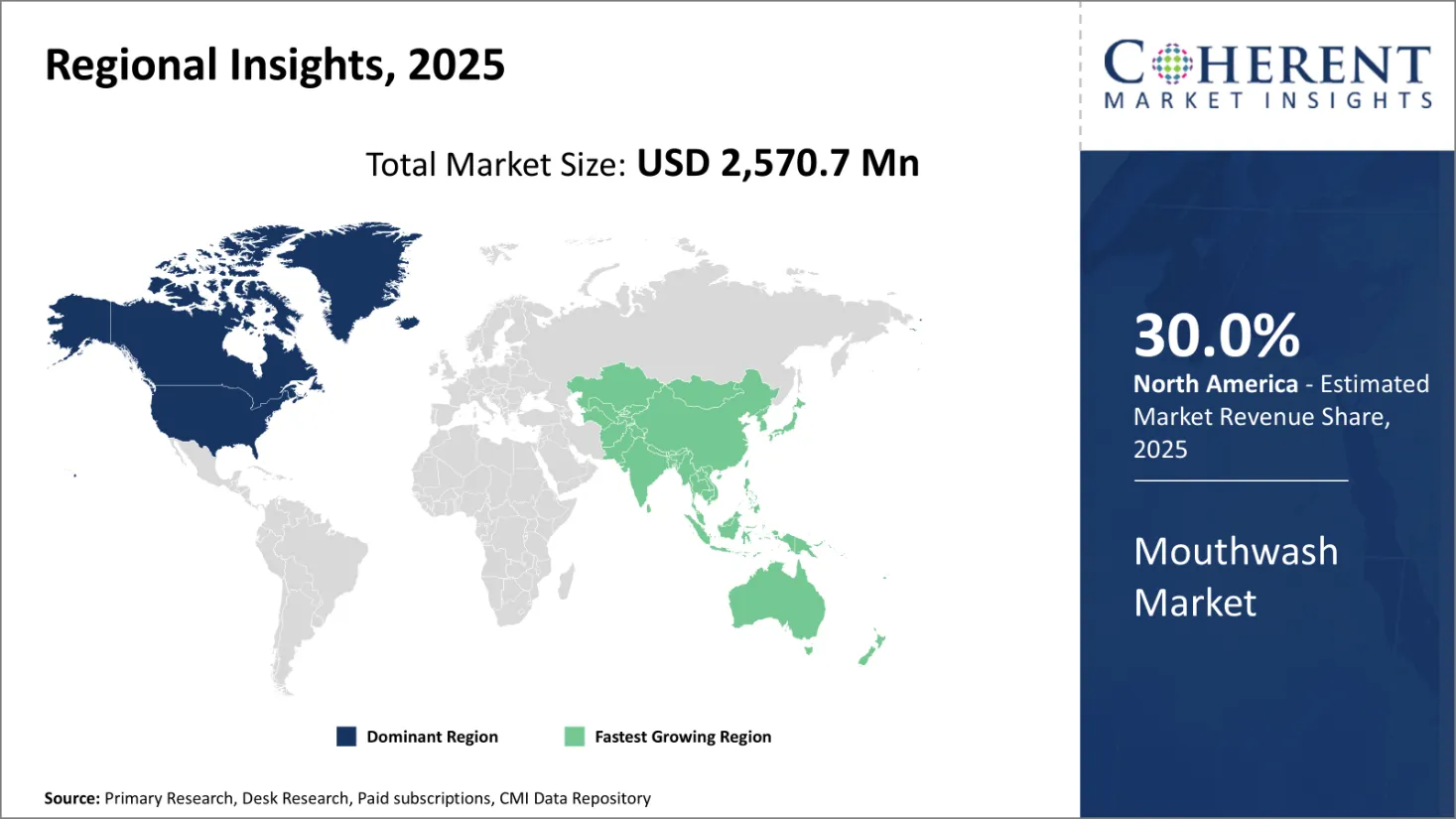
- By Region, North America is anticipated to maintain dominance in the global mouthwash market outlook with a 30% share by 2026, attributed to high oral hygiene awareness, established retail networks, and the presence of key market players.
Market Overview:
The Mouthwash Market value is growing steadily due to rising oral hygiene awareness, increasing dental concerns, and a consumer shift toward natural, alcohol-free products. Rising incidence of dental problems, including decay and gum diseases fuel the demand for mouthwash market during the forecast period.
Current Events and Its Impact on the Mouthwash Market
Event | Description and Impact |
Geopolitical Trade Policies Impacting Raw Material Costs |
|
Technological Advancements in Product Formulations |
|
Economic Pressures Altering Consumer Behavior |
|
Pricing Analysis
- The mouthwash market growth globally has various price levels which are affected by product type, region, and market mentality. Therapeutic mouthwashes exceed in value due to specialized benefits, typically costing $5-10 for 500 ml, such as antiseptic and fluoride-based mouthwashes. Cosmetic variants that focus on breath freshening and whitening are mid-range priced at $3-7. Natural and organic products commanding premium pricing because of their unique appeal and certification costs are advertised at $8-15 for 500 ml.
- On a regional basis, North America captures the lead share for mouthwash consumption at $4-12 for premium brands, and affordable private labels surpassing the average at $1-4 per liter. Europe’s restrictions add to the cost of mouthwash production thereby increasing retail price for 500ml to €5-10. Eco-friendly packaging also adds to the price that needs to be paid for mouthwash. The Asia-Pacific region tends to aim for affordability with domestic brands pricing their products at $1-3 for 200 ml, while imported brands come at a price 30-50% higher.
- Promotions at drugstores also affect pricing patterns as well as online stores which give 10-20% discounts via bundles and subscriptions. Other renowned brands such as Listerine and Colgate-Palmolive follow combined pricing approaches cut for specific segments and areas.
- Sustainability changes and integration of mouthwash products with digital technologies are the mouthwasments I am expecting.
- Current Industry Events of 2026
- Market Size Estimation
- Regional Breakdown
- Competitive Landscape
- Customer Intelligence
- Segmental Analysis
- Pricing Analysis
- Key Market Drivers, Challenges & Future Trends
- Customized Insights Section
Segmentation Analysis
Global Mouthwash Market Insights, By Product Type
In terms of product type, fluoride mouthwash is expected to contribute the highest share of 41% in the global mouthwash market forecast in 2026, accounting for approximately 40%. This is attributed to its proven effectiveness in preventing tooth decay and strengthening the fluoride layer on tooth enamel. The therapeutic segment, which includes fluoride, antiseptics, and natural (herbal) mouthwash products, continues to drive demand as consumers increasingly seek oral health solutions beyond cosmetic benefits.
Global Mouthwash Market Insights, By Flavor
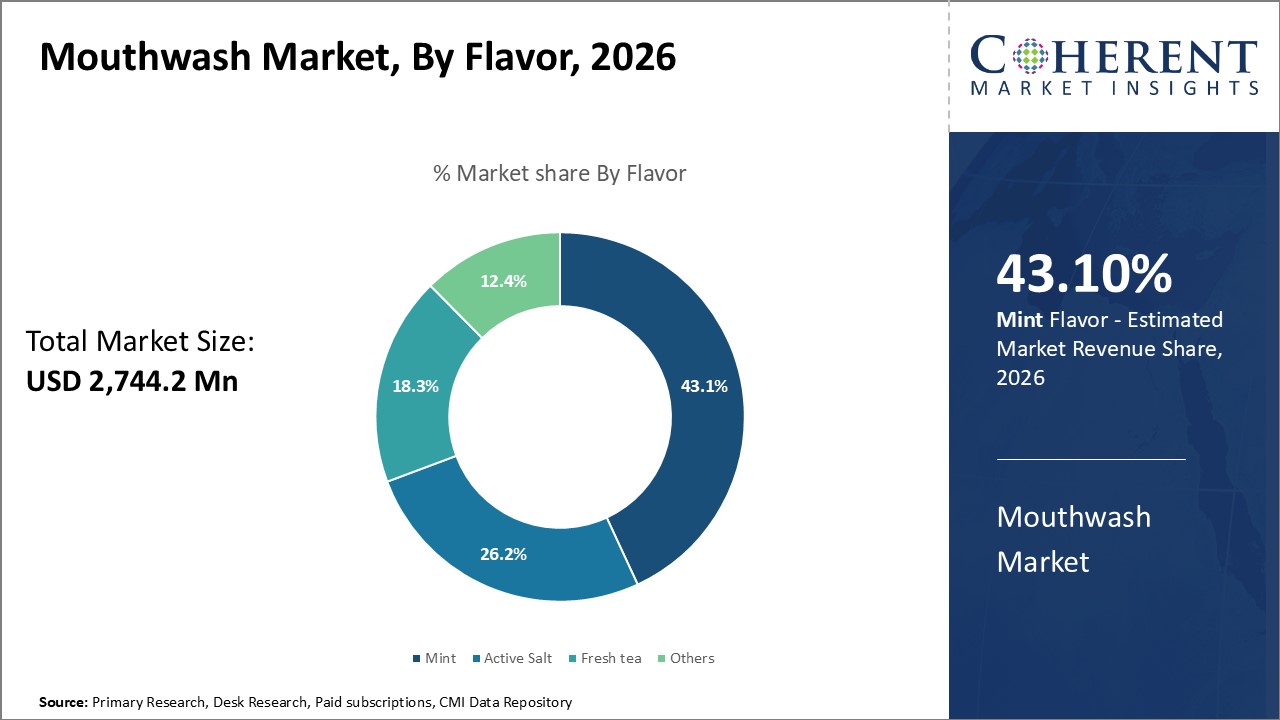
In terms of flavor, the mouthwash market is segmented into mint, fresh tea, active salt, and others. By far the most popular choice among consumers remains the mint flavor due to its strong connection with freshness and breath odor control for an adequate duration. Active salt and fresh tea flavors are gaining traction as well, particularly in regions where consumers prefer mild or herbal tastes. The presence of different flavor options aids manufacturers in addressing diverse consumer wants, improving overall satisfaction, and increasing repeat purchases.
Global Mouthwash Market Insights, By Distribution Channel
Concerning distribution channels, hypermarkets and supermarkets capture the global mouthwash market’s volume and value share, providing varied product choices at competitive prices. However, online stores are increasing in market share at a rapid pace due to growing consumer adoption of e-commerce and delivery right to their doorstep. Growth in the online segment is also driven by discounts and wider options offered, including niche and premium brand mouthwash products. Other channels include pharmacies, specialty stores, and direct sales, which continue to serve specific consumer segments.
Regional Analysis
North America Mouthwash Market Analysis and Trends
North America is expected to witness significant growth in the mouthwash market trend over the forecast period with 30.0% market share, driven largely by stringent regulatory frameworks governing packaging, product quality, and safety standards. The region’s leadership in this market is supported by increasing awareness of oral health, as well as regulatory oversight aimed at improving product efficacy and consumer safety.
For instance, the World Health Organization (WHO) Global Oral Health Status Report (2022) highlights that oral diseases affect nearly 3.5 billion people globally, with a substantial proportion residing in middle-income countries.
Asia Pacific Mouthwash Market Analysis and Trends
Asia Pacific is expected to be the fastest-growing region in the global mouthwash market over the forecast period. This growth is fueled by rapid urbanization, rising disposable incomes, and increased health consciousness among the expanding middle-class population in key countries such as China, India, Japan, South Korea, and Australia.
The region also benefits from improving healthcare infrastructure, wider availability of oral care products, and growing adoption of advanced formulations, including aluminum fluoride-enriched and herbal mouthwashes that cater to local preferences. Despite challenges like uneven access to oral healthcare and varying regulatory frameworks, the rising prevalence of oral disease and lifestyle changes—such as increased sugar intake and tobacco use—are driving demand for effective oral hygiene products.
Dominating Countries in the Global Mouthwash Market
United States Mouthwash Market Analysis and Trends
The U.S. leads the North American mouthwash market, supported by a well-established regulatory framework and strong consumer health awareness. The presence of key oral care product manufacturers and ongoing investments in oral health research bolster the country’s market position. Government regulations enforcing stringent quality control and safety standards continue to drive product innovation and market growth.
China Mouthwash Market Analysis and Trends
China stands out as the leading market within the Asia Pacific region, supported by its vast population base, growing urban middle class, and increasing focus on preventive healthcare. The country’s expanding oral care market is driven by rising awareness of oral health issues and a surge in demand for modern oral hygiene solutions.
Government programs promoting dental health education and the strengthening of regulatory standards for oral care products have contributed to market maturity. Additionally, China’s booming e-commerce sector and modern retail expansion have improved product accessibility, encouraging the penetration of both international and domestic mouthwash brands. Continuous innovation, including herbal and natural formulations tailored to Chinese consumers, is expected to further accelerate market growth.
Market Report Scope
Mouthwash Market Report Coverage
| Report Coverage | Details | ||
|---|---|---|---|
| Base Year: | 2025 | Market Size in 2026: | USD 2,744.2 Mn |
| Historical Data for: | 2020 To 2024 | Forecast Period: | 2026 To 2033 |
| Forecast Period 2026 to 2033 CAGR: | 6.8% | 2033 Value Projection: | USD 4,335.1 Mn |
| Geographies covered: |
| ||
| Segments covered: |
| ||
| Companies covered: | Key players operating in the global mouthwash include Colgate-Palmolive Company, Johnson & Johnson Inc., The Himalaya Drug Company, Amway Corporation, GlaxoSmithKline Plc., Lion Corporation, Caldwell Consumer Health, LLC, Uncle Harry's Natural Products, and Triumph Pharmaceuticals, Inc. | ||
| Growth Drivers: |
| ||
| Restraints & Challenges: |
| ||
Market Driver:
Rising awareness of public regarding oral hygiene:
Globally, mouthwash is mint to become one of the most profitable markets in the consumer good industry. This, in tum, has mouthwash commodity and open a wider market base. As in 2021, the National Oral Health Program Division of the Ministry of Health and Family Welfare proposed a draft framework for a National Oral Health Policy. This policy is aimed at the prevention of oral diseases and promoting good oral hygiene among the public. It as well is meant to edify the public and cultivate basic oral hygiene skills and is being circulated through other public forums for comments. Such step are meant to enhance the initiatives geared towards the prevention of oral diseases.
Due to the increasing consumer demand of mouthwash has been rapid, governmnetal bodies such as the Us Food & Drug Administration and the European Commission alongside the Health Sciences Authority have set precise regulations on the ingredients and even the packaging of mouthwash. According to the HSA, mouthwash containing chlorine containing compounds is banned alongside the mouthwash listing many lung phrasing warnings. In essence marking mouthwash with these labels, manufacturers are limited to ordering mouthwash outside the US in order to sell it. These types of regulations complemented with stiff competition from local and even foreign manufacturers motivate others to join the global hit and industrial market.
Analyst Viewpoint
- Innovation and sustainability remain the core drivers of growth alongside shifting consumer behavior and policy interventions with respect to the mouthwash industry.
- Preventative care is on the rise due to greater awareness of oral hygiene as seen in initiatives like India’s proposed National Oral Health Policy.
- Consumer satisfaction is enhanced by product diversification which includes multifunctional formulations of oral care products such as whitening and antiseptic mouthwashes.
- While most consumers still prefer organic products due to their growing popularity, there remains a tendency towards the use of natural ingredients. However, synthetic products are still more widely used because of their perceived effectiveness.
- Formulation flexibility and compliance costs due to regulatory hurdles like FDA standards for anticaries products heighten challenges.
- Competitive forces within the industry compel brands to focus on niche differentiation. At the same time, price sensitivity from developing economies constrains the uptake of nonessential premium products.
- While enhanced user engagement through oral health monitoring apps presents great opportunity, sustainability focused trends like eco friendly packaging and biodegradable materials is paving the way toward improving overall market engagement.
- Urbanization and e-commerce are propelling the growth of the Asia Pacific region, but mature markets such as North America and Europe are focusing on premiumization and innovation.
- Niche markets like sensitivity and alcohol-free variant mouthwashes require strategic collaboration and investment on R&D if businesses are looking to secure market share.
- Businesses in the industry must remain flexible in their approach while balancing compliance with regulations to succeed in the future.
Recent Development
- In January 2025, Hismile launched a foam mouthwash available in four fruity flavors—Strawberry, Watermelon, Blue Raspberry, and Grape Bubblegum—offering a novel, fun approach to daily oral hygiene.
- In April 2025, Haleon announced a US$167 million investment to establish a global oral health innovation center in Weybridge, Surrey, aimed at advancing research and development for brands including Sensodyne, Corsodyl, and Polident.
- In 2023, Procter & Gamble introduced a fluoride-free mouthwash designed for consumers preferring natural oral care products, quickly capturing 15% market share in the U.S.
Market Players: Key players operating in the global mouthwash market include Colgate-Palmolive Company, Johnson & Johnson Inc., The Himalaya Drug Company, Amway Corporation, GlaxoSmithKline Plc., Lion Corporation, Caldwell Consumer Health, LLC, Uncle Harry's Natural Products, and Triumph Pharmaceuticals, Inc.
Market Segmentation
- Global Mouthwash Market, By Product Type
- Fluoride
- Cosmetics
- Antiseptics
- Total Care
- Natural
- Global Mouthwash Market, By Flavor
- Active Salt
- Mint
- Fresh Tea
- Others
- Global Mouthwash Market, By Distribution Channel
- Hypermarkets
- Supermarkets
- Online Stores
- Others
- Global Mouthwash Market, By Region
- North America
- U.S.
- Canada
- Europe
- U.K.
- Germany
- Italy
- France
- Russia
- Rest of Europe
- Asia Pacific
- China
- India
- Japan
- ASEAN
- Australia
- South Korea
- Rest of Asia Pacific
- Latin America
- Brazil
- Mexico
- Rest of Latin America
- Middle East
- GCC
- Israel
- Rest of Middle East
- Northern Africa
- Central Africa
- South Africa
- North America
- Company Profiles
- Colgate-Palmolive Company
- Johnson & Johnson Inc.
- The Himalaya Drug Company
- Amway Corporation
- GlaxoSmithKline Plc.
- Lion Corporation
- Caldwell Consumer Health, LLC
- Uncle Harry's Natural Products
- Triumph Pharmaceuticals, Inc.
Sources
Primary Research Interviews:
- Dental professionals and oral care specialists
- Executives from leading mouthwash manufacturers (e.g., Colgate-Palmolive, Procter & Gamble)
- Retail and e-commerce platform strategists
- Hospital and dental clinic administrators
- Others
Databases:
- Others
Magazines:
- Dental Products Report
- Oral Health Journal
- Others
Journals:
- Journal of the American Dental Association
- International Journal of Dental Hygiene
- Others
Newspapers:
- The Wall Street Journal (health and consumer goods coverage)
- Financial Times (market trends analysis)
- The Economic Times (emerging market insights)
- Others
Associations:
- American Dental Association (ADA)
- Others
Public Domain Sources:
- National Institutes of Health (NIH) oral care guidelines
- U.S. Food and Drug Administration (FDA) safety reports
- Centers for Disease Control and Prevention (CDC) hygiene statistics
- Others
Proprietary Elements:
- CMI Data Analytics Tool
- Proprietary CMI Existing Repository of information for last 8 years
*Definition: Mouthwash, mouth rinse, oral rinse, or mouth bath is a liquid, which is held in the mouth passively or swilled around mouth by contraction of the perioral muscles and movement of the head, and maybe gargled, where the head is tilted back and the liquid bubbled at the back of the mouth.
Usually mouthwashes are antiseptic solutions intended to reduce the microbial load in the mouth, although mouthwashes might be given for other reasons such as for their analgesic, anti-inflammatory or anti-fungal actions. Additionally, some rinses act as saliva substitutes to neutralize acid and keep the mouth moist in xerostomia.
Get access to 250+ pages report
Every segment, forecast, competitor profile and data table behind the analysis above — available for instant download.
- ESOMAR Member
- ISO 9001:2015 Certified
- D-U-N-S Registered
- GDPR & CCPA Compliant
Missing comfort of reading report in your local language? Find your preferred language:
Transform your Strategy with Exclusive Trending Reports
Frequently Asked Questions
The Mouthwash Market size is estimated to be valued at USD 2,744.2 Mn in 2026, and is expected to reach USD 4,335.1 Mn by 2033.
Key players operating in the global mouthwash include Colgate-Palmolive Company, Johnson & Johnson Inc., The Himalaya Drug Company, Amway Corporation, GlaxoSmithKline Plc., Lion Corporation, Caldwell Consumer Health, LLC, Uncle Harry's Natural Products, and Triumph Pharmaceuticals, Inc.
Fluoride segment based on product type, accounted for the highest demand in the market
Rising awareness of public regarding oral hygiene are the key factors driving growth of the market.
The CAGR of the Mouthwash Industry is projected to be 6.8% from 2026 to 2033.
North America is dominating the market growth.