

Grooming Products Market Size and Forecast — 2026-2033
Overview
Grooming products are used to clean or nourish the body. The products are utilized for various body parts such as skin, hair, lips, and teeth. Increasing adoption of grooming products for aesthetic appeal is driving growth of the market in emerging economies. Increasing awareness towards overall body care and social trends have resulted in market growth. However, stringent regulations regarding ingredients and growing preference of consumers towards organic products is restraining growth of the market.
Grooming Products Market Size and Forecast – 2026 – 2033
The Grooming Products Market size is estimated to be valued at USD 62.14 billion in 2026 and is expected to reach USD 95.93 billion by 2033, exhibiting a compound annual growth rate (CAGR) of 6.4% from 2026 to 2033.
Key Takeaways
The hair care segment leads grooming products market share with 38%, driven by innovative formulations and rising consumer preferences in Asia Pacific.
Online retail channels dominate distribution with 35% share, reflecting broader digital adoption trends influencing market revenue expansion globally.
Europe maintains a significant industry share at 27%, propelled by strong consumer demand for premium and organic grooming products.
Asia Pacific is the fastest-growing region, with a CAGR exceeding 7%, supported by government initiatives enhancing manufacturing capabilities and expanding urban consumer base.
Grooming Products Market – Segmentation Analysis
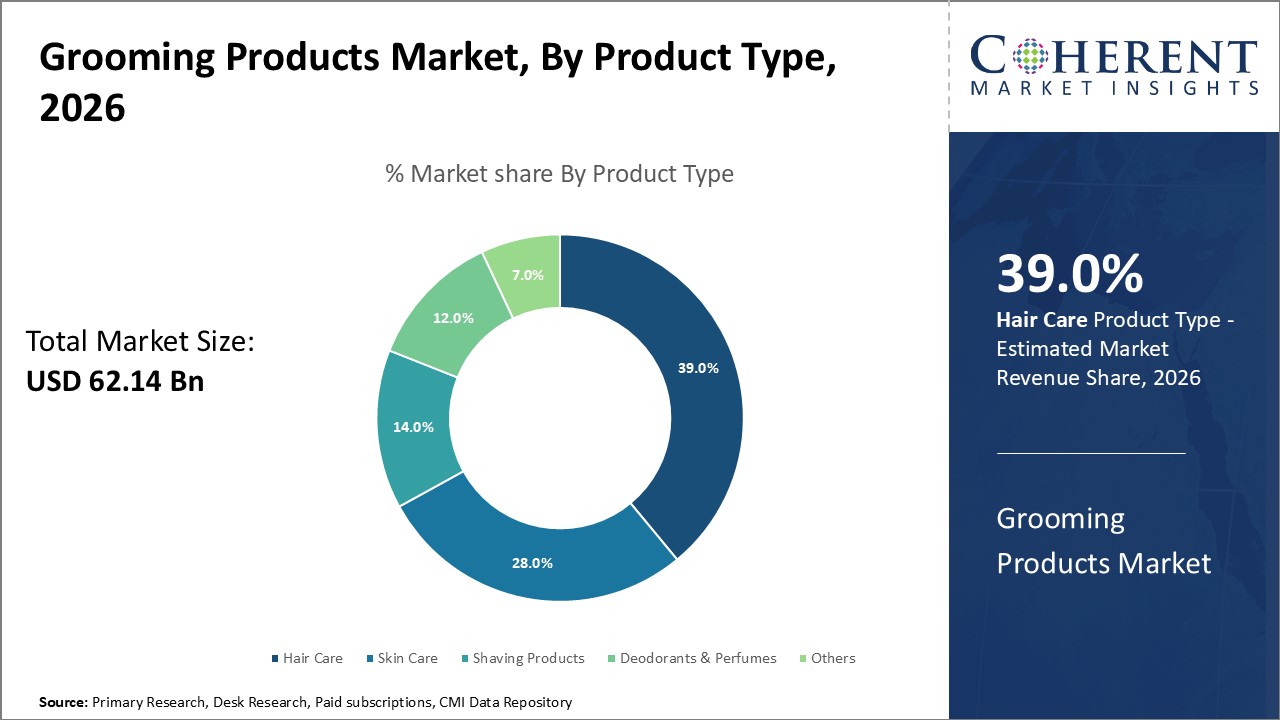
Grooming Products Market Insights, By Product Type
In terms of product type, the market is segmented into Hair Care, Skin Care, Shaving Products, Deodorants & Perfumes, and Others, among which Hair Care dominates the market share with 38.0%. Hair Care products benefit from strong demand for anti-hair fall and scalp health solutions, particularly in Asia Pacific and Europe, where consumers increasingly prioritize hair wellness.
Grooming Products Market Insights, By Gender-based
The market is divided into four segments based on gender: Male Grooming, Female Grooming, Unisex, and Others. Male grooming is the most popular category because of increased knowledge, rising disposable incomes, and men's growing acceptance of personal care. The market share of male grooming goods is high, and the sales of skincare, haircare, and shaving products have increased significantly.
Grooming Products Market Insights, By Distribution Channel
In the distribution channel segment, the market is classified into Online Retail, Supermarkets & Hypermarkets, Specialty Stores, Pharmacies & Drugstores, and Others, wherein Online Retail claims a commanding 34% market share. This growth is propelled by consumers' preference for convenient access, wide product ranges, and personalized recommendations backed by AI.
Grooming Products Market Insights, By Geography
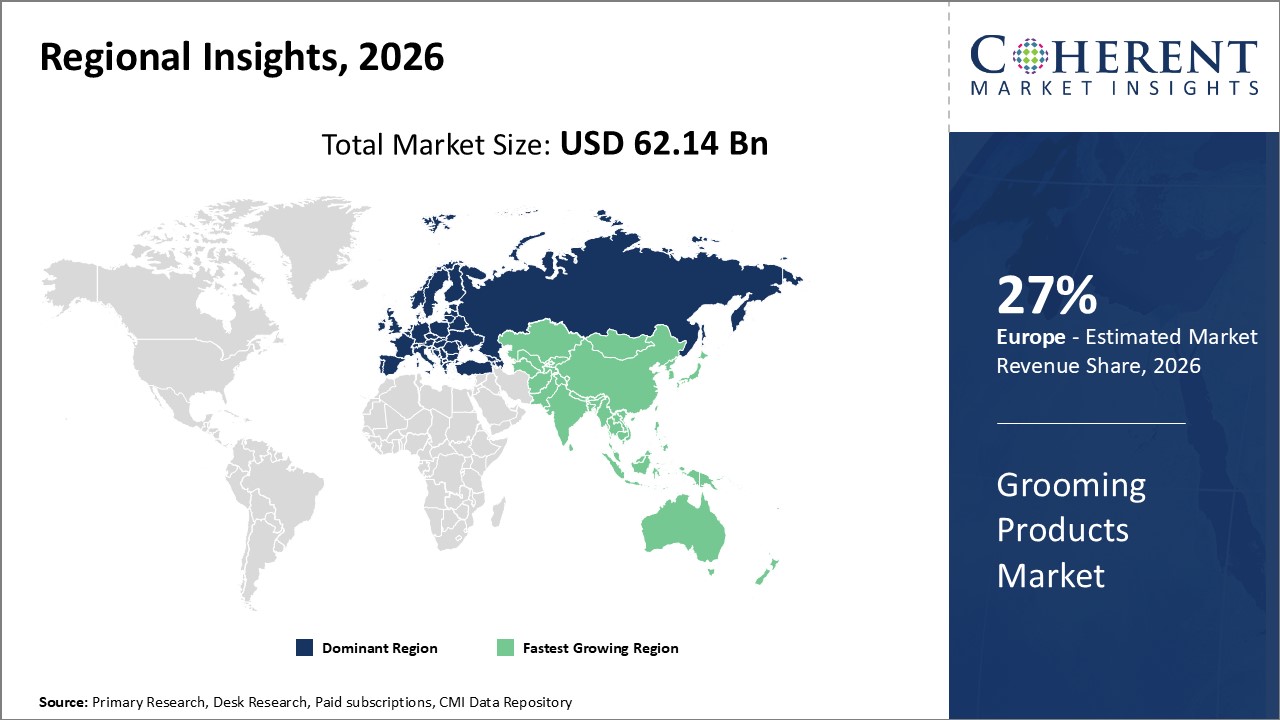
Europe Grooming Products Market Analysis and Trends
Europe is expected to dominate the target market growth holding 27% of market share particularly the men's grooming segment, which is a rapidly growing industry driven by rising awareness and demand for specialized personal care products tailored to men's skin and hair needs. This market comprises a wide array of products including shaving creams, aftershaves, beard oils, facial cleansers, moisturizers, and hair care items designed specifically for men.
Asia Pacific Grooming Products Market Analysis and Trends
As a result of changing consumer lifestyles, growing urban populations, and the increasing use of online sales channels, Asia Pacific is growing at the quickest rate, with a compound annual growth rate (CAGR) of over 7%. Product innovation and accessibility are strengthened by the presence of major manufacturers and government assistance, which accelerates market expansion.
Grooming Products Market Outlook for Key Countries
United States Grooming Products Market Analysis and Trends
The USA commands a leading position within North America, contributing over 70% of the regional market share. The presence of global key players like Procter & Gamble and Johnson & Johnson along with a mature retail ecosystem facilitates significant grooming products market revenue. In 2025, the U.S. witnessed a 13% increase in e-commerce grooming product sales, reinforcing the country’s influence as a market growth driver. Consumer trends favoring natural ingredients and personalized grooming solutions have underpinned new product launches, maintaining the U.S. as a focal point of industry innovation and business growth.
India Grooming Products Market Analysis and Trends
India's grooming products market is expanding rapidly, fueled by increasing urbanization and disposable incomes. The country's e-commerce grooming product sales surged by 40% in 2025, the highest growth rate observed globally. Government support for domestic manufacturing through schemes encouraging production capabilities and export of personal care products amplifies India's attractiveness. Domestic and international market players such as L’Oréal and Amorepacific are intensifying investments here to capture rising consumer demand. The growing male grooming sector and youth population provide key momentum supporting India’s strong market growth trajectory.
Analyst Opinion
The rising demand for male grooming products has notably influenced market size in recent years. For example, male grooming product sales in the U.S. soared by approximately 15% in 2025, highlighting a critical shift in consumer behavior driving revenue growth. This segment now accounts for an increasing share of industry revenue and is expected to accelerate further.
Production capacity expansions across Asia Pacific, especially India and China, have enhanced market availability and pricing dynamics. Factories in these countries ramped up output by over 18% in 2026 compared to 2023, enabling better affordability and penetration in emerging markets. Such supply-side improvements are fuelling the overall market expansion.
Demand-side indicators reveal diversified use cases with grooming products increasingly adopted by younger demographics and varied age groups, supported by over 30 million new users entering the market globally in 2025 alone. This demographic shift underpins robust market revenue growth and diversification.
Import-export trends suggest regional trade flows are optimizing supply chains; for instance, exports of grooming products from Southeast Asia to North America increased by 22% in 2025, indicating enhancing global trade relations impacting market share distribution worldwide.
- Current Industry Events of 2026
- Market Size Estimation
- Regional Breakdown
- Competitive Landscape
- Customer Intelligence
- Segmental Analysis
- Pricing Analysis
- Key Market Drivers, Challenges & Future Trends
- Customized Insights Section
Market Scope
| Report Coverage | Details | ||
|---|---|---|---|
| Base Year: | 2025 | Market Size in 2026: | USD 62.14 billion |
| Historical Data for: | 2020 To 2024 | Forecast Period: | 2026 To 2033 |
| Forecast Period 2026 to 2033 CAGR: | 6.4% | 2033 Value Projection: | USD 95.93 billion |
| Geographies covered: |
| ||
| Segments covered: |
| ||
| Companies covered: | L’Oréal, Procter & Gamble, Unilever, Beiersdorf AG, Colgate-Palmolive, Shiseido, Johnson & Johnson, The Estée Lauder Companies, Henkel AG & Co. KGaA, Revlon, Amorepacific Corporation. | ||
| Growth Drivers: |
| ||
Growth factors
The increasing urban population globally is a primary growth driver, with urban centers fueling demand for grooming products, supported by rising disposable income and lifestyle changes. In 2025, urban grooming products consumption grew 11% faster than rural regions in Asia Pacific. Alongside this, there is a rising momentum for sustainable fashion, driven by growing consumer awareness and demand for ethically produced, eco-friendly apparel.
Technological innovations such as AI-driven personalized grooming solutions have allowed companies to tailor products, leading to retention improvements of up to 20% in customer base in 2026. Moreover, growing online retail channels have broadened market reach—e-commerce growth for grooming products surged by 25% in 2025 globally, reflecting convenience-driven consumer preferences.
Grooming Products Market Development
- In May 2026, Philips, a global leader in health technology, launched a new generation of AI-driven premium electric shavers in India, redefining personal grooming for the modern man. The launch event, hosted by Vidyut Kaul, Head of Personal Health at Philips Growth Region (JAPAC, ISC, META & LATAM), and India's tech expert Rajiv Makhni, showcased three new products — the Philips Series 7000, i9000, and i9000 Prestige Ultra. SkinIQ technology, a cutting-edge AI-powered invention that intuitively adjusts to different skin and beard types, is the standout feature of the new collection. This enables a close, cozy, and irritation-free shave every time, enabling a customized grooming experience.
Market Trends
The grooming products market is witnessing a pronounced shift towards natural, organic, and sustainable product formulations, responding to consumer concerns regarding chemical ingredients. Notably, 46% of new product launches in 2025 across North America and Europe featured organic certification. Additionally, subscription-based models and personalized grooming kits are gaining traction, as evidenced by a 31% rise in subscription sales in 2026 within the male grooming segment. The integration of IoT-enabled grooming devices also marks a technological transition, with smart razors and connected skincare tools increasing user engagement. These trends illustrate a paradigm shift toward convenience, customization, and sustainability as core facets shaping market evolution.
Key Players
Procter & Gamble
Unilever
Beiersdorf AG
Colgate-Palmolive
Shiseido
Johnson & Johnson
The Estée Lauder Companies
Henkel AG & Co. KGaA
Revlon
Amorepacific Corporation
Among these, L’Oréal and Unilever spearheaded market growth strategies in 2025 by emphasizing eco-friendly product lines, resulting in a 13% increase in market share in Europe and Asia Pacific, respectively. At the same time, Johnson & Johnson employed digital marketing and direct-to-consumer sales approaches, contributing to a 16% revenue growth in North America within one year.
Grooming Products Market Future Outlook
The future outlook for the Grooming Products Market is very promising, driven by several evolving trends. Increasing awareness of personal grooming and self-care among men globally is expanding the consumer base. There is a strong shift towards premium and specialized grooming products that cater to specific skincare and haircare needs. Innovations in natural and organic formulations continue to grow in demand due to rising consumer preference for sustainability and health-conscious choices.
Digital marketing, influencer endorsements, and e-commerce growth are enhancing product accessibility and consumer education, fueling market expansion. Personalized grooming solutions and multifunctional products are gaining traction, meeting diverse consumer lifestyles and preferences. Technological advancements in grooming tools and eco-friendly packaging also contribute to shaping the competitive landscape. Geographic expansion, especially into emerging markets, along with lifestyle changes, supports sustained growth and broad adoption of grooming routines worldwide. Overall, the market is expected to evolve with a focus on premiumization, customization, and sustainability, reinforcing long-term growth prospects.
Historical Analysis
For instance, in May 2019, Beiersdorf AG acquired sun care brand ‘Coppertone’ from Bayer for a value of US$ 550 million. This acquisition was expected to strengthen Beiersdorf AG’s sun care business in the American market.
In September 2019, Beiersdorf AG launched a new product skin care brand for tattooed skin named ‘OSCAR&PAUL’. The new brand was available in retail stores and at selected certified tattoo studios. This new product helped Beiersdorf AG to increase its product portfolio in the European market.
For instance, in July 2019, Colgate-Palmolive acquired Laboratoires Filorga Cosmétiques (Filorga) Skin Care Business for a value of US$ 1690 million. Filorga was a premium anti-aging skin care brand focused primarily on facial care. This acquisition was expected to strengthen Beiersdorf AG’s presence in the anti-aging skin care business in the global market.
In October 2017, Coty Inc. acquired grooming brands from Burberry including beauty luxury fragrances, cosmetics, and skincare. This acquisition helped Coty Inc. to expand its product portfolio in the European market.
For instance, in June 2016, L’Oreal Group launched a new hair care range under the range Garnier Ultra Blends made with natural ingredients in an effort to cash in on the growing popularity of Ayurvedic products in India. This new product was expected to increase L’Oreal Group’s product portfolio in the Indian market.
Sources
Primary Research interviews:
Salon and spa owners / barbers
Dermatologists & skincare specialists
Distributors and wholesalers of grooming products
Databases:
Mintel GNPD (Global New Product Database)
UN Comtrade
World Bank Data
Magazines:
Men’s Health
Harper’s Bazaar
Cosmopolitan
Journals:
International Journal of Cosmetic Science
Cosmetics & Toiletries Journal
Skin Research & Technology
Newspapers:
Business Standard
The Hindu Business Line
Financial Express
Associations:
Cosmetics Europe (European trade association)
Fragrance Creators Association
International Fragrance Association (IFRA)
Get access to 250+ pages report
Every segment, forecast, competitor profile and data table behind the analysis above — available for instant download.
- ESOMAR Member
- ISO 9001:2015 Certified
- D-U-N-S Registered
- GDPR & CCPA Compliant
Missing comfort of reading report in your local language? Find your preferred language:
Transform your Strategy with Exclusive Trending Reports
Frequently Asked Questions
The dominant market players include L’Oréal, Unilever, Procter & Gamble, Beiersdorf AG, and Colgate-Palmolive, each leveraging innovation and sustainability to enhance their market share.
The Grooming Products market size is projected to grow from USD 62.14 billion in 2026 to USD 95.93 billion by 2033, reflecting a CAGR of 6.4% over the forecast period.
The male grooming segment shows substantial growth prospects, driven by evolving social norms and rising awareness, with sales growth outpacing other segments in recent years.
Market trends emphasize organic formulations, digital penetration via online channels, personalized grooming solutions, and IoT integration, reshaping consumer engagement and product innovation.
The competitive landscape features intense innovation competition, with challenges like stringent regulatory compliance and shifting consumer preferences toward clean beauty demanding agile business growth strategies.
Key strategies include product diversification into natural ingredients, expanding digital sales and marketing, strategic partnerships, and sustainability-driven branding to cater to evolving consumer demographics.