

Global Freight Brokerage Market Size and Forecast – 2026 To 2033
The global freight brokerage market is expected to grow from USD 69.50 Bn in 2026 to USD 104 Bn by 2033, registering a compound annual growth rate (CAGR) of 6% from 2026 to 2033. The global freight brokerage market is driven by rapid expansion of e-commerce and omni-channel retail logistics. On May 18, 2026, Amazon announced the expansion of Amazon Now, its ultra-fast delivery services, to 100 cities across India. Amazon will scale its specialized fulfilment infrastructure to over 1,000 micro-fulfilment centers (MFCs) to support this growth. (Source: Amazon)
Key Takeaways of the Global Freight Brokerage Market
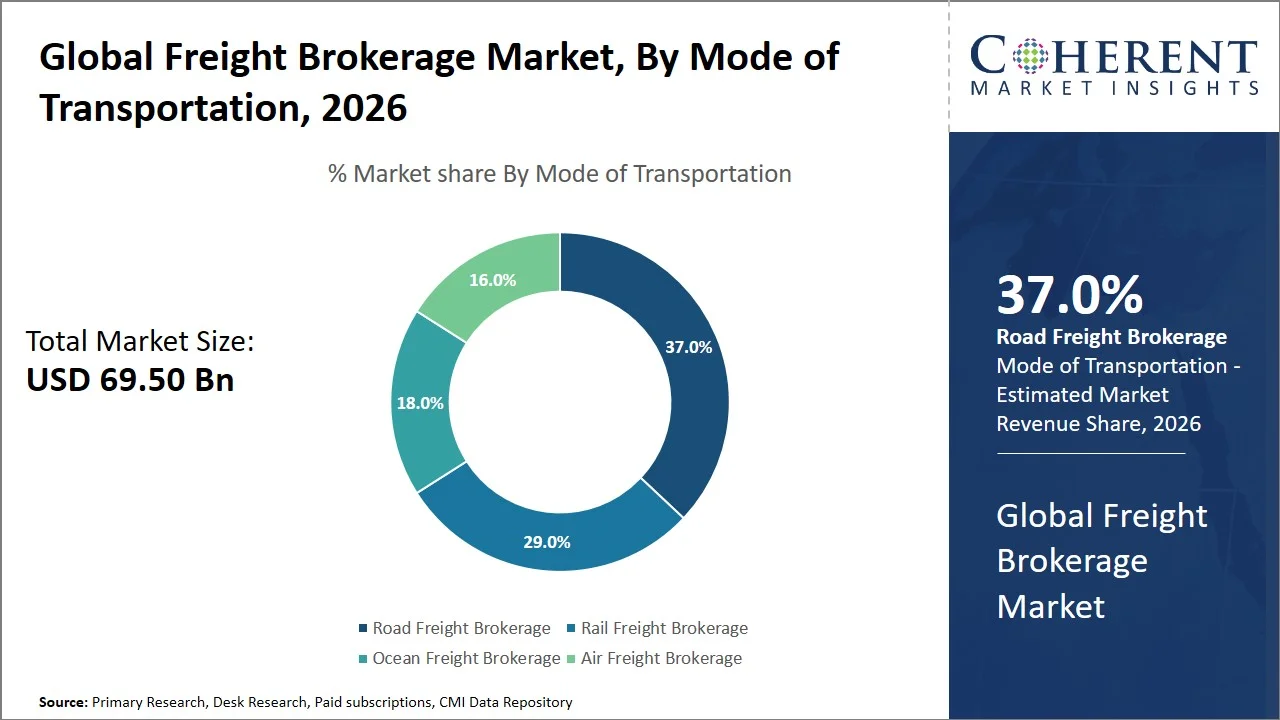
- The road freight brokerage segment is expected to account for 37.0 % of the global freight brokerage market share in 2026. Growing need for real-time shipment visibility and route optimization is driving the growth of the segment. On February 12, 2025, project44, the leader in supply chain visibility, today announced six capabilities to automate and optimize the most resource-intensive supply chain tasks. (Source: project44)
- The spot freight brokerage segment is estimated to capture 41.0 % of the market share in 2026. Increasing demand for flexible and asset-light logistics solutions is majorly driving the growth of the segment. On May 20, 2025, Cambridge Capital announced the combination of existing portfolio company, Everest Transportation Systems, a transportation brokerage focused on dry truckload and drayage moves, with Simple Logistics, a transportation brokerage specializing in service-sensitive refrigerated truckload freight.
- The retail and e-commerce segment is estimated to capture 27.0 % of the market share in 2026. Rising adoption of digital freight matching platforms and AI-enabled brokerage tools is driving the growth of the segment. On August 14, 2025, GoodShip raised USD 25 million in Series B financing to enhance its AI-based freight management and brokerage technology. (Source: GoodShip)
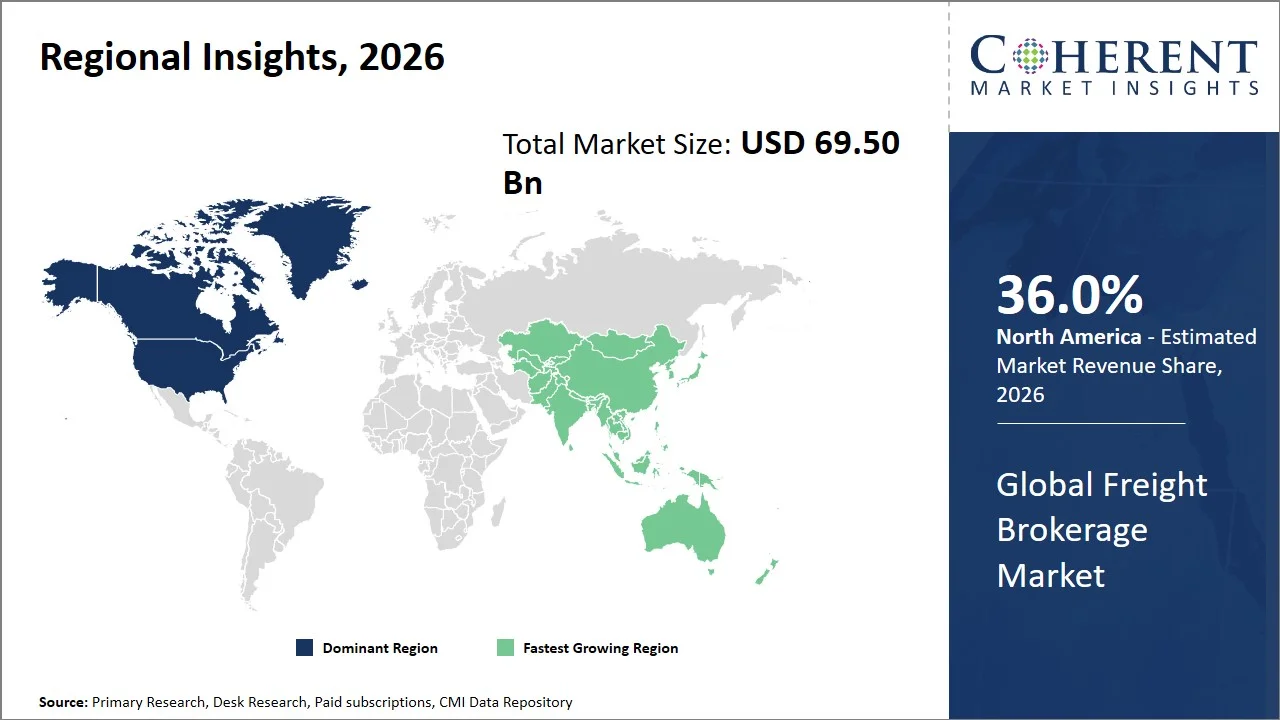
- North America is expected to dominate the freight brokerage market in 2026 with a market share of 36.0 %. Rising demand for multimodal and intermodal transportation solutions in North America is driving the growth of the regional market. On July 31, 2025, BNSF Railway, one of North America’s leading freight transportation providers, in partnership with Patriot Rail and the Utah Inland Port Authority (UIPA), announced the official opening of the Class I railroad’s new intermodal facility in Salt Lake City. (Source: BNSF)
- Asia Pacific is expected to account for 29.0 % share in 2026 and is projected to record the fastest growth over the forecast period. Increasing logistics requirements from emerging economies across Asia Pacific is driving the growth of the regional market. On November 5, 2025, A.P. Moller - Maersk (Maersk) officially opened its largest contract logistics facility in Asia Pacific, the Maersk Mega Distribution Centre (DC), boosting its warehouse footprint by more than 30% in Malaysia. (Source: Maersk)
- Rapid Adoption of Digital Freight Brokerage Platforms: Freight brokerage companies are quickly adopting digital platforms to automate the processes of load matching, carrier selection, pricing, and booking. Such tech-enabled solutions provide operational efficiencies, reduce manual involvement, increase visibility of goods and accelerate transactions between shippers and carriers leading to better supply chain agility.
- Growing Integration of Artificial Intelligence and Predictive Analytics: Artificial intelligence and advanced analytics are now critical for freight brokers to improve route planning, anticipate capacity requirements, predict freight pricing, and enhance decision-making. Organizations have the opportunity to use AI-based technology to optimize resource use, minimize transportation costs and act proactively to market shifts and supply chain
Segmental Insights
Why Does Road Freight Brokerage Dominate the Global Freight Brokerage Market?
The road freight brokerage segment is expected to account for 37.0% of the global freight brokerage market share in 2026. Road freight brokerage dominates, mostly because road transportation has the greatest coverage and the highest flexibility in moving freight. Trucks can deliver directly from manufacturers to distribution centers, merchants and end customers, without the need for further modal transfers, providing an efficient door-to-door service. With such vast accessibility, and the increasing need for e-commerce fulfillment and regional freight transit, road freight is the most popular option for brokers and shippers around the world.
On March 26, 2026, RXO enhanced its RXO Extra marketplace by introducing a premium brokerage experience for trucking carriers. The expansion was aimed at increasing truck capacity participation and improving digital access to road freight opportunities, reflecting continued growth in truck-based brokerage demand. (Source: RXO)
- Current Industry Events of 2026
- Market Size Estimation
- Regional Breakdown
- Competitive Landscape
- Customer Intelligence
- Segmental Analysis
- Pricing Analysis
- Key Market Drivers, Challenges & Future Trends
- Customized Insights Section
Why is Spot Freight Brokerage the Most Preferred Service Type?
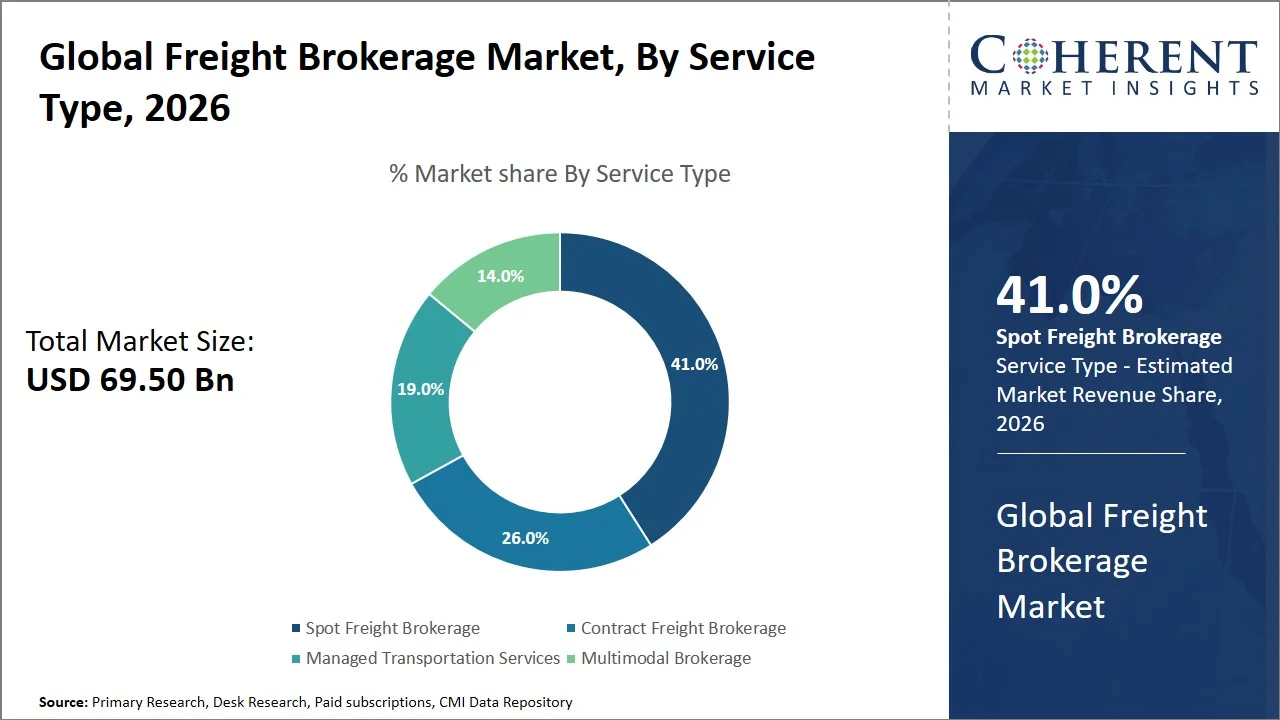
The spot freight brokerage segment is expected to account for 41.0% of the global freight brokerage market share in 2026. Spot freight brokerage allows shippers the greatest flexibility in sourcing transportation capacity, depending on instant market demand and real-time price. This provides companies the ability to adapt to changes in cargo volumes, seasonal peaks in demand, and evolving supply chain requirements without being tied to long-term contractual commitments. On July 30, 2025, DAT acquired the Convoy Platform, empowering brokers and carriers with best in-class automation, intelligent freight matching, and trusted capacity at scale. (Source: Convoy Platform)
Retail and E-commerce Dominates the Global Freight Brokerage Market
The retail and e-commerce segment is expected to account for 27.0% of the global freight brokerage market share in 2026. This growth can be attributed to the industry generating extraordinarily high shipment volumes that need flexible, scalable and time-sensitive transportation services. The rapid growth of online shopping and omnichannel fulfillment is also driving a rapid increase in the demand for efficient freight coordination. Brokerage services are critical to managing large-scale product distribution networks. On April 9, 2024, Cainiao Group, a global leader in e-commerce logistics, announced a rapid expansion of its local express delivery services, now operational in 10 countries and regions worldwide, in addition to its strong presence in Chinese mainland. (Source: Cainiao)
Currents Events and their Impact
Current Events | Description and its Impact |
European Union Electronic Freight Transport Information (eFTI) Regulation - Implementation Acts (2025) |
|
U.S. FMCSA Transparency in Property Broker Transactions Proposal (2024–2026) |
|
(Source: European Commission, Federal Motor Carrier Safety Administration)
Freight Brokerage Market Dynamics
Market Drivers
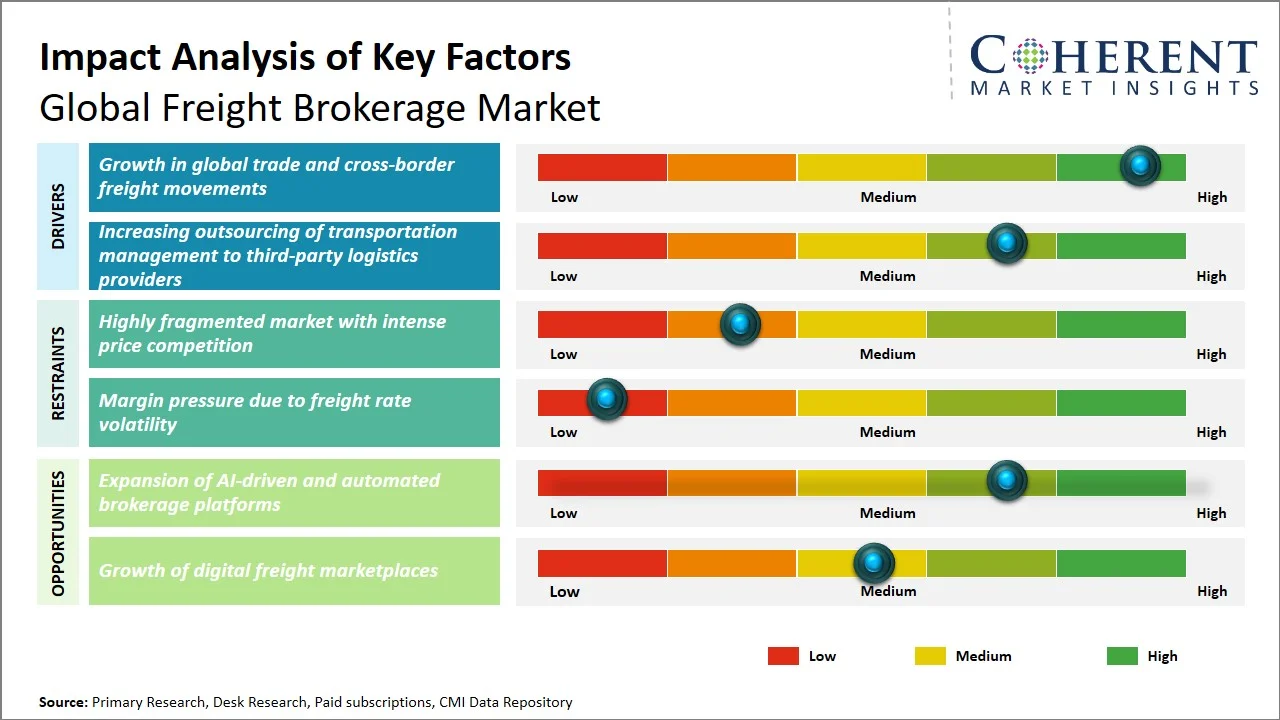
Growth in global trade and cross-border freight movements
The increase in global trade and cross-border freight movements is a significant driver of the freight brokerage market, as the growth of international commerce increases the need for effective transportation coordination and logistics management services. Increasing amounts of commodities are moving between regions and countries, driven by trade agreements, imports and exports, manufacturing in rising economies and the diversification of global supply chains. These complex transportation networks rely on freight brokers to connect shippers to carriers, optimize routes, adhere to regulations, and offer increased visibility into shipments that help to move freight efficiently across global markets.
On June 11, 2025, DHL Group announced plans to invest more than USD 500 million in the Middle East, with a strategic focus on the rapidly expanding Gulf markets of Saudi Arabia (KSA) and the United Arab Emirates (UAE). (Source: DHL)
Increasing outsourcing of transportation management to third-party logistics providers
The increasing outsourcing of transportation management to third-party logistics providers is one of the major factors driving the freight brokerage market. Companies are outsourcing their transportation management to third-party logistics providers to reduce the complexity of their operations and to focus on their core competencies. Logistics service providers have the expertise, carrier networks and technology platforms to help companies improve transportation efficiency, improve shipment visibility, optimize freight costs and provide access to scalable logistics solutions without heavy investment in internal transportation infrastructure. The tendency is especially strong among manufacturers, merchants and e-commerce operators needing flexible and cost-efficient freight management to satisfy changing supply chain requirements.
On December 22, 2025, DHL Supply Chain announced it has been appointed by Siemens Mobility, a leader in intelligent rail transport solutions, in a new multi-year transport contract. Through the contract, DHL will deliver vital rail components to depots across the U.K., supporting the repair, maintenance, and refurbishment of trains. (Source: DHL)
Emerging Trends
- Expansion of Multimodal and Intermodal Transportation Solutions: As firms look for more cost-effective and reliable logistics networks, freight brokers are offering more multimodal transportation solutions, integrating road, rail, air, and ocean freight. Shippers can use this trend to improve transit times, reduce transport costs, boost cargo flexibility and reduce hazards of dependence on a single method of transport.
- Increasing Focus on Sustainability and Green Logistics: Environmental sustainability is emerging as a major concern in the freight transportation industry. Freight brokers are employing route optimization technologies, carbon-emission tracking tools and carrier sustainability programs to help customers reduce their environmental footprint. Companies, consumers and regulators are increasingly demanding greener logistics solutions, forcing the industry to implement these ways more quickly, and to meet corporate ESG commitments.
Regional Insights
Why is North America a Strong Market for Freight Brokerage?
North America is expected to account for a market share of 36.0% in 2026. North America is the most established freight brokerage market with many digital brokers and fully integrated transportation networks in the U.S., Canada, and Mexico. The region has been fast to implement AI-powered freight-matching platforms, with Uber Freight introducing automated pricing and load booking tools, and C.H. Robinson incorporates generative AI methods into their Navisphere shipment management software. The trade deal, USMCA, has also resulted in growth in cross-border freight industry, which, in turn, has created a need for brokerage services that can handle customs, compliance and multimodal transportation needs.
In addition, the development of supply chain technology in the region is also aiding to market growth. On January 15, 2025, FourKites announced the next evolution in supply chain technology with the launch of Intelligent Control Tower. The FourKites Intelligent Control Tower represents an evolution from traditional planning- and reporting-focused control towers, incorporating capabilities developed through ongoing innovation and customer collaboration. (Source: FourKites)
Why Does the Asia Pacific Freight Brokerage Market Exhibit High Growth?
Asia Pacific is projected to account for 29.0% of the global freight brokerage market and is expected to register the fastest growth. The Asia Pacific freight brokerage market is undergoing transformation owing to increasing logistics digitalization and growing regional trade corridors. Countries such as China, India, Vietnam and Indonesia are investing extensively in logistics infrastructure and freight technology systems to support rising industrial exports and e-commerce fulfillment networks. Mobile-enabled brokerage solutions are further increasingly linking shippers to fragmented carrier networks through regional logistics startups and digital freight marketplaces, while initiatives like China’s Belt and Road logistics corridors are spurring international freight flows throughout Asia Pacific. On December 1, 2025, CEVA Logistics, in collaboration with CooperVision Asia Pacific, opened a new Regional Service Center in Singapore, marking a significant milestone in both companies’ commitment to enhance supply chain and logistics capabilities across the Asia Pacific region. (Source: CEVA Logistics)
Global Freight Brokerage Market Outlook for Key Countries
Why is the U.S. Emerging as a Major Hub in the Freight Brokerage Market?
The U.S. freight brokerage sector is heavily reliant on technology and consolidation is on the rise among brokerage firms. Digital brokers like RXO and Uber Freight are using artificial intelligence, real-time pricing engines and predictive analytics to increase load matching and carrier utilization. Meanwhile, federal regulatory efforts by the Federal Motor Carrier Safety Administration (FMCSA) to improve broker transparency and enhance financial responsibility rules are changing how brokers do business and creating a new level of accountability in the brokerage ecosystem.
Is China the Next Growth Engine for the Freight Brokerage Market?
China’s status as a global manufacturing and export powerhouse is giving a boost to its freight brokerage business. Digital logistics systems like Full Truck Alliance have revolutionized freight matching by linking hundreds of thousands of truck drivers and shippers on online markets. Continued development of smart logistics hubs and multimodal transportation corridors under national logistics modernization plans, as well as the continued rise of cross border e-commerce exports, continue to produce large demand for brokerage and freight management services.
Germany Freight Brokerage Market Analysis and Trends
Germany is the logistics gateway to Europe and is the hub of the freight brokerage sector in Europe. The country has a comprehensive road freight network, a resilient industrial base and a strategic location, which makes it easier to move goods across the European Union. The European Union’s Electronic Freight Transport Information (eFTI) framework is gaining momentum to encourage paperless freight documentation and digital information exchange, and German freight brokers are preparing for changes on the horizon, unlocking potential for improved operational efficiency and better visibility across cross-border shipments.
India Freight Brokerage Market Analysis and Trends
Logistics digitization and government-led infrastructure development programs are driving fast transformation in India’s freight brokerage business. The ongoing expansion of Dedicated Freight Corridors, Unified Logistics Interface Platform (ULIP) and National Logistics Policy has improved visibility and coordination of freight movement across the country. Digital freight companies like BlackBuck and Rivigo are embracing technology-led brokerage models to better match transportation operators with shippers, especially in the fast-growing e-commerce and retail sectors.
Canada Freight Brokerage Market Analysis and Trends
The Canadian freight brokerage sector is highly integrated with cross-border trade with the U.S., with a high proportion of freight movements dependent on integrated North American supply chains. Brokers are key to managing shipments along important trade routes connecting Ontario, Quebec, British Columbia and U.S. manufacturing areas. Growing demand is prompting freight brokers to expand their service offerings, to provide greater end-to-end supply chain visibility, and increased investments in port infrastructure, like at the Port of Vancouver, are helping to broaden the scope of intermodal transportation solutions.
Global Freight Brokerage Market - Brokered Freight Volume by Region
Region | Freight Shipments Brokered Annually (Million Units) 2025 | Estimated Freight Shipments Brokered Annually (Million Units) 2026 |
North America | 532 | 562 |
Europe | 412 | 434 |
Asia Pacific | 457 | 489 |
Latin America | 125 | 133 |
Middle East & Africa | 98 | 105 |
Global Freight Brokerage Market - Supply Chain Control Tower Deployments
Region | Estimated Control Tower Deployments (2025) |
North America | 2,050 |
Europe | 1,420 |
Asia Pacific | 1,280 |
Latin America | 340 |
Middle East & Africa | 170 |
Global Freight Brokerage Market - AI-Based Load Matching Deployments
Region | Estimated AI-Based Load Matching Deployments (2025) Share of Global |
North America | 3,850 |
Europe | 2,050 |
Asia Pacific | 1,950 |
Latin America | 540 |
Middle East & Africa | 360 |
How is the Expansion of AI-Driven and Automated Brokerage Platforms Creating New Growth Opportunities in the Freight Brokerage Market?
The freight brokerage sector is poised for significant expansion with the emergence of AI-powered and automated brokerage systems. These systems enhance the speed, accuracy and effectiveness of freight matching, pricing and transportation management processes. Brokers can use modern technologies such as artificial intelligence, machine learning, predictive analytics and robotic process automation to automate load sourcing, enhance route selection, anticipate capacity availability and provide real-time shipment visibility. These features can minimize operating expenses, reduce empty miles, increase carrier utilization and improve customer service levels. With shippers increasingly demanding faster, more transparent logistics solutions, freight brokers are using AI-powered brokerage platforms to scale their operations, handle larger transaction volumes and deliver value-added services that make them more competitive and fuel market expansion.
On January 26, 2026, C.H. Robinson, the global leader in Lean AI supply chains, announced that it is using artificial intelligence to ease a widespread pain point in less-than-truckload shipping: missed pickups. New AI agents are tracking down missed pickups and using advanced reasoning to determine how to keep freight moving. (Source: C.H. Robinson)
Market Players, Key Development, and Competitive Intelligence
Key Developments
- On May 21, 2025, Uber Freight announced the launch of the industry’s first scaled AI logistics network, powered by its proprietary logistics-specific large language model (LLM) and embedded directly into its transportation management system (TMS) and logistics platform. With this launch, Uber Freight is reimagining how shippers of all sizes manage transportation, placing AI at the center to drive better decisions, faster execution, and stronger performance.
- On April 16, 2025, H. Robinson announced it has performed over 3 million shipping tasks with its fleet of generative AI agents, proprietary tech tools the global logistics provider has built to automate steps across the lifecycle of a shipment and reduce customers’ speed-to-market from hours to seconds.
Competitive Landscape
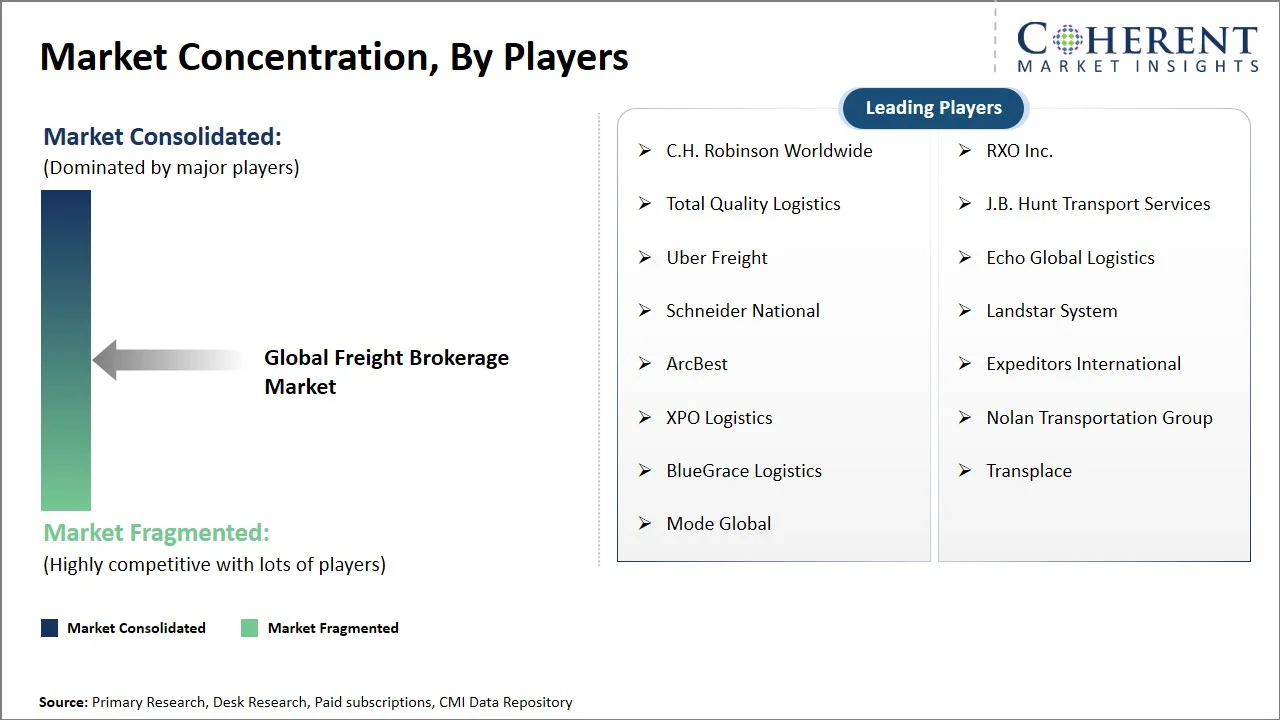
The worldwide freight brokerage business is marked by fierce competition among traditional logistics providers, asset-light brokerage firms and new-age digital freight platforms. To improve their market positions, industry players are increasingly turning to technology investments, strategic acquisitions, carrier network development and service diversification. Companies like C.H. Robinson, RXO, Total Quality Logistics, Uber Freight, Echo Global Logistics and J.B. Hunt are deploying state-of-the art transportation management systems, artificial intelligence and real-time visibility solutions to improve operational efficiency and customer experience. The emergence of digital freight markets that speed up load matching and automate transaction processing is also influencing the competitive landscape.
Market Report Scope
Freight Brokerage Market Report Coverage
| Report Coverage | Details | ||
|---|---|---|---|
| Base Year: | 2025 | Market Size in 2026: | USD 69.50 Bn |
| Historical Data for: | 2020 To 2024 | Forecast Period: | 2026 To 2033 |
| Forecast Period 2026 to 2033 CAGR: | 6% | 2033 Value Projection: | USD 104 Bn |
| Geographies covered: |
| ||
| Segments covered: |
| ||
| Companies covered: | C.H. Robinson Worldwide, RXO Inc., Total Quality Logistics, J.B. Hunt Transport Services, Uber Freight, Echo Global Logistics, Schneider National, Landstar System, ArcBest, Expeditors International, XPO Logistics, Nolan Transportation Group, BlueGrace Logistics, Transplace, and Mode Global | ||
| Growth Drivers: |
| ||
| Restraints & Challenges: |
| ||
Analyst Opinion (Expert Opinion)
- The freight brokerage market is undergoing a prolonged shift driven by increasing supply chain complexity, expanding transportation outsourcing and the rapid digitization of logistics operations. Increased attention is being paid to automation, predictive analytics and real-time visibility of freight to increase operational performance and profitability. Technological capabilities, strength of carrier networks and ability to provide integrated transport solutions will progressively drive competitive advantage. Market consolidation is also expected as industry players will also look for size, efficiency and digital competence.
- Further advancements in artificial intelligence, digital freight matching and multimodal transportation management will influence the future of the freight brokerage industry. As cross-border trading activity and e-commerce fulfilment needs grow, and significant investments are made in logistics infrastructure, new possibilities are expected to arise for brokerage service providers. There is likely to be an increase in the use of cloud-based transportation platforms, automated pricing systems and sustainability-focused logistics solutions, which will aid the long-term sector development. Moreover, the use of data analytics and intelligent decision-making technology is expected to improve the efficiency of freight networks and strengthen the resilience of the entire supply chain.
Speak to the analyst
Want personalized insights?
Take the findings above to one of our principal consultants, or have the report rebuilt around the segments, geographies and competitors you actually track.
Market Segmentation
- Mode of Transportation Insights (Revenue, USD Billion, 2021 - 2033)
- Road Freight Brokerage
- Rail Freight Brokerage
- Ocean Freight Brokerage
- Air Freight Brokerage
- Service Type Insights (Revenue, USD Billion, 2021 - 2033)
- Spot Freight Brokerage
- Contract Freight Brokerage
- Managed Transportation Services
- Multimodal Brokerage
- End User Insights (Revenue, USD Billion, 2021 - 2033)
- Retail and E-commerce
- Manufacturing
- Automotive
- Healthcare and Pharmaceuticals
- Food and Beverage
- Chemicals
- Regional Insights (Revenue, USD Billion, 2021 - 2033)
- North America
- U.S.
- Canada
- Latin America
- Brazil
- Argentina
- Mexico
- Rest of Latin America
- Europe
- Germany
- U.K.
- Spain
- France
- Italy
- Russia
- Rest of Europe
- Asia Pacific
- China
- India
- Japan
- Australia
- South Korea
- ASEAN
- Rest of Asia Pacific
- Middle East
- GCC Countries
- Israel
- Rest of Middle East
- Africa
- South Africa
- North Africa
- Central Africa
- North America
- Key Players Insights
- H. Robinson Worldwide
- RXO Inc.
- Total Quality Logistics
- B. Hunt Transport Services
- Uber Freight
- Echo Global Logistics
- Schneider National
- Landstar System
- ArcBest
- Expeditors International
- XPO Logistics
- Nolan Transportation Group
- BlueGrace Logistics
- Transplace
- Mode Global
Sources
Primary Research Interviews
- Chief Executive Officers (CEOs) of Freight Brokerage and 3PL Companies
- Chief Operating Officers (COOs) and Logistics Directors
- Transportation Managers and Supply Chain Managers
- Freight Brokers and Carrier Network Managers
Magazines
- FreightWaves - Freight market intelligence and brokerage trends
- Transport Topics
- Journal of Commerce (JOC)
- Inbound Logistics
- Logistics Management
Journals
- Transportation Journal
- Journal of Business Logistics
- International Journal of Physical Distribution & Logistics Management
- Transportation Research Part E: Logistics and Transportation Review
Associations
- Transportation Intermediaries Association (TIA)
- Council of Supply Chain Management Professionals (CSCMP)
- International Air Transport Association (IATA)
Public Domain Sources
- U.S. Department of Transportation (USDOT)
- Federal Motor Carrier Safety Administration (FMCSA)
- U.S. Bureau of Transportation Statistics (BTS)
- U.S. Census Bureau Foreign Trade Statistics
Proprietary Elements
- CMI Data Analytics Tool
- Proprietary CMI Existing Repository of information for last 10 years
Get access to 250+ pages report
Every segment, forecast, competitor profile and data table behind the analysis above — available for instant download.
- ESOMAR Member
- ISO 9001:2015 Certified
- D-U-N-S Registered
- GDPR & CCPA Compliant
Missing comfort of reading report in your local language? Find your preferred language:
Transform your Strategy with Exclusive Trending Reports
Frequently Asked Questions
The global freight brokerage market is expected to stand at USD 69.50 Bn in 2026 and is expected to reach USD 104 Bn by 2033.
The CAGR of the global freight brokerage market is projected to be 6% from 2026 to 2033.
Growth in global trade and cross-border freight movements and increasing outsourcing of transportation management to third-party logistics providers are the major factors driving the growth of the global freight brokerage market.
Highly fragmented market with intense price competition and margin pressure due to freight rate volatility are the major factors hampering the growth of the global freight brokerage market.
In terms of mode of transportation, the road freight brokerage segment is estimated to dominate the market revenue share in 2026.
Freight brokerage helps shippers access carrier networks, reduce transportation costs, and improve delivery efficiency.
E-commerce is increasing demand for fast, scalable, and flexible freight transportation solutions.