

GCC and Saudi Arabia Clot Management Devices Market Size and Forecast – 2026 To 2033
The GCC and Saudi Arabia clot management devices market is expected to grow from USD 49.6 Mn in 2026 to USD 82.8 Mn by 2033, registering a compound annual growth rate (CAGR) of 7.6% from 2026 to 2033. The market is experiencing a significant growth, fueled by the soaring burden of cardiovascular diseases and thromboembolic disorders.
Saudi Arabia has a high prevalence of cardiovascular risk factors, particularly obesity and diabetes. According to the Saudi Ministry of Health, the obesity rate in Saudi Arabia among adults (18 and above) reached 20.2%, while 38.2% of adults are overweight reinforcing the need for timely diagnosis and treatment of clot-related conditions.
(Source: Ministry of Health)
Key Takeaways of the GCC and Saudi Arabia Clot Management Devices Market
- Percutaneous thrombectomy devices are projected to hold a market share of 36.9 % of the GCC and Saudi Arabia clot management devices market share in 2026, making it the dominant product segment, owing to their minimally invasive approach, shorter recovery time, and high procedural success rates. The segment continues to benefit from the increasing adoption of endovascular therapies for acute ischemic stroke and peripheral vascular occlusions. For instance, the Saudi Stroke Society recommends mechanical thrombectomy as the standard of care for eligible patients with acute ischemic stroke, supporting the adoption of advanced thrombectomy devices across stroke centers.
- Venous thromboembolism (VTE) is projected to hold a market share of 41.5 % of the GCC and Saudi Arabia clot management devices market share in 2026, making it the dominant application segment, driven by the rising prevalence of cardiovascular diseases, obesity, and prolonged hospitalization. The segment continues to benefit from increasing emphasis on early diagnosis and evidence-based thrombosis management. For instance, the Saudi Heart Association published national Clinical Practice Guidelines for Venous Thromboembolism, recommending routine VTE risk assessment and thromboprophylaxis for hospitalized patients, supporting the demand for clot management technologies.
- Hospitals are projected to hold a market share of 54.7 % of the GCC and Saudi Arabia clot management devices market share in 2026, making it the dominant end user segment, owing to the availability of advanced catheterization laboratories, hybrid operating rooms, and specialized vascular care services. The segment continues to benefit from increasing investments in tertiary healthcare infrastructure. For instance, the Saudi Ministry of Health continues to expand the Comprehensive Stroke Center network across the Kingdom to improve timely access to advanced stroke interventions, including mechanical thrombectomy.
- Expansion of Mechanical Thrombectomy in Acute Ischemic Stroke Care: The increasing establishment of comprehensive stroke centers across Saudi Arabia and the GCC is accelerating the adoption of mechanical thrombectomy as the standard of care for eligible acute ischemic stroke Growing investments in neurointerventional infrastructure and 24/7 stroke services are expected to create significant demand for advanced clot retrieval and aspiration thrombectomy devices.
- Rising Adoption of Catheter-Directed Therapies for Venous Thromboembolism (VTE): Healthcare providers across the GCC are increasingly adopting catheter-directed thrombolysis and mechanical thrombectomy for the treatment of deep vein thrombosis (DVT) and pulmonary embolism (PE), driven by improved clinical outcomes and reduced bleeding risks compared to systemic thrombolysis. This shift toward minimally invasive vascular interventions presents substantial growth opportunities for clot management device
Segmental Insights
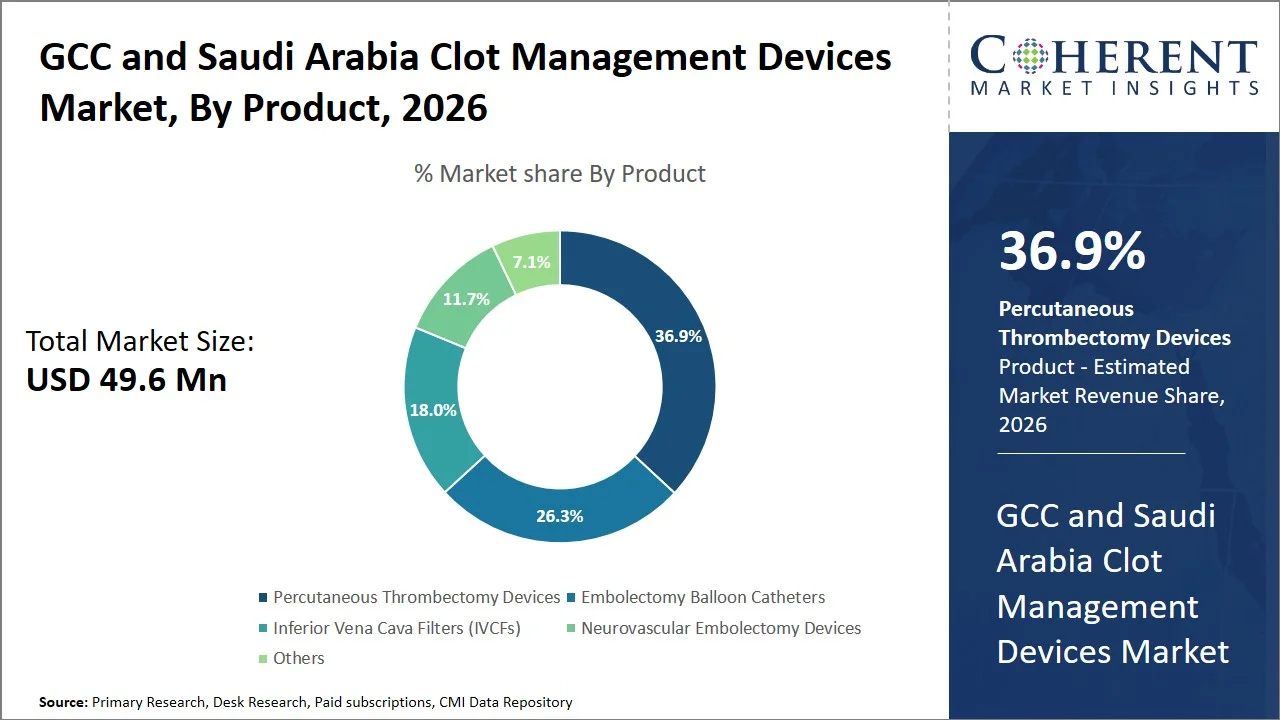
Why Do Percutaneous Thrombectomy Devices Dominate the GCC and Saudi Arabia Clot Management Devices Market?
Percutaneous thrombectomy devices are projected to hold a market share of 36.9% in 2026, owing to their minimally invasive nature, ability to rapidly clear clots, and the increasing adoption over open surgeries. The demand for this segment is on an upswing with the increasing treatment of acute ischemic stroke, deep vein thrombosis, and pulmonary embolism. The percutaneous thrombectomy devices segment can be further bifurcated into aspiration and mechanical devices, as these technologies are used for fast removal of blood clots. For instance, the Department of Health - Abu Dhabi has updated its Acute Stroke Management Standard (Version 2) with effect June 2025 which guides stroke centers in providing timely access to evidence-based reperfusion therapies, such as mechanical thrombectomy. The new standard would be likely to accelerate advanced thrombectomy device adoption in the GCC region.
- Current Industry Events of 2026
- Market Size Estimation
- Regional Breakdown
- Competitive Landscape
- Customer Intelligence
- Segmental Analysis
- Pricing Analysis
- Key Market Drivers, Challenges & Future Trends
- Customized Insights Section
Why is Venous thromboembolism (VTE) the Most Preferred Application in GCC and Saudi Arabia Clot Management Devices Market?
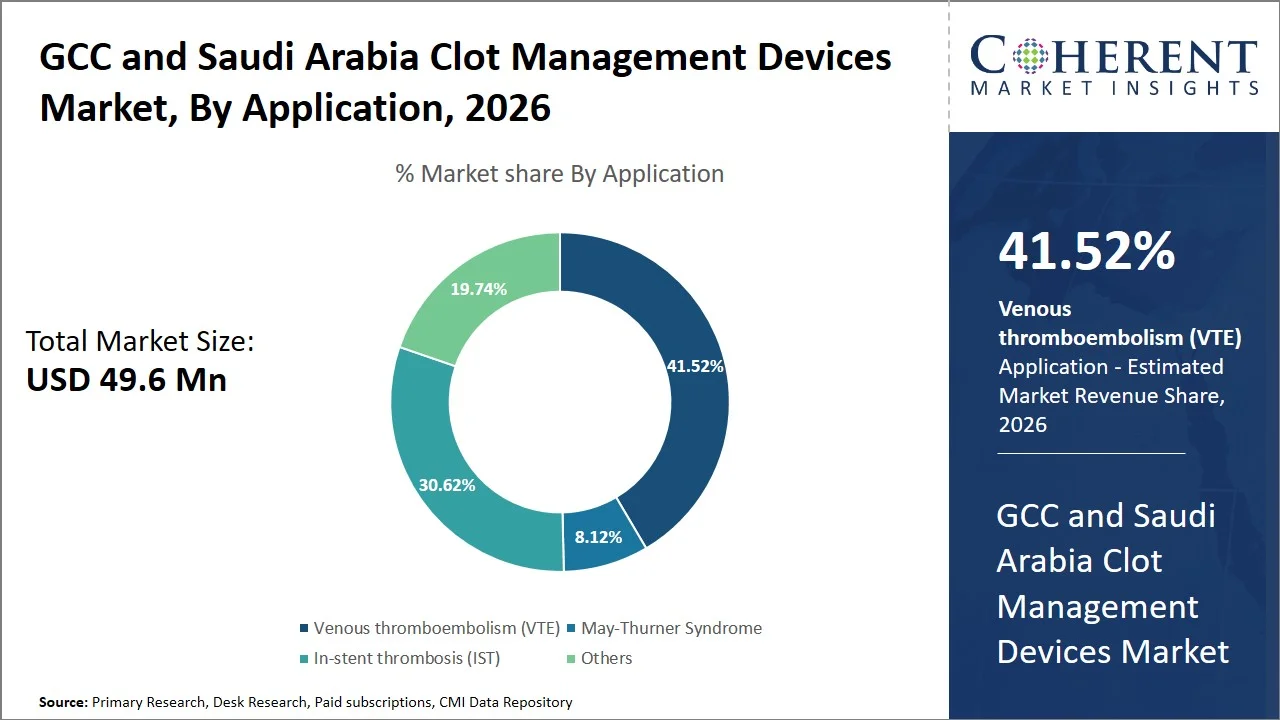
Venous thromboembolism (VTE) is projected to hold a market share of 41.5% in 2026, owing to its high prevalence of deep vein thrombosis (DVT) and pulmonary embolism (PE) especially among hospitalized patients and high-risk populations. In addition to this, heightened consciousness pertaining to timely diagnoses and development of catheter-based interventions are also fueling market growth. For instance, in January 2025, a study published by the Journal of Comparative Medicine Research Reviews and Reports, evaluated 33,237 hospitalized patients and demonstrated that continuous venous thromboembolism monitoring, risk assessment, and prophylaxis significantly improved patient outcomes, highlighting the growing clinical focus on venous thromboembolism (VTE) management in Saudi Arabia.
Hospitals Dominate the GCC and Saudi Arabia Clot Management Devices Market
The hospitals segment is projected to hold a market share of 54.7% in 2026, owing to the robust availability of sophisticated catheterization laboratories, hybrid operating rooms and experienced multidisciplinary team which perform complicated endovascular procedures. Rising hospital admission cases of acute ischemic stroke, deep vein thrombosis (DVT), and pulmonary embolism (PE) are further boosting the penetration of clot management devices in tertiary care hospitals. For instance, in August 2025, Cleveland Clinic Abu Dhabi introduced Artisse Intrasaccular Flow Modulator, the first of its kind in the MENA region. It is a minimally invasive endovascular implant for the treatment of wide-necked intracranial aneurysms and marks the region’s growth of adopting sophisticated neurovascular techniques as well as hospitals expanding its advanced endovascular techniques and infrastructure. (Source: Cleveland Clinic)
Currents Events and their Impact
Current Events | Description and its Impact |
Saudi Food and Drug Authority (SFDA) Strengthens Regulation of Medical Device Clinical Studies (July 2025) |
|
American Heart Association & Department of Health – Abu Dhabi Expand Regional Stroke Care Collaboration (March 2025) |
|
GCC and Saudi Arabia Clot Management Devices Market Dynamics
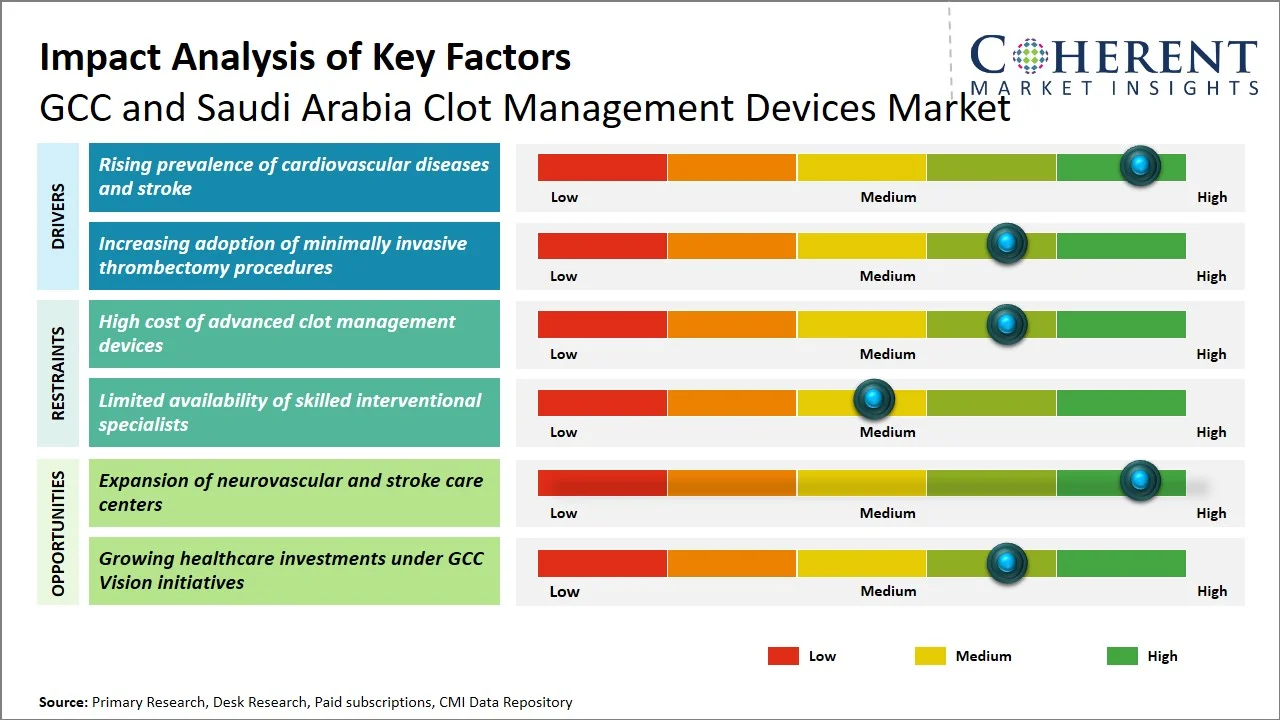
Market Drivers
- Rising prevalence of cardiovascular diseases and stroke: Increasing prevalence of cardiovascular diseases, obesity, diabetes and hypertension across the GCC and Saudi Arabia is stimulating the requirement of innovative clot management devices. Increasing load of acute ischemic stroke, and several other thromboembolic disorders are the leading cause of increased uptake of minimally invasive thrombectomy devices and catheter-based interventions. For instance, according to the Saudi Ministry of Health, cardiovascular diseases account for over 45.7% of all deaths in the Kingdom, underscoring the need for effective clot management technologies.
- Increasing adoption of minimally invasive thrombectomy procedures: The growing inclination towards minimally invasive thrombectomy procedures prompts higher uptake of enhanced clot management devices in the GCC and Saudi Arabia catheter-based thrombectomy. Compared with conventional surgery, catheter-based thrombectomy enables faster reperfusion, shorter hospital stays, and improved clinical outcomes for patients with acute ischemic stroke and venous thromboembolism. For instance, Saudi Arabia has implemented dedicated Stroke Readiness Standards that emphasize rapid patient triage and timely access to reperfusion therapies, including mechanical thrombectomy, to improve stroke outcomes nationwide.
Emerging Trends
- Growing Adoption of Aspiration-Based Mechanical Thrombectomy Systems: The aspiration-based mechanical thrombectomy system is getting popular among the healthcare providers of the GCC region. It offers efficient clot removal in a less-invasive way to the patients. Technical developments have taken place on both the imaging guidance and aspiration catheters which are enabling an efficient procedure time to removal of blood clot in patient’s brain or arteries.
- Integration of AI and Advanced Imaging in Stroke Intervention: AI combined with state-of-the-art CT and angiography imaging helps to speed up detection and selection of patients who have an acute ischemic stroke. It may facilitate quicker identification and access of eligible stroke patients to mechanical thrombectomy. This also assists in hastening device utilization among full-service stroke centers in cases of stroke with mechanical thrombectomy treatment.
Clinical Applications Driving the GCC and Saudi Arabia Clot Management Devices Market
Clinical Condition | Primary Treatment Approach | Key Clot Management Devices | Impact on Market |
Acute Ischemic Stroke | Mechanical thrombectomy | Stent retrievers, aspiration thrombectomy systems | Largest driver of neurovascular clot management device adoption due to increasing stroke intervention capabilities. |
Deep Vein Thrombosis (DVT) | Catheter-directed thrombectomy & thrombolysis | Aspiration catheters, thrombectomy systems, thrombolysis catheters | Rising prevalence of VTE and preference for minimally invasive therapies are accelerating demand. |
Pulmonary Embolism (PE) | Mechanical thrombectomy & catheter-directed thrombolysis | Aspiration thrombectomy systems, thrombectomy catheters | Increasing adoption of catheter-based interventions for high-risk PE supports market growth. |
Peripheral Arterial Occlusion | Endovascular thrombectomy | Rotational thrombectomy devices, aspiration catheters | Growing use of minimally invasive peripheral vascular procedures is driving device utilization. |
Dialysis Access Thrombosis | Percutaneous thrombectomy | Mechanical thrombectomy devices, aspiration catheters | Rising dialysis population and vascular access maintenance procedures create niche growth opportunities. |
How is the expansion of neurovascular and stroke care centers creating new growth opportunities in the GCC and Saudi Arabia clot management devices market?
The expansion of dedicated neurovascular and stroke care centers across GCC and Saudi Arabia offers enormous opportunity for utilization of cutting-edge clot management devices. These will lead to greater opportunities for the uptake of innovative clot retrieval and thrombectomy devices, with increasing investment into full stroke care facilities that are raising the profile and adoption rates for mechanical thrombectomy and other minimally invasive procedures. For instance, in January 2026, the American Heart Association awarded King Faisal Specialist Hospital & Research Centre (KFSHRC) Comprehensive Stroke Center Certification, underscoring the hospital’s advanced stroke intervention capabilities, which will fuel the demand for revolutionary new clot management solutions.
Market Players, Key Development, and Competitive Landscape
Key Developments
- In June 2025, Saudi Arabia introduced its first Mobile Stroke Unit during the Hajj season in Makkah to enable rapid diagnosis and treatment of acute stroke patients. The initiative strengthens pre-hospital stroke management and is expected to increase timely referrals for mechanical thrombectomy, supporting the demand for advanced clot management devices.
- In May 2024, Bayer AG expanded its partnership with Huma by launching a digital heart risk assessment platform in Saudi Arabia, supporting the Kingdom's Vision 2030 healthcare transformation. The initiative enhances early cardiovascular risk identification and preventive care, strengthening stroke prevention pathways and supporting long-term demand for interventional clot management services.
Competitive Landscape
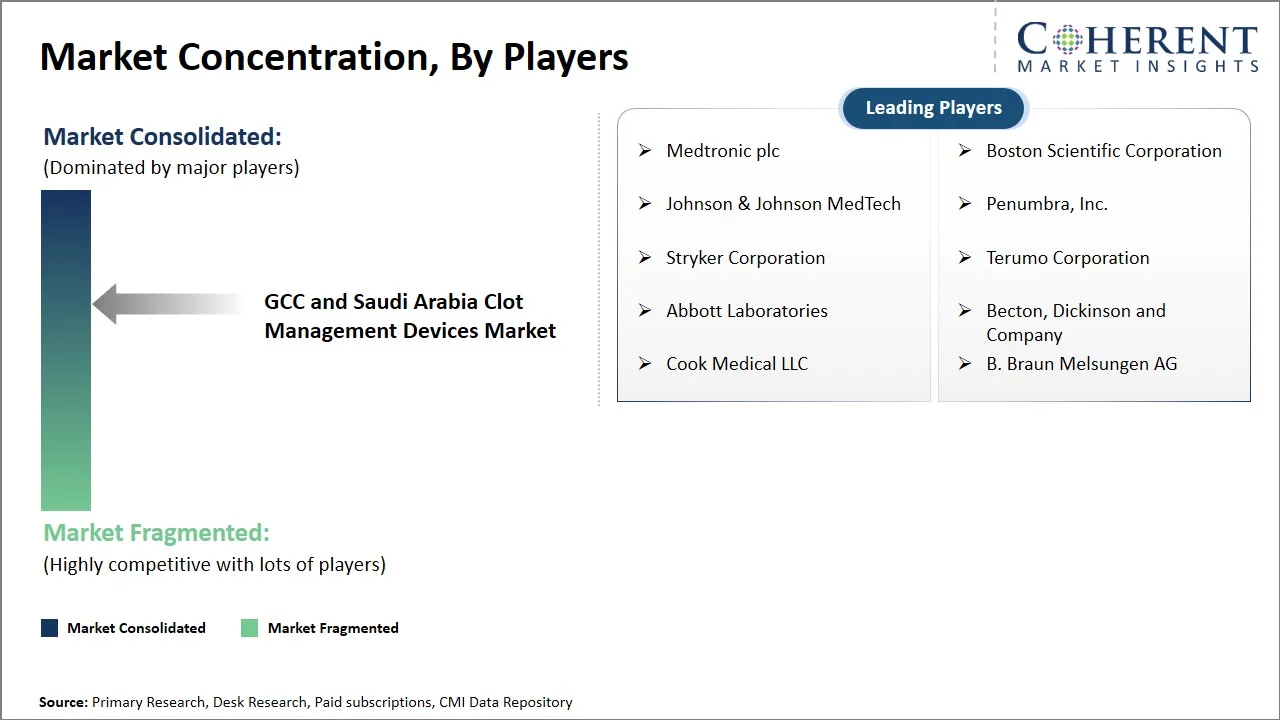
The GCC and Saudi Arabia clot management devices market is moderately to highly competitive, characterized by the presence of leading global medical device manufacturers offering advanced thrombectomy systems, aspiration catheters, stent retrievers, and catheter-directed thrombolysis technologies. Market participants are strengthening their regional footprint through distributor partnerships, product portfolio expansion, and collaborations with hospitals to support the growing demand for minimally invasive stroke and vascular interventions. The competitive landscape is further shaped by increasing investments in innovation, physician training, and expansion of neurovascular and peripheral vascular care services. Key focus areas include:
- Expansion of mechanical thrombectomy and aspiration thrombectomy product portfolios
- Strategic collaborations with hospitals, distributors, and stroke care centers to strengthen regional presence
- Investment in physician training and minimally invasive neurovascular and peripheral vascular intervention technologies
Market Report Scope
GCC and Saudi Arabia Clot Management Devices Market Report Coverage
| Report Coverage | Details | ||
|---|---|---|---|
| Base Year: | 2025 | Market Size in 2026: | USD 49.6 Mn |
| Historical Data for: | 2020 To 2024 | Forecast Period: | 2026 To 2033 |
| Forecast Period 2026 to 2033 CAGR: | 7.6% | 2033 Value Projection: | USD 82.8 Mn |
| Geographies covered: |
| ||
| Segments covered: |
| ||
| Companies covered: | Medtronic plc, Boston Scientific Corporation, Johnson & Johnson MedTech, Penumbra, Inc., Stryker Corporation, Terumo Corporation, Abbott Laboratories, Becton, Dickinson and Company, Cook Medical LLC, and B. Braun Melsungen AG | ||
| Growth Drivers: |
| ||
| Restraints & Challenges: |
| ||
Analyst Opinion (Expert Opinion)
- In the coming years, GCC and Saudi Arabia clot management devices market is expected to witness sustained growth, supported by rising stroke and venous thromboembolism (VTE) cases, expanding neurovascular care infrastructure, and increasing adoption of minimally invasive endovascular procedures. The market is likely to shift toward advanced aspiration and mechanical thrombectomy technologies as hospitals enhance acute stroke and vascular intervention capabilities.
- The most promising opportunity are expected within mechanical thrombectomy devices for acute ischemic stroke treatment in Saudi Arabia, driven by the expansion of comprehensive stroke centers, increasing availability of neurointerventional specialists, and continued healthcare investments under Vision 2030. VTE management through catheter-directed therapies also presents significant potential across the GCC.
- In order to gain an edge, market players should focus on strengthening partnerships with leading hospitals and regional distributors, investing in physician training for thrombectomy procedures, and introducing next-generation minimally invasive clot management technologies. Local regulatory engagement and post-market clinical support will further enhance market penetration and long-term competitiveness.
Speak to the analyst
Want personalized insights?
Take the findings above to one of our principal consultants, or have the report rebuilt around the segments, geographies and competitors you actually track.
Market Segmentation
- Product Insights (Revenue, USD Mn, 2021 - 2033)
- Percutaneous Thrombectomy Devices
- Embolectomy Balloon Catheters
- Inferior Vena Cava Filters (IVCFs)
- Neurovascular Embolectomy Devices
- Others
- Application Insights (Revenue, USD Mn, 2021 - 2033)
- Venous thromboembolism (VTE)
- May-Thurner Syndrome
- In-stent thrombosis (IST)
- Others
- End User Insights (Revenue, USD Mn, 2021 - 2033)
- Hospitals
- Ambulatory Surgery Centers
- Specialty Clinics
- Others
- Country Insights (Revenue, USD Mn, 2021 - 2033)
- UAE
- Saudi Arabia
- Bahrain
- Kuwait
- Oman
- Qatar
- Key Players Insights
- Medtronic plc
- Boston Scientific Corporation
- Johnson & Johnson MedTech
- Penumbra, Inc.
- Stryker Corporation
- Terumo Corporation
- Abbott Laboratories
- Becton, Dickinson and Company
- Cook Medical LLC
- Braun Melsungen AG
Sources
Primary Research Interviews
- Head of Interventional Radiology / Neurointervention (Saudi tertiary care hospital)
- Vascular Surgeon / Interventional Cardiologist (GCC multispecialty hospital)
- Procurement Head (Government & private hospitals in Saudi Arabia)
- Regulatory Affairs Specialist (Saudi Food and Drug Authority - SFDA)
- Regional Sales Director (Clot management device manufacturer – GCC)
- Clinical Application Specialist (Mechanical thrombectomy & vascular intervention devices)
Stakeholders
- Clot Management Device Manufacturers (Global OEMs & regional offices)
- Medical Device Distributors (Saudi Arabia & GCC)
- Interventional Cardiology & Neurovascular Centers
- Hospital Procurement & Group Purchasing Organizations (GPOs)
- Regulatory Authorities (SFDA & GCC Health Council)
- Catheterization Laboratory (Cath Lab) Service Providers
- End-use Sectors
- Hospitals & Multi-specialty Healthcare Networks
- Cardiac & Vascular Care Centers
- Stroke & Neurointervention Centers
- Ambulatory Surgical Centers (ASCs)
- Diagnostic & Imaging Centers
- Academic Medical Centers & Research Institutes
- Regulatory & Health Bodies
- Saudi Food and Drug Authority (SFDA), Saudi Arabia
- Ministry of Health (MOH), Saudi Arabia
- Gulf Health Council (GHC)
- Dubai Health Authority (DHA), UAE
- Department of Health – Abu Dhabi (DoH), UAE
- Ministry of Health and Prevention (MOHAP), UAE
- Qatar Ministry of Public Health (MOPH)
- Oman Ministry of Health
- Bahrain National Health Regulatory Authority (NHRA)
Databases
- Saudi Food and Drug Authority (SFDA) – Medical device registrations & approvals
- Ministry of Health (Saudi Arabia) – Health statistics & cardiovascular disease burden
- Gulf Health Council – Regional healthcare statistics
- World Health Organization (WHO) – Cardiovascular disease & stroke data
- Institute for Health Metrics and Evaluation (IHME) – Stroke & VTE epidemiology
- OECD Health Statistics – Healthcare infrastructure benchmarking
Magazines
- Medical Buyer
- MedTech Dive
- NeuroNews International
- Cardiovascular News
- Medical Device Network
- Gulf Medical Journal
Journals
- Journal of NeuroInterventional Surgery
- Journal of Vascular Surgery
- Journal of Endovascular Therapy
- European Stroke Journal
Newspapers
- Arab News (Saudi healthcare, medical technology & Vision 2030 developments)
- Saudi Gazette (Healthcare policy, hospital infrastructure & medical device updates)
- Zawya (GCC healthcare investments, medtech partnerships & M&A)
- The National (UAE) (Regional healthcare and medical technology coverage)
- Gulf News (GCC healthcare, hospitals & medical device industry updates)
Associations
- Saudi Stroke Society
- Saudi Heart Association (SHA)
- Gulf Heart Association (GHA)
- World Stroke Organization (WSO)
- Society of Vascular and Interventional Neurology (SVIN)
- Society of Interventional Radiology (SIR)
Public Domain Sources
- Saudi Ministry of Health Statistical Yearbooks
- Saudi Food and Drug Authority (SFDA) Medical Device Database
- Gulf Health Council Reports
- World Health Organization (WHO) Global Health Observatory
- Institute for Health Metrics and Evaluation (IHME)
- World Bank Health Indicators
Proprietary Elements
- CMI Data Analytics Tool, Proprietary CMI Existing Repository of information for last 10 years.
Get access to 250+ pages report
Every segment, forecast, competitor profile and data table behind the analysis above — available for instant download.
- ESOMAR Member
- ISO 9001:2015 Certified
- D-U-N-S Registered
- GDPR & CCPA Compliant
Missing comfort of reading report in your local language? Find your preferred language:
Transform your Strategy with Exclusive Trending Reports
Frequently Asked Questions
The GCC and Saudi Arabia Clot Management Devices market is estimated to be valued at USD 49.6 Mn in 2026 and is expected to reach USD 82.8 Mn by 2033.
Percutaneous thrombectomy devices dominate due to their high clinical efficacy, minimally invasive approach, and increasing adoption for the treatment of acute ischemic stroke, deep vein thrombosis (DVT), and pulmonary embolism (PE).
Clot management devices are specialized medical devices used to diagnose, remove, dissolve, or prevent blood clots in arteries and veins.
The CAGR of the GCC and Saudi Arabia clot management devices market is projected to be 7.6% from 2026 to 2033.
Mechanical thrombectomy offers faster clot removal, reduced procedural invasiveness, shorter recovery time, and improved patient outcomes compared to open surgery.
Venous thromboembolism (VTE), including deep vein thrombosis and pulmonary embolism, is expected to remain the leading application due to its rising incidence and growing adoption of catheter-based interventions.
Rising prevalence of cardiovascular diseases and stroke, and increasing adoption of minimally invasive thrombectomy procedures are the major factors driving the growth of the GCC and Saudi Arabia clot management devices market.