

Global Acoustic Insulation Market Size and Forecast — 2026-2033
Global acoustic insulation market is estimated to be valued at USD 18.20 Bn in 2026 and is expected to reach USD 24.77 Bn by 2033, exhibiting a compound annual growth rate (CAGR) of 4.5% from 2026 to 2033.
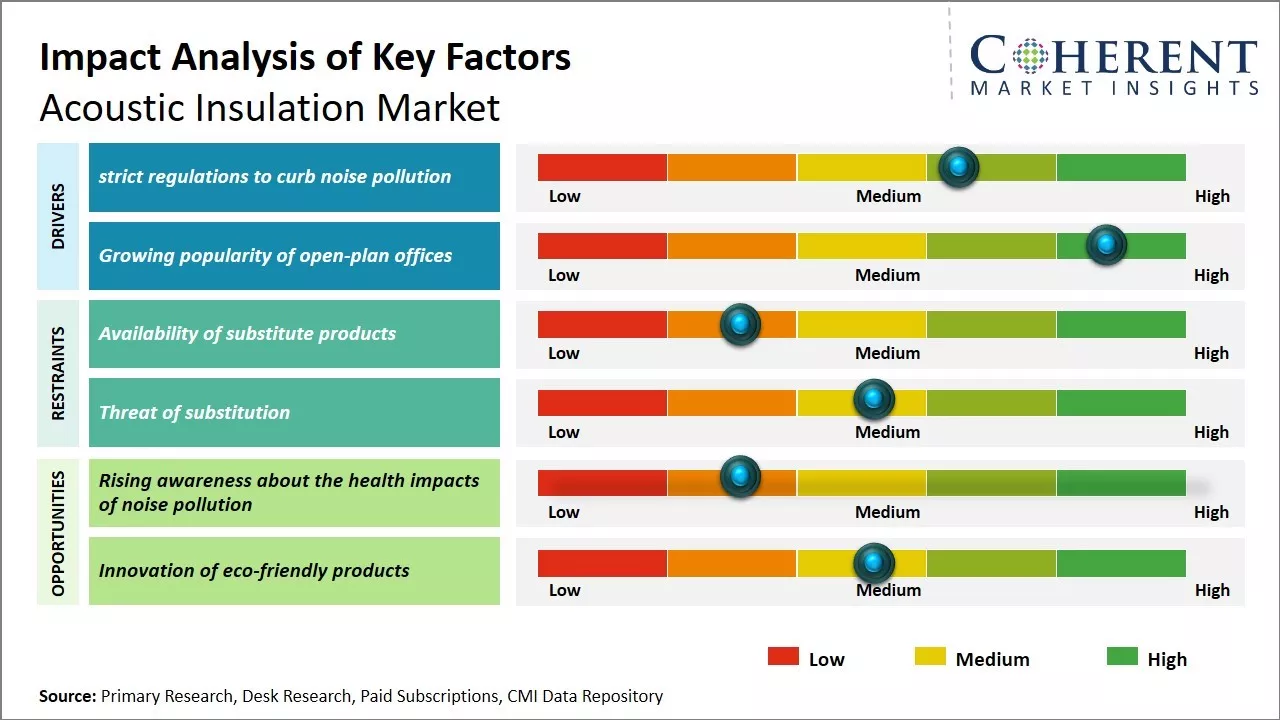 Acoustic insulation finds wide application in the building & construction sector for insulation in walls, under floors, and within ceilings. Strict noise pollution norms across countries boosts need to reduce noise levels in residential and commercial buildings. Global acoustic insulation market is expected to witness significant growth over the forecast period. Growing construction activities coupled with rising consumer awareness about noise pollution are expected to boost demand for acoustic insulation. Furthermore, stringent government regulations regarding noise control in workplaces are encouraging building owners to opt for acoustic insulation. However, high costs associated with acoustic insulation solutions may hinder the market growth. Key players are focusing on developing cost-effective and innovative acoustic insulation materials to expand their market reach.
Strict regulations to curb noise pollution
With growing industrialization and urbanization worldwide, noise pollution has become a major concern for both individuals and governments. For instance, according to European Environment Agency in 2020, excessive and chronic exposure to high noise levels can cause significant health issues like hearing impairment, sleep disturbances, high blood pressure, and cardiovascular problems. To protect citizens from the harmful effects of noise and provide a quiet living environment, many countries and municipalities have established strict regulations that set maximum permissible noise levels for different zones like residential, commercial, and industrial areas. Non-compliance with these norms can attract heavy fines and penalties. This has increased the importance of noise control solutions during construction activities. Builders have to adopt measures that ensure the noise generated from operations like hammering, drilling, and piling stays within approved decibel limits. Acoustic insulation materials have become particularly crucial for apartments, office buildings, factories, and infrastructure projects located near noise-prone areas. Regulations mandate using soundproof windows, insulation in walls and ceilings, suspended ceilings, and acoustic paneling to attenuate noise transmission. Many construction firms also install noise barriers around sites to shield neighborhoods. Growing stringency of regulations has significantly boosted demand for acoustic insulation from the building industry, aiming to comply with noise standards and minimize complaints regarding disturbance. This driver will continue propelling the acoustic insulation market as urban noise issues exacerbate and communities pressurize governments into strengthening controls over sound pollution.
Insights, By Type
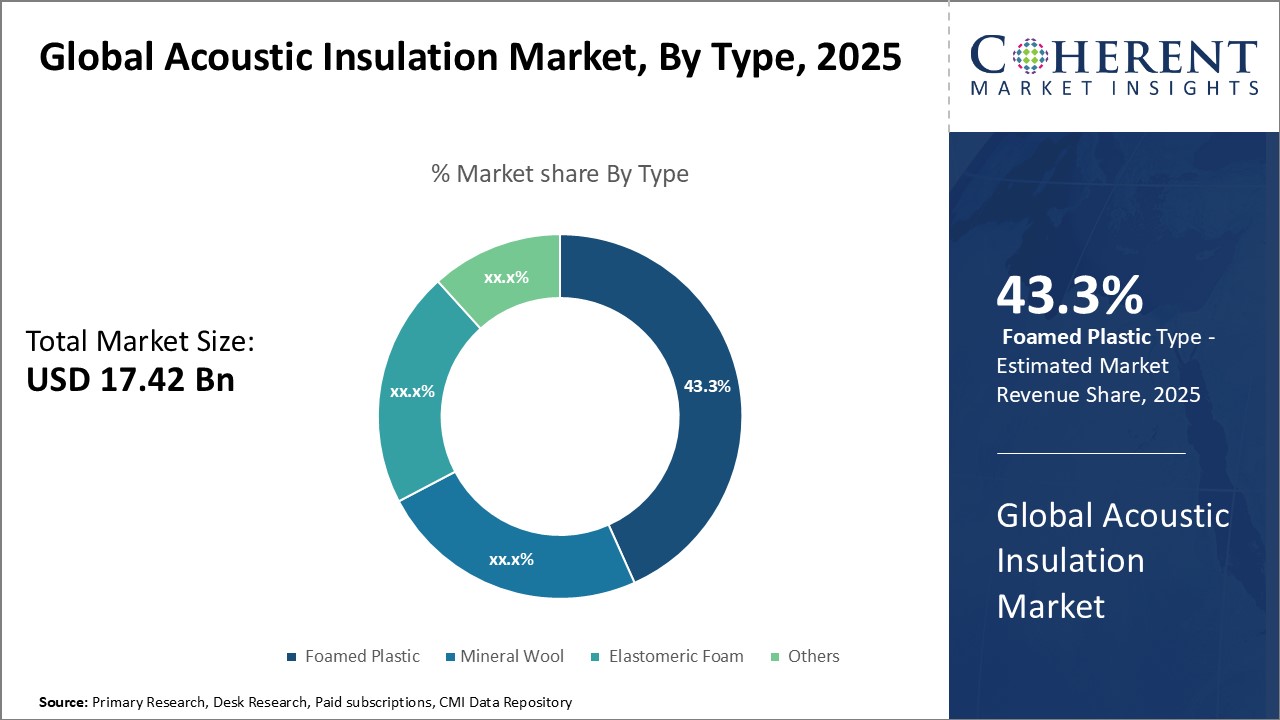 Insights, By Type: Foamed Plastic Segment Leads as Most Effective Acoustic Insulation Material
In terms of type, foamed plastic segment is estimated to contribute the 44.3% share of the acoustic insulation market in 2026, owing to its effective sound absorption properties. Foamed plastics, such as expanded polystyrene (EPS) and extruded polystyrene (XPS), have a porous, cellular structure that allows sound waves to enter the material. The small air pockets inside trap and dampen vibrations, minimizing sound reflection. This makes foamed plastics highly effective at blocking noise transmission through walls, ceilings, and other building components. Foamed plastics are also lightweight and easy to install as compared to other acoustic insulation materials like mineral wool or fiberglass. Contractors can rapidly install foamed plastic panels with minimal physical exertion. The light weight also reduces structural loading during installation. From a design perspective, foamed plastics allow for thinner, more space-efficient insulation layers that does not compromise on acoustic performance. This is appealing in applications with restricted ceiling heights or wall cavity depths.
Insights, By End-use Industry
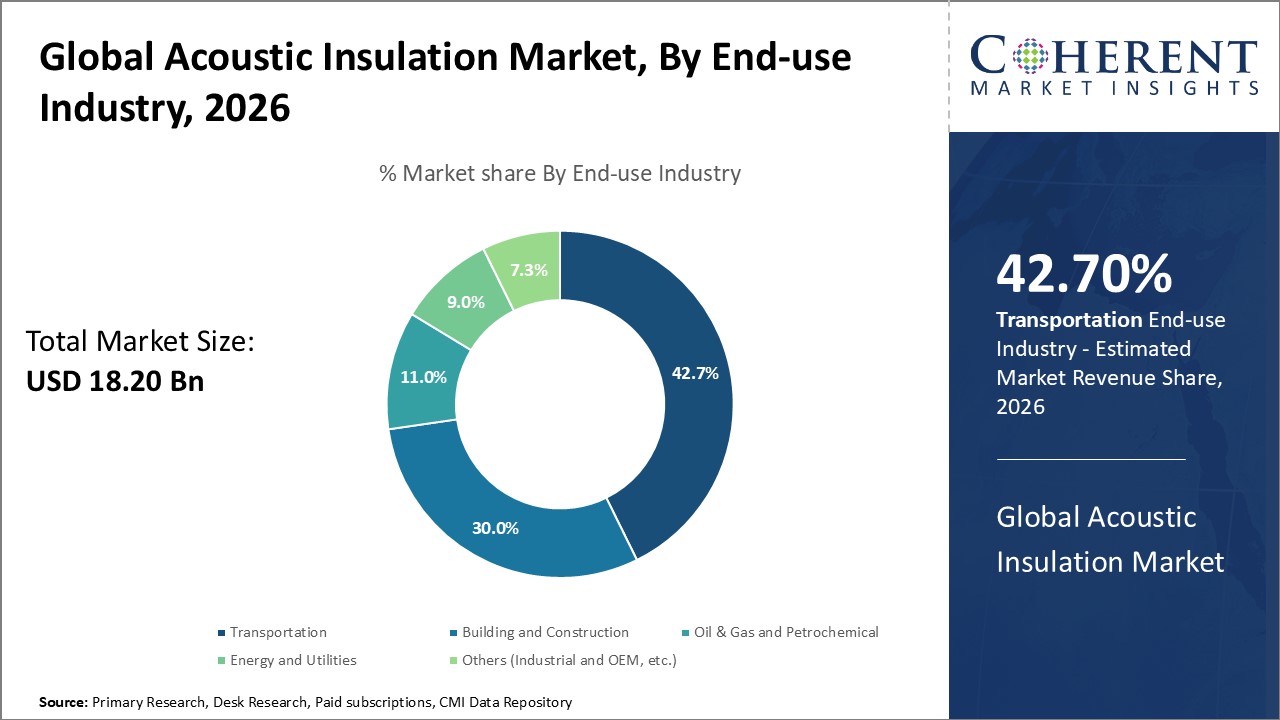
Insights, By End-use Industry: Transportation Sector Demands Highest Levels of Noise Control
Among end-use industry, transportation segment is estimated to contribute the 42.7% share of the acoustic insulation market as various modes of transportation like automobiles, aircraft, high-speed rail, and more recently electric vehicles require stringent noise control to meet regulatory and customer expectations. Road, aircraft, train, and construction equipment noise have negative health and environmental impacts that are actively regulated. For automakers and OEMs, superior acoustic insulation is also a key product differentiator that attracts brand-loyal customers. Achieving sufficient noise reduction to comply with airport and residential noise abatement regulations requires massive acoustic insulation installation, driving material requirements. Similarly, high-speed bullet trains create disturbances that must be quelled to avoid disturbing populations near railway lines. As urban transit networks expand to less densely inhabited outskirts, meeting more stringent railway noise standards is essential. Electric vehicles present new acoustic insulation challenges as compared to internal combustion engines. The smooth, vibration-free operation of electric powertrains allows more cabin noise intrusion that must be remedied.
Regional Insights
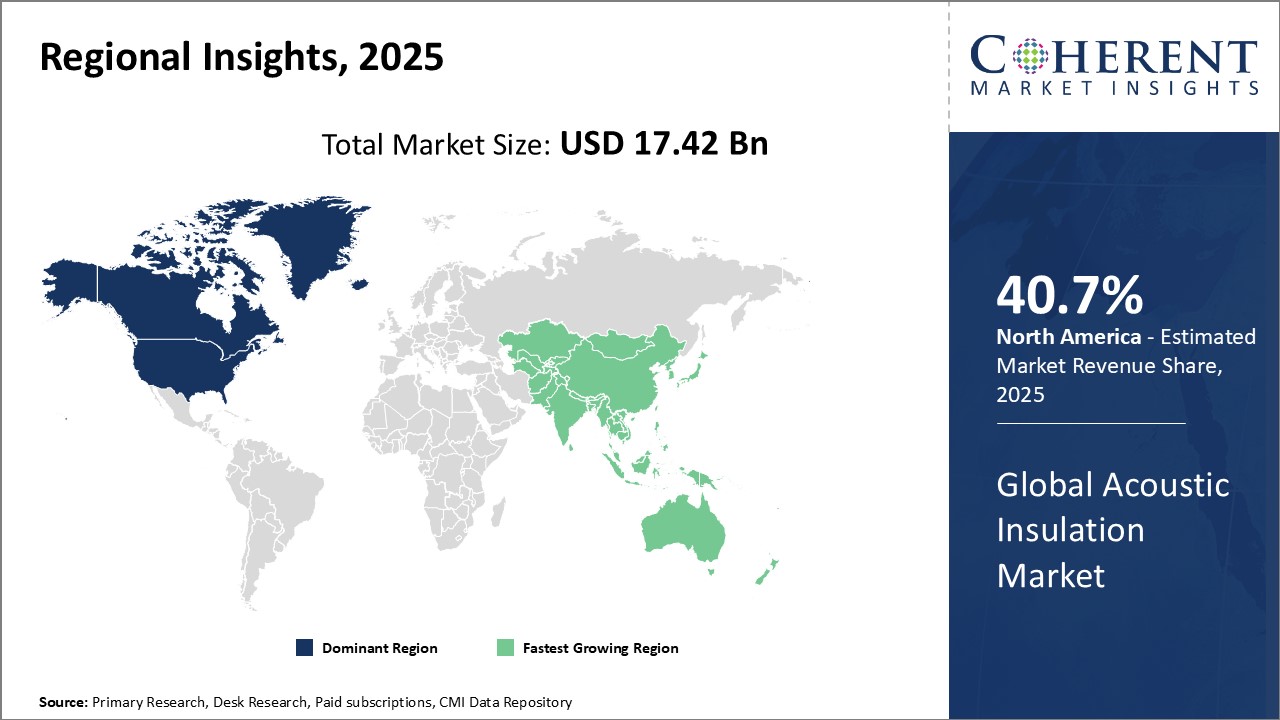 North America region has dominated the global acoustic insulation market for many years with estimated 40.7% share in 2026, owing to strong policy support and industry presence. The U.S. is one of the largest producers and consumers of acoustic insulation globally. It has stringent regulations pertaining to noise control especially in the construction sector. This has boosted consistent demand from the commercial and industrial construction segments. Many leading insulation manufacturers are headquartered in the U.S., and have established distribution networks across Canada as well. The growing skyline of cities like New York and Chicago constantly require acoustic materials for ceiling, walls and floor applications in buildings. The aerospace and automotive sectors are also major consumers. As a result, North America contributes significantly to the global supply of acoustic insulation materials. The region also has a highly competitive market structure with several local and international brands vying for market share. This competition has ensured product quality and pricing remains optimum for both manufacturers as well as building contractors.
Asia Pacific region has emerged as the fastest growing market for acoustic insulation in recent years. The boom in the construction industry across China, India and several Southeast Asian countries has fuelled demand. Rapid urbanization is driving residential and commercial construction in the region. These emerging nations are witnessing expansion of manufacturing industries which utilize acoustic insulation to meet noise control standards.
Market Players, Key Development, and Competitive Intelligence
 Growing popularity of open-plan offices
In recent years, traditional closed offices have been steadily replaced by open-plan layouts to improve collaboration and communication between employees. While this design offers various benefits like more interactions, better supervision, and increased space utilization, it also brings the disadvantage of heightened noise distractions. In open desks getting interspersed among busy co-workers, concentrating on tasks and having private conversations becomes challenging due to constant interruptions, side talks, and ambient office sounds like tapping, paper shuffling and phone ringing. This affects productivity, causes stress, and leads to employee complaints. To address rising acoustical issues in shared workspaces, companies are equipping their interiors with acoustic insulation products. Ceiling tiles, acoustic panels, sound-absorbing fabric walls and partitions help suppress reverberations and create a more focused yet peaceful work environment. With open-plan offices becoming standard globally, the need for installing acoustic control solutions is perceived to increase substantially over the coming years. This is anticipated to drive considerable market gains for insulation materials.
- Current Industry Events of 2026
- Market Size Estimation
- Regional Breakdown
- Competitive Landscape
- Customer Intelligence
- Segmental Analysis
- Pricing Analysis
- Key Market Drivers, Challenges & Future Trends
- Customized Insights Section
Market Report Scope
Global Acoustic Insulation Market Report Coverage
| Report Coverage | Details | ||
|---|---|---|---|
| Base Year: | 2025 | Market Size in 2026: | USD 18.20 Bn |
| Historical Data for: | 2020 To 2024 | Forecast Period: | 2026 To 2033 |
| Forecast Period 2026 to 2033 CAGR: | 4.5% | 2033 Value Projection: | USD 24.77 Bn |
| Geographies covered: |
| ||
| Segments covered: |
| ||
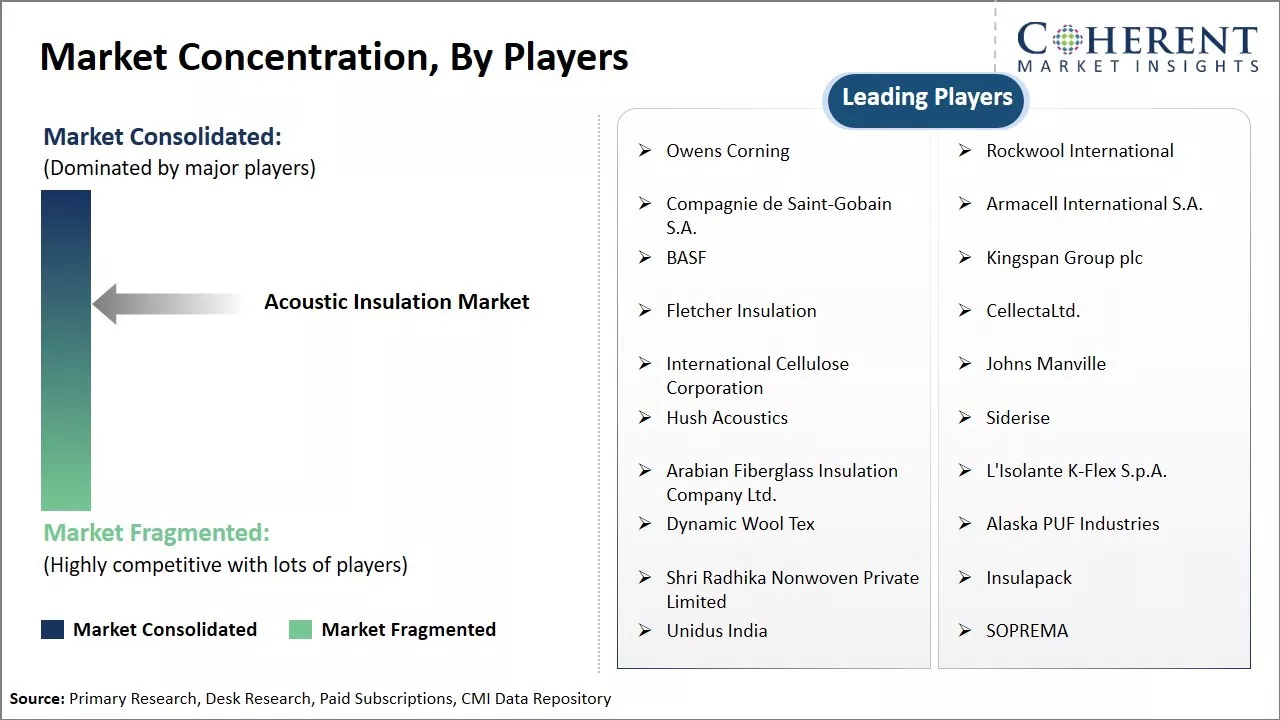
| Companies covered: | Gates Industrial Corporation plc, Owens Corning, Rockwool International, Compagnie de Saint-Gobain S.A., Armacell International S.A., BASF, Kingspan Group plc, Fletcher Insulation, CellectaLtd., International Cellulose Corporation, Johns Manville, Hush Acoustics, Siderise, Arabian Fiberglass Insulation Company Ltd., L'Isolante K-Flex S.p.A., Dynamic Wool Tex, Alaska PUF Industries, Shri Radhika Nonwoven Private Limited, Insulapack, Unidus India, SOPREMA | ||
| Growth Drivers: |
| ||
| Restraints & Challenges: |
| ||
Analyst Opinion (Expert Opinion)
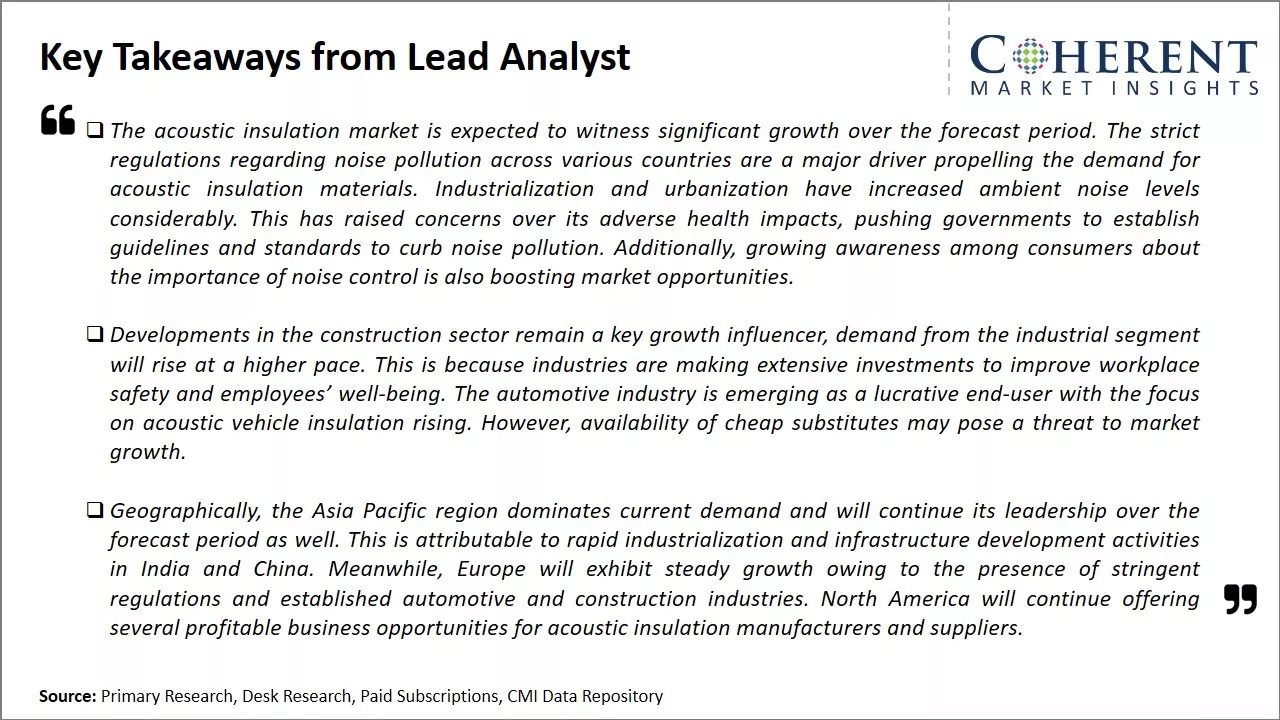 Market Challenges: Availability of substitute products
The availability of substitute products is significantly restraining the growth of the global acoustic insulation market. There are numerous substitute products available that can perform the noise control and soundproofing functions almost as effectively as traditional acoustic insulation materials. For instance, mass loaded vinyl barriers and resilient channel systems are widely used as alternatives to conventional fiberglass and fiber based insulation materials. These substitutes offer competitive acoustic performance while having advantages such as lower cost of installation and greater ease of application. The use of substitute products is gaining increasing popularity among end users such as construction contractors and building owners. This is because acoustic insulation requires careful installation to achieve its rated acoustic performance, whereas substitutes can often provide near equivalent results with less demanding fitting procedures. This makes substitutes an attractive proposition especially for projects with tight budgets and timelines. According to the data from the United Nations Environment Programme in 2021, the sales of mass loaded vinyl barriers have grown at an annual rate of over 7% in recent years taking away market share from traditional fiberglass insulation globally.
Market Opportunities: Rising awareness about the health impacts of noise pollution
Rising awareness about the health impacts of noise pollution is prompting more people to soundproof their homes and workspaces. As urban populations grow exponentially, demand for noise-reducing commercial and residential building materials increases. Developing innovative acoustic insulation products from sustainable materials can help companies’ access green-conscious customers.
Speak to the analyst
Want personalized insights?
Take the findings above to one of our principal consultants, or have the report rebuilt around the segments, geographies and competitors you actually track.
Market Segmentation
- Type Insights (Revenue, USD Bn & KT, 2021 - 2033)
- Mineral Wool
- Foamed Plastic
- Elastomeric Foam
- Others
- End-use Industry Insights (Revenue, USD Bn & KT, 2021 - 2033)
- Building and Construction
- Transportation
- Oil & Gas and Petrochemical
- Energy and Utilities
- Others (Industrial and OEM, etc.)
- Regional Insights (Revenue, USD Bn & KT, 2021 - 2033)
- North America
- U.S.
- Canada
- Latin America
- Brazil
- Argentina
- Mexico
- Rest of Latin America
- Europe
- Germany
- U.K.
- Spain
- France
- Italy
- Russia
- Rest of Europe
- Asia Pacific
- China
- India
- Japan
- Australia
- South Korea
- ASEAN
- Rest of Asia Pacific
- Middle East & Africa
- GCC Countries
- Israel
- Rest of Middle East & Africa
- North America
- Key Players Insights
- Gates Industrial Corporation plc
- Owens Corning
- Rockwool International
- Compagnie de Saint-Gobain S.A.
- Armacell International S.A.
- BASF
- Kingspan Group plc
- Fletcher Insulation
- CellectaLtd.
- International Cellulose Corporation
- Johns Manville
- Hush Acoustics
- Siderise
- Arabian Fiberglass Insulation Company Ltd.
- L'Isolante K-Flex S.p.A.
- Dynamic Wool Tex
- Alaska PUF Industries
- Shri Radhika Nonwoven Private Limited
- Insulapack
- Unidus India
- SOPREMA
Get access to 250+ pages report
Every segment, forecast, competitor profile and data table behind the analysis above — available for instant download.
- ESOMAR Member
- ISO 9001:2015 Certified
- D-U-N-S Registered
- GDPR & CCPA Compliant
Missing comfort of reading report in your local language? Find your preferred language:
Transform your Strategy with Exclusive Trending Reports
Frequently Asked Questions
The Global Acoustic Insulation Market is estimated to be valued at USD 18.20 Bn in 2026, and is expected to reach USD 24.77 Bn by 2033.
The CAGR of the Global Acoustic Insulation Market is projected to be 4.5% from 2026 to 2033.
Strict regulations to curb noise pollution and growing popularity of open-plan offices are the major factor driving the growth of global acoustic insulation market.
Availability of substitute products and threat of substitution are the major factor hampering the growth of global acoustic insulation market.
In terms of type, foamed plastic segment is estimated to dominate the market in 2026.
Gates Industrial Corporation plc, Owens Corning, Rockwool International, Compagnie de Saint-Gobain S.A., Armacell International S.A., BASF, Kingspan Group plc, Fletcher Insulation, CellectaLtd., International Cellulose Corporation, Johns Manville, Hush Acoustics, Siderise, Arabian Fiberglass Insulation Company Ltd., L'Isolante K-Flex S.p.A., Dynamic Wool Tex, Alaska PUF Industries, Shri Radhika Nonwoven Private Limited, Insulapack, Unidus India, SOPREMA are the major players.
North America is expected to lead the global acoustic insulation market.