

Global Grain Roller Market Size and Forecast – (2026-2033)
Coherent Market Insights estimates that the global grain roller market is expected to reach USD 17.5 Bn in 2026 and will expand to USD 26 Bn by 2033, registering a CAGR of 5% between 2026 and 2033.
Key Takeaways of the Grain Roller Market:
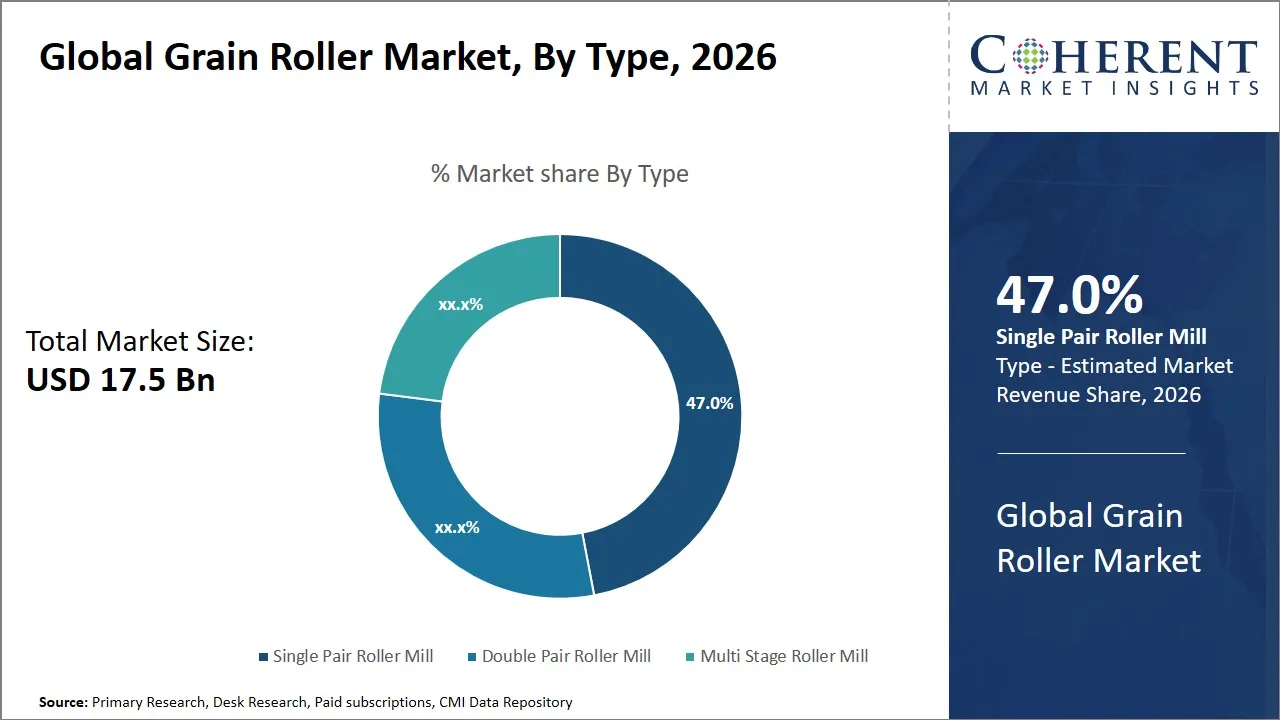
- The single pair roller mill segment is expected to account for 47% of the grain roller market share in 2026.
- The feed processing segment is projected to capture 44% of the market share in 2026.
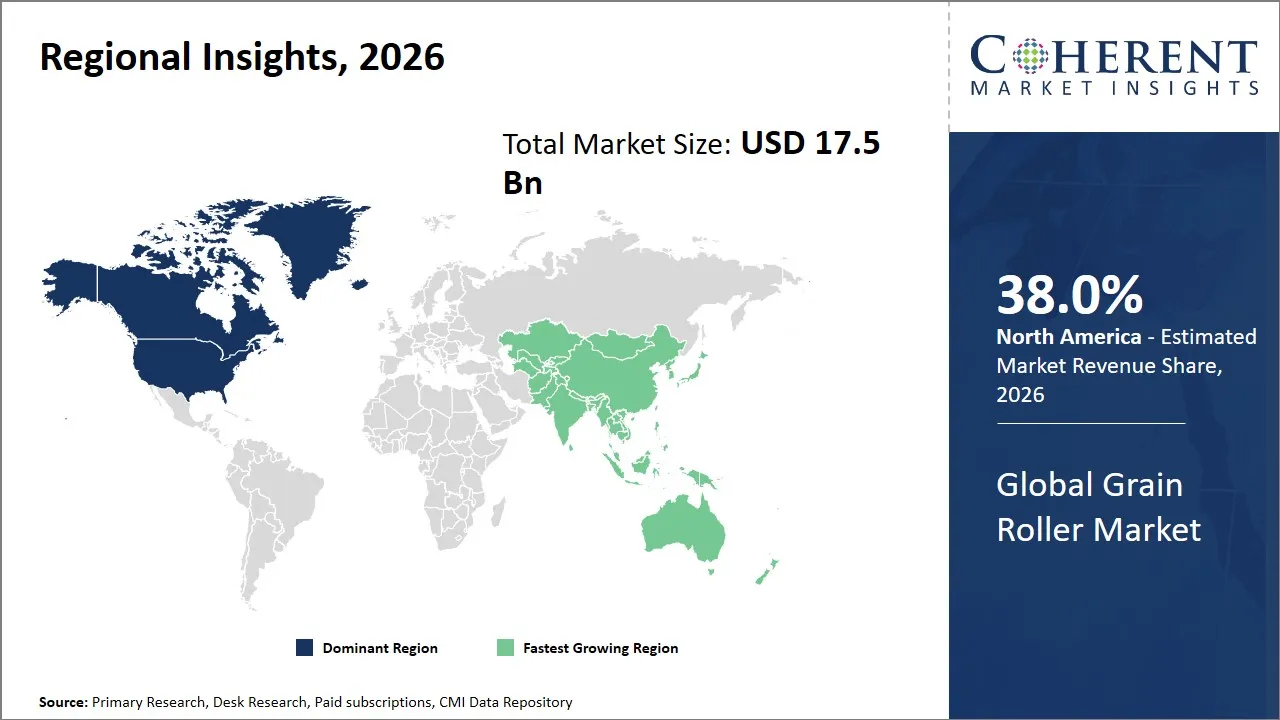
- North America will dominate the grain roller market in 2026 with an estimated 38%
- Asia Pacific will hold 24% share in 2026 and is expected to record the fastest growth over the forecast period.
Currents Events and Its Impact
Current Events | Description and its Impact |
Buhler Group Product Launch |
|
Segmental Insights
- Current Industry Events of 2026
- Market Size Estimation
- Regional Breakdown
- Competitive Landscape
- Customer Intelligence
- Segmental Analysis
- Pricing Analysis
- Key Market Drivers, Challenges & Future Trends
- Customized Insights Section
Why Does the Single Pair Roller Mill Segment Dominate the Global Grain Roller Market in 2026?
The single pair roller mill segment is expected to account for 47.0% of the global grain roller market share in 2026. Growth stems from simple structure, smooth operation, low upkeep. Efficiency shows clearly when energy demand remains minimal during fine grain processing. A single roller system reduces complications - downtime fades with simpler construction. Over months, upkeep grows easier while costs gradually decline. Small firms notice this quickly, especially where steady function outweighs advanced features. Simplicity turns into reliability under real-world conditions.
Feed Processing Segment Dominates the Global Grain Roller Market
The feed processing segment is expected to hold 44.0% of the global grain roller market share in 2026. Driven by rising worldwide appetite for animal protein, demand grows for superior feed. With more intensive livestock operations spreading across regions, attention turns sharply toward better feed conversion. This means faster development in animals, along with higher output. Essential, the reduction of grain size occurs within these setups. Through mechanical pressure, transformation takes place via roller mechanisms.
Accessibility improves when internal structures open up. Digestion benefits follow structural changes induced by crushing actions. Improved breakdown supports stronger uptake of vital elements within the digestive tract.
For instance, on January 28, 2025, AMANDUS KAHL showcased its OE 23.2 expander and its WSB 2040.2 crushing roller mill with individual drive during the International Production & Processing Expo, 2025.
Cost per Ton Milled vs Roller Tech
Metric | Roller Mill (per ton) | Hammer Mill (per ton) |
Energy Cost / ton | USD 9 – USD 15 | USD 12 – USD 20 |
Total Operating Cost / ton | USD 0.32 / ton | USD 0.41 / ton |
Maintenance Cost / ton | USD 0.05 – USD 0.07 (typical) | USD 0.02 – USD 0.03 (typical) |
Total Cost (incl. energy + maintenance) | USD 0.36 – USD 0.42 | USD 0.44 – USD 0.50 |
Regional Insights
North America Grain Roller Market Analysis and Trends
The North America region is projected to lead the market with a 38% share in 2026. Driven by advanced farming methods and widespread machinery use, expansion emerges from a long-standing agricultural network. Leading nations such as the U.S. and Canada drive demand for practical equipment, among which grain rollers are relevant. Backing emerges via regulations promoting sustainable methods together with investment into agricultural infrastructure.
Progress grows strong in areas where established companies work: names like Bühler Group, AGi, and CPM lead here, offering machines that draw lower energy yet manage higher output. Distribution networks extend widely, proven through years, ensuring consistent movement of supplies and products. Shifting harvests between countries pushes broader use of advanced roller setups built for intricate needs.
Asia Pacific Grain Roller Market Analysis and Trends
The Asia Pacific region is expected to exhibit the fastest growth in the market contributing 24% share in 2026. Driven forward through broader farming practices, higher demand from more people, yet also supported by official programs seeking updated farm methods. In places including India, China, along with countries across Southeast Asia, spending on machines grows steadily to lift output while cutting waste after crops are gathered.
A lively environment for farm-related businesses emerges; attention rises toward better ways to handle grains and this pushes wider use of available tools. Alongside international names like AGI and Bühler, domestic producers settle firmly into local markets, reshaping machinery designs - for example, compact rollers fit for many kinds of harvests. Open trade rules combined with focused farm regulations add momentum here, leading to quicker uptake than observed elsewhere. Despite differences, similarities form around shared goals shaped by practical need.
Global Grain Roller Market Outlook for Key Countries
Why is the U.S. Emerging as a Major Hub in the Grain Roller Market?
High levels of automation mark the market in the U.S., where major producers of grain rollers hold firm positions. Firms such as Bühler Inc. and AGI deliver sophisticated machinery that uses less power, serving processing facilities across regions. Funding from public sources enables farm upgrades, steering agriculture toward environmentally aware methods that encourage adoption of continuous operational models. Attention shifts to reducing post-harvest losses; at the same time, better output in animal nutrition keeps demand steady.
Efficiency gains ripple through supply chains, subtly reshaping long-term priorities across rural economies. Driven by exports, the national grain sector relies on uniform standards, therefore favoring equipment built with advanced engineering.
India Grain Roller Market Analysis and Trends
Growth in India's grain roller sector follows state-led efforts to upgrade farm practices through programs including PM-Kisan. Fueled largely by numerous modest-sized agricultural operations, the need focuses on machinery offering adaptability combined with affordability. International players including Bühler and AGI operate beside local manufacturers, guiding development of tools adjusted to specific environments - compact layouts paired with straightforward maintenance. Efforts to strengthen food availability and cut losses after harvest fuel steady expansion of the industry. At the same time, import and export regulations support capital inflow into advanced handling systems for grains.
Is China the Next Growth Engine for the Grain Roller Market?
Even with changes across regions, leadership in grain-processing machinery within the Asia Pacific area remains largely with China. Driven by policies aiming at consistent food availability, expansion has taken root gradually. Among active participants are Shandong Leader Animal Husbandry Equipment, working parallel to global names including Bühler. What these companies do mirrors wider movement in manufacturing sectors.
A large domestic output of grains forms one pillar of expansion. At the same time, consumer appetite for refined grain goods grows steadily. This drives interest in advanced roller technologies. Infrastructure upgrades play a role too. So does wider use of mechanical systems in agricultural zones. Efficiency improves where automation replaces manual steps. Losses during storage and transport see measurable decline. Progress unfolds unevenly, yet direction remains clear.
Brazil Grain Roller Market Analysis and Trends
Ahead of many nations in grain exports, Brazil experiences changes within its roller milling sector due to robust agricultural infrastructure. Because sustainability gains focus, officials encourage modern processing equipment via favorable trade policies.
Firms such as AGI, along with domestic players including Romani Agroindustrial, deliver durable rollers suited to extensive production needs. Expanding overseas shipments of cereals, paired with rising need for animal nutrition inputs, fuel equipment uptake. This trend gains momentum as automated farm machinery becomes more widespread across rural regions.
Australia Grain Roller Market Analysis and Trends
Farming spans vast regions across Australia, creating steady demand for grain rollers. Strong international ties support equipment imports and exports. Innovation in machinery advances under favorable regulations. Progress grows where agriculture meets structured policy frameworks.
Firms like Bühler and AGI meet local needs as well as overseas orders, supplying robust machines built for varied crops across the continent. With attention turning to sustainable practices alongside streamlined operations, demand grows for upgraded equipment. Because of this shift, renewal efforts sustain consistent requirements, placing the country visibly ahead across regional benchmarks.
Downtime & Changeover Cost Mapping
Cost Component | Typical Value (USD) |
Changeover Labor Cost | USD 200–USD 480 per event |
Lost Production (Roll Change) | USD 320–USD 960 |
Cost of Unscheduled Mill Downtime | ~USD 746 per hour |
Cost of Yield Loss | USD 100–USD 2,000+ per day |
Total Daily Impact (Mixed Downtime) | USD 1,000–USD 10,000+ |
Market Players, Key Development, and Competitive Intelligence
Key Developments
- On November 7, 2025, Ag Growth International Inc announced the launch of two new additions to its conveyor lineup, the FX4 SP (gas over hydraulic drive) and FX4 18S (electric top-drive). Engineered for high-capacity performance, these fuel-diverse conveyors deliver the power, durability and efficiency farmers need to keep grain moving.
- On September 15, 2025, Omas unveiled its Leonardo Edge, the next-generation evolution of its iconic Leonardo roller mill. Engineered through years of research and real-world feedback, Leonardo Edge blends automation, precision and energy efficiency at IPACK-IMA 2025 in Milan.
Top Strategies Followed by Global Grain Roller Market Players
- Across the world, the grain roller industry shows wide variation in company size and approach, with firms pursuing separate paths to grow influence. Large firms maintain position by backing ongoing inquiry aimed at improving how tools perform in today’s agriculture setups. Progress emerges when testing leads to updates - tougher components appear, energy needs drop, smart features become standard. While strategies differ, what holds attention is steady movement forward, powered by invention year after year.
- Within the grain roller industry, some companies focus on straightforward solutions for price-conscious customers. Where performance aligns with affordability, equipment serves modest-scale needs effectively. Simplicity defines these machines - reliable function replaces unnecessary features. Found less often than larger brands, they suit those who value consistency over added cost. With consistency, partnerships emerge as a pathway toward broader manufacturing reach alongside updated methods. Advantages grow when shared efforts lead to stronger output and smarter design absorption.
- In case of smaller firms, focus moves away from large-scale output toward specialized characteristics instead. Product modifications start reflecting specific crop needs. Sustainability increasingly influences decisions about materials. Compatibility with recently adopted farming equipment occasionally shapes design details. These focused improvements allow service to precise local needs, areas where widespread providers do not always reach. Advantage forms slowly, built on narrow expertise instead of volume.
Market Report Scope
Global Grain Roller Market Report Coverage
| Report Coverage | Details | ||
|---|---|---|---|
| Base Year: | 2025 | Market Size in 2026: | USD 17.5 Bn |
| Historical Data for: | 2020 To 2024 | Forecast Period: | 2026 To 2033 |
| Forecast Period 2026 to 2033 CAGR: | 5 % | 2033 Value Projection: | USD 26 Bn |
| Geographies covered: |
| ||
| Segments covered: |
| ||
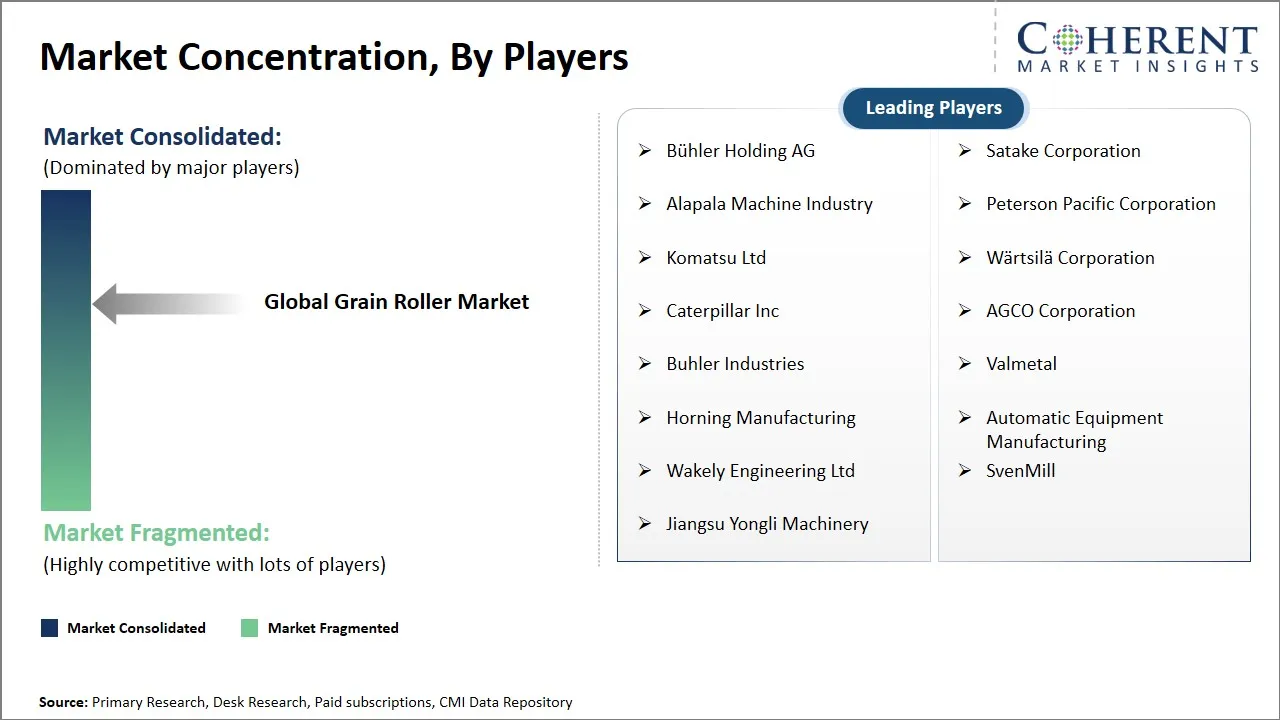
| Companies covered: | Bühler Holding AG, Satake Corporation, Alapala Machine Industry, Peterson Pacific Corporation, Komatsu Ltd, Wärtsilä Corporation, Caterpillar Inc, AGCO Corporation, Buhler Industries, Valmetal, Horning Manufacturing, Automatic Equipment Manufacturing, Wakely Engineering Ltd, SvenMill, and Jiangsu Yongli Machinery | ||
| Growth Drivers: |
| ||
| Restraints & Challenges: |
| ||
Global Grain Roller Market Dynamics
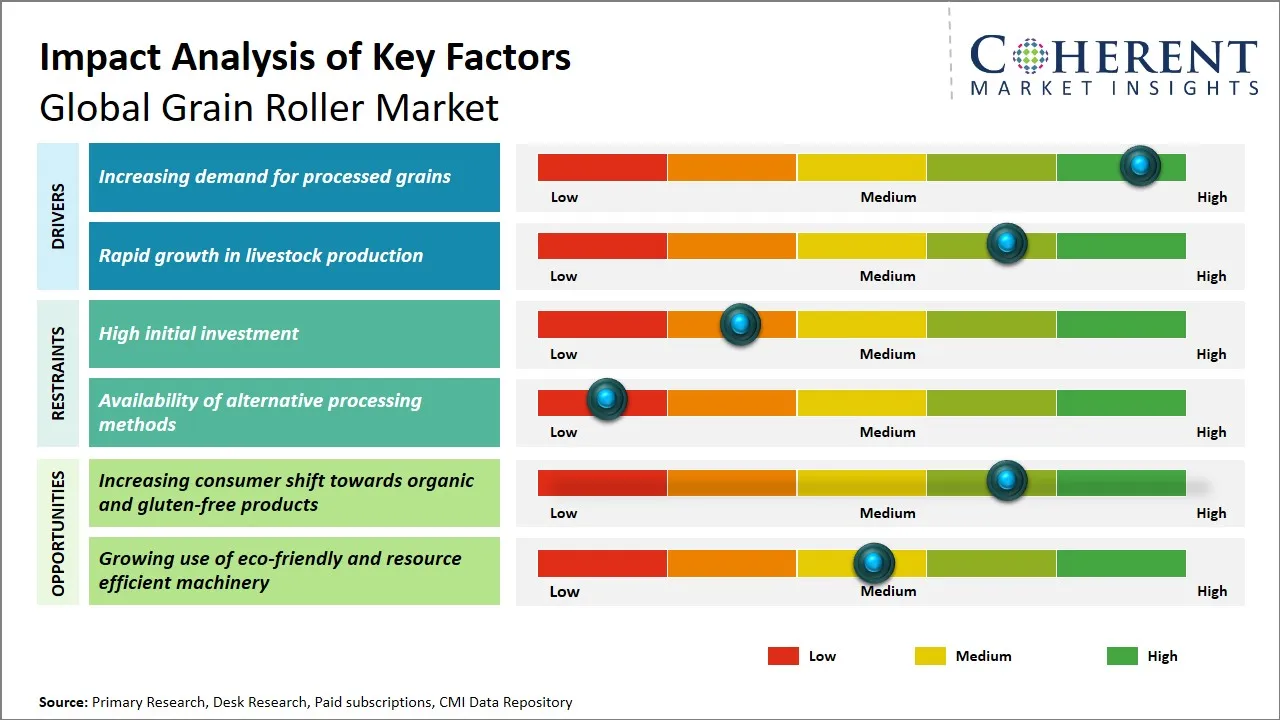
Global Grain Roller Market Driver - Increasing Demand for Processed Grains
Consumption trends now favor processed grains and whole grain foods, shaping expansion within worldwide milling apparatus sectors. With city populations swelling and daily routines tightening, ease-of-use gains importance like rolled oats, morning cereals, along with similar refined grain items see stronger interest. Owing to this change, producers aim machinery spending toward modern rolling systems capable of turning basic kernels into uniform fragments or fine particles fit for varied culinary roles. Equipment performance matters more under these evolving conditions.
Global Grain Roller Market Opportunity - Increasing Consumer Shift Towards Organic and Gluten Free Products
A major outcome of shifting eating habits involves greater interest in organically grown breakfast cereals without gluten. Health awareness, along with specific diet needs, pushes producers to modify how they prepare food items. Equipment used to flatten seeds must keep nutrients intact during operation. Maintaining uncontaminated batches matters most when dealing with sensitive raw materials like those labeled organic or free from wheat protein. Purity concerns grow stronger alongside public favor for simple ingredient listings and fewer industrial steps in meals. Machines capable of managing crops such as quinoa, millet, or sorghum see rising usage across facilities focused on natural ingredients.
Analyst Opinion (Expert Opinion)
- Growth appears likely across certain regions, especially within Asia Pacific and North America, driven by higher farming yields, more animal farming activity, because of greater use of milled grains in foods.
- In smaller and mid-sized feed setups, a shift toward using single pair roller mills is noticeable, supported further by updates in operational tech - smart monitoring features plus reduced power draw - which sets apart major firms such as Bühler and Satake.
- Positive momentum continues overall, since efforts to update food production methods and meet eco-efficiency goals maintain pressure on adopting improved grain rolling equipment
Speak to the analyst
Want personalized insights?
Take the findings above to one of our principal consultants, or have the report rebuilt around the segments, geographies and competitors you actually track.
Market Segmentation
- Type Insights (Revenue, USD Billion, 2021 - 2033)
- Single Pair Roller Mill
- Double Pair Roller Mill
- Multi Stage Roller Mill
- Application Insights (Revenue, USD Billion, 2021 - 2033)
- Feed Processing
- Brewery and Distillery
- Flour Milling
- Regional Insights (Revenue, USD Billion, 2021 - 2033)
- North America
- U.S.
- Canada
- Latin America
- Brazil
- Argentina
- Mexico
- Rest of Latin America
- Europe
- Germany
- U.K.
- Spain
- France
- Italy
- Russia
- Rest of Europe
- Asia Pacific
- China
- India
- Japan
- Australia
- South Korea
- ASEAN
- Rest of Asia Pacific
- Middle East
- GCC Countries
- Israel
- Rest of Middle East
- Africa
- South Africa
- North Africa
- Central Africa
- North America
- Key Players Insights
- Bühler Holding AG
- Satake Corporation
- Alapala Machine Industry
- Peterson Pacific Corporation
- Komatsu Ltd
- Wärtsilä Corporation
- Caterpillar Inc
- AGCO Corporation
- Buhler Industries
- Valmetal
- Horning Manufacturing
- Automatic Equipment Manufacturing
- Wakely Engineering Ltd
- SvenMill
- Jiangsu Yongli Machinery
Sources
Primary Research Interviews
- Agricultural Equipment Manufacturers
- Grain Processing Facility Operators
- Agricultural Machinery Distributors
- Food Processing Industry Executives
Databases
- FAOSTAT (Food and Agriculture Organization Statistics)
- Euromonitor International
- Global Trade Atlas
Magazines
- World Grain Magazine
- Feed & Grain Magazine
- Agricultural Machinery Magazine
- Food Processing Magazine
Journals
- Journal of Food Engineering
- Agricultural Engineering International
- Journal of Cereal Science
Newspapers
- AgriPulse
- Farm Progress
- The Western Producer
- AgriNews
Associations
- International Association of Operative Millers (IAOM)
- Grain Elevator and Processing Society (GEAPS)
- North American Millers' Association (NAMA)
- European Flour Millers Association
Public Domain Sources
- USDA Economic Research Service
- FAO Global Information and Early Warning System
- European Commission Agriculture Reports
- Government Agricultural Statistics Portals
Proprietary Elements
- CMI Data Analytics Tool
- Proprietary CMI Existing Repository of information for last 8 years
Get access to 250+ pages report
Every segment, forecast, competitor profile and data table behind the analysis above — available for instant download.
- ESOMAR Member
- ISO 9001:2015 Certified
- D-U-N-S Registered
- GDPR & CCPA Compliant
Missing comfort of reading report in your local language? Find your preferred language:
Transform your Strategy with Exclusive Trending Reports
Frequently Asked Questions
The global grain roller market is expected to stand at USD 17.5 Bn in 2026 and is expected to reach USD 26 Bn by 2033.
The CAGR of global grain roller market is projected to be 5 % from 2026 to 2033.
Increasing demand for processed grains and rapid growth in livestock production are the major factors driving the growth of the global grain roller market.
High initial investment and availability of alternative processing methods are the major factors hampering the growth of the global grain roller market.
In terms of type, single pair roller mill is estimated to dominate the market revenue share in 2026.
Buhler Holding AG, Satake Corporation, Alapala Machine Industry, Peterson Pacific Corporation, Komatsu Ltd, Wartsila Corporation, Caterpillar Inc, AGCO Corporation, Buhler Industries, Valmetal, Horning Manufacturing, Automatic Equipment Manufacturing, Wakely Engineering Ltd, SvenMill, and Jiangsu Yongli Machinery are the major players.
North America is expected to lead the global grain roller market in 2026.