

Global Grinding Mill Market Size and Forecast – 2026 - 2033
The Global Grinding Mill Market is estimated to be valued at USD 13,200.4 Mn in 2026 and is expected to reach USD 21,758.0 Mn by 2033, exhibiting a compound annual growth rate (CAGR) of 7.4% from 2026 to 2033.
Key Takeaways of the Grinding Mill Market
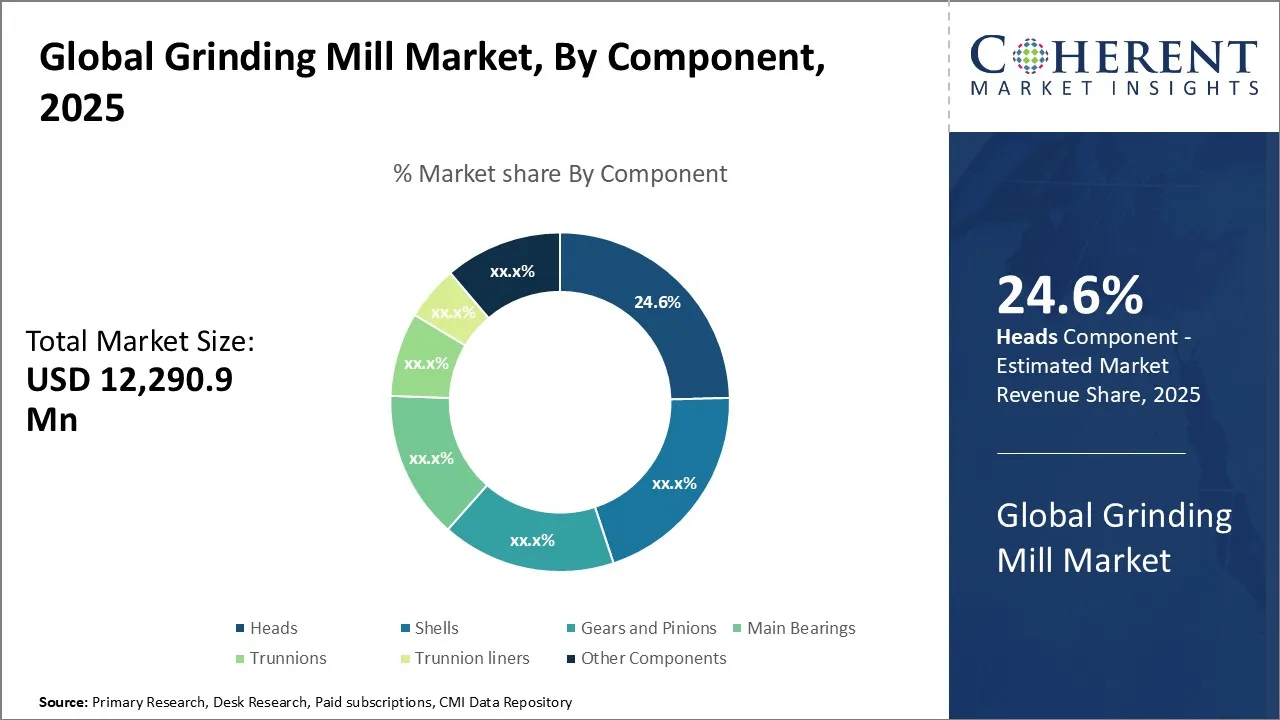
- The Heads segment is projected to account for 25.6 % of the grinding mills market in 2026, largely due to its essential functional role and the intricate engineering it demands.
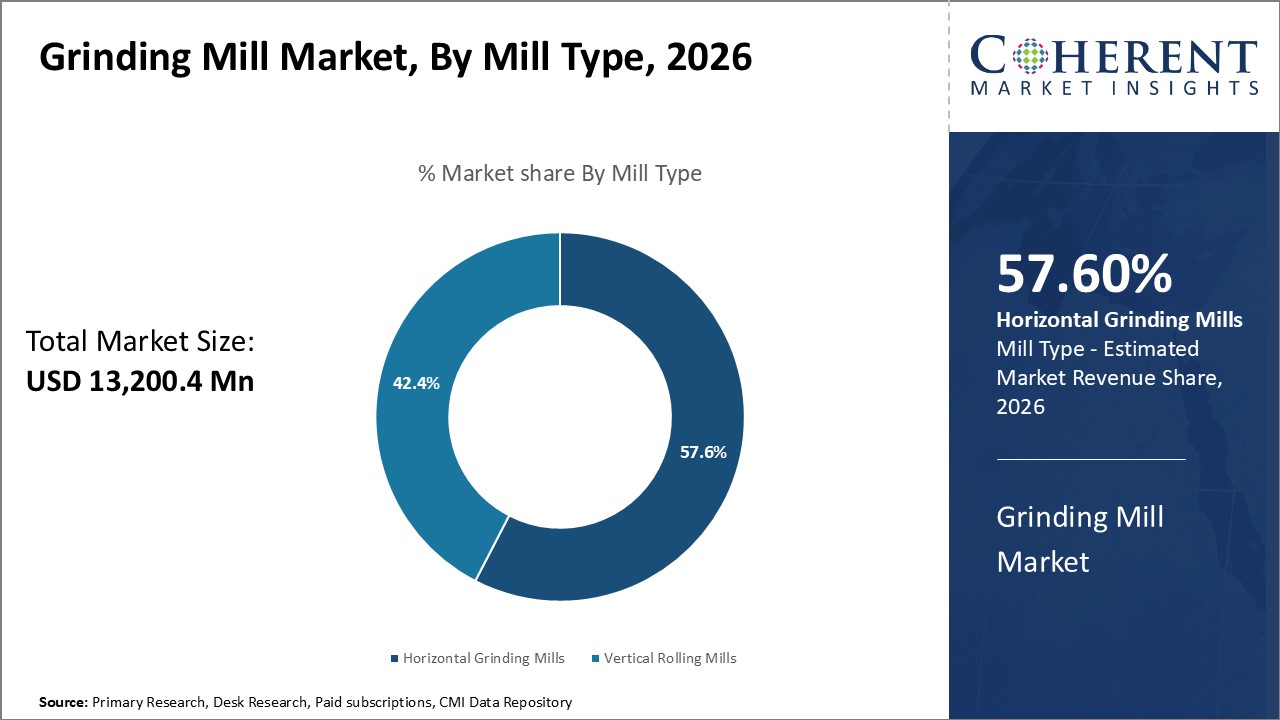
- The Horizontal Grinding Mills segment is expected to lead the global grinding mills market, capturing a significant 57.6 % share in 2026.
- The Above 10 TPH segment is expected to dominate the global market in 2026 with a 47.4 % share, driven by high industrial demand from mining, cement, and large-scale chemical industries.
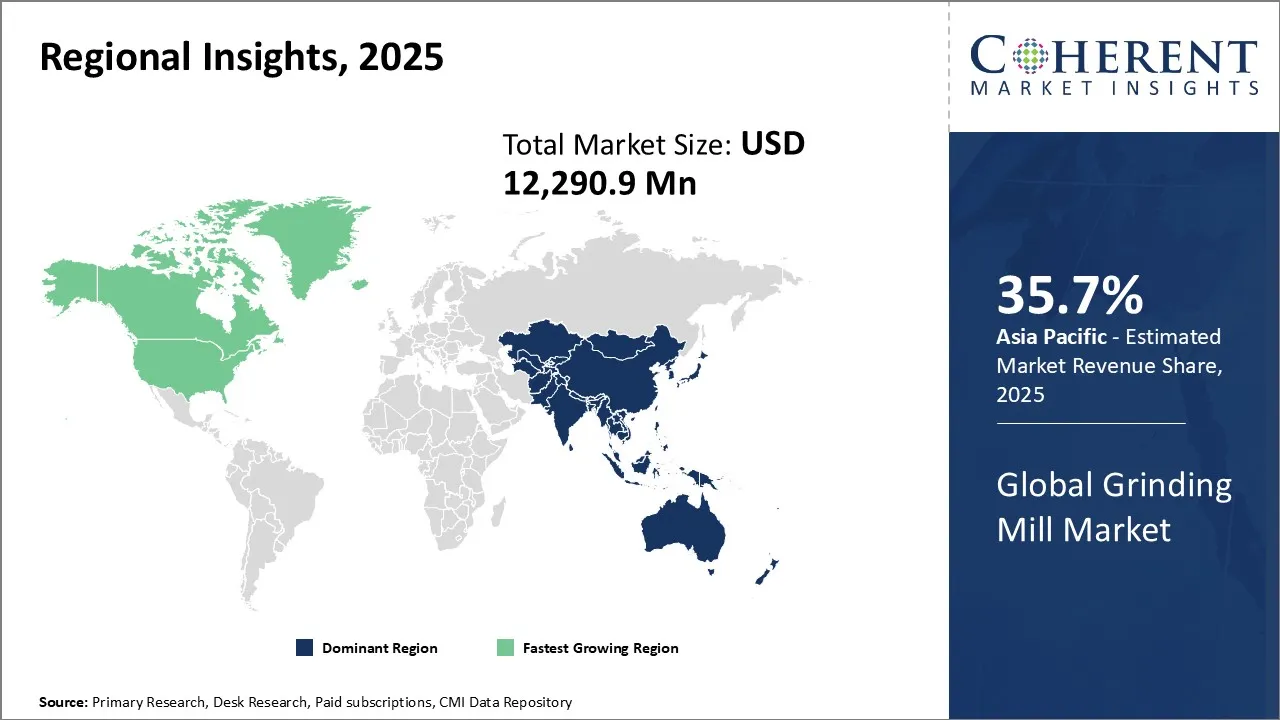
- Asia Pacific is set to lead the global grinding mills market in 2026 with a 35.7 % share, driven by rapid industrialization, expanding mining activities, and increasing infrastructure development. North America, holding a 27.5% share in 2026, will be the fastest-growing region, supported by technological advancements, growing demand from the cement and chemical industries, and strong government investments in modernization.
Market Overview
A key market trend is the growing adoption of energy-efficient and automated grinding mills integrated with advanced control systems and IoT technologies. This shift aims to optimize resource utilization and minimize environmental impact. Additionally, the rising demand for sustainable and eco-friendly manufacturing processes fuels the development of innovative grinding solutions. Expansion in emerging economies, driven by infrastructure development and urbanization, further propels market growth, positioning grinding mills as vital components in modern industrial ecosystems.
Current Events and Its Impact
Current Events | Description and its impact |
Predictive Control Solutions and Energy Efficiency |
|
Rise of Automated and Robotic Grinding Solutions |
|
Segmental Insights
- Current Industry Events of 2026
- Market Size Estimation
- Regional Breakdown
- Competitive Landscape
- Customer Intelligence
- Segmental Analysis
- Pricing Analysis
- Key Market Drivers, Challenges & Future Trends
- Customized Insights Section
Grinding Mill Market Insights, By Component – Heads Segment is Leading the Component Market Share in Grinding Mills, Due to Strong Structural Demand and Superior Wear Resistance
The Heads segment is expected to constitute 25.6% of the grinding mills market in 2026, a position driven primarily by their critical functional importance and complex engineering requirements. Reflecting steady demand and ongoing innovation, this segment is growing at a CAGR of 7.5%. The head of a grinding mill serves as the central interface for both power transmission and material flow control within the mill system. Its design and manufacturing demand high precision and the use of durable materials to endure extreme operational stresses, including high rotational forces and abrasive environments.
The robustness of Heads is a fundamental factor influencing their dominant market position. Grinding processes impose continuous mechanical loads, vibrations, and thermal stresses, requiring Heads to be manufactured from wear-resistant alloys and often subject to specialized heat treatment techniques. This elevates their cost and technological complexity relative to other components, prompting end-users to upgrade or replace Heads regularly to maintain optimal mill performance. As a result, the aftermarket demand for Heads remains consistently strong across various industries utilizing grinding mills.
Grinding Mill Market Insights, By Mill Type - Horizontal Grinding Mills Driving Growth Through Versatility and Operational Efficiency
The Horizontal Grinding Mills segment is projected to dominate the global grinding mills market in 2026, commanding a substantial 57.6% market share. This dominance is largely driven by the mills' versatility, durability, and high operational efficiency—factors that are fueling the market’s overall growth at a robust CAGR of 7.8%. Horizontal Grinding Mills are increasingly favored across key industries such as mining, cement manufacturing, and chemical processing. One of the primary drivers of their widespread adoption is their ability to process large volumes of material while maintaining uniform particle size reduction. This capability is essential for ensuring product quality and process consistency, especially in large-scale industrial operations where reliability and throughput are critical.
Grinding Mill Market Insights, By Capacity - Above 10 TPH Drives Market Growth through Industrial Scale Processing
Above 10 TPH segment are projected to hold a dominant 47.4% share of the global market in 2026. This trend is fueled by the industrial scale and throughput requirements of key sectors such as mining, cement production, and large-scale chemical manufacturing. Reflecting the increasing demand for high-capacity solutions, this segment is expanding at a strong CAGR of 7.6%.
Mills in this capacity range are favored for their ability to process massive volumes of material while maintaining efficiency, consistency, and cost-effectiveness. The preference for mills above 10 TPH is deeply rooted in the need for economies of scale—large-scale operations benefit from reduced unit costs and improved process integration when employing higher-capacity grinding equipment. These mills facilitate continuous operations and are engineered to withstand harsh industrial conditions, offering durability that supports long operational cycles with minimal downtime.
Regional Insights
Asia Pacific Grinding Mill Market Analysis and Trends
The Asia Pacific region is projected to lead the market with a 35.7% share in 2026, driven by the region's vast manufacturing base, abundance of raw materials, and rapid industrialization. Countries such as China, India, and Japan house a significant portion of the global heavy machinery manufacturing ecosystem, supporting a robust demand for grinding mills across mining, cement, chemical processing, and construction sectors. Government initiatives aimed at infrastructure development and resource extraction further spur equipment procurement. The region is also expected to witness a strong CAGR of 7.7%, reflecting sustained expansion driven by ongoing industrial growth and technological advancements.
Additionally, the presence of prominent grinding mill manufacturers like Metso Outotec (with strong operations in China), FLSmidth’s local subsidiaries, and domestic leaders such as CITIC Heavy Industries bolster regional market growth. Trade dynamics, including export of raw materials and import of advanced grinding technology, complement the ecosystem, sustaining Asia Pacific as the largest and most mature market for grinding mills.
North America Grinding Mill Market Analysis and Trends
The North America region is expected to exhibit the fastest growth in the market, contributing a 27.5% share in 2026, driven by strong demand across mining, construction, cement, and industrial manufacturing sectors in the U.S. and Canada. The market is projected to grow at a robust CAGR of 7.3%. Investments in infrastructure modernization, mineral processing, and energy-efficient industrial systems are boosting the need for advanced grinding technologies.
In June 2026, Ozinga broke ground on a 1Mt/yr alternative cement grinding plant in East Chicago, Indiana. The plant is equipped with a Gebr. Pfeiffer MVR5300-C6 vertical roller mill and will produce ASTM C989-compliant slag cement and other blended cements. When operational in 2026, it will be the largest of its kind in North America and is expected to avoid 700,000t/yr of CO₂ emissions from conventional cement production. Its strategic location offers rail, road, and shipping access to large markets across the US and Canada.
Global Grinding Mill Market Outlook for Key Countries
China Grinding Mill Market Trends
China’s grinding mill market is extensive due to its vast industrial base and strategic focus on resource processing and infrastructure expansion. The market is expected to grow at a CAGR of 8.3%, driven by strong industrial demand and government-backed modernization initiatives. Major players like CITIC Heavy Industries and Metso Outotec operate manufacturing plants and service centers catering to diverse sectors including mining, cement, and steel.
Government policies promoting the modernization of manufacturing equipment and investment in sustainable technologies further intensify demand for advanced grinding mills. China also benefits from an integrated supply chain ecosystem that supports cost-effective production and continuous innovation, thereby maintaining its global lead.
India Grinding Mill Market Trends
India's grinding mill market is characterized by growing demand from the cement and mining industries, which are both expanding to meet infrastructure and energy needs. The market is projected to grow at a CAGR of 8%, fueled by increasing investments in mining and heavy industries. The government’s ‘Make in India’ initiative supports domestic manufacturing capabilities, encouraging companies like Larsen & Toubro and Thermax to develop grinding mill solutions locally. While import reliance on European and Asian players such as FLSmidth and Metso persists, it is gradually reducing due to rising domestic production. The market is also poised for significant technological advancements in the coming years.
Japan Grinding Mill Market Trends
Japan continues to lead in grinding mill technology innovation, with key players such as Kawasaki Heavy Industries focusing on high-precision and energy-efficient grinding solutions. The market is projected to grow at a CAGR of 8.1%, driven by the country’s mature industrial ecosystem, strong R&D capabilities, and emphasis on quality. This growth supports increasing demand for technologically advanced grinding mills in sectors such as chemicals and advanced materials. Domestic manufacturers benefit from government incentives for energy-efficient manufacturing, and Japan actively exports its grinding mill technology to other regions, reinforcing its global leadership.
Australia Grinding Mill Market Trends
Australia’s grinding mill market is closely tied to its robust mining and mineral processing industries, which are among the largest contributors to the national economy. The market is projected to grow at a CAGR of 7.9%, driven by large-scale operations in gold, iron ore, and lithium mining. The demand for high-performance, durable grinding mills is met by leading global manufacturers such as Metso Outotec and thyssenkrupp, often in collaboration with local engineering firms to deliver site-specific solutions. Government support for mining innovation and environmental sustainability is accelerating the adoption of energy-efficient and automated grinding technologies.
U.S. Grinding Mill Market Trends
The U.S. grinding mill market is experiencing steady growth, driven by advanced manufacturing, mining, and construction sectors. The market is projected to expand at a CAGR of 7.6%, supported by strong demand for high-capacity, precision grinding solutions across industries such as cement, aggregates, and industrial minerals. Leading companies like Metso Outotec, FLSmidth, and General Kinematics maintain a strong presence through domestic production facilities and extensive service networks. Increased emphasis on automation, energy efficiency, and modernization of legacy infrastructure is fueling investment in next-generation grinding technologies. Additionally, federal infrastructure programs and reshoring initiatives are contributing to sustained equipment demand and market expansion.
Raw Material & Pricing Trends
- The cost structure for grinding mills is highly sensitive to raw material price fluctuations, particularly for inputs like steel, alloys, and abrasives. Variability in these prices has a direct impact on the manufacturing cost and, subsequently, on the final pricing of grinding mills.
Volatility in raw material prices arises from
- Economic factors: market demand cycles, cost of energy, and global supply dynamics.
- Geopolitical tensions: sanctions, trade barriers, and regional instability affect supply chains.
- Supply chain disruptions: logistics issues, shortages, or delays increase costs and uncertainty for manufacturers.
- This volatility leads to uncertain profit margins and often forces manufacturers to adjust pricing strategies or absorb costs, sometimes resulting in reduced profitability or increased pricing pressure in the market.
Market Players, Key Development, and Competitive Intelligence
Key Developments
- On July 02, 2025, UltraTech Cement commissioned its second cement grinding mill at the Maihar unit in Madhya Pradesh on June 26, adding 1.8 Mn tonnes per annum (mtpa) to its production capacity. This marks a significant step in the company’s ongoing expansion strategy. The first grinding mill at the same facility was commissioned earlier in March 2025, further strengthening UltraTech’s position as a leading cement producer in India.
- In March 2025, Heidelberg Materials placed an order for an MVR 5000 C-4 vertical roller mill from Gebr. Pfeiffer for its Airvault plant in France. The mill, equipped with an SLS 4500 VC classifier, is designed to grind ultra-fine Portland cement at a capacity of 145 t/h and a fineness of 4500 cm²/g. This high-efficiency grinding system supports the company’s sustainability goals by enabling lower CO₂ emissions through reduced clinker content in blended cements. The project is being managed by China-based contractor CBMI, with commissioning scheduled for the first half of 2026.
- In August 2024, Cemento Cruz Azul announced a nearly USD40 Mn investment to construct a new grinding mill at its Lagunas cement plant in Oaxaca. The project, scheduled for completion by October 2025, aims to significantly boost the plant’s cement production capacity. According to general manager Mario Morán, the new mill will be a cornerstone of the company’s expansion strategy. Board chairman Víctor Velázquez highlighted the facility's advanced design, emphasizing its high energy efficiency and environmentally friendly operation, notably eliminating water usage in the grinding process.
Top Strategies Followed by Global Grinding Mill Market Players
- Established players in the market typically prioritize heavy investments in research and development (R&D) to innovate and launch high-performance grinding mill products that deliver enhanced efficiency, durability, and energy savings. This focus on innovation ensures they maintain a technological edge and meet the increasingly rigorous standards of industrial applications. In addition to product development, these leading companies form strategic partnerships and alliances with major industry players, including original equipment manufacturers (OEMs), to integrate their technologies and solidify their presence in key sectors.
- For example, such as FLSmidth, Metso Outotec, and Gebr. Pfeiffer, focus heavily on research and development (R&D) to deliver cutting-edge grinding mill technologies. These firms prioritize developing energy-efficient, high-performance grinding solutions tailored for large-scale industrial operations such as mining, cement, and power generation.
- Mid-level players within the grinding mill market typically adopt strategies centered on offering cost-effective products that strike a balance between quality and affordability. These companies aim to capture the attention of price-sensitive customers, including small to medium enterprises and industries in developing economies, by providing reliable grinding solutions at competitive prices. To strengthen their market position and improve product offerings, mid-tier manufacturers often engage in collaborations or joint ventures with technology providers, suppliers, or even larger firms.
- For example, Loesche targets medium-sized cement manufacturers by offering modular grinding mills that are easier to maintain and install.
- Small-scale players in the global grinding mill market adopt more niche-focused strategies, frequently concentrating on specialized features or unique product innovations to distinguish themselves from larger competitors. These players leverage cutting-edge technologies such as automation, sensor integration, or material-specific grinding solutions to serve particular industrial or regional needs.
- For example, Guilin Hongcheng focuses on fine powder grinding mills specifically for calcium carbonate and other non-metallic minerals, using HCQ reinforced mills and HLM vertical mills.
Market Report Scope
Grinding Mill Market Report Coverage
| Report Coverage | Details | ||
|---|---|---|---|
| Base Year: | 2025 | Market Size in 2026: | USD 13,200.4 Mn |
| Historical Data for: | 2020 To 2024 | Forecast Period: | 2026 To 2033 |
| Forecast Period 2026 to 2033 CAGR: | 7.4% | 2033 Value Projection: | USD 21,758.0 Mn |
| Geographies covered: |
| ||
| Segments covered: |
| ||
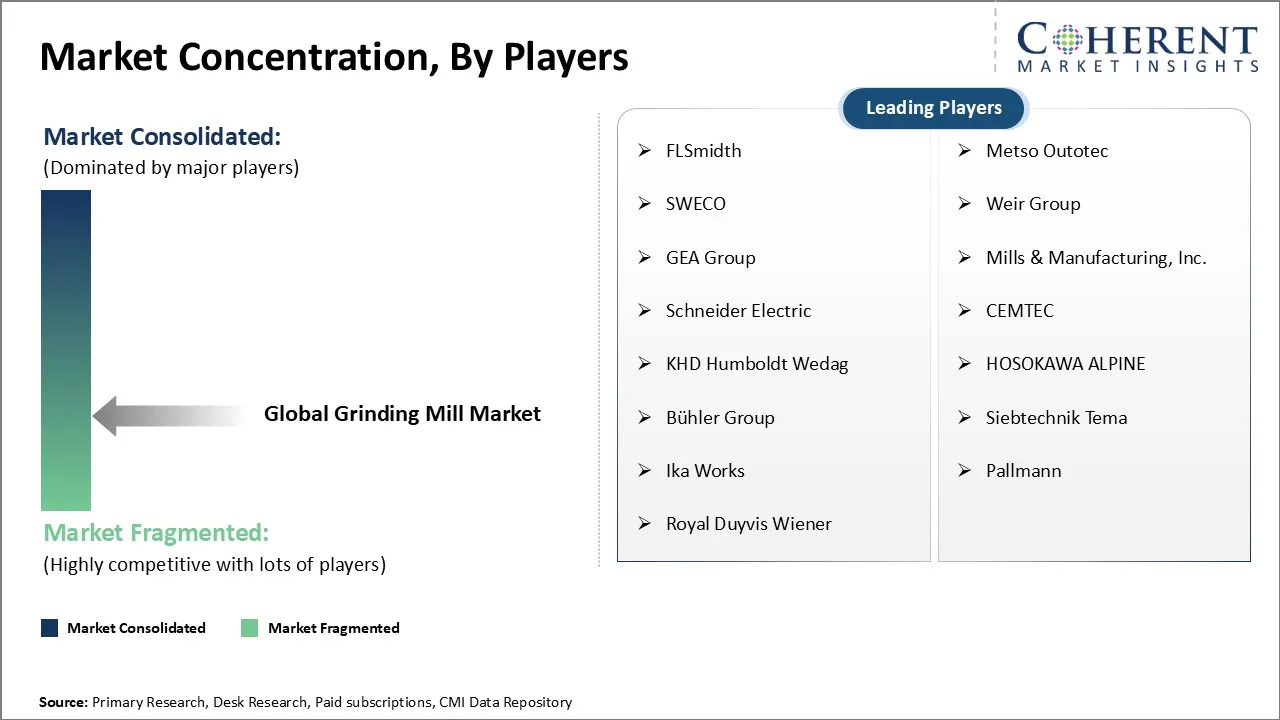
| Companies covered: | FLSmidth, Metso Outotec, SWECO, Weir Group, GEA Group, Mills & Manufacturing, Inc., Schneider Electric, CEMTEC, KHD Humboldt Wedag, HOSOKAWA ALPINE, Bühler Group, Siebtechnik Tema, Ika Works, Pallmann, and Royal Duyvis Wiener | ||
| Growth Drivers: |
| ||
| Restraints & Challenges: |
| ||
Grinding Mill Market Dynamics
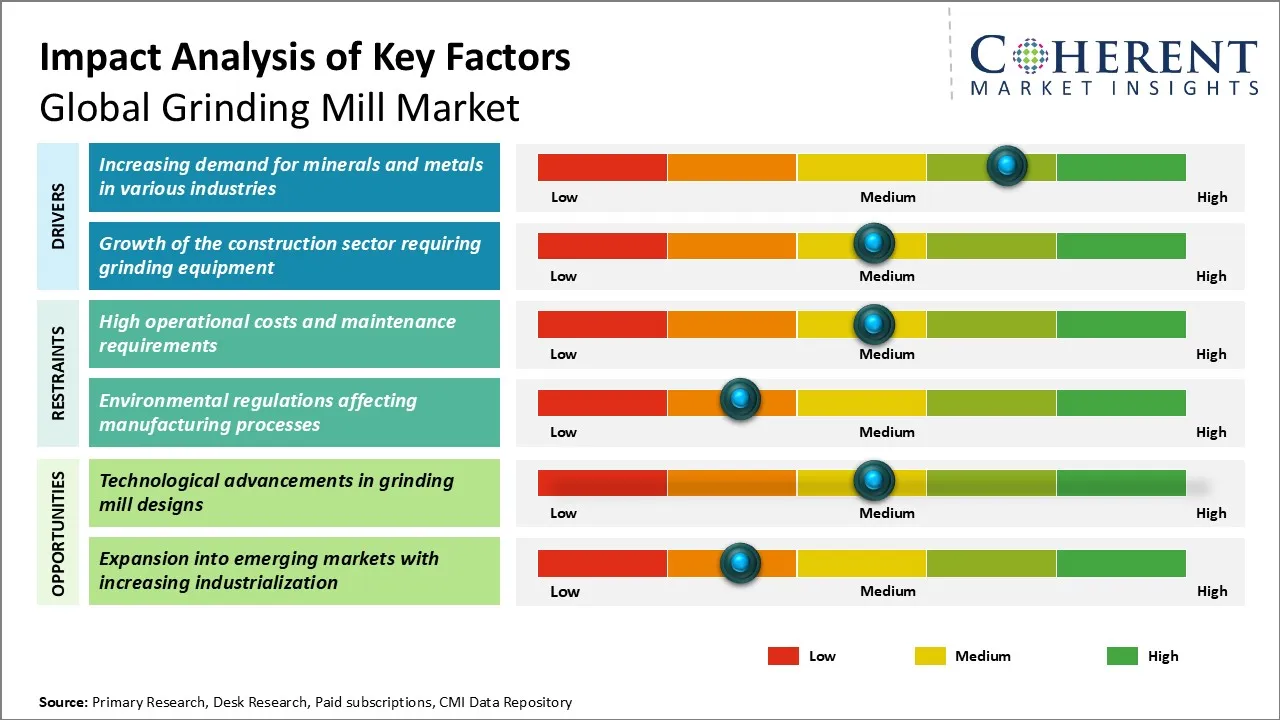
Grinding Mill Market Driver - Increasing Demand for Minerals and Metals in Various Industries
The escalating demand for minerals and metals in sectors such as automotive, construction, electronics, and aerospace are significantly propelling the need for efficient grinding mill machines. As these industries expand and modernize, there is a growing requirement to process raw ores into finer particles for further refinement and manufacturing. Grinding mills play a crucial role in reducing large chunks of mined materials to powder or smaller sizes, enabling easier extraction of valuable metals like iron, copper, and aluminum. Additionally, the surge in infrastructural development and technological advancements in manufacturing emphasizes the importance of high-quality, finely ground mineral inputs.
The shift towards electric mobility has increased the global demand for lithium, nickel, cobalt, and copper—crucial materials for batteries and electric motor systems. For instance, Global EV Outlook 2024 (IEA) forecasts a 7-fold increase in lithium demand by 2030 to meet the requirements of electric vehicle batteries.
Grinding Mill Market Opportunity - Technological Advancements in Grinding Mill Designs
The global grinding mill market presents significant growth opportunities, driven by continuous technological advancements in grinding mill designs. Innovations such as automation, incorporation of advanced materials, and enhanced power efficiency are transforming traditional grinding mills into highly sophisticated systems. Cutting-edge developments like smart sensors and IoT integration enable real-time monitoring and control, improving operational efficiency and reducing downtime.
For instance, Solutions such as the W22 Magnet IE4 Super Premium and IE5 Ultra-Premium motors, when paired with advanced variable speed drives like the CFW11, have been shown to reduce electricity consumption by up to 35% in ball mill applications.
Analyst Opinion (Expert Opinion)
- The global grinding mill market is experiencing a transformative phase, primarily driven by advancements in technology and the growing demand for efficient milling solutions across various industries. Companies like FLSmidth and Metso Outotec are innovating with high-performance grinding mills that enhance energy efficiency and reduce operational costs.
- Recent conferences, such as the Minerals Processing and Metallurgy Conference (2023) and the International Powder & Bulk Solids Conference (2022), have underscored the market's evolution, showcasing breakthroughs in mill design and automation that significantly improve productivity. Case studies presented at these events highlighted successful implementations where modern grinding solutions have optimized processes in sectors like mining and food production.
- The increasing focus on sustainability is pushing manufacturers to develop eco-friendly grinding technologies that minimize waste and energy consumption. As industrial applications continue to expand and the need for customized grinding solutions grows, the global grinding mill market stands poised for substantial growth. The convergence of technological innovation, sustainability initiatives, and rising demand across diverse sectors will be pivotal in shaping the future landscape of this market, making it a critical area for investment and development.
Speak to the analyst
Want personalized insights?
Take the findings above to one of our principal consultants, or have the report rebuilt around the segments, geographies and competitors you actually track.
Market Segmentation
- Component Insights (Revenue, USD Mn, 2021 - 2033)
- Heads
- Shells
- Gears and Pinions
- Main Bearings
- Trunnions
- Trunnion liners
- Other Components
- Mill Type Insights (Revenue, USD Mn, 2021 - 2033)
- Horizontal Grinding Mills
- Vertical Rolling Mills
- Capacity Insights (Revenue, USD Mn, 2021 - 2033)
- Above 10 TPH
- 1 to 10 TPH
- Less than 1 TPH
- Product Type Insights (Revenue, USD Mn, 2021 - 2033)
- Wet Grinding Mills
- Dry Grinding Mills
- End-use Industry Insights (Revenue, USD Mn, 2021 - 2033)
- Mining and Metallurgy
- Construction
- Chemical and Petrochemical
- Food and Beverage
- Power Generation
- Others
- Regional Insights (Revenue, USD Mn, 2021 - 2033)
- North America
- U.S.
- Canada
- Latin America
- Brazil
- Argentina
- Mexico
- Rest of Latin America
- Europe
- Germany
- U.K.
- Spain
- France
- Italy
- Russia
- Rest of Europe
- Asia Pacific
- China
- India
- Japan
- Australia
- South Korea
- ASEAN
- Rest of Asia Pacific
- Middle East
- GCC Countries
- Israel
- Rest of Middle East
- Africa
- South Africa
- North Africa
- Central Africa
- North America
- Key Players Insights
- FLSmidth
- Metso Outotec
- SWECO
- Weir Group
- GEA Group
- Mills & Manufacturing, Inc.
- Schneider Electric
- CEMTEC
- KHD Humboldt Wedag
- HOSOKAWA ALPINE
- Bühler Group
- Siebtechnik Tema
- Ika Works
- Pallmann
- Royal Duyvis Wiener
Sources
Primary Research Interviews
- R&D Director – Leading Grinding Mill Manufacturer (e.g. ball/vertical/SAG mills)
- Procurement Manager – Major industrial equipment reseller or end‑user
- Product Development Head – Well‑known mill equipment brand
- Sustainability Manager – Certification body or industry standards authority validating sustainability credentials (e.g. energy‑efficient mills)
Stakeholders
- Manufacturers (OEMs of ball, vertical roller, SAG, rod mills, etc.)
- End-use Sectors:
- Mining & mineral processing
- Cement production
- Construction (sand/gravel grinding)
- Food & agriculture processing (e.g. grain milling)
- Regulatory & Certification Bodies (such as industry associations, environmental regulators influencing equipment standards)
- E commerce Platforms and Retailers (distributors and online sales platforms for industrial equipment)
Databases
- UN Comtrade Database (international trade data)
- National import-export databases (e.g. India EXIM stats)
- India Import Export (EXIM) Database
Magazines
- International Mining – Trends in grinding technologies and market demand
- Global Cement Magazine – Innovations and upgrades in milling for cement production
- Plant & Machinery – Developments in industrial milling and automation
- Mining Weekly – Business news and growth drivers for milling in mining
- Industrial Minerals – Applications and market opportunities for grinding solutions
Journals
- Minerals Engineering – Advances in grinding circuit design and energy efficiency
- Powder Technology – Material science and surface engineering for mills
- International Journal of Mineral Processing – Process optimization in grinding mills
- Journal of Cleaner Production – Environmental impacts and sustainability in milling
Newspapers
- The Financial Times – Market analysis and M&A deals in equipment manufacturing
- Mining Journal – Industry growth and infrastructure trends
- Nikkei Asia – Asia-Pacific regional manufacturing and mining investments
- South China Morning Post – Industrial development and environmental trends
Associations
- International Mineral Processing Council (IMPC)
- European Federation of Chemical Engineering (EFCE)
- National Mining Association (NMA, US)
- CEMBUREAU – European Cement Association
- World Cement Association (WCA)
Public Domain Sources
- U.S. Department of Energy – Manufacturing energy consumption and technology benchmarking
- India Ministry of Heavy Industries – Industrial machinery standards
- World Bank – Market drivers and trends for industrial machinery
- European Commission – Machinery Directive compliance and updates
Proprietary Elements
- CMI Data Analytics Tool, Proprietary CMI Existing Repository of information for last 8 years.
Get access to 250+ pages report
Every segment, forecast, competitor profile and data table behind the analysis above — available for instant download.
- ESOMAR Member
- ISO 9001:2015 Certified
- D-U-N-S Registered
- GDPR & CCPA Compliant
Missing comfort of reading report in your local language? Find your preferred language:
Transform your Strategy with Exclusive Trending Reports
Frequently Asked Questions
The global grinding mill market is estimated to be valued at USD 13,200.4 Mn in 2026 and is expected to reach USD 21,758.0 Mn by 2033.
The CAGR of global grinding mill market is projected to be 7.4% from 2026 to 2033.
Increasing demand for minerals and metals in various industries and growth of the construction sector requiring grinding equipment are the major factors driving the growth of global grinding mill market.
High operational costs and maintenance requirements and environmental regulations affecting manufacturing processes are the major factors hampering the growth of global grinding mill market.
In terms of Component, Heads areestimated to dominate the market revenue share in 2026.
FLSmidth, Metso Outotec, SWECO, Weir Group, GEA Group, Mills & Manufacturing, Inc., Schneider Electric, CEMTEC, KHD Humboldt Wedag, HOSOKAWA ALPINE, Bühler Group, Siebtechnik Tema, Ika Works, Pallmann, and Royal Duyvis Wiener are the major players in the global grinding mill market.
Asia Pacific is expected to lead the global grinding mill market in 2026.