

Global High-Bandwidth Memory Market Size and Forecast – 2026 To 2033
The global high-bandwidth memory market is expected to grow from USD 9 Bn in 2026 to USD 46 Bn by 2033, registering a compound annual growth rate (CAGR) of 26% from 2026 to 2033. The global high-bandwidth memory market is driven by the growing expansion of hyperscale cloud data centers. On December 9, 2025, Microsoft announced its largest investment in Asia Pacific of USD 17.5 billion over four years (CY 2026 to 2029), to advance India’s cloud and artificial intelligence (AI) infrastructure, skilling and ongoing operations. (Source: Microsoft)
Key Takeaways of the Global High-Bandwidth Memory Market
- The HBM1 segment is expected to account for 42.0 % of the global high-bandwidth memory market share in 2026. Rising demand for advanced GPUs and AI accelerators is driving the growth of the segment. On June 12, 2025, AMD launched the AMD Instinct MI350 Series, delivering up to 4x generation-on-generation AI compute improvement and up to 35x leap in inferencing performance. (Source: AMD)
- The artificial intelligence segment is estimated to capture 31.0 % of the market share in 2026. Expansion of AI infrastructure spending globally is driving the growth of the segment. On June 5, 2026, Air Trunk, backed by Blackstone, revealed plans to invest approximately USD 30 billion over the next three to five years in AI-focused data center developments throughout India.
- Asia Pacific is expected to dominate the high-bandwidth memory market in 2026 with a market share of 61.0 %. Adoption of HBM in edge AI platforms across Asia Pacific is driving the growth of the regional market. On June 4, 2026, Taiwan's Foxconn announced a strategic partnership with Intel Corp. to jointly develop AI infrastructure, edge AI and physical AI solutions.
- North America is expected to account for 23.0 % share in 2026 and is projected to record the fastest growth over the forecast period. Increasing adoption of generative AI and large language models in North America is primarily driving the growth of the regional market. On February 24, 2025, Anthropic announced the launch of Claude 3.7 Sonnet, a next-generation big language model that features hybrid reasoning capabilities, letting users choose between fast responses and prolonged reasoning modes for challenging tasks.
- Rapid Transition Toward HBM4 and Higher-Layer Memory Stacks: The industry is transitioning from HBM3E to HBM4 designs, with manufacturers creating 12-layer and 16-layer stacked memory solutions that provide much higher bandwidth, better power efficiency and bigger memory capacity. These innovations are becoming essential for next generation AI training clusters, exascale computing systems and high end graphic processing.
- Increasing Integration of HBM with AI Accelerators and Custom ASICs: As generative AI workloads become more complicated, AI chip designers are progressively integrating HBM directly with GPUs, AI accelerators, and custom ASICs. This allows for faster data processing, lower latency and improved performance for large language models, recommendation engines and AI inference applications.
Segmental Insights
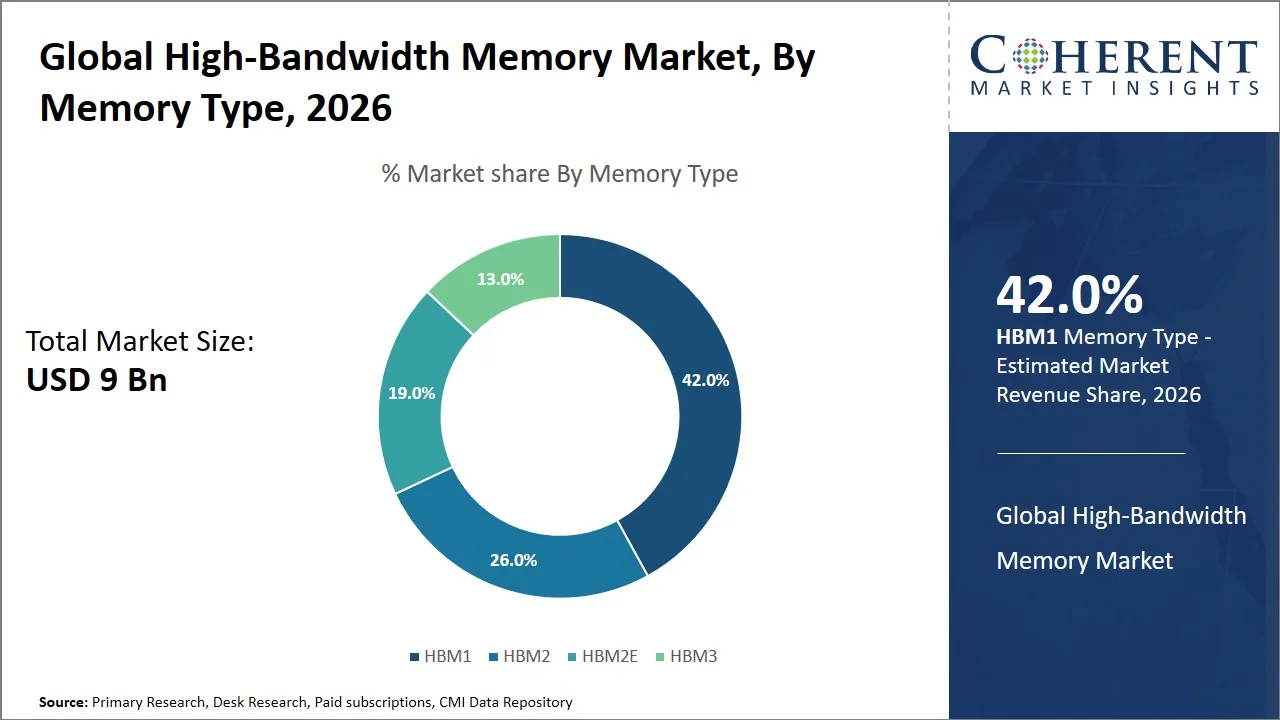
Why Does HBM1 Dominate the Global High-Bandwidth Memory Market?
The HBM1 segment is expected to account for 42.0% of the global high-bandwidth memory market share in 2026. Due to its early adoption and its proven integration in first-generation HBM-enabled systems, HBM1 still has a considerable installed base in legacy high-performance computing and graphics applications. Many existing installations in industrial, research and enterprise environments are still in use and provide enough performance for the needs, allowing enterprises to prolong hardware lifecycles and postpone expensive upgrades to newer HBM generations. The ongoing use of legacy infrastructure keeps HBM1 relevant in the market while more sophisticated memory technologies emerge. On June 22, 2026, AMD launched FSR 4.1 compatibility for previous Radeon GPU generations, meaning older graphics hardware doesn't have to be replaced right away and can stay viable. This is indicative of sustained industry support for older GPU installations, including systems delivered during the early adoption era of HBM-enabled graphics architectures.
- Current Industry Events of 2026
- Market Size Estimation
- Regional Breakdown
- Competitive Landscape
- Customer Intelligence
- Segmental Analysis
- Pricing Analysis
- Key Market Drivers, Challenges & Future Trends
- Customized Insights Section
Why is Artificial Intelligence the Most Widespread Application?
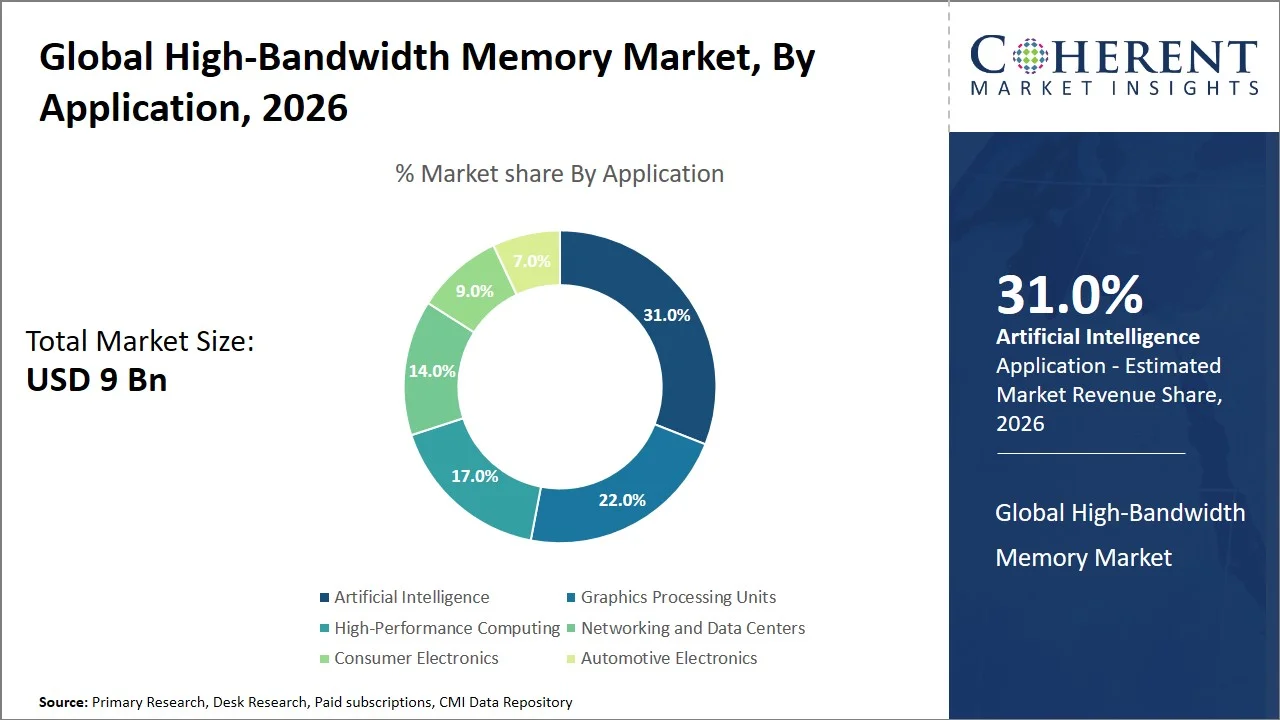
The artificial intelligence segment is expected to account for 31.0% of the global high-bandwidth memory market share in 2026. Artificial intelligence is the most common use case for high-bandwidth memory. Modern AI training and inference workloads require the rapid movement of massive data sets between processors and memory.” HBM is a vital technology to remove the data bottlenecks and maximize the performance of accelerators. Generative AI systems and other advanced machine learning algorithms, such as large language models, require exceptionally high memory bandwidth to efficiently process billions of parameters. The rising demand for HBM-enabled processors due to AI infrastructure scaling by corporations, cloud providers and research institutions highlights the technology’s importance in the artificial intelligence ecosystem. On March 19, 2025, NVIDIA announced the newest evolution of the Blackwell AI manufacturing platform, the Blackwell Ultra, geared to deliver AI reasoning. NVIDIA Blackwell Ultra boosts training and test-time scaling inference, assisting enterprises to boost accuracy and expedite applications such as AI reasoning, agentic AI and physical AI.
Currents Events and their Impact
Current Events | Description and its Impact |
U.S. - Framework for Artificial Intelligence Diffusion (2025) |
|
U.S. - Export Controls on High-Bandwidth Memory (HBM) and Advanced Semiconductors (2025) |
|
High-Bandwidth Memory Market Dynamics
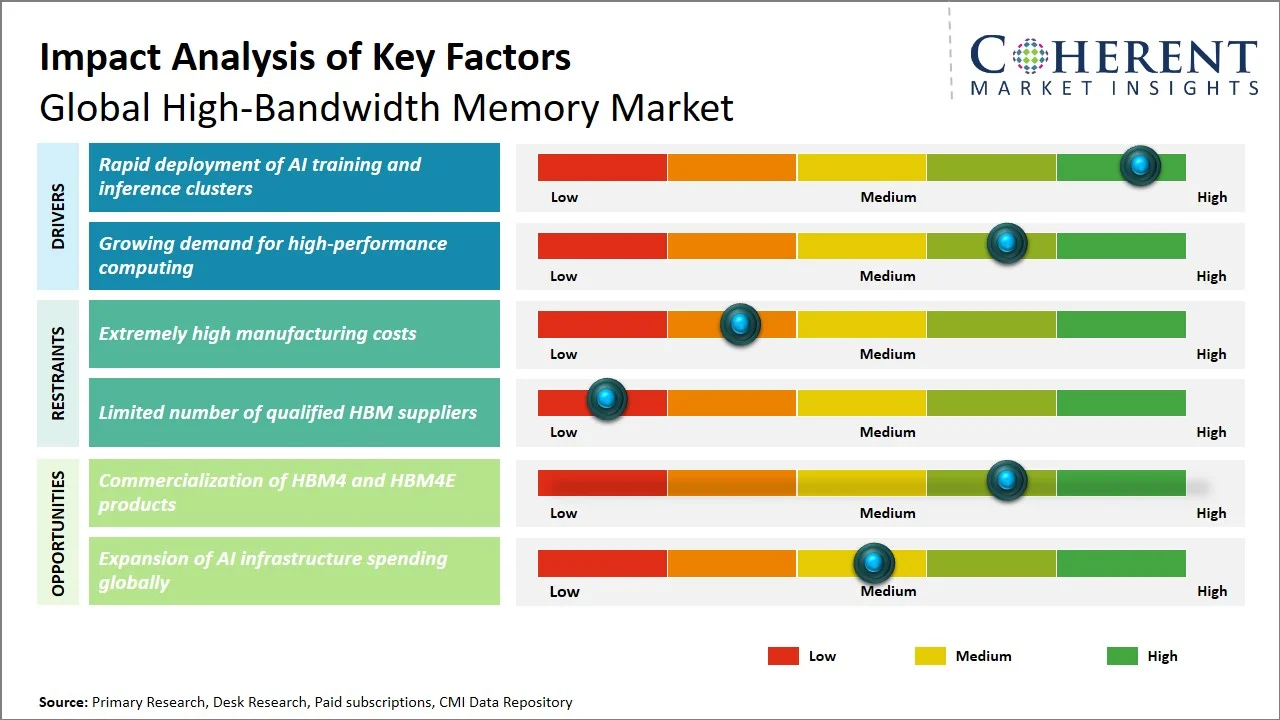
Market Drivers
Rapid deployment of AI training and inference clusters
As enterprises ramp up their computing infrastructure to serve increasingly sophisticated artificial intelligence workloads, the rapid deployment of AI training and inference clusters is considerably accelerating the demand for high-bandwidth memory. HBM is a key feature of today's AI accelerators and GPUs, since large language models, generative AI applications, recommendation engines, and advanced analytics all demand tremendous data throughput and low latency memory access. As hyperscale cloud providers and corporations and research institutions continue to invest in large-scale AI data centers, the requirement for high-capacity, high-performance memory solutions is expanding, resulting in widespread adoption of advanced HBM technologies across the global semiconductor ecosystem.
On September 11, 2024, Oracle announced the first zettascale cloud computing clusters accelerated by the NVIDIA Blackwell platform. Oracle Cloud Infrastructure (OCI) is now taking orders for the largest AI supercomputer in the cloud, available with up to 131,072 NVIDIA Blackwell GPUs. (Source: Oracle)
Growing demand for high-performance computing
High-performance computing demand is driving the adoption of high-bandwidth memory, as HPC systems require high data processing speeds to handle complex simulations, scientific research, weather forecasting, engineering design, and large-scale data analytics. The computational power of CPUs has always exceeded that of memory technologies , causing a performance bottleneck. This problem is being addressed by high-bandwidth memory that provides much higher data transfer rates and improved energy efficiency to enable supercomputers and advanced computing platforms to process massive workloads more efficiently and continue enabling advances in research, industrial and enterprise computing applications.
On October 27, 2025, AMD and the U.S. Department of Energy (DOE) announced two next-generation systems at Oak Ridge National Laboratory (ORNL) designed to expand America’s leadership in artificial intelligence (AI) and high-performance computing (HPC), the Lux AI supercomputer and the Discovery supercomputer. Discovery and Lux will be DOE flagship supercomputers designed to drive breakthroughs in science, energy, and national security.
Emerging Trends
- Expansion of Advanced Packaging Technologies: The HBM ecosystem is being accelerated by 2.5D and 3D semiconductor packaging technologies, including chiplet designs and silicon interposers. Data-center and HPC environments are increasingly reliant on advanced packaging solutions to connect HBM stacks to high-performance CPUs, while increasing bandwidth density and decreasing power consumption.
- Growing Investments in AI Data Centers and Sovereign AI Infrastructure: Strong demand for high-capacity HBM solutions is being driven by government, hyperscale cloud provider, and enterprise investments in AI data centers and sovereign AI infrastructure. The long-term growth in HBM deployment in cloud, enterprise and research infrastructure is driven by the demand to handle ever larger AI models and high-performance computing workloads.
Regional Insights
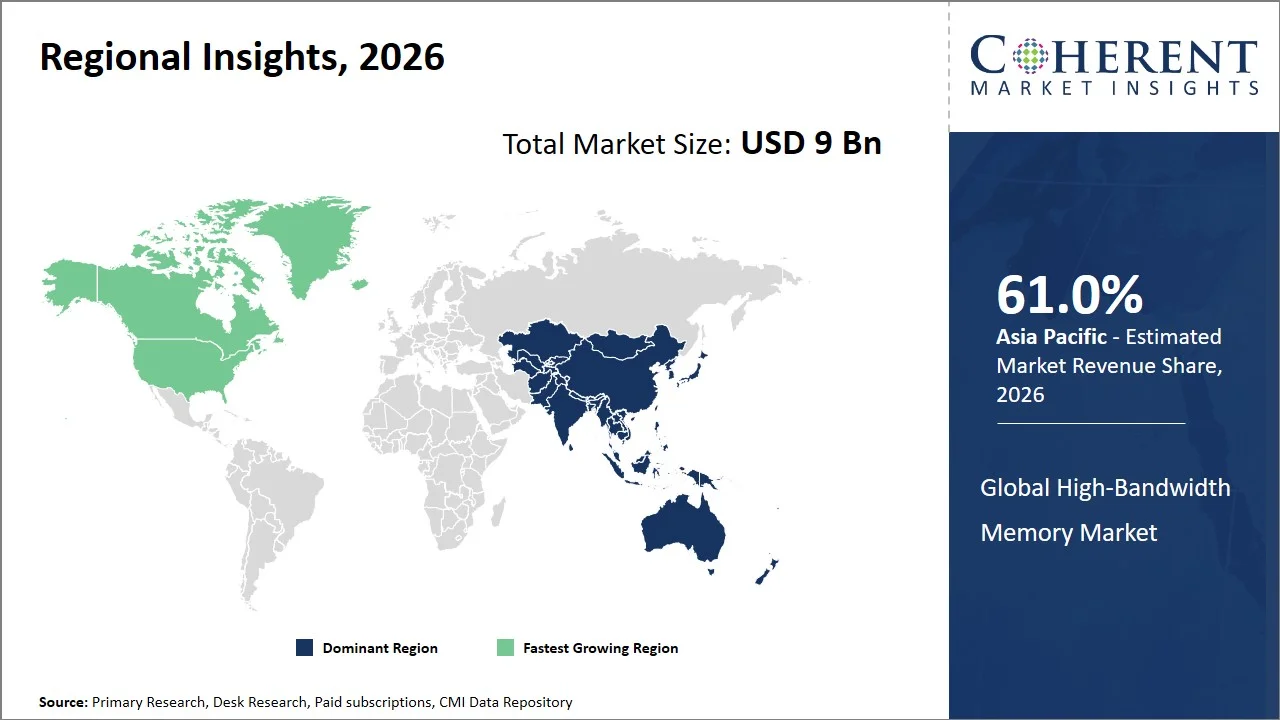
Why is Asia Pacific a Strong Market for High-Bandwidth Memory?
Asia Pacific is expected to account for a market share of 61.0% in 2026. South Korea, Taiwan, Japan and China account for most of the manufacture of memory, sophisticated semiconductor packaging and AI hardware, making Asia Pacific the epicenter of the global high-bandwidth memory ecosystem. Samsung Electronics and SK hynix also have a leadership advantage in HBM development, while TSMC is expanding its CoWoS advanced packaging capability to serve AI accelerators from NVIDIA, AMD and other chip makers. Also, regional governments are pushing semiconductor investments, with Japan giving incentives for advanced memory manufacture and China increasing domestic AI chip development to lessen dependence on imported technology. On December 25, 2025, SoftBank Corp. announced the launch of an AI computing platform powered by the NVIDIA GB200 NVL72, marking a major milestone in the enhancement of Japan's domestic AI infrastructure.
Why Does the North America High-Bandwidth Memory Market Exhibit High Growth?
North America is projected to account for 23.0% of the global high-bandwidth memory market and expected to register the fastest growth. North America is a crucial center for demand for high-bandwidth memory, owing to its dominance in artificial intelligence infrastructure and advanced computing. The likes of NVIDIA, AMD, Intel, Microsoft, Amazon, Google and Meta are all rolling out increasingly powerful AI training clusters that rely largely on HBM-equipped accelerators. The NVIDIA Blackwell platform and AMD Instinct AI accelerators have greatly boosted demand for next-gen HBM3E and future HBM4 products, and the nationwide development of hyperscale data centers continues to drive memory usage for generative AI workloads. On April 5, 2025, Meta launched Llama 4 Maverick and Llama 4 Scout, increasing access to open-weight base models for a wider range of organizations and developers. The release accelerated the adoption of generative AI tremendously, enabling enterprises to implement state-of-the-art AI capabilities while preserving a greater level of control over customization and deployment environments.
Global High-Bandwidth Memory Market Outlook for Key Countries
Why is China Emerging as a Major Hub in the High-Bandwidth Memory Market?
China is investing aggressively in AI, indigenous semiconductor research and sophisticated computing infrastructure, all helping it make inroads in the high-bandwidth memory market. Companies including Huawei and a number of domestic AI chip developers are stepping up attempts to offer alternatives to imported AI technology, boosting demand for domestically supplied sophisticated memory technologies. As China confronts export limitations on advanced semiconductors, its companies are accelerating research in memory technology and advanced packaging capabilities to bolster national AI and supercomputing ambitions.
Is the U.S. the Next Growth Engine for the High-Bandwidth Memory Market?
The U.S. is a key driver of worldwide high-bandwidth memory demand given its expertise in AI accelerator design and cloud computing. Rapid deployment of NVIDIA’s Blackwell-based systems, continuous development of AMD’s Instinct GPU capabilities and Intel’s AI-focused processor roadmap are driving high-capacity HBM solutions. Major cloud providers like Microsoft Azure, Amazon Web Services and Google Cloud are also making big bets in AI infrastructure, driving large-scale buying of HBM-enabled CPUs for training and inference applications.
Taiwan High-Bandwidth Memory Market Analysis and Trends
Taiwan’s critical position in the high-bandwidth memory value chain is because it is home to the world’s most advanced semiconductor production and packaging ecosystem. TSMC's superior CoWoS packaging technology has become a must-have to enable the integration of HBM stacks with AI accelerators and high-performance processors, with the company expanding packaging capacity regularly to satisfy customer demand. The island’s semiconductor supply chain, including packaging and testing professionals, continues to serve the expanding production needs of global AI hardware makers.
Japan High-Bandwidth Memory Market Analysis and Trends
Japan is improving its position in the high-bandwidth memory market with targeted investments in semiconductors manufacturing and advanced materials. Micron to expand advanced memory efforts in Hiroshima with Japanese government backing to develop next-generation high-bandwidth memory for AI applications Japan continues to be a key contributor to the global HBM supply chain, fueled by the country’s expertise in semiconductor materials, manufacturing equipment and precision technologies as demand for advanced memory and packaging solutions rises.
South Korea High-Bandwidth Memory Market Analysis and Trends
South Korea is one of the world’s leading producer of high-bandwidth memory, led by Samsung Electronics and SK hynix. SK hynix has become a significant provider of HBM3E products for top AI accelerator manufacturers, while Samsung is committed to the development of next-generation HBM4 and advanced memory packaging technologies. Owing to close cooperation between memory makers, equipment suppliers and government-backed semiconductor programs, South Korea has kept its technological edge in the fast-growing AI memory sector.
Global High-Bandwidth Memory Market - Base Station Antennas Installed Annually
Year | North America | Asia Pacific | Europe | Latin America | Middle East & Africa |
2024 | 6.3 | 9.8 | 1.7 | 0.4 | 0.3 |
2025 | 10.8 | 16.2 | 2.9 | 0.7 | 0.6 |
2026 | 17.6 | 25.4 | 4.9 | 1.1 | 0.8 |
How is Commercialization of HBM4 and HBM4E Products Creating New Growth Opportunities in the High-Bandwidth Memory Market?
Commercialization of HBM4 and HBM4E products is unlocking significant growth opportunities in the high-bandwidth memory market by providing substantially higher memory bandwidth, capacity and power efficiency for next-generation artificial intelligence, high-performance computing and data center applications. These innovative memory solutions are expected to help enable more complicated AI models and data-intensive workloads that require more data transmission between processors and memory, which will assist in removing performance bottlenecks for advanced accelerators and GPUs. The adoption of next generation AI infrastructure by semiconductor companies, cloud service providers and hyperscale data center operators will drive accelerated demand for HBM4 and HBM4E, spurring investments in memory manufacturing, advanced packaging technologies and semiconductor supply chain expansion while creating new revenue opportunities across the broader AI hardware ecosystem. On May 29, 2026, Samsung Electronics announced that it has begun shipping the industry’s first 12-layer HBM4E samples to major global customers, further strengthening its leadership in the next-generation HBM market. (Source: Samsung)
Market Players, Key Development, and Competitive Intelligence
Key Developments
- On March 18, 2026, Micron Technology, Inc. announced that it has begun volume shipment of its HBM4 36GB 12H in the first quarter of calendar year 2026 and is designed for NVIDIA Vera Rubin. With HBM4, Micron achieves over 11 Gb/s pin speeds, enabling a bandwidth greater than 2.8 TB/s, representing a 2.3 times bandwidth and greater than 20% power efficiency2 improvement over its HBM3E.
- On February 12, 2026 Samsung Electronics announced that it has begun mass production of its industry-leading HBM4 and has shipped commercial products to customers. This achievement marks a first in the industry, securing an early leadership position in the HBM4 industry.
Competitive Landscape
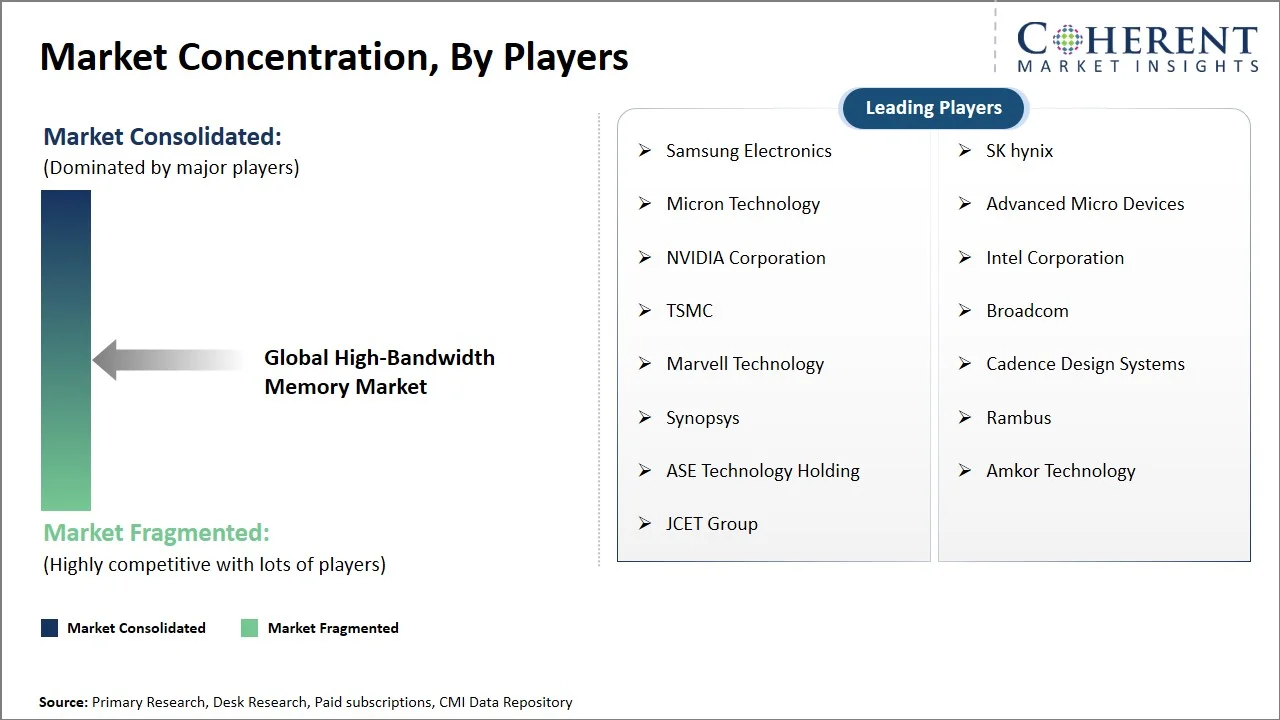
The worldwide high-bandwidth memory market is extremely concentrated, with Samsung Electronics, SK hynix and Micron Technology dominating advanced HBM production. The race is heating up around the development of HBM3E, HBM4 and future memory architectures and the signing of long-term supply deals with AI accelerator makers and hyperscale data center operators. Key market players are making strategic investments in advanced packaging technologies, manufacturing capacity expansion, and R&D to strengthen their market positions. Collaborations among memory suppliers, foundries, and AI chip developers are increasingly vital to meet growing demand for artificial intelligence and high-performance computing applications.
Market Report Scope
High-Bandwidth Memory Market Report Coverage
| Report Coverage | Details | ||
|---|---|---|---|
| Base Year: | 2025 | Market Size in 2026: | USD 9 Bn |
| Historical Data for: | 2020 To 2024 | Forecast Period: | 2026 To 2033 |
| Forecast Period 2026 to 2033 CAGR: | 26% | 2033 Value Projection: | USD 46 Bn |
| Geographies covered: |
| ||
| Segments covered: |
| ||
| Companies covered: | Samsung Electronics, SK hynix, Micron Technology, Advanced Micro Devices, NVIDIA Corporation, Intel Corporation, TSMC, Broadcom, Marvell Technology, Cadence Design Systems, Synopsys, Rambus, ASE Technology Holding, Amkor Technology, and JCET Group | ||
| Growth Drivers: |
| ||
| Restraints & Challenges: |
| ||
Analyst Opinion (Expert Opinion)
- The high-bandwidth memory market is moving to a phase of steady growth supported by the rapid emergence of artificial intelligence infrastructure and advanced computing systems. Demand is likely to remain robust as more advanced AI models necessitate greater memory bandwidth and capacity, and technological improvements in memory stacking and packaging are expected to enhance performance and efficiency. Scale manufacturing, increase yields and develop strategic relationships across the semiconductor value chain are likely to confer competitive benefits for enterprises.
- The extensive usage of HBM4 and next-generation memory technologies across artificial intelligence, cloud computing, networking, and supercomputing applications is likely to create significant growth prospects. Capital expenditures in enhanced semiconductor packaging, memory foundries and data center infrastructure with an emphasis on AI to meet increasing performance needs will see growth. In the next years, we will see ongoing innovation in memory designs, wider adoption of AI accelerators, and increased worldwide efforts to boost the resilience and technological independence of the semiconductor supply chain.
Speak to the analyst
Want personalized insights?
Take the findings above to one of our principal consultants, or have the report rebuilt around the segments, geographies and competitors you actually track.
Market Segmentation
- Memory Type Insights (Revenue, USD Billion, 2021 - 2033)
- HBM1
- HBM2
- HBM2E
- HBM3
- Application Insights (Revenue, USD Billion, 2021 - 2033)
- Artificial Intelligence
- Graphics Processing Units
- High-Performance Computing
- Networking and Data Centers
- Consumer Electronics
- Automotive Electronics
- Regional Insights (Revenue, USD Billion, 2021 - 2033)
- North America
- U.S.
- Canada
- Latin America
- Brazil
- Argentina
- Mexico
- Rest of Latin America
- Europe
- Germany
- U.K.
- Spain
- France
- Italy
- Russia
- Rest of Europe
- Asia Pacific
- China
- India
- Japan
- Australia
- South Korea
- ASEAN
- Rest of Asia Pacific
- Middle East
- GCC Countries
- Israel
- Rest of Middle East
- Africa
- South Africa
- North Africa
- Central Africa
- North America
- Key Players Insights
- Samsung Electronics
- SK hynix
- Micron Technology
- Advanced Micro Devices
- NVIDIA Corporation
- Intel Corporation
- TSMC
- Broadcom
- Marvell Technology
- Cadence Design Systems
- Synopsys
- Rambus
- ASE Technology Holding
- Amkor Technology
- JCET Group
Sources
Primary Research Interviews
- Semiconductor Manufacturers & Chip Designers
- Data Center & Cloud Infrastructure Providers
- AI & HPC (High-Performance Computing) Solution Providers
- Memory Module Distributors & Supply Chain Executives
Magazines
- IEEE Spectrum
- EE Times (Electronic Engineering Times)
- Semiconductor Digest
- Electronics Weekly
Journals
- IEEE Journal of Solid-State Circuits
- Journal of Semiconductor Technology and Science
- Microelectronics Journal (Elsevier)
Associations
- JEDEC Solid State Technology Association
- Semiconductor Industry Association (SIA)
- SEMI (Semiconductor Equipment and Materials International)
- Global Semiconductor Alliance (GSA)
Public Domain Sources
- U.S. Department of Commerce – Semiconductor Reports
- European Semiconductor Industry Association (ESIA) Public Reports
- World Semiconductor Trade Statistics (WSTS)
- U.S. International Trade Commission (USITC) Reports
Proprietary Elements
- CMI Data Analytics Tool
- Proprietary CMI Existing Repository of Information for Last 10 Years
Get access to 250+ pages report
Every segment, forecast, competitor profile and data table behind the analysis above — available for instant download.
- ESOMAR Member
- ISO 9001:2015 Certified
- D-U-N-S Registered
- GDPR & CCPA Compliant
Missing comfort of reading report in your local language? Find your preferred language:
Transform your Strategy with Exclusive Trending Reports
Frequently Asked Questions
The global high-bandwidth memory market is expected to stand at USD 9 Bn in 2026 and is expected to reach USD 46 Bn by 2033.
The CAGR of the global high-bandwidth memory market is projected to be 26% from 2026 to 2033.
Rapid deployment of AI training and inference clusters and growing demand for high-performance computing are the major factors driving the growth of the global high-bandwidth memory market.
Extremely high manufacturing costs and limited number of qualified HBM suppliers are the major factors hampering the growth of the global high-bandwidth memory market.
TSVs are vertical electrical connections that link stacked memory layers to increase performance and reduce latency.
HBM removes memory bottlenecks by delivering extremely fast data transfer speeds required for complex computational workloads.
In terms of memory type, the HBM1 segment is estimated to dominate the market revenue share in 2026.