

Global High-Density Interconnect (HDI) PCB Market Size and Forecast – 2026-2033
The Global High-Density Interconnect (HDI) PCB Market is estimated to be valued at USD 21.54 Bn in 2026 and is expected to reach USD 40.15 Bn by 2033, exhibiting a compound annual growth rate (CAGR) of 9.3% from 2026 to 2033.
Key Takeaways of the Global High-Density Interconnect (HDI) PCB Market
- The FR4 segment is projected to lead the market holding a share of 32.8% in 2026.
- The smartphones and mobile devices segment is projected to dominate the market with a share of 30.2% in 2026.
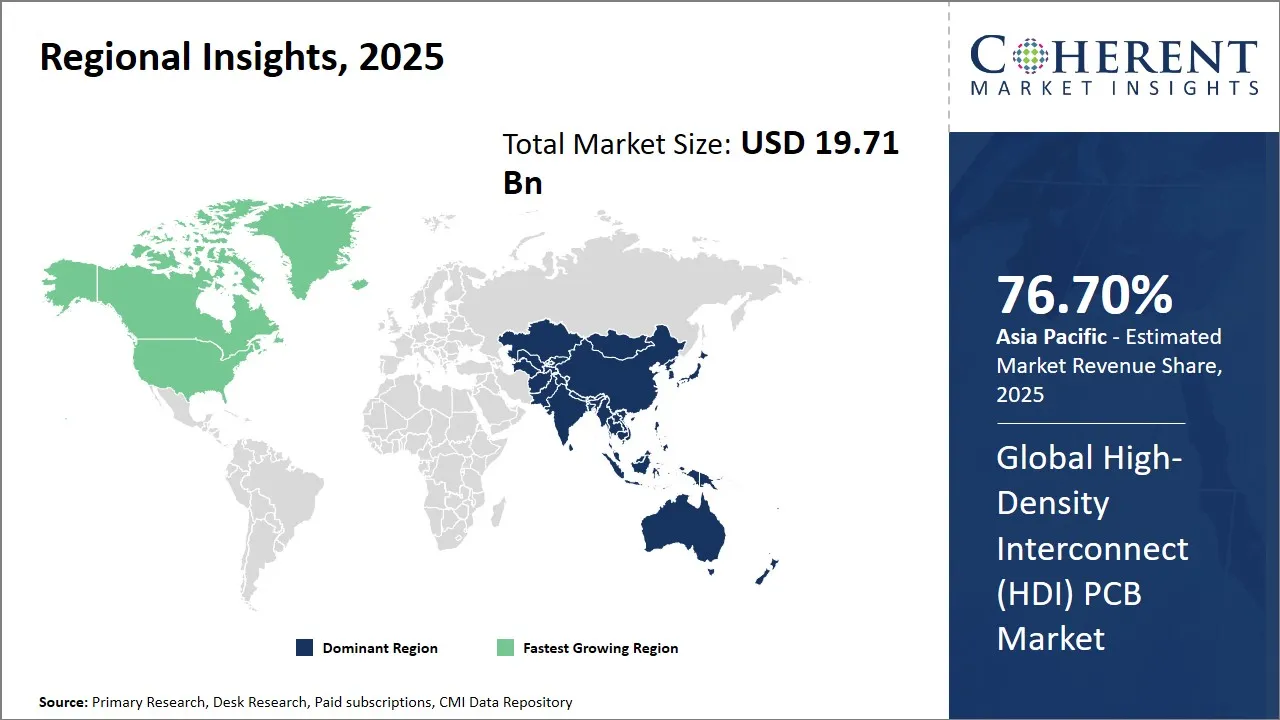
- Asia Pacific, holding a share of 76.7% in 2026, is projected to dominate the market.
- North America, holding a projected share of 9.8% in 2026, shows the fastest growth in the market.
Market Overview
The market sees a shift towards the use of HDI PCBs in compact and high-performance applications such as smartphones, automotive electronics, and medical devices. Also, emerging technologies like 5G and IoT are making demand for HDI PCBs due to their superior electrical performance, signal integrity, and reliability, positioning the market for sustained expansion over the forecast period.
Current Events and Its Impact
Current Events | Description and its Impact |
Geopolitical Tensions in the Taiwan Strait |
|
U.S. industrial policy/CHIPS & advanced packaging funding |
|
Copper price surge and trade measures (tariffs) |
|
Segmental Insights
- Current Industry Events of 2026
- Market Size Estimation
- Regional Breakdown
- Competitive Landscape
- Customer Intelligence
- Segmental Analysis
- Pricing Analysis
- Key Market Drivers, Challenges & Future Trends
- Customized Insights Section
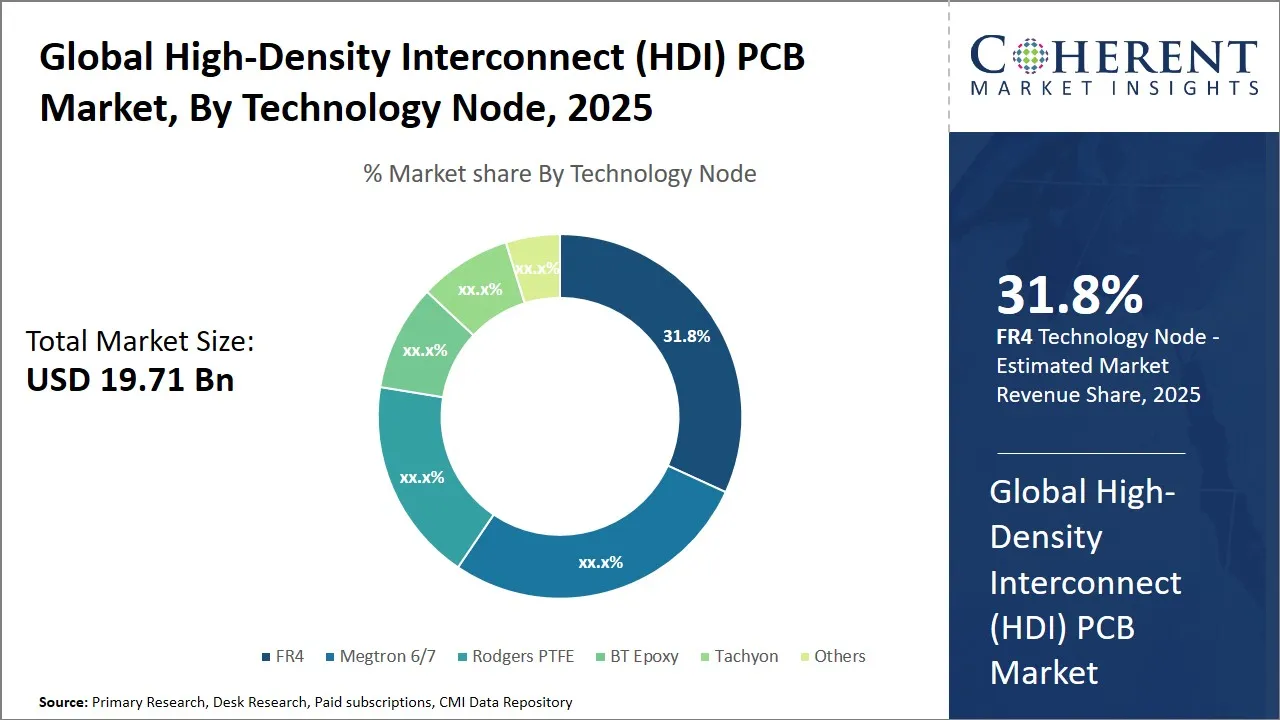
Global High-Density Interconnect (HDI) PCB Market Insights, By Technology Node – FR4 Leads Because of its Cost-Effectiveness and Versatility
The FR4 technology node is expected to dominate the global High-Density Interconnect (HDI) PCB market with a 32.8% share in 2026, because of its affordability, mechanical strength, and manufacturing versatility. As a glass-reinforced epoxy laminate, FR4 offers a balance between performance and cost, making it suited for mass-market applications in consumer electronics, computing, and automotive segments.
Its compatibility with existing PCB fabrication infrastructure makes its position stronger, making possible efficient production scalability and reduced lead times. Continuous resin and laminate improvements are also adding to FR4’s thermal and electrical properties, allowing it to compete closely with premium materials like Megtron 6 or Rogers PTFE.
In 2024, TTM Technologies added to its FR4-based HDI PCB capacity in its Shanghai plant to cater to growing demand from smartphone and wearable OEMs, citing cost efficiency and scalability as primary factors.
-pcb-market-by-application.webp "High-Density Interconnect (HDI) PCB Market, By Application")
Global High-Density Interconnect (HDI) PCB Market Insights, By Application – Smartphones and Mobile Devices Leads Because of the Relentless Demand for Miniaturization and Enhanced Functionality
Smartphones and mobile devices represent the largest application segment, accounting for an estimated 30.2% of the High-Density Interconnect (HDI) PCB market share in 2026. The segment leads because of the demand for thinner, lighter, and more powerful devices with 5G, AI, and high-resolution imaging capabilities. HDI PCBs support these innovations through dense interconnections and compact layouts, making possible device miniaturization without affecting functionality.
Also, the proliferation of wearables and tablets reinforces segment growth, as these devices rely on compact PCBs for energy efficiency and thermal stability. Frequent product refresh cycles in the mobile sector ensure consistent HDI PCB adoption. Zhen Ding Technology Holding (ZDT), a key Apple supplier, announced in June 2025 its increased HDI PCB shipments for the iPhone 16 series, because of the integration of advanced RF modules and thinner device architectures.
Pricing Analysis of the High-Density Interconnect (HDI) PCB Market
HDI PCB Type/Typical Specs | Prototype (1–5 pcs) USD | Low-volume (100–1,000 pcs) USD | High-volume (10,000+ pcs) USD |
4-layer FR4 HDI (microvias, 50 cm²) | USD 25 – USD 120 | USD 4 – USD 18 | USD 0.40 – USD 1.20 |
6-layer HDI (blind/buried vias, 50 cm²) | USD 80 – USD 400 | USD 15 – USD 60 | USD 1.80 – USD 3.80 |
Advanced 8+ layer HDI/High-density multi-stack (microvias + buried, 50–100 cm²) | USD 200 – USD 900 | USD 50 – USD 200 | USD 5.00 – USD 25.00 |
Smartphone production HDI (high-spec FR4/low-loss hybrid, small area ~30–60 cm²) | USD 15 – USD 120 (depending on complexity) | USD 3 – USD 12 | USD 0.80 – USD 6.00 (OEM contract pricing) |
Rigid-Flex HDI (FR4 + polyimide layers) | USD 150 – USD 800 | USD 40 – USD 250 | USD 8 – USD 60 |
Rogers/High-frequency HDI (PTFE/Megtron) | USD 200 – USD 1,200 | USD 75 – USD 400 | USD 15 – USD 200 |
Small prototype PCBA (HDI PCB + SMT of simple BOM) | USD 300 – USD 1,200 per panel | N/A (quoted per assembly) | N/A |
Regional Insights
Asia Pacific High-Density Interconnect (HDI) PCB Market Analysis and Trends
The Asia Pacific region, holding a share of 76.7% in 2026, is expected to dominate the global High-Density Interconnect (HDI) PCB market driven by a robust manufacturing ecosystem, extensive electronics supply chains, and strong government support for advanced electronics industries. Countries like China, Japan, South Korea, and Taiwan are important hubs, hosting a lot of PCB manufacturers, contract electronics manufacturers, and end-user industries.
Government initiatives supporting technological innovation, export incentives, and infrastructure development have further strengthened the region's position. The presence of big players like Unimicron Technology Corp., Ibiden Co., Ltd., and Samsung Electro-Mechanics contributes a lot to the advanced manufacturing capabilities and R&D of HDI PCBs in Asia Pacific. Also, the region sees well-established trade networks and access to raw materials, allowing efficient production and distribution globally.
North America High-Density Interconnect (HDI) PCB Market Analysis and Trends
North America, holding a share of 9.8% in 2026, is expected to exhibit the fastest growth in the High-Density Interconnect (HDI) PCB market, fueled by escalating demand for high-performance electronics in sectors such as aerospace, defense, medical devices, and next-generation communication systems. The U.S. has a vibrant ecosystem of research institutions and high-tech firms investing heavily in innovation involving HDI PCB technologies.
Strong government policies for domestic manufacturing revitalization, defense modernization programs, and incentives for innovation also add to market expansion. Companies like TTM Technologies, Sanmina Corporation, and Multek play big roles in advancing HDI PCB manufacturing solutions and driving product adoption in industries. The focus on supply chain security alongside increasing collaborations between industry and federal agencies also adds to the market's pace in North America.
High-Density Interconnect (HDI) PCB Market Outlook for Key Countries
China High-Density Interconnect (HDI) PCB Market Analysis and Trends
China is a crucial backbone of the global HDI PCB ecosystem due to its large-scale electronics manufacturing industry and rapidly growing consumer electronics sector. Big enterprises like Shenzhen Suntak Technology and Kingboard Chemical Holdings are very important in developing innovative multilayer HDI PCBs catering to smartphones, 5G infrastructure, and automotive electronics. China’s integration into global supply chains drives capacity expansion and technology upgrades in HDI PCB production.
Japan High-Density Interconnect (HDI) PCB Market Analysis and Trends
Japan continues to lead the development of cutting-edge HDI PCB technologies, because of its mature electronics manufacturing base and strong focus on quality and precision engineering. Japanese companies like Ibiden, Meiko Electronics, and Shinko Electric Industries are leading in HDI board design and ultra-fine pitch technologies. The country’s government pushes high-tech innovation with grants and subsidies for advancing automotive electronics, robotics, and medical devices. Japan sees steady demand growth because of advanced applications needing miniaturization and reliability, making it a big player in the global HDI PCB landscape.
South Korea High-Density Interconnect (HDI) PCB Market Analysis and Trends
South Korea High-Density Interconnect (HDI) PCB market thrives on its leadership in semiconductor and consumer electronics sectors. Home to industry giants like Samsung Electro-Mechanics and LG Innotek, the country has a technological ecosystem known for fast innovation cycles and vertical integration. Government policies that support semiconductor and ICT development push private sector investments in HDI PCB R&D and manufacturing facilities. South Korea’s strength lies in the production of high-spec HDI PCBs made for mobile devices, 5G communication equipment, and automotive electronics, which reinforces its strategic importance to the Asia Pacific dominance in this market.
U.S. High-Density Interconnect (HDI) PCB Market Analysis and Trends
The U.S. stands out in the High-Density Interconnect (HDI) PCB market because of strong innovation capacity, advanced manufacturing technologies, and significant end-user demand from aerospace, defense, and healthcare industries. U.S.-based companies including TTM Technologies, Sanmina, and Viasystems (now part of TTM) are at the forefront of integrating HDI PCB solutions into high-reliability applications that require complex circuit designs and superior performance. Government initiatives aimed at revitalizing domestic manufacturing and reducing dependency on foreign supply further support the growth trajectory. The U.S. market focuses on customization, fast prototyping, and addition with embedded systems, adding to technological advances in HDI PCB manufacturing.
Germany High-Density Interconnect (HDI) PCB Market Analysis and Trends
Germany High-Density Interconnect (HDI) PCB market sees a strong industrial base, especially in automotive, industrial machinery, and automation sectors. German manufacturers focus on quality, precision, and durability in their HDI PCB offerings, made for the needs of premium automotive electronic systems and Industry 4.0 applications. Big players like AT&S and Schweizer Electronic make Germany’s position stronger through continuous innovation and partnerships with multinational automotive firms. The country’s strict environmental regulations and quality standards also push HDI PCB producers to use sustainable and high-performance solutions, making sustained demand in the region.
Market Players, Key Development, and Competitive Intelligence
Key Developments
- In April 2025, Meiko Electronics, an Apple supplier, announced plans for its expanded Printed Circuit Board (PCB) manufacturing facility in the northern province of Hoa Binh, Vietnam.
- In February 2025, TTM Technologies announced its new, state-of-the-art manufacturing facility being built in Central New York, designed to meet the growing demand for advanced printed circuit board (PCB) functionality in smaller, more efficient packages.
- In October 2024, DuPont and Zhen Ding Technology Group entered a strategic cooperation agreement in advanced Printed Circuit Board (PCBs) technology.
- In August 2024, Bain Capital, a global private investment firm, announced it has agreed to acquire a controlling stake in Somacis, an Italian-headquartered manufacturer of high-mix/low-volume, high-specification and mission-critical printed circuit boards (PCBs) from Chequers Capital.
Top Strategies Followed by High-Density Interconnect (HDI) PCB Market Players
- Established market leaders use substantial investments in research and development to drive innovation in high-performance HDI PCB products.
- AT&S AG invested over USD 1.16 billion (€1 billion) in its Kulim, Malaysia facility (2023–2025) to produce next-generation ABF and HDI substrates for AI, 5G, and advanced packaging applications.
- Mid-level players in the High-Density Interconnect (HDI) PCB market adopt a distinct competitive approach that emphasizes cost-effective solutions without compromising the essential quality and performance required by their clients.
- Suntak PCB emphasizes mass production of affordable FR4-based HDI boards for smartphones and consumer electronics, using economies of scale and domestic sourcing to maintain competitive pricing.
- Small-scale players in the HDI PCB arena focus on innovation and specialization to grow amid fierce competition.
- APCT Inc. focuses on prototype and quick-turn HDI PCBs for aerospace, defense, and medical devices, offering fast lead times and customized service.
Market Report Scope
High-Density Interconnect (HDI) PCB Market Report Coverage
| Report Coverage | Details | ||
|---|---|---|---|
| Base Year: | 2025 | Market Size in 2026: | USD 21.54 Bn |
| Historical Data for: | 2020 To 2024 | Forecast Period: | 2026 To 2033 |
| Forecast Period 2026 to 2033 CAGR: | 9.3% | 2033 Value Projection: | USD 40.15 Bn |
| Geographies covered: |
| ||
| Segments covered: |
| ||
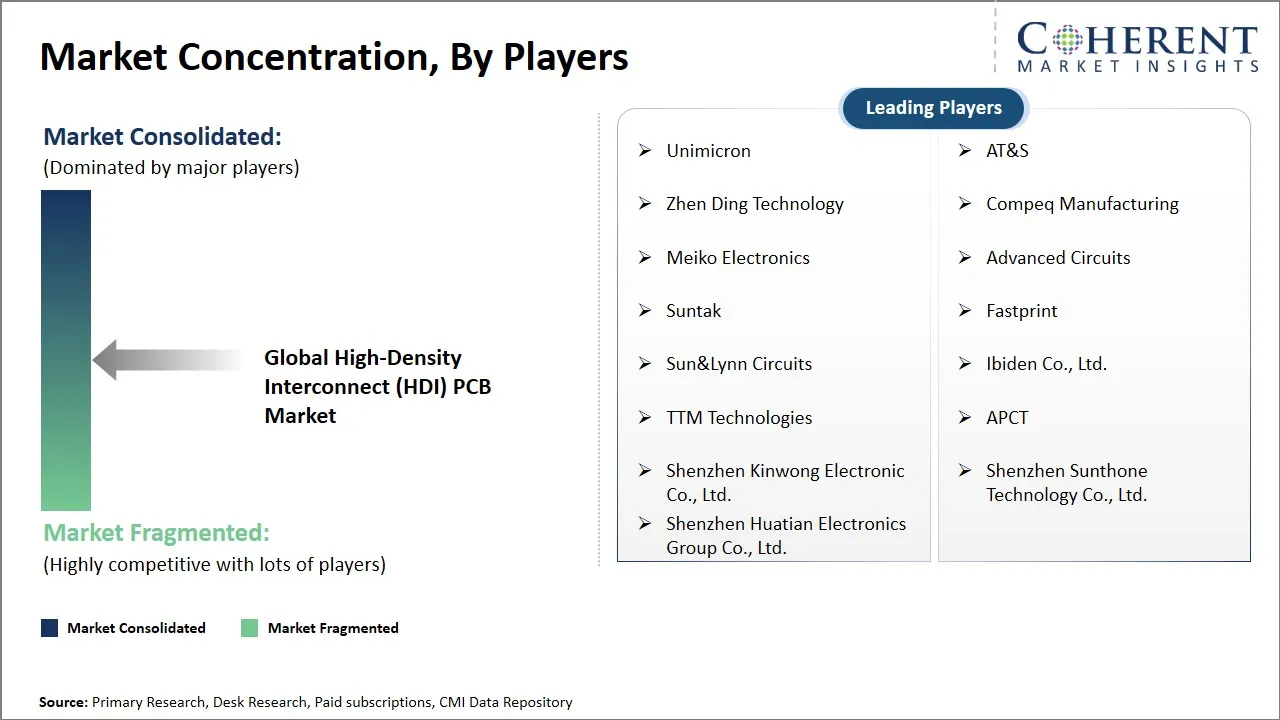
| Companies covered: | Unimicron, AT&S, Zhen Ding Technology, Compeq Manufacturing, Meiko Electronics, Advanced Circuits, Suntak, Fastprint, Sun&Lynn Circuits, Ibiden Co., Ltd., TTM Technologies, APCT, Shenzhen Kinwong Electronic Co., Ltd., Shenzhen Sunthone Technology Co., Ltd., and Shenzhen Huatian Electronics Group Co., Ltd. | ||
| Growth Drivers: |
| ||
| Restraints & Challenges: |
| ||
Market Dynamics
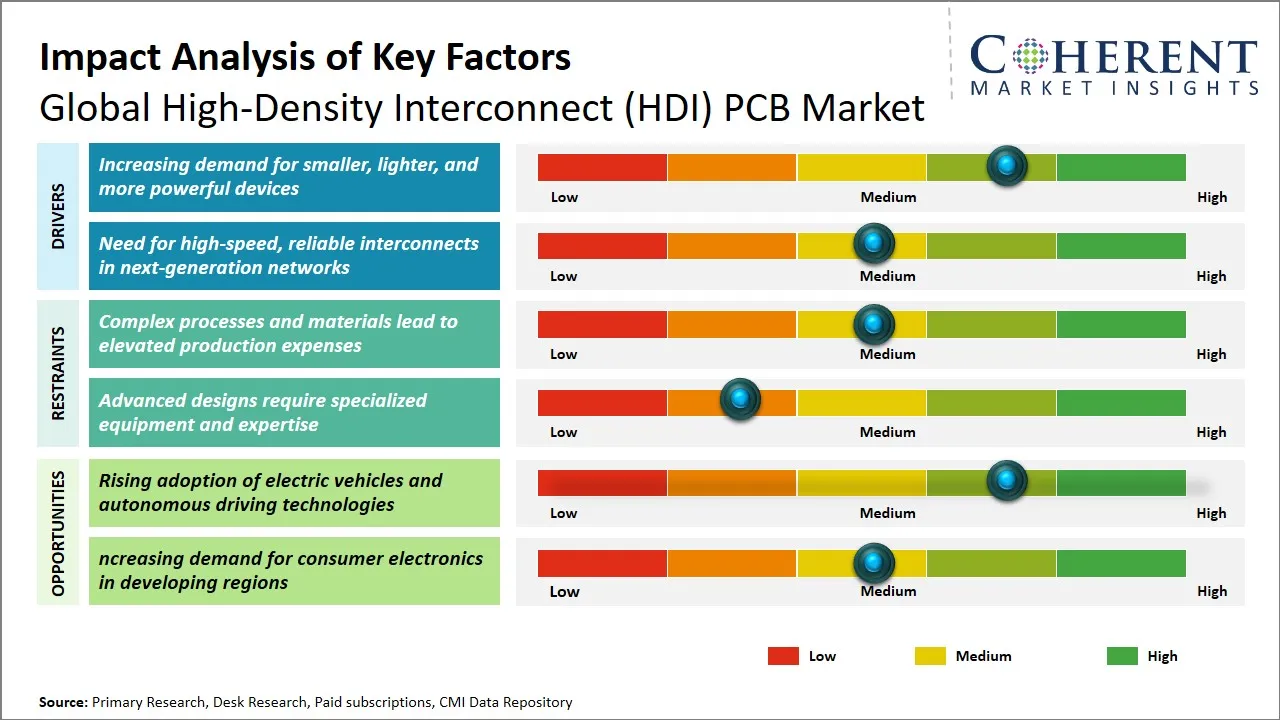
Global High-Density Interconnect (HDI) PCB Market Driver – Increasing Demand for Smaller, Lighter, and More Powerful Devices
The global shift toward compact, high-performance electronic devices—from smartphones and wearables to medical and automotive systems—continues to propel HDI PCB adoption. HDI technology allows miniaturization through microvias and fine-line designs, making possible greater component density, faster signal transmission, and improved thermal management.
As device architectures become more complex, HDI PCBs have become very important for achieving higher functionality in smaller footprints. In 2024, Apple Inc. increased the use of substrate-like HDI PCBs supplied by Zhen Ding Technology and Compeq for its iPhone 15 series, allowing slimmer form factors with improved 5G performance and processing efficiency.
Global High-Density Interconnect (HDI) PCB Market Opportunity – Rising Adoption of Electric Vehicles and Autonomous Driving Technologies
The fast transition to electric and autonomous vehicles presents a big growth avenue for HDI PCBs. These boards offer high wiring density, heat resistance, and electrical reliability, supporting compact control units, ADAS sensors, and battery management systems needed for EV performance.
As automakers add more electronics to vehicles, HDI PCBs are very important for handling high-speed signals and complex power circuits. Tesla’s Model 3 and Model Y production lines have begun incorporating Meiko Electronics’ high-layer HDI PCBs for power control and sensor modules, boosting reliability and space efficiency in EV electronic systems.
Analyst Opinion (Expert Opinion)
- The industry is seeing a rise in raw material costs, especially high-performance laminates like Rogers PTFE and Megtron 6, which have eroded profitability even for large-scale manufacturers. Unless supply chain stability improves and material innovations become more cost-accessible, smaller fabricators will continue to find it difficult to stay competitive.
- Despite its advantages, HDI fabrication remains capital- and precision-intensive, demanding advanced laser drilling, sequential lamination, and strict quality control. Many mid-tier PCB manufacturers do not have the technical infrastructure needed to scale efficiently, making a bottleneck that could affect market expansion in the next few years.
- The market’s high dependence on China, Taiwan, and South Korea for both material sourcing and fabrication makes it vulnerable to geopolitical risks. Western OEMs’ efforts to localize production are commendable but far from sufficient—true regional diversification remains a long-term challenge that the industry has yet to solve.
Speak to the analyst
Want personalized insights?
Take the findings above to one of our principal consultants, or have the report rebuilt around the segments, geographies and competitors you actually track.
Market Segmentation
- Technology Node Insights (Revenue, USD Bn, 2021 - 2033)
- FR4
- Megtron 6/7
- Rodgers PTFE
- BT Epoxy
- Tachyon
- Others
- Application Insights (Revenue, USD Bn, 2021 - 2033)
- Smartphones and Mobile Devices
- Communications
- Automotive Electronics
- Computing and Networking Equipment
- Datacenter
- Others
- Regional Insights (Revenue, USD Bn, 2021 - 2033)
- North America
- U.S.
- Canada
- Latin America
- Brazil
- Argentina
- Mexico
- Rest of Latin America
- Europe
- Germany
- U.K.
- Spain
- France
- Italy
- Russia
- Rest of Europe
- Asia Pacific
- China
- India
- Japan
- Australia
- South Korea
- ASEAN
- Rest of Asia Pacific
- Middle East
- GCC Countries
- Israel
- Rest of Middle East
- Africa
- South Africa
- North Africa
- Central Africa
- North America
- Key Players Insights
- Unimicron
- AT&S
- Zhen Ding Technology
- Compeq Manufacturing
- Meiko Electronics
- Advanced Circuits
- Suntak
- Fastprint
- Sun&Lynn Circuits
- Ibiden Co., Ltd.
- TTM Technologies
- APCT
- Shenzhen Kinwong Electronic Co., Ltd.
- Shenzhen Sunthone Technology Co., Ltd.
- Shenzhen Huatian Electronics Group Co., Ltd.
Sources
Primary Research Interviews
Stakeholders
- PCB Manufacturers and Fabricators
- Electronic Component Suppliers and Material Vendors
- OEMs and EMS Companies
- Semiconductor and Chipset Manufacturers
- Automotive Electronics Manufacturers
- Telecommunications Equipment Providers
- Industry Consultants and Supply Chain Experts specializing in PCB and substrate technologies
Databases
- World Electronics Data Bank (WEDB)
- IPC Global PCB Statistical Database
- U.S. Department of Commerce – Electronics & Information Industries Division
- TechManufacturing Global Trade Data Repository
- Asia PCB Manufacturers Directory (2025 Edition)
- OECD Electronic Components Outlook
- Eurostat
Magazines
- PCB Design & Fabrication Magazine
- Electronics Weekly
- Circuit Assembly Review
- Printed Circuit Design & Fab (PCD&F)
- SMT007 Magazine
- Electronic Product Design & Test (EPDT)
- EE Times
Journals
- Journal of Electronics Manufacturing and Materials
- IEEE Transactions on Components, Packaging, and Manufacturing Technology
- Microelectronics Reliability Journal
- Journal of Circuit Technology and Design
- International Journal of Advanced Printed Circuit Systems (IJAPCS)
Newspapers
- The Business Standard (India)
- Nikkei Asia
- South China Morning Post (Technology Section)
- The Financial Times (Tech Industry Focus)
- The Wall Street Journal (Manufacturing & Tech Segment)
- The Economic Times (Electronics Manufacturing Focus)
Associations
- IPC – Association Connecting Electronics Industries (Global)
- Japan Electronics and Information Technology Industries Association (JEITA)
- European Institute for Printed Circuits (EIPC)
- Printed Circuit Board Association of India (PCBAI)
- Taiwan Printed Circuit Association (TPCA)
- China Printed Circuit Association (CPCA)
- International Electronics Manufacturing Initiative (iNEMI)
Public Domain Sources
- U.S. Census Bureau
- EUROSTAT
- World Bank Data on High-Tech Manufacturing
- United Nations Industrial Development Organization (UNIDO)
- World Trade Organization (WTO) – Electronics Trade Reports
- ResearchGate
- OECD Digital Economy Outlook
Proprietary Elements
- CMI Data Analytics Tool, Proprietary CMI Existing Repository of Information for the Last 8 Years
Get access to 250+ pages report
Every segment, forecast, competitor profile and data table behind the analysis above — available for instant download.
- ESOMAR Member
- ISO 9001:2015 Certified
- D-U-N-S Registered
- GDPR & CCPA Compliant
Missing comfort of reading report in your local language? Find your preferred language:
Transform your Strategy with Exclusive Trending Reports
Frequently Asked Questions
The global High-Density Interconnect (HDI) PCB market is estimated to be valued at USD 21.54 billion in 2026 and is expected to reach USD 40.15 billion by 2033.
The CAGR of the global High-Density Interconnect (HDI) PCB market is projected to be 9.3% from 2026 to 2033.
Increasing demand for smaller, lighter, and more powerful devices and need for high-speed, reliable interconnects in next-generation networks are the major factors driving the growth of the global High-Density Interconnect (HDI) PCB market.
Complex processes and materials lead to elevated production expenses and advanced designs require specialized equipment and expertise are the major factors hampering the growth of the global High-Density Interconnect (HDI) PCB market.
HDI (High-Density Interconnect) PCB is a circuit board with finer lines, microvias, and higher wiring density, allowing compact and high-performance electronic designs.
It enhances power efficiency, signal reliability, and compact design in EV battery management and control systems.
In terms of technology node, the FR4 segment is estimated to dominate the market revenue share in 2026.