

India Ube Market Size and Forecast – 2026 To 2033
The India ube market is estimated to be valued at USD 12.4 Mn in 2026 and is expected to reach USD 23.2 Mn by 2033, exhibiting a compound annual growth rate (CAGR) of 9.3% from 2026 to 2033. Ube is still a niche ingredient in India, but demand is gradually shifting from limited ethnic/Filipino dessert use to broader adoption across bakery, confectionery, frozen desserts, beverages, and ready-to-eat dessert formats. Its strong purple color, mild sweet-nutty flavor, and suitability for premium visual positioning make it attractive for urban cafés, dessert chains, cloud kitchens, home bakers, and food manufacturers.
This market growth in India is supported by the expansion of the country’s processed food sector, as ube is primarily used as a value-added ingredient in bakery products, confectionery, frozen desserts, beverages, packaged snacks, and ready-to-eat desserts. The growth of food manufacturing, packaged food consumption, and ingredient-led product innovation creates a stronger commercial base for shelf-stable ube formats such as ube powder, extract, puree, and jam. For instance, in September 2025, according to the India Brand Equity Foundation, India’s processed food sector is expected to reach US$ 535 billion by the end of FY26, driven by rising consumption, exports, and government initiatives under Make in India. This indicates a favorable environment for specialty ingredients such as ube to be adopted in value-added food and dessert formulations. (Source: India Brand Equity Foundation (IBEF))
Key Takeaways of the India Ube Market
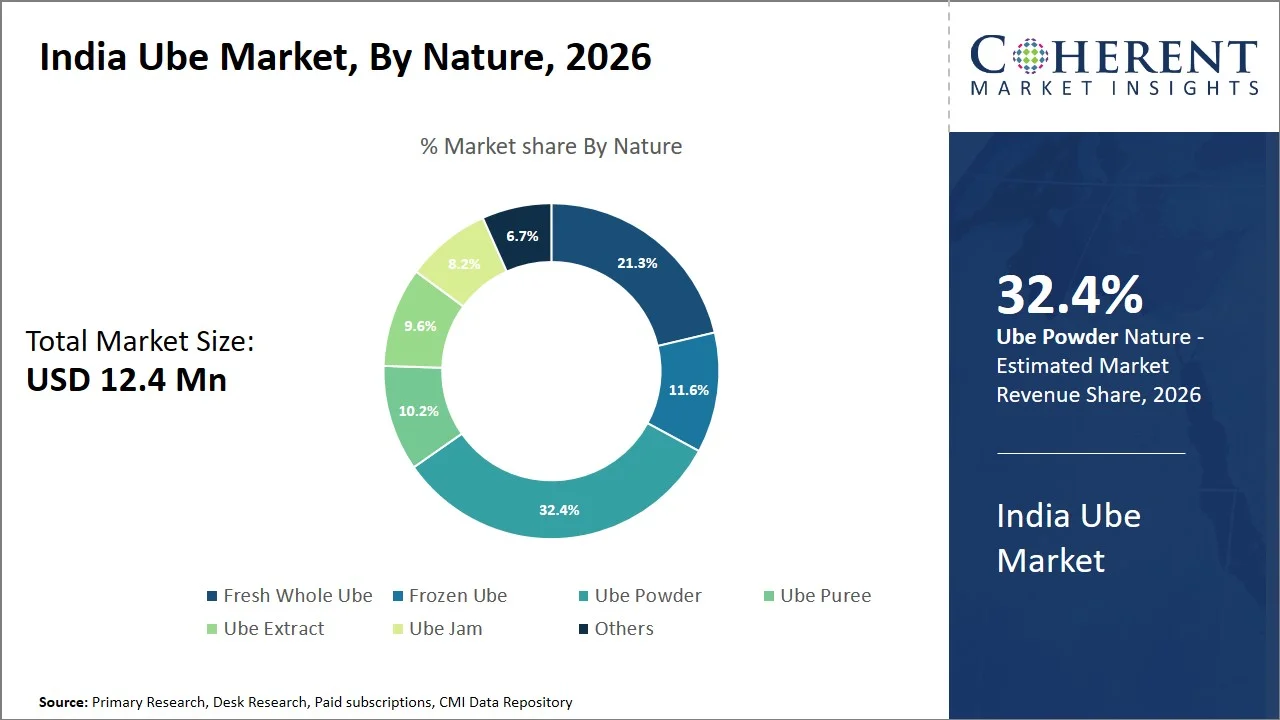
- Ube powder is expected to hold 32.4 % share in 2026, making it the dominant commercial form. Its dominance is driven by high formulation flexibility in cakes, cookies, ice creams, fillings, instant dessert mixes, beverages, and packaged snacks. Compared with fresh or frozen ube, powder is easier to transport, standardize, and use in B2B food manufacturing. For instance, India’s food processing sector has been expanding through PM Formalization of Micro Food Processing Enterprises (PMFME), Pradhan Mantri Kisan SAMPADA Yojana (PMKSY), and PLI-led infrastructure support, creating a stronger base for shelf-stable specialty ingredients. (Source: Ministry of Food Processing Industries (MoFPI))
- The bakery products segment is expected to account for 32.1 % share in 2026, making it the leading application segment in the India ube market. The segment’s dominance is driven by the increasing use of ube in cakes, pastries, breads, cookies, muffins, donuts, and specialty desserts, where its distinctive purple color and mildly sweet flavor help create premium and visually differentiated offerings. Growing consumer interest in innovative bakery products and café-style desserts further supports the demand for ube-based bakery applications. For instance, India’s bakery market continues to expand due to rising urbanization, premiumization trends, and increasing consumption of packaged and artisanal baked goods across major cities. (Source: All India Bread Manufacturers' Association)
- The food manufacturers segment is expected to account for 38.7 % share in 2026 is the most important demand creators in the market. Food manufacturers prefer ube powder, extract, and puree for scalable formulations, while foodservice operators use ube in limited-time menus, frozen desserts, milkshakes, pastries, and fusion desserts to attract younger urban consumers.
- Rising Adoption of Ube in Processed Food Products: Ube processed food applications have been emerging as a premium visual and flavor trend in bakery products, confectionery, frozen desserts, beverages, packaged snacks and ready-to-eat desserts. The purple color can help brands develop unique products used for flavors other than the popular chocolate, vanilla, mango and strawberry. This means that ube can be used in limited edition cakes, dessert cups, ice cream, fillings, wafers, milk shakes, and coffee drinks for urban consumers. For instance, processed food exports from India can be seen in various categories like cereal preparations, processed vegetables, processed fruits, juices, nuts, jaggery and confectionery, cocoa products, miscellaneous preparations, which gives a wide processed-food base for specialty ingredients. (Source: Agricultural and Processed Food Products Export Development Authority (APEDA))
- Expansion Through Quick Commerce and E-Commerce Channels: The opportunity for ube powder, ube jam, and ube extract, particularly for home bakers, small dessert outlets, cafes, and urban retail consumers, is growing from quick commerce and e-commerce channels. These formats are convenient to ship, store and portion, making them ideal for ecommerce and small pack retail than fresh or frozen ube. Ube's visibility online can also help educate India's consumers about its difference from taro and purple sweet potato. For instance, BigBasket planned to roll out 10-minute food delivery services nationwide by the end of FY26, reflecting the rapid expansion of urban quick-commerce channels that can support niche food ingredient discovery. (Source: Reuters)
Segmental Insights
Why Does Ube Powder Dominate the Commercial Form Segment in the India Ube Market?
In the India ube market, ube powder is projected to hold a 32.4% share in 2026, making it the dominant commercial form segment. The segment leads because the powder can easily be stored, transported, standardized and incorporated into industrial recipes, whereas fresh whole ube and frozen ube are not as easily manipulated as powder. It possesses longer shelf life and reduced wastage and can thus be used in bakery premixes, dessert powder, ice cream base, milkshake mixes, confectionery filling and packaged snacks, and ready to eat dessert formulations. The advantage of ube powder for Indian food manufacturers is that it provides a consistent color, flavor and dosage in the batch, which is crucial when scaling niche ingredients to commercial products. In India, the food processing industry was valued at US$ 354.5 billion in 2024, and is projected to expand to US$ 535 billion by the end of FY26, providing a wider market for shelf-stable specialty ingredients like ube powder. (Source: India Brand Equity Foundation)
- Current Industry Events of 2026
- Market Size Estimation
- Regional Breakdown
- Competitive Landscape
- Customer Intelligence
- Segmental Analysis
- Pricing Analysis
- Key Market Drivers, Challenges & Future Trends
- Customized Insights Section
Why are Bakery Products the Largest Application Segment in the India Ube Market?
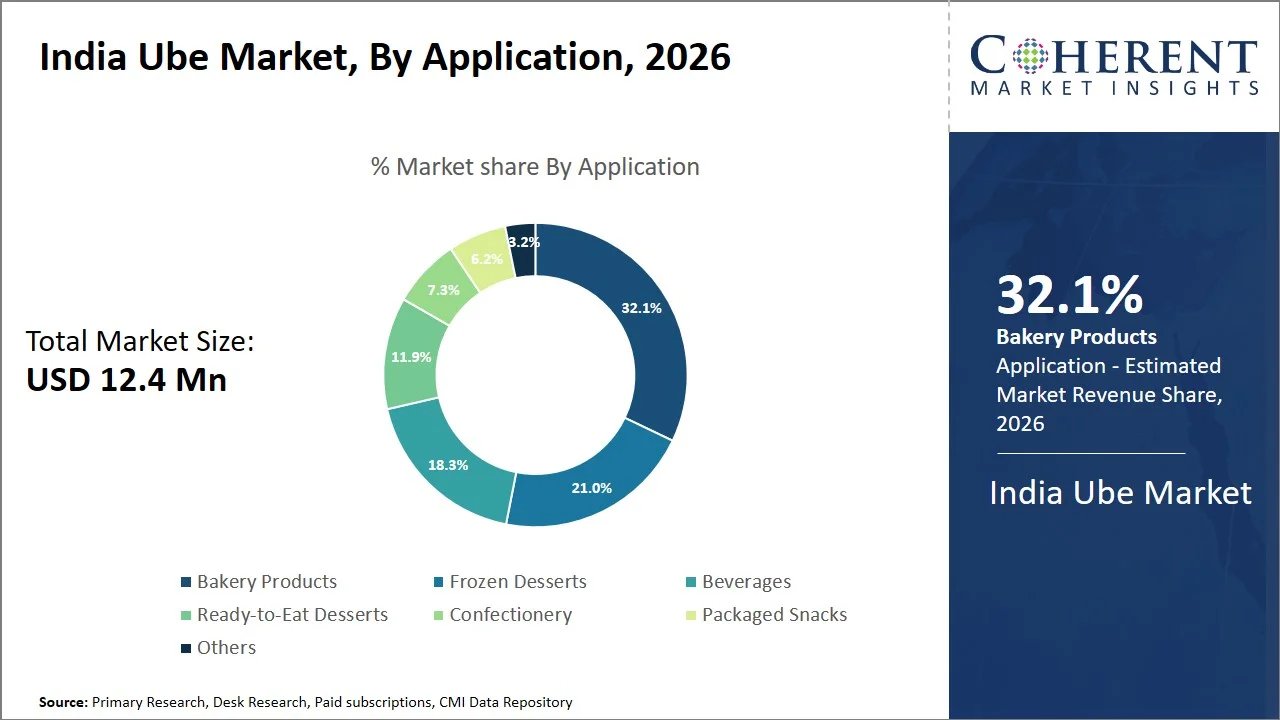
Bakery products are projected to hold 32.1% share in 2026, making them the largest application segment in the India ube market. Ube fits strongly into bakery products because of its purple color and its mild sweet-nutty flavor help create visually premium products such as cakes, muffins, cream rolls, cookies, pastries, donuts, breads, and dessert fillings. Bakeries and cafés can use ube to differentiate their offerings from standard chocolate, vanilla, strawberry, mango, and butterscotch flavors. The segment also benefits from easier recipe integration, as ube powder, puree, jam, and extract can be used in fillings, sponge bases, frostings, creams, and toppings. The bakery segment continues to benefit from rising consumer demand for premium and visually distinctive products, encouraging bakeries and café chains to introduce innovative flavors, fillings, and specialty ingredients such as ube in cakes, pastries, cookies, and dessert offerings.
For instance, in Chennai, The Nini Cafe x Lazy Cookies introduced/promoted a Japanese Ube Cheesecake as a viral dessert offering, highlighting the use of ube in premium bakery and café-style products. The product gained attention for its purple color, soft cheesecake texture, and differentiated flavor profile, showing how ube can be positioned beyond beverages and used in bakery-led applications such as cheesecakes, cakes, pastries, and dessert formats. This supports the strong role of bakery products in the India ube market, as cafés and dessert brands are experimenting with ube to create visually distinctive and social-media-friendly offerings.
Why Do Food Manufacturers Dominate the Buyer Type Segment in the India Ube Market?
Food manufacturers are projected to hold 38.7% share in 2026, making them the dominant buyer type in the India ube market. Their dominance is driven by higher and repeat ingredient demand across packaged bakery, confectionery, frozen desserts, ready-to-eat desserts, beverage mixes, and snack applications. Food manufacturers prefer standardized ingredient formats such as ube powder, extract, puree, and jam because these forms support consistent formulation, quality control, shelf-life management, and scalable production. Compared with foodservice operators or retail consumers, manufacturers purchase in larger volumes and require reliable B2B supply, documentation, and stable pricing. For instance, under the Pradhan Mantri Formalizations of Micro food processing Enterprises (PMFME) scheme, the government of India aims to assist two lakh micro food processing units with credit-linked subsidy, strengthening the organized and semi-organized food manufacturing ecosystem where specialty ingredients such as ube can be introduced into value-added products. (Source: Ministry of Food Processing Industries)
Currents Events and their Impact
Current Events | Description and its Impact |
MoFPI Expands Food Processing Infrastructure Support (February 2026) |
|
FSSAI Updates Norms Related to Synthetic Food Color Preparations and Mixtures (August 2025) |
|
(Source: Ministry of Food Processing Industries, FSSAI)
India Ube Market Dynamics
Market Drivers
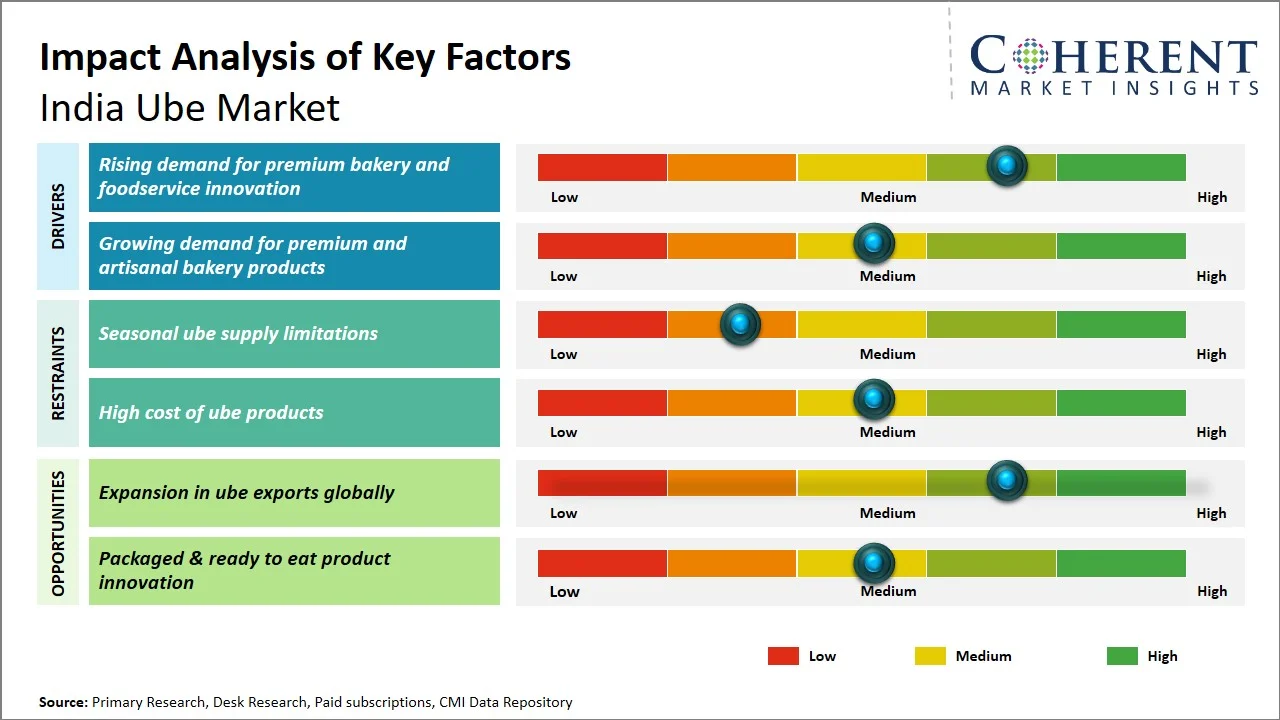
- Rising demand for premium bakery and foodservice innovation: Increasing experimentation by bakeries, cafés, dessert chains, restaurants, and cloud kitchens is driving the demand for visually differentiated ingredients such as ube. Its purple color and mildly sweet, nutty flavor make it suitable for cakes, pastries, donuts, muffins, cookies, milkshakes, ice creams, and fusion desserts. Ube also helps foodservice operators create limited-time offerings and premium menu items that stand out on social media and appeal to urban consumers. For instance, India’s foodservice industry is expected to reach US$ 8,139.48 Mn by 2028, growing at 8.1% CAGR, which reflects strong growth potential for new dessert and café-led ingredient experimentation. (Source: Restaurant India)
- Growing demand for premium and artisanal bakery products: The India ube market is benefiting from the increasing consumer preference for premium bakery and confectionery products that offer distinctive flavors, visual appeal, and novel eating experiences. Ube’s naturally vibrant purple color and mildly sweet taste make it an attractive ingredient for cakes, pastries, donuts, cookies, dessert fillings, and specialty breads. Bakeries and dessert brands are increasingly incorporating unique global ingredients to differentiate their offerings and attract younger consumers seeking innovative food experiences. For instance, the Indian bakery market is experiencing significant growth, driven by evolving consumer preferences, rising disposable incomes, and increasing urbanization. Valued at USD 12.6 billion in 2023, the market is projected to reach USD 29.4 billion by 2032, exhibiting a CAGR of 9.9% supported by rising urbanization, changing lifestyles, and growing demand for value-added baked goods, creating favorable opportunities for ube-based product innovation. (Source: The India Watch)
Emerging Trends
- Rising use of natural purple color concepts in food innovation: Ube is gaining relevance as brands look for visually appealing ingredients that can deliver both color and flavor differentiation. Its violet-purple profile supports bakery creams, cakes, dessert cups, frozen desserts, beverages, confectionery fillings, and ready-to-eat sweets. This trend is especially important as food brands increasingly focus on premium appearance, ingredient storytelling, and distinctive product identity. For instance, anthocyanins, the pigment group responsible for red, purple, and blue colors in many plants, have traditionally been used as natural food colorants; however, their stability is influenced by pH, light, temperature, and structure, making formulation expertise important for commercial ube-based products. (Source: National Library of Medicine)
- Growth of quick commerce and online discovery for specialty ingredients: Ube powder, ube extract, and ube jam are likely to benefit from e-commerce and quick-commerce channels as these formats are easier to store, pack, ship, and use in small quantities. Online platforms can improve awareness among home bakers, small dessert businesses, premium cafés, and urban consumers who are experimenting with global dessert flavors.
Technology & Innovation Landscape for the India Ube Market
Technology Category | Key Innovation / Trend | Relevance to India Ube Market | Impact on Market |
Advanced Drying & Powder Processing | Use of spray drying, freeze drying, vacuum drying, and fine milling to convert ube into stable powder formats with controlled moisture, particle size, and color consistency. | Highly relevant for ube powder, which is the dominant commercial form. Powder processing enables use in bakery premixes, dessert powders, beverage bases, confectionery fillings, packaged snacks, and ready-to-eat desserts. | Improves shelf life, reduces wastage, lowers cold-chain dependency, and supports large-scale B2B adoption among food manufacturers. |
Natural Purple Color Stabilization | Formulation techniques focused on protecting anthocyanin-based purple color against heat, pH variation, oxidation, light exposure, and storage instability. | Important for bakery products, frozen desserts, beverages, and confectionery, where maintaining a consistent violet-purple appearance is essential for premium product appeal. | Enables brands to use ube as both a flavor and natural color ingredient, supporting clean-label and visually differentiated food launches. |
Ready-to-Use Ube Puree, Paste, and Filling Systems | Development of standardized ube puree, jam, paste, and bakery filling formats for easier application in cakes, pastries, donuts, dessert cups, mousse, and frozen desserts. | Supports foodservice operators, bakeries, cafés, and dessert chains that require convenient, portion-controlled, and repeatable ingredient formats. | Reduces preparation time, improves menu consistency, and accelerates adoption of ube in premium bakery and café-led dessert applications. |
Bakery Premix and Dessert Base Integration | Incorporation of ube powder into cake premixes, cookie mixes, muffin mixes, milkshake powders, ice cream bases, and instant dessert blends. | Strongly supports the bakery products segment, the leading application area for ube in India. It allows manufacturers to create scalable, standardized ube-flavored product lines. | Expands ube from niche artisanal use to packaged bakery and dessert manufacturing, improving commercial scalability. |
Market Players, Key Development, and Competitive Intelligence
Key Developments
- In May 2026, Coffee Island India launched a limited-edition ube beverage range across its cafés in India, making it one of the first café brands to introduce the global ube drink trend to Indian consumers. The range includes Iced Ube Latte, Iced Ube Matcha Blend, Ube Smoothie, and Bobastic Coconut Ube, and was made available across Coffee Island outlets in Delhi, Gurugram, Pune, and Mumbai.
- In April 2026, Wilderness Poets Ube Purple Yam Powder, 4 oz (113 g) became available through iHerb India, indicating growing access to imported ube powder through cross-border e-commerce platforms.
Competitive Landscape
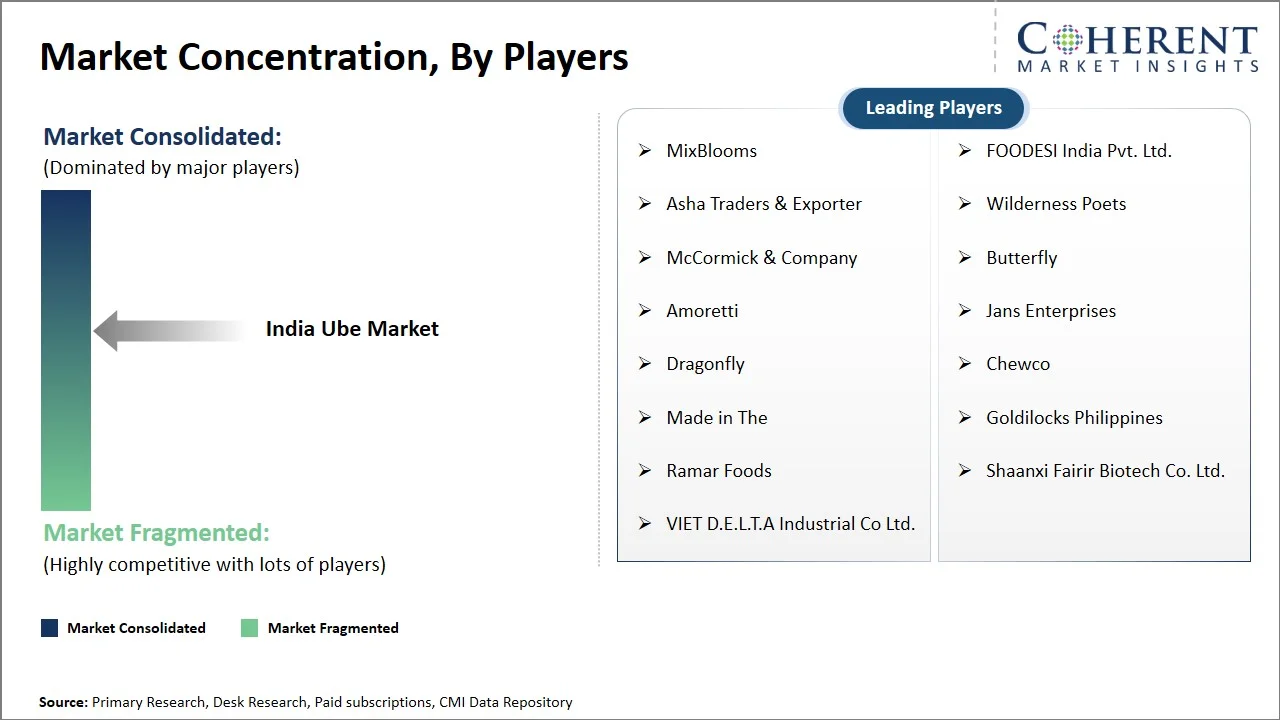
The India ube market is at an early growth stage and remains moderately fragmented, with competition spread across specialty ingredient importers, food ingredient distributors, bakery ingredient suppliers, online gourmet ingredient sellers, artisanal dessert brands, cafés, and small-scale food manufacturers. Since ube is not yet a mainstream ingredient in India, the market does not have a highly concentrated supplier base. Most players compete through product availability, imported ingredient sourcing, powder quality, color consistency, shelf life, pricing, packaging size, and application support for bakery and dessert formulations.
Competition is stronger in ube powder, as it is the most commercially scalable format and can be supplied to food manufacturers, bakeries, cafés, cloud kitchens, and home bakers. Distributors and suppliers offering stable quality, reliable batch consistency, food-grade documentation, and small as well as bulk pack options are likely to gain an advantage. In applications, bakery products create the highest competitive pull, as brands are using ube to develop visually distinctive cakes, pastries, cookies, donuts, dessert fillings, and café-style desserts.
The market is also influenced by substitutes such as taro, purple sweet potato, beetroot powder, butterfly pea flower, and synthetic purple food colors. Therefore, players need to clearly communicate authentic ube positioning, natural purple color appeal, flavor profile, and application suitability.
Key focus areas include
- Standardized ube powder and shelf-stable ingredient formats
- Natural purple color stability for bakery, desserts, and beverages
- B2B formulation support for food manufacturers and bakeries
- E-commerce and small-pack distribution for home bakers and cafés
- Authentic ube positioning versus taro and purple sweet potato substitutes
Market Report Scope
India Ube Market Report Coverage
| Report Coverage | Details | ||
|---|---|---|---|
| Base Year: | 2025 | Market Size in 2026: | USD 12.4 Mn |
| Historical Data for: | 2020 To 2024 | Forecast Period: | 2026 To 2033 |
| Forecast Period 2026 to 2033 CAGR: | 9.3% | 2033 Value Projection: | USD 23.2 Mn |
| Segments covered: |
| ||
| Companies covered: | MixBlooms, FOODESI India Pvt. Ltd., Asha Traders & Exporter, Wilderness Poets, McCormick & Company, Butterfly, Amoretti, Jans Enterprises, Dragonfly, Chewco, Made in The, Goldilocks Philippines, Ramar Foods, Shaanxi Fairir Biotech Co. Ltd., and VIET D.E.L.T.A Industrial Co Ltd. | ||
| Growth Drivers: |
| ||
| Restraints & Challenges: |
| ||
Analyst Opinion (Expert Opinion)
- The India ube market is expected to witness steady growth over the forecast period, supported by the rising demand for visually differentiated bakery, dessert, and beverage products. Ube’s natural purple color, mildly sweet flavor, and premium appeal make it well suited for urban cafés, dessert chains, packaged food manufacturers, and home-baking consumers. Increasing adoption of global dessert flavors and natural color-led food innovation is likely to strengthen its relevance in India’s processed food ecosystem.
- The highest revenue opportunities are expected to emerge across bakery products, food manufacturers, and foodservice-led dessert innovation. confectionery, frozen desserts, beverages, and snack products. Metro and Tier-1 markets such as Mumbai, Delhi NCR, Bengaluru, Pune, Hyderabad, and Chennai are likely to act as early adoption hubs due to higher exposure to café culture, online food trends, and premium dessert consumption.
- To gain a competitive advantage, market participants should focus on building reliable ube powder, extract, puree, and jam supply chains with consistent color, flavor, moisture control, and food-grade documentation. Suppliers should also invest in application support for bakeries, ice cream makers, beverage companies, and packaged food manufacturers to help improve formulation success. Clear differentiation from taro, purple sweet potato, synthetic purple colors, and other substitutes will be important for premium positioning. Companies that combine B2B bulk supply, small-pack e-commerce formats, clean-label storytelling, and recipe-led marketing are likely to capture stronger visibility in the India ube market.
Speak to the analyst
Want personalized insights?
Take the findings above to one of our principal consultants, or have the report rebuilt around the segments, geographies and competitors you actually track.
Market Segmentation
- Nature Insights (Revenue, USD Mn, 2021 - 2033)
- Fresh Whole Ube
- Frozen Ube
- Ube Powder
- Ube Puree
- Ube Extract
- Ube Jam
- Others
- Application Insights (Revenue, USD Mn, 2021 - 2033)
- Bakery Products
- Confectionery
- Frozen Desserts
- Beverages
- Packaged Snacks
- Ready to Eat Desserts
- Buyer Type Insights (Revenue, USD Mn, 2021 - 2033)
- Food Manufacturers
- Beverage Manufacturers
- Foodservice Operators
- Retail Consumers
- Ingredient Distributors
- Distribution Channel Insights (Revenue, USD Mn, 2021 - 2033)
- Direct Sales
- Indirect (Via Distributor)
- Key Players Insights
- MixBlooms
- FOODESI India Pvt. Ltd.
- Asha Traders & Exporter
- Wilderness Poets
- McCormick & Company
- Butterfly
- Amoretti
- Jans Enterprises
- Dragonfly
- Chewco
- Made in The
- Goldilocks Philippines
- Ramar Foods
- Shaanxi Fairir Biotech Co. Ltd.
- VIET D.E.L.T.A Industrial Co Ltd.
Sources
Primary Research Interviews
- Head of Product Development – Bakery & Confectionery Manufacturer
- Procurement Manager – Food Ingredient Distributor / Importer
- R&D Manager – Frozen Dessert and Ice Cream Manufacturer
- Category Manager – Gourmet / Specialty Ingredient E-commerce Platform
- Founder / Operations Head – Premium Bakery or Dessert Café Chain
- Business Development Manager – Food Ingredient Supplier
- Executive Chef / Innovation Chef – Dessert and Café Chain
- Sales Manager – Bakery Premix and Dessert Ingredient Supplier
- Quality Assurance Manager – Processed Food Manufacturer
- Distributor / Trader – Imported Asian Food Ingredients and Specialty Powders
Databases
- Ministry of Food Processing Industries (MoFPI) – Food processing schemes, infrastructure, PMFME, PMKSY, and PLISFPI data
- Food Safety and Standards Authority of India (FSSAI) – Food additive, food color, labelling, and compliance regulations
- Agricultural and Processed Food Products Export Development Authority (APEDA) – Processed food exports, bakery products, cereal preparations, confectionery, and value-added food categories
- India Brand Equity Foundation (IBEF) – Food processing industry size, investment, export, and sector outlook
- Directorate General of Foreign Trade (DGFT) – Import/export policy and trade classification references
- Directorate General of Commercial Intelligence and Statistics (DGCIS) – India trade statistics for processed food and ingredient categories
- UN Comtrade – Global trade data for yam, tuber, processed fruit/vegetable, and food ingredient categories
- ITC Trade Map – Import/export benchmarking for relevant processed food and specialty ingredient categories
- FAOSTAT – Root and tuber crop production and international agricultural data
- National Restaurant Association of India (NRAI) – Foodservice industry size, restaurant network, and growth outlook
Magazines / Industry Publications
- Food Ingredients First
- FoodNavigator-Asia
- FnB News
- BakeryBiz
- The Baker’s Journal
- Food Technology Magazine
- Packaging South Asia
- Agro & Food Processing
- Indian Food Industry Magazine
- Restaurant India
Journals
- Journal of Food Science and Technology
- Food Chemistry
- Food Research International
- LWT – Food Science and Technology
- Foods – MDPI
- Food & Nutrition Research
- Applied Food Research
- Journal of Agricultural and Food Chemistry
- International Journal of Food Science & Technology
- Frontiers in Nutrition
Newspapers / Business Media
- The Economic Times
- Business Standard
- The Hindu BusinessLine
- Financial Express
- Mint
- Times of India
- Indian Express
- Deccan Herald
- CNBC-TV18
Associations
- All India Bread Manufacturers’ Association (AIBMA)
- National Restaurant Association of India (NRAI)
- All India Food Processors’ Association (AIFPA)
- Protein Foods and Nutrition Development Association of India (PFNDAI)
- Association of Food Scientists and Technologists India (AFSTI)
- Confederation of Indian Industry (CII) – Food and Agriculture Centre of Excellence
- Federation of Indian Chambers of Commerce & Industry (FICCI) – Food Processing Division
- Agricultural and Processed Food Products Export Development Authority (APEDA)
- Federation of Biscuit Manufacturers of India (FBMI)
- Hotel and Restaurant Association of India (HRAI)
Public Domain Sources
- Ministry of Food Processing Industries (MoFPI), Government of India
- Press Information Bureau (PIB), Government of India
- Food Safety and Standards Authority of India (FSSAI)
- Agricultural and Processed Food Products Export Development Authority (APEDA)
- Ministry of Commerce and Industry, Government of India
- Directorate General of Foreign Trade (DGFT)
- Directorate General of Commercial Intelligence and Statistics (DGCIS)
- Ministry of Agriculture and Farmers Welfare, Government of India
- Ministry of Statistics and Programme Implementation (MoSPI)
- FAOSTAT
- UN Comtrade Database
- International Trade Centre (ITC Trade Map)
- World Bank Data
Proprietary Elements
- CMI Data Analytics Tool, Proprietary CMI Existing Repository of information for last 10 years.
Get access to 250+ pages report
Every segment, forecast, competitor profile and data table behind the analysis above — available for instant download.
- ESOMAR Member
- ISO 9001:2015 Certified
- D-U-N-S Registered
- GDPR & CCPA Compliant
Missing comfort of reading report in your local language? Find your preferred language:
Transform your Strategy with Exclusive Trending Reports
Frequently Asked Questions
The CAGR of the India ube market is projected to be 9.3% from 2026 to 2033.
The India ube market is estimated to be valued at USD 12.4 million in 2026 and reach USD 23.2 million in 2033.
Cultural demand in Philippines & SEA and cafe & bakery adoption via social media are the major factors driving the growth of the India ube market.
Seasonal ube supply limitations and high cost of Ube products are the major factors hampering the growth of the India Ube market.
In terms of nature, ube powder is estimated to dominate the market revenue share in 2026.
MixBlooms, FOODESI India Pvt. Ltd., Asha Traders & Exporter, Wilderness Poets, McCormick & Company, Butterfly, Amoretti, Jans Enterprises, Dragonfly, Chewco, Made in The, Goldilocks Philippines, Ramar Foods, Shaanxi Fairir Biotech Co. Ltd., and VIET D.E.L.T.A Industrial Co Ltd. are the major players.