

Global Industrial Silica Sand Market Size and Forecast – 2026 To 2033
The Global Industrial Silica Sand Market is projected to grow from USD 14.14 Bn in 2026 to USD 20.35 Bn by 2033, reflecting a compound annual growth rate (CAGR) of 5.3% over the forecast period 2026-2033. Demand for industrial silica sand is increasing due to its extensive use in glass manufacturing, foundry, hydraulic fracturing, and construction industries. This growth is further supported by the expanding base of end users and advancements in silica sand extraction, beneficiation, and processing technologies.
In September 2025, Western Australia's Department of Water and Environmental Regulation approved the Arrowsmith North Silica Sand Project by VRX Silica Ltd. The approval is for the construction, commissioning and time limited operation of a silica sand processing plant of 1 million tons per annum in the first 3 years and 2 million tons per annum thereafter. This reflects ongoing investment, building and development of silica sand extraction and processing capacity for other industrial uses including the glass industry, foundry, construction materials and export.
Key Takeaways of the Global Industrial Silica Sand Market
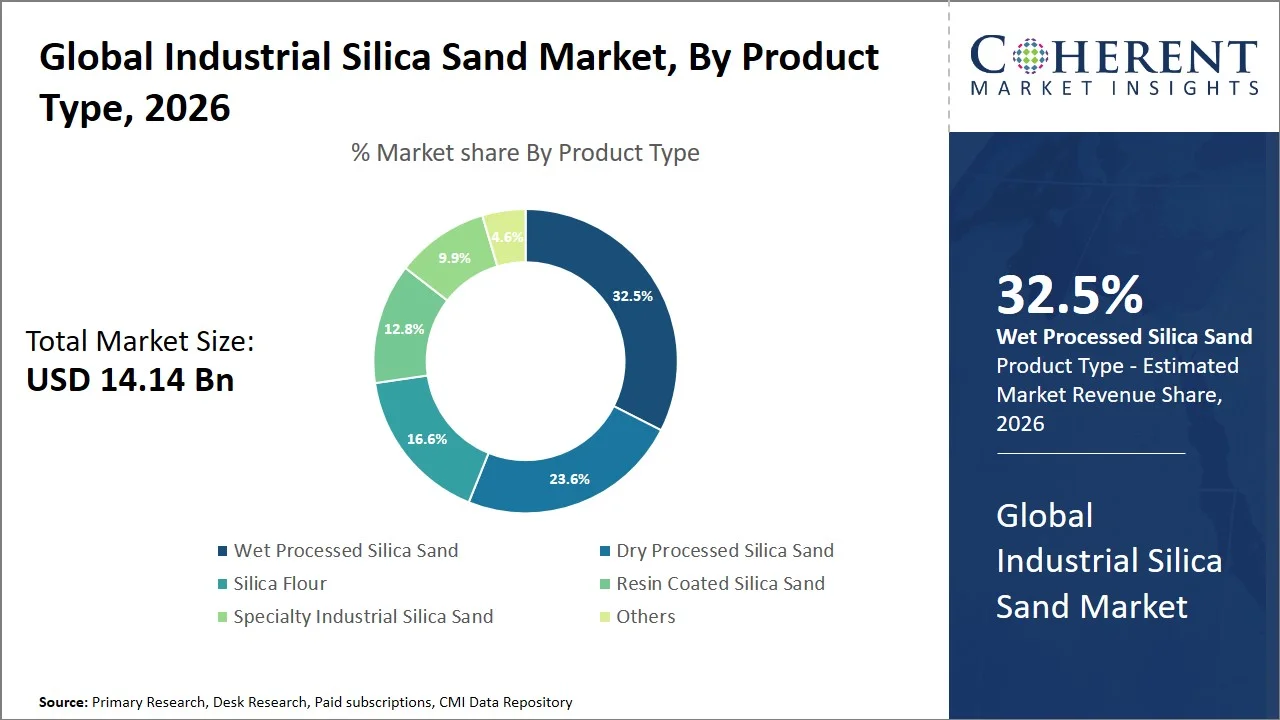
- The wet processed silica sand segment is the leading product type segment, holding an estimated 32.5 % of the market share in 2026. Through advanced processing capabilities, industrial silica sand market can be effectively cleaned to remove clay, dust, and other impurities, making it suitable for applications in glass manufacturing, foundries, construction materials, and water treatment. In September 2025, the Central Pollution Control Board (CPCB) issued guidelines for silica sand mining and washing plants, stating that Silica Sand beneficiation process includes mining, crushing, washing and drying and specifying that silica sand is used in glass production, foundry, ceramics, abrasives, building materials, etc. This highlights the significance of processed and washed silica sand in industrial uses. (Source: The Central Pollution Control Board)
- In terms of purity grade, the High Purity Grade (Above 97.0% to 99.0% SiO₂ segment is projected to lead the market with 47.5 % of the market share in 2026. Demand is linked to glass and solar glass, electronics, foundry and advanced material applications where controlled SiO₂ content and low contamination is key. New investment in high-purity silica sand projects is strengthening supply capacity for glass, solar, automotive, technology, and defense applications. For instance, in October 2025, Queensland Investment Corporation (QIC) invested USD 30 million in Silica Resources Australia's Mourilyan Silica Sands Project in Queensland. The project will produce over 360,000 tons per year over the next 12 months, and will increase to over 750,000 tons per year within five years, meeting the demand for high purity silica sand for various applications such as glass, solar, automotive, technology and defense. (Source: Silica Resources Australia.)
- The glass industry is the top end-use segment, accounting for an estimated 36.4 % of the market share in 2026. Silica sand is an essential raw material for manufacturing flat glass, container glass, fiberglass, solar glass, specialty glass products. Silica sand, for example, is a main raw material in the manufacture of glass containers, and 47 glass container manufacturing plants in the U.S. use it, with approximately 7.5 million tons per year of silica sand being supplied to the glass container industry. This is the raw material dependency of glass makers of industrial silica sand market is very prominent. (Source: Glass Packaging Institute)
- North America is the dominant regional market, with an expected share of 48.3% in 2026, driven by high consumption in hydraulic fracturing, well-packing, cementing, glassmaking, foundry, filtration, and industrial manufacturing applications. According to the U.S. Geological Survey (USGS), around 81% of U.S. industrial sand and gravel tonnage in 2025 was used for hydraulic fracturing sand, well-packing, and cementing, while 7% was used as glassmaking sand. This indicates strong regional demand from both the energy and glass sectors, positioning North America as a major production and consumption hub for industrial silica sand market, though not the fastest-growing region. (Source: U.S. Geological Survey, Mineral Commodity Summaries)
- Asia Pacific is the fastest-growing regional market, with an expected share of 32.6 % in 2026, supported by strong glass manufacturing, construction, foundry, electronics, and solar PV supply chains across China, India, Japan, South Korea, and Southeast Asia. Regional demand for high-purity silica sand is rising due to rapid solar PV expansion, especially in China. According to IEA PVPS, China added 103.6 GW of new PV capacity in 2024, increasing the need for solar glass, where high-purity silica sand is a key raw material. This supports demand for high-quality silica sand used in solar glass, silicon-based materials, electronics, and other industrial applications. (Source: International Energy Agency)
- Opportunity solar glass and high purity silica sand: Solar PV manufacturing use silica sand with consistently low iron and high purity, for photovoltaic glass and other clean energy components.
- Water Treatment & Filtration Demand: Growth in municipal and industrial water infrastructure is driving demand for graded silica sand in water and wastewater treatment applications.
Segmental Insights
What Makes Wet Processed Silica Sand the Leading Product Type?
Wet processed silica sand is expected to dominate the product type segment with 32.5% of the market share in 2026, supported by its ability to deliver cleaner and better-graded silica sand for glass, foundry, construction materials, and water filtration applications. Wet processing helps reduce clay, dust, and other impurities, making the sand more suitable for quality-sensitive industrial use. For instance, the Arrowsmith North Silica Sand Project by VRX Silica in Western Australia is a high-grade silica sand mine proposal, reflecting continued investment in processed silica sand supply for industrial markets. (Source: Environmental Protection Agency)
- Current Industry Events of 2026
- Market Size Estimation
- Regional Breakdown
- Competitive Landscape
- Customer Intelligence
- Segmental Analysis
- Pricing Analysis
- Key Market Drivers, Challenges & Future Trends
- Customized Insights Section
Why does the High Purity Grade (97.0% to 99.0% SiO₂) segment support the largest demand in the industrial silica sand market?
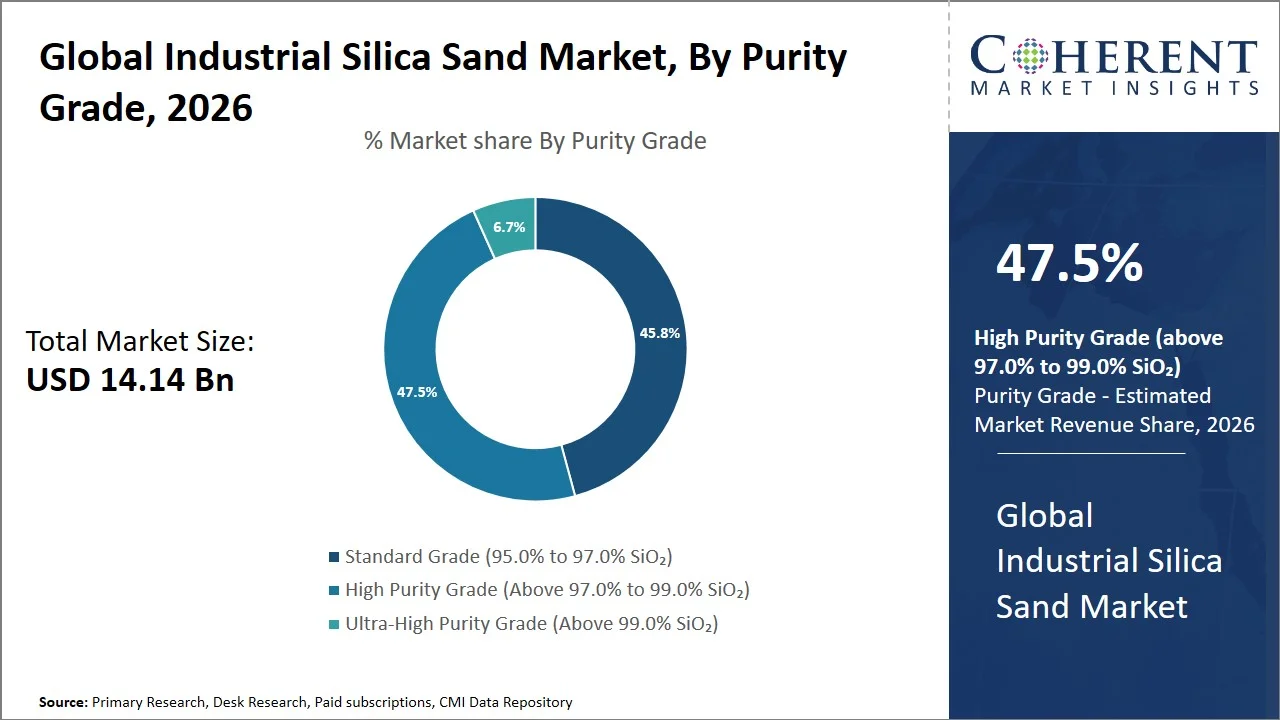
High Purity Grade Silica Sand, with above 97.0% to 99.0% SiO₂ content, is expected to dominate the purity grade segment with 47.5% of the market share in 2026, owing to its wide use in glass, solar PV, ceramics, foundry, and advanced industrial applications. This grade offers a balance between purity, availability, and commercial scalability. For instance, Australia’s Northern Silica Project was awarded Major Project Status in July 2025; the government stated that the project will produce 3 to 5 million tons of silica sand annually over 25 years for solar panels, silicon wafers, and high-end electronics. (Source: Department of Industry Science and Resources)
Why does the glass industry remain the largest end-use segment in the Industrial Silica Sand Market?
The glass industry is expected to dominate the end-use industry segment, accounting for 36.4% of the market share in 2026, as silica sand is a primary raw material in flat glass, container glass, solar glass, fiberglass, and specialty glass manufacturing. Its purity and grain consistency directly influence glass clarity, strength, and production efficiency. The Glass Packaging Institute states that silica sand is a primary raw material in glass container manufacturing. Separately, the International Energy Agency (IEA) projects that global renewable power capacity will increase by almost 4,600 GW between 2025 and 2030, with solar PV accounting for nearly 80% of worldwide renewable electricity capacity expansion. This supports demand for solar glass and high-quality silica sand. (Source: Glass Packaging Institute, International Energy Agency (IEA))
Currents Events and their Impact
Current Events | Description and Its Impact |
Stricter Silica Dust Rules Reshaping Mining Compliance |
|
Arrowsmith North Silica Sand Project Moving Toward New Supply Capacity |
|
Solar PV Expansion Increasing High-purity Silica Sand Demand |
|
(Source: Federal Register, IEA, and USGS)
Industrial Silica Sand Market Dynamics
Market Drivers
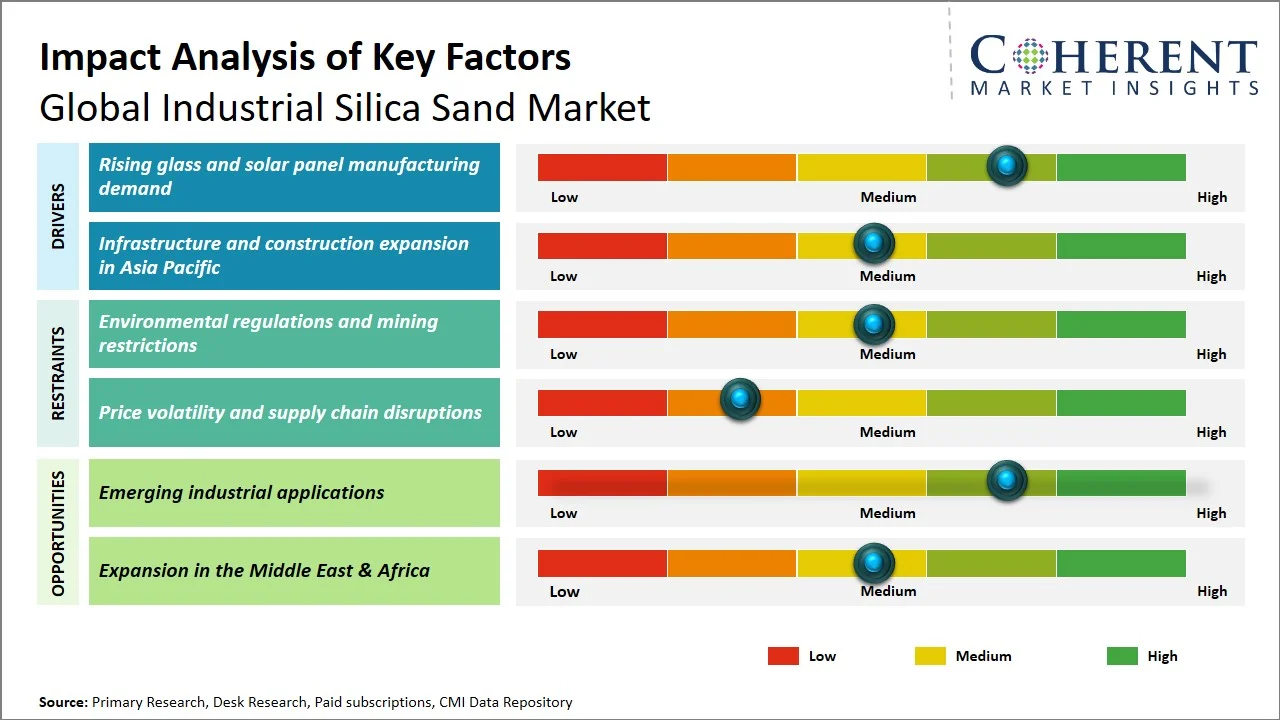
- Rising Glass and Solar Panel Manufacturing Demand: Demand for high-purity industrial silica sand market continues to grow due to its extensive use in the production of flat glass, container glass, automotive glass, and solar photovoltaic (PV) glass. Silica sand serves as a key raw material because of its high silica content, which is essential for producing clear, durable, and high-performance glass products. According to NSG Group, sand is one of the principal raw materials used in soda-lime silicate glass manufacturing, highlighting its fundamental role in large-scale glass production across multiple industries. In the renewable energy sector, the increasing installation of solar power systems is driving demand for solar glass, which requires high-purity, low-iron silica sand to ensure maximum light transmission and energy efficiency. Reflecting this trend, Borosil Renewables has expanded its solar glass manufacturing capacity to 1,350 tons per day (TPD), equivalent to approximately 8.5 GW of solar module capacity, and plans to increase capacity to 1,600 TPD by CY2026. This capacity expansion indicates strong growth in solar panel manufacturing and, consequently, rising consumption of high-quality silica sand as a critical input material. (Source: borosilrenewables)
- Infrastructure and Construction Expansion in Asia Pacific: The rapid growth of infrastructure and construction activity in Asia Pacific is increasing demand for industrial silica sand market across construction materials, glass manufacturing, foundry products, filtration systems, and specialty building applications. Processed silica sand demand is growing in China, India and Southeast Asia due to urbanization, public infrastructure investments, road construction, industrial parks, housing and renewable energy initiatives. According to the Asian Development Bank (ADB), developing Asia requires around USD 1,700,000 Mn annually in infrastructure investment through 2030 to sustain its current growth momentum. India’s National Infrastructure Pipeline (NIP) was estimated at approximately USD 1,162,200 Mn for infrastructure capital expenditure across energy, roads, urban development, railways, ports, and airports during FY2020–FY2025. The region continues to have a large infrastructure footprint which can sustain the ongoing silica sand demand. (Source: Asian Development Bank)
Emerging Trends
- Shift from Conventional Silica Sand Uses to Solar Glass and Electronics-grade Demand: Asia Pacific industrial silica sand demand is moving beyond traditional glass, foundry, and construction applications toward high-purity silica sand used in solar glass, silicon wafers, and electronics. This shift is strongly linked to the region’s solar PV manufacturing base, especially in China, India, Japan, South Korea, and Southeast Asia. High-purity silica sand is becoming more important as solar glass producers and electronics manufacturers require consistent SiO₂ content, low iron impurities, and reliable supply. For instance, Australia’s Northern Silica Project is positioned to supply silica sand for solar panels, silicon wafers, and high-end electronics, showing how Asia Pacific demand is shifting toward clean energy and technology-linked applications.
- Rising Demand for Processed and Export-ready Silica Sand: The Asia Pacific market is witnessing growing demand for washed, graded, and processed silica sand that can meet industrial specifications for glassmaking, foundry, filtration, and construction materials. Buyers are increasingly preferring export-ready silica sand with consistent grain size, moisture control, and lower impurities, as these properties improve performance in large-scale manufacturing. For instance, the Arrowsmith North Silica Sand Project in Western Australia received works approval for a processing plant with capacity linked to industrial silica sand market production. This supports the region’s move toward processed silica sand supply chains that can serve domestic industries as well as export markets across Asia.
Regional Insights
Why is North America the dominant region the global industrial silica sand market ?
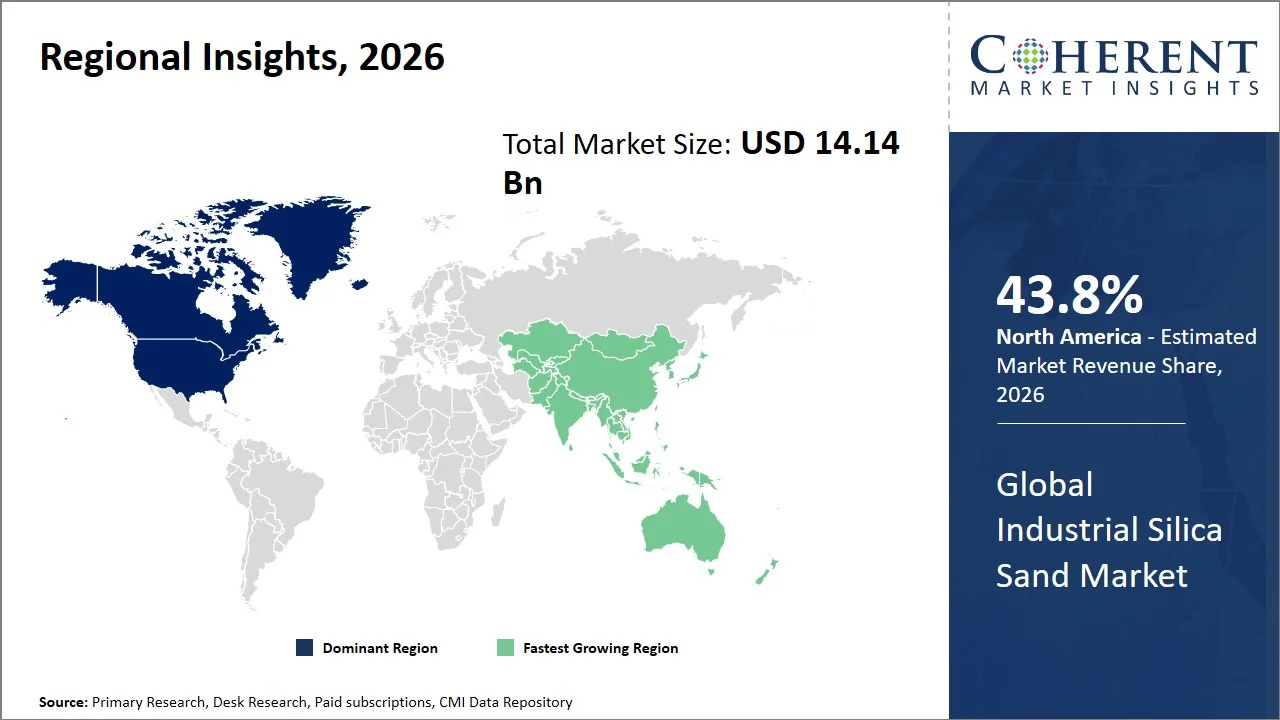
North America remains the dominant region in the global industrial silica sand market, with an expected market share of 48.3%, driven by its large mining base, established processing infrastructure, and diversified demand from hydraulic fracturing, glassmaking, foundry, filtration, and building material industries. The U.S. acts as the anchor market, supported by strong reserves, advanced beneficiation capabilities, and well-developed logistics networks. For instance, Covia states that it operates 27 silica sand mining plants across North America, strategically located near high-quality silica sand deposits. These operations serve multiple applications, including glass, foundry castings, building products, sports turf, and water filtration media. This broad application base confirms North America’s position as both a major production hub and a high-volume consumption center for industrial silica sand market. (Source: Covia Holdings LLC.)
Why is Asia Pacific the fastest growing region in the global industrial silica sand market?
The Asia Pacific region is projected to register the fastest growth in the industrial silica sand market, capturing a 32.6% share, fueled by accelerated industrialization, expanding glass manufacturing sectors, and increased investments in infrastructure and construction. Government initiatives aimed at boosting domestic manufacturing and mineral resource exploitation in countries like China, India, and Australia further stimulate demand. Rising consumption of industrial silica sand in emerging application areas such as electronics manufacturing and foundry operations is also contributing to market expansion. Asia Pacific is expected to record the fastest growth, supported by rising demand from solar PV glass, electronics, construction glass, ceramics, and foundry applications. China’s large renewable energy buildout, India’s infrastructure growth, and Australia’s high-purity silica sand project pipeline are strengthening the regional value chain. For instance, China added 278 million kilowatts of solar power capacity in 2024, while Australia’s Critical Minerals Prospectus highlights projects such as Cape Flattery and Muchea, which are positioned to supply low-iron, high-purity silica sand for solar PV glass and specialty glass markets in Asia Pacific. (Source: Nuclear Energy Agency (NEA))
Industrial Silica Sand Market Outlook for Key Countries
Why does the U.S. Lead Demand in the Industrial Silica Sand Market?
The U.S. remains the most important country in the industrial silica sand market because of its strong shale oil and gas industry, large domestic reserves, and advanced sand processing infrastructure. Demand is mainly supported by frac sand, well cementing, glassmaking, filtration, foundry, and industrial filler applications. The country also benefits from in-basin sand supply, strong rail and road logistics, and proximity to oilfield demand centers. For instance, International Energy Agency (EIA) notes that hydraulic fracturing uses sand or similar proppants to keep fractures open and allow oil and gas flow, while U.S. Geological Survey (USGS) reported that frac sand and well-related uses accounted for the majority of U.S. industrial sand consumption in 2025. (Source: U.S. Energy Information Administration)
Why is China Strengthening Growth in the Industrial Silica Sand Market Through Solar PV and Specialty Glass Demand?
China’s industrial silica sand market is expanding due to the country’s large-scale solar PV manufacturing base, glass production, electronics manufacturing, foundry activity, and infrastructure development. High-purity and low-iron silica sand is becoming increasingly important for solar glass and specialty glass production. For instance, China’s National Energy Administration data showed that solar power capacity reached 887 million kilowatts by the end of 2024, with solar power increasing by 278 million kilowatts during the year. This rapid PV expansion supports the demand for silica sand used in solar glass and related high-purity applications.
Why is India Emerging as a Key Demand Center in the Industrial Silica Sand Market?
India’s industrial silica sand market is gaining momentum due to demand from construction, float glass, container glass, ceramics, foundry, and solar-related manufacturing. Infrastructure expansion, urbanization, and domestic manufacturing policies are supporting higher consumption of glass and mineral-based industrial inputs. For instance, Invest India notes that the National Infrastructure Pipeline envisaged investment of approximately USD 1,162,200 Mn during 2020–2025, while the Directorate General of Trade Remedies (DGTR) clear float glass investigation states that float glass is manufactured by melting raw materials such as silica sand, soda ash, feldspar, and dolomite. This directly links India’s infrastructure, construction, and glass industry growth with rising demand for industrial silica sand market. (Source: Invest India).
Why is Australia Positioned as a High-purity Silica Export Hub in the Industrial Silica Sand Market?
Australia is emerging as a strategic supplier of high-purity silica sand for Asia Pacific glass, solar PV, electronics, and specialty glass supply chains. Its advantage lies in large low-iron deposits, port access, export orientation, and project pipelines targeting high-end Asian glass markets. For instance, Austrade’s 2025 Critical Minerals Prospectus highlights the Cape Flattery Silica Sand Project as suitable for high-quality glass and solar PV glass, with planned exports to glass manufacturers in Asia. It also notes the Muchea Silica Sand Project has high-grade silica sand quality required for ultra-clear solar panel glass, supporting Australia’s role as a premium silica supply base. (Source: GlobalData Plc)
Regulatory Landscape for Processed Industrial Silica Sand Market
Country/Region | Key Regulations/Authorities | Key Requirements | Impact on Industrial Silica Sand Market |
Global | IARC classification and OECD responsible sand/silicate supply-chain guidance | Crystalline silica exposure is treated as a serious occupational health risk, while sand and silicate supply chains are increasingly assessed for environmental, human rights, working-condition, and responsible sourcing risks. | Buyers are likely to prefer suppliers with traceable sourcing, dust-control systems, worker-safety programs, environmental management, and ESG documentation. This raises compliance expectations for exporters and large B2B suppliers. |
North America – U.S. | OSHA Respirable Crystalline Silica Standards; MSHA final silica rule; EPA 40 CFR Part 60 Subpart OOO | OSHA requires hazard communication, worker training, exposure records, and silica-control measures. MSHA’s 2024 final rule lowers the miner exposure limit to 50 micrograms/m³ as an 8-hour TWA and requires corrective action, engineering controls, dust sampling, and medical surveillance. EPA Subpart OOO applies to non-metallic mineral processing equipment such as crushers, grinding mills, screening, conveyors, bagging, storage bins, and truck/railcar loading stations. | Raises operating costs for silica sand mines and processing plants through air monitoring, wet suppression, ventilation, enclosure, PPE, medical surveillance, and recordkeeping. Large integrated producers may benefit because smaller operators may struggle with compliance investment. |
North America – U.S. State-Level Mining Controls | State DNR / Pollution Control Agencies, local zoning, stormwater, wetland, air, water withdrawal permits | Wisconsin DNR notes that industrial sand mines may need stormwater, air, wetland, high-capacity well, waste, drinking-water, and endangered-species permits. Minnesota PCA notes that water quality, discharge, water appropriation, wetlands, air-emission permits, and environmental assessment worksheets may apply to silica sand projects. | Site approval timelines can lengthen, especially for greenfield mines. Operators with strong permitting, water-management, reclamation, and community-engagement capabilities gain a competitive advantage. |
North America – Canada | Impact Assessment Act, provincial environmental approvals, provincial OHS exposure limits | The Vivian Sand Project in Manitoba was reviewed under Canada’s impact-assessment process, with issues including silica sand extraction, processing, slurry transport, groundwater reinjection, Indigenous rights, fish habitat, species at risk, and human health considerations. | Regulatory review can directly affect project timelines and investor confidence. Projects must demonstrate groundwater protection, Indigenous consultation, species-risk mitigation, and responsible extraction practices. |
Europe / EU | Directive (EU) 2017/2398 under Carcinogens and Mutagens Directive; Extractive Waste Directive 2006/21/EC | EU rules include work involving exposure to respirable crystalline silica dust generated by a work process and set a binding exposure limit of 0.1 mg/m³ for the respirable fraction. EU rules also emphasize prevention, minimization, and management of extractive waste from mining operations. | EU suppliers must maintain strong worker-exposure controls, waste-management plans, reclamation systems, and documentation. Compliance favors high-quality producers serving glass, foundry, ceramics, and specialty industrial applications. |
U.K. | HSE silica dust guidance and COSHH controls | HSE states that silica occurs in rocks, sand, clay, bricks, and concrete, and that workplace activities can create fine respirable dust harmful to health. Employers are expected to prevent or control exposure through risk assessment and control measures. | Importers, processors, construction-material suppliers, and foundry users must maintain dust-control and worker-protection systems. This increases demand for safer handling, dust-suppressed products, and compliant SDS documentation. |
Market Players, Key Development, and Competitive Intelligence
Key Developments
- In September 2025, VRX Silica Limited received works approval for its Arrowsmith North Silica Sand Project in Western Australia, allowing construction to commence and enable operations at the processing plant and associated infrastructure. This development is relevant as it supports new industrial silica sand production capacity for glassmaking, foundry, construction materials, and export markets.
- In June 2025, Diatreme Resources Limited announced a major upgrade at its Northern Silica Project in Queensland increasing the measured resource from 49.5 million tons to 187.5 million tons, along with 42 million tons indicated and 43 million tons inferred resources. This development is highly relevant as it strengthens future supply of high-purity silica sand for glass, solar, and advanced industrial applications.
Competitive Landscape
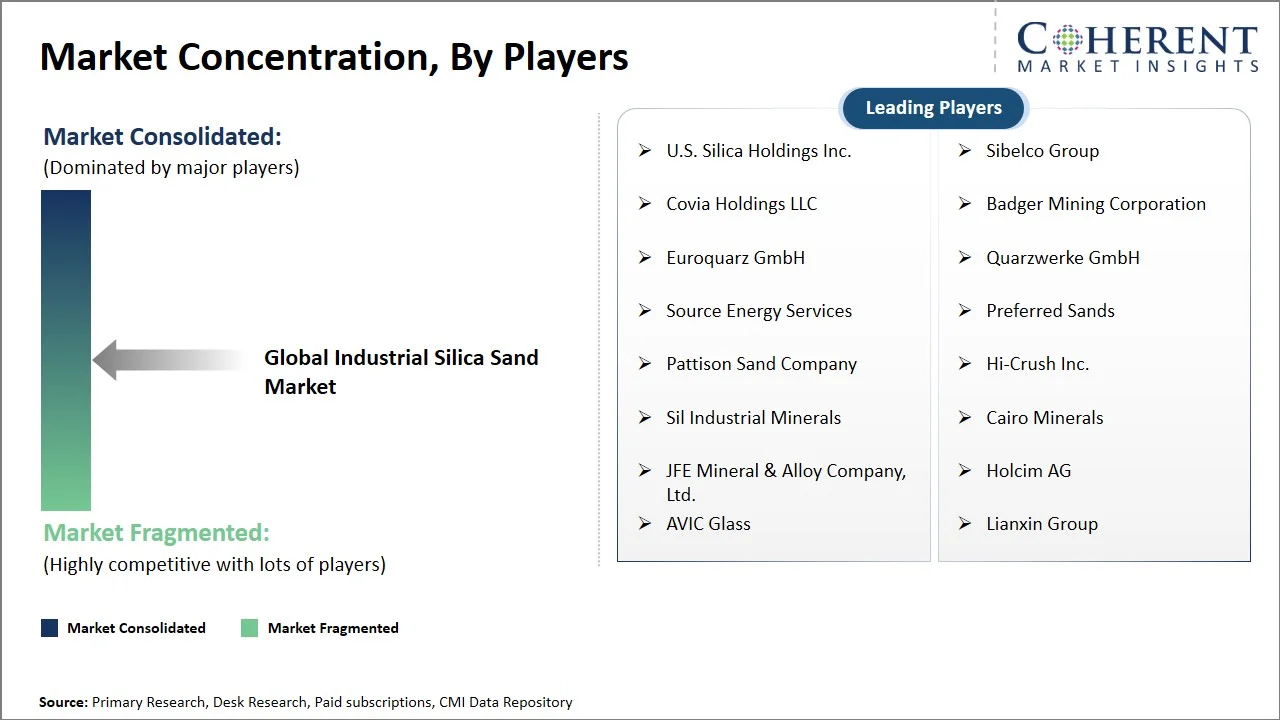
The global industrial silica sand market is becoming increasingly competitive, driven by rising demand from glass manufacturing, solar PV glass, foundry, construction materials, ceramics, filtration, and electronics applications. Established suppliers with access to high-purity reserves, advanced beneficiation facilities, and strong logistics networks are better positioned to serve large industrial buyers. Competition is mainly based on silica purity, low iron content, grain-size consistency, processing capability, supply reliability, export infrastructure, and regulatory compliance. As end-use industries shift toward higher-specification materials, suppliers are focusing on value-added grades rather than only bulk silica sand supply.
Key focus areas include
- Suppliers are focusing on low-iron, high-silica sand for solar glass, specialty glass, electronics, and premium industrial applications.
- Washing, drying, screening, magnetic separation, and grading are becoming important to meet strict customer specifications.
- Resource-rich countries such as Australia, Malaysia, Vietnam, and Indonesia are strengthening exports to China, India, Japan, and South Korea.
- Dust control, water management, land rehabilitation, environmental approvals, and responsible mining practices are becoming key differentiators.
- Producers are targeting long-term supply agreements with glass manufacturers, solar glass producers, foundries, ceramic companies, and filtration media suppliers.
Market Report Scope
Industrial Silica Sand Market Report Coverage
| Report Coverage | Details | ||
|---|---|---|---|
| Base Year: | 2025 | Market Size in 2026: | USD 14.14 Bn |
| Historical Data for: | 2020 To 2024 | Forecast Period: | 2026 To 2033 |
| Forecast Period 2026 to 2033 CAGR: | 5.3% | 2033 Value Projection: | USD 20.35 Bn |
| Geographies covered: |
| ||
| Segments covered: |
| ||
| Companies covered: | U.S. Silica Holdings Inc., Sibelco Group, Covia Holdings LLC, Badger Mining Corporation, Euroquarz GmbH, Quarzwerke GmbH, Source Energy Services, Preferred Sands, Pattison Sand Company, Hi‑Crush Inc., Sil Industrial Minerals, Cairo Minerals, JFE Mineral & Alloy Company, Ltd., Holcim AG, AVIC Glass, and Lianxin Group | ||
| Growth Drivers: |
| ||
| Restraints & Challenges: |
| ||
Analyst Opinion (Expert Opinion)
- The global industrial silica sand market is expected to remain structurally strong, supported by demand from glass manufacturing, foundry applications, hydraulic fracturing, filtration, construction materials, and emerging high-purity applications such as solar glass and electronics. Ther market is shifting from a volume-driven mineral supply business to a more specification-driven industrial input market. Buyers are increasingly prioritizing silica purity, grain size consistency, low iron content, reliable logistics, and compliance with environmental and occupational safety standards. This trend is likely to benefit organized producers with beneficiation capabilities, captive reserves, strong quality control, and access to rail, road, and port infrastructure.
- North America is expected to retain its dominance due to its mature mining ecosystem, strong fact sand demand, and established glass and foundry industries. However, the highest incremental growth opportunity is likely to come from Asia Pacific, where infrastructure expansion, solar PV glass manufacturing, electronics, construction glass, and industrial manufacturing are increasing the demand for high-grade silica sand. Australia is expected to play a strategic role as a high-purity export hub for Asian glass and solar supply chains, while China and India will remain major consumption centers. suppliers that can offer high-purity grades, stable long-term supply contracts, sustainable mining practices, and regulatory-compliant operations will be better positioned than low-cost unorganized producers.
Speak to the analyst
Want personalized insights?
Take the findings above to one of our principal consultants, or have the report rebuilt around the segments, geographies and competitors you actually track.
Market Segmentation
- Product Type Insights (Revenue, USD Bn, 2021 - 2033
- Wet Processed Silica Sand
- Dry Processed Silica Sand
- Silica Flour
- Resin Coated Silica Sand
- Specialty Industrial Silica Sand
- Others
- Purity Grade Insights (Revenue, USD Bn, 2021 - 2033)
- Standard Grade (95.0% to 97.0% SiO₂)
- High Purity Grade (Above 97.0% to 99.0% SiO₂)
- Ultra-High Purity Grade (Above 99.0% SiO₂)
- Grain Size Insights (Revenue, USD Bn, 2021 - 2033)
- Coarse Grain Silica Sand
- Medium Grain Silica Sand
- Fine Grain Silica Sand
- Micronized Silica Powder
- Others
- End-use Industry Insights (Revenue, USD Bn, 2021 - 2033)
- Glass Industry
- Oil and Gas Industry
- Foundry Industry
- Construction Materials Industry
- Water Treatment Industry
- Others
- Distribution Channel Insights (Revenue, USD Bn, 2021 - 2033)
- Direct Sales
- Indirect (via distributors)
- Regional Insights (Revenue, USD Bn, 2021 - 2033)
- North America
- U.S.
- Canada
- Latin America
- Brazil
- Argentina
- Mexico
- Rest of Latin America
- Europe
- Germany
- U.K.
- Spain
- France
- Italy
- Russia
- Rest of Europe
- Asia Pacific
- China
- India
- Japan
- Australia
- South Korea
- ASEAN
- Rest of Asia Pacific
- Middle East
- GCC Countries
- Israel
- Rest of Middle East
- Africa
- South Africa
- North Africa
- Central Africa
- North America
- Key Players Insights
- U.S. Silica Holdings Inc.
- Sibelco Group
- Covia Holdings LLC
- Badger Mining Corporation
- Euroquarz GmbH
- Quarzwerke GmbH
- Source Energy Services
- Preferred Sands
- Pattison Sand Company
- Hi‑Crush Inc.
- Sil Industrial Minerals
- Cairo Minerals
- JFE Mineral & Alloy Company, Ltd.
- Holcim AG
- AVIC Glass
- Lianxin Group
Sources
Primary Research Interviews
- Industrial silica sand mining companies and quarry operators
- Silica sand washing, beneficiation, drying, and grading plant operators
- High-purity silica sand producers for glass, solar glass, and electronics applications
- Glass manufacturers, including container glass, flat glass, fiberglass, and solar glass producers
- Foundry operators and metal casting companies using foundry-grade silica sand
- Oilfield service companies and hydraulic fracturing sand buyers
- Construction material manufacturers, cement/concrete product companies, and mortar/dry mix producers
- Water filtration media suppliers and industrial filtration system providers
- Distributors, bulk material traders, logistics providers, and rail/port handling companies
- Environmental consultants, mining regulators, occupational safety experts, and permitting agencies
Magazines / Trade Publications
- Industrial Minerals
- Global Mining Review
- Mining.com
- Pit & Quarry
- Aggregates Business
- Glass International
- Glass Worldwide
- Foundry Management & Technology
- Modern Casting
- Oil & Gas Journal
- World Oil
- Ceramic Industry Magazine
- Construction & Demolition Recycling
- Mining Technology
Journals
- Minerals
- Resources Policy
- Minerals Engineering
- Journal of Cleaner Production
- Construction and Building Materials
- International Journal of Mining Science and Technology
- Journal of Sustainable Mining
- Ceramics International
- Journal of Materials Research and Technology
- Applied Clay Science
- Environmental Science and Pollution Research
- Powder Technology
- Materials Today: Proceedings
Associations / Industry Bodies
- National Stone, Sand & Gravel Association
- Industrial Minerals Association – North America
- IMA-Europe – Industrial Minerals Association Europe
- Society for Mining, Metallurgy & Exploration
- American Foundry Society
- World Foundry Organization
- Glass Packaging Institute
- British Glass
- Glass Alliance Europe
- The Australian Foundry Institute
- Minerals Council of Australia
- Canadian Institute of Mining, Metallurgy and Petroleum
- Federation of Indian Mineral Industries
- Indian Foundry Organization
Regulatory / Government Sources
- U.S. Geological Survey
- U.S. Occupational Safety and Health Administration
- U.S. Mine Safety and Health Administration
- U.S. Environmental Protection Agency
- U.S. Energy Information Administration
- Natural Resources Canada
- European Commission
- European Chemicals Agency
- British Geological Survey
- Geoscience Australia
- Australian Department of Industry, Science and Resources
- Indian Bureau of Mines
- Ministry of Mines, Government of India
- Central Pollution Control Board, India
- China Ministry of Natural Resources
- National Bureau of Statistics of China
- South African Department of Mineral and Petroleum Resources
- Saudi Ministry of Industry and Mineral Resources
Public Domain Sources
- USGS Mineral Commodity Summaries
- USGS Industrial Sand and Gravel reports
- UN Comtrade Database
- ITC Trade Map
- World Bank WITS trade database
- Eurostat mineral and trade datasets
- FAOSTAT, where relevant for construction/mineral-linked indicators
- Geoscience Australia mineral resources publications
- Indian Minerals Yearbook
- China customs and mineral production data
- Company annual reports and investor presentations
- Company websites and product portfolios
- Company press releases and project updates
- Environmental impact assessment reports for silica sand mining projects
- Mining lease, quarry permit, and mineral concession databases
- Import-export shipment databases, where available
Proprietary Elements
- CMI Data Analytics Tool
- Proprietary CMI Existing Repository of information for last 10 years
Get access to 250+ pages report
Every segment, forecast, competitor profile and data table behind the analysis above — available for instant download.
- ESOMAR Member
- ISO 9001:2015 Certified
- D-U-N-S Registered
- GDPR & CCPA Compliant
Missing comfort of reading report in your local language? Find your preferred language:
Transform your Strategy with Exclusive Trending Reports
Frequently Asked Questions
The CAGR of the global industrial silica sand market is projected to be 5.3% from 2026 to 2033.
The global industrial silica sand market is estimated to be valued at USD 14.14 billion in 2026 and reach USD 20.35 billion in 2033.
U.S. is the largest producer in the global industrial silica sand market.
Rising glass and solar panel manufacturing demand and infrastructure and construction expansion in Asia Pacific are the major factors driving the growth of the global industrial silica sand market.
Environmental regulations and mining restrictions and price volatility and supply chain disruptions are the major factors hampering the growth of the global industrial silica sand market.
In terms of product type, wet processed silica sand is estimated to dominate the market revenue share in 2026.
North America is expected to lead the global industrial silica sand market in 2026.